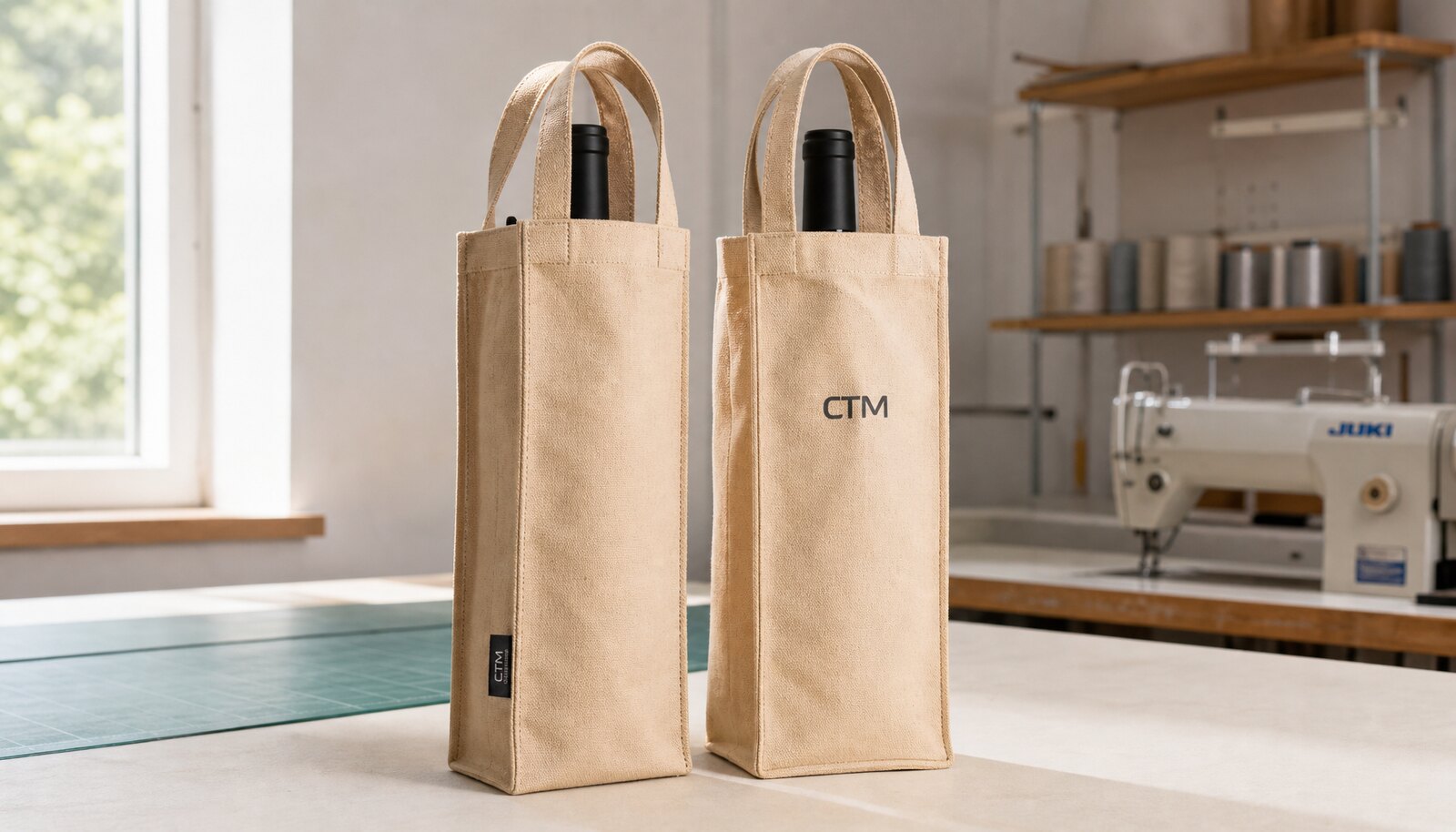
Why a pricing plan matters before you ask for quotes
For gift shops, canvas wine carriers are not a simple commodity item. The same-looking carrier can price very differently depending on fabric weight, handle reinforcement, print method, carton packing, and whether the supplier is quoting from stock material or a custom build. If those variables are not fixed before you request prices, every quote will be built on a different assumption and the numbers will not be useful for procurement.
The buyer-side mistake is to ask for a generic “canvas wine carrier” and then compare unit prices as if the products were identical. They are not. A low-cost souvenir channel may tolerate a lighter bag with simpler construction, while a gift shop assortment sold at a higher ticket usually needs better hand feel, neater stitching, and more controlled branding. A pricing plan should start with the intended shelf position, target margin, and bottle type, then move into construction and decoration.
That order matters because it gives your sourcing team a shared baseline. If you are buying for a chain, an e-commerce program, or a regional gift assortment, the quote should reflect the same bottle dimensions, same canvas spec, same print method, and same packing format across suppliers. Otherwise one vendor may appear cheaper only because they used a lighter fabric, a smaller logo, or a less protective carton. For procurement, the real question is not “what is the price?” but “what is the price for this exact spec, at this volume, with this level of quality control?”
- Use the retail channel and target price point to define the carrier spec, not the other way around.
- Compare suppliers only on the same fabric basis, same decoration method, same packing, and same bottle fit.
- Treat setup fees, samples, and packing changes as part of the total landed cost, not as side notes.
Start with the product spec that protects both margin and shelf appeal
For a standard single-bottle program, 12 oz finished canvas is usually the practical starting point. It gives enough body to stand up better on shelf, holds a bottle cleanly, and keeps the bag from feeling flimsy without driving freight and sewing cost too high. If the gift-shop position is more premium, 14 oz or 16 oz can improve drape control and hand feel, but that extra substance comes with a higher fabric bill and a heavier carton weight.
The word canvas also needs clarification. Some suppliers quote greige weight, some quote finished weight, and some use prewashed or coated fabric that changes the feel. That is why a buyer should ask for the fabric basis in writing. If the factory cannot state whether the quoted weight is finished or greige, the quote is not yet procurement-ready. The same point applies to shrinkage, color tolerance, and seam allowance. These are not “detail” questions; they determine whether the carrier still fits after sewing and whether repeat orders match the first sample.
For gift shops, the visible details matter as much as the fabric number. Confirm the handle drop, the side gusset depth, the bottom reinforcement, and whether the bag is meant to sit upright beside a bottle display. If the carrier will be merchandised next to premium bottles, the retail impression may justify a slightly heavier canvas or cleaner internal finishing. If it will be sold as a value add-on, cost discipline is more important. The correct spec is the one that protects margin without making the bag feel like an afterthought.
- 12 oz finished canvas: balanced starting point for most standard retail wine carriers.
- 14-16 oz canvas: better structure and premium hand feel, but higher sewing and freight cost.
- Add bottom reinforcement if the bag will be handled frequently on open shelves or sold with heavier bottles.
Decide on construction before decoration so the quote stays comparable
A decoration-first buying process often produces messy quotations. In practice, construction decisions change the price just as much as printing does. A single-layer sleeve, a lined version, and a bag with a reinforced bottom are different products even if they carry the same logo. Ask the supplier to quote the carrier as a construction package: body fabric, reinforcement, handle type, seam finish, and then decoration.
This is also where buyers can avoid the trap of paying for a “premium look” that does not hold up in use. A cleaner top edge, folded handle, or hidden reinforcement can add more perceived value than a more expensive print effect. For a gift shop, customers usually touch the handle first, then look at the logo. That means handle comfort, seam neatness, and fabric body often matter more than an elaborate graphic treatment.
When comparing options, keep the construction language specific. For example: single-bottle sleeve, self-fabric handles, reinforced base, visible topstitch, and clean-bound seams or overlock on interior edges. A factory can work with that language. It lets the sewing line understand what is expected, and it gives your QA team a checklist for inspection. If the supplier proposes a different structure, ask them to explain exactly what changes in the process, the material use, and the unit cost. That is the only way to know whether the change is an upgrade or simply a cheaper substitute.
- Quote construction first, then decoration, then packing.
- Specify whether seams should be visible topstitch, overlock, binding, or hidden finish.
- Ask for a simple stitch map or sample photo showing handle reinforcement and bottom support.
Price drivers: what really moves the unit cost in bulk
Bulk pricing for canvas wine carriers is usually driven by a small set of variables: fabric weight, print complexity, sewing time, setup fees, and packing labor. Fabric weight tends to be the first lever. Moving from 12 oz to 16 oz increases material cost and can slow sewing because thicker seams are harder to run cleanly. Decoration is the second lever. One-color screen print is generally the most economical for repeatable artwork, while embroidery or multi-step branding can add labor and extra QC risk.
Setup charges are the cost item that often gets buried in quote summaries. A proper supplier quote should separate screen fees, digitizing, sample charges, pattern setup, and any custom trimming. If those are rolled into a single unit price, the buyer loses visibility into the actual cost of changing artwork or running a second color. This matters especially for gift shop buyers who launch seasonal artwork or need more than one design in a year.
Packing also changes cost more than many teams expect. Bulk-packed export cartons are efficient for wholesalers and importers, but retail-ready polybagging, hangtags, barcode labels, and insert cards all add labor. Freight cost can move too, because a heavier canvas spec and extra packing materials increase gross weight and change carton utilization. When a supplier says the price is “higher than expected,” ask which of these inputs changed. In many cases, the quote is not expensive because the factory is overpriced; it is expensive because the spec is underdefined.
- Fabric weight affects both material cost and sewing speed.
- Decoration method affects setup, labor, and reject risk.
- Packing format affects labor, carton weight, and warehouse efficiency.
A stronger comparison matrix for buyers sourcing at scale
A thin comparison table can make a buying guide feel complete without actually helping the sourcing decision. For procurement, a useful matrix should show what to choose, when to upgrade, what evidence to ask for, and what risk to watch. Use the table below as a practical spec screen before you send an RFQ or shortlist suppliers.
The important part is not the row count alone; it is whether the matrix helps you see tradeoffs. A lower MOQ may look attractive until setup fees are added. A premium print method may look attractive until you realize the artwork is too fine for canvas. A heavy fabric may look impressive until freight and shelf cost eat into the margin. The buyer’s job is to connect product design to landed cost and sell-through, not to maximize every spec at once.
Supplier route selection: direct factory, converter, or trading company
Not every supplier route is wrong; each one solves a different problem. A direct factory is usually the best option when you want recurring bulk orders, clearer cost structure, and the ability to audit sewing and print quality. A local converter can be useful if you need faster communication, lower MOQs, or more flexible assembly, but you should still confirm whether they outsource the actual sewing or decoration. A trading company can help when your basket includes mixed product types or you need one shipment managed across several categories.
For procurement, the key issue is not just the route but visibility. Ask where the canvas comes from, who does cutting and sewing, who handles the print, and which step is inspected before packing. If a supplier cannot answer that clearly, they may still be usable, but the risk profile is harder to manage. Direct factory quotes often look more transparent because the quote separates material and labor. That transparency is valuable if you expect to reorder.
The supplier route also affects claim verification. A factory may be able to send you fabric certificates, in-house QC photos, and production line images. A trading company may need to gather those from upstream sources. Neither is automatically better, but buyers should know which proof they are getting. If your purchase is for a seasonal gift shop launch, the route with the fastest and clearest quality evidence is usually the better commercial choice, even if it is not the absolute lowest quote.
- Direct factory works best for repeatable programs and tighter spec control.
- Converter works well when communication and speed matter more than the lowest unit cost.
- Trading company can help consolidate, but confirm the real production source and QC responsibility.
How MOQ changes the pricing plan in real buying terms
MOQ is best understood as a pricing lever, not only as a minimum order barrier. When an order is small, the factory has to spread fixed costs across fewer units. Those fixed costs include pattern setup, screen preparation, trimming adjustments, sample approval time, and sometimes carton labeling or custom packaging. That is why a 500-piece order can be significantly more expensive per unit than a 2,000-piece order even when the bag looks identical.
A buyer-friendly way to structure the discussion is to ask for three lines: setup cost, sample cost, and unit cost at each tier. That lets you see whether the supplier is actually offering a better deal at higher volume or simply disguising setup fees inside the unit price. It also helps when you are planning a test order. If you are launching into a new gift-shop channel, a low-volume first buy can make sense, but only if you know which options are standard and which are surcharge items.
A practical MOQ band for custom canvas wine carriers is often 500-1,000 pieces per color/style, with 1,000-3,000 pieces usually giving a better balance of price and flexibility. Below 500 pieces, you should expect either stock materials, limited color choice, or a more expensive setup structure. That does not mean small orders are bad. It means the commercial logic changes. The right question is whether the lower volume is worth the higher per-unit cost for your sales test or seasonal program.
- 500-1,000 pcs: useful for pilots, regional tests, and gift shop trial assortments.
- 1,000-3,000 pcs: often the best balance of pricing and customization flexibility.
- Below 500 pcs: expect stock fabric, limited options, or a higher setup burden per unit.
Sample approval should test fit, finish, and repeatability, not just appearance
A sample that looks good in a photo is not enough for a procurement decision. For a wine carrier, the sample needs to prove the fit, the finish, and the repeatability of the production method. Insert a real bottle or a dimensional dummy and see whether the carrier slides on easily, sits straight, and still looks clean after the bottle is removed and reinserted. If the bag is meant for higher-end gift shops, the handles should feel comfortable in hand, the seams should sit flat, and the print should align cleanly with the body panel.
The best sample process uses the actual bulk materials whenever possible. A pre-production sample made from the same canvas, same ink, same thread, and same packing method is far more useful than a presentation sample made from substitute materials. Keep the approval criteria short and objective: dimensions, fabric weight, color match, print position, stitch quality, and carton labeling. If you need a second sample round, note exactly what changed and why. That history is valuable when the factory repeats the order later.
It also helps to define tolerance before approval. For example, you can allow slight variation in canvas tone but require print placement within a defined distance from the edge, or allow minor seam variance but not skipped stitches or obvious puckering. Buyers often struggle when the sample process is only visual. You can avoid that by writing down the acceptance standard before the sample is made. When the production run arrives, the final decision becomes easier because the approval reference is already clear.
- Fit test with an actual bottle, not only a flat sample.
- Approve the sample only if it uses the same or equivalent bulk materials.
- Write the acceptance criteria before sample approval so the factory knows the target.
How to build a quote structure that exposes hidden cost
A useful quote is not just a final number. It should let you see where the money is going and what changes if your specification changes. Ask for material, labor, decoration, setup, packing, and inland handling as separate line items when possible. That structure makes it easier to compare suppliers and easier to explain to internal stakeholders why one option is more expensive than another. It also helps when your team needs to adjust the design for budget or margin reasons.
If the supplier gives only one unit price, ask them to state the assumptions behind it: fabric weight, decoration method, bag size, packing count, and whether the quote includes outer carton marks or retail labeling. Without those assumptions, the quote is not actually a quote; it is a rough estimate. Procurement teams that buy for gift shops know this problem well because the final selling price often depends on a few cents of extra cost or a slight change in packing labor.
For a more grounded price plan, ask the supplier to give you a low-volume tier, a mid-volume tier, and a higher-volume tier using the same spec. That lets you see the breakpoints and decide whether you should combine designs or commit to a deeper buy. It also reveals whether the supplier has real bulk pricing logic or is simply using a flat number for every order size. When a quote is structured well, the buying decision becomes clearer and the internal margin model becomes easier to defend.
- Request separate pricing for unit cost, setup, samples, and packing upgrades.
- Ask for three volume tiers on the same spec so you can see real breakpoints.
- Make the supplier state the assumptions behind any single-number quote.
QC detail that matters for gift-shop programs and repeat orders
Canvas wine carriers may look simple, but they still need a real inspection plan if you want repeatable quality. The most important checks are fabric weight, stitch density, seam integrity, handle anchoring, print adhesion, color consistency, and packing accuracy. A supplier sample can pass visually while still failing on load, rub resistance, or carton consistency. That is why procurement teams should ask for measurable QC, not just “good quality.”
A practical inspection plan starts with dimensions. Check the finished length, width, and gusset depth against the approved spec and allow a defined tolerance, not an informal judgment. Then inspect stitching in the handle anchor and bottom seams, where most stress occurs. If the bag is printed, review logo placement and edge clarity; for darker inks on light canvas, rub performance matters because store handling can transfer ink or fuzz fibers onto the surface. If the bag is sold in a gift set or shipped long distance, odor and stain checks also matter.
For larger orders, use an AQL-style random inspection before shipment. You do not need a complex lab process to get value from this. A standard sampling plan, a clear defect list, and a final report are often enough to catch bad batches early. Ask the factory whether they can support AQL 2.5 or your preferred acceptance level, and make sure the report includes defect count by category rather than only a pass/fail note. That gives your team evidence if you need to negotiate rework or replacement later.
- Set a measurement tolerance for length, width, and gusset depth before production starts.
- Inspect handle anchors, bottom seams, and visible topstitch for consistency and strength.
- Use an AQL-style random inspection for shipment release and ask for a written report.
- Ask for stitch-per-inch consistency in visible seams and reinforcement areas, not just a general workmanship statement.
- Request load test results or at least an internal factory test method for carrying a full bottle or weighted dummy.
- Check dry rub or colorfastness behavior if the print or fabric color may transfer during handling.
Specification comparison for buyers
| Spec decision | Buyer-recommended baseline | When to upgrade | What to verify with supplier documents or tests | Buyer risk to check |
|---|---|---|---|---|
| Fabric weight | 12 oz finished canvas for standard retail use | Upgrade to 14 oz or 16 oz for a more substantial premium feel, stiffer shape, or heavier-bottle positioning | Ask for fabric spec sheet showing finished GSM/oz basis, weave count if available, and whether weight is finished or greige | A light sample can hide a weak hand feel and collapse after bottle insertion |
| Bottle fit | Sized for one standard 750 ml bottle with enough clearance for easy insertion and removal | Adjust if you sell boxed wine bottles, wider Burgundy shapes, or promotional sets with inserts | Request internal width, gusset depth, and a sample fit test with the actual bottle or a dimensional dummy | A sleeve that looks fine flat may be too tight once stitched and folded |
| Handle construction | Reinforced self-fabric handles with bar-tack or dense reinforcement at load points | Upgrade to longer drop, wider handle width, or folded double-layer handles for premium retail use | Ask for stitch map or a construction sketch showing handle anchoring and reinforcement length | Short reinforcement causes seam opening and rough handling comfort |
| Print method | One-color screen print for simple logos and repeatable seasonal art | Upgrade to woven label, embroidery, or a two-step decoration only if the price point justifies it | Request print method sample, ink type, and adhesion or rub-test evidence on the approved fabric | Complex art can look good in a mockup and poor on textured canvas |
| MOQ structure | 500-1,000 pcs per color/style for custom production | Go lower only if stock fabric, stock trim, or a standard blank is acceptable | Ask for MOQ by color, by artwork, and by fabric choice; separate setup from repeat cost | Artificially low MOQ often hides setup charges or inflexible color options |
| Packing format | Bulk packed in export cartons with clear style/color/carton marks | Switch to retail-ready polybags or insert cards if shelf presentation or store handling requires it | Request carton pack count, master carton dimensions, gross weight, and inner pack method | Retail-ready packing adds cost; poor bulk packing can mix SKUs or crease product |
| QC standard | AQL-style random inspection with measurements, stitch checks, and print review | Tighten acceptance for premium programs, custom colors, or holiday launch orders | Ask whether the factory can support AQL 2.5 or your preferred inspection level and provide a pre-shipment report | Without inspection levels, quality decisions become subjective and hard to enforce |
| Lead time | 25-35 days after sample approval for standard custom orders | Allow more time for dyeing, embroidery, new trims, or busy season capacity pressure | Request a timeline by milestone: sample, material booking, production, final inspection, and packing | Lead time often slips at artwork approval or fabric sourcing, not sewing |
Buyer checklist before sampling
- Confirm bag dimensions, gusset depth, handle drop, and the exact bottle profile it must fit.
- Specify fabric weight on a finished basis, not just a visual description of canvas.
- State acceptable color tolerance, shrinkage expectation, and whether wash testing is required.
- Send vector artwork, Pantone references, logo placement, and maximum print area in writing.
- Ask for one pre-production sample from actual bulk materials before production release.
- Agree carton pack count, carton dimensions, master marks, and barcode or hangtag needs before PO release.
- Define inspection criteria for stitching, print adhesion, stains, odors, count accuracy, and carton condition.
- Record who approves artwork, who approves samples, and who signs off on the final shipment.
- Confirm whether pricing includes setup, screens, embroidery digitizing, inserts, or retail packaging.
- Ask for production photos or in-process checkpoints if the order is seasonal or launch-critical.
Factory quote questions to send
- Is the quoted fabric weight finished weight or greige weight, and can you share the spec sheet?
- What is the exact construction: single-layer, lined, bottom reinforcement, or double-handle wrap?
- Which decoration method is included in the unit price, and what changes the price if we switch methods?
- What are the MOQ requirements by color, design, and fabric option, and what if we use stock material?
- Please separate one-time setup charges from recurring unit cost so we can compare suppliers fairly.
- What sample rounds are included, and what is the charge and turnaround for a pre-production sample?
- What is the estimated carton pack count, carton size, gross weight, and outer carton marking format?
- What lead time do you quote by milestone, from artwork approval to final packing?
- What inspection standard do you use before shipment, and can you share the report format?
- Can you provide photos of the actual fabric, stitching, and print tests rather than only renderings?
Quality-control points to confirm
- Measure fabric weight against the agreed finished GSM/oz target and record tolerance on the inspection sheet.
- Check stitch density in critical zones such as handle anchors, bottom seams, and side seams; require a consistent stitch pattern, not loose or skipped stitching.
- Set a practical stitch-per-inch expectation for visible seams and confirm consistency across the run; inspect for uneven stitch length, thread tension issues, and seam puckering.
- Perform a load test using a filled bottle or weighted dummy; verify the carrier holds the load without handle pull-out, seam separation, or bottom distortion.
- Inspect print position, print edge clarity, ink coverage, and rub resistance against the approved sample.
- Verify colorfastness or at least dry rub performance if the bag will be handled frequently in-store or shipped with other goods.
- Check dimensions against the approved spec, allowing a defined tolerance for length, width, and gusset depth; confirm the finished carrier still fits the intended bottle.
- Open cartons at random and verify count accuracy, folding method, labels, and the absence of mixed SKUs or damaged goods.
- Use an AQL-style sampling plan for pre-shipment inspection; align acceptance/rejection levels with the order value and the risk of the selling season.
- Reject cartons or pieces with stains, loose threads, broken stitches, print smearing, odor issues, crushed corners, or moisture damage.