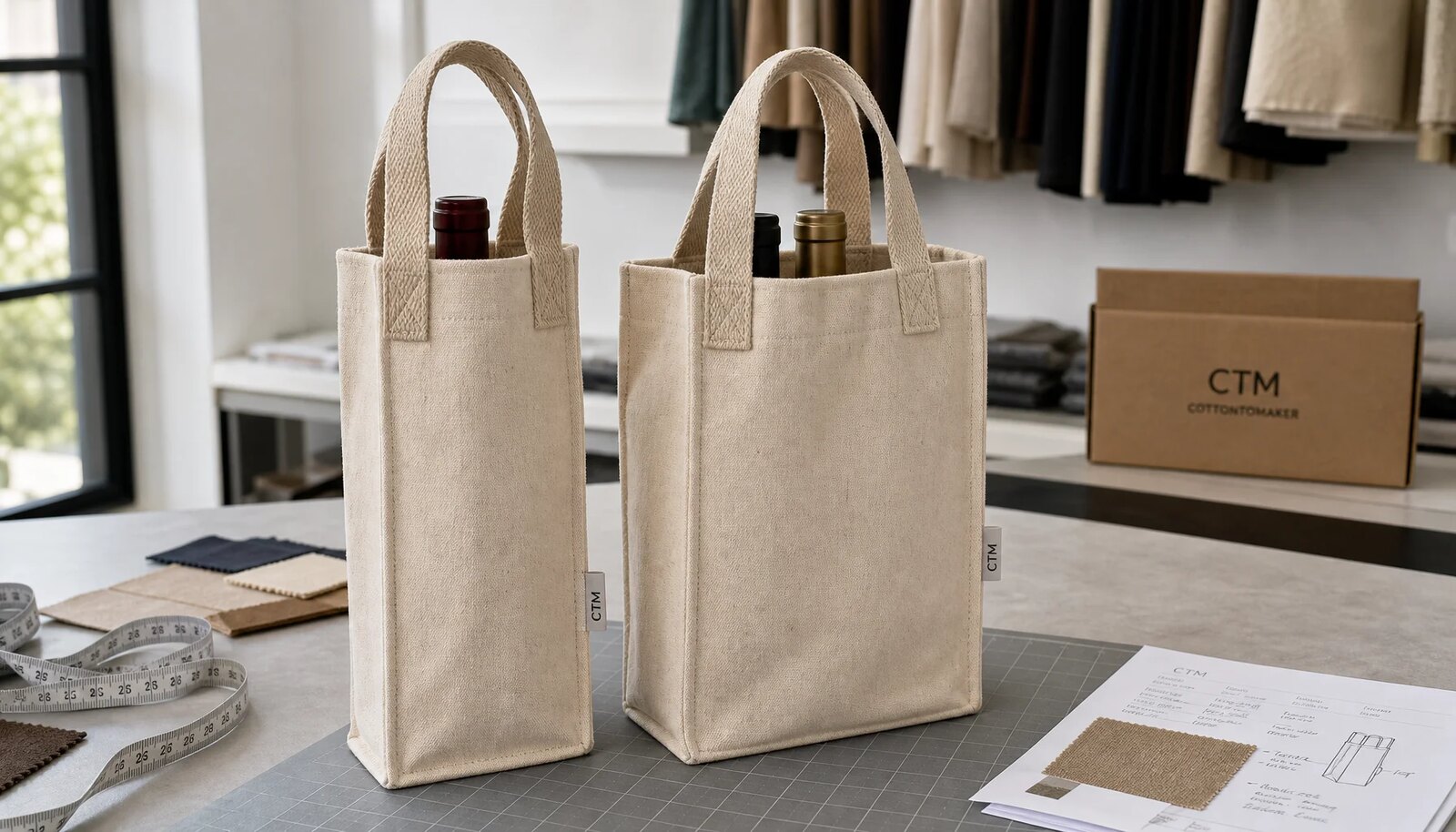
1. Start with the bottle, then price the carrier
A workable bulk pricing plan for canvas wine carriers starts with the bottle in the customer's hand. Not the logo. Not the first unit price. Farmers market vendors often sell more than one bottle format from the same booth: wine, cider, olive oil, vinegar, shrubs, mixers, or gift bundles packed in glass. To a casual shopper those are all bottle goods. To a pattern maker, they are different shapes with different risks.
The RFQ should include a bottle-fit schedule. List the outside diameter, total height, shoulder profile, and filled weight for every bottle that must fit. If the carrier needs to work across several bottle families, identify the widest bottle and the tallest bottle. A narrow Bordeaux-style 750 ml bottle, a wider Burgundy-style bottle, and a tall specialty bottle can all drive different pattern decisions. The wrong assumption here shows up later as tight insertion, awkward handle height, or bottles pressing into seams.
Checkout speed matters too. A farmers market vendor may be working from a crowded table with a line forming. A carrier that looks good in a sample photo but needs two hands to open can slow every transaction. For a single-bottle carrier, the top opening should be easy to access without leaving the bottle loose. For a two-bottle carrier, the divider should guide bottles into place without catching the shoulder. If the carrier is a resale item, it also needs to look clean when empty, folded, hung, or stacked beside the register.
- Attach a bottle schedule to the RFQ with OD, height, shoulder notes, and filled weight.
- Mark the widest bottle and tallest bottle if the carrier must fit a range.
- Test the sample with the hardest bottle to fit, not only the most common one.
- Confirm whether the carrier will be used at checkout, pre-packed for pickup, or sold empty as merchandise.
2. Make canvas weight measurable
Canvas sounds simple until two suppliers quote the same ounce weight and deliver different goods. A 12 oz canvas may refer to greige fabric before finishing, finished fabric after dyeing, or fabric after washing. Dyeing, washing, calendaring, and softening can change GSM, shrinkage, stiffness, and hand feel. For a bag carrying glass bottles, those differences are not cosmetic; they affect structure and repeatability.
For many reusable farmers market programs, 12 oz finished canvas is a sensible baseline. It usually has more body than a lightweight promotional sleeve without the higher sewing difficulty of heavy canvas. A 10 oz finished canvas can work when the carrier is a low-cost giveaway or a simple single-bottle sleeve, but buyers should expect a softer product. For a premium giftable carrier, or any format that needs better upright presentation, 14 oz or 16 oz finished canvas may justify the added cost.
Put the fabric definition in writing. Ask for finished GSM, fabric composition, shrinkage percentage, and the finish state: natural, bleached, dyed, washed, or softened. Natural canvas should also have an acceptable shade range because cotton tone can shift between lots. If artwork will be printed, ask the supplier to test the actual fabric. Coarse canvas can break up fine lines and small type; smoother canvas may print better but change the intended rustic look.
- Specify finished canvas weight and GSM instead of using ounce weight alone.
- Use 12 oz finished canvas as the starting point for many reusable retail programs.
- Choose 10 oz only when a softer promotional feel is acceptable.
- Move to 14-16 oz when structure, gift presentation, or resale positioning requires it.
- Request shrinkage, shade range, and print suitability before approving bulk fabric.
3. Define the build before comparing quotes
The phrase canvas wine carrier can hide a lot of variation. A flat single-bottle sleeve, a gusseted one-bottle carrier, a two-bottle bag with a sewn divider, and a four- or six-bottle tote are not interchangeable products. If the RFQ uses a broad product name without construction detail, each supplier may price a different version. The cheapest quote may simply be the one that left out the structure the vendor needs.
Start with the carry format. For a single bottle, decide whether the base is flat or gusseted, whether the top edge is bound or folded, and whether the handle is a short hand strap or a longer drop. For a two-bottle carrier, the divider deserves its own line in the spec. A sewn-in divider usually gives better bottle separation and a more controlled user experience than a loose insert, but it adds sewing time and inspection points. A boxed or reinforced bottom can improve upright stability, though it increases fabric use.
Closures should earn their place. An open top is faster for market checkout and simpler to inspect. Ties, snaps, flaps, and drawcords can suit gift sets or pre-packed club pickup bags, but they add parts, labor, and potential fit problems with tall bottles. The same logic applies to lining and base boards. They may improve presentation, but they change cost, weight, packing, and sometimes recyclability. A clear RFQ labels each feature as required, optional alternate, or excluded.
- State the format: single-bottle, two-bottle, four-bottle, or six-bottle.
- Define the base as flat, gusseted, boxed, reinforced, or unsupported.
- For two-bottle carriers, say whether the divider is sewn into the base and side seams.
- Quote closures, lining, binding, base boards, and dividers as separate features.
- Ask suppliers to identify which construction choices move the price most.
4. Build the bulk pricing plan in layers
For B2B buying, a single unit price is not enough. Procurement teams need to know what is inside that number. A canvas wine carrier price usually includes fabric, cutting, sewing, handles, reinforcement, decoration, packing, cartons, sampling, and inspection assumptions. The first order may also include pattern development, print screens, woven label setup, or special carton marking. When these costs are hidden, supplier comparison becomes guesswork.
Request the same exact spec at several order quantities. Common quote tiers are 1,000, 3,000, and 5,000 units, though the right levels should match the buyer's forecast. At lower volumes, setup charges can weigh heavily. At higher volumes, fabric yield, print efficiency, and sewing-line rhythm become more important. If a price drop looks unusually large, ask what changed. Sometimes the answer is real efficiency. Sometimes it is a lighter canvas, fewer QC steps, looser packing, or a different decoration process.
Also make the trade term visible. EXW, FOB, DDP, and other terms can make a low unit price look better than the delivered cost will feel. Ask for carton quantity, carton dimensions, gross weight, inner bundle count, and carton marks during the quote stage. A farmers market vendor program may not be national retail scale, but poor carton planning can still create warehouse labor, storage, and allocation problems.
- Request 1,000, 3,000, and 5,000 unit tiers, or tiers that match the actual buying plan.
- Separate sample, pattern, screen, label, setup, unit, packing, and carton charges.
- Confirm whether the quote is EXW, FOB, DDP, or another term.
- Ask whether overruns or underruns are allowed and whether overruns are billable.
- Compare landed handling impact, not just the first unit price.
5. Choose decoration that can repeat cleanly
Branding has to survive production reality. A canvas wine carrier may be photographed, displayed at a booth, handed to customers, and reused in public. The mark should look intentional without making production fragile. For most volume programs, one-color screen printing on a flat panel is the easiest path to consistent results. It is straightforward to approve and efficient once screens are prepared.
That does not mean every logo should be screen printed. A woven side label can give the carrier a quieter, more premium look while keeping the canvas face clean. It works well when the brand wants an understated retail feel. The buyer should still define label size, fold type, placement, stitch position, MOQ, and lead time. Embroidery can work for a small mark, but dense embroidery may pucker canvas, require backing, and leave an untidy reverse side if the carrier is unlined.
Artwork approval should be measured, not described loosely. Replace center logo on front with a distance from top edge, side seam, or bottom seam, plus an acceptable tolerance. A placement tolerance such as +/- 5 mm may be practical for simple front-panel artwork, but the factory should confirm it for the actual build. Require a strike-off on the intended canvas color and weight. Ink coverage, fine lines, pale colors, and small text all behave differently on natural, dyed, washed, or heavy-texture canvas.
- Use one-color screen print for simple, repeatable volume artwork.
- Use woven labels when a subtle branded finish is more important than a large front mark.
- Limit embroidery to small marks unless the sample proves the panel stays flat.
- Define decoration placement with measurements and a tolerance.
- Approve ink, label, or embroidery on production-intended canvas, not only on a digital mockup.
6. Treat handles and seams as load-bearing specs
Handles are not trim on a bottle carrier. They are the part most likely to turn a small defect into a serious product issue. A filled glass bottle weighs more than its liquid volume because the glass adds weight. Two filled bottles place real stress on handle anchors, side seams, bottom corners, divider joins, and top binding during an ordinary walk from booth to car.
Define handle material, width, drop, stitch pattern, and reinforcement. Cotton webbing in the 25-38 mm range is common for hand-carry products, but width should match the load and price point. A narrow handle can save money and still feel uncomfortable. A long handle drop may seem convenient but allow bottles to swing more. For many programs, box-X stitching, bar tacks, or reinforced multi-row stitching at anchor points should be specified instead of left to factory habit.
Seam allowance and stitch density deserve the same attention. A carrier can look fine empty and still fail under shifting bottle weight. Ask the supplier for a practical carry or load test using the intended filled-bottle load. It does not need to be elaborate, but it should mirror use: load the carrier, lift by the handle, carry or suspend for a defined period, then check for seam popping, handle stretch, thread breakage, needle damage, and base distortion. The approved sample sets the benchmark.
- Specify handle webbing material, width, finished drop, thread color, and stitch pattern.
- Require reinforcement at every handle anchor, especially on two-bottle carriers.
- Inspect side seams, bottom corners, divider joins, and top binding as stress points.
- Use a loaded carry test based on the intended filled-bottle weight.
- Treat open seams, broken handle stitches, and unsafe load failure as high-severity defects.
7. Approve samples with numbers, not memory
A pre-production sample should be close to the bulk order, not just a nice representation of the idea. It should use the same fabric weight, finish, handle webbing, thread, divider construction, closure, decoration method, and packing approach planned for production. A showroom sample made from different materials can help with early discussion, but it should not release a purchase order by itself.
Create a sample approval sheet while the sample is in hand. Record finished outside dimensions, usable bottle cavity dimensions, handle width, handle drop, divider position, print size, print placement, label position, top opening width, carton pack, and notes on hand feel or stiffness. Add tolerances where possible. For many sewn canvas goods, +/- 5 mm on key finished dimensions is a useful starting request, though the supplier must confirm what is realistic for the fabric and construction. Divider placement may need tighter attention because a small shift can make one cavity tight and the other loose.
Keep one sealed approved sample at the factory and one duplicate on the buyer side. Bulk inspection should compare production against both the written spec and the sealed sample. If the sample is approved with an exception, write that exception clearly. For example, if the sample handle drop is 5 mm too long and bulk must be corrected, the approval sheet should say so. Otherwise the production team may copy the sample exactly and believe it has followed instructions.
- Approve a production-representative sample before bulk release.
- Measure outside size, cavity size, top opening, handle drop, divider position, and decoration placement.
- Use the written spec and sealed sample together during inspection.
- Record approved exceptions and state whether bulk production must correct them.
- Do not approve production until actual bottle fit has been checked.
8. Write QC rules that match resale risk
Canvas wine carriers look simple, but the wrong defect can create a real B2B problem. A weak handle can become a safety issue. A wrong logo version can damage brand control. A tight bottle cavity can slow checkout or make the item unsellable. Stained natural canvas can look poor on a farmers market table where customers pick up goods directly. Quality control should be specific enough to catch the problems that matter.
Separate defects into critical, major, and minor categories before production begins. Critical defects may include unsafe handle failure under intended load, severe mold or odor, wrong brand artwork, or a bottle cavity that cannot fit the approved bottle. Major defects may include open seams, missing dividers, crooked print beyond tolerance, wrong color, loose handle stitching, mixed SKUs, and carton labels that prevent accurate receiving. Minor defects may include small loose threads, light removable marks, or slight cosmetic variation within the approved range.
Use your company's AQL standard or another written sampling plan. If no formal plan exists, still state how many units will be checked from each lot and which tests will be run. Include measurement, visual inspection, bottle-fit testing, loaded carry testing, decoration placement checks, carton counts, and carton mark verification. Receiving teams should also confirm that units arrive flat, clean, dry, and ready for booth or retail use. Repacking and steaming can quickly erase savings from a cheaper quote.
- Classify unsafe handle failure, wrong logo, severe odor, and unusable bottle fit as high-severity issues.
- Measure decoration placement and finished dimensions instead of relying only on visual judgment.
- Test bottle insertion during inspection with the approved bottle or a verified dummy.
- Check carton marks, inner counts, and artwork versions to prevent allocation errors.
- Document defects with photos, measurements, carton numbers, and lot references.
9. Pack for receiving, storage, and market tables
Packing is part of the product. Canvas carriers can be flat-packed efficiently, but careless packing can crease handles, crush boxed bases, trap moisture, or mix artwork versions. A bag may pass sewing inspection and still arrive looking too wrinkled or distorted for resale. Decide how each unit is folded, how handles sit, how many units go into each inner bundle, and how master cartons are marked.
Receiving accuracy depends on clean identification. Master cartons should show SKU, color, artwork version, quantity, carton number, gross weight, and destination details when needed. Inner bundles might be 10, 20, 25, or another agreed count. Choose the count for warehouse and booth workflow, not only for factory convenience. If barcode stickers, hangtags, retail tags, or polybags are required, the PO should say whether they are attached, packed loose, or handled after arrival.
Moisture control deserves special care with cotton canvas. Cartons should be dry, clean, and suited to the shipping route. Overstuffing can deform the bottle cavity and strain handle anchors before the product ever reaches a vendor. Ask for carton dimensions and gross weight at quote stage, then confirm them again before shipment. If the carrier includes loose inserts, base boards, gift tags, or divider cards, define whether those pieces are installed or packed separately.
- Define fold method, handle position, inner bundle count, and master carton quantity.
- Mark cartons by SKU, color, artwork version, quantity, and carton number.
- Avoid overfilled cartons that crush handles or distort bottle cavities.
- Keep cotton canvas dry, clean, and protected through packing and shipment.
- Decide before quoting whether tags, inserts, and base boards are installed or packed loose.
10. Compare suppliers by control, not only unit price
The best supplier for canvas wine carriers is not automatically the one with the lowest first quote. For a farmers market vendor program, the supplier must control fit, fabric, sewing, decoration, packing, and repeatability. A direct cut-and-sew factory may be best for custom sizing and larger volume. A trading company may help when several related SKUs need consolidation. A local decorator may be fastest when blank carriers are acceptable and only a logo is needed.
Ask who buys the fabric, who cuts the panels, who prints or labels, who sews, who performs final inspection, and who packs. If decoration happens before sewing, placement on flat panels can be easier, but seam allowance must be controlled. If decoration happens after sewing, access and alignment may be harder. If woven labels come from a separate label supplier, label MOQ and lead time may control the schedule more than sewing capacity does.
For repeat programs, documentation discipline matters. Can the supplier keep a spec sheet, sealed sample record, artwork file, label file, carton mark, and inspection checklist for reorder use? Can they tell you when cotton price, fabric dye lot, carton material, or labor assumptions change? Farmers market vendor demand can be seasonal, with reorders needed before harvest events, tasting weekends, holiday markets, or club pickup windows. A quote that can be audited from sample approval through receiving is worth more than a low number that has to be rebuilt every season.
- Compare direct factory, trading company, and local decorator options by responsibility.
- Ask who controls fabric, cutting, decoration, sewing, inspection, and packing.
- Check whether repeat-order specs and sealed samples are retained.
- Confirm whether multiple colors or artwork versions create separate MOQs.
- Choose the supplier that can protect the approved spec across reorders.
Specification comparison for buyers
| Spec decision | Recommended option | When it fits | Buyer risk to check |
|---|---|---|---|
| Bottle fit basis | Build the pattern around actual bottle OD, height, shoulder profile, and filled weight; do not rely only on 750 ml wording | Farmers market vendors may sell wine, cider, olive oil, vinegar, shrubs, or gift bundles in similar but not identical bottles | A standard 750 ml bottle can vary by shape; confirm whether the carrier must fit Bordeaux, Burgundy, sparkling, olive oil, or specialty bottles |
| Finished dimensions | Quote finished sewn size with +/- 5 mm tolerance for key width/height points and divider placement where the factory can hold it | Needed for repeat display, barcode setup, carton planning, and fast bottle insertion at checkout | Cut size is not finished size; shrinkage, seam allowance, pressing, and packing can change the usable cavity |
| Fabric weight | 12 oz finished canvas for most reusable retail carriers; 10 oz for lower-cost promotional sleeves; 14-16 oz for premium giftable carriers | Best when the bag needs enough body to stand, protect from light scuffing, and feel reusable | Ask whether ounce weight is raw greige, finished after dyeing, or finished after wash; request GSM and shrinkage percentage |
| Canvas construction | Plain-weave cotton canvas or cotton-rich canvas with defined GSM, yarn count if available, colorfastness target, and shrinkage limit | Useful when vendors want a natural material appearance and sturdy hand feel without a rigid box | Unspecified canvas can vary across lots; color, slub level, stiffness, and pilling may shift between orders |
| Carrier structure | Single-bottle sleeve, two-bottle carrier with sewn center divider, or four/six-bottle tote only when base support is engineered | Matches market-stall add-ons, tasting-room gifts, bottle club pickup, and small-batch retail bundles | Two-bottle and larger carriers need load testing; a soft bottom or weak divider can let bottles collide |
| Handle construction | Cotton webbing 25-38 mm wide with box-X stitching, bar tacks, or reinforced multi-row stitching at stress points | Reusable hand carry, parking-lot carry, event pickup, and vendor-branded resale | Handle drop, stitch density, thread size, and webbing shrinkage affect comfort and strength more than handle color alone |
| Decoration method | One-color screen print on a flat panel for volume; woven side label for understated premium branding; embroidery only for small marks | Best when artwork must repeat cleanly across 1,000+ units and still look intentional at a booth | Ink bleed, poor registration, crooked labels, and embroidery puckering are common when placement and tolerances are not defined |
| Closure and top edge | Open top with bound hem for speed; snap, tie, drawcord, or flap only when retail presentation or gift use requires it | Open tops work for fast checkout and market carry; closures suit gift sets or pre-packed bundles | Closures add labor, material, and inspection points; poorly placed closures can interfere with tall bottles |
| Packing format | Flat pack in counted inner bundles with SKU/color/artwork marks; avoid carton compression that crushes handles or bases | Supports warehouse receiving, booth replenishment, and clean inventory counts | Overfilled cartons can distort bottle cavities; mixed artwork versions create receiving and vendor allocation errors |
Buyer checklist before sampling
- Define the sales use: booth add-on, branded resale item, club pickup bag, market gift set, or promotional giveaway.
- Confirm bottle count per carrier and list every bottle type that must fit, including diameter, total height, shoulder shape, and filled bottle weight.
- State finished sewn dimensions, not only flat pattern dimensions; include tolerance targets such as +/- 5 mm on key outside dimensions and divider placement.
- Specify fabric as finished weight, such as 12 oz finished canvas, and request GSM, shrinkage percentage, colorfastness target, and whether the fabric is dyed, natural, bleached, or washed.
- Lock the structure before quoting: single-bottle sleeve, two-bottle sewn divider, boxed base, lining, base board, closure, bound top, or reinforced bottom panel.
- Define handle material, width, finished drop length, stitch type, stitch density expectation, thread color, and reinforcement method at each anchor point.
- Choose one decoration method per quote round: screen print, woven label, embroidery, heat transfer, or blank carrier; include artwork size, color count, placement, and acceptable placement tolerance.
- Ask whether logo setup is charged per artwork, per color, per size, or per production batch.
- Require a pre-production sample made from the same fabric weight, handle webbing, divider structure, and decoration method planned for bulk.
- Set carton requirements: units per inner bundle, units per master carton, SKU marks, color marks, barcode labels, moisture protection, and maximum carton gross weight.
Factory quote questions to send
- Which finished canvas weight and GSM are you quoting, and is that measured before or after dyeing, washing, and sewing?
- What shrinkage tolerance do you expect for this canvas, and will the pre-production sample use the same fabric lot or an approved bulk lot?
- What finished outside dimensions and usable bottle cavity dimensions are included in the quote? Please include the tolerance you can hold in bulk production.
- Which bottle diameter and height did you use to draft the pattern, and can the sample be tested with our actual bottle before approval?
- Is the quoted structure a single-bottle sleeve, a two-bottle carrier with sewn divider, or another construction? Is the divider sewn into the base and side seams?
- What handle material, width, finished drop, stitch pattern, thread type, and reinforcement method are included in the base price?
- What load test or carry test do you normally perform on bottle bags, and can that test be documented during production inspection?
- How many print colors are included, what print area is included, and what additional charge applies for extra colors, larger artwork, or a second print location?
- For woven labels, what label size, fold type, stitch position, MOQ, and lead time are included?
- For embroidery, what stitch-count range is included, and will embroidery backing or puckering be visible on the inside of the carrier?
Quality-control points to confirm
- Check finished outside dimensions and usable bottle cavity dimensions against the approved spec; use the same measurement points on every inspection lot.
- Verify that fabric weight, hand feel, color, weave appearance, and stiffness match the sealed sample, not only the supplier's written fabric name.
- Inspect shrinkage-sensitive parts such as top opening width, divider height, and handle drop after pressing and packing.
- Test the actual bottle fit with the buyer's bottle or a verified bottle dummy; the bottle should insert smoothly, stand upright, and not force the seams.
- For two-bottle carriers, confirm divider position, divider height, and bottom attachment so bottles do not strike each other during normal carry.
- Inspect handle anchors for box-X stitching, bar tacks, skipped stitches, loose threads, insufficient backstitching, cracked thread, and needle damage.
- Perform a practical carry test using the intended filled-bottle load; the bag should show no seam pop, handle stretch beyond the approved sample, or base collapse.
- Check stitch density and seam allowance on handles, side seams, divider joins, bottom corners, and top binding; record any open seam as a major or critical defect depending on severity.
- Confirm print or label placement using a measured tolerance, such as +/- 5 mm from approved placement for simple front-panel art where the factory can reasonably hold it.
- Inspect print quality for ink bleed, pinholes, poor coverage, crooked registration, cracking after folding, and color mismatch against the approved strike-off.