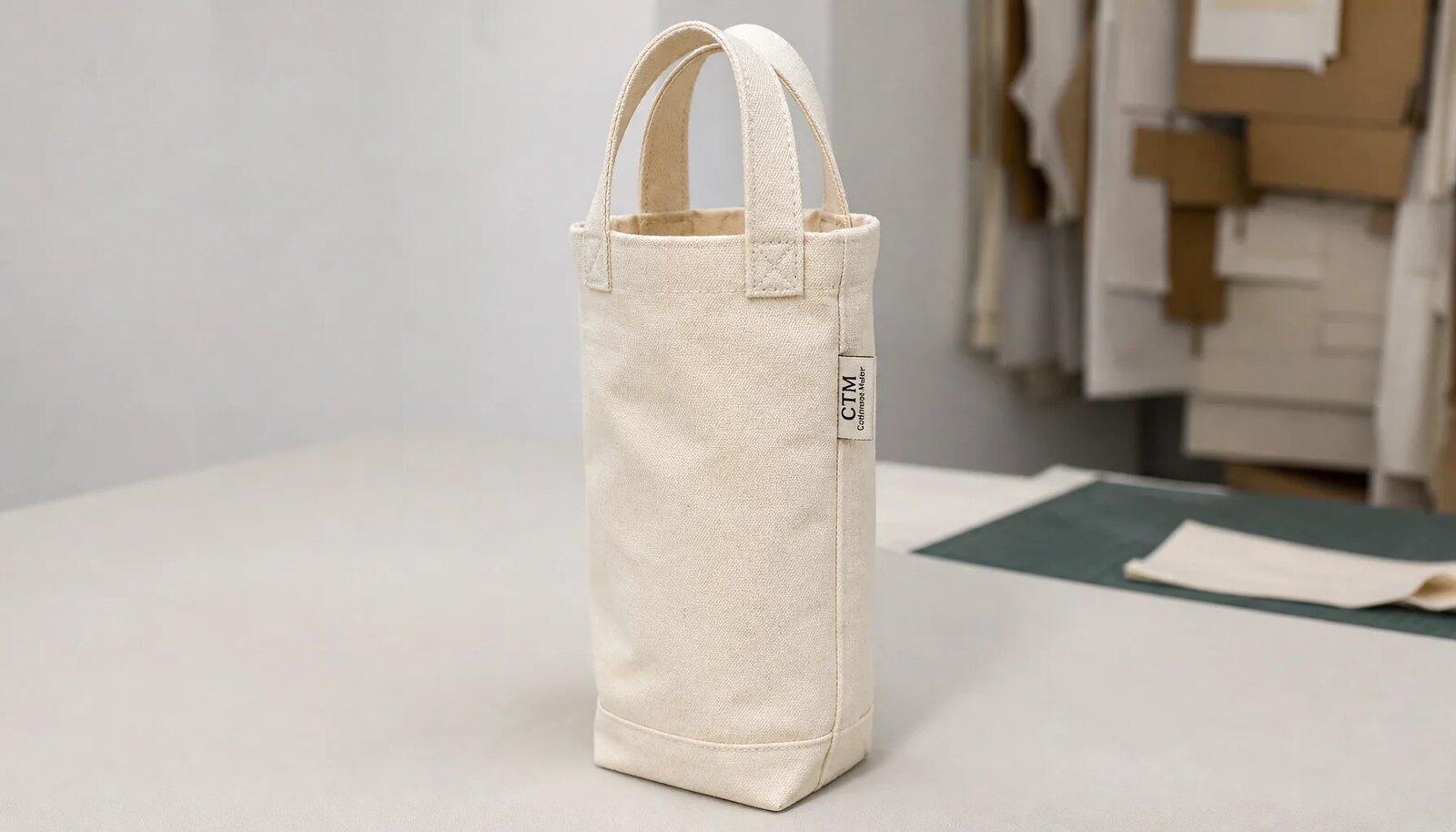
Start with the event job
A canvas wine carrier for an event program has to do more than hold a bottle. It may be handed to guests at registration, placed on banquet tables, packed into hotel welcome kits, used for sponsor gifting, or distributed after a tasting. Each use case changes the buying spec. A short-life giveaway can be lighter and simpler. A VIP gift needs better structure, cleaner seams, and packing that protects the presentation before staff touch it.
Before asking for wholesale pricing, define how the carrier will be used and handled. Will it be empty when handed out, or filled with a bottle before delivery? Will staff pack hundreds of bottles quickly in a staging area? Will the bag sit upright where guests can see the logo? Will it travel through a hotel, venue, or courier network? These details affect fabric weight, gusset size, handle drop, bottom support, and carton planning.
This is where a canvas wine carriers for event planners wholesale buying checklist earns its keep. The goal is not to make sourcing complicated. The goal is to remove assumptions before they turn into event-week sorting, repacking, or logo complaints.
- Define the use case: giveaway, table presentation, sponsor gift, hospitality kit, retail-style gift, or reusable client item.
- Confirm whether recipients carry an empty or filled carrier; filled use requires stronger handle and bottom control.
- Share the event date, receiving address, and required in-hand date before suppliers quote.
- For premium programs, specify that the bag should stand neatly and recover well after unpacking.
Confirm bottle fit first
Bottle fit should come before artwork. A standard 750 ml Bordeaux bottle, a wider Burgundy bottle, a tall Riesling bottle, a sparkling bottle, and many spirits bottles can all behave differently inside the same carrier. If the bag is too narrow, staff may force the bottle in and stress the seams. If it is too loose, the bottle swings and the gift feels unfinished. If the handle drop is short, the bottle neck can crowd the grip.
Ask suppliers for finished dimensions and usable internal dimensions. Outside width is not the same as bottle space after seam allowance, gusset folds, and divider seams. For double-bottle styles, the divider reduces usable width again. Send the supplier the actual bottle height and widest diameter in millimeters. If the final bottle is not selected yet, give a maximum bottle range and ask the supplier to confirm the largest safe fit.
Approve fit with a physical sample whenever possible. Insert the filled bottle, lift the carrier, set it down, remove the bottle, and repeat. Look for mouth distortion, seam strain, handle twisting, and bottle movement. If event staff will pack quickly, the bottle should slide in without snagging.
- Request body width, height, gusset depth, mouth opening, handle drop, and usable internal bottle height.
- Give bottle diameter and height in millimeters, especially for sparkling, Burgundy, and spirits-style formats.
- For double-bottle carriers, test two filled bottles together and check divider stability during lifting.
- Do not approve final logo placement until the printable area is confirmed on the final pattern.
Specify fabric and construction
Canvas weight drives cost, structure, print behavior, carton weight, and perceived value. A 10 oz canvas can work for budget promotional handouts or short campaigns. A 12 oz canvas is often a practical middle choice for event gifting because it gives better body without becoming bulky. A 16 oz canvas gives a firmer premium feel, but it raises material cost and may need stronger sewing, heavier folding pressure, and more careful carton planning.
Do not let suppliers quote only the word canvas. Ask for weight in oz or GSM, fabric condition, and whether the fabric is natural, bleached, dyed, washed, pre-shrunk, coated, laminated, or untreated. Natural canvas is popular because it suits simple branding and prints well, but shade can vary by lot. Dyed canvas gives stronger color direction but adds color tolerance, shrinkage, and MOQ questions. Washed canvas may feel softer but may stand less crisply.
Construction matters because a bottle is heavy for a small fabric product. The handle joints, side seams, bottom seam, gusset, and optional divider are the main stress points. Specify handle width, handle drop, thread color, reinforcement method, and whether the bottom uses an extra fabric layer, sewn-in panel, or insert. A clean sample is not enough if the load-bearing details are vague.
- Use 10 oz canvas for low-cost promotions, 12 oz for most event gifting, and 16 oz for firmer premium presentation.
- Ask whether fabric is pre-shrunk or washed when finished size accuracy matters.
- Specify handle width, handle drop, seam allowance, stitch type, reinforcement method, and thread color.
- For double-bottle formats, define divider material, height, seam location, and attachment method.
Choose controllable branding
Branding affects appearance, cost, and production risk. Screen printing is usually efficient for one-color logos, simple event marks, and repeat wholesale orders. Heat transfer can help with gradients, fine text, or several colors, but buyers should check hand feel and rub resistance. Embroidery, woven labels, and patches can lift presentation, although they add cost, approval steps, and sometimes separate minimums.
Confirm the logo area on the sewn carrier, not on a flat drawing. Seams, gusset folds, top hems, bottom folds, and handle attachments reduce the clean print zone. A logo that looks balanced on a mockup may land too close to a seam once the bag is sewn. For sponsor programs, one controlled print layout often works better than crowded small logos that lose detail on textured canvas.
Color matching also needs practical expectations. Pantone references help, but ink on natural cotton canvas will not look identical to ink on coated paper or a screen. Ask for a print strike-off on the actual fabric. For dyed canvas, approve the fabric swatch and print test together because the ground color changes logo contrast.
- Use screen print for simple logos, repeat volume, and cost control.
- Use heat transfer for gradients, fine artwork, or multi-color marks that screen print cannot hold cleanly.
- Use woven labels, embroidery, or patches when presentation value matters more than lowest unit cost.
- Approve branding on a sewn sample or strike-off using the actual fabric.
Pick the right supplier route
The best route depends on timing, quantity, customization, and risk tolerance. A direct factory usually fits stable specs, repeat volume, and buyers who want control over fabric, sewing, print, packing, and inspection. A trading company may help when one order includes several related textile items, but the buyer should know who controls production. A stock distributor or local decorator can be useful when the event date is close and customization can stay simple.
For canvas wine carriers, small substitutions are visible. Lighter fabric may collapse on a display table. A weaker print method may make sponsor artwork look dull. Tight packing can crease the logo face. A low quote may exclude packing, setup charges, labels, carton marks, or export cartons. Compare the route on total order risk, not only the first unit price.
Ask operating questions early. Who cuts the fabric? Who sews the carrier? Is printing in-house or subcontracted? Who keeps the sealed approved sample? Can the same pattern and fabric be repeated next season? Clear answers are a good sign for event planners who need repeatability across campaigns.
- Choose direct factory sourcing for repeatable specs, larger quantities, and tighter QC control.
- Choose a stock or domestic route for urgent events where exact pattern control matters less.
- Ask who performs printing, packing, and inspection if the supplier is not vertically integrated.
- Favor quotes that separate material, sewing, branding, packing, and freight assumptions.
Control MOQ and samples
MOQ is shaped by fabric color, cutting efficiency, print setup, trim buying, and packing labor. A natural canvas single-bottle carrier with one-color screen print may support a lower MOQ than a custom-dyed double-bottle carrier with a divider, woven label, and individual retail packing. Ask for MOQ by color, by design, by print method, and by shipment. A low total MOQ may still hide separate minimums for labels, fabric colors, or custom cartons.
Treat sampling as a control point, not a courtesy. A useful sample proves material, size, handle construction, bottle fit, print method, logo placement, and packing format. A photo can help early discussion, and a digital proof can confirm artwork proportion, but neither can confirm fabric body, odor, seam strength, or carton recovery after folding. For first orders, request a material swatch, print strike-off, and sewn pre-production sample.
Approval language should be specific. Production should begin only after written approval of the pre-production sample and final spec sheet. The supplier should keep a sealed approved sample, and the buyer should keep one when practical. Any change to fabric, logo size, color, handle length, label position, or packing should be treated as a revision with cost and schedule impact.
- Ask for MOQ per color, design, print method, label type, and packaging style.
- Request swatch, print strike-off, and sewn pre-production sample for first orders.
- Measure the sample and record dimensions before approving bulk production.
- Tie approval to a dated spec sheet, artwork file, and packing instruction.
Compare landed cost
Unit price only helps when suppliers quote the same product. One supplier may quote 10 oz canvas with bulk packing. Another may quote 12 oz canvas with screen print, individual polybag, carton marks, and stronger handle reinforcement. One may quote EXW while another quotes FOB. One may include screen setup; another may add it later. A good comparison sheet forces every supplier into the same fields.
For event planners, landed cost often matters more than factory cost. Canvas carriers are compact, but fold direction, carton count, pack density, and carton size affect freight and warehouse handling. A few cents saved in sewing can disappear if the bags pack poorly or require repacking before event distribution. Ask for carton dimensions, units per carton, gross weight, net weight, estimated CBM, and carton mark details with every formal quote.
Also compare risk cost. A cheaper supplier that cannot confirm fabric weight, refuses a pre-production sample, or gives vague carton data may create inspection and sorting work later. A higher quote with clear material, print, and packing control may be the stronger procurement choice when the delivery date is fixed.
- Compare the same trade term before ranking prices: EXW to EXW, FOB to FOB, or DDP to DDP.
- Use consistent quantity breaks such as 500, 1,000, 2,500, and 5,000 pcs.
- Request carton size, pack count, gross weight, net weight, and estimated CBM.
- Separate product cost, branding cost, packing cost, sample cost, setup cost, and freight assumptions.
Write QC into the order
Quality control should be in the purchase order before production starts. Common defects are practical: crooked logo, weak handle, uneven seam, loose thread, fabric stain, odor, crushed fold, wrong carton count, or tight bottle fit. These problems are expensive because they usually appear when staff are packing close to the event date. Name the approved sample as the standard and list the checkpoints for size, stitching, print, cleanliness, odor, and packing.
Dimensional tolerance matters on bottle carriers. A small change in gusset depth or mouth opening can affect loading. Check finished width, height, gusset, handle drop, and divider placement. For sewing, inspect handle joints, bottom seams, side seams, stitch density, skipped stitches, and thread trimming. For print, check placement from top edge and side seam, ink opacity, edge sharpness, registration, and color consistency.
Functional tests are simple and useful. Put the intended filled bottle or agreed test weight into the carrier and lift it repeatedly. Watch for handle twisting, seam pulling, and bottom distortion. For double-bottle bags, move the filled carrier and check whether bottles knock together. For packing QC, open cartons from different parts of the order and confirm piece count, fold direction, carton condition, and shipping marks.
- Use the approved sample, spec sheet, and artwork file as the inspection standard.
- Inspect dimensions, fabric, stitching, print, odor, stains, loose threads, carton count, and carton marks.
- Test handle strength with a filled bottle or agreed test weight.
- Reject missing reinforcement, severe print misalignment, strong odor, oil stains, wrong fit, and incorrect quantity.
Plan packing and logistics
Packing is part of the product experience. A technically correct carrier can still arrive wrinkled, dusty, crushed, or slow to process. Flat folding is usually efficient for freight, but the fold direction should protect the logo face and let staff open each piece quickly. Individual polybags keep units clean and support retail-style distribution, but they add cost and material. Bulk packing lowers cost and may be acceptable for back-of-house programs.
Cartons should match the receiving workflow. Overweight cartons slow event teams. Oversized cartons are awkward in staging rooms, elevators, and hotel storage areas. For split deliveries, carton marks should show design, color, quantity, PO number, destination, and event date if needed. Ask whether inner cartons help the receiving team or whether master cartons alone are simpler.
Moisture and odor deserve attention with cotton canvas. Long transit, humid storage, and sealed plastic can create smell or mildew risk if fabric is packed before it is dry. For sea freight or long storage, ask about drying time after printing, desiccant, carton lining, and warehouse conditions. Confirm printed bags are fully cured before packing so ink does not transfer or block inside cartons.
- Define fold direction, polybag choice, carton count, carton size, and shipping marks before production.
- Keep carton weight practical for manual handling at venues and warehouses.
- Ask for carton photos before shipment when the order has multiple colors, designs, or destinations.
- For long transit, check moisture control, ink curing, odor, and carton compression risk.
Use one complete RFQ
A strong RFQ should read like a working specification. Start with product type, quantity, bottle format, intended bottle dimensions, finished carrier dimensions, canvas weight, fabric color, print method, artwork size, handle construction, packing, delivery term, and required delivery date. Attach vector artwork when possible and include Pantone references if color matching matters.
Then ask every supplier to answer the same commercial fields: MOQ, sample fee, sample time, production lead time, unit price by quantity, setup charges, carton specs, trade term, payment terms, overrun or underrun tolerance, and quote validity. This makes comparison faster and prevents suppliers from quoting different versions of the same idea.
The RFQ should also ask for production controls. Can the supplier provide a pre-production sample? What finished size tolerance do they use? What print placement tolerance is acceptable? Can they support inline inspection or final random inspection? What is the reorder process? A practical wholesale checklist makes assumptions visible, which is exactly what buyers need when an event date cannot move.
- Include bottle dimensions, bag dimensions, canvas weight, fabric color, branding method, handle spec, and packing format.
- Ask all suppliers to quote the same quantity breaks and trade term.
- Request sample, production, inspection, and shipping timelines in calendar days.
- Keep the final RFQ, approved sample, purchase order, artwork, and packing instruction consistent.
Specification comparison for buyers
| Buying scenario | Best route | Specify first | Main risk to check |
|---|---|---|---|
| Repeat order of 1,000+ pcs | Direct factory with coordinated cutting, sewing, and printing | Canvas weight, finished size, handle spec, print method, packing | Confirm the quote includes printing, labels, export cartons, carton marks, and overrun or underrun rules. |
| Pilot run or urgent event | Stock distributor, local decorator, or domestic converter | Available bag size, stock fabric color, logo area, delivery date | Stock bags may limit print size, color choice, handle length, and exact bottle fit. |
| Premium gifting program | Factory with stronger canvas, clean finishing, and retail-ready packing | 12-16 oz canvas, reinforced base, tidy fold, individual packing | Check whether bags arrive clean, flat, presentable, and ready to pack without rework. |
| Multi-sponsor artwork | Supplier with proven print control | Artwork size, print colors, registration, ink opacity | Ask for a strike-off on actual canvas; digital proofs do not show texture or opacity. |
| Double-bottle carrier | Factory with pattern and divider experience | Divider height, divider seam, usable inner width, bottom support | Test two filled bottles for contact, tilt, seam strain, and carton compression. |
| Several delivery dates | Factory run with staged release or split shipments | Carton labels, storage terms, release dates, destination marks | Confirm who holds stock, free storage period, and responsibility after partial release. |
| Many fabric colors | Factory using stock dyed canvas or clear dye MOQ | Color MOQ, fabric lot tolerance, shrinkage, print contrast | Each color may trigger separate MOQ, setup, shade approval, and inspection needs. |
| First order with a new supplier | Factory willing to sample and support inspection | Swatch, print strike-off, pre-production sample, QC checklist | Do not rely only on photos; require measurable approval samples before bulk production. |
Buyer checklist before sampling
- Confirm the bottle format before quoting: single bottle, double bottle, divider or no divider, and whether the carrier must fit only standard 750 ml wine bottles or also Burgundy, sparkling, Riesling, or spirits-style bottles.
- Lock finished dimensions in millimeters: body width, height, gusset, mouth opening, handle drop, handle width, and usable inner depth after seams and folds.
- Specify canvas weight in oz or GSM. Common buying targets are 10 oz for budget giveaways, 12 oz for general event gifting, and 16 oz for firmer premium presentation.
- Define fabric condition: natural greige, bleached, dyed, washed, pre-shrunk, coated, laminated, or untreated. Ask about odor, shrinkage, colorfastness, and shade variation.
- Choose the branding method early: screen print, heat transfer, woven label, embroidery, patch, or hangtag. Confirm printable area on the sewn pattern, not only on a flat mockup.
- Specify handle construction, seam allowance, bottom reinforcement, thread color, bar-tack or box-stitch placement, and divider construction when used.
- Request a material swatch, print strike-off, and pre-production sample with measured dimensions, logo placement, stitch details, and packing method.
- State packing requirements: flat folded or standing, individual polybag or bulk pack, tissue or paper band if needed, inner carton count, master carton size, shipping marks, and carton weight limit.
- Collect the same quote fields from every supplier: unit price, sample fee, setup charge, MOQ by color and design, lead time, carton specs, trade term, payment terms, and quote validity.
- Ask for overrun and underrun tolerance before ordering so the final event quantity is not disrupted by factory yield rules.
Factory quote questions to send
- What is the exact fabric specification in oz or GSM, and is it greige, natural, bleached, dyed, washed, pre-shrunk, coated, or laminated canvas?
- What are the finished dimensions for body width, height, gusset, mouth opening, handle drop, handle width, and recommended bottle diameter and height?
- What print method is included in the quoted unit price, how many colors are included, what is the maximum printable area, and what setup charge applies?
- How do you control logo color on natural or dyed canvas: Pantone reference, ink mixing record, heat transfer proof, woven label approval, or another method?
- What is the MOQ per color, per design, per fabric, and per shipment? Does MOQ change if we use stock fabric instead of custom-dyed fabric?
- Can you quote 500, 1,000, 2,500, and 5,000 pcs using the same specification so we can compare true price breaks?
- What handle reinforcement is included: bar-tack, box stitch, cross stitch, double row stitching, reinforcement patch, heavier thread, or another method?
- What packing is included, and what are the carton pack count, carton size, gross weight, net weight, and estimated CBM?
- What are the sample time, pre-production sample timing, production lead time after approval, and earliest ship date under the current production queue?
- What inspection points do you use for finished size, stitching, print alignment, ink coverage, odor, stains, loose threads, carton strength, and quantity accuracy?
Quality-control points to confirm
- Measure finished size against the approved sample, especially body width, gusset depth, mouth opening, handle drop, and divider position. A 5-10 mm loss can affect bottle loading.
- Check fabric weight and hand feel against the approved swatch. Natural canvas can look similar across weights, so substitution may not be obvious in photos.
- Inspect stitch density, seam straightness, thread tension, skipped stitches, and loose threads at handle joints, side seams, bottom seams, and divider attachment points.
- Test handle strength with a filled bottle or agreed weighted equivalent. Confirm the specified bar-tack, box stitch, cross stitch, or reinforcement patch is present on both handles.
- Review print placement, registration, ink opacity, edge sharpness, color consistency, and rub resistance under normal indoor light and stronger side light.
- Rub the printed area with a clean dry cloth to check obvious transfer, flaking, tackiness, or poor curing before goods leave the factory.
- Open cartons from different parts of the order and verify fold direction, piece count, carton size, gross weight, shipping marks, and carton condition.
- Check odor, dust, oil marks, stains, chalk marks, printing residue, and loose thread buildup. Small factory defects become expensive sorting work at event warehouses.
- For double-bottle carriers, confirm divider height, divider seam strength, and whether two filled bottles contact each other when lifted and moved.
- Confirm color lot consistency across the full order, especially for multiple fabric colors or split shipments.