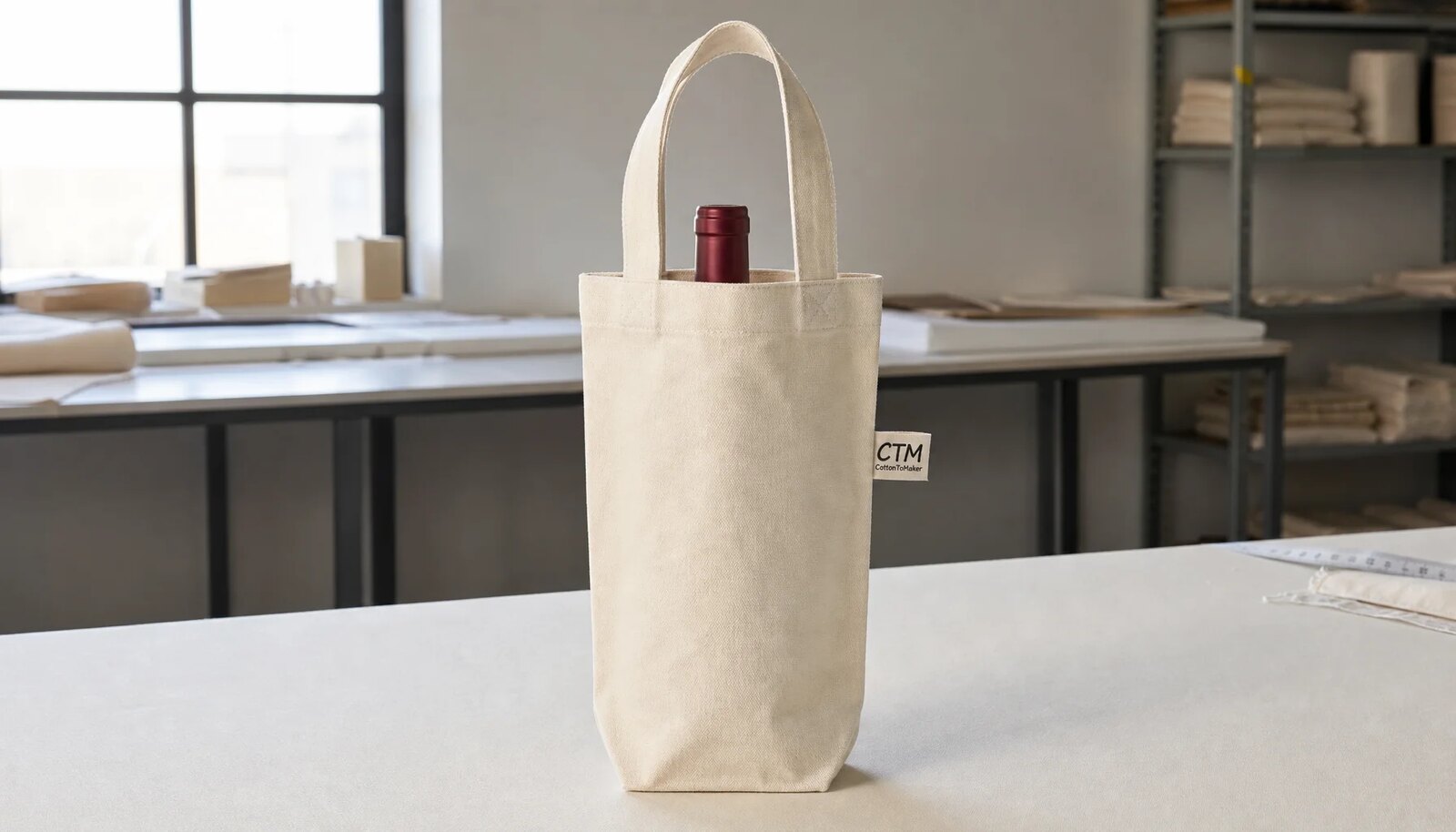
Compliance Starts With the Event Use
Canvas wine carriers look simple, but for event procurement they sit at the intersection of presentation, guest handling, brand visibility, and deadline risk. They may hold sponsor bottles, VIP welcome gifts, tasting kits, wedding favors, auction takeaways, or hotel-room amenities. A failed handle, wrong logo, poor bottle fit, or mixed carton can become visible at the exact moment the item is being handed to a guest.
A useful canvas wine carriers for event planners supplier compliance checklist should therefore check repeatability, not just a pretty sample. The supplier must prove that the same bottle fit, fabric, reinforcement, decoration, label, carton mark, and delivery plan can be repeated across the whole order.
Start by mapping how the carrier will be used. Will staff fill it at a warehouse, venue, hotel, or retail counter? Will it stand upright on tables? Will guests carry it across a long reception area? Will cartons be split by sponsor, table, guest tier, or city? Those details decide which supplier evidence matters most.
- Treat the carrier as a measured sewn product, not a generic giveaway bag.
- Tie specifications to receiving, sorting, filling, display, guest handoff, and reuse.
- Use a signed sample and written spec as the acceptance reference.
- Ask for evidence of material, sewing, decoration, packing, and inspection control.
Start With the Bottle, Not the Bag
A 750 ml bottle is not enough information for a final quote. Bordeaux, Burgundy, Riesling, Champagne-style, cider, olive oil, and sparkling water bottles can differ in height, shoulder width, base diameter, and filled weight. A carrier that works for a slim bottle may pull tight around a broad shoulder or lean when loaded with a heavier bottle.
Send the actual bottle measurements before asking suppliers to lock price. Record total height, base diameter, widest body or shoulder diameter, and filled weight. If the bottle will be wrapped with tissue, placed in a sleeve, fitted with a neck tag, protected by netting, or paired with an insert card, test that finished condition too.
Two-bottle carriers need special attention. The divider should limit glass-to-glass contact during normal carrying, and the handle position should keep the loaded carrier balanced. If the event uses mixed items, such as wine plus olive oil, test the widest and heaviest combination.
- Provide bottle height, base diameter, widest diameter, and filled weight in the RFQ.
- Test samples with the real bottle and all sleeves, tags, wraps, tissue, or inserts.
- For two-bottle bags, define divider material, height, attachment points, and allowed bottle movement.
- Ask for loaded fit photos from front, side, top opening, and bottom.
- Confirm whether the loaded carrier must stand upright, hang, sit on a table, or ship prefilled.
Lock Fabric Before Comparing Price
Canvas weight is one of the easiest places for quotes to drift. Common wine-carrier options include about 10 oz, 12 oz, and 16 oz cotton canvas per square yard. Suppliers may also provide approximate gsm, such as around 340 gsm, 410 gsm, and 540 gsm, though exact results depend on yarn, weave, finishing, and mill tolerance.
For many event programs, 12 oz cotton canvas is a practical baseline because it balances structure, sewability, print performance, carton efficiency, and perceived value. A 10 oz canvas can work for short-use presentation bags but may collapse more easily when loaded. A 16 oz canvas feels more substantial and holds shape better, but it costs more, takes more carton space, and can be harder to decorate cleanly on heavy texture.
Composition and finish should be named in writing. Cotton canvas, cotton-blend canvas, recycled cotton blend, jute-cotton blend, and washed canvas do not behave the same way. Natural canvas may show seed flecks and shade variation. Dyed canvas needs color control. Recycled blends may show fiber variation. These are manageable issues when disclosed before approval.
- Require a written fabric line: composition, weight, color, finish, and stock or custom status.
- Ask whether stated weight is before or after dyeing, washing, coating, or finishing when the supplier can confirm it.
- Keep fabric swatches or cuttings with the approved sample file.
- For colored canvas, agree on shade tolerance between sample, bulk, and repeat orders.
- Do not compare a 10 oz stock natural carrier with a 12 oz custom dyed carrier as equivalent.
Specify Construction in Measurable Terms
A supplier can reduce cost while still calling the item a canvas wine carrier. Handles can become narrower, stitch density can drop, reinforcement can disappear, the bottom panel can lose structure, or the top opening can become harder to fill. These changes may not show clearly in a catalog photo, but they matter during event packing and guest use.
The RFQ should state finished height, width, gusset, top opening, bottom panel, handle width, handle drop, seam allowance, stitch type, stitches per inch, top hem, side seam finish, reinforcement pattern, lining, divider, binding, and base insert if used. A tight opening slows staff. A short handle feels awkward. A weak bottom makes the loaded carrier look unstable.
Handle reinforcement deserves a direct question. Wine is heavy enough that neat stitching alone is not a load specification. Ask whether the supplier uses bar-tacks, box stitches, cross stitches, reinforcement patches, or another method, then ask how that method is checked during production.
- Use finished dimensions with tolerances, not only a reference image.
- Define handle width and handle drop because both affect comfort and perceived quality.
- State whether the bottom is flat, gusseted, boxed, reinforced, or supported by an insert.
- For dividers, define height, material, attachment points, and whether bottles may touch.
- Request sample photos of handle anchors, bottom seams, and inside construction.
Choose Decoration by Risk
Artwork approval is not the same as decoration approval. A digital mockup can show scale and placement, but it cannot prove ink coverage on woven texture, transfer adhesion, embroidery puckering, label alignment, or color behavior on natural canvas. Approve the branding on production-intent fabric with the intended decoration process.
Screen printing is often efficient for simple event logos, sponsor marks, and one- or two-color artwork. It is also easy to inspect if placement, registration, and color tolerance are written clearly. For many sewn canvas products, a practical logo placement tolerance may be agreed in millimeters, such as plus or minus 3 mm to 5 mm, depending on artwork and construction.
Transfers can support full-color artwork, gradients, or photos, but they need adhesion, edge-lift, cracking, and hand-feel checks. Embroidery can look premium on heavier canvas, though dense stitching may distort lighter panels. Woven labels, cotton labels, patches, and hang tags can be better for repeat programs where subtle, durable branding matters more than a large front print.
- Specify decoration method, artwork size, color reference, and placement from top edge, side seam, or centerline.
- Confirm whether decoration happens before or after sewing because that affects print area and positioning.
- Require a production-intent sample for print, transfer, embroidery, label, patch, or hang tag approval.
- Define checks for coverage, registration, curing, rub resistance, transfer edge lift, embroidery puckering, and label alignment.
- Separate setup fees such as screens, digitizing, transfer setup, label tooling, insert cards, and barcode labels.
Request Documents That Match the Order
A thick document folder is not automatically useful. Compliance evidence should connect to the legal seller, production site, material, destination, and claim wording. Start with the supplier's legal company name, factory address, business registration where available, and confirmation of whether the order is made directly or through a subcontracted workshop.
Material documents should match the quoted canvas. Ask for a composition declaration, fabric weight reference, dye or color information when relevant, and any restricted-substance documents required by the destination market or buyer policy. REACH or Prop 65 review may be relevant for some EU or California-facing programs. CPSIA is only relevant when the product is intended for children. Fiber content, country-of-origin marking, packaging material rules, and retail labeling may matter even for simple carriers.
Claims need support before they appear on hang tags, product pages, or sponsor materials. If the wording says organic, recycled, washable, biodegradable, reusable, food-adjacent, or made from a stated fiber, procurement should keep the supporting evidence in the order file. Avoid soft sustainability language that the supplier cannot document.
- Request business registration, legal seller name, factory address, and production-site confirmation where possible.
- Ask for composition declaration, fabric weight reference, and destination-relevant test reports or declarations.
- Check report holder, tested material, production site, document date, and whether the report covers the actual order.
- Confirm country-of-origin marking, fiber labeling, retail label content, and packaging requirements by destination.
- Do not approve environmental or material claims without evidence tied to the product.
Make Quotes Truly Comparable
MOQ is rarely just a sewing quantity. It may be driven by fabric color, stock availability, print screens, transfer sheets, embroidery digitizing, woven labels, hang tags, insert cards, individual packing, carton marks, and export handling. A supplier may offer 300 pieces for blank natural stock carriers but require 1,000 pieces for custom dyed canvas or private woven labels.
Ask each supplier to quote the same specification at several quantities, such as 500, 1,000, and 3,000 pieces. This shows how setup costs spread and whether the supplier is assuming stock material. The quote should separate sample fee, tooling, fabric, cutting, sewing, decoration, labels, inserts, packing, cartons, inspection support, and freight assumptions.
Normalize trade terms before choosing. EXW, FOB, CIF, DAP, and DDP shift cost and responsibility in different ways. Event planners often need usable goods delivered to a warehouse, venue, hotel, fulfillment center, or retail location by a fixed date. Compare accepted delivered cost, including freight, duties where applicable, destination handling, sorting, and repacking labor.
- Ask MOQ by fabric color, artwork version, decoration method, label type, packing method, and destination.
- Request price tiers at identical specs so setup dilution is visible.
- List quote exclusions in writing, including samples, setup fees, inspection, freight, duty, and carton upgrades.
- Clarify production variance because many event orders need exact counts.
- Compare delivered usable goods, not only factory unit price.
Control Samples and Approvals
A physical sample is essential for canvas wine carriers because it lets the buyer check bottle insertion, hand feel, stiffness, bottom support, handle comfort, decoration finish, odor, and packing result. The best sample uses production-intent fabric, trim, thread, labels, decoration, and packing. If an early development sample uses substitute material, mark it clearly and require a true pre-production sample before bulk approval.
The signed golden sample should become the acceptance reference. The buyer keeps one sample, and the supplier keeps a matching sample near the production or QC area. Both should be dated and tied to the PO, artwork file, specification sheet, and tolerance list. Photos help communication but do not replace a physical sample because canvas weight, print hand, stiffness, and odor do not translate reliably through images.
Write tolerances before cutting starts. Include finished dimensions, handle drop, handle width, logo placement, color variation, stitch quality, label position, carton quantity, carton marks, and packing orientation. Define what can be repaired, what is rejected, and what requires buyer review.
- Approve a signed golden sample before bulk production.
- Use the real bottle and event inserts when testing sample fit.
- Document tolerances for size, handle length, logo placement, color, stitching, labels, and packing.
- Require first-piece approval photos before full production continues.
- If the sample uses substitute material or decoration, require a production-intent sample before final approval.
Inspect Against Real Failure Modes
QC should focus on how the carrier can actually fail: wrong material, poor fit, weak handles, sagging bottom, crooked logo, dirty fabric, odor, mixed labels, or packing errors. A final inspection should compare random finished goods against the signed sample and written spec. For larger, brand-sensitive, or deadline-critical orders, add an in-line inspection after cutting, early sewing, or first decoration output so problems are found before the whole lot is packed.
Use a sampling plan that both sides understand. Many buyers reference ANSI/ASQ Z1.4 or ISO 2859-1 with an agreed inspection level and AQL, then define critical, major, and minor defects. For example, unsafe handle failure, wrong artwork, incorrect material, or unusable bottle fit should be treated more seriously than trimable loose threads. The exact AQL should match buyer policy, order value, and risk.
Functional checks must use the intended filled bottle or a weight equivalent. Empty-bag inspection misses the stress on handle anchors, bottom seams, gussets, and dividers. Decoration checks should match the method: print coverage and curing for screen print, adhesion and edge lift for transfers, puckering and thread breaks for embroidery, and version accuracy for labels and hang tags.
- Agree on inspection timing: pre-production sample, first-piece check, in-line inspection, final random inspection, or loading check.
- Classify critical, major, and minor defects before production.
- Inspect loaded fit and lift performance, not only flat dimensions.
- Review decoration before final packing so repair or replacement is still possible.
- Require packing list confirmation and final carton photos for event-critical shipments.
Plan Packing, Delivery, and Landed Cost Together
Packing is not a late detail when the order is tied to an event date. Bulk packing may be efficient if the venue team will fill carriers on-site. It reduces waste and speeds unpacking, but it gives less protection against dust and handling marks. Individual polybags can protect light natural canvas, yet they create more labor and disposal work when staff unwrap hundreds or thousands of pieces.
Retail-style or sponsor-table presentation needs another level of control. Hang tags, barcode labels, belly bands, insert cards, tissue, base inserts, inner cartons, and display orientation should be part of sample approval because they affect appearance, carton volume, receiving work, and cost. If the order has multiple logos, colors, gift tiers, venues, or destinations, carton marks should match the sorting workflow.
Lead time should include RFQ clarification, artwork preparation, sample making, sample shipping, buyer review, revision time, material booking, decoration setup, first-piece approval, bulk sewing, inspection, packing, freight booking, customs clearance, and final receiving. The real procurement target is accepted goods in the right version, at the right place, by the event deadline.
- Choose bulk, inner pack, individual polybag, hang tag, insert card, or retail-ready packing based on distribution workflow.
- Approve how the carrier looks after unpacking, especially for premium event or retail display programs.
- Use carton marks by PO, artwork version, venue, table, date, color, gift tier, or destination when sorting matters.
- Set a maximum practical carton weight for venue handling and freight safety.
- Compare landed cost to the required delivery point, including inspection, freight, duty, handling, sorting, and repacking.
Specification comparison for buyers
| Supplier option | What to verify | Commercial advantage | Buyer risk to control |
|---|---|---|---|
| Direct sewing factory | fit-test photos with reference bottle, bottom reinforcement close-up, handle load proof, and final carton photo set | Better sample-to-bulk control and faster production feedback | May be weaker on export paperwork or branded packing unless checked early |
| Trading company | Factory name, production photos, trim-source proof, and who owns QC decisions | Can coordinate small mixed orders and extra services | Markup can hide real factory capability and slow defect decisions |
| Specialized bag workshop | bottle fit, bottom reinforcement, handle or cord strength, divider option, seam allowance, and upright stability | More practical for detailed construction, trims, and repeat programs | Capacity may be limited during peak seasons |
| Low-price general supplier | cotton canvas, jute, felt, nonwoven, or laminated paper sized to bottle diameter, weight, and condensation risk | Useful for simple promotional runs with loose specs | Material downgrades, weak packing, and vague inspection scope can erase savings |
| Retail-ready supplier | upright or flat packing, bottle-protection insert, carton count, moisture control, and retail display orientation | Can handle labels, SKU separation, carton marks, and receiving rules | Higher unit cost must be compared against reduced warehouse work |
| Compliance-focused supplier | Fabric records, labeling review, test plan, and production traceability | Safer for retail programs and repeat brand orders | Documentation claims need evidence, not only sales language |
| Local sample room plus bulk factory | Signed sample, bulk factory handoff, first-piece photos, and deviation owner | Good for complex branding before large production | Sample room quality may not match bulk line unless handoff is controlled |
Buyer checklist before sampling
- Define the bottle format: one 750 ml bottle, two standard bottles, Champagne-style bottle, magnum, cider bottle, olive oil bottle, sparkling water bottle, or specialty gift bottle.
- Record bottle height, base diameter, widest shoulder or body diameter, filled weight, and whether the bottle will be bare, wrapped, sleeved, tagged, boxed, netted, or packed with tissue.
- Specify finished carrier dimensions with tolerances: height, width, gusset, top opening, bottom panel, handle drop, handle width, divider position, and logo placement area.
- Lock fabric composition, weight, color, finish, and source; record canvas weight in oz per square yard and approximate gsm when available.
- Confirm whether fabric is stock natural, stock dyed, custom dyed, washed, recycled blend, or substituted from current inventory.
- Define construction: seam allowance, stitch type, stitches per inch, top hem, side seam finish, bottom reinforcement, handle attachment, lining, divider, base insert, or binding.
- Set a realistic load requirement using the intended filled bottle, then ask how handle anchors and bottom seams are checked.
- Choose decoration based on artwork and fabric texture: screen print, transfer, embroidery, woven label, cotton label, patch, hang tag, or insert card.
- Request a production-intent sample using the correct fabric, trim, decoration, thread color, labels, and packing method before bulk approval.
- Keep a signed golden sample with the buyer and require a matching signed sample at the supplier for first-piece and final inspection.
Factory quote questions to send
- What finished size are you quoting, including height, width, gusset, top opening, handle drop, handle width, bottom panel, divider, and logo area?
- Which bottle size has this pattern been tested with, and can you show fit photos using a bottle close to our height, diameter, shoulder shape, and filled weight?
- What canvas weight is included in the price, in oz per square yard and approximate gsm, and what lot-to-lot weight tolerance applies?
- Is the fabric 100% cotton canvas, cotton-polyester blend, recycled cotton blend, jute-cotton blend, or another material, and can you provide a composition declaration?
- Is the canvas stock natural, stock dyed, custom dyed, washed, or otherwise finished, and how will bulk shade variation be controlled?
- What stitch type, seam allowance, stitches per inch, handle width, handle drop, and reinforcement method are included?
- How do you test handle anchor points and bottom seams for a filled bottle, and what lift or load method is used during internal QC?
- Will cutting, sewing, decoration, label attachment, inspection, and packing be done in-house, or will any steps be outsourced?
- Which decoration method are you quoting, what is the maximum print area, and what tolerances apply to placement, color, registration, curing, and edge sharpness?
- Does the price include sample fees, screen charges, embroidery digitizing, transfer setup, woven-label tooling, hang tags, insert cards, barcode labels, carton marking, and inspection support?
Quality-control points to confirm
- Fabric composition, weave, color, hand feel, and weight match the approved sample and agreed tolerance, with no unapproved substitution or mixed fabric lots.
- Finished dimensions stay within written tolerance for height, width, gusset, top opening, bottom panel, handle drop, handle width, divider position, and logo position.
- The intended bottle fits smoothly with tissue, sleeve, tag, wrap, net, box, or insert, without excessive slack, dangerous tightness, tilted presentation, or stressed seams.
- Bottom construction supports the filled bottle upright without sagging, twisting, open corners, exposed raw edges, loose reinforcement, or visible seam strain.
- Handle anchors use the approved reinforcement, such as bar-tack, box stitch, cross stitch, or patch, with no skipped stitches, broken threads, or loose ends.
- Stitching is straight and secure, with agreed stitches per inch, no needle cuts, puckering, unraveling, frayed seams, or poor back-tacking.
- Top hem, binding, lining, divider, insert board, and base stiffener are positioned correctly and do not shift, curl, scrape the bottle, or create bulk.
- Screen print, transfer, embroidery, woven label, cotton label, or patch matches the approved sample for placement, color, coverage, registration, adhesion, and finish.
- Print curing or transfer adhesion is checked by the agreed method, such as rub check, tape pull where suitable, or buyer-defined handling simulation.
- Labels, hang tags, care labels, barcode labels, and carton marks are accurate, aligned, firmly attached, and consistent by SKU, destination, artwork version, and PO.