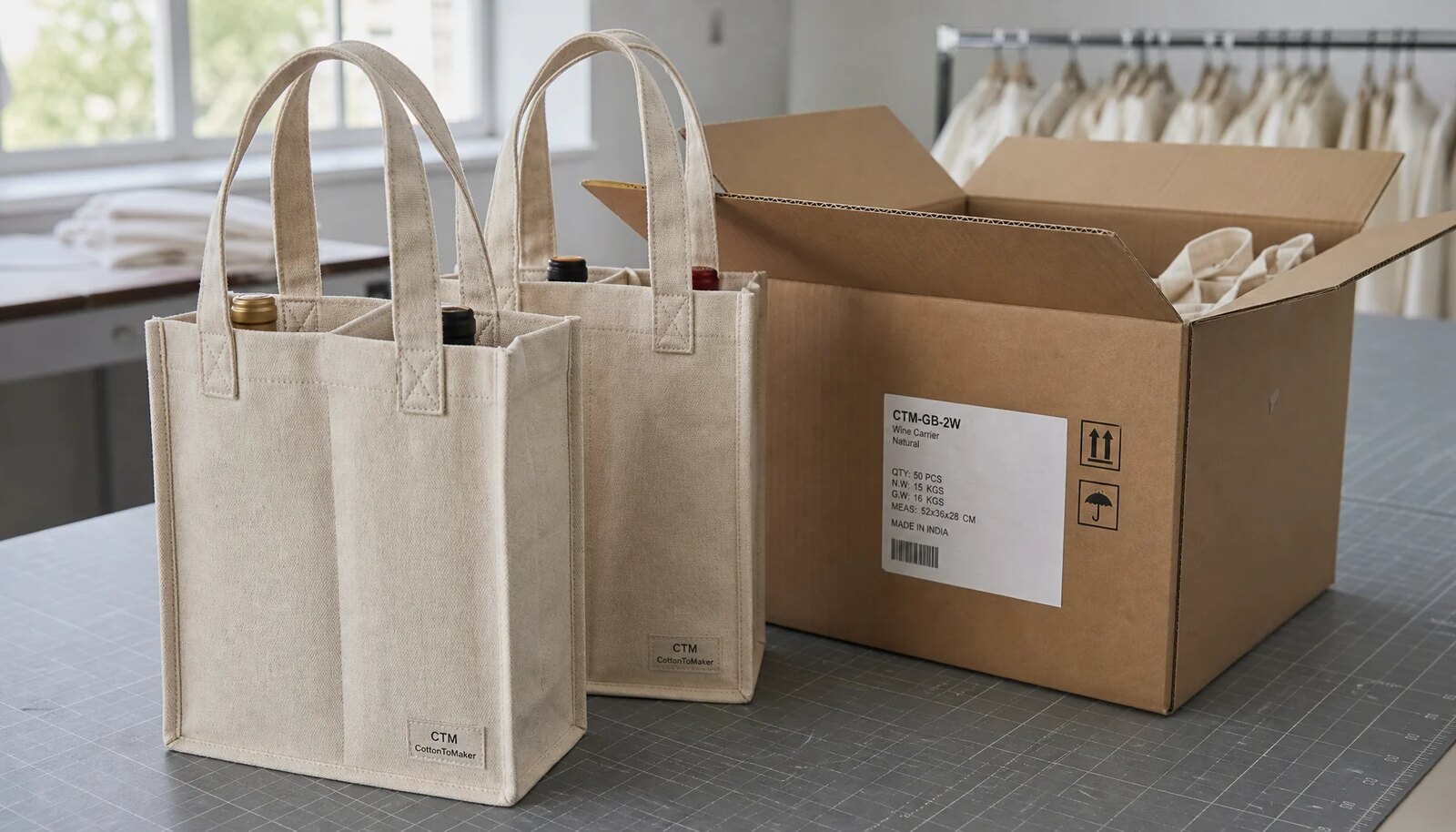
Start With the Shipment, Not the Bag
For B2B event procurement, a canvas wine carrier is not just a sewn item with a logo. It is also a handling unit, a receiving unit, and sometimes part of a larger gift kit. The carrier has to move through fabric inspection, cutting, sewing, decoration, packing, export handling, freight, warehouse receiving, event staging, and final handout. Many order problems do not start with the canvas. They start when carton count, gross weight, carton marks, and receiving rules are treated as afterthoughts.
Good canvas wine carriers for event planners shipping carton planning begins with the route. Are cartons going to one warehouse, several hotels, a fulfillment center, a distributor, or directly to venues? Will staff insert bottles at the venue, or will the carrier ship as part of a pre-built kit? Will every carton be opened and counted, or does each box need to arrive already marked by destination, sponsor, room, or session? These answers affect fold direction, inner bundle count, carton size, label format, and final landed cost.
A product-only quote is incomplete for this category. Ask for carrier specifications and carton data in the same supplier response: pieces per inner pack, pieces per master carton, carton dimensions, net weight, gross weight, total carton count, pallet pattern if used, and carton mark content. That makes it possible to compare suppliers on real cost, not just unit price. It also prevents a late surprise where the approved sample folds poorly, carton quantity drops, and freight cost changes after the event budget is already fixed.
- State the final receiving point, such as warehouse, venue, hotel, fulfillment center, or distributor.
- Confirm whether bottles are inserted before shipping, after receiving, or during event setup.
- Define the priority: lowest freight cube, fastest handout, retail-style presentation, or easy destination splitting.
- Require product quotation and master carton planning in the first supplier response.
Turn Bottle Data Into the Product Spec
The bottle is the engineering reference for the carrier. A 750 ml wine bottle is not one universal shape. Bordeaux, Burgundy, sparkling, dessert, olive oil, and specialty beverage bottles can vary in height, widest diameter, shoulder profile, punt shape, and filled weight. A carrier that fits one bottle neatly may be tight on another. For two-bottle carriers, even a small divider shift can slow loading or allow glass contact.
The RFQ should include a simple measurement table for the bottle. At minimum, provide full height, widest diameter, base diameter if different, shoulder note, neck height, filled weight, and any added packaging such as tissue, sleeve, hangtag, bottle collar, wrap, or insert. If procurement cannot send a physical bottle, use a technical drawing or a buyer-approved dummy bottle. The supplier should confirm usable internal dimensions, not only the flat fabric dimensions before sewing.
Sampling needs a real loaded fit test. Insert the intended bottle, lift the carrier several times, set it on a table, remove the bottle, and inspect the base, side seams, divider, and handle anchoring. If temporary event staff will load hundreds or thousands of pieces quickly, the opening cannot be too tight. A sample that looks sharp in a photo can still become a labor problem when staff are packing under a two-hour room setup window.
- Provide bottle height, widest diameter, base diameter, filled weight, and added sleeve or wrap thickness.
- Specify usable bottle cavity dimensions and tolerance, commonly plus or minus 5 mm unless tighter control is needed.
- For multi-bottle carriers, define divider height, divider width, attachment points, and acceptable movement after loading.
- Approve fit with the actual bottle or a documented dummy bottle before bulk cutting starts.
Specify Canvas Weight and Construction Together
Canvas weight needs a number, not a soft description such as sturdy or premium. Lightweight canvas around 8 oz, approximately 280 gsm, may work for short-use promotional sleeves where the bottle is carried briefly. For many event wine carriers, 10 oz to 12 oz canvas, approximately 340 to 400 gsm, is a practical starting range because it balances body, print stability, sewing strength, and carton weight. Heavier 14 oz to 16 oz canvas, approximately 470 to 540 gsm, can feel more substantial, but it adds bulk and may reduce pieces per carton.
The purchase specification should include an allowed fabric tolerance. In many textile orders, plus or minus 5 percent by weight can be a workable control point, though the final number should be agreed with the supplier and inspection team. If the approved sample is 380 gsm and bulk fabric arrives at 320 gsm, the difference is not merely cosmetic. It can affect structure, handle performance, print opacity, folding behavior, and perceived value.
Construction often matters more than another ounce of fabric. A well-made 12 oz carrier with reinforced handle anchoring, sufficient seam allowance, controlled stitch density, and stable divider sewing can outperform a heavier carrier with narrow handles and loose stitching. Specify handle tape width, handle drop, reinforcement method, thread color, top edge finish, divider material, bottom support, and whether the carrier is single-layer, lined, bound, or folded hem. Natural canvas also needs expectation setting: flecks, seed marks, slubs, and shade variation should be accepted, limited, or rejected in writing.
- Use measured GSM or ounce weight in the PO and sample approval record.
- State fabric tolerance and whether natural canvas flecks, slubs, and shade variation are acceptable.
- Define handle tape width, handle drop, seam allowance, stitch density, reinforcement, divider, and base support.
- Ask the supplier to flag substitution risks for fabric, thread, handle tape, divider material, or bottom support before production.
Choose a Sourcing Route That Matches the Event Risk
Different sourcing routes create different control points. A direct sewing factory can be strong for custom work when it controls fabric cutting, sewing, branding coordination, final packing, and carton marking. That route fits repeat event programs and orders where one approved technical file needs to be followed closely. A trading company can help consolidate multiple event items, but the buyer still needs to know which factory owns each SKU and who pays for rework if an item fails inspection.
A stock blank with logo decoration can be the right answer for rush programs or smaller quantities. It should still be tested before decoration. A showroom blank may look consistent while warehouse inventory contains mixed lots, different canvas weights, shade differences, or slightly different handle sewing. Low-MOQ workshops can suit pilots, internal gifts, or small sponsor runs, though buyers should expect more manual variation in documentation and packing. Packaging-integrated suppliers are useful when the carrier sits inside a larger event kit because they can plan inserts, labels, carton flow, and pallet layout together.
To compare suppliers fairly, put the same structure into every quote request. Ask for carrier dimensions, fabric weight, construction, branding method, sample path, carton count, incoterm, inspection method, and delivery assumption. A cheaper quote without carton dimensions is not yet cheaper. A fast quote without sample approvals and QC obligations is not yet lower risk. The best sourcing route is the one that matches order complexity, delivery window, and accountability.
- Ask which steps are in-house and which are subcontracted: sewing, printing, packing, carton marking, and palletizing.
- Require separate quote lines for product cost, setup cost, sample cost, branding, inner packing, carton cost, pallet fee, and freight assumption.
- For stock blanks, inspect available inventory before decoration, not only a showroom sample.
- For multi-SKU event kits, require SKU-level carton counts, version control, and defect ownership.
Plan Cartons Before the Sample Is Frozen
Carton planning should happen before the pre-production sample is signed. The carrier’s fold behavior, divider stiffness, handle thickness, bottom support, and print placement all determine how many pieces fit into a master carton. A one-bottle flat carrier may pack efficiently. A two-bottle carrier with a divider and bottom board may resist flattening. If the supplier changes from flat packing to semi-assembled packing after approval, carton count, dimensional weight, and pallet count can change even when the unit price does not.
A practical carton plan includes pieces per inner bundle, pieces per master carton, master carton length, width, and height, net weight, gross weight, total cartons, carton material or board strength when required, and pallet pattern. Many buyers prefer hand-lift cartons around 15 kg to 18 kg gross weight, but the right limit depends on warehouse or venue policy. Very heavy cartons can look efficient on paper and still create crushing, handling, or receiving problems.
Dimensional weight is the quiet cost in bulky textile items. A slightly higher unit price can still land cheaper if the carrier folds cleanly and holds more pieces per carton. Ask the supplier to run a packed-carton trial before bulk production. The evidence should show fold direction, bundle count, carton fill, carton closure, print protection, and whether dividers or handles are being crushed. If the pack method changes, the freight estimate should be refreshed immediately.
- Set target pieces per carton and maximum gross weight before pre-production approval.
- Request carton dimensions, net weight, gross weight, total carton count, board details if needed, and pallet pattern in the quote.
- Test flat packing against logo location, divider shape, bottom support, and handle bulk.
- Require a revised freight estimate if pack method, carton size, carton count, or pallet pattern changes.
Select Branding for Handling, Not Just the Photo
Branding should be chosen for the canvas surface and the handling environment. Screen print is often efficient for simple one-color or two-color logos, especially at larger quantities. It needs proper ink selection, curing, and fabric stability. Heat transfer can handle more detailed artwork or gradients, but buyers should check adhesion, edge lifting, hand feel, and rub resistance. Woven labels and sewn patches give a durable, understated finish, though they add placement tolerance and sewing steps. Embroidery can look premium, but dense stitches may pucker lighter canvas or distort small details.
Color control should be realistic. A Pantone reference printed on natural canvas will not look identical to coated paper because cotton shade, absorbency, and weave texture affect the result. If exact brand color is critical, a woven label, patch, or transfer may provide tighter control than ink directly on raw canvas. The approval record should include artwork size, distance from edges, placement tolerance, color reference, acceptable edge quality, and whether minor fabric texture showing through the ink is allowed.
Version control matters in event work. Sponsor A, Sponsor B, VIP, speaker gift, and general-attendee versions must be packed and labeled so the receiving team can separate them without opening every carton. Carton marks should identify SKU, artwork version, quantity, PO, event name, destination, and carton sequence. A beautiful logo still creates a problem if the wrong version arrives at the wrong room.
- Use screen print for simple artwork, labels or patches for durable branding, and heat transfer only after adhesion checks.
- Approve physical strike-offs when color, opacity, edge quality, or rub resistance matters.
- Define logo placement tolerance, such as plus or minus 3 mm or 5 mm, before bulk printing.
- Separate logo versions by SKU or version code, carton mark, packing list, and carton sequence.
Make Sampling Prove Production Reality
Sampling should answer specific questions in sequence. A fit prototype confirms shape, bottle clearance, handle drop, silhouette, and basic construction. A material swatch confirms canvas weight, color, hand feel, and acceptable natural variation. A print strike-off confirms artwork size, color direction, ink behavior, transfer adhesion, or label appearance. A pre-production sample should combine the real fabric, trim, thread, divider, bottom support, branding method, and packing method intended for bulk.
The pre-production sample is the commercial reference. It should be signed, dated, photographed, and linked to the PO. If the supplier later changes fabric source, handle tape, thread, print method, divider board, carton size, or pack method, the change should trigger written approval. That protects the buyer from silent substitution and protects the factory from unclear expectations. Fixed-date events rarely leave time for arguments about what was implied after goods are packed.
The sample review should simulate use. Load the carrier with the intended bottle weight, lift it repeatedly, set it down, check whether it stands as expected, and inspect seam stress. Rub the print with a dry clean cloth and, if agreed, a slightly damp cloth after curing. Fold the sample according to the proposed carton method and leave it compressed long enough to see whether the logo creases or the divider deforms. A sample that only passes in a front-view photo has not proved readiness.
- Use separate approvals for fit sample, material swatch, print strike-off, pre-production sample, and packed-carton trial.
- Require the pre-production sample to match bulk material, trim, branding, divider, bottom support, and pack method.
- Record approved deviations clearly instead of relying on loose email descriptions.
- Keep one signed sample with the buyer and one with the supplier or inspector.
Write QC Criteria in Measurable Language
Quality control should focus on how the carrier can fail in use. The highest-risk points are handle anchoring, side seams, bottom seams, divider attachment, bottle fit, print durability, odor, stains, and carton condition. A general visual check is not enough unless it includes loaded checks and measurable tolerances. The inspector should know what counts as critical, major, or minor before production is finished.
Critical defects may include handle failure, wrong bottle fit, missing divider, wrong artwork, mold, severe odor, unsafe sharp trim, or a quantity shortage that cannot be corrected before shipment. Major defects may include open seams, loose handle reinforcement, print misplacement beyond tolerance, visible stains on main panels, badly skewed labels, crushed cartons, unreadable carton marks, or mixed SKU packing. Minor defects may include small loose threads, mild creasing, or slight shade variation within the approved range.
If AQL inspection is used, define the inspection level, acceptable quality limits, and defect classifications in the PO or inspection booking. If the order is smaller and factory QC is used, ask for a report with measured checks instead of a one-line pass statement. Useful evidence includes dimension photos, loaded handle photos, logo measurement photos, packed carton interior, sealed carton exterior, carton mark close-up, and pallet photos if applicable.
- Measure finished dimensions, handle drop, divider position, and logo placement against agreed tolerances.
- Load test using intended bottle count or equivalent dead weight, not an empty carrier.
- Check print rub, transfer lifting, label skew, patch stitching, stains, odor, holes, skipped stitches, and loose threads.
- Include carton condition, label readability, count accuracy, and packing-list match in the inspection scope.
Prepare for Warehouses, Venues, and Split Shipments
The receiving environment should shape the packing file. A warehouse may require barcode labels, SKU codes, PO numbers, carton quantities, and advance shipping notice data. A hotel or venue may need event name, room name, delivery date, sponsor version, destination contact, and carton sequence. A distributor may require pallet labels, consistent carton orientation, and no mixed cartons. Collect these rules before carton artwork is printed.
Inner packing protects the product and controls labor. Canvas can absorb dust, moisture, and warehouse odors. Printed panels can scuff when packed face to face. Depending on the order, buyers may request bundle poly bags, kraft paper interleaving, carton liners, silica gel or desiccant where appropriate, or reduced-plastic packing that still protects against contamination. Sustainability goals should be written as requirements early, because they affect carton fill and handling.
Split shipments need discipline. If one order ships to ten venues, carton marks and packing lists should be built by destination from the start. Mixed-destination cartons create receiving errors and repacking labor. If multiple logo versions are involved, each version should have its own SKU or clear version code. The carton sequence should be simple enough for temporary event staff to follow without opening boxes to investigate.
- Confirm barcode format, SKU, PO, event name, destination code, carton sequence, and warehouse routing label.
- Specify whether mixed SKUs or mixed destinations are allowed.
- Use inner protection for dust, scuffing, moisture, and odor based on the transit and storage environment.
- Confirm pallet height, stretch wrap, corner protection, pallet labels, and delivery appointment rules.
Read Lead Time and Landed Cost Together
Lead time is more than sewing time. It includes artwork approval, sample making, material booking, cutting, sewing, printing or label application, print curing, internal QC, inspection booking, carton packing, export paperwork, freight booking, customs clearance if applicable, inland delivery, warehouse receiving, and event staging. A supplier may quote a fast production window while still depending on late artwork, special fabric, custom labels, or carton printing.
Work backward from the event date. Include time for final receiving, shortage resolution, destination splitting, kitting, and replacement handling. A factory-ready date is not the same as an event-ready date. If the wine carriers are going into a larger gift kit, the fulfillment center needs time to receive, count, stage, and assemble. If a venue has limited receiving hours or requires delivery appointments, that time belongs in the schedule.
Landed cost deserves the same attention. Fabric weight affects material cost and carton weight. Construction affects carton cube. Branding affects setup fees and production pace. Packing method affects dimensional weight. Incoterms decide which costs are included. EXW can look low until inland freight and export handling are added. DDP can look convenient while hiding inefficient cartons. The strongest comparison ties unit price to carton data, freight basis, sample path, inspection scope, and final delivery point.
- Separate sample lead time, material lead time, bulk production time, inspection window, freight booking, and final delivery.
- Compare EXW, FOB, FCA, CIF, and DDP only after carton dimensions, gross weight, and carton count are known.
- Add buffer for receiving, kitting, venue staging, shortage handling, and replacement shipping.
- Recalculate landed cost whenever fabric weight, construction, pack method, carton count, or shipping mode changes.
Specification comparison for buyers
| Spec decision | Recommended option | When it fits | Buyer risk to check |
|---|---|---|---|
| Single-bottle event carrier | 10 oz to 12 oz cotton canvas, approximately 340 to 400 gsm, reinforced handle anchoring, clean top hem, and a bottom seam that stays stable when loaded. | Sponsor gifts, hotel-room drops, tasting events, welcome packs, and one-bottle attendee handouts. | Test the handle with the actual filled bottle weight. Empty samples can hide weak anchoring, seam slippage, and poor balance. |
| Two-bottle carrier with divider | 12 oz to 14 oz canvas or reinforced midweight canvas, sewn divider, bottom support, and measured bottle cavities for the intended bottle shape. | VIP gifts, paired tasting kits, wine club activations, sponsor packages, and retail-style event bundles. | Divider drift, narrow cavities, and weak base support can slow packing and allow bottle-to-bottle contact. |
| Flat-packed master carton | Controlled fold direction, bundled inner packs, carton count stated before approval, and print area protected from hard crease lines. | High-volume orders where freight efficiency, warehouse storage, and lower dimensional weight matter. | Fold lines can mark print areas, bend dividers, distort handles, or create uneven carton compression if not trial-packed. |
| Semi-assembled packing | Carrier body lightly opened, divider positioned, and bundles protected with paper, carton liner, or inner bags as required. | Venue-direct programs where staff need faster setup but freight cost still matters. | Carton count usually drops compared with flat packing. Compare dimensional weight and handling time before approval. |
| Fully assembled packing | Carriers packed open or nested with shape protection, dividers ready, and carton fill controlled to prevent crushing. | Luxury gifting, small premium runs, rushed venue setup, or labor-sensitive events. | Convenience can sharply increase carton volume, pallet count, and delivered cost. |
| Direct factory route | One accountable sewing factory quotes fabric, cutting, sewing, branding coordination, inner packing, carton marks, and export carton data. | Custom runs, repeat event programs, and orders where product and packing control matter more than a quick stock blank. | Confirm which steps are in-house. Outsourced printing or packing needs clear defect ownership and rework rules. |
| Stock blank with logo add-on | Existing wine carrier style with confirmed dimensions, handle strength, fabric lot, and simple screen print, label, patch, or hangtag. | Rush orders, small quantities, and programs that can accept standard sizing and limited construction changes. | Inventory lots may vary in canvas weight, shade, stitch quality, and handle reinforcement unless checked before decoration. |
| Packaging-integrated supplier | Supplier manages carrier, insert, inner pack, master carton, carton mark, and pallet pattern as one controlled packing file. | Multi-destination events, retail-ready kits, distributor stocking, and warehouse receiving with strict routing rules. | Ask who owns carton compression, barcode readability, count accuracy, and repacking if the carton plan fails. |
| Dual-source production | Same approved tech pack, artwork files, inspection checklist, carton marks, and retained samples used across two factories. | Large event calendars, tight delivery windows, and programs where delivery risk is spread across factories. | Small differences in fabric shade, handle tape, print placement, carton size, or label format become visible when cartons are mixed. |
Buyer checklist before sampling
- Define the event use case: bottle type, bottle count per carrier, filled bottle weight, event date, final ship-to location, and whether bottles are inserted at the factory, warehouse, venue, or by the recipient.
- Measure the bottle: height, widest diameter, base diameter if relevant, shoulder width, neck height, filled weight, and extra sleeve, tissue, hangtag, label wrap, or insert thickness.
- Set carrier dimensions with practical clearance: bottle cavity width, usable height, handle drop, divider height, base width, and tolerance such as plus or minus 5 mm unless a tighter tolerance is agreed.
- Approve canvas by measured GSM or ounce weight, color standard, weave appearance, shrinkage expectation, hand feel, and whether natural flecks, seed marks, slubs, or shade bands are acceptable.
- Specify construction: seam allowance, stitch type, stitch density, handle tape width, reinforcement patch or box stitch, divider attachment, bottom support, top hem or binding, thread color, and trim material.
- Choose branding with exact artwork size, color reference, placement tolerance, production method, curing or pressing requirement, rub resistance expectation, and physical strike-off approval.
- Plan packing before bulk production: fold direction, pieces per inner pack, pieces per master carton, maximum gross weight, carton dimensions, carton board grade or burst strength if required, carton mark layout, and pallet pattern.
- Request quote lines in comparable units: EXW, FOB, FCA, CIF, or DDP basis; sample fee; setup fee; unit price; print charge; label or patch charge; inner packing; carton cost; pallet fee; and freight assumptions.
- Define the approval path: fit prototype, material swatch, print strike-off, pre-production sample from bulk materials, packed carton trial, and retained signed reference sample.
- Write QC thresholds into the purchase order for fabric weight, dimensions, handle load, seam quality, divider position, print alignment, stains, odor, loose threads, carton condition, label readability, and quantity accuracy.
Factory quote questions to send
- What fabric weight are you quoting in GSM and ounces, and what tolerance will you allow against the approved sample, for example plus or minus 5 percent?
- What are the finished carrier dimensions, bottle cavity dimensions, handle drop, base width, divider height, and dimensional tolerance after sewing and pressing?
- Will the carrier fit our exact bottle size, including height, widest diameter, shoulder shape, filled weight, and any sleeve, tissue, neck tag, label wrap, or insert?
- Is the construction single-layer, lined, bound, or folded hem, and what are the handle tape width, seam allowance, stitch density, divider material, and bottom support details?
- What load test can you perform on the handle and seams, using how many kilograms, for how long, and with what pass or fail criteria?
- Which production steps are in-house: fabric inspection, cutting, sewing, printing, curing, label application, final packing, carton printing, carton marking, and palletization? Which steps are subcontracted?
- What is included in the unit price: fabric, cutting, sewing, divider, bottom board, print setup, woven label, patch, hangtag, inner bag, master carton, carton print, palletization, and export packing?
- How will the carrier be packed: flat, semi-assembled, or fully assembled, and how many pieces fit per inner pack and master carton at the target gross weight?
- Can you provide carton length, width, height, net weight, gross weight, board type or strength, pieces per carton, total carton count, and pallet pattern before bulk approval?
- What print or branding method are you quoting, how many colors are included, what color reference will you follow, and what tolerance applies to placement and color variation?
Quality-control points to confirm
- Fabric weight should be checked against the approved GSM or ounce range, using an agreed tolerance such as plus or minus 5 percent when suitable, and the hand feel, color, weave density, and shrinkage behavior should match the signed reference.
- Finished dimensions should be measured after sewing and normal finishing, including body width, usable bottle cavity, height, gusset or base width, handle drop, divider position, and logo placement.
- Bottle fit should be verified with the intended bottle or buyer-approved dummy bottle, including insertion speed, bottle height clearance, divider spacing, bottle lean, and removal without snagging.
- Side seams, bottom seams, handle anchoring, divider attachment, and top finishing should show even stitch length, balanced thread tension, no skipped stitches, no broken thread, no raw exposed edges where not approved, and no loose needle holes.
- Handle load testing should use the intended bottle count or equivalent dead weight, with attention to seam slippage, handle stretch, fabric tearing, reinforcement patch movement, and distortion after repeated lifting.
- Print or branding should be checked for placement, centering, color direction, edge sharpness, rub resistance, cracking, ink odor, transfer lifting, label skew, patch stitching, and damage caused by stitch-through.
- Visible defects such as stains, oil marks, water spots, lint buildup, loose threads, fabric holes, severe slubs, bad creases, mildew, and musty odor should be screened before packing.
- Carton strength should match pack density and transit conditions; crushed, underfilled, overbulged, wet, soft, or poorly taped cartons should be treated as shipment risks rather than cosmetic issues.
- Carton labels and marks must match the packing list, SKU, event name if required, carton sequence, quantity, destination, barcode, PO number, and warehouse routing requirement.
- Quantity control should reconcile finished pieces, rejected pieces, inner pack counts, master carton counts, packing list totals, retained samples, and replacement pieces before goods leave the factory.