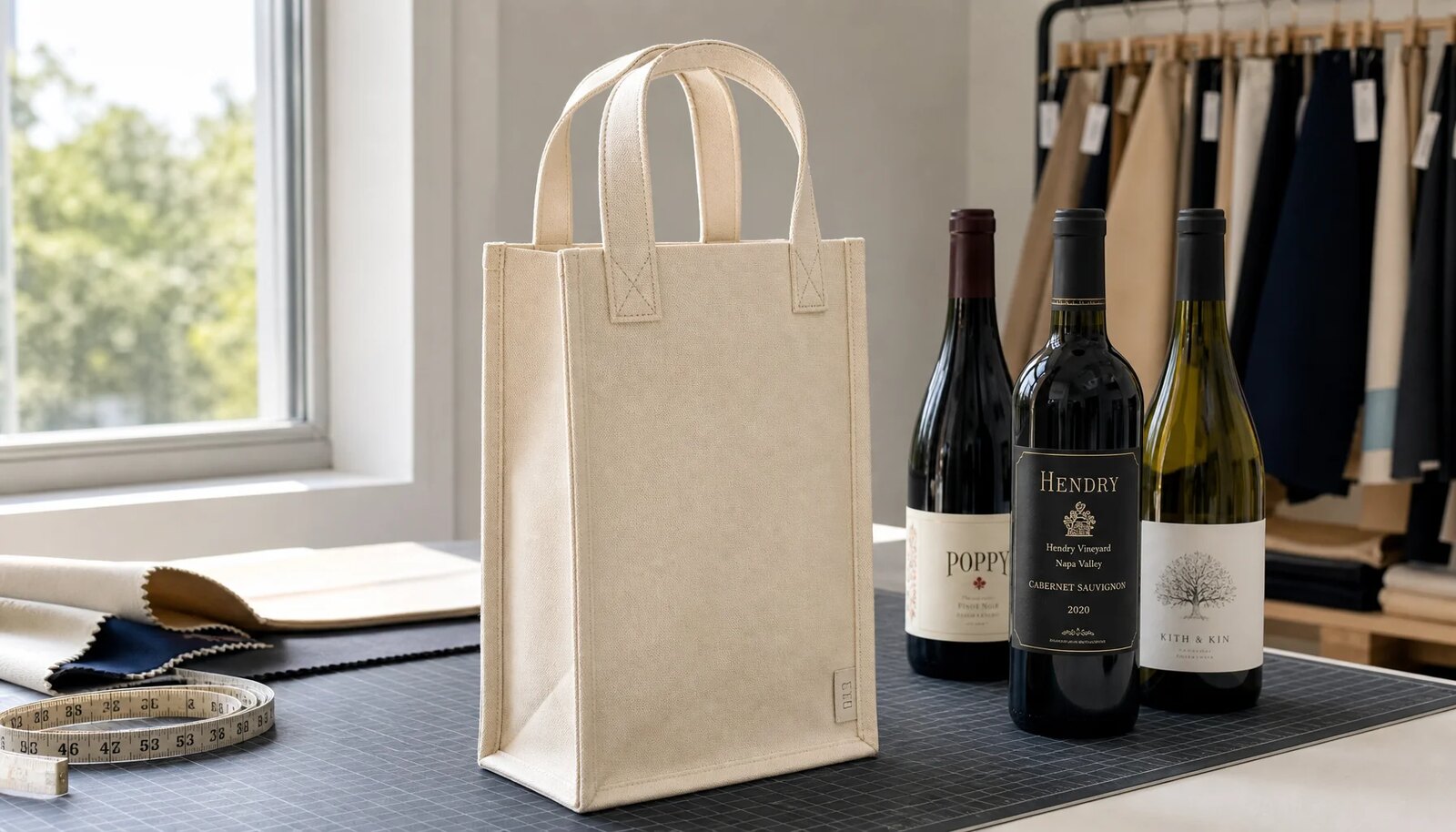
1. Start with the event use case, not the product photo
Canvas wine carriers look simple in a catalog. In event procurement, they are rarely that simple. The same bag may be handed out at a tasting booth, placed in a hotel room, sold in a winery shop, packed into a sponsor gift kit, or presented at a VIP dinner. Each use puts different pressure on the material, the handles, the decoration, and the packing plan.
Start by deciding what the carrier must do after it leaves the factory. If it only moves one bottle from a table to a guest’s hand, a lighter 10 oz canvas with efficient bulk packing may be enough. If the carrier is part of a premium welcome gift or a retail item, buyers usually need a cleaner structure, better shade control, reinforced handles, and more careful packing. The mistake is not choosing light or heavy fabric. The mistake is buying from a photo without matching the construction to the event journey.
Map that journey before the RFQ goes out. Who inserts the bottle? How fast must they work? Will the bottle travel inside the carrier, or are bags shipped empty to a venue? Will staff carry hundreds through a hotel corridor? Will guests walk between locations? The answers affect finished internal dimensions, handle drop, carton quantity, fold method, labeling, and inspection timing. A good canvas wine carrier specification protects both the brand presentation and the operations team that has to use the product under deadline.
- Use a premium specification for VIP gifts, winery clubs, sponsor kits, retail resale, and hospitality programs where the carrier remains part of the brand experience.
- Use a lighter promotional specification for short-duration giveaways, bottle handoffs, sampling events, and programs where carton efficiency is a major cost driver.
- Confirm whether the carrier holds one bottle only, one bottle plus a card, one bottle plus a small accessory, or a larger sparkling bottle.
- Decide whether bags need to be sorted by venue, city, sponsor, artwork version, event date, or gift-kit assembler before the factory quotes packing labor.
2. Bottle fit is the first technical specification
The most common failure is not the canvas. It is the bottle fit. A front-view mockup can look perfect while the real bottle is taller, wider, heavier, or more rounded than the bottle used to make the sample. A standard 750 ml Bordeaux bottle is usually straighter and narrower than many Burgundy or Champagne-style bottles. Sparkling bottles often use heavier glass and wider bodies, which changes both the pattern and the way the loaded carrier hangs.
Give the supplier the actual bottle whenever possible. If that is not practical, provide the maximum expected height, maximum body diameter, shoulder width, base diameter, and approximate filled weight. A filled 750 ml glass wine bottle commonly weighs about 1.2 kg to 1.6 kg, depending on the glass and fill. Some sparkling bottles may be heavier. If the final SKU is not selected, design for the largest likely bottle and accept that smaller bottles may sit with more room.
Finished internal dimensions are more useful than flat pattern dimensions. Seam allowance, side seam bulk, top hems, gusset folds, and thicker canvas all reduce usable space. This matters more with 12 oz canvas and reinforced seams. Review the sample empty, loaded, standing upright, and carried by the handle. If venue staff will insert hundreds of bottles, the top opening needs enough clearance for speed, not just enough clearance to prove the bottle can be forced in.
- Ask for front, side, top-opening, and loaded-standing photos of the sample with the intended bottle inserted.
- Measure usable internal width, height, top opening, and gusset depth after sewing, not only the cut fabric panel.
- For critical fit points, define a realistic tolerance with the factory; many buyers use around plus or minus 5 mm on top opening and gusset when the bottle fit is tight.
- Check whether the carrier still stands upright with the bottle inserted and whether the printed face remains centered.
- Add allowance for tissue, gift cards, hang tags, corkscrews, or inserts before approving the final pattern.
3. Choose canvas weight, GSM, composition, and finish together
For event wine carriers, the practical range is often 10 oz to 12 oz canvas. Ask for both ounces and GSM because suppliers may describe material differently. A 10 oz canvas is commonly around 330-350 GSM, while 12 oz canvas is commonly around 390-420 GSM, depending on yarn, weave, and finishing. Treat those as working ranges, not universal conversions. The quote should also state whether the weight is measured before or after dyeing, washing, coating, preshrinking, or other finishing.
A 10 oz canvas can be the right commercial choice for high-volume handouts. It folds flatter, keeps carton cube lower, and can reduce freight pressure. A 12 oz canvas gives more body and a stronger gift feel, especially when the carrier is unlined and the fabric is the main visual surface. Heavier material is not automatically better. It can create bulky seams, harder folds, pronounced creasing, higher carton weight, and slower sewing. Match the fabric to the event, not to the assumption that more GSM always means more value.
Composition also needs to be written, not implied. A quote that says only “canvas” is incomplete. Buyers may choose 100% cotton for natural handfeel, a recycled cotton blend for internal sourcing goals, or a cotton-poly blend for cost or dimensional behavior. If the event copy, hang tag, or retail label makes sustainability claims, ask for documentation that supports the claim. Natural cotton canvas may show seed flecks, slubs, and lot-to-lot shade variation. Dyed canvas can support brand colors, but it adds lab dip approval, shade tolerance, and colorfastness review.
- 10 oz / about 330-350 GSM: useful for high-volume event distribution, flat packing, and controlled freight costs.
- 12 oz / about 390-420 GSM: better for structured presentation, reusable feel, winery retail, and premium gifting.
- Natural canvas: appropriate for winery, rustic, neutral, or sustainability-led aesthetics, but shade tolerance must be defined.
- Bleached white canvas: cleaner for bright print colors, but more likely to show handling marks, carton dust, and stains.
- Dyed canvas: stronger for brand-color programs, but usually adds lab dip approval, shade risk, MOQ impact, and lead time.
- Washed canvas: softer and more relaxed, but buyers should check shrinkage, dimension stability, and print behavior.
4. Handles are load-bearing parts, not decoration
A full bottle makes the handle the functional center of the product. Guests judge the carrier the moment they lift it. Staff may judge it even faster if they are moving loaded bags in batches. A narrow, soft, or poorly reinforced handle can make an otherwise good bag feel cheap. A weak anchor can pull out under load, creating both a product failure and an event operations problem.
The RFQ should define handle material, width, drop, anchor depth, stitch pattern, thread color, and reinforcement. Same-fabric handles look coordinated, but they add bulk at the attachment point and require clean sewing. Cotton webbing is consistent and practical for larger runs. For a one-bottle carrier, box-X stitching or bar-tacks at each anchor are common ways to distribute stress. Single-row stitching may be acceptable only for a very low-cost, short-use program, and even then it should be checked with a loaded sample.
Handle drop changes both comfort and stability. A shorter hand-carry drop keeps the bottle closer to the hand and may reduce swing. A longer wrist-carry drop can feel convenient, but it may increase movement and stress at the top edge. Width matters too. A very narrow handle can dig into the hand under a 1.2 kg to 1.6 kg load. For events where guests walk through parking areas, hotel lobbies, shuttles, or outdoor venues, handle comfort should be part of approval, not an afterthought.
- Specify handle width in millimeters or inches; avoid relying on a photo because scale can be misleading.
- State handle drop from the top edge of the bag to the top of the handle loop.
- Require box-X stitching, bar-tacks, or a named equivalent reinforcement for premium, reusable, or long-carry programs.
- Check that handle anchors are symmetrical so the loaded bottle does not twist or lean.
- Ask for a loaded hang test using the actual bottle or a weight equal to the heaviest expected bottle.
- For dark webbing on light canvas, check dry rub and packing transfer so handle dye does not mark the bag body.
5. Match the logo method to canvas texture and event timing
Artwork that looks sharp in a PDF may not print cleanly on woven canvas. The surface has texture, absorbency, and small irregularities. Thin sponsor text, fine rules, gradients, and small reversed details are the usual trouble spots. For simple one-color or two-color artwork, screen printing is often the most dependable route. It can give good opacity on natural canvas and scale efficiently, but the buyer should approve a strike-off and define minimum stroke width, minimum text height, print size, and placement tolerance.
Heat transfer and digital transfer are useful when the event requires full-color artwork, short runs, multiple venue versions, or graphics that are too detailed for standard screen printing. The tradeoff is feel and finish. Transfers can look glossier than the surrounding fabric. Poor bonding or rushed packing can cause cracking, lifting edges, adhesive halo, scorch marks, or marks on nearby bags. Ask the supplier to state the transfer type, press conditions, cooling method, and any rub or fold checks before packing.
Embroidery, woven labels, and sewn patches can also work, but they solve different problems. Embroidery can look premium, yet it adds stitch-count cost and may pucker thinner fabric. Woven side labels create subtle branding without covering the front panel. Patches fit winery, heritage, or rustic gift aesthetics, but they add placement and sewing inspection points. If the event has sponsors, confirm whether there is one shared artwork, several sponsor versions, or variable date and location versions. MOQ and packing can change by version.
- Screen print: best for bold marks, simple logos, event dates, sponsor logos, and repeat programs with stable artwork.
- Heat or digital transfer: useful for full-color art and small batches, but inspect edge bonding, gloss, cracking, and packing marks.
- Embroidery: premium on suitable fabric, but confirm backing, stitch count, puckering risk, and added lead time.
- Woven label: good for subtle brand identity, side seams, retail presentation, and minimalist designs.
- Patch: strong for textured gift aesthetics, but placement, edge stitching, and thread color need QC checks.
- Set print placement tolerance before approval; for visible front logos, many buyers target plus or minus 3-5 mm when the construction allows it.
6. MOQ and quote comparison: find the real cost drivers
Two suppliers can quote a canvas wine carrier that looks identical in a photo while pricing very different products. One quote may include 12 oz cotton canvas, reinforced handles, a printed strike-off, individual polybags, carton labels, and destination sorting. Another may use lighter fabric, single stitching, bulk packing, and separate screen charges. Before negotiating price, make every quote answer the same specification.
MOQ is usually driven by fabric availability, cutting efficiency, dyeing, printing setup, trim purchasing, packing labor, and inspection requirements. Natural canvas with one-color screen print is usually easier to source at lower quantities than custom-dyed canvas with special handles, patches, hang tags, and retail barcodes. Multiple artwork versions can also change the economics. The MOQ may apply per total order, per fabric color, per artwork, per size, or per packing destination. If that is not stated, late charges can appear after the event budget is already approved.
Separate product cost from service and logistics cost. When practical, ask for line items: base carrier, print setup, per-unit print cost, woven label or patch, tag, barcode, individual packing, carton labeling, sample fee, inspection support, and export packing. Also ask for the trade term and freight handover point. A lower ex-factory price is not always a lower landed cost if carton cube is larger, packing is incomplete, or destination sorting is excluded.
- Ask whether MOQ is per total order, per fabric color, per artwork version, per size, or per packing configuration.
- Request price breaks at 500, 1,000, 3,000, and 5,000 units using the same construction and packing standard.
- Separate fabric, sewing, branding, trim, packing, sample, inspection, and freight-related charges where possible.
- Clarify whether screen charges, films, plates, strike-offs, and artwork revisions are included or separate.
- For multi-location events, ask whether carton sorting and destination labels are included in the quoted packing labor.
- When a quote is unusually low, check fabric weight, handle reinforcement, print method, sample process, and packing exclusions first.
7. Treat the approved sample as the control record
A sample is more than a sales preview. For canvas wine carriers, it becomes the control reference for fabric weight, shade, handfeel, dimensions, handle strength, stitching, print quality, and packing presentation. If the factory makes a sample from available fabric but plans to use a different bulk fabric, the sample is not a reliable production standard. Any change in fabric lot, color, handle tape, print method, label, or fold method should be documented before mass production.
Use a two-stage sample process when the deadline and order value allow it. The blank sample checks construction: bottle fit, gusset behavior, top opening, handle drop, seam strength, and standing stability. The decorated sample checks artwork size, color, placement, print opacity, curing, label alignment, and fold behavior. A printed strike-off can catch artwork issues before a full sewn sample is made, especially when sponsor logos include small type or brand colors.
Approval notes should be measurable. Instead of writing only “approved,” record the fabric weight, composition, shade reference, finished dimensions, bottle used for fit, handle construction, logo placement, packing method, and accepted tolerances. For important programs, keep one physical approved sample with the buyer, one with the factory, and one available for inspection. Photos are helpful, but they cannot fully show handfeel, seam bulk, structure, or print texture.
- Insert the actual bottle and record whether the fit is easy, snug, or loose.
- Measure finished width, height, gusset depth, top opening, handle width, and handle drop with a ruler.
- Check whether the loaded bag stands upright and whether the print remains visually centered.
- Fold the sample using the proposed packing method and confirm the crease does not damage the logo or distort the handle.
- Rub the print after curing and inspect for ink dusting, tackiness, cracking, transfer, or lifting edges.
- Record approval comments in writing and attach them to the quote, artwork proof, purchase order, and QC checklist.
8. Packing and logistics decide event readiness
Packing is part of the product when the delivery date is fixed. A well-made carrier can arrive looking poor if it is folded inconsistently, over-compressed, mixed across artwork versions, or exposed to carton dust. Decide early whether the carriers ship flat, folded, bulk packed, individually polybagged, tissue wrapped, tagged, barcoded, or pre-sorted. Each choice affects unit cost, carton cube, labor, sustainability profile, warehouse receiving, and venue setup time.
Flat bulk packing is efficient, but the fold location should be approved. Heavy canvas can hold a visible crease, particularly if it is folded through the logo or handle anchor. Individual polybags protect against dust and handling marks, but they add material and unpacking labor. Tissue can improve presentation for VIP gifting, but it only works if cartons are not over-compressed. Hang tags, belly bands, barcodes, sponsor inserts, and retail labels all become bill-of-material items and inspection points.
Multi-destination event programs need carton discipline. A national campaign may require cartons split by city, venue, date, sponsor version, or assembly site. If sorting is not specified in the RFQ, the supplier may quote basic export packing and add labor later. Carton marks should include PO number, item name, artwork version, quantity, destination, carton number, and handling notes where needed. Ask for packed-carton photos before shipment so receiving teams know what to expect.
- Approve the fold method before bulk packing, especially for 12 oz canvas and printed front panels.
- Request carton size, units per carton, gross weight, net weight, and carton mark layout before freight is booked.
- Use printed or clearly formatted destination labels for multi-location events, not informal handwritten marks.
- If there are multiple sponsor or date versions, require carton-level identification and packing list separation.
- For premium programs, evaluate tissue, individual protection, or inner cartons against added cube and unpacking time.
- Ask for final packed-carton photos showing carton marks, opened carton layout, fold method, and any labels or tags.
9. QC inspection should focus on fit, strength, print, and packing
Quality control for canvas wine carriers should be practical, measurable, and tied to event performance. The product is small, so small defects are visible. A front logo that drifts 10 mm can look crooked. A top opening that is slightly narrow can slow down staff filling hundreds of bags. A weak handle may pass a quick visual check but feel unreliable once the bottle is inserted. A useful QC plan turns those risks into inspection points, tolerances, and reject categories.
Set tolerances before production starts. Finished dimensions can often accept some variation, but top opening and gusset depth may need tighter control because they determine bottle fit. Print placement should be measured from fixed references such as the top edge, side seam, or centerline. Handle stitching should be checked for reinforcement pattern, stitch density, skipped stitches, loose threads, thread breaks, and alignment. Natural canvas shade should be compared with the approved sample under consistent lighting, with realistic tolerance for cotton variation.
For larger orders or fixed-date programs, consider both during-production and final inspection. A during-production check can catch wrong fabric weight, wrong handle tape, incorrect logo size, poor curing, or sewing distortion before the full lot is finished. Final inspection should include random carton selection, count verification, packed appearance, carton marks, moisture or odor checks, and comparison to the sealed sample. Inspection timing should leave enough room for rework before the freight cutoff.
- Fabric: check weight, shade, composition if required, odor, stains, slubs, weave consistency, and surface cleanliness.
- Dimensions: measure finished height, width, gusset, top opening, handle drop, and handle width against approved tolerances.
- Stitching: inspect handle anchors, side seams, top hem, gusset corners, thread tension, skipped stitches, loose threads, and seam puckering.
- Load handling: hang with the intended bottle or equivalent weight and watch for handle pullout, seam distortion, and twisting.
- Print: check opacity, registration, placement, curing, cracking after folding, bleeding, pinholes, tackiness, and ink transfer.
- Transfers: check edge bonding, gloss, scorch marks, adhesive halo, lifting corners, and marks from stacking.
- Packing: confirm unit count, fold method, polybag or tissue use, hang tags, labels, carton marks, destination split, and gross weight.
10. Build the RFQ around landed cost and repeat control
A canvas wine carrier may look inexpensive at the unit-price level and still become costly once samples, setup charges, packing labor, carton cube, freight, inspection, and redistribution are included. Compare total delivered cost to the warehouse, venue, or gift-kit assembler. A heavier canvas, individual protection, or destination sorting plan may be worth paying for on a premium event. The key is to show those costs in the landed-cost worksheet instead of discovering them after production.
A strong RFQ separates product specifications from commercial terms. Product details include bottle profile, fabric weight, composition, color, dimensions, tolerances, handle construction, logo method, trim, packing, and QC requirements. Commercial details include MOQ, price breaks, sample fee, setup charges, lead time, payment term, trade term, freight handover point, inspection cost, and document requirements. If a supplier cannot quote a line item, ask them to mark it excluded. Blank spaces make quote comparison unreliable.
For buyers searching for a canvas wine carriers for event planners material selection guide, the workable sourcing sequence is straightforward: lock the bottle first, choose canvas weight based on the event role, specify handle reinforcement for the loaded condition, match the decoration method to canvas texture, approve a physical sample, define measurable tolerances, and inspect packing before shipment. That process does not overcomplicate the product. It makes supplier quotes comparable and keeps a simple event item from becoming an event-day problem.
- Compare quotes using the same bottle fit, fabric weight, composition, dimensions, handle reinforcement, logo method, packing, and QC requirements.
- Ask suppliers to identify inclusions and exclusions for screens, films, strike-offs, samples, trims, tags, barcodes, carton marks, sorting, and export packing.
- Calculate freight from carton dimensions and gross weight, not only unit quantity.
- Check whether a lower price is coming from lighter fabric, simpler stitching, fewer print colors, looser tolerances, or reduced packing.
- Build landed cost with samples, production, setup, packaging, inspection, freight, duties where applicable, warehouse receiving, and event redistribution.
- Keep repeat-order notes so the next event can reuse the approved construction instead of restarting from a product photo.
Specification comparison for buyers
| Spec decision | Recommended option | When it fits | Buyer risk to check |
|---|---|---|---|
| Bottle profile | Approve the carrier against the actual bottle or the largest expected 750 ml profile before bulk cutting | Wine tastings, wedding welcome gifts, winery retail, sponsor dinners, hotel room drops, and corporate hospitality programs | Bordeaux, Burgundy, Champagne, sparkling, and some local bottles vary in diameter, shoulder, height, and weight; a sample approved on the wrong bottle can be tight, short, unstable, or slow for venue staff to fill |
| Internal fit | Request finished internal measurements after sewing, including top opening, usable width, height, and gusset depth | Any program where staff insert bottles at speed or where bottle SKUs may change close to the event | Flat pattern dimensions are not usable space; seam bulk, top hems, gusset folds, and heavy canvas reduce clearance |
| Fabric weight | 10 oz canvas, approximately 330-350 GSM depending on construction and finish | High-volume event giveaways, short-use carrier programs, tighter freight budgets, and flat bulk packing | Loose weave or underweight fabric can collapse, wrinkle sharply, show bottle contours, and reduce perceived value |
| Fabric weight | 12 oz canvas, approximately 390-420 GSM depending on construction and finish | VIP gifting, winery retail, corporate hospitality, reusable merchandise, and premium sponsor kits | Heavier fabric increases carton cube and can hold hard creases if folded through the logo, top hem, or handle area |
| Fabric composition | 100% cotton canvas, cotton-recycled cotton blend, or cotton-poly blend stated on the quote and invoice | Programs with sustainability language, retail labels, internal sourcing review, or material compliance requirements | Unstated blends can create labeling, claim, handfeel, shrinkage, or dye-behavior problems |
| Fabric color | Natural canvas with an approved shade range, or dyed canvas with lab dip and bulk shade tolerance | Natural winery aesthetics, neutral hospitality programs, and brand-color event merchandise | Natural cotton is not optic white and can vary by lot; dyed lots need colorfastness review and shade control |
| Handle construction | Cotton webbing or same-fabric handles with box-X stitch, bar-tack reinforcement, or a named equivalent at each anchor | Any carrier expected to hold a full glass bottle during walking, reception, shuttle, hotel, or retail use | Single-row stitching, narrow tape, or shallow anchor depth can twist, pull, tear, or feel uncomfortable under load |
| Logo method | 1-color or 2-color screen print with approved strike-off and placement tolerance | Bold logos, event dates, sponsor marks, repeat corporate programs, and natural canvas surfaces | Fine lines can fill in on textured canvas; buyers should set minimum stroke width, minimum text height, and allowed placement variance |
| Logo method | Digital transfer or heat transfer with bonding, rub, fold, and packing checks | Full-color artwork, small MOQs, multiple event versions, or short lead times | Transfer film can shine, crack after folding, lift at edges, scorch fabric, or mark adjacent bags if stacked warm |
Buyer checklist before sampling
- Confirm the exact bottle profile before pattern approval: Bordeaux, Burgundy, Champagne-style, sparkling, magnum, half bottle, or a local winery bottle may require different height, width, gusset depth, top opening clearance, and load testing.
- Classify the use case before choosing materials: one-time event handout, VIP gift, winery retail item, sponsor kit, hotel room-drop amenity, or reusable branded merchandise.
- Specify fabric weight in both ounces and approximate GSM, and ask whether the value is measured before or after dyeing, washing, coating, preshrinking, or finishing.
- State fabric composition clearly: 100% cotton, recycled cotton blend, cotton-poly blend, or another material, especially if retail labeling or sustainability language will be used.
- Define finished external dimensions and usable internal dimensions separately, including height, width, gusset depth, seam allowance, top opening width, handle width, and handle drop.
- Set realistic tolerances before sampling: for many sewn canvas bags, buyers commonly define finished dimension tolerances around plus or minus 5 mm for critical fit points and plus or minus 10 mm for less critical external dimensions, but the supplier should confirm what is achievable for the construction.
- Choose handle reinforcement for the loaded condition, not the empty sample photo; a 750 ml glass wine bottle commonly weighs about 1.2 kg to 1.6 kg depending on bottle weight and fill.
- Approve logo size, color reference, placement from top edge and side seams, minimum line thickness, minimum text height, and placement tolerance before the pre-production sample.
- Ask whether the print quote includes all colors, screens, films, plates, curing, strike-offs, artwork adjustment, label application, and rejected print allowance.
- State whether carriers ship flat, folded, bulk packed, individually polybagged, tissue wrapped, tagged, barcoded, pre-kitted, or sorted by event location or artwork version.
Factory quote questions to send
- What exact canvas weight are you quoting in ounces and GSM, and is that measurement taken before or after dyeing, washing, coating, preshrinking, or other finishing?
- What is the fabric composition, yarn type if known, weave style, and recycled content if claimed, and can those details appear on the proforma invoice or product specification sheet?
- Which bottle profile did you use for the pattern, and can you test the sample with our actual bottle or with a bottle of the maximum height and diameter we specify?
- What are the finished external dimensions and the finished internal usable dimensions after sewing, including height, width, gusset depth, top opening width, handle width, and handle drop?
- What finished-dimension tolerance are you quoting for this construction, and which dimensions are considered critical for bottle fit?
- What handle reinforcement is standard: single stitch, double stitch, box-X, bar-tack, rivet, extra fabric patch, or another method, and what thread type or stitch density do you use at the anchor?
- Can you perform a loaded hang test using at least the intended bottle weight, and can you share the method, duration, and result in the sample approval record?
- Which print method is included, how many colors are covered, what is the maximum print area, and what setup, screen, film, plate, strike-off, or artwork adjustment charges are separate?
- For screen printing, what minimum line thickness, minimum text height, registration tolerance, curing method, and print placement tolerance do you recommend on this fabric?
- For transfer printing, what film type, press temperature and dwell range, cooling method, rub test, fold test, and packing precautions do you use to reduce peeling or marking?
Quality-control points to confirm
- Fabric weight should be checked against the approved sample and specification within an agreed tolerance; if the bulk lot feels materially thinner, production should pause for written approval before cutting continues.
- Fabric composition, weave density, color shade, odor, surface cleanliness, stains, slubs, and roll-to-roll variation should be reviewed before cutting, especially on natural canvas where shade and seed flecks are visible.
- Finished dimensions should be measured empty and with the intended bottle inserted; top opening width, usable internal width, height, and gusset depth are critical because they control fit and filling speed.
- Handle attachment should match the approved reinforcement method with no skipped stitches, loose threads, broken threads, twisted tape, shallow anchor depth, or seam tearing under a loaded check.
- Load testing should use the intended bottle or an equivalent weight; inspection should watch for handle pullout, seam distortion, top hem stretching, and uncomfortable handle twisting.
- Top edge finishing should be flat and even, with no raw edges, fraying, puckering, uneven folding, or distorted hem that makes the carrier look crooked when upright.
- Side seams and gusset seams should sit straight enough that the loaded bottle stands upright and the printed face does not rotate visibly around the bottle.
- Print placement should remain within the approved tolerance from the top edge, side seam, and centerline; large event logos and sponsor marks should not drift visibly between cartons.
- Screen print ink should show even opacity without pinholes, heavy bleeding, misregistration, cracking after folding, poor curing, tackiness, odor, or ink transfer onto adjacent bags.
- Transfer print edges should be fully bonded with no lifting corners, excessive gloss difference, scorch marks, adhesive halo, cracking after fold checks, or marks caused by stacking before cooling.