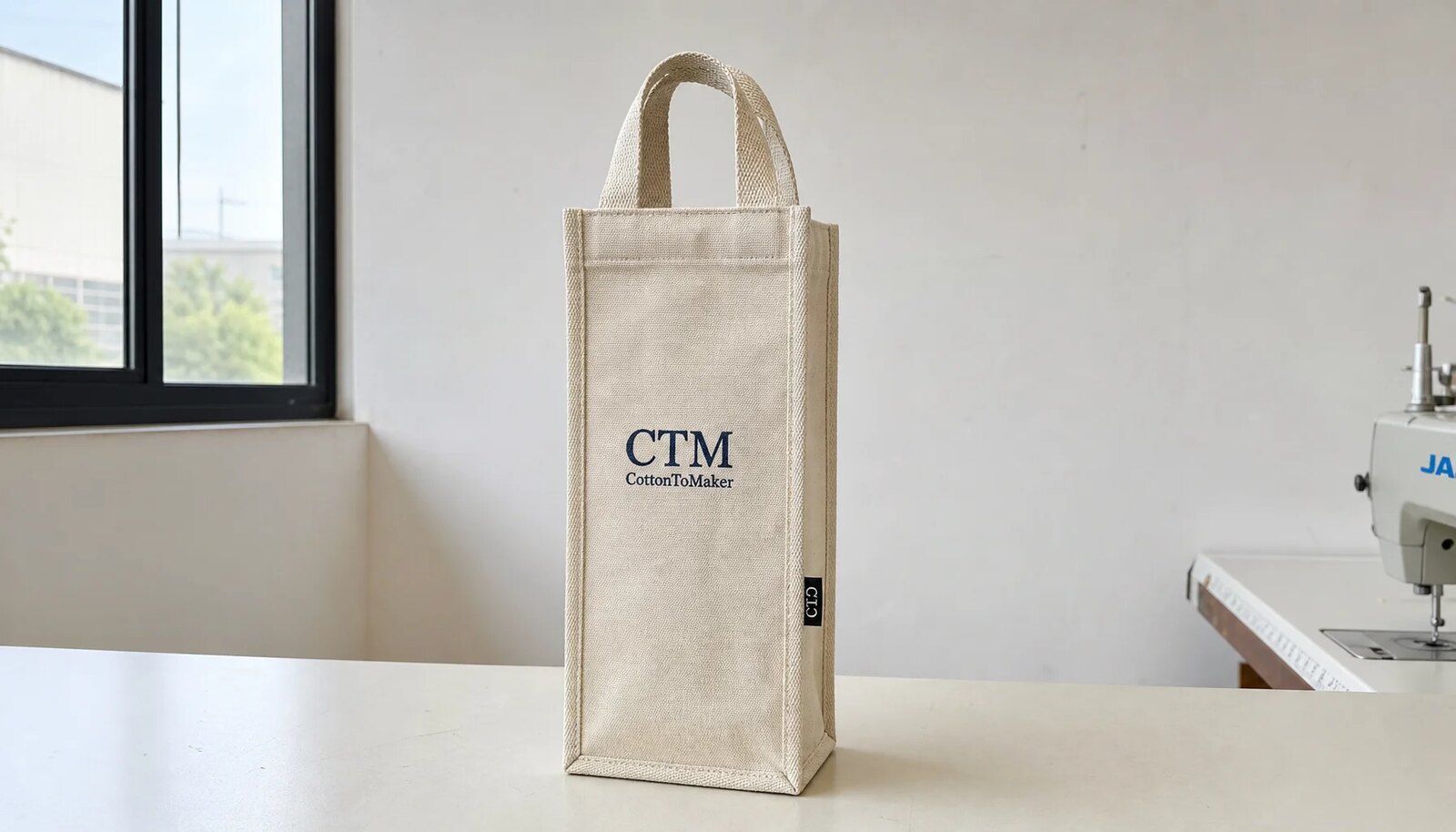
Start With the Bottle, Not the Artwork
Logo placement on canvas wine carriers looks simple in a PDF. In production, the bottle decides more than the artwork does. A standard 750 ml wine bottle, a champagne bottle, a mini bottle, and a tall specialty bottle load the bag differently. Height changes where the neck reaches. Base diameter changes side tension. Weight changes how the handle pulls the front panel. A logo that looks centered on an empty sample can tilt or wrinkle once the carrier is filled.
For event planners and procurement buyers, the first specification should be the bottle fit. Give the supplier the bottle height, base diameter, and any unusual shoulder profile. If the carrier must fit several bottle types, say so at RFQ stage, because a universal size often means a wider gusset, taller body, or longer handle drop. If the bag will be pre-packed with tissue, a gift card, neck tag, or product insert, the opening needs extra clearance and the front panel may sit differently.
Think through the moment of use. Will staff hand out the carrier empty at a gala check-in desk? Will it sit loaded on a banquet table? Will it ship with a bottle already inside? Each scenario changes the stress points. The logo should stay away from areas that bend most: the top hem, handle bartacks, side seam curve, bottom fold, and any divider seam. On a single-bottle carrier, the front panel is usually the best branding area. On two-bottle carriers, the usable logo zone can be much smaller than the front face suggests.
- Confirm bottle type before confirming artwork: 750 ml wine, champagne, sparkling wine, magnum, half bottle, mini bottle, or mixed use.
- Provide bottle height and base diameter instead of using only the phrase wine carrier.
- Ask the factory to photograph the sample with the intended bottle inside before logo approval.
- Define the logo panel as a measured flat zone, not as the whole front of the bag.
- State whether the carrier will be empty, pre-packed, tissue-wrapped, tagged, or displayed upright at the event.
Draw the Logo Placement Zone
A useful logo placement guide removes guesswork. The phrase centered on front is not enough for a narrow canvas wine carrier. Procurement should provide a dimensioned layout showing print width, print height, horizontal centerline, distance from the finished top hem, distance from side seams, and distance from the bottom fold. When the logo appears on both sides, the file should say whether side two is identical, adjusted, or excluded from the same tolerance standard.
The safest front-panel position is usually centered horizontally, high enough to read when the bag sits on a table, and low enough to clear handle stitching. That sounds obvious until the carrier is sewn. Seam allowance reduces the visible panel. Curved side seams narrow the flat area. A boxed bottom can pull the lower front panel backward. Buyers should ask for the maximum flat print area on the finished bag, not just the panel size before sewing.
Logo size should match the viewing environment. Sponsor logos for event photos often need bold, one-color front placement. Retail programs may need a quieter woven side label so the carrier feels giftable rather than promotional. Corporate gifting may use both: a clean front print plus a small woven label for repeat brand recognition. Each approach needs its own tolerance. A side-seam label that is a few millimeters crooked can look worse than a larger screen print that shifted slightly but stayed level.
- Specify placement in millimeters from finished seams, hem, fold, or centerline.
- Approve a finished-bag artwork proof, not only a flat panel proof.
- Keep decoration away from handle bartacks, top hem bulk, side folds, and the bottom crease.
- For two-sided printing, state whether both sides use the same logo size and placement.
- For woven labels, approve label size, fold type, seam distance, label orientation, and exposed edge finish.
Specify Canvas Weight and Hand Feel
Canvas weight affects cost, structure, print performance, carton weight, and how premium the carrier feels in hand. A light 10 oz canvas, often around 340 gsm depending on mill and finish, can work for short-life event giveaways where budget and speed matter most. A 12 oz canvas, often around 410 gsm, is a practical middle ground for many reusable wine carrier programs because it has enough body for gifting while still sewing cleanly. A 14 oz canvas, often around 475 gsm, feels heavier and more retail-ready, but it can slow sewing and add freight cost.
Buyers should be precise about how weight is measured. Greige weight, finished weight, washed weight, dyed weight, coated weight, and laminated weight can differ. Two suppliers may both quote 12 oz canvas while delivering noticeably different hand feel. Ask for the canvas weight in oz and GSM where possible, then approve a physical swatch or sample bag. If the program includes reorders, record the weave, color, finish, and supplier description in the buying file.
Natural canvas is popular for wine carriers because it supports a clean event or gifting look, but it is not perfectly uniform. Small cotton flecks and weave variation are normal unless the buyer specifies a cleaner finish. Dyed canvas adds brand color options, yet it raises color consistency questions across fabric lots. Coated or laminated canvas may improve structure or wipeability, but it can change print adhesion and folding behavior. The right choice is the one the supplier can repeat, not merely the one that looks best in a mockup.
- Use 10 oz canvas for budget-driven, short-life event programs where lower cost is the main priority.
- Use 12 oz canvas for balanced structure, repeat handling, and reliable screen print performance.
- Use 14 oz canvas for premium gifting or retail programs after confirming sewing, decoration, carton weight, and lead time.
- Ask whether quoted weight is greige, finished, washed, dyed, coated, or laminated.
- Keep an approved fabric swatch with the signed pre-production sample for reorder control.
Lock Construction Before Pricing
Construction choices can change the logo area as much as the artwork does. An unlined carrier with a folded top and boxed bottom is efficient and common for straightforward event programs. A lined carrier looks more finished and may protect the bottle better, but extra seam layers can make the opening thicker and alter how the front panel lies. A divider, bottom board, inside binding, padded insert, or reinforced base adds structure and perceived value. It also adds sewing operations, inspection points, and cost.
Handles deserve close attention. Cotton webbing, self-fabric handles, rope handles, and reinforced cutout handles all pull on the bag differently. A short handle may make the loaded carrier press against the bottle neck. A long handle can swing more during guest handout. Handle bartacks should sit outside the print zone and should not cause visible puckering on the front panel. If a buyer approves logo placement before handle position is final, the decoration may land too close to stress points.
The RFQ should describe the finished carrier, not just canvas plus logo. State whether the bag is unlined or lined, whether the base is boxed, reinforced, or supported by a board, and whether the carrier includes a divider. For procurement teams comparing several suppliers, these details keep quotes honest. A cheaper quote may simply be assuming a simple side seam where another supplier priced a reinforced base.
- Define unlined, lined, laminated, divider, bottom board, boxed bottom, simple side seam, or reinforced base construction.
- Specify handle material, webbing width, handle length, handle drop, and attachment method.
- Keep handle bartacks clear of the logo area and include them in the placement drawing.
- Ask whether the carrier is printed before sewing or after sewing, because that affects placement tolerance.
- Require the sample to stand, hang, and load in the same way the production bag should.
Match Decoration to the Artwork
Decoration should follow the artwork and the use case. Screen print is usually the most practical option for canvas wine carriers when the mark is bold, flat, and built from one to three solid colors. It gives strong visibility on a narrow panel and can be cost-efficient at volume. Still, textured canvas can break fine lines, and natural fabric can affect opacity. Test the exact ink on the exact canvas before approving a large production run.
Embroidery can feel premium, but it is not always the best answer. Dense stitching on a narrow wine carrier may pucker the panel, add stiffness, and distort the front face. It works best for small marks, monograms, patches, or low-stitch-count designs. Woven labels are useful when the buyer wants durable branding without a large front print. A side-seam woven label can look clean and retail-friendly, provided the label is straight and the seam distance is controlled.
Heat transfer and digital transfer help when artwork has fine detail, multiple colors, or sponsor marks that cannot be simplified. The risk is surface feel and durability. Transfers can look glossy on matte canvas, lift on heavy texture, or crack near a bend. If a transfer is required, request a strike-off on the actual production canvas. Bend it, rub it, load the bag, and check the edge before approval. A decoration method is only successful if it survives the way the carrier will actually be handled.
- Choose screen print for bold logos, strong visibility, and controlled unit cost.
- Choose woven labels for small durable branding, side labels, retail programs, or understated sponsor marks.
- Choose embroidery when stitch density is low enough to avoid puckering and panel distortion.
- Choose transfer printing for detailed or multi-color artwork only after adhesion and flexibility testing.
- Ask whether decoration is handled in-house, by a nearby partner, or by a separate decorator.
Build an RFQ That Quotes Cleanly
A strong RFQ makes supplier quotes comparable. A weak RFQ lets each supplier fill in missing details differently, and that is how the cheapest quote becomes expensive later. For canvas wine carriers, include finished dimensions, canvas weight, canvas color, construction, handle type, logo method, print size, logo placement measurements, number of colors, packing method, carton requirements, sample stages, lead time, and inspection expectations.
Separate one-time costs from recurring unit costs. Screens, artwork setup, woven label tooling, embroidery digitizing, transfer setup, sample fees, insert cards, barcode labels, and custom packing materials should not disappear inside a vague unit price. This is especially important when comparing a trial order with a repeat order. It also helps when a sponsor changes from one-side printing to two-side printing after the first quote.
Ask the supplier to state what will trigger a revised quote. Moving a logo a few millimeters may be simple if the same jig can be used. Enlarging the print, adding a second side, switching to a woven label, changing from bulk pack to individual pack, or moving from standard wine to champagne size can affect cost and timing. Put those decision points in writing before the purchase order is placed.
- Include finished bag dimensions, reference bottle dimensions, and construction details in the RFQ.
- Attach vector artwork plus a placement diagram with print size and seam distances.
- Ask suppliers to itemize screens, labels, digitizing, sample fees, packing materials, and barcode application.
- Require quote assumptions for MOQ, lead time, packing, carton count, and decoration method.
- Ask each supplier to quote the same base version first, then list optional upgrades separately.
Choose the Right Sourcing Route
The best sourcing route depends on volume, urgency, customization, and control needs. A direct factory is usually the strongest option for stable repeat orders because cutting, sewing, decoration, and packing can be managed against one approved specification. For 500 pieces and up, with one canvas color and one logo position, direct production often gives better repeatability and cleaner cost visibility.
A trading company can be useful when the program includes several SKUs or when one buyer needs wine carriers, bottle pouches, tote bags, and retail packaging under one shipment plan. The tradeoff is visibility. Ask which parts are made in-house, which parts are subcontracted, and how the approved sample is communicated to each production site. If the trader changes factories between orders, canvas hand feel, label quality, or logo position may shift while the item description stays the same.
Regional decorators and domestic converters can be the right choice for urgent events, low-MOQ sponsor gifts, or market tests. They may decorate existing blank carriers instead of producing a fully custom bag. Timing improves, but choices narrow. Canvas weight, handle color, carrier dimensions, and print area may be limited to stock options. That may be acceptable for a one-off event. For a repeat procurement program, decide when the item should move to a direct production spec.
- Use direct factory sourcing for repeat volume orders with fixed specifications and stronger control.
- Use a trading company when several related products need coordinated sampling and shipment timing.
- Use regional decoration for urgent events, trials, or low MOQs where stock blanks are acceptable.
- Ask where decoration happens and who controls the artwork placement jig.
- For reorders, require confirmation of the same factory, canvas source, trim, screen, and packing method.
Approve Samples Like Production Evidence
A sample should prove the production method, not just the look of one hand-made piece. For canvas wine carriers, sample approval should include the finished fabric, handle, decoration, label, construction, and packing. Review it empty, loaded with the target bottle, and viewed from the angle guests or shoppers will see. This catches tilting, panel stretch, handle imbalance, print distortion, and label placement issues before the full run starts.
Name each sample stage clearly. A proto sample may confirm shape and dimensions while using substitute fabric or temporary decoration. A strike-off may confirm ink color and print behavior on canvas but not the finished sewn bag. A pre-production sample should represent the approved production standard. A packing sample should show folding, polybag, insert card, barcode sticker, carton label, and master carton method. When those stages are blurred, buyers may approve one thing while factories produce another.
After the pre-production sample is approved, manage changes tightly. Moving the logo, resizing the mark, changing canvas weight, changing handle tape, adding a woven label, or adding retail packaging can require a revised sample. Even a small visual change may affect production if printing happens before sewing or if the placement jig was built for the previous position. Keep one signed reference sample with the buyer and one at the factory, both dated and tied to the purchase order.
- Review the sample flat, upright, hanging, and loaded with the intended bottle.
- Measure print placement from top hem, side seams, bottom fold, and centerline with a ruler.
- Approve the actual decoration method, not only a digital rendering or paper mockup.
- Keep a sealed pre-production sample as the standard for mass production inspection.
- Require written reapproval if logo, fabric, handle, construction, label, or packing changes after sign-off.
Set QC Tolerances Before the Line Runs
Quality control is easier when the limits are measurable before production. For logo placement, state the acceptable tolerance in millimeters from the approved position. A narrow wine carrier has less visual forgiveness than a large tote. A small shift can look obvious because the front panel is slim. Define whether the tolerance is measured from the centerline, top hem, side seam, bottom fold, or label edge.
Sewing QC should cover more than loose threads. Handle bartacks need to be strong and consistent because a loaded bottle stresses those points. Inspect stitch density, seam allowance, top hem width, bottom shape, side seam alignment, and thread trimming across cartons. The carrier should hang straight when loaded, and the base should stay square enough to stand or present cleanly. Twisting under weight may point to cutting misalignment, uneven sewing tension, or a drifting bottom panel setup.
Decoration QC should include print opacity, edge sharpness, ink cure, transfer adhesion, embroidery puckering, and woven label straightness. Natural canvas may absorb ink unevenly. Dyed canvas can change the perceived brand color. State whether color is checked against Pantone, a physical swatch, or the approved sample. A practical inspection should include handling: insert a bottle, lift the carrier, inspect the print area, and check whether seams and handles remain stable.
- Set logo placement tolerance in millimeters and define the measurement reference.
- Inspect finished dimensions, handle drop, gusset width, base shape, and loaded balance.
- Check print opacity, registration, edge quality, cure, and surface marks on the final sewn product.
- Check bartacks, skipped stitches, seam allowance, thread trimming, and side seam alignment.
- Pull-test or loaded-lift test samples from the production lot according to buyer risk level.
- Require first-line photos or video before full production when the event date leaves little room for rework.
Plan Packing, Freight, and Reorders
Packing should match how the carriers will be received and used. For an event, cartons may need to be marked by venue, sponsor, table number, or distribution wave. The carriers may be bulk packed if staff will load bottles onsite, but the cartons still need to protect the logo from rubbing and dust. For retail, each unit may need an individual polybag, swing tag, insert card, barcode sticker, country-of-origin label, and SKU-specific carton mark.
Canvas can wrinkle, absorb moisture, and pick up lint or dye transfer if packed poorly. A large front print can rub against another bag when units are compressed. A side label can fold backward if the carrier is bundled at the wrong angle. If the product must look clean on a premium event table, ask whether it will be folded, pressed, tissue-wrapped, or packed upright. If it must move through a warehouse, confirm carton count, carton dimensions, gross weight, and carton label format before freight is booked.
Lead time often depends on details outside sewing. Artwork revisions, screen making, woven label lead time, fabric dyeing, packing materials, sample shipping, inspection, and freight can all become the critical path. Build the schedule backward from the event date or retail in-stock date. For reorders, keep the approved sample, spec sheet, artwork file, inspection notes, and packing photos together. The next buyer should be able to repeat the program from evidence, not memory.
- State whether packing is bulk-packed, event-ready, retail-ready, or warehouse-ready.
- Approve folding direction so the logo is not creased across the main print area.
- Request carton dimensions, carton count, gross weight, and recommended pallet pattern before shipment.
- Match barcode stickers, SKU labels, purchase order numbers, and carton marks to the receiving format.
- For multi-venue events, require carton labels showing destination, design, quantity, and inner pack count.
- For reorders, confirm the same canvas spec, handle tape, decoration method, placement file, and packing plan.
Specification comparison for buyers
| Spec decision | Recommended option | When it fits | Buyer risk to check |
|---|---|---|---|
| Lowest landed cost on a stable repeat order | Direct factory with one sewing line and one-color screen print | 500 pcs and up, one bag size, one logo position, predictable replenishment | Artwork freeze, fabric weight, handle tape, and packing method must be locked early or the quote can change after sampling |
| Simple logo on natural canvas | Direct factory using screen print or woven label | Flat artwork, solid brand mark, no gradients, standard 12 oz canvas, single front panel placement | Ink opacity, print registration, and logo centering can drift if the print jig is not controlled on the finished panel |
| Multi-color artwork or small text | Factory with heat transfer support or a managed transfer station | Brand programs that need fine detail, tight typography, or multiple spot colors on a short event timeline | Transfers can crack, lift, or look glossy if pressure, temperature, and canvas texture are not tested on the actual fabric |
| Low MOQ trial order | Domestic decorator or regional converter | 100 to 300 pcs for market testing, sales kits, sponsor gifting, or a one-off event | Unit cost rises quickly and reorder consistency can suffer if the next batch uses a different blank carrier |
| Mixed SKU program across several bottle carrier styles | Trading company coordinating multiple factories | One buyer needs single-bottle carriers, two-bottle carriers, bottle pouches, tote extensions, and matching gift packaging | Spec drift and margin opacity can hide changes in canvas weight, handle tape, logo method, or packing source |
| Retail-ready packing and barcode labels | Direct factory with in-house packing or a factory-managed 3PL handoff | Orders needing swing tags, barcode stickers, inserted cards, SKU labels, carton marks, and warehouse-ready master cartons | Mix-ups happen when packing instructions are not tied to a final SKU-level packing list and approved carton label |
| Tight event deadline | Regional supplier with stock canvas, stock handles, or pre-cut panels | Short lead programs where delivery matters more than custom trim, custom dyeing, or unusual structure | Color, canvas weight, handle length, and logo area choices are narrower, so the buyer must accept fewer spec options |
| Compliance-sensitive buyer file | Direct factory able to provide test reports, traceable material records, and inspection records | Retail, distributor, hospitality, or corporate accounts that need documented materials and repeatable QA across reorders | Paperwork can look complete while the actual production lot varies from the approved sample unless lot-level checks are required |
Buyer checklist before sampling
- Lock the bottle size first: standard 750 ml, champagne height, mini bottle, magnum, or tall specialty bottle changes carrier height, depth, handle drop, and logo balance.
- State finished carrier dimensions in width, height, gusset, handle length, handle drop, and print zone; do not rely only on a product photo or generic wine bag description.
- Specify canvas weight in oz and GSM where possible, and state whether the weight is greige, finished, washed, coated, laminated, or measured after dyeing.
- Define body construction: unlined, lined, divider, bottom board, reinforced base, inside binding, boxed corners, folded top hem, or simple side seams.
- Place the logo on a flat measured panel with margins from seams, top hem, handle stitching, side folds, and bottom fold so decoration is not distorted under load.
- Choose the print method based on artwork complexity and use case: screen print for bold art, woven label for durable small marks, embroidery for controlled texture, transfer only when detail requires it.
- Provide vector artwork, Pantone references, print size, placement distance, orientation, and whether the same logo appears on one side, both sides, or a side label.
- Define the acceptable sample standard before mass production: logo position tolerance, color tolerance, stitch quality, handle symmetry, loaded-bottle balance, and carton labels.
- Ask for the actual packing method in the quote: folded or upright, individual polybag, tissue, insert card, barcode sticker, master carton count, carton dimensions, and gross weight.
- Get a photo or short video of the first production unit with a loaded bottle before the line runs at full speed if the order is time-sensitive.
Factory quote questions to send
- What finished carrier dimensions are you quoting, including width, height, gusset, bottom construction, handle length, handle drop, and usable logo area?
- What canvas weight, weave, and finish are included, and is the weight measured before or after washing, coating, dyeing, or lamination?
- Which decoration method is included in the price, how many print colors are included, and what is the maximum print area before seam distortion or cost changes?
- Where exactly is the logo placed on the bag, and what tolerance do you hold for placement shift from the approved artwork and finished seam line?
- Can you provide a dimensioned artwork layout showing print size, distance from top hem, distance from side seam, bottom clearance, and centerline reference?
- What is the MOQ by bag color, canvas weight, print method, label type, handle color, and packing configuration if we need retail-ready units?
- What sample stages are included: proto sample, strike-off, pre-production sample, production reference sample, and packing sample, and is there a fee for each?
- What is the standard lead time after artwork approval, and what part of the schedule changes if we revise the handle, lining, divider, label, or packaging?
- What carton size, carton pack count, inner pack method, and master carton gross weight do you recommend for this carrier size and decoration method?
- What inspection records, material traceability, production photos, first-line approval images, and final packing photos can you provide before shipment?
Quality-control points to confirm
- Canvas weight should stay within the agreed tolerance band and match the approved hand feel across the whole lot, not only the top sample in a carton.
- Finished dimensions should match the approved size after sewing and pressing, with width, height, gusset, handle drop, and bottom shape checked separately.
- Logo position should land within the agreed millimeter tolerance from the seam, hem, centerline, or fold on every visible side of the carrier.
- Print edges must be clean, opaque, and free of pinholes, smearing, ghosting, heat marks, or ink buildup at the fold line and canvas texture peaks.
- Pantone or approved color standard should be checked under consistent lighting, especially for dark ink on natural canvas or light ink on dyed canvas.
- Stitch density, seam allowance, and bartacks at handle attachment points should be consistent, with no skipped stitches, loose thread tails, or weak backtacking.
- Handle length and symmetry should be even so the carrier hangs straight when a loaded bottle is placed inside.
- Bottom panel and side seams should stay square under load; twisting, leaning, or base sag is a sign that cutting, folding, or sewing setup drifted.
- Label placement should match the approved height and seam distance, with no crooked woven labels, loose corners, or exposed raw label edges.
- Color consistency should match the sealed sample under daylight and factory lighting, especially for dyed canvas, contrast handles, binding, or printed trims.