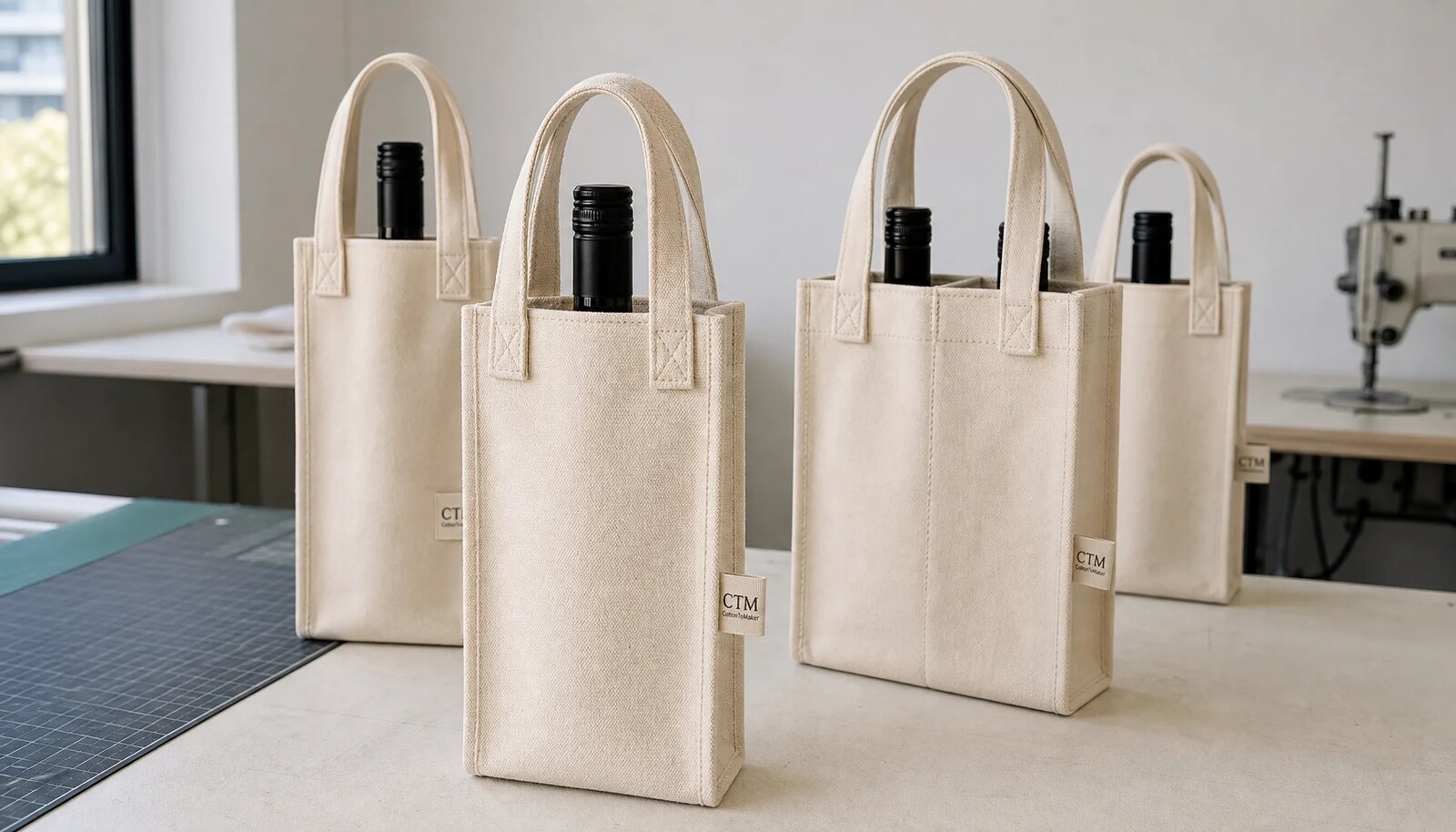
Begin With the Event Workflow, Not the Bag Photo
Canvas wine carriers look simple in a catalog, which is exactly why many bulk orders start with too little information. For an event planner, hospitality buyer, or procurement team, the carrier has to survive a chain of handling steps before a guest ever sees it. It may be received by a warehouse, split by destination, staged behind registration, loaded by venue staff, placed on tables, sold at a tasting room counter, or shipped as part of a gift kit. The right canvas wine carriers for event planners bulk pricing plan starts with that workflow.
Write down the path of the carrier in plain operational terms. Will staff load 800 bottles during a narrow venue setup window? Will the bags sit upright as place settings? Are they packed before arrival at the hotel, or filled on site? Will sponsors provide different bottle shapes at the last minute? A table favor can use a lighter construction than a VIP two-bottle gift that guests carry through a parking lot. A room-drop amenity may need cleaner folding and carton allocation. A retail program may need barcodes, hang tags, and stricter presentation control.
This early work also prevents pricing confusion. A supplier quoting a one-bottle open-top sleeve from stocked natural canvas is not quoting the same product as a supplier pricing a two-bottle divided carrier with a patch, snap closure, and retail packing. Before asking for bulk pricing, define the use case, bottle list, branding level, packing route, and delivery deadline. Those details turn a vague promotional item into a product a factory can measure, sample, sew, inspect, and ship against.
- Name the exact use case: check-in gift, table favor, room drop, tasting room, retail resale, VIP package, trade-show sponsor gift, or direct-to-guest shipment.
- Map who handles the carriers at each step: supplier, freight forwarder, warehouse, hotel, venue staff, sales team, or guest.
- Confirm whether bags are filled at the factory, at a warehouse, at the venue, or by a third-party kitting team.
- Decide whether presentation, load strength, fast loading, carton allocation, or retail labeling is the top priority.
- Use the workflow to decide which specs are mandatory and which styling details are optional.
Build the Bottle List Before You Build the Pattern
A 750 ml bottle is not one shape. Bordeaux bottles are usually straighter and narrower. Burgundy bottles tend to be wider with sloped shoulders. Riesling bottles can be taller and slimmer. Sparkling wine and Champagne bottles are often wider, heavier, and more demanding at the base and shoulder. Olive oil and specialty sponsor bottles add another layer of variation. If the supplier quotes from a generic wine tote size, the fit may work for one bottle and fail for the actual program.
Give suppliers measured bottle data, not only bottle names. The useful numbers are total bottle height, maximum body diameter, base diameter, shoulder profile, and filled bottle weight. If labels must remain visible above the carrier, state the required exposed label height. If the bag should cover most of the label for a cleaner gift look, say that too. For mixed-bottle events, provide the largest and smallest expected bottle profiles. A good fit spec protects both ends of the range: the large bottle should load without forcing, and the slim bottle should not lean or rattle so much that the presentation looks careless.
Fit also affects labor. A carrier that is technically large enough may still be slow to load if the opening is tight, the shoulder catches the top hem, or the divider collapses into the bottle path. For an event team loading hundreds of units, those seconds matter. During sampling, test the real loading motion: pick up the carrier, insert the bottle, set it down, lift it by the handle, and repeat. Procurement should approve how the carrier behaves when filled, not just how it looks flat on a table.
- Measure maximum bottle height, body diameter, base diameter, shoulder width, and filled weight.
- List every bottle family in the program: Bordeaux, Burgundy, Riesling, sparkling, Champagne, olive oil, or specialty bottle.
- State whether the bottle label should be fully visible, partly visible, or covered by the carrier.
- Send the largest and smallest expected bottle profiles when sponsors or venues supply mixed bottles.
- Require sample fit testing with actual bottles or accurate bottle dummies before production approval.
Translate Fit Into Finished Measurements
Once the bottle list is known, turn it into a finished measurement sheet. A procurement-ready wine carrier spec should include total height, body width, gusset depth, opening width, handle drop, handle width, divider height for two-bottle styles, and logo placement. These are the dimensions a factory can cut, sew, inspect, and report. A style name alone is not enough for bulk production.
Sewn canvas products naturally vary. Fabric relaxes, shrinks, and shifts during cutting and stitching, especially at gussets and top hems. The goal is controlled variation, not unrealistic precision. For many wine carriers, +/-5 mm is a practical starting point for key body dimensions where fit matters. Logo placement may use +/-3 mm to +/-5 mm depending on artwork size, seam location, and print method. The supplier may propose different tolerances, but the final numbers should be written into the approval record.
Opening width and gusset depth deserve special attention. A small reduction at the opening can slow loading or scrape a bottle label. A loose gusset can make a slim bottle lean. In two-bottle carriers, divider height and attachment method are just as important as outside dimensions. A divider sewn too low can allow glass contact at the shoulders. A divider that is too tall or too stiff can make loading awkward and folding bulky. Ask the factory to show divider construction on the measurement sheet so inspection teams know what to check.
- Specify finished height, body width, gusset depth, opening width, handle drop, handle width, and logo placement.
- For two-bottle carriers, define divider height, divider material, divider width, and attachment method.
- Use written tolerances for dimensions and logo placement instead of relying on visual approval only.
- Ask for a measurement report on the pre-production sample and on final inspection samples.
- Keep the approved measurement sheet with the purchase order, artwork file, and retained sample.
Choose Canvas by Use, Weight, and Repeatability
Fabric weight is one of the clearest cost and quality drivers. For most B2B event and gifting programs, 12 oz to 16 oz cotton canvas is the practical range. A 12 oz canvas can suit cost-aware one-bottle giveaways when the pattern is stable and the handle construction is sound. A 14 oz canvas often gives a stronger reusable feel without making the carrier bulky. A 16 oz canvas is better for premium gifting, heavier bottles, two-bottle formats, or programs where standing shape matters. A 10 oz canvas may work for short-life use, but only after loaded sample testing.
Do not treat ounce weight as the whole fabric spec. Weave density, finish, shrinkage, and shade control change the finished product. Natural cotton canvas has a useful, honest texture, but shade can vary from roll to roll. Dyed canvas gives tighter brand color control, yet it may require lab dips, higher fabric minimums, and longer lead time. Washed canvas feels softer but can have more shade variation and less crisp print edges. Stiffened canvas may stand neatly, although hard folding can leave creases if the packing method is poor.
Repeat orders need extra discipline. If a planner orders the same carrier every season, the first order's fabric roll may not match the next order perfectly. That can be acceptable when expectations are set. Ask for a fabric swatch, shade range, or roll reference where color matters. For natural canvas, define the difference between acceptable fiber character and unacceptable dirt. Seed flecks, small slubs, and subtle shade variation may be normal; oil stains, water marks, mold odor, and dirty handling marks are not.
- Use 12 oz canvas for economical one-bottle programs that still need reasonable structure.
- Use 14 oz canvas for reusable event gifting and a stronger hand feel.
- Use 16 oz canvas for premium programs, heavier bottles, two-bottle carriers, or better standing shape.
- Ask whether the fabric is natural, bleached, dyed, washed, stiffened, greige, stocked, or custom produced.
- Approve fabric shade, texture, and hand feel before printing, cutting, or bulk production.
Engineer Handles, Seams, and Load Points
The handle system carries the real risk. An empty carrier can look clean and still fail when a filled bottle pulls against weak stitching. For procurement, a complete quote should identify handle material, handle width, handle drop, thread type, reinforcement method, seam allowance, and stitch density at stress points. Common options include cotton webbing handles and self-fabric handles. Webbing can be consistent and durable. Self-fabric handles can look more integrated. Either option needs a secure handle root.
Ask the supplier to describe the reinforcement, not just promise that the handle is strong. Box stitch, cross stitch, bartack, and reinforced top-seam construction can all work when matched to the fabric and pattern. For two-bottle carriers, handle placement must balance the load so the bag does not twist. The top hem should resist distortion when staff lift filled bags quickly from cartons or staging tables. The divider, bottom gusset, and side seams should also be treated as load points, not decorative sewing lines.
Sampling should include loaded handling. Put the intended bottle weight in the carrier, lift it, hold it, set it down, and repeat the motion. For a two-bottle style, load one side first and then both sides, because uneven loading often exposes divider and handle stress. After testing, inspect the handle roots, seam slippage, top-edge distortion, bottom corners, and divider pull. The best time to find a weak construction detail is before the factory cuts bulk fabric.
- State handle material, handle width, handle drop, thread color, thread type, and reinforcement method.
- Ask for stitch density or stitches per inch on handle roots, dividers, and other stress areas.
- Confirm that handle ends are fully captured or reinforced, not only surface-stitched to the panel.
- Load-test samples with the target bottle weight and repeat normal event handling motions.
- Inspect two-bottle carriers for twisting, uneven pull, divider stress, and bottom gusset stability.
Match Branding Method to the Artwork
Branding should be chosen from the artwork and the canvas, not from habit. Screen print is usually the best-value method for bold one-color or two-color artwork. It suits event names, clean venue marks, and simple sponsor branding with enough line weight. It is weaker for gradients, tiny sponsor lists, low-contrast ink, thin serif type, and artwork placed over heavy texture. A digital mockup can make every line look sharp. The real test is actual-size artwork on the chosen canvas.
Woven labels, sewn patches, cotton labels, and debossed patches can be stronger choices for detailed or premium programs. They add setup charges and may create separate MOQs, but they can improve consistency across reorders and reduce some print abrasion concerns. A small side label can keep the carrier useful beyond the event. A front patch can make a VIP gift feel more finished when the artwork includes a venue mark, sponsor lockup, or program name.
Placement matters as much as method. Avoid placing artwork too close to seams, handle roots, boxed corners, closure gathers, or fold lines unless the supplier has tested the position. State logo size and placement in millimeters from the top edge and side edge. If the program has different sponsor, venue, or region versions, create an artwork matrix with exact file names, quantities, and carton-mark instructions. Version control is not glamorous, but it is often what prevents the wrong logo from arriving at the wrong event.
- Use screen print for bold, simple, limited-color artwork and price-sensitive quantities.
- Use woven labels, sewn patches, cotton labels, or debossed patches for fine detail and premium reuse.
- Review artwork at actual size on the final canvas, not only on a flat digital mockup.
- Specify logo size, color reference, placement from edges, and placement tolerance.
- Create an artwork matrix when multiple sponsors, venues, regions, or event dates are involved.
Make Bulk Pricing Comparable Before You Negotiate
Bulk pricing only helps when every supplier is quoting the same thing. One quote may include 12 oz canvas, reinforced cotton webbing, a sewn divider, one-color screen print, carton marks, and inspection support. Another may use lighter fabric, a looser pattern, no defined packing, and no sample revision allowance. The lower unit price may not be the lower cost. Normalize the specification first, then compare price breaks.
Ask suppliers to quote realistic quantity tiers such as 500, 1,000, 3,000, and 5,000 pieces if the program could scale. Event planners often buy for multiple venues, seasonal activations, client gifts, or sponsor packages. A shared carrier body with different artwork versions can make sense, but each version may add setup charges, screens, label minimums, patch tooling, approval steps, packing separation, and inspection records. Put those costs on separate lines so procurement can see what is fixed, what is variable, and what changes with quantity.
MOQ should be tied to the decision that creates it. Stocked natural canvas may support a lower MOQ than custom-dyed canvas. Standard webbing is usually simpler than a custom-dyed handle. Labels, patches, snaps, drawcords, hang tags, barcodes, and retail packaging may each carry their own minimums. Ask the supplier to state MOQ by bag color, artwork version, label version, trim color, closure type, and packing style. That detail gives buyers room to simplify the order without weakening the product.
Finally, compare landed cost per accepted usable unit. Include sample charges, setup, screens, patch tooling, freight, duty, inland transport, inspection, storage, receiving labor, relabeling, rush handling, and expected fallout. A domestic decoration route may be more practical for a small urgent program. Factory-direct bulk can be better for stable, higher-volume orders. The right answer depends on lead time, complexity, and the cost of a missed event date.
- Give every supplier the same carrier format, fabric, handle, branding, closure, packing, and inspection requirements.
- Request itemized price breaks at realistic quantities and artwork-version counts.
- Separate unit cost from setup, sample, screen, label, patch, tooling, packing, and freight charges.
- Confirm MOQ by material, color, trim, artwork, label, closure, and packaging choice.
- Award based on landed cost per accepted usable unit, not the lowest visible unit price.
Vet Suppliers for Sewn-Bag Competence
Canvas wine carriers are sewn load-bearing products first and branded merchandise second. A supplier may be strong in promotional printing and still have weak control over pattern making, handle reinforcement, divider construction, and packing. During sourcing, listen for the topics the supplier raises. A capable factory or sourcing partner should be able to discuss finished measurements, seam allowance, stitch density, handle roots, bottom gussets, divider attachment, fabric basis, folding, carton count, and inspection records.
Ask for practical evidence. Comparable product photos are more useful than polished renderings. Request close views of handle roots, top hems, bottom corners, divider seams, inside finishing, closures, labels, and packed cartons. Ask for a sample measurement sheet from a similar sewn bag order. The supplier does not need to reveal confidential customer information, but it should be able to show that it has made similar construction and understands the control points.
Substitution control is another sign of maturity. A factory may see a thread change, webbing change, carton change, or canvas roll change as minor. For the buyer, it can affect strength, color, print result, carton count, and receiving accuracy. Put the rule in the purchase order: no substitution of fabric, trim, thread, label, print method, closure, carton count, or packing method without written approval. For repeat orders, also confirm how the supplier stores the approved artwork file, fabric reference, measurement sheet, sample version, and packing instruction.
- Ask for comparable sewn product photos, not only digital renderings or flat mockups.
- Review handle roots, divider attachment, top hems, bottom corners, inside seams, and packed cartons.
- Require written approval before any material, trim, thread, print, label, closure, or packing substitution.
- Confirm who controls the measurement sheet, approval sample, artwork matrix, and packing instruction.
- Treat vague construction answers as a sourcing risk, even when the unit price looks attractive.
Approve Samples With Written Acceptance Criteria
A pre-production sample should represent the bulk order as closely as possible. It should use the final canvas weight, fabric color, thread, handle material, divider, closure, branding method, artwork scale, label or patch, and folding method. Early prototypes made from substitute materials can help with development, but they should not become the final approval reference. The signed sample is the standard the buyer, factory, and inspector will use when production is ready.
Test the sample in the actual event condition. Load the largest approved bottle. Load the smallest approved bottle. Insert and remove bottles several times to check speed, label scuffing, shoulder clearance, and opening restriction. Set the filled carrier down and see whether it stands as intended. Lift it by the handles and inspect stress points afterward. For two-bottle carriers, test both sides loaded, one side loaded, and repeated handling. If the design includes a closure, make sure staff can close it quickly after loading.
Write acceptance criteria before the factory starts production. Define measurement tolerance, logo placement tolerance, shade range, print quality, stitch expectations, loose-thread limits, stain limits, odor limits, and packing method. For natural canvas, separate acceptable fiber flecks from unacceptable oil stains, water marks, dirty handling, or mold odor. For printed bags, state which issues are major defects: wrong artwork, poor registration, weak ink opacity, serious rub-off, crooked placement, or print damage from folding. Clear criteria reduce arguments when cartons are waiting to ship.
For important orders, keep two references. One signed sample should remain with the factory. One should stay with the buyer, inspector, or receiving team. If third-party inspection is used, provide the inspector with the measurement sheet, artwork files, approved sample photos, packing requirements, and defect list. The better the approval package, the less the final inspection depends on memory or personal judgment.
- Approve a true pre-production sample, not only a digital mockup or substitute-material prototype.
- Test bottle loading, standing shape, handle strength, divider performance, closure use, and logo durability.
- Write measurable criteria for dimensions, placement, shade, stitching, stains, odor, and packing.
- Keep one signed sample with the factory and one retained sample with the buyer or inspector.
- Document sample corrections and approvals before releasing bulk production.
Define QC, AQL, Packing, and Release Rules
Quality control should be part of the order, not a rescue step after defects appear. For canvas wine carriers, inspection should cover dimensions, bottle fit, loaded handling, stitching, branding, cleanliness, shade, component accuracy, and packing. The buyer can use a third-party inspector or the supplier's internal QC team, but the checklist must be specific enough that both sides classify defects the same way.
AQL is a sampling method, not a promise that every unit is perfect. Many sewn bag inspections classify issues as critical, major, or minor. The exact AQL level should be agreed with the supplier and inspector based on order size, risk, and buyer standards. Critical defects may include broken needles, unsafe sharp objects, mold, severe contamination, or handle failure under reasonable loaded handling. Major defects may include wrong size outside tolerance, wrong artwork, open seams, weak handles, serious stains, crooked logo placement, or divider failure. Minor defects may include small loose threads or slight cosmetic variation within the approved range.
Loaded handling checks deserve their own line on the inspection sheet. Sampled units should be tested with the target bottle weight, then checked for handle-root stress, seam slippage, divider pull, top-edge distortion, and bottom gusset stability. Print and label checks should compare registration, opacity, edge sharpness, color, rub resistance, and placement to the approved sample. Component checks should include labels, patches, snaps, ties, drawcords, hang tags, barcode labels, and any retail packaging.
Packing is part of quality because it affects how the order arrives and how quickly the event team can use it. Confirm inner pack count, master carton count, carton dimensions, gross weight, carton marks, SKU labels, artwork version separation, packing-list totals, and pallet instructions. Review the folding method before production packing begins. A hard fold through a screen print, woven patch, divider, or boxed base can create visible damage even when the sewing is correct. Do not release shipment until the product inside the cartons and the markings outside the cartons match the purchase order.
- Agree defect categories before inspection: critical, major, and minor.
- Measure body dimensions and logo placement against the approved sheet and tolerance table.
- Load-test sampled units with the approved bottle weight and inspect stress points afterward.
- Check print, label, patch, closure, divider, stitching, cleanliness, shade, and carton accuracy.
- Require inspection photos, measurement reports, packed-carton photos, and packing-list verification before shipment release.
Specification comparison for buyers
| Spec decision | Recommended option | When it fits | Buyer risk to check |
|---|---|---|---|
| Bottle fit baseline | Quote from measured bottle diameter, bottle height, shoulder profile, base diameter, and filled bottle weight; do not rely on a generic 750 ml wine bag size | Best for events using Bordeaux, Burgundy, Riesling, Champagne, sparkling wine, olive oil, or mixed sponsor bottles | A carrier sized around a narrow Bordeaux bottle can be too tight for sparkling bottles, while an oversized carrier lets slim bottles rattle and lean |
| Finished size tolerance | Use a written measurement table with +/-5 mm for key body dimensions where fit matters and +/-3 mm to +/-5 mm for logo placement, unless the factory proposes a different workable tolerance | Best for bulk orders where fast loading, clean presentation, and repeatability matter | Loose tolerances can create inconsistent opening width, crooked logos, bottle scrape, or cartons that do not match the receiving plan |
| Fabric weight | 12 oz to 16 oz cotton canvas for most B2B event programs; 10 oz only for low-cost, short-life use after loaded testing | Use 12 oz for economical one-bottle giveaways, 14 oz for balanced reusable gifting, and 16 oz for premium or heavier bottle programs | Too-light canvas can collapse, wrinkle deeply in cartons, and feel mismatched with higher-value bottles |
| Carrier format | Single-bottle gusseted sleeve, two-bottle carrier with sewn divider, or boxed-base gift format with defined insert space | Choose based on whether guests receive one bottle, paired bottles, or a bottle plus card, opener, stopper, or collateral | A divider that is too low, loose, or poorly anchored can allow glass contact and uneven weight pull |
| Handle construction | Cotton webbing or self-fabric handles with reinforced box stitch, cross stitch, or bartack at the handle root | Best for warehouse picking, event staging, guest carry-out, and any two-bottle loaded use | Weak stitch density, narrow seam allowance, or missed reinforcement at the handle root is a common load-bearing failure point |
| Branding method | Screen print for bold one- or two-color artwork; woven label, sewn patch, or debossed patch for fine detail, sponsor groups, or premium reuse | Screen print suits simple marks; labels and patches suit detailed logos, small text, and repeat programs | Fine lines, gradients, low-contrast ink, and print placed near seams can soften, distort, or abrade on canvas |
| Closure style | Open-top for rapid event packing; tie, snap, flap, or drawcord only when presentation, retail control, or transport containment requires it | Open-top suits venue assembly and check-in handoff; closures suit retail shelves, VIP gifting, or prepacked shipping | Closures add components, labor, MOQ exposure, sample time, and additional inspection points |
| MOQ route | Factory-direct bulk using stocked natural canvas, standard webbing, standard thread, and consolidated artwork versions where possible | Best when buying the same carrier body for multiple venues, sponsors, or seasonal programs | Custom dyeing, special lining, custom hardware, multiple labels, and many logo versions can push effective MOQ above the event need |
| Packing method | Flat pack by defined inner count and master carton count, with carton dimensions, gross weight, carton marks, SKU labels, and protection for printed faces | Best for import, warehouse receiving, event allocation, and inventory control | Hard folds through logos, overfilled cartons, ink-to-ink contact, and mixed artwork cartons can create receiving errors or visible damage |
Buyer checklist before sampling
- List every bottle type in the program with diameter, height, base diameter, shoulder profile, filled bottle weight, and whether the label must remain visible above the carrier.
- Define the event use case: check-in gift, table favor, room-drop amenity, retail resale, tasting-room use, VIP sponsor gift, or direct-to-guest shipment.
- Choose one-bottle, two-bottle, or gift-set construction before requesting bulk pricing, and state whether a divider, bottom gusset, lining, or insert space is required.
- Lock canvas weight, fiber composition, weave/color basis, handle type, closure, divider construction, thread color, branding method, artwork size, and logo placement before comparing quotes.
- Ask suppliers to quote the same quantity breaks, such as 500, 1,000, 3,000, and 5,000 units, with separate lines for setup charges, samples, labels, patches, screens, tooling, packing, and freight.
- Require a pre-production sample using the exact canvas, thread, handle material, divider, closure, label, print method, artwork scale, and folding method intended for bulk production.
- Request a measurement sheet that states finished height, body width, gusset depth, opening width, handle drop, divider height, logo placement, seam allowance, stitch density, and tolerances.
- Specify inspection expectations in the purchase order: measurement checks, loaded handling checks, logo checks, cleanliness, shade range, defect classification, and packing verification.
- Confirm inner pack count, master carton count, carton dimensions, carton gross weight, carton marks, SKU labels, barcode needs, destination allocation, and pallet instructions if applicable.
- Compare landed cost per accepted usable unit, including freight, duty, inland transport, inspection, storage, relabeling, receiving labor, rush handling, and expected fallout.
Factory quote questions to send
- What finished dimensions are you quoting, and which bottle diameter, bottle height, base diameter, shoulder profile, and filled weight did you use for the fit calculation?
- What canvas weight in ounces, fiber composition, weave, color basis, shrinkage range, and finishing process are included in the price? Is the fabric stocked, mill-dyed, piece-dyed, or garment-washed?
- What is the finished-size tolerance for height, width, gusset, opening width, handle drop, divider height, and logo placement? Can these tolerances be shown on a measurement sheet?
- Which handle material, handle width, handle length, reinforcement method, stitch type, thread type, seam allowance, and stitch density are included in the quotation?
- For two-bottle carriers, how is the divider attached: sewn into the base, caught in the side seams, suspended from the top seam, or another method? What divider height are you quoting?
- Which print or branding method is included, what is the maximum logo size, how many colors are included, and what artwork details may lose clarity on this canvas texture?
- What is the MOQ by bag color, artwork version, label version, patch version, trim color, closure type, and packaging style? Which custom elements change the MOQ?
- What is included in the sample charge, how many revisions are included, what is the sample lead time, and is any sample cost credited against the production order?
- How are the bags folded and packed per inner pack, master carton, and pallet? What are the estimated carton dimensions, gross weight, and carton-mark details?
- What is the full milestone lead time from artwork approval, sample approval, production start, final inspection, shipment booking, transit, and destination receiving?
Quality-control points to confirm
- Measure finished height, body width, gusset depth, opening width, handle drop, divider height, handle width, and logo placement against the approved measurement sheet and tolerance table.
- Test bottle fit with the largest and smallest approved bottle profiles, checking loading speed, label scuffing, opening restriction, shoulder clearance, and whether the carrier stands as intended when filled.
- Load-test sampled units with the target bottle weight, and inspect handle roots, seam stress, divider pull, top-edge distortion, bottom gusset stability, and any stitch slippage after handling.
- Check handle reinforcement consistency, including box stitch, cross stitch, bartack, thread color, stitch density, seam allowance, and whether the handle ends are fully captured in the seam.
- Inspect print registration, ink opacity, edge sharpness, color consistency, rub resistance, cure quality if applicable, and placement tolerance against the approved sample and artwork file.
- Verify woven labels, patches, snaps, ties, drawcords, buttons, hang tags, and barcode labels for correct placement, attachment strength, orientation, color, and version control.
- Inspect seam straightness, side gusset symmetry, divider alignment, bottom corners, top hem, opening shape, inside raw edges, skipped stitches, broken threads, and loose thread trimming.
- Confirm no oil stains, water marks, dirty handling marks, mold odor, heavy slubs beyond agreed tolerance, exposed sharp trim, broken needles, or adhesive residue on visible panels or inside seams.
- Check shade consistency between fabric rolls and components, especially for natural canvas, custom-dyed canvas, cotton webbing, thread, labels, and patches under consistent lighting.
- Verify inner pack count, master carton count, carton dimensions, gross weight, carton marks, SKU labels, artwork version separation, packing-list totals, and palletization before shipment release.