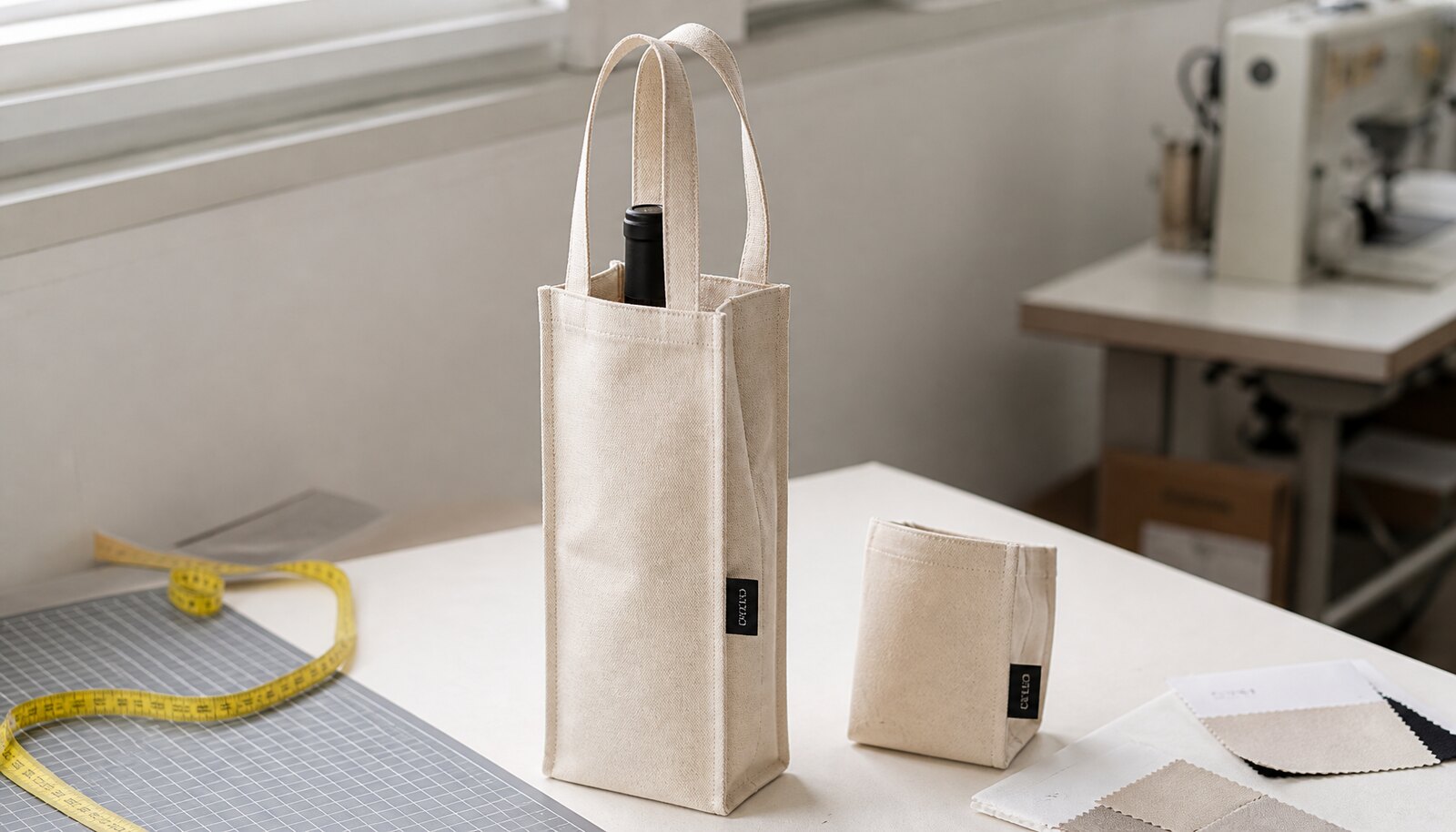
What the buyer is actually buying
For a boutique winery, a canvas wine carrier is not just a bag. It is a small branded packaging system that has to fit the bottle correctly, protect the label, survive handling, and still look good enough to sell as a gift item. That means the buying decision is about more than a unit price. It is about how the carrier performs in tasting room retail, distributor handling, direct-to-consumer fulfillment, and seasonal promotions.
The same carrier can behave very differently in those channels. A tasting room carryout bag can be simple and attractive. A carrier that ships with a bottle order needs better reinforcement and a more disciplined packing plan. If you do not state the use case up front, suppliers will quote against their own assumptions, and the prices will not be comparable.
- Retail-first programs can prioritize hand feel, print clarity, and shelf presentation.
- Ship-with-bottle programs need better fit control, stronger seams, and a more reliable insert or divider.
- Gift and event programs often need cleaner packing and fewer visible handling marks.
Set the spec before price shopping
The fastest way to get a misleading quote is to ask for 'canvas wine carriers' without fixing the spec. Canvas weight is the first decision that changes the cost curve. Lighter fabric lowers the unit cost, but it can slump, wrinkle, or lose the premium feel that boutique wineries want. Heavier fabric improves structure, but it raises cost and can make simple printing look dense or heavy.
Most buyers should decide the key construction choices before they compare factories: canvas weight, carrier format, closure style, print method, and whether the item needs a divider or baseboard. If those choices are still open, the quote may be technically correct but commercially useless.
- 12 oz canvas: lower cost and lighter feel, but more likely to sag in a retail setting.
- 16 oz canvas: the most practical middle ground for a premium look without overbuilding the item.
- 18 oz canvas: stronger structure and a heavier hand feel, but the premium must justify the added cost.
How bulk pricing really moves
A useful pricing plan starts with order bands, not a single number. For a simple one-bottle natural canvas carrier with one-color screen print and bulk packing, the quote usually behaves differently at 300 units, 500 units, 1,000 units, and 3,000 units. The actual numbers will depend on fabric source, decoration, and packing, but the shape of the curve matters more than the exact figure at first.
As a planning example, buyers often see the steepest per-unit cost at the smallest lot because setup is spread across fewer pieces. Once the run reaches a more efficient band, the unit price can fall materially even if the design stays the same. That is why a quote at 500 units is not a scaled-down version of a 3,000-unit price. It is a different cost structure.
For budgeting purposes, a basic buyer model can look like this: factory price plus freight plus duty plus receiving or repacking. If a carrier costs $1.20 at the factory and shipping, duty, and handling add another $0.45 to $1.05, the landed cost lands around $1.65 to $2.25 before domestic distribution. That is only a planning range, but it is more useful than comparing factory quotes in isolation.
- Use at least four breakpoints in the RFQ so the factory shows where the price curve actually bends.
- Separate the sample fee from the production price so the MOQ does not hide setup expense.
- Ask whether the quoted price assumes stock fabric, reserved fabric, or a new dye lot.
Compare sourcing routes and regions, not just vendor names
The route matters as much as the supplier. A direct factory in an export hub usually gives the cleanest view of cost and the best control over stitching, decoration, and packing. That route is usually strongest when the winery expects repeat orders or wants the same spec to hold across multiple seasons.
A trading company can be useful when the buyer needs project management, multi-SKU consolidation, or help coordinating between factories. The drawback is opacity. If the trader cannot clearly identify the production site, the actual process owner, and the QC method, the buyer is not really comparing manufacturing options. The buyer is comparing sales overlays.
Region also matters. China still tends to be strong on capacity, decoration options, and export logistics. Vietnam can be attractive when a buyer values stitched canvas work, clean export discipline, and straightforward packing. India is often relevant for cotton-based canvas and natural-fiber positioning, but lead-time control and finishing consistency should be verified carefully. A local decorator or regional importer can win on speed, but the unit cost is usually higher and the customization envelope is narrower.
- Direct factory: best for repeatability and tighter technical discussion.
- Trading company: useful when the buyer needs one point of contact, but the real factory must be verified.
- Local decorator or importer: fastest route, but usually the highest per-unit cost and the least flexibility.
How to qualify a factory before you request samples
The best factory qualification questions are simple and specific. Ask what is actually made in-house. If the vendor says it makes canvas carriers, you still need to know whether cutting, sewing, printing, embroidery, carton making, and final packing are internal or subcontracted. That tells you how much control the supplier really has over quality and lead time.
Then ask for evidence, not just claims. A capable factory can show recent work with the same seam type, the same type of print, and the same kind of packing you need. Video or photo evidence should show the inside of the bag, the handle attachment, the stitching line, and the carton pack. If the supplier can only show polished catalog images, the buying team still does not know whether the production line can hold the spec.
For compliance-sensitive buyers, ask about any certifications or audits the factory already holds, but do not treat a certificate as proof of capability by itself. It is only useful if it matches your own vendor approval process.
- Request a short factory capability sheet: machinery, monthly capacity, in-house process list, and peak season constraints.
- Ask for two recent production references that are visually similar to your carrier, even if the customer names are masked.
- Verify sample turnaround time separately from mass-production lead time because those two clocks are often very different.
Write an RFQ that exposes hidden cost
A strong RFQ is a control document, not a polite inquiry. It should force every supplier to price the same thing. That means the RFQ has to state bottle size, carrier format, fabric weight, print size, number of colors, packing method, and destination terms. If any of those are vague, one supplier will price a simple version and another will price a more robust version, and the comparison will be meaningless.
The most common hidden costs are setup, extra decoration passes, packaging changes, and sample rounds. A supplier can make a quote look attractive by leaving out divider cost, print setup, or carton work, then recover that money later when the order is already moving. The antidote is line-item pricing. Ask for the real cost of fabric, sewing, print setup, sample rounds, packing, and freight assumptions instead of accepting one blended number.
You should also ask the factory to quote the same item at multiple order bands. That shows whether the supplier is giving you a real scale discount or just a synthetic low number at one odd quantity.
- Ask for a separate line item for each print color setup.
- Ask whether the quote includes the divider, baseboard, handle reinforcement, and any internal stiffener.
- Ask the supplier to state the assumed incoterm and destination port or warehouse.
Approve the sample like it is a production part
A pre-production sample should answer three questions: does the bottle fit, does the brand mark read correctly, and does the carrier hold up under handling. This is the point where assumptions get removed from the project. The winery bottle should be checked with the actual neck, base, and label dimensions, not with a generic sample bottle that happens to be nearby.
Decoration is just as important as fit. On textured canvas, a logo can blur, break at the edges, or shift slightly off panel if the print method is wrong for the fabric. The sample should be checked under normal indoor lighting, not only in a bright photo booth, because print density and edge quality can look different in real use.
If the buyer expects repeat orders, the approved sample should be tagged and stored as the golden reference. That sample is the easiest way to settle a later dispute about placement, color, or stitch consistency.
- Approve the exact artwork version, not a near match.
- Measure handle drop, body width, and opening size on the sample before production starts.
- Keep one physical reference sample with notes on fabric lot, decoration method, and packing.
Use QC thresholds that protect the bottle and the brand
A quality plan for wine carriers should focus on function first and cosmetics second. The important failures are the ones that create breakage, label damage, or a poor customer impression. That is why a good QC plan needs measurable thresholds, not vague instructions like 'check stitching carefully.'
A buyer-grade inspection plan usually starts with a formal sampling method such as ANSI/ASQ Z1.4 or an equivalent table-based standard. For most bulk orders, using AQL 0 for critical defects, 2.5 for major defects, and 4.0 for minor defects is a defensible starting point. For premium winery packaging, many buyers tighten the major defect threshold further if the factory can hold it without excessive rework.
Critical defects are the ones that make the carrier unsafe or unusable: open seams, failed handles, incorrect fit, or a divider that damages the bottle. Major defects are visible issues that affect sellability: print drift, poor symmetry, or significant size deviation. Minor defects are cosmetic issues that are still worth tracking, such as light thread trimming or small finish marks that do not affect function.
- Set fit tolerances before mass production starts.
- Define handle pull expectations and make sure the factory understands that reinforcement is a pass/fail item.
- Require the inspection report before shipment so any rework happens at origin, not at your receiving dock.
Packing, freight, and landed cost are part of the quote
Packaging can change both the unit cost and the quality outcome. A carrier that is bulk packed in a master carton is cheaper to ship, but it may need better carton strength and better handle control. An individual polybag protects finish and cleanliness, but it adds labor and material cost. If the item is sold as a retail gift product, the buyer should ask whether the packing configuration supports display, warehousing, and shelf replenishment at the same time.
Freight changes the economics even more than many buyers expect. A low factory quote can become expensive once the carton count, carton weight, and pallet pattern are added. That is why the quote should always include carton dimensions, gross weight, and the pack count per carton. Those numbers are necessary to estimate cube, compare transport modes, and understand whether a cheaper factory price is really cheaper on a landed basis.
For planning, it helps to think in three freight layers: origin handling, international freight, and destination receiving. If any one layer is missing from the quote, the buyer does not yet know the real landed cost.
- Ask for carton count, carton dimensions, gross weight, and pack method in the same quote.
- Make sure the carton is not overpacked to the point that handles crease or the body distorts.
- Compare all supplier quotes on the same incoterm so freight is not being hidden.
Make the buying decision with a simple rule set
For boutique wineries, the cheapest carrier is not always the best purchase. If the bag is going to be handed to a retail customer, sold as a gift, or shipped with a bottle order, the buying team should pay for the spec that protects the bottle and the brand. That usually means better fit control, more stable stitching, cleaner packing, and a quote that makes setup visible instead of hidden.
A practical rule is this: pay less only when the use case is truly simple and the order is stable. If the carrier is part of a recurring packaging program, spend the extra money where it improves repeatability: fabric quality, seam strength, decoration clarity, and packing consistency. If the run is a one-off event or a seasonal promo, protect cash by simplifying the construction and reducing custom extras.
The most expensive mistake is usually not the price per unit. It is choosing a quote that looked low because key costs were missing, then discovering those costs later in sample fees, rework, packing changes, or freight surprises.
- Choose the cheaper spec only when the wine bottle, channel, and packing method are all low risk.
- Choose the stronger build when the item will be shipped, resold, or handled repeatedly.
- Treat the approved sample and the landed-cost model as the final decision tools, not the first quote.
Specification comparison for buyers
| Sourcing route | Typical MOQ / price behavior | Best fit | Buyer risk to check |
|---|---|---|---|
| Direct factory in an export hub | Lowest unit cost at larger volumes; setup, printing, and sewing are usually more transparent when the factory owns the full process | Repeat programs, branded retail lines, and buyers who need stable specs across seasons | Verify that cutting, sewing, printing, and packing are actually in-house, not quietly outsourced |
| Direct factory in a higher-cost or near-market region | Higher unit price, but freight, lead time, and rework can be lower if the market is close to your warehouse | Short replenishment cycles, seasonal drops, and programs that value speed over the last cent of unit cost | Check whether the quote includes local compliance, carton labeling, and small-run flexibility |
| Trading company or sourcing agent | Usually mid-range on price and often more flexible on MOQ, but margins can be hidden inside the quote | Multi-SKU orders, buyers who need project management, or teams that want one contact for several factories | Confirm the real factory identity, the production location, and whether the trader controls QC or just relays the order |
| Stock importer or local decorator | Highest per-unit cost, but the quote is easiest to understand and the lead time is shortest | Events, urgent seasonal promotions, and very small runs with limited customization | Check stock consistency, print limitations, and whether you are buying a true custom item or a stock bag with a logo applied later |
| Material | cotton canvas, jute, felt, nonwoven, or laminated paper sized to bottle diameter, weight, and condensation risk | Before price comparison | Different cloth weights, backing, or certification claims make quotes hard to compare |
| Construction | bottle fit, bottom reinforcement, handle or cord strength, divider option, seam allowance, and upright stability | Before sampling | Weak stress points create returns and failed inspections |
| Decoration | screen print, hot stamp, woven label, embroidery, or paper label positioned for curved bottle presentation | Before artwork approval | The wrong method can crack, bleed, pucker, or fail on the chosen fabric |
| MOQ | Base MOQ plus change drivers | During quote review | Custom colors, trims, and packing can change minimums |
Buyer checklist before sampling
- Lock the bottle dimensions first: height, maximum diameter, neck height, and whether the carrier must also clear a neck label, corkscrew, or gift insert.
- Write the exact canvas spec in the RFQ: fabric weight in oz or GSM, weave feel, whether the material is natural, dyed, or bleached, and whether shrinkage allowance matters for fit.
- Define the carrier format before asking for pricing: single-bottle, two-bottle, divider style, sleeve style, or open-top tote with reinforced base.
- Choose the decoration method in advance and keep it fixed for comparison: screen print, heat transfer, woven label, embroidery, or a combination.
- Ask for line-item pricing, not one all-in number: fabric, cut and sew, print setup, packaging, sample fee, and carton work should each be visible.
- Request pricing at multiple order bands so you can see the curve: for example 300, 500, 1,000, and 3,000 units, or the closest breakpoints the factory actually uses.
- State the packing standard in writing: individual polybag or no polybag, master carton count, carton strength, and whether the item is shelf-ready or warehouse-packed.
- Ask for a production photo or video that shows stitching, handle attachment, print registration, and carton packing on a current order, not just a catalog image.
- Confirm what is in-house and what is subcontracted: printing, embroidery, cut-and-sew, inspection, and carton making should each be named.
- Ask for the incoterm and the assumed destination so the quote is not hiding freight, duty, or inland trucking behind a low factory price.
Factory quote questions to send
- What exact canvas weight, weave, and finish are you quoting, and what tolerance do you hold on finished fabric weight?
- Is the quoted price based on a natural canvas body, a dyed body, or stock fabric that may vary between lots?
- What are the MOQ breakpoints by fabric color, print color, and carrier format?
- Which processes are in-house: cutting, sewing, printing, embroidery, packing, and carton production?
- How many setup charges apply, and are they charged once per design, once per color, or once per order?
- What is the price at 300, 500, 1,000, and 3,000 units, and what changes at each tier?
- Does the unit price include the divider, baseboard, reinforcement stitching, and handle attachment, or are those add-ons?
- What is the sample charge, how many sample rounds are included, and what changes if we revise artwork or packaging?
- What carton count, carton dimensions, net weight, and gross weight are you quoting for export packing?
- What defect standard do you use for final inspection, and will you share the inspection report before shipment?
Quality-control points to confirm
- Use a formal sampling standard, not visual guesswork. A practical default is ANSI/ASQ Z1.4 Level II with AQL 0 for critical defects, 2.5 for major defects, and 4.0 for minor defects, unless your brand requires tighter limits.
- For premium winery programs or DTC shipments, tighten the acceptance standard to 1.0 major and 2.5 minor if the factory can hold it without inflating rework risk.
- Set measurable fit tolerances before production starts: +/- 3 mm on critical bottle-fit dimensions and +/- 5 mm on non-critical sewn dimensions is a workable starting point for most carriers.
- Define handle-drop tolerance explicitly, because handle length affects look and function. A practical buyer limit is +/- 5 mm unless the bottle shape requires a tighter fit.
- Reject open seams, skipped-stitch clusters, and loose-thread bundles that exceed your trimming standard. If the item is sold as premium retail, even small sewing defects are visible at shelf distance.
- Treat print drift as a real defect. For a front-panel logo, more than 2 mm of visible placement shift or any obvious bleed into the seam area should trigger correction on premium orders.
- Inspect fabric weight against the agreed spec, not against a generic 'canvas' description. If the quote says 16 oz or 280 GSM, measure it and record the result.
- For a pre-shipment inspection, sample from multiple cartons across the lot. If you do not use a formal table, inspect at least 32 pieces for a pilot lot and 80 to 125 pieces for a production lot over 1,000 units.
- Check the bottle fit with the actual bottle shape the winery uses, including label thickness, neck height, and base width. A carrier that fits a dummy bottle can still fail on the real SKU.
- Inspect carton integrity, pack count, moisture, odor, and print transfer. A good carrier can still arrive unsellable if the carton is crushed, damp, or overpacked.