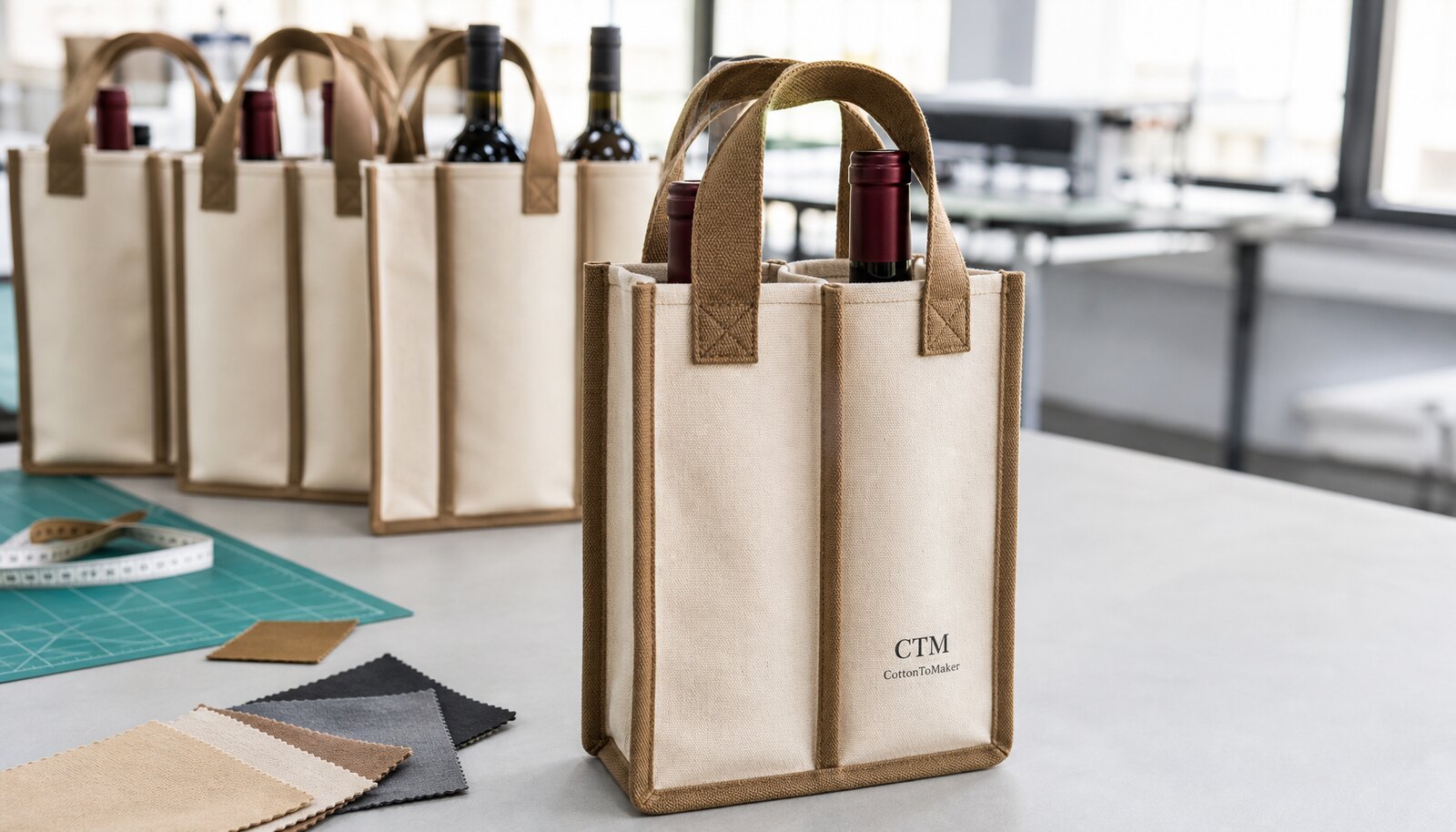
Why inspection matters for winery bottle carriers
Canvas wine carriers look simple, but they fail in predictable ways: the bottle sits too loose, the handle twists under weight, the print shifts off center, or the carton pack arrives crushed and dirty. For boutique wineries, that is not a cosmetic issue. These carriers often sit in tasting rooms, gift shops, club shipments, and retail displays, so the first batch becomes part of the brand image immediately. A buyer who treats the item like a generic tote usually learns too late that wine carriers have different loading, seam, and presentation requirements than standard shopping bags.
The right inspection checklist starts with use case. A tasting room carrier is judged on appearance, quick hand feel, and easy bottle insertion. A retail or e-commerce carrier needs stronger handles, tighter bottle control, and better packing discipline. If the quote does not distinguish those end uses, compare suppliers on the same terms is impossible. The goal here is not just to reject bad goods. It is to build an RFQ that tells factories what failure looks like before they cut the first roll.
- A good carrier keeps the bottle upright without forcing the neck or abrading the label.
- A good inspection plan checks both appearance and load performance, not only dimensions.
- A good RFQ defines use case first, then material, decoration, and packing.
Choose the right canvas before you inspect anything else
Canvas weight is the first commercial decision because it affects structure, cost, and sewing performance. For most boutique winery carriers, a canvas in the 12 oz to 14 oz range, roughly 400 to 475 GSM, is a practical baseline. That weight usually gives enough body for premium presentation without turning the carrier into a stiff box. Lighter canvas can work for tasting-room giveaways, but once a 750 ml glass bottle is inserted, thin fabric tends to sag and telegraph the bottle shape in a way that feels unfinished. Heavier canvas can improve perceived value, but it also raises sewing resistance and may require slower production or more robust needles and thread.
The buyer should also define finish. Raw canvas gives a natural look but may fray more at cut edges. Washed canvas softens the hand feel and can reduce shrink risk if the supplier controls the process, while coated canvas offers better stain resistance but may crack if the fold lines are too tight. If the winery wants a rustic aesthetic, the issue is not whether the fabric looks natural. The issue is whether the chosen finish stays consistent from sample to bulk and whether the same fabric can be sewn cleanly across all order quantities.
- Ask for canvas weight in GSM or oz per square yard, not as a vague 'heavy duty' description.
- State whether the fabric must be raw, washed, dyed, or coated.
- Request a roll photo or swatch set to confirm weave tightness and color consistency.
Supplier routes and what each one actually changes
Not every sourcing route is equal for this product. A direct factory with bottle-bag experience usually gives the best control over panel shape, handle reinforcement, and carton packing, because the maker sees the same construction every day. A trading company can be useful if it manages multiple factories and consolidates categories, but the buyer loses visibility into who is cutting, sewing, and inspecting the bags. A local decorator may handle branding quickly, yet often depends on generic blanks that were not built for wine bottle dimensions, so the final fit can be acceptable only after compromise.
For procurement teams, the practical question is not which route sounds simplest. It is which route can document the real production chain. A strong supplier should be able to show sample photos, fabric spec, sewing details, and packed carton images before shipment. If the quote only lists 'canvas wine bag' with a logo and carton count, there is not enough information to compare risk. The inspection checklist should therefore include supplier evidence, not just product appearance.
- Direct factory: best for repeatability and custom engineering.
- Trading company: useful for coordination, weaker on process transparency.
- Local decorator: fast for branding, weaker for structural control unless they own the blank spec.
Use the comparison table to separate cost from risk
When buyers compare canvas wine carrier quotes, the lowest unit price often comes from the route that removes the most detail from the spec. That can be fine for a one-off event item, but not for a boutique winery line that needs repeat orders. The useful comparison is not only price against price. It is price against total control: who owns the material, who approves the sample, how the logo is applied, and how much inspection evidence you get before shipment.
A clean comparison should expose whether the supplier is quoting a known construction or improvising around stock material. If one factory offers a 12 oz carrier with stitched divider and bar-tacked handles while another quotes a thin blank with a printed logo, those are not equivalent products. Buyers should force the quote into common decision rows so the hidden tradeoffs are visible early.
- Compare the same bottle count, same canvas weight, and same decoration method.
- Separate blank-bag cost from branding cost and packaging cost.
- Treat sample approval and inspection evidence as part of the offer, not a courtesy.
Inspection points that catch the defects buyers usually miss
The most common quality issue is fit. The bottle may enter the carrier too tightly, which creates label scuffing and makes the product awkward in a tasting room. The opposite problem is worse from a premium standpoint: the bottle sits loose and tips inside the carrier. For a 1-bottle version, the opening should be measured against the target bottle profile, not just the bag width on paper. For a 2-bottle version, the divider must stay centered and firm enough that bottles do not contact each other during normal handling. A supplier can pass dimensions and still fail in actual loading.
The next issue is stitching discipline. A visual pass is not enough. Look at the handle join, top hem, divider junction, and bottom corners where tension collects. Thread tails should be trimmed cleanly, stitches should run straight, and bar-tacks should be placed consistently. If the bag uses webbing handles, the webbing edge should be sealed or hidden so it does not fray during use. The bag should also stand and hang straight when loaded; a lean or twist usually means the pattern was cut off-grain or the handle placement is uneven.
- Test fit with the actual bottle shape the winery uses, including taller or wider neck profiles.
- Inspect seam direction, stitch density, and handle symmetry on both left and right sides.
- Load the carrier and check whether the base sits flat and the bottle remains centered.
Print method, branding, and approval standard
Decoration is where many good carriers get downgraded by poor spec writing. Screen print remains the most practical option for simple winery logos, especially one-color or two-color artwork with bold shapes. It gives good opacity on natural canvas and usually keeps unit cost under control at moderate volumes. For smaller runs or more detailed marks, heat transfer can be easier to manage, but the buyer should know that some transfer films change hand feel or show edge lift after handling. Embroidery can look premium, yet on lighter canvas it may create puckering unless the backing and stitch density are carefully controlled.
The approval standard should be visual and physical. A logo that looks close enough on a screen mockup can still fail if it is too high, too low, or too close to a seam. The buyer should approve the actual print position on a pre-production sample with the real fabric and real closure hardware. If the design uses Pantone matching, note that natural canvas can shift perceived color slightly because the base fabric is not a pure white substrate. A good factory will state the expected color variance and show where on the bag the print will land.
- Use screen print for bold logos and predictable repeat production.
- Use heat transfer only when artwork complexity or low MOQ justifies it.
- Approve print location on a physical sample, not only a flat artwork proof.
MOQ logic and how it affects unit price
MOQ for canvas wine carriers should reflect actual production setup, not a random number. If the supplier is changing fabric color, printing a new logo, and cutting a custom divider, the MOQ rises because the factory is absorbing setup time, material loss, and inventory risk. For a simple open-top carrier with one-color print and stock canvas, a lower MOQ may be reasonable. Once the design adds closures, reinforced handles, or multiple bottle sizes, the economic threshold moves quickly. Buyers should ask for a price ladder at 1,000, 3,000, and 5,000 pieces so the quote shows how much each production burden costs.
A low MOQ can be a trap if it depends on leftover stock fabric or temporary labor. The first sample may look fine, then the second batch shifts in shade or stitch quality. For boutique wineries, consistency usually matters more than chasing the cheapest entry order. The better strategy is to define the smallest order that still gives the factory stable material sourcing and enough run length to maintain sewing standards. If the order is meant to support multiple tasting rooms or seasonal retail, a slightly larger run often lowers total landed cost by reducing rework, repeat sampling, and freight inefficiency.
- Request a price break by quantity, not a single quote line.
- Ask whether MOQ changes with color, print count, or handle construction.
- Watch for stock-fabric quotes that cannot guarantee color repeatability.
Sample approval should simulate the real bottle load
A sample that only looks good on the table is not enough. The approval sample should be tested with the winery's actual bottle format, because bottle diameter, height, shoulder shape, and label placement all affect fit. Insert and remove the bottle several times, then inspect whether the opening relaxes too much or the seams distort. For a carrier with divider, check that both bottles can be inserted without fighting the seam or rubbing glass against glass. If the carrier is intended for gifting, also view it from shelf distance and in hand, because buyers often underestimate how quickly a crooked handle or off-center print becomes visible.
The sample should also reflect the final packaging method. If the production goods will arrive folded in polybags and compressed in cartons, the sample needs to show how the fabric recovers from packing creases. If the carrier has a closure tab or snap, make sure the closure does not scratch the bottle neck or snag the label. A good pre-production approval includes a simple written note of what is accepted, what is corrected, and which measurements are locked. That note protects the buyer when bulk production begins.
- Test the sample with the actual target bottle, not a substitute bottle.
- Evaluate opening size, divider alignment, and handle comfort under load.
- Record the approved measurement set and print position before bulk release.
Packing, carton count, and shipping damage control
Packing is not the last step to ignore. It directly affects presentation, crease lines, moisture exposure, and carton damage in transit. For canvas wine carriers, individual polybags are common when the bags are retail-facing or used in gift sets. If the product is for internal tasting-room use, some buyers may skip individual polybags to reduce plastic, but then carton cleanliness and fold protection matter more. The carton count should be chosen to avoid over-compression that leaves deep fold marks on arrival. Flat folding is usually better than stuffing the bag irregularly, and each carton should have a clear label showing SKU, color, quantity, and any inner pack details.
Shipping damage often comes from poor assumptions about carton weight and stacking. A carrier that looks sturdy in a sample can still arrive deformed if the master carton is too soft or overloaded. Ask for carton dimensions, gross weight, and pack count on the quote so you can estimate pallet efficiency and freight impact early. If the order is mixed by color or size, insist on carton separation and outer marks that prevent fulfillment errors. The buyer's QC process should include a quick check on crushed corners, dirt marks, moisture smell, and mismatched packing counts before accepting the shipment.
- Confirm whether goods ship polybagged, folded, or bulk packed.
- Ask for carton labels that separate SKU, size, and color clearly.
- Check carton strength and fold pattern if the product will travel by sea.
Build a quote review that makes suppliers compete on facts
A useful quote review turns vague offers into comparable data. Start with the fabric spec, bottle count, print method, handle construction, divider style, sample lead time, bulk lead time, and packing format. Then compare the supplier's assumptions. One factory may price a 12 oz carrier with one-color print and simple fold; another may include a better handle reinforcement, cleaner packing, and a stricter inspection step. Those differences matter more than a small unit-price gap. The buyer should identify the real cost driver, not just the invoice line.
This is also where landed cost thinking helps. A slightly higher factory quote can be cheaper overall if it reduces rework, rejected cartons, or freight inefficiency. Buyers often spend time negotiating unit price while ignoring the cost of damage, relabeling, or replacement shipments. For boutique wineries, where branding and retail presentation matter, one weak batch can erase the savings from a lower quote. A disciplined quote review should therefore score the supplier on documentation, communication clarity, sample accuracy, and packing discipline, not only on price.
- Compare all quotes on the same spec sheet, not on supplier-created descriptions.
- Score documentation quality and sample discipline alongside unit price.
- Treat cheaper freight, cleaner packing, or lower rework as part of total cost.
Specification comparison for buyers
| Spec decision | Recommended option | When it fits | Buyer risk to check |
|---|---|---|---|
| Sourcing route | Direct factory with bag experience | Best for private label programs, repeat orders, and custom sizing | Confirm they actually make bottle bags, not only general totes |
| Fabric weight | Canvas around 12 oz to 14 oz per square yard, or about 400 to 475 GSM | Works for premium winery packs that need structure and reduced bottle rub | Light canvas can collapse; heavy canvas can raise cost and slow sewing |
| Handle construction | Reinforced webbing or folded canvas handles with bar-tacks | Good for 1-bottle and 2-bottle carriers that need real carry strength | Thin handles can twist, stretch, or detach under bottle weight |
| Closure style | Open top, snap tab, or flap with velcro, depending on retail use | Open top for tasting rooms; closure for gifting and shipping | Snaps and velcro can hit bottle necks or scratch labels if placed poorly |
| Decoration method | Screen print for simple logos, woven label or heat transfer for small runs, embroidery only if artwork allows | Choose based on logo detail, unit cost, and wash or rub requirements | Overly detailed art can blur in screen print; embroidery can pucker light canvas |
| Divider structure | Fixed stitched divider or removable insert for two-bottle carriers | Useful when wineries need separation between glass bottles or mixed labels | Loose inserts can shift in transit; stitched dividers can be too narrow for larger bottles |
| Supplier type | Factory with sample approval and inline QC photos | Best for importers needing controlled tolerances and carton packing discipline | Trading layers can hide the real maker and complicate defect accountability |
| MOQ strategy | 1,000 to 3,000 pcs for custom construction; lower if using stock fabric and one-color print | Fits boutique winery seasonal programs and SKU testing | Very low MOQ may mean leftover stock fabric, unstable color lots, or weak pricing |
| Packing route | Individual polybag with carton count and master carton label | Appropriate when carriers go into gift sets or e-commerce fulfillment | Weak packing creates fold marks, dusty goods, or mixed sizes in the same carton |
Buyer checklist before sampling
- Lock the bottle count first: 1-bottle, 2-bottle, or mixed pack, because this drives panel width, divider design, handle strength, and carton size.
- Specify canvas weight in GSM or oz, not just 'heavy canvas,' and state whether you want washed, raw, or coated canvas.
- Define the print method, logo size, Pantone target, and whether the decoration must survive rub testing or only shelf display.
- Approve a pre-production sample with actual bottle fit, seam alignment, and handle pull test before bulk cutting begins.
- Confirm carton pack count, inner polybag requirements, master carton marks, and whether the product ships folded or flat.
- Ask for a cutting layout or size sheet so you can see if the supplier is using efficient panels or stretching the pattern to save material.
- Request inspection photos of stitching, binding corners, label placement, and packed cartons before shipment release.
Factory quote questions to send
- What is the exact canvas weight, weave style, and finishing treatment, and can you show the base fabric spec on the quote?
- Is the quoted price based on stock canvas or dyed-to-order fabric, and what color lot tolerance should we expect?
- Which print method is included, how many colors are priced, and what is the setup charge for a second artwork placement?
- What is the MOQ by construction type, not just by logo color, and how does the price change at 1,000, 3,000, and 5,000 pcs?
- Can you quote separate prices for open-top, snap closure, and divider versions so we can compare functionality against cost?
- What is the sample lead time, bulk lead time, and whether lead time starts from artwork approval or deposit receipt?
- What carton size, packing count, and gross weight are you quoting, and can you confirm if master carton labels are included?
- What QC documents can you provide before shipment, such as inline photos, final random inspection photos, or measurement reports?
Quality-control points to confirm
- Fabric weight should match the approved spec within a reasonable production tolerance, and the supplier should state the tolerance in writing.
- Cut panels should be symmetrical, with no visible skew that causes the carrier to lean when loaded with a bottle.
- Seam density should be consistent, and stress points on handles, divider ends, and base corners should receive bar-tacks or equivalent reinforcement.
- Bottle fit should allow easy insertion without forcing the neck, while still preventing excessive movement inside the carrier.
- Print color should stay within the approved visual target, and there should be no bleeding, cracking, or smudging on handling.
- Handle pull strength should be tested on a filled sample, not only on empty goods, because empty-bag strength often hides weak stitching.
- Edges and binding should be clean with no exposed fraying threads, loose needles, or sharp internal cut ends.
- Cartons should arrive with the correct count, correct SKU labeling, and no mixed sizes or unapproved color substitutions.