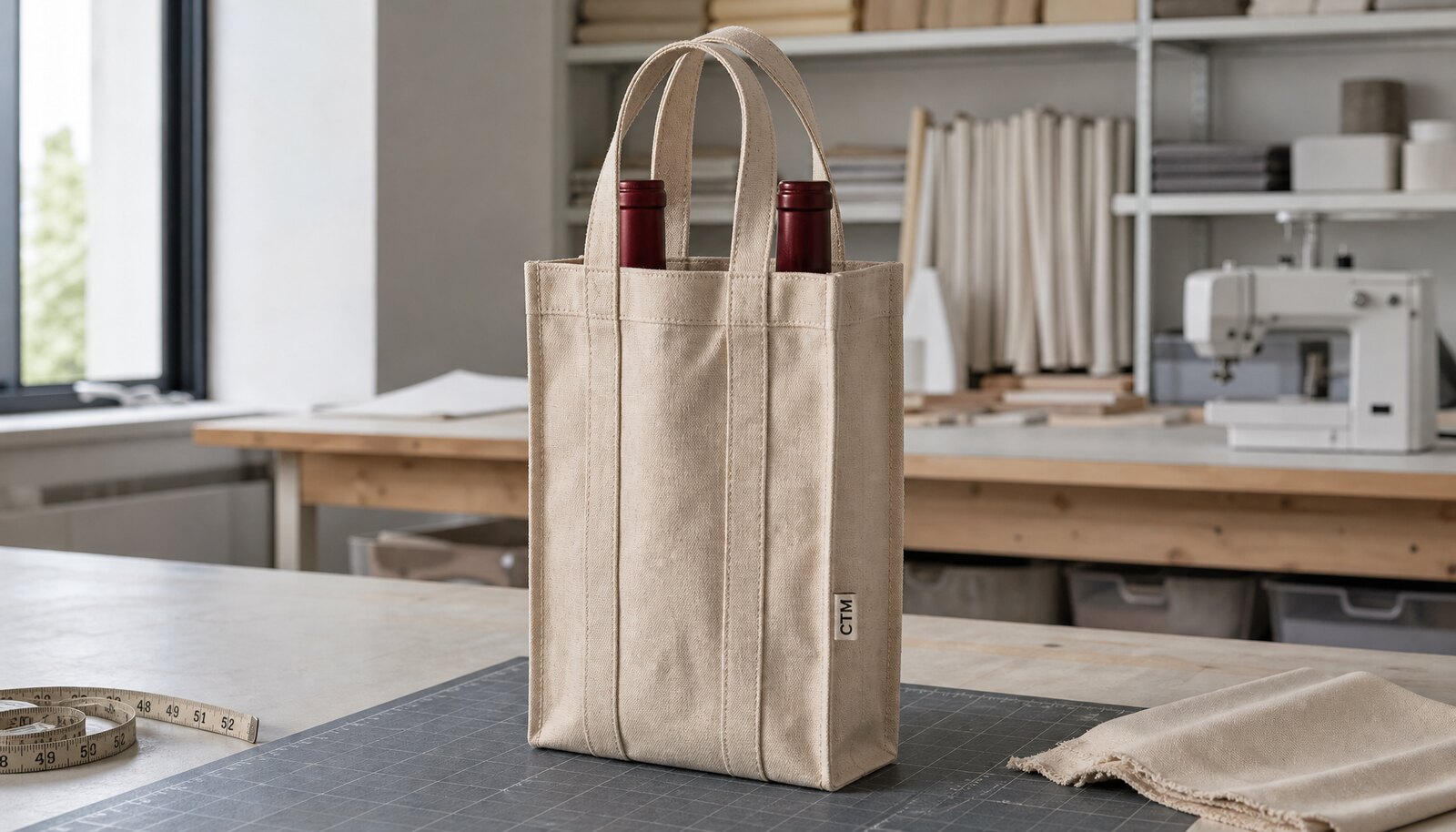
Begin with the buying job, not the fabric number
Canvas wine carriers usually start as a branding idea: a winery wants something better than a paper gift bag, something guests will keep, photograph, or carry out of the tasting room with pride. Procurement, however, needs to view the item differently. A wine carrier is a load-bearing package. It holds glass, liquid, and brand value at the same time. If the handle tears, the divider collapses, or the bag looks limp on the shelf, the problem is not just cosmetic.
The same phrase, “custom canvas wine bag,” can describe very different products. A holiday gift carrier handed directly to a customer has one job. A tasting-room resale bag has another. A wine club carrier may pass through warehouse counting, barcode handling, and seasonal fulfillment before it reaches the end customer. Event giveaways may need a simpler build because speed and MOQ matter more than long-term reuse. Premium merchandise needs stronger fabric, cleaner stitching, better packing, and tighter repeat control.
Before you discuss GSM or ounces, write down the use case. Where will the bag be used? Who will load it? How far is it likely to be carried? Will it sit filled on a retail shelf? Does it need to be giftable, reusable, barcode-ready, or shipped flat inside another carton? These questions keep the specification commercial instead of subjective. A buyer may like the feel of 14 oz canvas, but that does not automatically make it the right choice for a low-cost tasting event carrier.
This is also where boutique wineries protect their brand positioning. Customers often read packaging quality as a signal of bottle quality. A bag that feels thin, wrinkles around the bottle, or lets two bottles clink together can make an otherwise thoughtful gift feel improvised. On the other hand, overspecifying every detail can push the unit cost beyond what the program can support. The goal is not to buy the heaviest carrier. The goal is to buy the right carrier for the job.
- Tasting-room resale: prioritize shelf shape, logo presentation, and repeat handling strength.
- Holiday gifting: prioritize appearance, cost control, simple loading, and clean packing.
- Wine club or subscription use: prioritize folded size, carton efficiency, barcode readiness, and receiving accuracy.
- Event giveaways: prioritize MOQ, simple artwork, fast production, and predictable freight volume.
- Premium merchandise: prioritize fabric hand feel, stitching consistency, branded trims, and long-term replenishment repeatability.
Fabric weight guide: what GSM and ounces mean in practice
For buyers searching for a canvas wine carriers for boutique wineries fabric weight guide, the first trap is treating fabric weight as a stand-alone quality grade. It is not. Weight affects structure, sewing difficulty, print appearance, carton volume, and perceived value, but it works together with weave, finishing, reinforcement, and pattern design. A heavy fabric with weak handles is still a weak carrier.
Canvas is commonly described in ounces per square yard, while many factories and inspection teams also use GSM. The conversion is not always exact because finishing can change the fabric. As a practical reference, 10 oz canvas is often around 340 GSM, and 12 oz canvas is often around 410 GSM. When writing an RFQ, include both units if possible. It reduces back-and-forth and helps suppliers in different sourcing systems understand the target more quickly.
For many boutique winery programs, 10–12 oz canvas is the safest starting range. It usually feels substantial enough for retail, supports common logo methods, and remains manageable in sewing and packing. An 8–9 oz fabric, roughly 270–305 GSM, can work for a simple one-bottle gift carrier where the buyer is controlling cost and does not expect a structured merchandise feel. At the premium end, 12–14 oz canvas, roughly 410–475 GSM, can make sense for two-bottle carriers, higher-priced gift sets, or reusable branded merchandise. But heavier fabric brings trade-offs: thicker seams, slower sewing, larger cartons, more folding memory, and sometimes more difficult logo execution.
Do not approve fabric by weight alone. Ask whether the stated weight is greige, dyed, washed, bleached, coated, or finished. Two fabrics with similar GSM can behave differently if one is tightly woven and stiff while another is looser and softer. Natural canvas shade can also vary from lot to lot, which may affect ink color and brand presentation. A physical swatch tells you more than a spreadsheet, and a sewn sample with real bottles tells you more than a swatch.
- 8–9 oz or about 270–305 GSM: suitable for basic gifting, lighter one-bottle carriers, and cost-sensitive promotions.
- 10 oz or about 340 GSM: a common balanced option for retail-ready carriers with moderate structure.
- 12 oz or about 410 GSM: stronger hand feel for premium two-bottle carriers and tasting-room resale.
- 14 oz and above: possible for premium merchandise, but review seam bulk, fold method, print method, and freight cost carefully.
- Always approve the fabric as a swatch plus a sewn sample; weight alone does not define final quality.
Bottle fit is where many wine carrier specs go wrong
A 750 ml wine bottle is not a single shape. Bordeaux bottles tend to be straighter. Burgundy bottles have broader shoulders. Riesling bottles can be taller and slimmer. Champagne and sparkling bottles are often wider, heavier, and more demanding on the bag. Some boutique wineries use custom glass, wax finishes, taller closures, or seasonal gift combinations. If the carrier is designed around the wrong bottle, no fabric weight will save the program.
Start with the largest bottle the carrier must accept, then check the most common bottle it must present well. Those are not always the same. A bag sized only for the largest bottle may look loose around a slimmer daily-use bottle. A bag sized for the standard bottle may frustrate retail staff when a guest wants to buy sparkling wine or a mixed two-bottle gift set. The RFQ should list bottle families, maximum diameter, total height including closure, and whether the carrier must work for mixed bottle pairs.
Two-bottle carriers need extra attention. The divider is not decoration; it is a functional part. If it is too low, bottle shoulders or necks can touch. If it is too narrow, loading becomes awkward. If it is stitched only where it looks neat but not where it carries movement, it can twist or pull loose during normal handling. A useful divider is aligned with the bag body, secured into the base or seams, and sized for the real bottle combination.
Gusset depth and bottom structure affect both stability and appearance. A narrow bottom makes bottles push outward and can make the carrier lean. A wide but unsupported bottom may sag. Some programs need a reinforced bottom panel, a removable insert, or a partial lining to keep the profile clean. Inserts are helpful, but they are not free: they add material, packing decisions, and sometimes warehouse labor. Decide early whether the bag must stand upright when loaded, because that requirement changes the construction.
- List the bottle families to be supported, not only “750 ml wine bottle.”
- Measure the largest bottle diameter and height with closure, foil, wax, or cap included.
- For two-bottle carriers, confirm divider height against the bottle shoulder line and neck movement.
- Specify whether bottles must stand upright on shelf when loaded.
- Test fit with the actual winery bottles before approving the pre-production sample.
Construction details that prevent handle, seam, and divider failures
Most canvas wine carriers do not fail in the middle of the fabric panel. They fail where load concentrates: handle bases, side seam intersections, bottom corners, and divider joins. A two-bottle carrier may look elegant when empty, then strain immediately when loaded. That is why construction details deserve the same attention as fabric weight.
Handles are the obvious stress point. Folded canvas handles and heavy cotton webbing can both work, provided they are properly anchored. Box-X stitching, dense bartacks, or approved reinforcement patches spread the load better than a single decorative line of stitching. Handle drop also matters. If the drop is too short, customers may hold the bag awkwardly or strain the handle angle. If it is too long, the loaded bag may swing more than desired and feel less controlled.
Thread, seam allowance, and stitch density need to match the fabric. Heavy canvas sewn with weak thread or narrow seam allowance can still slip. Very dense stitching with the wrong needle can perforate or pucker the material. Buyers do not need to dictate every machine setting, but the purchase specification should require consistent stitching, no skipped stitches, visible reinforcement, and secure seams at all load-bearing points. Close-up sample photos are useful, especially when teams are approving remotely.
The divider is the part suppliers may simplify when cost or time is tight. An empty sample with a soft divider can look acceptable in photos. Once bottles are loaded, the divider may collapse, bow, or detach. For boutique wineries selling two-bottle gifts, that clinking sound is damaging because it makes the customer worry about breakage. Inspect the divider with real bottles, not just by opening the bag and looking inside.
- Require reinforced handle bases with box-X stitching, bartacks, or an approved equivalent.
- Check that seam allowance is wide enough for the fabric weight and load condition.
- Inspect bottom corners where multiple canvas layers meet; this is a common skipped-stitch area.
- Make sure divider joins are functional, not only decorative.
- Avoid approving a beautiful empty sample that has not been load tested.
Logo method: design for canvas, not for a paper label
Canvas has texture. That sounds obvious, but it changes branding decisions quickly. A winery logo that looks refined on a bottle label may lose detail on a woven cotton surface. Fine serif text, tiny vineyard line art, thin rules, and subtle gradients can fill in or break up. Low-contrast ink on natural canvas may look tasteful in a mockup and too quiet in real life. Always evaluate artwork on the actual fabric or a very close production fabric.
For many boutique wineries, one- or two-color screen printing is the most practical choice. It is repeatable, cost-effective, and suited to bold marks. It works especially well when the logo has clean shapes and enough line weight. Heat transfer can produce sharper edges for some designs, but it changes the surface feel and may not suit a natural, craft-focused brand. Embroidery can look premium, yet it adds cost, may pucker lighter canvas, and does not always handle small lettering well. Woven labels are useful when the main panel should stay minimal or when the bag is positioned as merchandise.
Placement is just as important as method. Artwork should be measured from finished bag edges, not cut panel edges. If a logo is centered before sewing, the final gusset, seam allowance, handle base, or bottom fold may make it appear off-center. This is one of the most common reasons a sample looks less polished than the buyer expected. Provide a placement guide with finished width, finished height, print area, clearance from seams, and distance from the top opening or bottom fold.
Pantone references help, but natural canvas is not a coated paper substrate. Fabric shade, absorbency, and ink behavior can influence the final color. State the target, define an acceptable tolerance, and request a strike-off if color is important. For heritage, estate, or premium wine brands, a small print test is cheaper than discovering after bulk production that the logo is too faint or the fine text is unreadable.
- Use screen print for bold one- or two-color logos and clean tasting-room resale programs.
- Avoid very small type, hairline rules, delicate gradients, and low-contrast ink on natural canvas.
- Specify Pantone targets while allowing realistic tolerance for natural fabric shade variation.
- Measure artwork placement from finished edges, not from cut panel edges.
- Request a print strike-off on the actual canvas whenever logo detail or color matching is important.
Compare supplier quotes by assumptions, not headline unit price
Two suppliers can quote the “same” canvas wine carrier and still be pricing different products. One may assume 8 oz canvas, simple stitching, no fixed divider, and loose bulk packing. Another may assume 12 oz canvas, reinforced handles, a sewn divider, individual polybags, and stronger export cartons. The second quote will look higher, but it may be closer to what the winery actually needs.
A strong RFQ removes guesswork. It should state finished dimensions, fabric weight, fabric composition, color, bottle format, handle style, divider requirement, logo method, number of print colors, packing method, carton data, and inspection expectations. If you are not sure which construction is best, ask suppliers to quote options side by side. For example, request 10 oz versus 12 oz canvas, or single-layer body versus reinforced bottom. This creates a useful comparison instead of a race to the thinnest acceptable version.
Ask suppliers to identify what is included and what is not. Screen charges, embroidery digitizing, woven label setup, custom dyeing, sample fees, barcode labels, carton marks, and polybags can all affect the final order cost. The goal is not to force a supplier into an unrealistic line-by-line cost breakdown. The goal is to make assumptions visible before you choose a factory.
Landed cost deserves special attention. Canvas carriers are often bulkier than buyers expect, especially with heavier fabric, structured bottoms, or inserts. Carton dimensions, carton quantity, gross weight, net weight, and CBM influence freight and warehouse receiving. A slightly higher unit price may be more competitive if the packing is efficient and count accuracy is better. Procurement should compare the carrier as a delivered, countable, sellable item, not only as a sewn unit.
- Ask every supplier to quote against the same finished dimensions, fabric weight, print method, and packing plan.
- Request carton size, carton quantity, gross weight, net weight, and CBM before supplier selection.
- Separate one-time costs such as screens, embroidery digitizing, custom dyeing, or sample charges.
- Confirm whether barcode stickers, hangtags, woven labels, carton marks, and inner bags are included.
- Treat any missing quote assumption as a risk item, not as a small administrative detail.
Sampling should prove production reality, not showroom skill
A sample is valuable only if it represents how the bulk order will be made. Canvas wine carrier samples can be misleading when they use substitute fabric, hand-finished seams, simplified printing, or special pressing that will not happen in production. Early concept samples may use temporary materials, and that is fine if everyone labels them clearly. Final approval, however, should be based on production-like fabric, construction, logo method, divider, and packing.
Review the sample physically. Put in the heaviest intended bottle configuration. Lift it by the handles several times. Set it down. Watch the bottom. Check whether the side seams twist, whether the handle bases strain, and whether the divider keeps bottles apart. If it is a two-bottle carrier, use two bottles. Testing with one bottle or empty filler does not show how the load really behaves.
Also review the sample after folding. Many buyers approve a bag standing upright on a table, then receive bulk goods folded tightly in cartons. Canvas can hold creases, handles can bend, and dividers can flatten. Ask the supplier to fold the sample as they plan to pack the order. Leave it folded, reopen it, and judge whether the presentation is still acceptable for your channel.
Once approved, turn the sample into a controlled reference. Record the fabric weight, fabric color, artwork version, print size, placement, measurements, handle construction, divider details, packing method, and approval date. Keep one signed physical sample with the buyer or brand team and one with the factory QC team. This simple discipline helps prevent spec drift during production and future reorders.
- Request an initial sample for construction review and a pre-production sample for final approval when timing allows.
- Use the final artwork and intended print method before signing off on logo quality.
- Test with real bottles, including the heaviest and widest formats in the program.
- Keep one signed physical sample with the buyer and one with the factory QC team.
- Do not release bulk production while critical items are still marked “to be confirmed.”
Packing and logistics can make or break the program
Packing often gets discussed after the bag is approved, but it should be part of the quotation. The way canvas wine carriers are folded, bundled, labeled, and cartoned affects retail appearance, warehouse speed, freight cost, and count accuracy. A beautifully sewn carrier can arrive with crushed handles, hard fold lines, or bent dividers if the packing method is careless.
Choose the packing style based on channel. A tasting-room resale item may need individual protection, clean folding, and possibly a barcode sticker. A holiday gift program may need easy unpacking for staff who are loading bottles quickly. A distributor or event program may accept bundle packing if the bags are unpacked before use. Wine club programs may require SKU separation, predictable carton quantities, and labels that match warehouse receiving systems.
If the carrier has a bottom insert, decide how it ships. It can be placed inside the bag, packed flat beside the bag, or supplied separately. Each choice changes labor and carton volume. A fixed insert may improve presentation but can make folding bulkier. A removable insert may save space but requires the end user or staff to position it correctly. There is no universal answer; the right choice depends on the operation.
Carton size matters too. Underfilled cartons crush more easily and waste freight space. Overfilled cartons can deform bags or split during handling. Ask for carton dimensions, carton quantity, gross weight, net weight, and estimated CBM before confirming the supplier. This information helps compare landed cost and prevents surprises when the goods reach a winery warehouse, 3PL, or retail location.
- Define fold direction, handle position, bundle quantity, inner pack, and master carton quantity.
- Use carton labels that match purchase order, SKU, color, artwork version, and quantity.
- Confirm whether polybags require suffocation warnings, recycling marks, or barcode labels for your market.
- Avoid cartons that are too large for the contents; underfilled cartons crush more easily.
- Check packing by reopening samples after several days to see whether creases affect retail presentation.
Quality control: inspect the points customers will stress first
Quality control for canvas wine carriers should combine measurement, visual review, functional testing, and packing verification. A quick glance at the front logo is not enough. The inspection should be tied to the approved sample and written tolerances, not to memory or general appearance. Finished width, height, gusset, handle drop, divider height, logo placement, fabric shade, print quality, stitching, odor, cleanliness, count, and carton marks all deserve attention.
Loaded testing is essential. Use the heaviest intended bottle configuration or a defined equivalent weight. For a two-bottle carrier, test two full-weight bottles because the load pulls differently from a single bottle. Inspectors should lift by the handle, not support the bag body. Watch for seam slippage, broken stitches, popping thread, handle twisting, bottom sag, and divider movement. Any failure in a small inspection sample should trigger a pause and root-cause review before shipment release.
Inspect stress points closely. Handle bases should show the approved reinforcement. Side seams should be straight and secure. Bottom corners should not have skipped stitches where thick layers meet. Divider joins should be aligned and firmly attached. These details may not be obvious in a front-facing product photo, but they determine whether the customer trusts the carrier once bottles are inside.
Print should be checked after sewing and folding. A flat printed panel can look centered before assembly and slightly wrong afterward. Inspect for pinholes, uneven coverage, bleeding, cracking, rubbing, or transfer marks on folded bags. Natural canvas variation should be judged against agreed tolerance, not rejected unpredictably. Finally, check odor and moisture. Cotton canvas can hold warehouse smell, ink odor, or dampness if it is packed too soon. Bags should be clean, dry, and ready for the channel before the shipment is released.
- Measure finished dimensions against written tolerances, not only against the sample by eye.
- Inspect all stress points: handle bases, side seams, bottom corners, divider seams, and thick layer intersections.
- Check logo placement from finished bag edges and compare it with the approved placement guide.
- Perform loaded lift checks using the heaviest intended bottle configuration.
- Verify carton count, SKU separation, carton marks, and packing cleanliness before balance payment or shipment release.
Reorders and seasonal launches need spec control
Boutique wineries often reorder canvas carriers for holiday gifting, tasting-room restocks, wine club shipments, release events, and special packs. Reorders seem easy because the product already exists. In practice, this is when quiet changes can creep in. A factory may use a similar canvas because the original lot is unavailable, switch thread, adjust handle material, change ink, revise folding, or alter carton quantities. Some changes may be harmless. None should happen without written approval.
A reorder file should contain more than the last purchase order. Include the approved physical sample reference, fabric weight, fabric color, composition, finished dimensions, artwork file, Pantone target, print size, placement guide, handle construction, divider notes, packing method, carton data, and previous inspection findings. If the last shipment had complaints or improvement requests, add them before issuing the new RFQ. This turns a reorder into a controlled repeat instead of a memory test.
Seasonal timing also matters. Canvas sourcing, sampling, artwork approval, printing, sewing, packing, inspection, and freight all take time. If the winery waits until the holiday window is close, the supplier may compress sample correction or inspection. That is when substitutions and quality shortcuts become more likely. A simple canvas carrier can still miss a critical sales period if approvals start too late.
Procurement teams should work backward from the required in-warehouse date, not the event date. Allow time for sample review, possible sample correction, production inspection, shipping, receiving, and internal distribution. Freeze specifications before bulk production. If marketing wants to change artwork or bottle assortment after sampling, revisit fit, logo placement, and packing instead of assuming the change is minor.
- Create a reorder spec sheet that includes fabric, construction, artwork, packing, and carton data.
- Ask the supplier to confirm whether the same fabric lot or equivalent fabric is available before accepting the order.
- Require written approval for substitutions in canvas, thread, handle material, label, ink, or packing.
- Compare new pre-production samples against the retained approved sample from the prior order.
- Build a timeline that includes sample correction, production inspection, and freight buffer before seasonal deadlines.
Specification comparison for buyers
| Spec decision | Recommended option | When it fits | Buyer risk to check |
|---|---|---|---|
| Fabric weight | 10–12 oz canvas, approximately 340–410 GSM, for most premium retail programs | Boutique winery gift shops, tasting-room resale, wine club gifting, and short-haul customer carry where the carrier should feel substantial | Canvas below about 300 GSM may photograph well but can sag, wrinkle, show bottle shapes, or distort after printing and sewing |
| Premium fabric option | 12–14 oz canvas, approximately 410–475 GSM, paired with suitable needle, thread, seam, and reinforcement settings | Higher-priced gift sets, two-bottle carriers, magnum-style presentation bags, or brands positioning the carrier as reusable merchandise | Heavier cloth alone does not create a stronger carrier; unchanged seam allowance, thread, or handle reinforcement can still fail at stress points |
| Wall structure | Single-layer body with reinforced bottom panel, bottom insert, or partial lining | Programs needing a clean upright profile without the cost and bulk of full lining | A thin single wall with no bottom support can let bottle bases push through visually and lower perceived value on shelf |
| Bottle divider | Fixed divider stitched securely into the base and side or center seam | Two-bottle carriers where bottles need separation during customer carry, retail handling, and gift presentation | Divider height, width, and stitch position must suit Bordeaux, Burgundy, Champagne, or mixed bottle formats; otherwise bottles can knock together |
| Handle style | Folded canvas handles or heavy cotton webbing with box-X stitching or dense bartacks | Retail-ready carriers that need reliable hand carry, consistent appearance, and a cleaner premium look than loose cord handles | Short handle drop, weak bartacks, poor thread selection, or narrow seam allowance can cause slippage when loaded with full bottles |
| Print method | 1–2 color screen print for simple marks; heat transfer, woven label, or embroidery when artwork and budget support it | Boutique wineries needing crisp branding on natural canvas without excessive setup complexity | Fine serif text, gradients, small vintage illustrations, and low-contrast colors can break up on coarse canvas; approve on the actual fabric, not paper only |
| Branding placement | Centered on the sewn front panel with clearance from seams, handle bases, fold lines, and bottom gusset | Most shelf-facing retail programs where the logo must be visible while the carrier remains balanced and premium | Artwork placed too close to a seam may distort during sewing; placement should be measured from finished bag edges, not cut fabric edges |
| Supplier route | Bag factory with canvas cutting, sewing, and wine or bottle bag experience | Repeat programs requiring fabric control, reinforcement consistency, sample discipline, and stable replenishment | A general promotional-goods route can add communication layers, unclear QC responsibility, and quiet substitutions when timelines tighten |
| MOQ approach | 500–1,000 pcs per print version when using stock canvas; higher for custom dyeing, special trims, or multiple artwork versions | Launches, seasonal winery gifting, tasting-room resale, and first-buy tests across a controlled SKU range | Very low MOQs often mean higher unit price, limited customization, fabric lot variation, or simplified packing |
Buyer checklist before sampling
- Confirm the exact bottle family before quoting: standard 750 ml Bordeaux, Burgundy, Riesling, Champagne, sparkling, half bottle, magnum, or mixed assortment. Bag height, divider width, and gusset depth should be based on the largest required bottle, not the average bottle.
- Specify canvas weight in GSM and/or ounces, and state whether the weight refers to greige, finished, washed, dyed, bleached, or coated fabric. Ask the supplier to confirm the expected tolerance and measurement method.
- Decide whether the carrier is a one-time gift wrap, tasting-room resale item, wine club premium, or reusable retail merchandise. This choice drives seam strength, reinforcement, lining, bottom support, and handle quality.
- Define construction in measurable terms: finished width, finished height, gusset depth, handle drop, divider height, seam allowance, stitch type, and reinforcement method at handle bases and divider joins.
- Provide artwork with print area, number of colors, Pantone targets, minimum line thickness, and no-print clearance from seams, handles, bottom fold, and gusset edges.
- Ask for a production-like sample using the intended fabric weight, real print method, final handle construction, actual divider, and proposed packing style. Do not approve a sample made from easier substitute fabric unless the change is clearly temporary and corrected before production.
- Set packing requirements before final quotation: individual polybag, bundle pack, carton liner, barcode sticker, carton mark, inner quantity, master carton quantity, and any warehouse receiving label requirements.
- Request quote assumptions in separate lines or clear notes: fabric, sewing, printing, trims, labels, packing, sample cost, setup charges, carton data, lead time, and quote validity period.
- Require pre-production sample photos that show front, back, bottom, inside divider, handle base, stitch density, logo placement, folded pack, and carton packing method.
- Keep an approved reference file with final artwork, sample approval date, fabric swatch, measured dimensions, packing photos, and written tolerance limits for replenishment orders.
Factory quote questions to send
- What canvas weight are you quoting in GSM and ounces, and is that before or after dyeing, washing, finishing, or coating?
- Is the fabric stock natural canvas, custom dyed canvas, bleached canvas, recycled cotton canvas, organic cotton canvas, or blended canvas? Can you state the fiber composition?
- What finished dimensions are included in the quote, including height, width, gusset depth, handle drop, divider height, and bottom panel size?
- Is the quoted construction single-layer, partial-lined, fully lined, laminated, or reinforced with a separate bottom insert?
- What stitch type, stitch density, seam allowance, thread type, and reinforcement method are used at the handles, side seams, bottom corners, and divider attachment points?
- Which logo method is included in the price, how many colors are covered, what print size is assumed, and what screen, plate, digitizing, or setup charges apply?
- Can you print or sew the logo after panels are cut but before final assembly, and how will you control final placement on the finished bag?
- What is the MOQ by fabric color, bag size, artwork version, and packing style? Can using stock fabric or shared trim reduce the minimum?
- What are the sample lead time, pre-production sample lead time, bulk production lead time, and realistic shipment-ready date after approval?
- What carton size, carton quantity, gross weight, net weight, and estimated CBM are included so landed cost and warehouse receiving can be compared?
Quality-control points to confirm
- Confirm fabric weight against the approved swatch and written tolerance. Record whether the supplier measures finished fabric, washed fabric, or raw greige fabric because these can differ.
- Measure finished dimensions on a statistically meaningful sample set, including width, height, gusset, handle drop, divider height, and logo placement from finished edges.
- Load test with the heaviest intended bottle configuration. For a two-bottle carrier, test with two full bottles and lift repeatedly by the handle, not by the body of the bag.
- Inspect stress points: handle bases, box-X or bartack density, side seam intersections, bottom corners, divider joins, and any area where thick canvas layers meet.
- Check divider function with real bottle shapes. Bottles should enter smoothly, stand upright, and remain separated during normal carry without pushing the divider loose.
- Review print after sewing and folding. A logo that looked centered on a flat panel can shift once the gusset, seam allowance, and handle placement are added.
- Evaluate print durability with light rub testing and visual inspection for pinholes, bleeding, uneven ink coverage, cracking, or transfer marks on folded bags.
- Check odor, moisture, and cleanliness before packing. Cotton canvas can hold warehouse smell, excess ink odor, or moisture if packed too soon after printing.
- Verify packing count, fold method, polybag size, barcode or carton marks, inner bundle quantity, and export carton strength before shipment release.
- Reject samples that require hidden hand trimming, extra pressing, or special posing to look acceptable. Those fixes are often not repeated in bulk production.