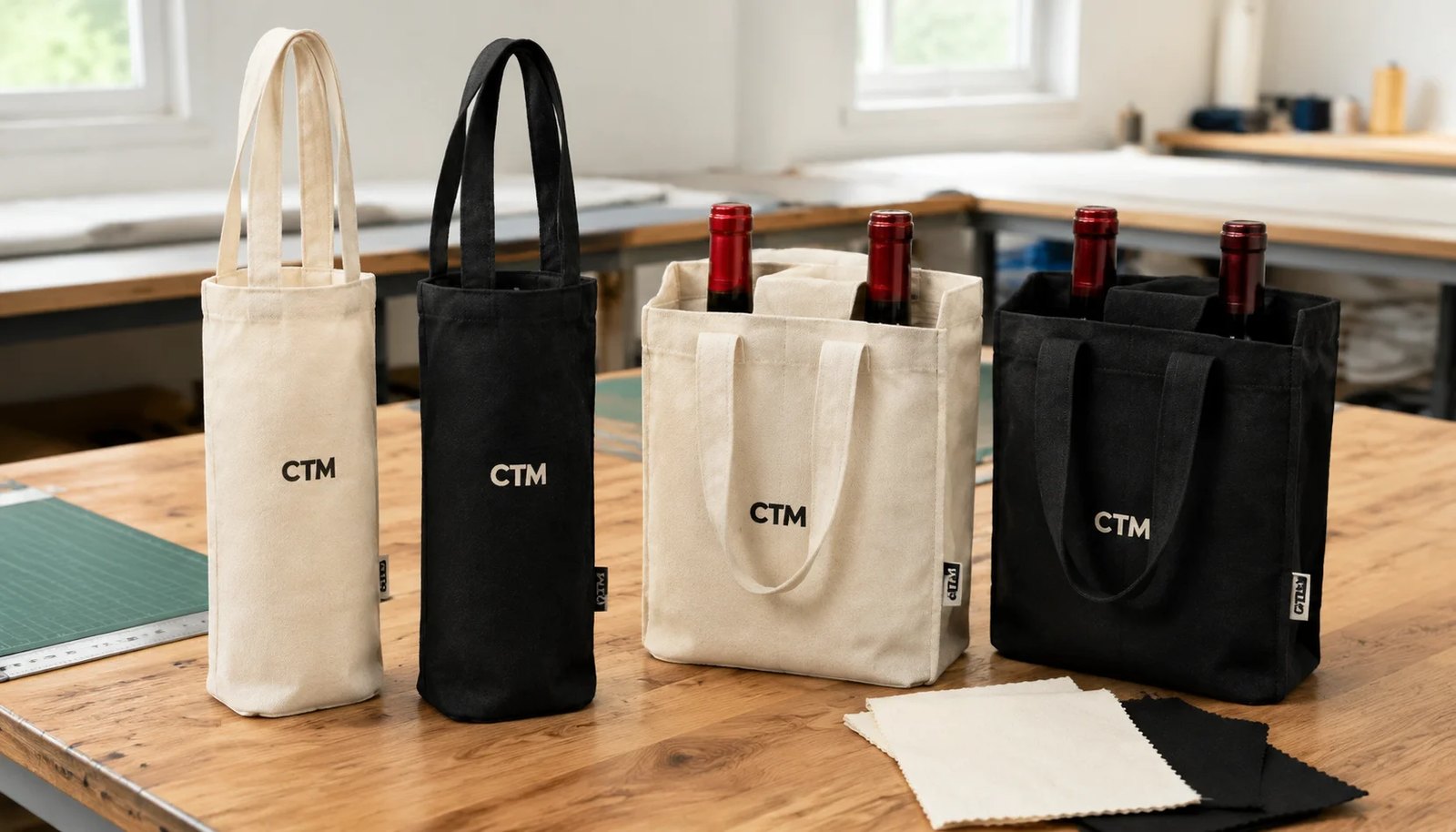
Why fabric weight is the main buying decision for canvas wine carriers
For natural grocers, a canvas wine carrier usually sits between two jobs: it has to carry a heavy glass bottle safely, and it also has to look presentable enough for shelf display, impulse gifting, or reusable checkout programs. Fabric weight is what connects those two jobs. If the canvas is too light, the bag collapses, the bottle swings, and the print panel wrinkles. If the canvas is too heavy, the bag cost rises, print detail may get rougher, and carton efficiency drops.
Buyers often receive quotes that look close in price but are built around different fabric assumptions. One supplier may quote 8 oz natural canvas for a single bottle, another may quote 12 oz dyed canvas with reinforced bottom. Both can be called a canvas wine carrier, but they are not commercially equivalent. The right starting point is not the lowest GSM you can get away with. It is the GSM that fits your bottle weight, shelf presentation standard, and target retail use cycle.
- Single bottle programs usually work in 340 to 407 GSM when construction is sound.
- Two-bottle or gift-set formats typically need 407 GSM and above, especially with dividers.
- Heavier fabric improves structure, but reinforcement and handle sewing still matter more than cloth weight alone.
- A natural grocer environment often favors unbleached or lightly processed canvas, so appearance tolerance must be written into approval.
Recommended GSM ranges by carrier format and store use
A one-bottle wine carrier for standard 750 ml bottles usually performs well in 10 oz to 12 oz canvas, roughly 340 to 407 GSM. That range gives enough body for a stable front panel while still allowing a reasonable fold for export packing. At the lower end, the bag feels more promotional. At the upper end, it feels more giftable and resists collapse better on shelf. If the grocer intends the bag as a value-add with occasional reuse, 10 oz may be enough. If it is sold as a reusable accessory, 12 oz is usually safer.
For two-bottle carriers, or bottle plus jar/olive-oil gift sets, move up to 12 oz to 14 oz and review the structure, not just the cloth. Two bottles create side swing and bottom stress that cannot be solved by fabric weight alone. In these formats, a center divider, cleaner bottom fold, and reinforced seams are what prevent the bag from looking tired after a few uses. A heavy fabric without internal control still lets bottles collide and distort the shape.
- 8 oz to 9 oz canvas can work for lightweight promo use, but it is risky for premium grocery shelf presentation.
- 10 oz to 12 oz is the common commercial zone for one-bottle carriers.
- 12 oz to 14 oz suits two-bottle and stronger retail presentation needs.
- 14 oz to 16 oz should be justified by premium positioning, not used by default, because cost and packing volume rise quickly.
- If bottles are sparkling-wine shape or oversized Burgundy style, side gusset should be reviewed before finalizing GSM.
Natural, bleached, and dyed canvas: weight is only part of the result
Natural grocers often prefer unbleached or natural cotton canvas because it looks less processed and aligns with a more earthy merchandising style. This is fine, but buyers should not treat natural canvas as a defect-free white surface. Natural cloth can show seed fleck, minor yarn slub, and slight shade difference by lot. Those are not manufacturing failures if the material was specified as natural. The commercial mistake happens when the buyer expects bright, clean, nearly uniform color from a natural fabric quote.
Dyed canvas changes the buying calculation. Black, olive, navy, or dark wine tones can elevate shelf appearance and hide handling marks, but dark shades introduce fixation and rubbing risks. If the bag may sit next to white bottle labels or tissue wrap, crocking resistance matters. Dyed heavy canvas can also become stiffer, which is good for structure but can affect fold marks during shipping. This is why fabric approval should include color, handfeel, and loaded appearance, not just a swatch card.
- Natural canvas: lower processing feel, rustic appearance, normal fleck variation.
- Bleached canvas: cleaner print ground, brighter base, usually higher expectation for shade consistency.
- Dyed canvas: stronger visual impact and stain masking, but request rubbing test information.
- If using recycled cotton blends, verify surface smoothness because lint and nep can affect logo edge definition.
Print method should follow the fabric texture, not the other way around
Many logo issues blamed on the printer actually begin with fabric selection. Medium-weight natural canvas with visible texture is excellent for one-color or two-color screen print, simple line art, and bold branding. It is a poor surface for very fine serif text, gradients, or tight registration. If the brand artwork depends on delicate detail, either move to a smoother fabric finish, simplify the logo application, or choose a woven label. Trying to force a complex print onto a textured heavy canvas often raises reject risk without improving shelf appeal.
For natural grocers, understated branding often works better commercially anyway. A small one-color screen print, a stitched cotton patch, or a woven side label usually looks more aligned with the category than a large glossy transfer. Buyers should also think about how the carrier is displayed. If bags hang side-on, a side label or gusset print may be seen more often than a front print. Print area and placement should therefore be chosen around actual retail presentation, not only artwork preference.
- Screen print is usually the best cost-to-result option on 10 oz to 14 oz canvas.
- Heat transfer can work for detailed art, but heavy texture may reduce edge cleanliness.
- Embroidery can look premium, but thread pull on small panels may distort the bag face.
- Woven labels are often more consistent than direct print for small logos on textured cloth.
- Set minimum artwork line thickness and print placement tolerance before sample approval.
MOQ logic: why fabric weight and color can change your minimum order fast
MOQ on canvas wine carriers is rarely only a sewing issue. Fabric stock availability drives much of the minimum. A supplier may hold 10 oz natural canvas as a regular stock item and quote a low MOQ for a one-color print order. Change that to a custom dyed 13 oz canvas with an internal divider and the MOQ jumps, not because the bag is complicated, but because the mill or dye lot requirement is different. Buyers comparing quotes should separate sewing MOQ from fabric-color MOQ and print setup MOQ.
This matters for natural grocers running seasonal or regional programs. If one design is spread across many stores with the same fabric and only barcode or hangtag changes, you may keep MOQ manageable. But if every region wants a different fabric shade or art variation, minimums can multiply. A practical RFQ tells the factory what can be shared across SKUs: same canvas, same lining policy, same handle spec, same carton, different print only. That often protects both MOQ and unit economics.
- Stock natural canvas generally supports the lowest MOQ.
- Custom dyed heavy canvas often triggers fabric lot minimums.
- Print screens or transfer setup can create MOQ per artwork version.
- Internal dividers and bottom inserts add labor time but usually do not drive MOQ as much as custom fabric does.
- Shared components across multiple SKUs can improve the quote if the buyer states them clearly.
Sample approval: use a loaded sample, not only a flat visual sample
A flat sample can confirm rough size, fabric, and branding, but it does not reveal how a wine carrier behaves under load. A bag that looks acceptable empty may twist when a bottle is inserted, buckle at the bottom, or pull the print off-center because the seam balance is wrong. For this category, a pre-production sample should be evaluated with the actual intended bottle format inside. That is especially important for two-bottle styles and any bag with a narrow base or long handles.
Approval should also be split into stages. First approve fabric and color. Then approve print strike-off or label placement. Then approve the fully sewn loaded sample. If all comments are collapsed into one approval step, suppliers often revise one element while accidentally changing another. A retained signed sample or clearly marked digital approval pack is useful here, including front photo, side photo, bottom photo, measured dimensions, handle drop, and bottle inserted view.
- Load the sample with the actual bottle type, not a bottle of similar height only.
- Photograph standing stability, side gusset opening, and handle angle under load.
- Measure usable internal width if adding divider panels.
- Review print appearance both flat and when the bottle fills the bag body.
- Retain approved sample notes for shade, fleck, stitching, and packing fold direction.
Construction details that affect quote value more than buyers expect
Two suppliers can quote the same GSM and dimensions and still deliver very different bags. The hidden differences are usually in seam allowance, handle attachment, bottom reinforcement, and whether there is any internal divider support. A low quote may save labor by using a simpler folded bottom, shorter seam allowance, no reinforcement tape, or lighter handles than the body fabric suggests. These points do not always appear in a headline quote line, so the buyer has to bring them into the RFQ.
For wine carriers, handle strength and bottom geometry are more important than decorative finishing. A neat-looking bag with weak handle stitching is a retail complaint waiting to happen. Likewise, a front panel that prints beautifully but collapses around the bottle does not support premium shelf positioning. If unit cost pressure is high, reduce noncritical extras first, such as oversized print area or complex hangtags, before downgrading structural construction.
- Preferred handle attachment: box-X or reinforced cross stitch with even backstitching.
- Self-fabric handles should be folded and topstitched cleanly to control stretch and fray.
- Two-bottle formats benefit from divider anchoring at base, not just a floating center panel.
- Bottom inserts can improve shape but add packing complexity and should be specified clearly.
- Seam allowance too small can show twisting after first loaded use, even if the bag passes visual inspection empty.
Packing plan and carton math: where a heavy canvas bag can lose margin
Packing is where premium-feeling wine carriers can quietly become expensive. Heavier canvas, divider panels, and long stitched handles increase folded thickness and reduce units per carton. That affects not just freight cost but warehouse handling and store replenishment. Some buyers optimize the bag spec and ignore the carton result until booking time. By then, the landed cost is already fixed. For this product, asking for folded packing photos and carton dimensions during quotation is not premature; it is necessary.
The right fold method depends on whether retail presentation matters on arrival. If bags will be inserted into gift displays, over-compressed folding can create lasting panel creases and distorted logo areas. If they are sold at checkout from a bin, tighter compression may be commercially acceptable. Polybag use should also be deliberate. Many natural grocers want lower plastic, but dark dyed bags or printed light-base bags may still need protective inner packing to prevent rub during transit. The tradeoff should be costed, not assumed.
- Request units per carton, carton size, and estimated gross weight before PO issue.
- Review whether handles are tucked inside or wrapped around the folded body; this changes crush marks.
- For premium retail display, avoid excessive carton compression ratio just to reduce freight.
- If skipping individual polybags, consider tissue interleave or master poly liner where rub risk exists.
- Carton marking should identify SKU, color, quantity, and PO reference clearly for mixed-store distribution.
Lead time risks specific to canvas wine carriers for grocery programs
Wine carriers look simple, but schedule risk often comes from approval sequencing. Fabric color approval, print strike-off, and loaded sample approval each affect the next step. If a buyer sends artwork before confirming bottle dimensions, the print placement may need to move after the final pattern is cut. If natural fabric shade is approved from one roll and bulk comes from another lot, hold points may be needed before cutting. The product is not technically complex, but it is sensitive to specification drift.
Seasonality adds pressure. Grocery gifting programs compress around holiday resets, local wine promotions, and harvest-related events. A missed sample week can move the whole production slot. Buyers should therefore separate estimated lead time from committed production lead time. A quote saying 35 days production may still depend on five prior approvals and fabric availability. The practical way to manage this is to issue a spec lock date for artwork, dimensions, and packing, then track only changes after that as schedule risks.
- Natural or custom dyed fabric may add lead time if not from stock.
- Artwork revisions after pattern confirmation can delay screen setup and sample remake.
- Divider or insert changes late in development usually affect packing dimensions too.
- Holiday programs need extra time for carton labeling, assortment control, and port congestion.
- Ask suppliers to state which materials are stock-supported and which require fresh procurement.
How to compare quotes on a landed-cost basis instead of unit price only
A useful quote comparison puts unit price beside fabric GSM, dimensions, print method, packing density, and freight impact. A bag quoted at a lower ex-factory price may use lighter canvas and fit more units per carton, but if it causes higher retail damage, lower perceived value, or customer returns, it is not cheaper in practice. At the other end, an overbuilt 14 oz bag with bottom insert may be excellent product-wise but wrong for a high-volume checkout program where shipping cube matters more than deluxe handfeel.
A simple landed-cost review should include at least these variables: quoted unit price, units per carton, carton CBM, gross weight, sample approval cost if any, expected reject exposure from natural shade variation, and retail fit. Buyers should also compare whether the quote includes standard export packing, barcode labels, or separate markups for those items. The purpose is not to force every supplier into the same construction. It is to understand which quote actually matches the intended store program.
- Compare GSM and construction before comparing price per piece.
- Add freight cube effect to any move from 10 oz to 14 oz fabric.
- Separate one-time sample or setup charges from repeat-order economics.
- Consider retail use cycle: promo giveaway, resale accessory, or gift-pack item.
- Use EXW and FOB comparisons consistently across suppliers to avoid hidden logistics differences.
Specification comparison for buyers
| Spec decision | Recommended option | When it fits | Buyer risk to check |
|---|---|---|---|
| Single-bottle carrier body weight | 10 oz to 12 oz canvas, about 340 to 407 GSM | Best for everyday grocery retail, promo resale, and standard 750 ml bottle carry | Below about 300 GSM, side panels may wrinkle heavily and bottom support can feel weak once bottle is loaded |
| Two-bottle carrier body weight | 12 oz to 14 oz canvas, about 407 to 475 GSM | Fits pairs, gift sets, and higher perceived value programs where bottle swing must be reduced | If divider and bottom are not reinforced, heavier cloth alone will not stop bottles knocking together |
| Premium gift-store handfeel | 14 oz to 16 oz canvas with softer enzyme-washed finish only if approved | Useful for holiday displays and higher ticket organic wine or olive oil gift bundles | Soft wash can shift shade lot to lot and may reduce print sharpness unless strike-off is approved |
| Natural unbleached fabric choice | 8 oz to 12 oz natural cotton canvas with visible cotton seed fleck acceptable | Good for natural grocers wanting earthy appearance and lower dye processing | Shade variation and fleck level must be approved in sample; some buyers reject normal natural cotton variation by mistake |
| Black or dark dyed canvas | 12 oz canvas with reactive dye or vat-dyed fabric for deeper shade stability | Works for wine clubs, premium shelves, and stronger stain masking at retail | Dark fabric can crock onto light labels or tissue if dye fixation is poor; request rub test result and lining policy |
| Print method on medium-weight canvas | 1-color or 2-color screen print | Best balance for natural grocer private label runs because setup cost is manageable and logo remains readable on textured cloth | Fine lines can break on coarse weave; artwork minimum line thickness and print position tolerance should be written into approval |
| Print method on textured premium look | Woven label or small cotton patch plus simple print | Useful when rustic look matters more than full-color branding | A large print on heavy textured canvas may look uneven; buyers sometimes pay more for embroidery when woven label would be cleaner |
| Handle construction | Self-fabric handles with cross stitch or box-X and folded seam allowance | Reliable for bottle weight and frequent in-store handling | Handle length inconsistency causes poor shelf presentation; set tolerance and load test requirement in QC plan |
| Bottom support | Folded bottom seam plus internal reinforcement tape or insert if using 2-bottle format | Needed where upright display and repeat use matter | Some factories quote low by omitting reinforcement, which leads to bottom sag and distorted print panel |
Buyer checklist before sampling
- Define bottle format first: 1-bottle, 2-bottle, or mixed gift set. Fabric weight selection is different once width and divider structure are fixed.
- State target GSM range, not only ounce fabric language. Many quote sheets use oz loosely and conversions are often inconsistent.
- Specify whether the natural grocer accepts unbleached cotton fleck and mild shade variation, or requires cleaner bleached appearance.
- Write bottle size in the RFQ: standard 750 ml Bordeaux, Burgundy, sparkling bottle, or oil bottle. Diameter affects side gusset and bottom stress.
- Set handle construction requirement: webbing or self-fabric, stitch pattern, attachment point, and minimum safe load expectation.
- Match print method to canvas texture and artwork detail. Fine text on coarse natural canvas should be avoided unless pre-tested.
- Approve a pre-production sample with an actual filled bottle inside, not a flat empty sample only.
- Request packed carton dimensions, gross weight, and units per carton early. Bottle bag shapes can waste carton space if folded poorly.
- Separate sample approval into fabric handfeel, print appearance, and loaded shape performance. One approved point should not imply all are approved.
- Require quote line items for fabric, printing, trims, and packing if comparing multiple suppliers; otherwise low quotes hide downgraded construction.
Factory quote questions to send
- What is the exact fabric specification in GSM, weave, yarn count if available, and whether weight is greige, dyed, or finished?
- Is the quoted canvas plain weave cotton, cotton-poly blend, or recycled cotton blend, and how does that change print appearance and strength?
- What bottle size was used to develop the quoted bag dimensions and can you share a filled sample photo from front, side, and bottom?
- Does the quote include an internal divider, bottom reinforcement, seam tape, or any hidden support parts for 2-bottle versions?
- What print method is included, how many colors, what is the maximum print area, and what artwork line thickness do you recommend on this canvas texture?
- What is the MOQ by fabric color and by logo design, and is the MOQ driven by fabric stock, dye lot, printing setup, or sewing efficiency?
- What are the sample lead time, production lead time, and the points at which artwork, fabric, and packing must be frozen to avoid delay?
- How will bags be folded and packed per carton, and what is the estimated carton count, carton size, and gross weight for the order quantity?
- What in-line and final QC checkpoints do you apply for handle attachment strength, seam tolerance, print placement, and fabric weight variation?
- Can you quote EXW and FOB separately and identify any optional cost for polybag, hangtag, barcode sticker, woven label, export carton marking, or drop test requirement?
Quality-control points to confirm
- Fabric weight should be verified from bulk fabric, not only supplier declaration. A practical acceptance range should be agreed because finished GSM can vary after dyeing and washing.
- Bag dimensions should be measured both flat and with bottle inserted. Flat dimensions alone do not show whether the gusset opens correctly.
- Handle attachment must be visually clean and structurally consistent, with no skipped stitches, loose thread nests, or asymmetrical box-X reinforcement.
- Print placement tolerance should be written in millimeters from top edge and center line. Canvas texture can make small logos look off-center if no tolerance is agreed.
- Natural canvas shade and fleck level should be approved against a retained sample. Otherwise normal cotton variation becomes a recurring dispute.
- For dark dyed bags, run dry and damp crocking checks against a white cloth or tissue to reduce risk of color transfer onto bottle labels or packaging.
- Bottom seam straightness and reinforcement are critical on wine carriers because loaded product exposes twisting and sag immediately at retail.
- Packed cartons should be checked for over-compression. Excessive pressing creates hard fold lines and distorts printed panels on arrival.