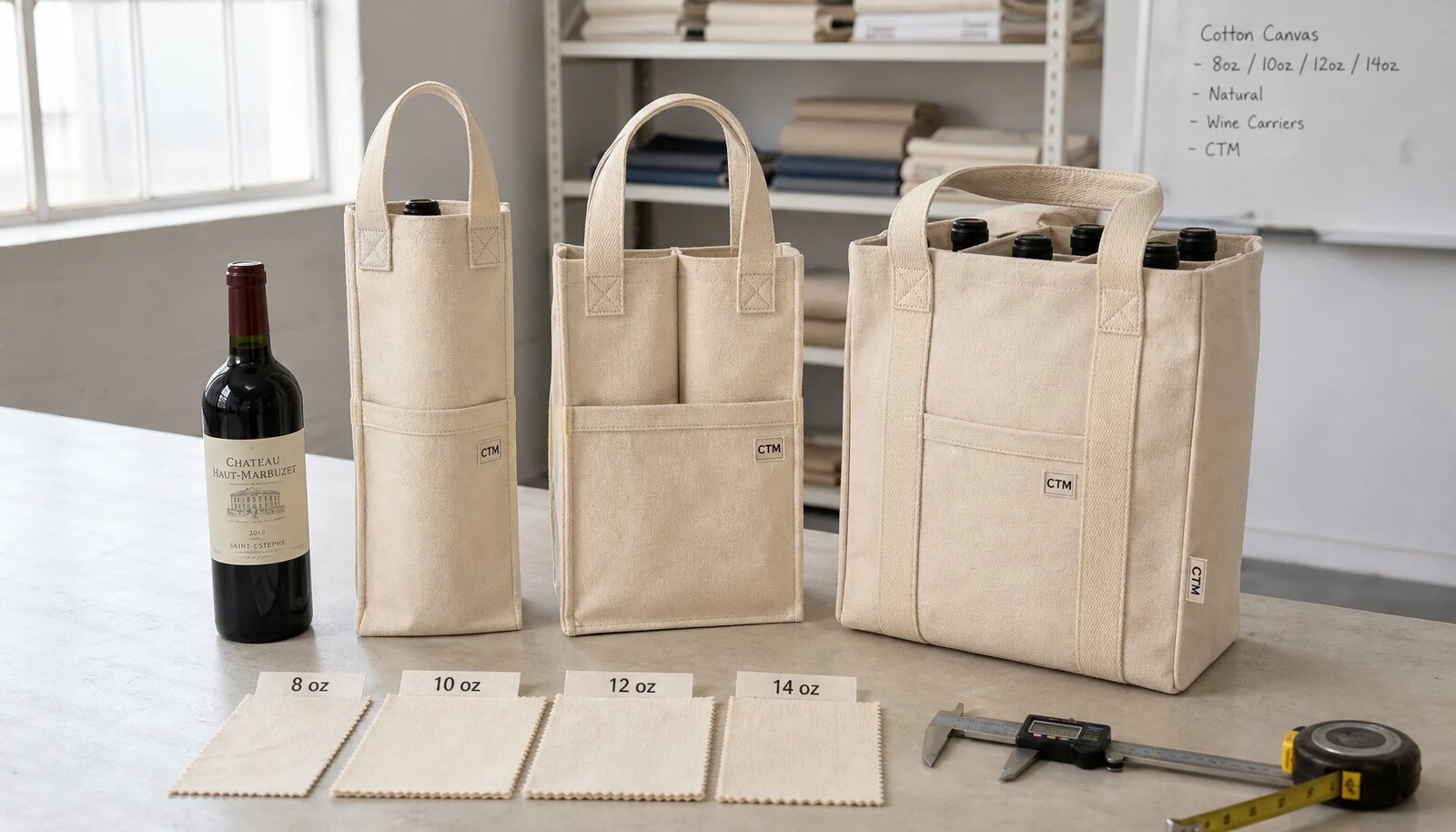
Start With Finished Fabric Weight, Not a Fabric Name
“Canvas wine carrier” sounds specific, but it is not enough for procurement. Cotton canvas can change dramatically by yarn count, weave density, finishing, shrinkage, stiffness, and surface texture. One supplier may use the term 12 oz canvas as a familiar mill name. Another may quote a measured finished GSM. If those two offers are compared without clarification, the buyer may select a carrier that arrives thinner, softer, heavier, stiffer, or less printable than expected.
A useful canvas wine carriers fabric weight guide for craft fairs starts with a controlled weight range. For most sourcing projects, the practical range is 8 oz to 16 oz cotton canvas, approximately 271 GSM to 542 GSM. Many single-bottle and two-bottle retail carriers land in the 10 oz to 12 oz range because these fabrics provide enough body for table display and customer carry, while still keeping sewing, packing, and freight reasonably efficient. Lightweight 8 oz canvas can work for basic single-bottle giveaways. Heavy 14 oz or 16 oz canvas can suit premium or multi-bottle programs, but it brings seam bulk, slower sewing, heavier cartons, and possible landed-cost pressure.
The key word is finished. Dyeing, washing, coating, laminating, calendaring, and printing can all change the hand-feel and measured weight. A greige fabric weight before finishing is not the same control point as finished GSM before cutting. For repeat craft fair seasons, keep a signed swatch from the approved pre-production sample and require the factory to compare bulk fabric against that swatch before cutting production.
- Use both oz/yd² and GSM in the RFQ so domestic, overseas, merchandising, and QC teams work from the same target.
- Treat 10 oz, about 339 GSM, as a practical starting point for many branded single-bottle carriers.
- Treat 12 oz, about 407 GSM, as a stronger retail option when upright structure and perceived value matter.
- Use 14 oz, about 475 GSM, only after checking seam bulk, carton weight, needle suitability, and sewing feasibility.
- Reserve 16 oz, about 542 GSM, for heavy-duty or premium programs where freight and handling impact are acceptable.
- Write whether the quoted weight is finished fabric weight, not greige weight or an informal fabric description.
Convert Oz, GSM, and Tolerance Before Pricing
Canvas weight conversions are helpful, but they should not be treated as exact laboratory promises. In everyday sourcing language, 8 oz canvas is often discussed around 271 GSM, 10 oz around 339 GSM, 12 oz around 407 GSM, 14 oz around 475 GSM, and 16 oz around 542 GSM. Finished measurement can still move because of yarn, weave, moisture content, finishing, and the supplier’s measurement method. That is why the purchase order should include a target, a tolerance, and the stage at which the fabric is measured.
A commercial tolerance should be agreed before production begins. Many buyers use a finished fabric weight tolerance such as +/-5% when the application allows it. For a premium retail item or a repeat replenishment program, the buyer may want tighter control or mandatory approval if the bulk lot falls outside the retained swatch and agreed range. The tolerance number matters, but it is only part of the control. The method, timing, and reference sample matter just as much.
Do not wait until final inspection to discover that the fabric is wrong. Ask the factory to measure the bulk fabric lot before cutting, record the GSM, and compare hand-feel, shade, weave, and stiffness against the approved swatch. Natural cotton canvas may show slubs and some shade variation; those characteristics should be reviewed at sample stage so they do not become a dispute later. Dyed canvas needs even clearer shade control because a small color shift can be obvious when carriers are displayed together on a craft fair table.
- RFQ example: 12 oz cotton canvas, approximately 407 GSM finished fabric, tolerance to be agreed in PO.
- State whether the fabric is natural, bleached, dyed, washed, coated, laminated, organic, recycled, or conventional cotton.
- Ask when GSM is measured: greige stage, after dyeing, after washing, after coating, or finished before cutting.
- Keep a signed production swatch from the pre-production sample for incoming fabric review and final inspection reference.
- For dyed fabric, approve shade under consistent lighting and keep the approved swatch with the PO file.
- Do not approve repeat orders by hand-feel only; compare GSM, shade, weave, stiffness, surface defects, and the retained sample.
Match Weight to Bottle Count and Real Bottle Geometry
A wine carrier is a load-bearing product. It is not just a printed cotton bag. A filled 750 ml bottle commonly weighs about 1.2 kg to 1.6 kg depending on glass weight, closure, and bottle style. Sparkling bottles and premium heavy-glass bottles can be heavier. Two bottles can put more than 3 kg on the handle system, and a six-bottle carrier becomes a meaningful load once glass and liquid are included. Fabric weight helps, but the full construction must match the bottle count.
Bottle shape matters as much as total weight. Bordeaux bottles are usually straighter and easier to fit. Burgundy bottles are wider through the shoulder. Sparkling wine bottles are often wider, taller, and heavier. Dessert wine, cider, spirits, olive oil, and specialty gift bottles can have completely different base, neck, shoulder, and height requirements. A carrier described as fitting a standard 750 ml bottle may still fail if the actual bottle has a wide shoulder or heavy glass base.
Before sampling, give the factory a bottle specification sheet. At minimum, include total height, maximum body diameter, base diameter, widest shoulder area, and filled weight. For mixed craft fair assortments, approve the carrier with the largest and heaviest bottle, not the easiest Bordeaux-style bottle. During sample review, check whether the bottle slides in without forcing, whether the bottom sits flat, whether the neck stays centered, whether the loaded carrier stands upright on a table, and whether the top edge covers or exposes the bottle exactly as intended.
- Single-bottle carriers: 8 oz to 12 oz depending on price point, reuse expectation, target presentation, and required structure.
- Two-bottle carriers: 10 oz to 14 oz with a fixed divider, reinforced handle attachment, and stable bottom gusset.
- Four-bottle carriers: 12 oz to 16 oz with stronger dividers, wider handles, and controlled base sag.
- Six-bottle carriers: 14 oz to 16 oz or reinforced construction with webbing handles and a structured bottom insert.
- Sparkling bottle programs require separate testing for height, shoulder width, diameter, filled weight, and neck clearance.
- Mixed bottle programs should be sampled with the widest, tallest, and heaviest bottles in the approved assortment.
Specify Handles as Load-Bearing Components
Handle failure is one of the highest practical risks in a canvas wine carrier program because the customer is carrying glass. A heavier body fabric will not compensate for weak handle attachment, narrow handles, low stitch density, or poor reinforcement. In a B2B spec, handles should be treated as functional components: material, width, length, drop, attachment area, stitch pattern, thread, and loaded performance requirement all need to be visible.
Self-fabric handles give a clean matched look and are common on branded craft fair wine carriers. Cotton webbing handles often feel more comfortable under heavier loads and can reduce sewing bulk compared with thick folded canvas. A typical handle width range is 25 mm to 38 mm. Narrower handles may be acceptable for low-cost single-bottle giveaways, but heavier multi-bottle carriers usually need wider webbing or reinforced self-fabric handles with enough surface area at the load points.
The reinforcement method should be part of the drawing or sample approval, not a loose promise. Common options include box-X stitching, bartacks, double rows, or dense stitching through sufficient fabric layers. Avoid vague notes such as strong handle or reinforced handle unless the approved sample clearly shows the reinforcement size, thread color, stitch density, and location from finished bag edges. Small changes at this point can have a large effect on customer confidence.
- Define handle material as self-fabric canvas, cotton webbing, contrast webbing, dyed-to-match webbing, or another approved tape.
- Specify width, total handle length, handle drop, attachment point spacing, and visible stitch pattern.
- Use box-X, bartack, or dense reinforced stitching at load points rather than a single straight seam.
- Require loaded testing with the intended bottle count and the heaviest expected filled bottle weight.
- Check for needle cutting, fabric tearing, loose stitches, broken thread, and seam distortion around folded heavy canvas.
- For four-bottle and six-bottle carriers, prioritize handle comfort and load distribution, not only body fabric weight.
Design Dividers, Bottoms, and Gussets for Stability
Dividers and bases decide whether a multi-bottle carrier feels safe, useful, and retail-ready. A two-bottle bag with a loose center divider may look fine when empty, then allow glass contact when a shopper walks across a parking lot. A six-bottle carrier with a weak bottom can sag, lean, or distort on the booth table. These are construction issues first and fabric weight issues second.
For two-bottle carriers, a sewn center divider may be enough if it reaches a practical height and is secured at the correct seams. For four-bottle and six-bottle carriers, buyers should define the divider grid, divider material, attachment points, and base support. Options may include canvas dividers, cotton or polyester tape reinforcement, heavier insert panels, removable boards, or sewn-in stiffeners. Each choice affects labor, packing thickness, recyclability, stability, and appearance.
The bottom gusset needs to be measured and checked while bottles are loaded. A carrier can meet the flat drawing and still fail because the gusset is too shallow, the bottom corners are poorly formed, or the base reinforcement shifts inside the bag. If the carrier must stand upright on a craft fair table, test it empty, loaded, and after flat packing. Heavier canvas has better body, but it can also hold hard fold lines, so the packing method can influence how the base opens during event setup.
- Specify divider height from the finished bottom seam or base panel, not only as full height or half height.
- Define whether dividers are fixed, removable, sewn into side seams, sewn into the base, or attached as a grid.
- For multi-bottle carriers, define bottom gusset depth and whether base reinforcement is canvas, board, or sewn stiffener.
- Check bottle-to-bottle contact during light movement, not only when the carrier is standing still.
- Inspect whether the loaded carrier sits flat and does not lean excessively on a table.
- Confirm whether base inserts create sharp edges, curling, odor, moisture risk, disposal issues, or recycling concerns.
Choose Print Method After Fabric and Artwork Are Known
Decoration should not be quoted as a generic logo application. Canvas texture changes how ink, transfers, embroidery, and labels perform. Fine linework that appears crisp on smoother 8 oz canvas may break up on coarse 14 oz canvas. A large solid screen print can look bold but feel stiff if the ink deposit is heavy. Embroidery may add a premium look, but it can distort lighter fabrics or lose small text detail.
Screen printing is often the practical choice for craft fair wine carriers with bold logos, one-color marks, event names, and repeat orders. It works best when artwork respects the weave texture and minimum line thickness. Heat transfer can support multicolor artwork, gradients, and shorter runs, but the transfer edge and hand-feel need approval on the actual canvas. Embroidery works best with simple marks and controlled stitch density. Woven labels are useful when the buyer wants small detail, consistent branding across multiple bag colors, or less risk from printing directly onto textured fabric.
Put artwork requirements in the RFQ instead of solving them after pricing. Provide print size, location, color count, Pantone or brand color reference, file format, and acceptable placement tolerance. Print position should be measured from finished bag edges, seams, or handle points, not from an unsewn panel. During QC, inspect color, registration, edge clarity, pinholes, dry rub, cracking, odor, and ink transfer between stacked carriers.
- Use screen print for bold logos, simple line art, one-color marks, and repeatable event branding.
- Use heat transfer for detailed multicolor artwork when the buyer accepts transfer hand-feel and edge visibility.
- Use embroidery for premium simple marks, not for very small text, gradients, or dense large fill areas.
- Use woven labels for small brand detail, multi-color fabric programs, and repeat style consistency.
- Set print placement tolerance in millimeters from finished bag edges or seams.
- Approve decoration on the same fabric weight and color planned for bulk production.
Compare Costs by Total Landed Sellable Unit
Fabric weight affects more than fabric cost. Heavier canvas uses more material, cuts more slowly, creates thicker folded seams, may require stronger needles, and can reduce sewing efficiency. It can also lower the number of pieces per carton and increase gross carton weight. A 14 oz carrier that looks only slightly more expensive at FOB level may cost noticeably more after ocean freight, warehousing, domestic handling, and craft fair distribution are included.
Under-specification has a cost too. A carrier that is too light, unstable, poorly printed, or weak at the handles can lead to returns, markdowns, rework, missed event sales, or damage to the buyer’s brand presentation. The buyer should first define the product tier: free giveaway, checkout carrier, reusable retail item, winery merchandise, or premium gift carrier. Each tier deserves a different balance of fabric weight, reinforcement, decoration, packaging, and inspection.
To compare suppliers fairly, control the quote. Ask the same factory to price 10 oz, 12 oz, and 14 oz options using identical finished dimensions, handles, dividers, print method, packing, and carton assumptions. Then ask other factories to quote the same specification. This prevents a low offer from being built on a lighter handle, thinner divider, cheaper carton, lower stitch density, or excluded decoration setup.
- Compare FOB unit price together with carton quantity, carton size, carton gross weight, and estimated landed cost.
- Separate one-time setup charges for screens, transfers, embroidery digitizing, labels, and tooling if any.
- Ask whether quoted prices include pre-production sample, carton marking, inner packing, barcode labels, and inspection support.
- For dyed canvas, include fabric MOQ, dye lot approval, shade risk, and extra lead time in the cost comparison.
- For multi-bottle carriers, price dividers and base reinforcement as separate visible line items when possible.
- Evaluate cost per sellable carrier, not only the lowest unit price on the quote sheet.
Plan MOQ Around Fabric, Artwork, and Packaging Versions
MOQ is rarely one simple number for canvas wine carriers. It can change by fabric availability, color, dyeing, decoration method, bag size, divider complexity, packaging, and factory scheduling. Natural cotton canvas in a common weight is usually easier to source than custom dyed canvas. A plain single-bottle carrier is easier to schedule than a six-bottle carrier with a divider grid, base insert, hangtag, and several artwork versions.
Separate the carrier body MOQ from the decoration MOQ. Some buyers can make one blank carrier style and decorate it with multiple winery logos or event names. Others need fully finished, packed units by SKU. If the RFQ does not show this structure, suppliers may quote a blended MOQ that becomes difficult to manage later. Ask for MOQ by fabric color, body style, print version, label version, packaging version, and shipment split.
Packaging can be the hidden MOQ driver. Hangtags, paper bands, barcode labels, printed cartons, retail sleeves, and individual polybags may each have separate supplier minimums. For craft fair programs with multiple designs, the packaging version count may become more complicated than the bag itself. Decide early whether the carrier is sold as merchandise, used as gift packaging, or kept behind the booth for checkout, because each use case has different packaging expectations.
- Plain natural canvas usually gives the most flexible MOQ and fastest sampling path.
- Custom dyed canvas can create fabric MOQ, lab dip approval, bulk shade approval, and dye lot risk.
- Multiple logo versions may increase setup cost even when the combined order quantity is high.
- Different bottle counts should be treated as separate patterns, not simple size variations.
- Divider, handle, and base changes can create separate production setups and inspection references.
- Packaging versions should be counted by SKU before final MOQ and unit price are accepted.
Approve Samples With Measurements, Not Photos Alone
A photo can show the general look of a canvas wine carrier, but it cannot prove fabric weight, handle strength, divider performance, print hand-feel, or loaded stability. For custom programs, the sample process should usually include a fit sample when bottle shape is uncertain, followed by a pre-production sample using bulk fabric, final construction, final decoration, and final packing. The pre-production sample then becomes the inspection standard.
The sample approval sheet should be measurable. Record finished width, height, gusset, bottom depth, divider height, handle width, and handle drop. Check seam allowance, stitch density, print size, print placement, label location, and packing fold. Weigh or verify the fabric against the approved GSM range. Load actual filled bottles and carry the sample long enough to observe handle stress, base sag, seam distortion, and divider movement.
Write sample comments as corrections, not preferences. Instead of “make the handle stronger,” write “use 38 mm cotton webbing, box-X stitch at each attachment, and test with two filled bottles.” Instead of “logo too low,” write “move print 15 mm upward from approved sample position” or “set center of logo 90 mm from top edge.” After approval, sign and date the sample or swatch, link it to the PO number, and keep it available for final random inspection.
- Approve fit first when bottle dimensions are uncertain, then approve the final pre-production sample for bulk production.
- Measure finished dimensions and compare them against written tolerance, not only the supplier drawing.
- Check the carrier empty, loaded, carried by hand, and placed on a table after flat packing.
- Review print color, placement, registration, edge quality, odor, rub, and hand-feel on bulk fabric.
- Record all approved changes in the PO, tech pack, or sample approval form before production starts.
- Keep the approved sample and swatch for repeat order control and final inspection reference.
Write QC Criteria Into the Purchase Order
Quality control is strongest when acceptance criteria are agreed before production. A line such as “good quality canvas wine carrier” leaves too much room for interpretation. The PO or tech pack should define fabric weight tolerance, size tolerance, handle construction, stitch density, seam allowance, divider attachment, base support, print tolerance, packing method, carton marking, and inspection standard.
Dimensional tolerance should reflect the product size and construction. Small carriers may use practical tolerances such as +/-5 mm for key finished dimensions if the pattern and fabric allow it. Larger multi-bottle carriers may need wider tolerances, such as +/-8 mm to +/-10 mm, because of seam bulk and construction complexity. These figures should be agreed with the factory and matched to bottle fit requirements. Print placement also needs a tolerance, usually in millimeters from finished edges, seams, or centerline.
For inspection, define critical, major, and minor issues. Critical defects may include unsafe handle failure, open load-bearing seams, severe mold or contamination, or wrong product construction. Major defects may include wrong fabric weight outside tolerance, poor bottle fit, wrong print color, significant print misplacement, broken stitches, loose dividers, or unstable bases. Minor defects may include small loose threads, slight approved shade variation, or minor wrinkles that do not affect retail appearance. If using AQL inspection, state the chosen AQL levels and defect classification before production.
- Check fabric GSM before cutting and again against the approved swatch during final inspection if needed.
- Inspect loaded handle performance, bottom seams, side seams, divider seams, and reinforcement areas.
- Measure finished size, handle drop, divider height, bottom depth, and print position against the approved sample.
- Reject open seams, skipped stitches at load points, broken bartacks, needle cutting, and weak divider attachment.
- Inspect print for color, placement, registration, rub, cracking, ink transfer, pinholes, and odor.
- Check packing for clean folding, moisture protection, SKU separation, carton strength, carton marking, and barcode readability.
Specification comparison for buyers
| Spec decision | Recommended option | When it fits | Buyer risk to check |
|---|---|---|---|
| Main fabric weight | 10 oz to 12 oz cotton canvas, approximately 339-407 GSM finished weight | Most branded single-bottle and two-bottle craft fair wine carriers needing structure, print clarity, and manageable carton efficiency | Confirm whether the quote states finished fabric weight after dyeing, washing, coating, or printing; do not compare greige weight against finished GSM |
| Lightweight alternative | 8 oz cotton canvas, approximately 271 GSM, with tighter sizing and reinforced handle attachment | Promotional single-bottle giveaways, short carry distance, event sampling, and low retail price points | May collapse around the bottle, show bottle outline, wrinkle more in packing, and feel less retail-ready; test with a filled 750 ml bottle |
| Heavy-duty option | 14 oz cotton canvas, approximately 475 GSM; 16 oz, approximately 542 GSM, only when sewing and freight impact are acceptable | Premium two-bottle carriers, four-bottle or six-bottle carriers, winery merchandise, and gift packaging with higher perceived value | Higher seam bulk, slower sewing, larger needle holes, reduced carton count, higher gross weight, and possible freight cost increase |
| Bottle format | Single and two-bottle carriers for craft fair checkout; four and six-bottle carriers only with defined base reinforcement and divider grid | Retail booths, tasting rooms, wine club pickup, holiday markets, event merchandise, and distributor promotional programs | One pattern rarely fits Bordeaux, Burgundy, sparkling, dessert, and oversized local bottles; approve fit using actual filled bottles |
| Handle construction | Self-fabric or cotton webbing handles, 25-38 mm wide, with box-X stitch, bartack, or dense reinforced stitching at load points | Reusable carriers carried across parking lots, sidewalks, market aisles, lawns, and winery grounds | Handle attachment is a common failure area; require loaded testing after final sewing and decoration, not only on an unfinished sample |
| Size tolerance | Finished bag tolerance of about +/-5 mm for width/height on small carriers and +/-8 mm to +/-10 mm on larger multi-bottle carriers, if agreed in the PO | Custom-sized carriers where bottle fit, retail presentation, and carton planning matter | Loose tolerances can create poor bottle fit, leaning carriers, exposed bottle shoulders, or inconsistent print placement |
| Print method | Screen print for solid logos; heat transfer for detailed short runs; woven label or embroidery for premium branding with suitable artwork | Craft fair buyers needing readable branding, repeatability, reasonable setup cost, and retail appearance | Coarse canvas reduces fine detail; heavy ink can crack or feel plastic; set Pantone targets, print location tolerance, rub check, and artwork limitations |
| Divider and base | Fixed canvas divider or structured insert, with bottom panel reinforcement for two-bottle, four-bottle, and six-bottle carriers | Gift carriers and market totes where bottles must not knock together during normal carry movement | Loose dividers shift, low dividers allow glass contact, weak bases sag; specify divider height, attachment seam, base material, and removability |
| Packing method | Flat packed with clean master liner, paper band, hangtag, interleaving, or individual polybag depending on presentation and sustainability requirements | Wholesale replenishment, booth stock, tasting room stock, seasonal promotions, and retail merchandise | Over-compression creates hard creases on 12 oz and heavier canvas; request carton dimensions, pcs/ctn, NW/GW, stacking limit, and moisture controls |
Buyer checklist before sampling
- Define the exact bottle range before pricing: 750 ml Bordeaux, 750 ml Burgundy, sparkling, 500 ml, dessert bottle, spirits, olive oil, or mixed assortment.
- Provide maximum bottle height, maximum body diameter, shoulder shape, base diameter, neck height if relevant, and filled bottle weight; avoid the phrase standard wine bottle unless dimensions are attached.
- State the commercial use: free giveaway, craft fair checkout carrier, retail resale, winery merchandise, tasting room packaging, gift set packaging, or distributor promotion.
- Specify fabric as cotton canvas by finished weight in both oz/yd² and GSM, and state whether the quoted weight must be measured after dyeing, washing, coating, laminating, or printing.
- List bottle count and structural needs: single, two-bottle, four-bottle, or six-bottle, including divider height, divider attachment, bottom gusset, base reinforcement, and whether inserts are removable or sewn in.
- Set finished size tolerances for width, height, gusset, bottom depth, divider height, handle width, and handle drop instead of approving only a flat drawing.
- Define handle material, width, total length, drop, reinforcement pattern, stitch density, thread type, and minimum loaded carry requirement for the intended bottle count.
- Provide artwork file, print size, color count, Pantone or brand color reference, print position from finished edges, acceptable placement tolerance, and expected hand-feel.
- Ask each supplier to quote the same size, fabric, handle, divider, print, packing, carton quantity, and inspection requirements so unit prices are comparable.
- Request a physical fit sample and a pre-production sample using bulk fabric, final sewing, final decoration, and final packing before authorizing mass production.
Factory quote questions to send
- What cotton canvas weight are you quoting in oz/yd² and GSM, and is it finished weight measured after dyeing, washing, coating, laminating, or other finishing?
- What fabric construction is being quoted, such as plain weave canvas or duck canvas, and can you provide a finished swatch from the same material planned for production?
- Can you quote 10 oz, 12 oz, and 14 oz options using the same finished size, handle construction, divider, print, packing, carton quantity, carton dimensions, and carton gross weight?
- What GSM tolerance can you commit to on finished bulk fabric, and how will it be measured before cutting?
- Can you make the carrier to fit our attached bottle dimensions, including maximum diameter, shoulder shape, height, base diameter, and filled weight?
- What finished size tolerances do you recommend for width, height, gusset, bottom depth, divider height, handle width, and handle drop?
- What is the MOQ by plain canvas, dyed canvas, fabric color, custom print version, custom size, divider construction, hangtag, barcode label, and individual packaging?
- Which decoration methods are suitable for our artwork on this fabric weight, and what limits apply for line width, small text, gradients, large ink coverage, or exact Pantone matching?
- What handle construction do you recommend for our bottle count and target loaded weight, and can you share your standard loaded carry or handle pull test method?
- What thread, needle size range, stitch type, stitch density, seam allowance, and reinforcement pattern will be used at the load-bearing seams?
Quality-control points to confirm
- Fabric weight tolerance should be written into the PO as finished bulk fabric weight, commonly within an agreed percentage range such as +/-5% when commercially acceptable, not as an undefined fabric name.
- Finished carrier dimensions should match the approved sample, with written tolerances for width, height, gusset, bottom depth, divider height, handle width, and handle drop.
- Bottle fit should be checked using actual filled bottles from the buyer's approved range, including the widest, tallest, and heaviest bottle.
- Loaded carry testing should use the intended bottle count and realistic filled weight; inspect handle attachment, upper seams, side seams, bottom seams, divider seams, and fabric distortion after loading.
- Handle attachment should use defined reinforcement such as box-X stitch, bartack, double row stitching, or dense stitching through sufficient fabric layers at each load point.
- Stitching should be even and secure, with no skipped stitches, open seams, loose thread tails, seam twisting, broken stitches, needle cutting, or fabric tearing at folded heavy areas.
- Stitch density should be defined for visible seams and load-bearing seams, for example as stitches per inch or stitches per 3 cm, so factories do not reduce sewing time by using sparse stitching.
- Seam allowance should be specified and checked, especially on bottom gussets, divider seams, and handle attachment areas where narrow allowance can reduce strength.
- Print should be checked for placement tolerance, Pantone or approved color reference, registration, edge clarity, pinholes, dry rub, cracking, ink transfer, odor, and hand-feel on the final fabric weight.
- Divider alignment should be inspected with bottles loaded; dividers should be tall enough and firmly attached enough to reduce bottle contact under normal carry movement.