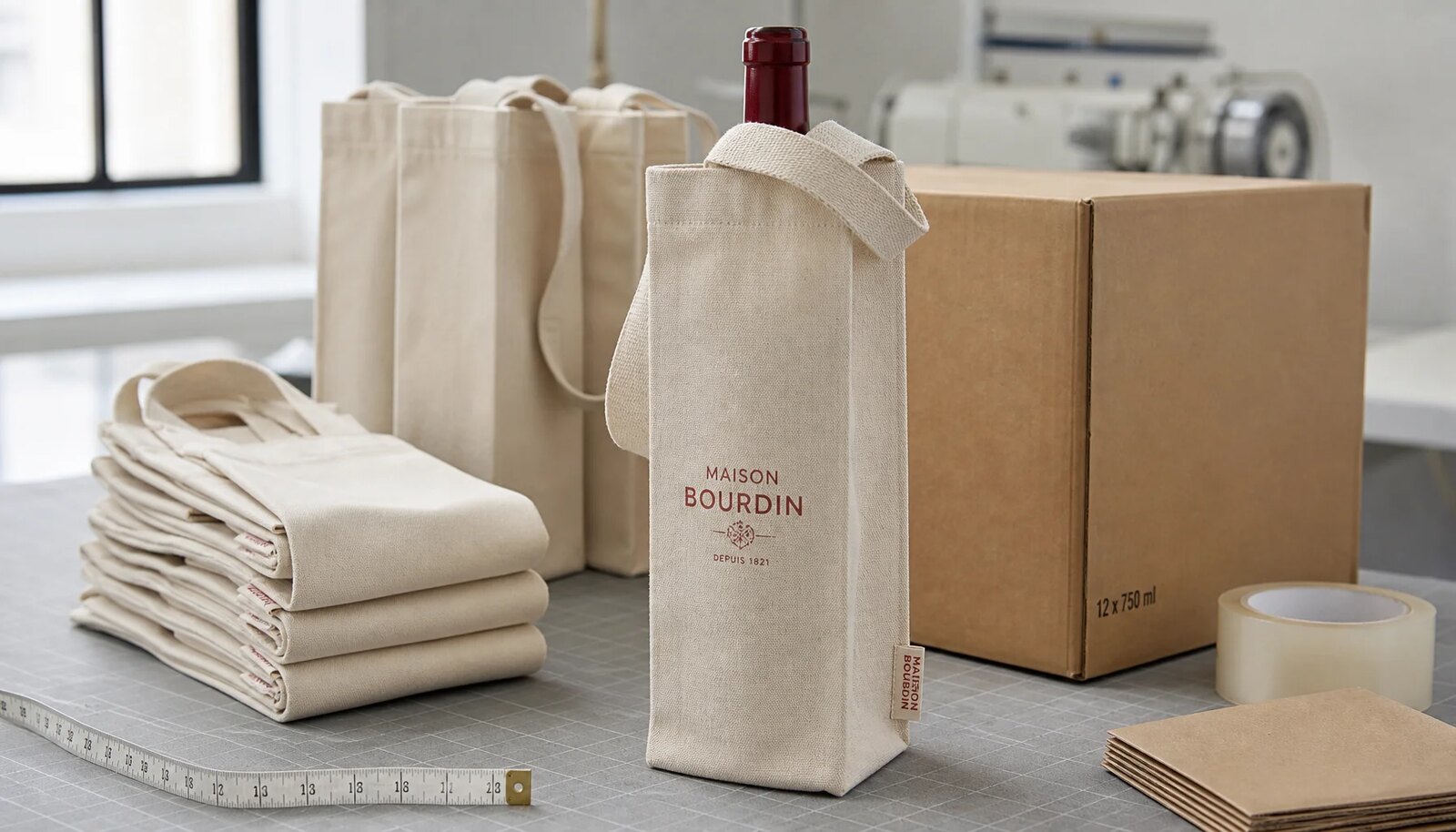
Why carton planning belongs in the first sourcing conversation
Canvas wine carriers for eco apparel brands are small in retail value but bulky in logistics. That makes them easy to under-specify. If the RFQ only asks for a natural canvas bag with a logo, suppliers may quote a low unit price using different fabric weights, handle constructions, folded formats, carton counts, and carton strengths. Those differences can change landed cost more than the buyer expects.
Shipping carton planning should begin before the design is final because the product is not a flat textile once handles, gussets, labels, seams, hangtags, and printed panels are added. A carrier that looks neat when open may become thick on one side when folded. A logo placed near a fold line may rub inside the bundle. A handle reinforced with box-X stitching may improve strength but add bulk at the carton corner. These are normal tradeoffs, but they need to be visible before a purchase order is issued.
For B2B procurement, the practical comparison is not supplier A at one unit price versus supplier B at another. It is unit price plus master carton quantity, carton dimensions, gross weight, carton board type, mixed-SKU risk, inspection method, and receiving labor. Ask for open dimensions and packed dimensions in the same quote table. If one supplier packs 200 units per carton and another packs 120, you cannot compare price until you know whether the 200-unit carton closes flat, survives stacking, and passes print-rub checks.
- Include folded unit size, carton count, carton dimensions, gross weight, and net weight in the first RFQ.
- Ask whether carton dimensions are measured from a real packed sample or estimated from open product dimensions.
- Require single-SKU cartons unless mixed cartons are operationally approved.
- Approve fold direction before approving logo placement.
- Keep product spec, artwork proof, packing sheet, and carton marks under one version-controlled file.
Start with the bottle: size, weight, and use case
A canvas wine carrier must be designed around the bottle it will actually carry. Many buyers say wine bottle, but bottle dimensions vary. A typical 750 ml wine bottle is often around 70-80 mm in diameter and roughly 300 mm tall, while sparkling wine or champagne-style bottles can be wider and heavier. Spirits bottles, olive oil bottles, and promotional gift sets may have different shoulders, caps, or label areas that change the fit.
Filled weight matters. A standard filled glass bottle can be around 1.2-1.6 kg depending on bottle weight and liquid volume; heavier sparkling bottles can exceed that. If the bag is expected to carry two bottles, the load and stress at the handle attachment change immediately. Do not approve a sample only with an empty bottle or a lightweight prop. Test with the intended filled product or a weight-matched dummy.
The use case also sets the required durability. A carrier handed to guests at a one-day event has a different risk profile than a retail reusable carrier sold or gifted with premium apparel. If the carrier must stand upright on a shelf, the gusset and base seam need more control. If it ships nested inside another gift box, folded thickness and handle position may matter more than upright structure. The quote should identify the main use case so the factory is not forced to guess.
- Record bottle height, diameter, shoulder shape, cap or neck exposure, and filled weight.
- Confirm single-bottle, two-bottle, or mixed gift-set configuration.
- Test the sample with the real bottle or equivalent weight.
- Specify whether the product is for event gifting, retail sale, wholesale kits, or warehouse fulfillment.
- If multiple bottle types may be used, design around the largest diameter and heaviest realistic bottle.
Fabric specifications: weight, composition, finish, and tolerances
For most branded single-bottle canvas wine carriers, 10-12 oz canvas, approximately 340-410 GSM, is a practical starting range. It provides enough body for a reusable handfeel without creating excessive carton cube. Lighter 8-10 oz canvas can work for cost-sensitive promotional programs, but it may collapse around the bottle and feel less consistent with quality-focused apparel branding. Heavier 12-16 oz canvas can look substantial, but it increases material cost, sewing time, needle wear, folded thickness, and master carton volume.
Always specify both oz and GSM. Ounce terminology can be used differently by market and by supplier, while GSM gives a clearer mass-per-area reference. Add a tolerance. For many commercial soft goods, a +/-5% GSM tolerance is a reasonable control point when the supplier can manage it; if the factory proposes a wider tolerance, document it and judge whether it affects structure and carton planning.
Eco apparel brands should be especially precise with material claims. Natural, unbleached, organic, recycled, low-impact dyed, and undyed are not interchangeable terms. Natural canvas may still be processed. Organic cotton requires documentation relevant to the actual lot. Recycled cotton blends may vary in shade and strength. If the marketing team wants a claim, procurement should ask for certificates, transaction records, supplier declarations, or composition documents before committing the language.
Shrinkage and finish also affect consistency. Washed canvas may feel softer but less crisp. Dyed canvas can require minimum yardage and shade approval. Natural canvas often has visible slubs, seed flecks, and shade variation. Those features may support the desired aesthetic, but they need an approved physical reference range so QC can distinguish acceptable natural variation from defects.
- Recommended middle range: 10-12 oz, about 340-410 GSM, for many single-bottle carriers.
- Add GSM tolerance, fabric composition, weave, finish, and color reference to the PO.
- Approve natural-canvas shade from physical swatches, not only photos.
- Ask for shrinkage expectation if washing, dyeing, or heat processes are involved.
- Do not publish organic or recycled claims unless documentation supports the production lot.
Construction details that affect cost, strength, and carton cube
Two canvas wine carriers can look similar in a front-view mockup but differ significantly in production cost. Construction affects fabric yield, sewing minutes, strength, rejection rate, and packed thickness. A useful RFQ should state body height, body width, usable bottle cavity, bottom gusset width, handle type, handle width, handle drop, seam allowance, reinforcement, label position, and finishing method.
Handles are the highest-risk construction point because they carry the load. Self-fabric handles give a clean material story but can become bulky at the seam. Cotton webbing handles may feel smoother and distribute weight well, but they add another color and material MOQ. For filled glass bottles, avoid vague wording such as strong handles. Specify box-X stitching, bar-tack reinforcement, dense double stitching, or the factory’s proposed method with photos. Handle drop should also be controlled; for many hand-carry formats, a comfortable short handle drop may sit in the 80-130 mm range, but the final dimension depends on bottle height, opening shape, and brand preference.
The base structure controls both presentation and packability. A bottom gusset of roughly 60-90 mm often suits many single-bottle wine carriers, but wider bottles may need more. A gusset improves stability and filled appearance, while a flat sleeve packs thinner but can twist around the bottle. Base inserts can improve upright display, yet they add another material, another packing component, and a thicker folded profile. For eco programs, inserts should be justified by function rather than added automatically.
Dimensional tolerances need to be realistic and written. For this type of sewn canvas product, buyers often use +/-5 mm to +/-10 mm for main body dimensions, +/-5 mm for gusset, +/-10 mm for handle drop, and +/-3 mm to +/-5 mm for logo placement depending on print size and artwork sensitivity. The final tolerance should be agreed with the factory and inspection team before production.
- Replace vague terms like sturdy with measurable construction requirements.
- Specify handle material, width, drop, stitch type, and reinforcement location.
- Define bottom gusset width and whether upright presentation is required.
- State finishing method for inside seams: raw edge, overlock, binding, or turned seam.
- Add measurement tolerances to the approved spec sheet and PO.
Decoration: screen print, transfer, labels, and fold-line risk
Decoration is often where a simple canvas wine carrier becomes difficult to control. For bold logos and short brand messages, one-color screen print is usually the most practical choice. It is cost-efficient, suitable for many natural-canvas programs, and visually aligned with understated eco branding. However, canvas texture can soften edges. Fine lines, small type, and thin reversed-out details may fill in or lose clarity.
Heat transfer can be useful for multi-color art, sharper edges, gradients, or complex graphics, but it should be tested under packed conditions. Transfers may look crisp on an unfolded sample and still scuff, peel, or mark adjacent units if folded too soon, pressed incorrectly, or packed under heavy carton pressure. If transfer is used, ask for the factory’s control points: temperature, pressure, dwell time, cooling time, and packing delay.
Decoration approval should include three views: open flat carrier, filled-bottle view, and folded packed view. A logo centered on the open panel may land near a fold edge when packed. A print that crosses a fold line may crack or crease. Printed faces that touch inside the bundle can transfer if ink is not fully cured. If the carrier will be packed without individual polybags, decoration rub control becomes more important.
Labels and hangtags also affect packing. A woven side label may support a subtle apparel-brand look, but it can twist in the seam or create a raised point when folded. Hangtags can bend or mark nearby units if placed before bulk packing. Define label size, placement, orientation, and attachment method in the artwork pack, not through a separate email thread.
- Use screen print for simple one- or two-color artwork where line weight is sufficient.
- Set minimum line thickness and minimum text height before releasing artwork.
- For transfers, inspect adhesion, edge lift, surface scuffing, and carton-pressure marks.
- Check whether printed panels touch printed panels inside bundles.
- Include label and hangtag placement in the same approval file as the print artwork.
MOQ and price breaks: separate the true cost drivers
MOQ for canvas wine carriers is rarely one number. A supplier may say the MOQ is 500 pieces or 1,000 pieces, but the real minimum depends on fabric availability, custom dye lots, handle material, print setup, label production, hangtags, inserts, and carton configuration. If the buyer does not separate these drivers, suppliers may quote differently and hide setup costs in the unit price.
Natural cotton canvas may support a lower or cleaner MOQ if the factory has suitable stock or can buy common fabric locally. Custom dyed canvas can require minimum yardage and lab dips. Custom webbing can have its own dye lot. Woven labels may be sourced from a label supplier with a separate minimum and lead time. Multiple artwork versions can require separate screens, transfers, production sorting, inspection, and carton marking.
Price breaks should be tied to real production logic. Ask what changes at 500, 1,000, 3,000, and 5,000 units: fabric buying efficiency, cutting lay efficiency, print setup amortization, sewing line allocation, carton purchasing, and packing labor. Also ask whether different SKUs can run together without mixing cartons. A lower MOQ with mixed artwork cartons may create higher warehouse labor later.
For eco apparel brands running seasonal drops, the best procurement approach is to lock a base construction and vary only controlled elements such as print artwork or hangtag. Every variation in fabric color, handle color, label, or packaging format increases the chance of shade mismatch, production errors, and receiving complexity.
- Request MOQ separately for blank carrier, decorated carrier, custom fabric color, label, and packaging.
- Ask for setup fees by print color and artwork version.
- Confirm whether labels or hangtags have separate supplier minimums.
- Avoid mixed-SKU cartons unless your warehouse explicitly wants them.
- Use one standardized construction across seasonal artwork versions where possible.
Build the RFQ around export carton data
Carton data should not be requested after production is complete. It belongs in the RFQ. Ask each supplier to quote folded unit dimensions, inner bundle quantity, master carton quantity, master carton length/width/height, gross weight, net weight, carton board type, and carton marking format. Without these figures, you cannot compare landed cost, volumetric weight, receiving workload, or pallet planning.
For air freight and courier shipments, volumetric weight can exceed actual weight if cartons are large and light. For LCL ocean freight, cube and carton handling matter. For palletized domestic distribution, carton dimensions affect pallet utilization, stacking height, and warehouse slotting. Even if the freight forwarder calculates final charges, procurement needs preliminary carton data early enough to choose between suppliers and packing options.
The best carton size is not automatically the carton with the highest unit count. Overfilled cartons may bulge, crush corners, distort folded carriers, and create print rubbing. Underfilled cartons collapse and waste cube. For many soft goods, master cartons should close flat without forcing, maintain a consistent rectangular shape, and stay within the buyer’s manual handling or warehouse weight limits. If your warehouse has a maximum carton gross weight, include it in the RFQ.
Ask whether cartons are single-wall or double-wall and what export-carton specification is used for the packed weight. Canvas carriers are soft, but that does not mean the carton can be weak. If cartons will be stacked during export, warehousing, or palletizing, board strength and fill level both matter. A carton-fill photo from a real packed sample is more useful than an optimistic estimate.
- Quote table should include unit price and carton data side by side.
- Ask for carton dimensions from a real packed sample whenever possible.
- Confirm gross weight and net weight per master carton.
- Set a maximum carton gross weight if your warehouse requires one.
- Request carton-fill photos before mass packing and again before shipment release.
Packing method: protect the product and simplify receiving
A practical packing method for canvas wine carriers is flat-folded units in fixed inner bundles, then master cartons with a consistent count. Inner bundles of 10, 20, 25, or 50 units are easier to audit than loose random quantities. The right bundle count depends on fabric thickness, handle bulk, decoration sensitivity, and carton size. The bundle should hold shape without over-compressing the print or bending hangtags.
Decide early whether each unit is loose, tied, belly-banded, sleeved, packed in paper, or individually polybagged. Eco apparel brands often prefer to avoid individual plastic bags, but then cleanliness, moisture protection, and print scuffing need another solution. Paper interleaving may help with print protection but adds labor and material. Bundling with kraft paper bands can support a lower-plastic approach, but it must be tested for pressure marks and receiving convenience.
Carton labels should be operational, not decorative. They should show supplier name or code, buyer item number, PO number, SKU/color/artwork version, quantity, carton number, gross weight, net weight, country of origin if required, and any warehouse routing information requested by the buyer. Carton markings must match the packing list and commercial documents. Wrong carton labels can be more damaging than a minor cosmetic defect because they create receiving errors.
Mixed cartons should be avoided unless they are deliberately planned. If a promotion has three artwork versions, single-SKU cartons are easier to receive, allocate, and replenish. If mixed cartons are required, the exact assortment must be printed on the carton label and packing list, and inner bundles should be clearly separated.
- Use fixed inner bundle quantities and document the bundle format.
- Confirm whether individual polybags are prohibited, optional, or required.
- Protect printed panels from direct rubbing if no individual bag is used.
- Mark cartons by PO, SKU, artwork version, color, quantity, and carton number.
- Reject unapproved mixed cartons during inspection or require relabeling and recounting.
Sample approval and QC: inspect the carrier as a packed system
A pre-production sample should prove more than appearance. It should confirm fabric, construction, decoration, bottle fit, folded profile, and packing method. Put the intended filled bottle into the sample. Lift it repeatedly by the handle. Set it down and check base stability. Fold it using the supplier’s proposed production method. Place multiple units into a bundle and check whether handles, labels, or prints create thick uneven areas.
Approval notes should be measurable. Instead of writing sample approved, record fabric weight and shade reference, body dimensions, gusset, handle drop, reinforcement, print size and placement, label position, folded dimensions, inner bundle count, master carton count, carton dimensions, and any acceptable tolerances. Photos should include front, back, inside seams, handle attachments, bottom gusset, filled-bottle view, folded unit, bundle, open carton, and closed carton.
Final inspection should cover product and carton together. Use visual workmanship checks for fabric defects, stains, shade variation, sewing, trimming, labels, and print. Use measurement checks for body, gusset, handle drop, print placement, and folded size. Use a functional handle lift test with the intended filled-bottle weight or agreed equivalent. Use a packing audit to verify inner bundle count, master carton quantity, carton labels, and carton condition.
If the buyer uses AQL, define defect categories before inspection. Critical defects may include wrong SKU, wrong artwork, unsafe sharp objects, severe seam failure, or unusable handle strength. Major defects may include open seams, incorrect dimensions outside tolerance, major print misplacement, mixed cartons, heavy stains, or carton count errors. Minor defects may include small thread tails or slight natural-canvas variation within the approved range. Clear classification prevents shipment-release disputes.
- Approve an actual-material sample, not only a photo or digital mockup.
- Run a simple lift test using the real bottle or equivalent weight.
- Measure folded size because it controls carton closure and freight cube.
- Open random cartons from different parts of the packed lot.
- Define rework rules for wrong counts, mixed SKUs, print defects, seam failures, and damaged cartons.
Lead time planning: control each stage, not just the ship date
Lead time for canvas wine carriers includes material sourcing, shade approval if needed, sample making, sample approval, artwork setup, cutting, sewing, decoration, drying or curing, trimming, folding, carton packing, inspection, and export booking. A single promise such as 30 days after deposit does not show which stage carries the risk. Procurement should request a stage-by-stage calendar.
Material is often the critical path when the buyer requests custom fabric color, organic documentation, recycled content, special webbing, or matching labels. Artwork can be another bottleneck. Screens, transfers, woven labels, and hangtags cannot proceed correctly until final files are approved. A small logo placement change may require another folded-view check if the artwork sits near a fold line.
Packing should have its own milestone. Once the folded sample and bundle count are confirmed, the supplier can finalize master carton dimensions and order export cartons. If carton sizing is left until production is finished, a wrong carton can delay shipment, force repacking, or produce cartons that bulge during inspection. Include time for carton-fill approval, final inspection, rework if needed, and freight booking.
For launch-date programs, keep the spec stable. Changing fabric color, label, carton count, or print location late in the process can reset sampling, sourcing, or carton planning. If the brand needs flexibility, pre-approve a base carrier construction and carton format, then manage artwork versions within that locked structure.
- Ask for dates for material readiness, sample, artwork setup, cutting, sewing, print, curing, packing, inspection, and booking.
- Identify the critical path for your exact specification.
- Approve carton dimensions before bulk packing begins.
- Do not reduce curing or drying time to recover schedule delays.
- Keep late-stage changes limited to avoid repacking, reprinting, or re-sampling.
Specification comparison for buyers
| Spec decision | Recommended option | When it fits | Buyer risk to check |
|---|---|---|---|
| Fabric weight | 10-12 oz canvas, approximately 340-410 GSM, with a stated GSM tolerance in the PO | Most single-bottle branded carriers that need a reusable handfeel without excessive carton cube | Too-light fabric can collapse around the bottle; too-heavy fabric increases carton volume, sewing time, and freight cost |
| Fabric composition | 100% cotton canvas, cotton-linen blend, recycled cotton blend, or certified organic cotton only when documentation is available | Eco apparel brands that need a defensible material story and consistent supplier paperwork | Do not market organic, recycled, or low-impact claims unless certificates, transaction documents, or supplier declarations match the production lot |
| Fabric color and finish | Natural/unbleached canvas or controlled dyed canvas with an approved shade band and shrinkage target | Low-waste visual positioning, seasonal gifting, and private-label retail programs | Natural canvas still varies by lot; dyed canvas adds shade, lead-time, and minimum-yardage risk |
| Open dimensions | Dimensioned to actual bottle height, bottle diameter, shoulder shape, and whether neck exposure is acceptable | 750 ml wine, champagne-style bottles, spirits bottles, or custom gift sets | Generic dimensions may not fit wider sparkling bottles or tall bottles once seam allowance and gusset are included |
| Handle construction | Self-fabric or cotton webbing handle with box-X, bar-tack, or dense reinforced stitch; handle drop controlled to a stated tolerance | Reusable gifting, retail, and warehouse handling where filled glass bottle weight is carried repeatedly | Thin handles twist or pull out; confirm stitch type, stitch density, and lift-test load before bulk approval |
| Base structure | Bottom gusset around 60-90 mm for many single-bottle styles; reinforced bottom seam; insert only if presentation requires it | Carriers that must sit squarely with a bottle for gifting or merchandising | Base inserts add cost, folded bulk, and material-claim complexity; loose inserts can shift inside cartons |
| Decoration | 1-color screen print for bold logos; transfer print only when artwork detail requires it and rub testing is passed | Eco apparel brands using simple marks, event branding, retail drops, or private-label gift packaging | Small text and fine lines can fill on canvas; uncured ink or transfers can block, scuff, or mark adjacent units |
| Brand labeling | Woven side label, printed patch, inside care/content label, hangtag, or subtle front print defined on the artwork drawing | Brands that want identification without heavy ink coverage | Labels can skew in seams or create pressure points when folded; set placement tolerance and inspect packed samples |
| Packing format | Flat-folded units in fixed inner bundles, then master cartons by single SKU unless mixed cartons are approved in writing | Import orders needing predictable receiving, lower sorting labor, and better carton-count control | Mixed cartons create picking errors; overfilled cartons crush product and underfilled cartons waste freight volume |
Buyer checklist before sampling
- Confirm the exact bottle use case: bottle height, diameter, shoulder shape, filled weight, 750 ml or non-standard size, one-bottle or two-bottle format, and whether the bottle neck remains exposed.
- Lock fabric specification in both oz and GSM, including composition, weave, finish, color, shade tolerance, shrinkage expectation, and whether the material claim requires documentation.
- State dimensional tolerances in the RFQ: body height and width commonly +/-5 mm to +/-10 mm, gusset width +/-5 mm, handle drop +/-10 mm, and print placement tolerance such as +/-3 mm to +/-5 mm depending on artwork.
- Define construction details before comparing prices: seam allowance, bottom gusset, handle material, handle width, handle attachment method, stitch density, reinforcement type, and whether inside seams are overlocked, bound, or raw-finished.
- Specify whether the carrier must stand upright with the intended bottle, fold flat for carton packing, fit into an outer gift box, or ship as part of a kitted apparel-and-wine promotion.
- Provide production-ready artwork with vector files where possible, Pantone or color standard, print size, placement, color count, minimum line thickness, minimum text size, and whether the logo crosses any fold line.
- Approve decoration using a physical sample when possible; check ink coverage, edge clarity, rub resistance, curing/drying, transfer adhesion if applicable, and appearance after flat folding.
- Request folded unit size, inner bundle quantity, master carton quantity, carton length/width/height, gross weight, net weight, carton material type, carton marking format, and whether carton dimensions are final or estimated.
- Ask for packing photos before bulk shipment: single folded unit, inner bundle, top view of open carton, side view of filled carton, closed carton, and carton label/marking.
- Separate MOQ and cost drivers by fabric color, handle color, decoration version, print color count, woven label, hangtag, insert, individual packing, and carton configuration.
Factory quote questions to send
- What exact canvas weight are you quoting in oz and GSM, and what production tolerance will you control: +/-5%, +/-7%, or another range?
- Is the fabric conventional cotton, organic cotton, recycled cotton, cotton-linen, dyed, washed, natural, or unbleached, and what documents can support any sustainability claim for the actual production lot?
- What are the open product dimensions, usable bottle cavity, bottom gusset width, handle drop, handle width, seam allowance, and folded packed dimensions?
- What bottle diameter and filled weight is this construction designed for, and have you checked it with a real bottle or weight-matched dummy?
- Are handles self-fabric, cotton webbing, or another material, and will the handle join use box-X stitching, bar-tacks, double stitching, or another reinforcement?
- What stitch density do you normally use for the body seam and handle area, and how will skipped stitches, loose threads, open seams, and seam slippage be classified during QC?
- Which decoration method is included in the price, what artwork limits apply for line weight and small text, and what drying or curing time is needed before folding and packing?
- What is the MOQ by fabric color, custom dye lot, handle material/color, print version, print color count, woven label, hangtag, insert, and carton packing format?
- How many units are packed per inner bundle and per master carton, and what are the master carton dimensions, gross weight, net weight, and carton board type?
- Are cartons single-wall or double-wall, and what is the supplier’s normal export-carton specification for this packed weight and stacking condition?
Quality-control points to confirm
- Fabric GSM should remain within the agreed tolerance, commonly +/-5% when specified and realistically controlled; bulk handfeel, weave density, and finish should match the approved pre-production sample.
- Canvas shade should stay within the approved physical shade band; obvious lot mixing, panel shade mismatch, or uncontrolled dyed-lot variation within the same carton should be rejected or segregated.
- Finished measurements should be checked against the approved spec: body height, body width, gusset width, handle drop, handle width, label position, and print placement, using the agreed tolerances.
- Cutting and sewing should show consistent seam allowance, straight body seams, no open seams, no skipped stitches, no broken stitches, no untrimmed thread clusters, and no sharp loose thread ends inside the bottle cavity.
- Handle attachment should match the approved reinforcement method and pass the agreed functional test using the intended filled-bottle weight or an equivalent test weight without tearing, seam popping, or excessive elongation.
- The carrier should fit the intended bottle without excessive tightness, twisting, base wobble, handle imbalance, or stress at the side seam when lifted and set down repeatedly.
- Bottom gusset and base seams should be symmetrical enough for the bottle to sit squarely where upright presentation is required; severe leaning or uneven gusset folding should be classified as a functional defect.
- Print color, position, scale, and orientation should match the approved artwork; reject major off-centering, upside-down prints, ink smears, pinholes beyond the agreed defect limit, patchy coverage, and unintended transfer to reverse panels.
- Printed or transferred surfaces should be fully dry/cured before packing; random rub checks should show no obvious ink transfer, blocking, peeling, or surface tackiness under normal handling.
- Woven labels, care/content labels, hangtags, inserts, stickers, or other accessories should be the approved version, attached in the approved position, and not causing distortion, pressure marks, or carton bulges.