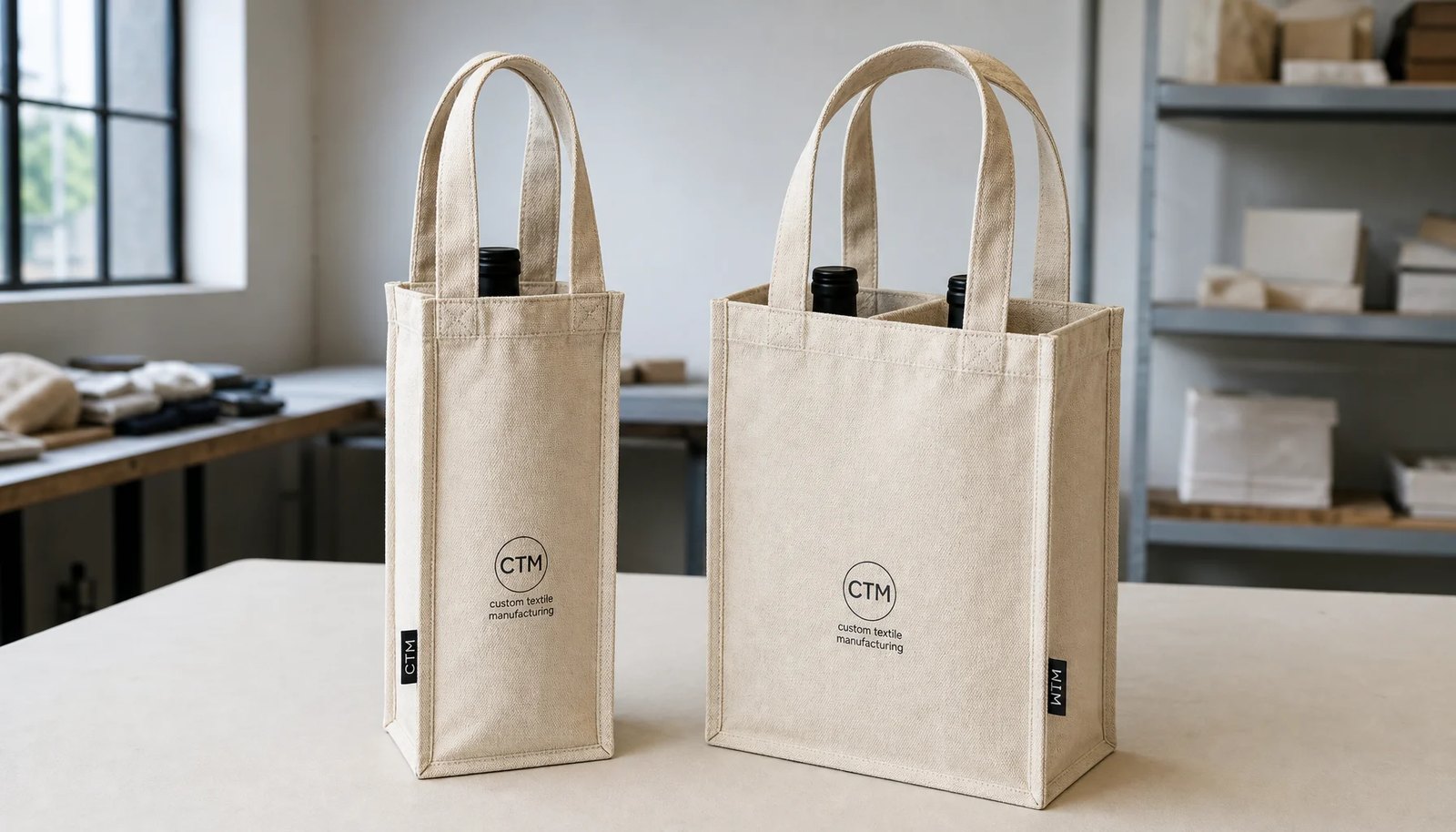
Why durability testing matters for trade show wine carriers
Canvas wine carriers used at trade shows face a different stress pattern from normal retail packaging. A guest may collect a bottle at the booth, add a catalog, walk the show floor for two hours, place the bag under a chair, then carry it through a hotel lobby or parking area. The carrier is not only holding weight; it is being swung, squeezed, rubbed against other bags, and handled by people who are not trying to protect the product.
For procurement teams, the common mistake is approving a nice-looking sample without testing it as a loaded carrier. A wine bag can look clean on a desk and still fail at the handle, bottom corner, divider seam, or printed panel. The right durability checklist helps you turn a vague RFQ into measurable acceptance criteria, which makes supplier quotes easier to compare and reduces arguments after production.
- The main load points are handle ends, side seams, bottom corners, and divider anchoring.
- The main appearance risks are print cracking, ink rub-off, fabric creasing, and dirty natural canvas.
- The main logistics risks are late sample approval, over-heavy cartons, and venue delivery rules.
- A useful RFQ should specify test method, sample standard, packing method, and defect tolerance before price negotiation.
Start with the bottle, not the bag size
A canvas wine carrier should be built around the bottle dimensions. A standard 750 ml Bordeaux bottle is usually slimmer and taller than a Burgundy bottle, while Champagne and sparkling wine bottles are wider and heavier. If the buyer writes only "wine bag for 750 ml bottle," suppliers may quote different mouth widths, bottom gussets, and heights while all claiming the same product type.
For trade show orders, bottle fit also affects the booth experience. Too tight and staff will struggle to insert bottles quickly. Too loose and the bottle leans, making the bag look cheap and increasing stress on the handle. If the carrier includes a divider, the divider must allow easy loading while keeping glass from knocking against glass during movement.
- For a single 750 ml wine bottle, provide bottle height, maximum diameter, shoulder shape, and filled weight.
- For two-bottle carriers, state whether both bottles are the same shape or mixed bottle types.
- Allow enough mouth opening for fast booth packing, especially when bottles are inserted by temporary event staff.
- For premium glass or Champagne bottles, treat the order as a higher-load specification even if quantity is small.
Choose canvas weight by load, not by habit
Canvas weight is one of the first cost drivers, but heavier is not automatically better. For a one-bottle carrier, 10 oz to 12 oz cotton canvas, roughly 280-340 GSM depending on weave and finishing, is often a practical range. It gives enough body for a branded giveaway without making the bag too stiff or expensive to ship. For two-bottle carriers, 12 oz to 16 oz canvas, about 340-450 GSM, is more appropriate because the handle and bottom carry a much higher dynamic load.
The buyer should avoid comparing quotes that say only "canvas" or "heavy canvas." Ask for the fabric weight, GSM tolerance, whether the fabric is natural, bleached, dyed, or recycled blend, and whether the weight is before or after finishing. Natural cotton canvas can vary in shade, seed flecks, and shrinkage. Dyed canvas has better color control for some brands but adds fabric MOQ, dye-lot risk, and longer lead time.
- Light-duty one-bottle carrier: 8 oz may work for display packaging but is risky for loaded trade show carrying.
- Standard event carrier: 10 oz to 12 oz canvas gives a better balance of strength, printability, and carton weight.
- Premium or two-bottle carrier: 12 oz to 16 oz canvas should be paired with reinforced handle and bottom construction.
- Quote comparison rule: do not compare a 10 oz quote against a 14 oz quote as if the bags are equal products.
Handle and seam construction decide real carrying strength
Most field failures happen at the handle attachment or bottom seam, not in the middle of the fabric. A full wine bottle creates downward load, but walking creates repeated shock load. The handle ends should be reinforced with box-x stitching, bartack stitching, or another clear reinforcement method. A single row of stitching may pass a quick visual inspection but open under swinging weight.
For a canvas wine carrier, thread and stitch density matter. Too few stitches reduce holding strength; too many stitches can perforate the canvas and create a tear line. The factory should show close-up photos or a physical sample of handle attachment, bottom seam, and binding before bulk cutting. If webbing handles are used, specify width, thickness, color, and whether the webbing is cotton, polyester, or blended.
- Set handle width at a comfortable carrying size, often around 2.5-3.0 cm for webbing handles.
- Use box-x or bartack reinforcement at each load-bearing handle end.
- Check for skipped stitches, loose thread tails, needle damage, and uneven seam allowance.
- For two-bottle carriers, require a stronger bottom and divider anchoring than for a single-bottle bag.
Build a practical durability test before production
A durability checklist does not need to be complicated, but it must be specific. The factory and buyer should agree on the loaded weight, test duration, pass/fail condition, and sample quantity. For example, a one-bottle carrier may be tested with a filled bottle or equivalent fixed bottle-shaped load, hung by the handles, then swung gently and placed upright several times. A two-bottle carrier needs a separate test because the divider and bottom panel carry different stress.
Testing should use the actual approved bottle or a dimensioned substitute that matches filled weight and diameter. Loose metal weights inside the carrier can create unrealistic pressure points, while empty bottles do not test the handle properly. After testing, inspect the product under normal light and at close range. The pass standard should include no fabric tear, no handle separation, no broken stitches, no bottom seam opening, and no divider detachment.
- Loaded hang test: carrier suspended by handles for the agreed time with filled bottle load.
- Swing simulation: controlled repeated swinging to expose handle and seam weakness.
- Insertion cycle test: bottles inserted and removed repeatedly to test divider and mouth opening.
- Standing test: filled carrier placed on a flat surface to see whether it tips, sags, or distorts.
- Post-test inspection: compare seams, handle ends, bottom corners, and print area against approved sample.
Match print method to canvas texture and event handling
Screen printing is usually the most stable option for simple logos, solid sponsor marks, and one- or two-color artwork on canvas wine carriers. It gives good durability when ink is matched to the fabric and cured correctly. Heat transfer can be useful for gradients or detailed artwork, but it must be tested carefully on textured canvas because edges may lift and large transfer areas can feel plastic. Embroidery is possible for premium positioning, but it adds cost, weight, and thread-density limits on smaller panels.
Trade show bags rub against cartons, booth counters, clothing, and other giveaways. This makes print durability part of the product function, not only decoration. The buyer should request print size, placement, Pantone reference, print tolerance, and testing method. Large ink coverage on natural canvas may crack if the bag is folded tightly before full curing, while very fine lines may break on coarse fabric.
- Screen print: best for bold logos, moderate cost, and good repeatability on cotton canvas.
- Heat transfer: useful for complex art, but require rub, fold, and edge-lift testing.
- Embroidery: premium look, but not ideal for very small text or large dense logos on thin fabric.
- Woven label: good for subtle branding, especially when front-panel printing must stay minimal.
- Print approval should include real fabric testing, not only an artwork proof on screen.
Sample approval should copy bulk production conditions
The pre-production sample is only useful if it represents the bulk order. Many problems start when a supplier sends a sample made from available fabric, temporary thread, or a different print method so the buyer can approve quickly. That may be acceptable for a shape sample, but it should not be treated as final production approval. For trade show orders with fixed dates, the buyer needs one clear approval sample made from production materials.
Separate the sample process into stages if time allows. A fit sample confirms bottle size, mouth opening, divider position, and basic sewing. A print strike-off confirms color, logo size, ink behavior, and placement. The final pre-production sample locks all details together. This reduces the risk of discovering during bulk sewing that the print stiffens the panel, the divider does not fit the bottle, or the handle length is uncomfortable.
- Fit sample: confirms dimensions, bottle loading, bottom gusset, and divider layout.
- Print strike-off: confirms ink color, coverage, curing, rub resistance, and line clarity.
- Pre-production sample: confirms final fabric, sewing, handle, print, label, and packing.
- Approval record: keep photos, measurement sheet, fabric weight, and signed comments in one file.
- Bulk production should not start until the sample approval standard is clear to both sides.
Packing can damage a good wine carrier
Canvas wine carriers are often flat packed, but the packing method still matters. Heavy cartons can crush the bottom shape, create deep fold marks across printed logos, and cause ink transfer if the print is not fully cured. A carrier with a reinforced boxed bottom may need a slightly looser carton than a flat sleeve-style bag. If each piece is folded differently by packing staff, the event team may receive inconsistent presentation quality.
For trade show logistics, cartons may go through warehouse handling, parcel delivery, booth builder receiving, hotel storage, or direct venue delivery. Carton weight should be practical for manual handling, and carton marks should match the event receiving instructions. Individual polybags reduce dust and abrasion but may conflict with sustainability goals or slow booth setup. A buyer can choose paper bands, bulk inner bags, or no individual packing if the carton test and cleanliness standard are acceptable.
- Set pieces per carton based on finished bag size, print protection, and carton gross weight.
- Avoid over-compression when the printed panel has large ink coverage or heat transfer artwork.
- Use slip sheets or alternating orientation if print-to-print contact may cause abrasion.
- Confirm carton dimensions early if the shipment goes to a trade show venue with receiving rules.
- Include carton drop or handling check for orders that ship by courier or mixed truck freight.
MOQ and quote data should expose the real cost drivers
MOQ for canvas wine carriers depends on fabric availability, print setup, cutting efficiency, sewing complexity, and packing requirements. A simple natural canvas one-bottle carrier with one-color screen print may be feasible at a lower MOQ, often in the 300-500 piece range depending on factory workload and material stock. Custom dyed canvas, unusual GSM, two-bottle construction, embroidery, custom labels, or special packing can move the practical MOQ higher.
When comparing quotes, insist on the same specification format. A low unit price may exclude sample charges, print setup, inner packing, reinforced handle, thicker fabric, or final inspection. For importers and distributors, it is better to compare total landed impact than unit price alone. Heavier canvas increases product cost and freight weight, while better construction may reduce replacement risk and protect the brand during the event.
- Request price breaks at 300, 500, 1,000, and 3,000 pieces if the campaign quantity is not fixed.
- Separate tooling, print setup, sample fee, unit price, carton packing, and freight estimate where possible.
- Ask whether quoted fabric is stock fabric or requires a fabric production MOQ.
- Compare carton quantity and gross weight because freight can change the real cost ranking.
- For repeat programs, check whether the same fabric and print standard can be reordered later.
Lead-time planning for fixed event dates
Trade show wine carrier orders are unforgiving because the product is needed on a specific date. A realistic schedule includes artwork preparation, factory review, sample making, sample shipping, buyer comments, print strike-off, bulk material preparation, cutting, printing, curing, sewing, QC, packing, export handling, freight, customs, and domestic delivery. The production lead time shown on a quote usually starts after all approvals, not after the first inquiry.
The highest schedule risk comes from late artwork, bottle-fit changes, delayed sample comments, and switching print method after the first sample. If the event date is close, reduce variables instead of adding them. Choose stock natural canvas, standard handle construction, one-color screen print, and simple bulk packing. For a premium retail launch with more time, custom dyed fabric, woven labels, and reinforced two-bottle construction can be planned properly.
- Early stage: lock bottle dimensions, quantity, event delivery address, and artwork file type.
- Sample stage: allow time for sample production, transit, internal review, and revision.
- Bulk stage: do not count production days until fabric, print, and sample are approved.
- Shipping stage: include buffer for customs, appointment delivery, venue receiving, and carton relabeling.
- Risk control: keep a backup plan for partial air shipment if the event date cannot move.
Specification comparison for buyers
| Spec decision | Recommended option | When it fits | Buyer risk to check |
|---|---|---|---|
| Fabric weight for single-bottle carrier | 10 oz to 12 oz cotton canvas, about 280-340 GSM | Standard 750 ml wine bottle giveaways, retail gift sets, moderate trade show carrying time | Below 10 oz may sag around the bottle base; request loaded hang test and check shrinkage after print curing |
| Fabric weight for two-bottle carrier | 12 oz to 16 oz canvas, about 340-450 GSM, with reinforced bottom | Premium exhibitor gifts, winery sampling kits, distributor events where buyers carry two full bottles | Heavier fabric raises freight weight and sewing difficulty; verify the divider does not pull the side seams inward |
| Handle construction | Self-fabric folded handles or 2.5-3.0 cm cotton webbing with box-x reinforcement | Orders where the bag must survive several hours on a crowded show floor | Plain straight stitches at the handle ends can tear under swinging load; require stitch photos and pull test results |
| Bottom design | Boxed bottom with extra canvas layer or binding at base seam | Round bottles, heavier glass, or carriers displayed standing on booth tables | Flat envelope bottoms are cheaper but can create pressure points; run drop and tilt tests with actual bottle samples |
| Print method | Screen print for solid logos; heat transfer only for complex artwork with approved wash/rub test | Brand logos, winery names, distributor marks, sponsor graphics | Large ink coverage on heavy canvas can crack or feel stiff; test rub resistance after curing and packing compression |
| Inner divider | Same canvas or 8-10 oz divider stitched into bottom and side seam | Two-bottle carriers or bottle-plus-catalog trade show sets | Loose dividers twist during use; confirm divider height, seam anchoring, and bottle insertion clearance |
| Sample approval | Pre-production sample using bulk fabric, bulk thread, bulk print ink, and final packing method | Any branded order above small pilot quantity or with a fixed event date | Sales samples made from substitute fabric can hide shrinkage, color, and handle-strength problems |
| Packing plan | Flat packed 50-100 pcs per export carton with print protection sheets when needed | Most trade show shipments where cartons go to warehouse, booth builder, or event venue | Over-tight cartons crease the printed panel and deform the bottom; check carton drop test and final carton weight |
| MOQ logic | 300-500 pcs for simple stock canvas with one-color print; higher MOQ for dyed fabric, custom GSM, or complex sewing | Trade show campaigns, wine distributors, retail launch packs, and brand activations | Low MOQ quotes may use available fabric only; lock fabric weight, color tolerance, and re-order availability in writing |
Buyer checklist before sampling
- Define the bottle size before quoting: 750 ml Bordeaux, Burgundy, Champagne, spirits bottle, or mixed bottle set.
- State whether the carrier must hold one bottle, two bottles, or bottle plus collateral without stretching the seams.
- Specify fabric type, weight, and tolerance, such as 12 oz cotton canvas with acceptable GSM range shown on the quote.
- Require handle reinforcement method, including box-x stitching, bartack, stitch density, and thread type.
- Set a loaded hang test using real filled bottles, not empty bottles or equivalent loose weights.
- Approve the bottom construction with a real bottle standing test and tilt test on a table surface.
- Confirm print method, logo size, Pantone reference, print placement tolerance, and curing requirement.
- Run dry rub and tape tests on printed areas before authorizing bulk production.
- Approve one pre-production sample made with bulk fabric, bulk trims, and final print process.
- Measure shrinkage and distortion if the carrier will be steamed, washed, or exposed to high heat during finishing.
Factory quote questions to send
- What canvas weight and GSM range are included in the quoted price, and is the fabric in stock or woven to order?
- Can you make the sample with the same bulk fabric, thread, handle material, print ink, and packing method as production?
- What loaded hang test do you use for a one-bottle and two-bottle canvas wine carrier, and for how long?
- How will the handle ends be reinforced, and can you provide close-up photos of the approved stitch construction?
- What bottle dimensions did you use when checking fit, and can you test against our actual bottle or a dimensioned bottle drawing?
- Which print method do you recommend for our artwork, and what are the limits for fine lines, large ink coverage, and color matching on canvas?
- What is your print placement tolerance from the top edge and side seams after sewing?
- How many pieces fit per export carton, what is the estimated gross weight, and how will printed panels be protected from abrasion?
- What is the earliest realistic ship date after artwork and pre-production sample approval, excluding freight time?
- What quality defects are considered major for this product, and what AQL level or inspection standard can be applied before shipment?
Quality-control points to confirm
- Fabric weight should be verified by GSM or ounce weight from bulk rolls, not only by supplier description.
- Finished carrier dimensions should be measured after sewing, including mouth opening, height, bottom width, and divider clearance.
- Handle attachment should pass the agreed loaded hang test with no skipped stitches, fabric tearing, or thread breakage.
- The bottom seam should hold a filled bottle upright without seam spreading, corner tearing, or visible distortion.
- Print should pass dry rub testing and basic tape adhesion testing after proper curing.
- Logo placement should stay within the agreed tolerance across randomly selected production pieces.
- Divider stitching should be checked by pulling the divider sideways and inserting/removing bottles repeatedly.
- Cartons should pass reasonable handling checks, with no crushed bottoms, ink transfer, moisture damage, or excessive carton weight.
- Needle holes, stains, loose threads, and oil marks should be classified before inspection so the factory and buyer use the same defect standard.
- Final inspection should include a loaded-use simulation, not only flat-table appearance checking.