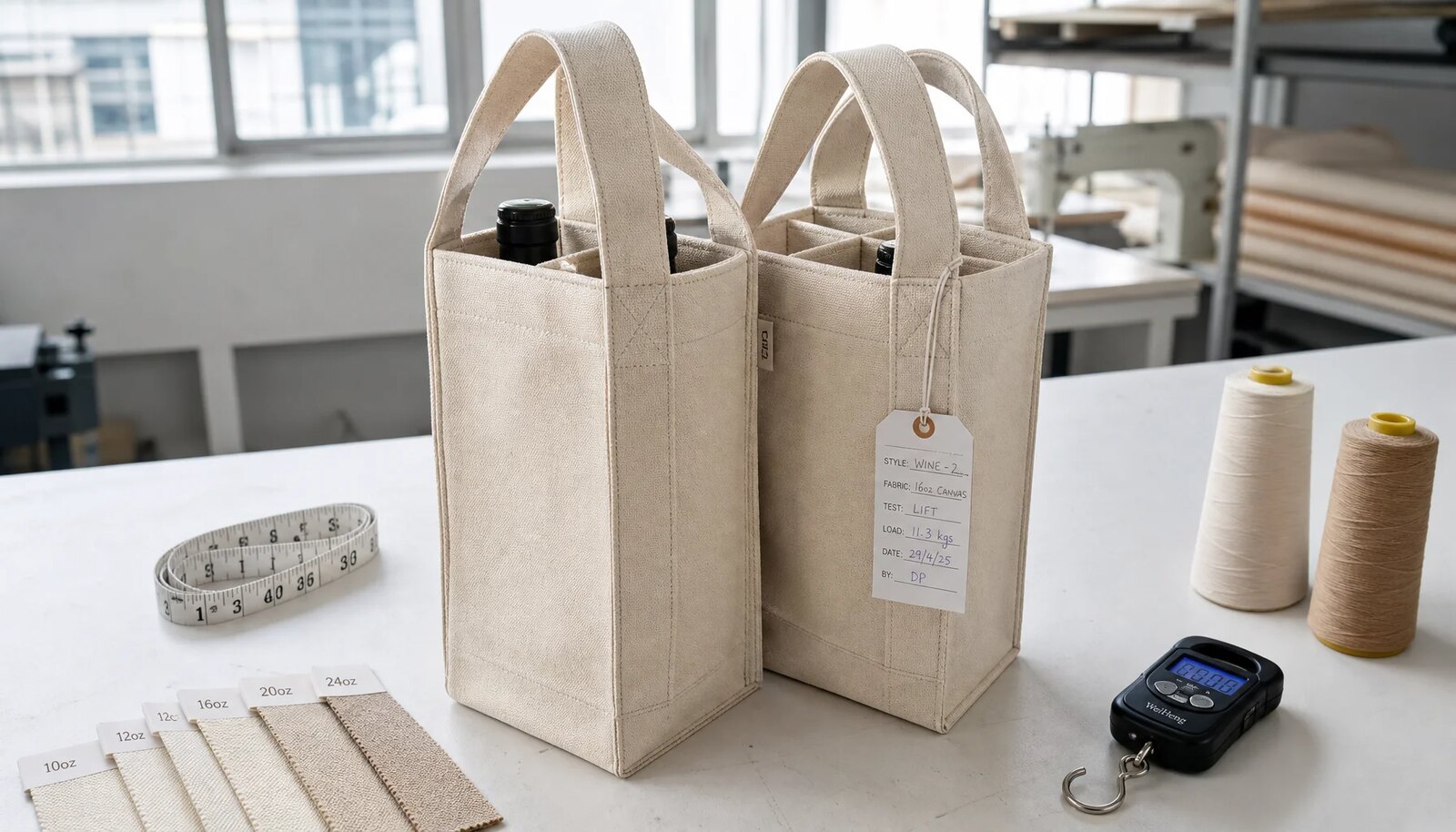
Start with the event path
Canvas wine carriers look simple in a catalog, but event orders put them through a rougher route. A carrier may be sewn, printed, cured, folded into cartons, stacked on pallets, split into kits, staged at a venue, filled by temporary staff, and handed to guests while carrying full bottles. That path repeatedly tests handle anchors, side seams, base corners, dividers, decoration, and carton protection.
The procurement question is not whether the empty sample looks clean on a table. The question is whether the approved construction can carry the intended bottle count, protect label presentation, arrive clean, and move quickly through pack-out. A low unit price becomes expensive when a warehouse team must sort mixed cartons, replace missing inserts, air out odor, or reject uncured print close to the event date.
Write the RFQ around the actual use case before requesting a final price. A one-bottle guest giveaway, two-bottle sponsor gift, tasting room retail carrier, and six-bottle redemption bag are different products even when suppliers use the same product name. State bottle formats, target loaded weight, branding method, packing route, inspection plan, and required arrival date.
- Define use case, bottle count, bottle formats, loaded weight, and handling path before requesting quotes.
- Treat handles, base support, dividers, print cure, and carton packing as required specifications.
- Ask every supplier to quote the same build so price comparisons are meaningful.
- Attach a canvas wine carriers for event planners durability testing checklist to the RFQ so testing is expected from the sample stage.
Turn bottle fit into numbers
Bottle fit is a common source of bulk-order mistakes. A supplier may say a carrier fits wine bottles, but that does not confirm fit for Bordeaux, Burgundy, Champagne, sparkling, 1 L, or oversized premium bottles. Diameter, shoulder shape, label thickness, punt depth, and neck height all affect the pocket. If staff must load hundreds or thousands of carriers under time pressure, a pocket that technically fits but needs force is still a poor event spec.
Start with bottle count and expected loaded weight. Many filled 750 ml wine bottles weigh about 1.2 kg to 1.6 kg each depending on glass weight, so a two-bottle carrier may carry roughly 2.4 kg to 3.2 kg before adding the carrier, divider, insert, tags, or collateral. Sparkling bottles and heavy-glass premium bottles can push the load higher. Treat these figures as internal acceptance examples and test against the actual bottle or equivalent weight whenever possible.
Dimensions need tolerances, not only nominal sizes. Finished carrier dimensions may be workable at plus or minus 5 mm to 10 mm depending on fabric, finishing, and sewing construction. Divider pockets deserve close attention because a small drift can create bottle rattle, label scuffing, or slow insertion. Handle drop should be measured from the top edge of the bag to the inside top of the handle curve while the carrier is loaded.
- List bottle formats by name and dimension, not only by the word wine.
- Estimate loaded weight from real bottle samples or equivalent weights before testing handles.
- Set tolerances for height, width, gusset, base width, handle drop, divider height, and pocket width.
- Test every required bottle format, especially Burgundy and sparkling bottles with wider diameters.
- Check loading speed and label scuffing because fit must work for event staff under time pressure.
Specify canvas before pricing
Fabric weight matters, but it is not a durability guarantee by itself. A heavier canvas can give better structure and perceived value, yet a 16 oz carrier with short handle stitching may fail sooner than a 12 oz carrier with stronger reinforcement. Specify fabric weight together with seam construction, handle anchoring, divider attachment, base support, and the load test method.
For one-bottle, short-use event giveaways, 12 oz finished cotton canvas, roughly 400 GSM, can be suitable when handles are reinforced and the bottle format is standard. For many two-bottle gifts, sponsor kits, and programs where reuse is expected, 14 oz finished canvas, roughly 475 GSM, is often a stronger baseline. For premium gifting, sparkling bottles, heavier glass, or multi-bottle builds, 16 oz finished canvas, roughly 540 GSM, may be appropriate, but it can also increase seam bulk, carton volume, sewing time, MOQ, and freight cost.
Ask whether the quoted weight is finished fabric weight. Some suppliers quote greige or raw fabric weight before dyeing, washing, steaming, or finishing. That makes comparison unreliable because processing can change shrinkage, hand feel, dimension stability, and print behavior. A practical fabric weight tolerance might be plus or minus 5% by production lot, but the buyer should confirm what the factory can actually measure and hold.
- Specify finished fabric weight in oz and/or GSM with a lot tolerance where feasible.
- Confirm the weight applies after dyeing, washing, steaming, coating, or finishing.
- Use 12 oz mainly for one-bottle programs, 14 oz for many two-bottle programs, and 16 oz for heavier or premium builds.
- Name fabric composition and require documentation for any recycled-content or certified-material claim.
- Approve bulk production only after the sample uses the same fabric type and finishing route planned for the order.
Build strength into stress points
Handle anchors deserve the first inspection. When a loaded carrier is lifted, force concentrates where the handle joins the body. A weak sample may use a short stitch line close to the top edge. It can look acceptable while empty, then distort once two bottles are inside. Stronger builds spread the load through a longer anchor, a box or box-X stitch pattern, bar-tacks at stress points, suitable thread, and a top edge that does not stretch open.
Ask for handle width, handle drop, anchor length, stitch pattern, thread type, stitch density, and bar-tack count. A handle width of about 25 mm to 38 mm is common for comfortable carrying, though the right choice depends on carrier size and brand design. Handle drop should be checked with the carrier fully loaded because bottles change balance and raise the center of mass.
Base and divider construction should be written into the spec. A single soft base may work for a snug one-bottle sleeve, but two-bottle and multi-bottle carriers usually need more support. Options include a double canvas base, reinforced gusset, removable board, inserted board, or sewn-in support. Fixed dividers help with fast deployment; removable dividers can reduce freight volume but increase counting and assembly risk.
- Define handle width, handle drop, anchor length, stitch pattern, stitch density, and bar-tack placement.
- Require loaded inspection of handle anchors after repeated lifting, not only visual approval.
- Specify base type: single layer, double layer, reinforced gusset, removable board, inserted board, or sewn-in support.
- For board inserts, check thickness, edge safety, moisture behavior, installation method, and packing count.
- Measure divider pocket width and height with the real bottle formats before approving the sample.
Choose branding that survives freight
Event planners care about logo presentation because the carrier often represents a sponsor, venue, winery, distributor, or hospitality brand. Procurement has to look one step further: decoration must survive production, curing, packing, freight, staging, and handling. A print that looks sharp the hour it is sampled can still fail if it is under-cured, printed over an unstable surface, or packed face-to-face without protection.
Screen printing is practical for many canvas wine carriers. It works well for one- or two-color marks, simple sponsor logos, and repeat orders on natural canvas. Ask for ink type, color matching method, artwork size, print location, placement tolerance, and curing process. If the factory can provide cure temperature, dwell time, or its practical curing control, that is more useful than a broad promise that the print is durable.
Canvas texture affects artwork more than a digital proof can show. Small reversed text, thin lines, large solid ink areas, and tight multi-color registration can be difficult on rough cloth. Woven labels, sewn patches, leatherette patches, and embroidery can create a more retail-style finish, but each adds QC points such as skew, puckering, backing, stitch density, edge finish, and placement tolerance.
- Match decoration method to fabric texture, artwork detail, order size, event deadline, and packing method.
- Require a physical strike-off for strict sponsor colors or small logo details.
- Set logo placement tolerance in millimeters and define acceptable skew for labels or patches.
- Check dry rub, damp rub, blocking, tackiness, cracking, transfer, edge clarity, color shift, and registration.
- Use interleaving or controlled packing when printed panels may contact other fabric surfaces.
Make quotes comparable
Canvas wine carrier quotes can hide major differences behind the same product name. One quote may include finished 14 oz cotton canvas, fixed dividers, bar-tacked handles, a base insert, one-color screen print, interleaving, and export cartons. Another may include a lighter stock body, short handle stitching, no base support, basic logo application, and factory-standard packing. If procurement compares only the headline unit price, the weaker build may look like the winner.
A better quote template separates the build into visible parts. Fabric weight, composition, dyeing or finishing, handle construction, divider type, base support, branding method, setup fee, sample charge, inner packing, carton quantity, carton dimensions, inspection cost, and freight assumptions should all be named. This keeps cost changes from hiding inside vague product language.
Supplier type matters, but no route is automatically best. A direct factory may give better visibility into cutting, sewing, and print control. A trading company may be useful when the buyer needs several merchandise categories and one commercial manager. A stock program can be right for short deadlines or smaller quantities. In every route, identify who controls the approved sample, QC, shipment release, and rework decision.
- Quote fabric, construction, branding, packing, inspection, and freight assumptions separately.
- Ask whether MOQ applies by total order, fabric color, logo version, print color count, patch, divider, insert, or carton format.
- Compare carton dimensions and units per carton because freight can change landed cost.
- Confirm who owns rework if samples or bulk production fail the agreed checklist.
- Shortlist suppliers that document construction details clearly and answer QC questions without vague language.
Run sample tests like event day
The pre-production sample should be tested the way it will be used. Load it with the intended bottle count and bottle format, lift it repeatedly by the handles, carry it a short distance, set it down on a hard surface, and inspect the stress points. For two-bottle and multi-bottle carriers, test all pockets loaded at once because balance and base deformation change under full load.
A practical B2B sample test can be simple, but it should be repeatable. Record the bottle type, total loaded weight, number of lift cycles, static hold time, and visible changes. As an internal acceptance example, a buyer might perform 25 to 50 normal lift-and-set-down cycles, then hold the loaded carrier suspended for 30 seconds, then inspect handle anchors, side seams, base corners, dividers, and top edge. For higher-risk programs, ask the factory or third-party inspector to run a higher cycle count or an agreed load margin.
Add deployment checks too. Insert bottles quickly, remove them, and repeat. Check whether labels scuff, necks collide, or pockets pinch at the shoulder. Fold the carrier according to the proposed packing method, leave it compressed overnight, then inspect crease recovery and whether it still stands square when loaded. Seal a packed sample for 24 hours and check odor when opened.
- Use actual bottles or equivalent weights for sample testing.
- Record loaded weight, cycle count, static hold time, and inspection findings.
- Inspect handle anchors, bar-tacks, side seams, base corners, dividers, and top hem after testing.
- Check loading speed, label scuffing, pocket fit, upright stability, crease recovery, and odor after packing.
- Reject or revise samples that show stitch failure, fabric tearing, divider collapse, print transfer, strong odor, or unstable bases.
Define QC defects early
Quality control works best when defect classes are defined before production. A broken handle, missing reinforcement, split base seam, torn divider, unsafe insert edge, or unusable pocket should be treated as a critical defect because the carrier cannot perform its basic job. Wrong dimensions, wrong logo version, poor print cure, severe staining, warped base, or incorrect packing may be major defects because the order can fail operationally even if the bag can still hold a bottle.
Set measurable tolerances wherever possible. Finished dimensions can often be held within a practical range such as plus or minus 5 mm to 10 mm, depending on fabric and construction. Logo placement might be specified as centered within plus or minus 5 mm to 10 mm depending on artwork size. Divider pockets should be checked against the bottle formats, not only against a ruler. Handle drop should be measured consistently across sample and bulk units.
Inspection should combine visual and functional checks. A neat front panel does not prove that handle anchors are reinforced or that print is cured. Require close-ups of stress points, loaded test units, divider pockets, print areas, folded units, inner packing, and carton labels. If the order contains multiple logo versions, sponsor versions, or destination kits, carton sorting becomes a QC point.
- Critical defects include broken handles, missing bar-tacks, split seams, torn dividers, unsafe inserts, and unusable pockets.
- Major defects include wrong dimensions, bad print cure, wrong logo version, warped base, severe stains, and poor carton packing.
- Minor defects may include small thread tails, light surface marks, or logo movement within the approved tolerance.
- Measure dimensions, logo placement, divider pockets, handle drop, fabric lot weight, and carton quantities.
- Require inspection photos, defect counts, and release approval before shipment leaves the factory.
Treat packing as product quality
Packing is not a back-end detail for event orders. A well-made carrier can arrive unusable if it is crushed, damp, scuffed, deeply creased, or mixed with missing dividers. Event teams often receive goods close to the activation date and may not have labor available to sort components, reshape carriers, or air out odor. Approve packing at the sample stage, while changes are still inexpensive.
Flat packing can reduce carton volume and freight cost, especially for simple one-bottle carriers or removable divider designs. The tradeoff is crease risk, print abrasion, loose components, and slower pack-out at destination. If dividers or base inserts ship separately, the packing list should count carriers, dividers, and inserts as separate items. Bundles should be labeled so warehouse staff can reconcile them quickly.
Assembled packing uses more space, but it can save destination labor. It may be better for VIP gifts, retail presentation, or fast venue loading. When carriers ship assembled, carton compression matters because stacked cartons can deform the base or top edge. Interleaving may be needed if printed panels touch each other. Polybags can protect against dirt and moisture, but they can also trap odor if goods are packed too soon after printing, dyeing, or finishing.
- Approve flat or assembled packing based on freight cost, receiving labor, and deployment speed.
- Check packed samples for creasing, print blocking, scuffing, odor, moisture, and divider deformation.
- Count carriers, dividers, inserts, hangtags, labels, and any extra components separately during inspection.
- Require carton labels with product, color, logo version, quantity, carton number, and component status.
- Confirm carton dimensions, gross weight, net weight, and units per carton before calculating landed cost.
Protect schedule and versions
Event procurement has a fixed-date problem. A shipment that arrives after the event may have little value, even if the product is technically correct. Build the schedule backward from the required warehouse arrival date. Separate artwork approval, sample production, sample transit, sample review, material booking, cutting, sewing, printing, curing, inspection, packing, export documents, freight, customs, destination delivery, and receiving.
MOQ can vary by more than total order quantity. It may apply by fabric color, logo version, print color count, woven label, patch material, divider type, base insert, or carton packing format. A supplier may accept a lower MOQ for natural canvas stock bodies but require more units for dyed canvas or custom labels. If the event has sponsor versions, regional artwork, or different bottle formats, ask whether MOQ applies to each version or to the combined order.
Version control deserves plain language. Multi-sponsor and multi-destination orders can fail through sorting errors even when the physical product is good. Use clear SKU names, artwork file names, carton labels, and packing lists. Tie each version to a color, quantity, carton range, and destination when applicable. Artwork approval is not structural approval; hold production until load testing, divider fit, print cure, odor review, and packing checks pass.
- Build lead time backward from the required arrival date, not the factory ship date.
- Ask whether MOQ applies by fabric, color, logo version, print method, divider, insert, or packing type.
- Use clear SKU names, artwork file names, carton labels, and packing lists for multi-version orders.
- Approve structural performance and packing before treating the sample as final.
- Build buffer for sample transit, sample revision, print curing, final inspection, freight delay, customs, and warehouse receiving.
Specification comparison for buyers
| Spec decision | Practical option | Best fit | Buyer risk to verify |
|---|---|---|---|
| Sourcing route | Direct factory with controlled sewing and print scheduling | Repeat event programs, custom constructions, tighter QC requirements, and buyers who need the same build across shipments | Confirm which steps are in-house: cutting, sewing, printing, curing, inspection, and packing; agree who approves rework if structural defects exceed the limit |
| Sourcing route | Trading company managing a named factory | Programs combining wine carriers with other event merchandise or buyers needing one commercial contact across categories | Require factory disclosure, approved-sample ownership, inspection checklist control, defect sorting method, and shipment release authority |
| Sourcing route | Stock canvas carrier with custom decoration | Short lead times, smaller trial orders, simple one-color branding, or lower-risk internal hospitality use | Check fixed dimensions, limited fabric choices, handle reinforcement, logo placement restrictions, and whether inventory comes from one lot or mixed lots |
| Finished fabric weight | 12 oz cotton canvas, about 400 GSM, with reinforced handle anchors | One-bottle giveaways, standard 750 ml bottles, moderate handling, and cost-sensitive events | Verify finished fabric weight after processing; run loaded lift testing because fabric weight alone does not prove strength |
| Finished fabric weight | 14 oz cotton canvas, about 475 GSM, with double-needle seams | Two-bottle gifts, sponsor kits, tasting room programs, and carriers expected to be reused | Confirm fabric tolerance, shrinkage, pocket fit, and base stability under full bottle load |
| Finished fabric weight | 16 oz cotton canvas, about 540 GSM, with bar-tacks and base support | Premium gifting, sparkling bottles, heavier glass, and multi-bottle carriers | Watch seam bulk, higher MOQ, slower sewing, larger carton volume, and different print coverage on heavier texture |
| Divider design | Fixed divider panels sewn into base and side walls | Fast event pack-out, upright bottle separation, and low component-loss risk | Inspect divider height, pocket width, stitch attachment, label scuffing, and whether dividers collapse after repeated loaded handling |
| Divider design | Removable divider insert with labeled component packing | Flat freight, flexible reuse after the event, or orders where warehouse staff can assemble before loading | Check missing inserts, loose fit, slower receiving, carton count mismatch, and bottle shifting if pocket dimensions drift |
| Base support | Double canvas base or removable board insert | Two-bottle and heavier carriers that need to stand square during handoff | Confirm board material, thickness, edge safety, moisture resistance, installation method, and whether inserts are counted separately at inspection |
Buyer checklist before sampling
- Define the event use case: guest giveaway, VIP gifting, sponsor kit, tasting room retail, bottle redemption, internal hospitality, distributor pack-out, or multi-location activation.
- State the exact bottle formats to be carried, including standard 750 ml Bordeaux, Burgundy, Champagne or sparkling, 1 L, or oversized bottles if applicable.
- Specify bottle count per carrier and expected loaded weight. As an internal working estimate, many filled 750 ml wine bottles weigh about 1.2 kg to 1.6 kg each depending on glass weight.
- Set finished carrier dimensions with tolerances: height, width, gusset, base width, handle drop, divider pocket width, divider height, and logo placement.
- Specify finished fabric weight in oz and/or GSM, with tolerance by production lot, and state whether weight is measured after dyeing, washing, steaming, or finishing.
- Define fabric composition clearly: natural cotton canvas, dyed cotton canvas, cotton-poly blend, recycled-content fabric, or another material, with documentation for any content claim.
- Require reinforcement details: handle width, handle anchor length, stitch box size, bar-tack position, thread type, seam allowance, folded top edge, side seam type, and base construction.
- State divider design: fixed sewn divider, removable divider insert, padded divider, no divider, pocket quantity, pocket width, pocket depth, and whether dividers ship installed or separately packed.
- Choose decoration before quoting: screen print, heat transfer, woven label, sewn patch, leatherette patch, embroidery, or mixed branding, including artwork size and placement tolerance.
- Ask for a pre-production sample made with the intended fabric, thread, handle, divider, base support, decoration method, curing process, inner packing, and carton plan.
Factory quote questions to send
- What is the finished fabric weight in GSM or oz, what tolerance do you hold by production lot, and how do you verify fabric weight before cutting?
- Is the canvas natural cotton, dyed cotton, cotton-poly blend, recycled-content fabric, or another composition, and what documentation supports any content or sustainability claim?
- What shrinkage range should we expect after dyeing, washing, steaming, or finishing, and how will finished dimensions be controlled after those processes?
- What are the finished dimensions and tolerances for height, width, gusset, base width, handle drop, divider pocket width, divider height, and logo placement?
- Which seams are single-needle, double-needle, overlocked, bound, folded, or bar-tacked, and what seam allowance is used at side seams, base seams, dividers, and top edge?
- What handle material, width, drop, anchor length, stitch pattern, thread type, and bar-tack count will be used at the load-bearing points?
- What total loaded weight is the carrier designed for, and can you perform a documented lift or static load test using the intended bottle count?
- How is the base built: single canvas layer, double layer, reinforced gusset, removable board, inserted board, or other support, and what material and thickness are used for any insert?
- How are dividers attached, and can you provide pocket dimensions for Bordeaux, Burgundy, and sparkling bottles if those formats are required?
- What exact branding method will be used, including ink type or label material, color matching process, curing method, placement tolerance, and rub-test procedure?
Quality-control points to confirm
- Verify finished dimensions against the approved spec, including height, width, gusset, base width, handle drop, pocket width, divider height, and logo placement.
- Check finished fabric weight by lot before cutting or at incoming material inspection, using the agreed oz or GSM tolerance.
- Confirm fabric composition, color, hand feel, odor, surface cleanliness, and shrinkage behavior match the approved pre-production sample.
- Load-test handle anchors using the intended bottle count plus any agreed margin, then inspect for stitch breakage, fabric tearing, seam opening, and handle distortion.
- Perform repeated lift cycles with actual bottles or equivalent weights, then inspect handle ends, side seams, base corners, divider joins, and top edge.
- Inspect stitch density, thread tension, skipped stitches, thread nests, bar-tack placement, seam allowance, folded edges, and loose thread trimming.
- Check base stability with actual bottle formats so the loaded carrier stands upright and does not sag, twist, bow, or pull side panels inward.
- Test divider alignment, pocket width, and insertion speed so bottles do not scrape labels, lean into each other, pinch at the shoulder, or shift during carrying.
- Test print or label durability for dry rub, damp rub, tackiness, cracking, transfer, edge blur, color shift, registration error, and placement drift.
- Review carton packing for print blocking, scuffing, crease damage, dampness, odor trapping, missing dividers, missing base inserts, and mixed logo versions.