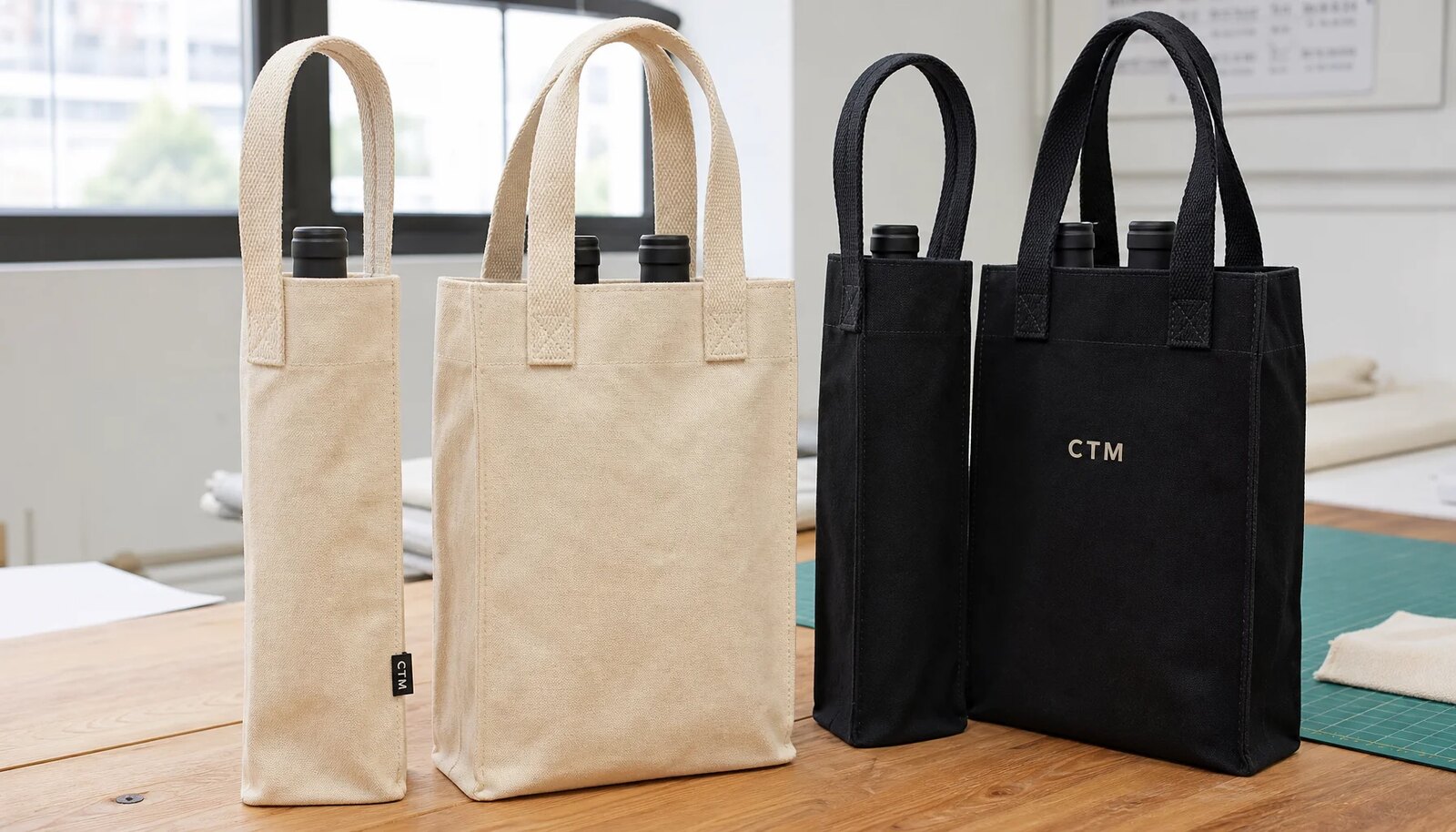
Why wine carriers need a real durability checklist
At first glance, a canvas wine carrier looks like a narrow tote. In use, it behaves very differently. A tote often carries soft, flexible goods: apparel, catalogs, scarves, accessories, or light retail items. A wine carrier holds a dense glass bottle, and that weight pulls hard on a few small areas: the handle joins, side seams, lower corners, bottom gusset, and divider if the style carries two bottles.
That difference changes the procurement risk. If a standard tote seam opens, the likely result is a return or complaint. If a wine carrier fails, the brand may be dealing with broken glass, spilled liquid, stained garments, damaged fixtures, and a safety issue for store staff or customers. The product is simple, but the failure mode is not.
Eco apparel brands often source canvas wine bags for holiday gifting, loyalty rewards, winery collaborations, VIP packaging, corporate merchandise, and retail add-ons. The natural cotton look fits the brand language. Water-based ink, organic or recycled cotton options, and reduced-plastic packing can support the sustainability direction. None of those choices, however, prove that the carrier can safely hold a filled bottle.
Treat the item as a load-bearing sewn textile. A strong RFQ should define fabric GSM, finished dimensions, bottle weight, handle reinforcement, seam allowance, stitch density, divider construction, static load testing, dynamic carrying cycles, print rub resistance, and packing protection. Without those details, suppliers may all quote a “canvas wine carrier” while pricing very different products.
- Glass bottles create concentrated load, not the soft distributed load of apparel
- A filled 750 ml wine bottle commonly weighs around 1.1-1.6 kg depending on glass weight; champagne and spirits can be heavier
- Single-bottle and two-bottle carriers have different failure modes and should not share one generic test plan
- Retail resale and repeat-use gifts need stronger validation than one-time promotional packaging
- Durability testing gives buyers an objective basis for quote comparison, supplier approval, and final inspection
Start with the bottle, not the bag
Many sourcing briefs begin with “750 ml wine bag.” That sounds clear, but it is not enough. Bottle geometry varies. Bordeaux bottles are usually straighter and narrower. Burgundy bottles are wider with sloped shoulders. Champagne bottles can be both wider and heavier. Spirits, olive oil, and specialty gift bottles may add more height, a broader base, or unusual shoulders.
If one carrier must work across several bottle types, test the hardest realistic combination: the widest approved bottle, the tallest approved bottle, and the heaviest filled bottle. Do not rely on the bottle a supplier happens to have in the sample room. A narrow Bordeaux bottle may slide in cleanly while a Burgundy or champagne bottle strains the side seam, distorts the gusset, or makes the divider unusable.
Route to market also changes the test level. A store handout for a short walk to the car has a different risk profile from a retail accessory expected to be reused. An e-commerce add-on may be compressed in cartons, scuffed during handling, and stored before the customer ever loads it. A winery shop item might be touched all day, repacked at checkout, carried outdoors, and placed on uneven surfaces.
Before asking for price, create a one-page performance brief. Include the bottle range, maximum filled weight, expected reuse level, retail presentation requirement, decoration method, and packing preference. This saves time later. It also prevents a common problem: the lowest quote wins because the hidden construction choices were never compared.
- Record maximum bottle height, body diameter, base diameter, and filled weight for the program
- Test champagne or spirits formats separately if they are included, because they are often heavier than standard wine
- Define whether the bag must stand upright when loaded and placed on a flat counter or shelf
- State whether customers will carry one bag at a time or whether staff may handle multiple filled bags together
- Confirm whether the bag will be displayed near light apparel, tissue, paper gift wrap, or other materials sensitive to dye transfer
Write an RFQ that makes supplier quotes comparable
“Canvas wine carrier with logo” leaves too much room for interpretation. One supplier may price 260 GSM cotton. Another may price 340 GSM canvas. A third may quote an ounce weight without explaining how it converts to GSM. In product photos, all three samples may look acceptable. Under load, they will not behave the same way.
For many retail-ready single-bottle carriers, 340-410 GSM is a practical starting range. It gives the bag enough body for presentation and reuse without making it unnecessarily stiff or expensive. Lighter fabric may still work for short-term programs if the handle and base are reinforced, but below roughly 300 GSM the risks increase: body collapse, wrinkling, seam strain, weak shelf presence, and poor recovery after packing.
Two-bottle carriers need more than a heavier fabric. The design must spread load through the handle, keep the bottles balanced, protect the lower corners, and prevent bottle-to-bottle contact. The divider should be treated as a structural component, not a soft decorative panel. If the RFQ does not specify the divider, the supplier may choose a single-layer floating divider that looks fine in a photo but folds or tears during use.
The purchase order should also block unapproved substitutions. Body fabric, webbing, thread, divider material, print ink, labels, reinforcement patches, and packing method should all match the approved specification. Cost pressure often appears after order placement. A clear substitution rule prevents quiet downgrades, especially on parts buyers do not see from the outside.
- State fabric in GSM and tolerance, such as 360 GSM plus or minus 5%, instead of only “12 oz canvas”
- Define finished size tolerances, for example plus or minus 5 mm on critical bottle-fit dimensions where feasible
- Specify handle width, handle drop, handle material, stitch type, bartack count, and attachment location
- Specify seam allowance target, SPI range, thread type, and raw-edge treatment
- Include decoration and packing method in the quoted spec so suppliers do not price different versions
Tighten fabric, fiber, and sustainability language
Canvas terminology can be surprisingly loose. “12 oz canvas” may refer to different measurement conventions, and some quotes do not state whether the weight is per square yard, per linear yard, or converted to GSM. For procurement, GSM is the more useful shared reference because it can be checked from production fabric. Ask for measured GSM, composition, weave, yarn count if available, finish, and tolerance.
Natural cotton canvas, dyed canvas, washed canvas, organic cotton canvas, and recycled cotton canvas can all perform differently. Dyeing and washing may change shrinkage, hand feel, and shade consistency. Recycled cotton blends can vary in tensile strength depending on fiber length and blend content. Organic cotton claims require documents that match the actual order, not a logo or general supplier statement.
Separate the material story from the performance requirement. A carrier made with an organic or recycled input still needs to pass load, seam, rub, fit, and packing checks. A conventional cotton carrier with reduced-plastic packing may support a different sustainability goal but cannot be marketed as certified organic or recycled unless the documents support that claim.
Bring marketing, sourcing, and compliance into the conversation early. If the finished item will be promoted with sustainability language, confirm what the supplier can actually provide: fabric certificates, scope certificates, transaction documents, or finished-goods documentation. It is better to adjust the claim before production than to discover after delivery that the marketing copy is not supportable.
- Ask whether GSM is tested after dyeing, washing, or finishing, not only before processing
- Confirm composition percentages if recycled cotton, polyester blend, or blended webbing is used
- Request shrinkage expectations when water-based printing, steaming, washing, or humid storage is involved
- Separate verified certification documents from general supplier claims or material descriptions
- Require production-lot swatches for color, hand feel, print testing, and GSM confirmation before bulk cutting
Handles, seams, and base construction decide the result
Most wine carrier failures begin in a small number of places: the handle attachment, the side seam, the bottom gusset, the lower corners, or the divider join. Buyers often focus on body fabric thickness because it is easy to feel. But a heavy canvas bag with weak bartacks can fail faster than a moderate-weight canvas bag with well-planned reinforcement.
Handles deserve a detailed specification. Self-fabric handles create a clean all-canvas look, but folded canvas alone can stretch, twist, cut into the hand, or tear near the attachment point. Cotton webbing is usually more stable and easier to define by width, thickness, and finished length. A self-fabric handle with internal webbing can preserve the natural look while improving load performance.
The stitch pattern matters too. Decorative topstitching may look neat on a sample, but it is not the same as load-bearing reinforcement. Handle ends should be secured with a box stitch plus bartack, box-X, or dense bartack pattern, depending on the design. The RFQ should define the reinforcement area, bartack placement, and minimum distance from the top edge so the stitch does not sit too close to a weak seam.
The bottom carries the shock of real use. Customers lift, swing, and set down the bag. A boxed bottom, inside reinforcement patch, double-layer base, and secure lower corners help the carrier stand upright and resist distortion. For two-bottle styles, the divider must be anchored into the side seams and base seam so bottles do not collide when the bag moves.
- Use lockstitch with consistent 8-10 SPI where appropriate for the construction
- Define seam allowance, commonly 8-12 mm where design permits, and verify it inside the sample
- Use bartacks, box stitch, or box-X reinforcement at handle load points rather than relying on decorative topstitching
- Add base reinforcement for heavier bottles, two-bottle styles, or retail resale items
- For two-bottle carriers, specify divider layer count, bottom anchoring, side attachment, and edge finishing
Durability testing checklist: load, carry, set down, and fit
A useful durability test plan does not need to be elaborate. It does need to be repeatable. The supplier should know the test weight, duration, cycle count, sample quantity, inspection points, and pass/fail criteria before production begins. The phrase “load tested” is too vague for procurement. Ask what was tested, how it was tested, and what defects were recorded after testing.
Start with static hanging. Load the carrier with bottle-equivalent weight and hang it for a defined period, such as 24 hours. For many programs, 1.5 times the intended filled-bottle weight is a practical minimum. Use 2.0 times for retail resale, two-bottle styles, heavier bottles, new suppliers, or first production runs. After hanging, inspect the handle joins, bartacks, top hem, side seams, bottom gusset, divider, and panel shape.
Static load is only one part of the picture. Customers do not carry wine bags in a perfectly still position. They lift them from counters, walk with them, swing them slightly, set them down, and pick them up again. A simple dynamic test can use 200 cycles for lower-risk gifting and 500 cycles for repeat-use or higher-risk programs. Use the agreed bottle-equivalent weight and inspect after the test, not only during it.
Add a controlled set-down check. Repeated placement from a low height, such as 100-150 mm onto a flat surface, can reveal bottom-corner weakness without creating unrealistic abuse. Watch for gusset distortion, seam strain, divider movement, and the bag tipping when loaded.
Bottle fit should be checked after the load tests as well as before them. A carrier may technically hold the weight but stretch enough to lose its retail shape, become hard to load, or allow the bottle to lean. For two-bottle carriers, test insertion and removal on both sides and confirm that the divider stays centered.
- Static load: 24 hours at 1.5-2.0 times intended filled-bottle weight, with no handle tear or broken reinforcement
- Dynamic carry: 200-500 lift or carry cycles depending on use case, with inspection after testing
- Set-down impact: controlled repeated placement to review gusset distortion and lower seam strain
- Bottle fit: test widest, tallest, and heaviest approved bottle profiles, not only one sample bottle
- Pass/fail: no broken bartack, no unsafe seam opening, no divider tear, no major distortion, and no unstable standing position
Print, dye, and decoration durability for apparel-adjacent brands
Decoration is often the first thing internal stakeholders notice. Procurement should also treat it as a durability item. The logo has to survive packing, shelf handling, customer reuse, and contact with tissue, paper wrap, or nearby apparel. A print that looks right at sample approval can still fail if the ink is not cured properly, the canvas finish is unstable, or printed panels rub together in an overpacked carton.
Water-based screen print is common for eco apparel brands because it gives a softer hand and suits simple artwork on natural canvas. Performance depends on the ink system, curing temperature and time, fabric finish, and print thickness. Ask for a strike-off on the actual production fabric. A strike-off on a substitute swatch does not prove how the final order will print or rub.
Dark canvas adds another concern: crocking from the dyed fabric itself. If black, navy, forest, burgundy, or other dark shades will be displayed near light garments or packed with white tissue, include dry and damp rub checks. This is especially important for apparel brands because the wine carrier may sit beside cotton tees, linen shirts, knits, or pale packaging in the same retail environment.
Other decoration methods need their own controls. Embroidery can feel premium, but high stitch density may pucker lighter canvas. Woven labels are durable and reduce large print-panel scuff risk, though they create less logo impact. Patches can add perceived value, but patch stitching becomes another inspection point. Heat transfers or DTF can handle detailed artwork, but buyers should check adhesion, flex, edge lift, and abrasion on textured canvas.
- Set logo placement tolerance, commonly within a few millimeters, based on artwork size and bag panel shape
- Check dry rub and damp rub on both printed artwork and dyed canvas surface
- Review print strike-off on the actual production fabric, not a substitute swatch
- Avoid print-to-print contact in cartons unless tissue, paper, or another separator is specified
- For embroidery, check puckering, backing comfort, thread colorfastness, and distortion after loading
Sample approval should reflect production, not showroom sewing
A development sample can look excellent and still be a poor predictor of bulk production. Sample rooms may sew more slowly, use available stock canvas, substitute stronger webbing, or add extra care that is not realistic on the production line. That is why buyers should separate sample stages. A design sample confirms appearance. A fit sample confirms dimensions. A pre-production sample confirms the actual production method.
The pre-production sample should use the same fabric source, GSM, finish, color, handle, thread, divider, print method, label, and packing route planned for bulk. If production-lot fabric is not yet available, approval should be conditional. Do not let a beautiful prototype become the production standard if it was made with materials that will not be used in the order.
Record the sample in detail. The approval sheet should include complete bag weight, width, height, gusset depth, handle drop, handle width, divider height, logo position, stitch count, seam allowance, and construction photos. Include inside photos, not only the front panel. The hidden construction is where many failures begin.
Turn the sample inside out before signing it off. Inspect seam allowance, raw-edge treatment, thread tension, reinforcement patches, bartack placement, lower corners, and divider anchoring. Then load it with the actual bottle profiles and maximum expected weight. Confirm that the bottle can be inserted and removed without force, the carrier stands upright, and the handles remain comfortable under load.
- Request outside, inside, handle, base, divider, print close-up, and packed-condition photos
- Measure the finished sewn product, not only pattern dimensions or supplier drawings
- Compare complete sample weight against expected fabric GSM and construction details
- Approve bulk only after bottle fit, static load, dynamic carry, print rub, and packing checks are complete
- Keep one sealed approved sample with the buyer and one with the factory for inspection reference
MOQ, pricing, and quote analysis without hidden weakness
MOQ for canvas wine carriers depends on fabric availability, color, decoration setup, cutting efficiency, and sewing complexity. Natural canvas with a one-color screen print is usually easier to source than custom-dyed canvas with a reinforced divider, woven label, and special packing. Ask what drives the MOQ. It may be per style, per color, per print, per fabric lot, or per label setup.
Price comparison must be like-for-like. A low quote may use lighter GSM, omit the bottom reinforcement, reduce bartacks, use thinner thread, pack too many units per carton, or exclude testing. This does not always mean the supplier is trying to mislead. Often the RFQ was too open, so the supplier optimized for the lowest cost version of the product name.
A better approach is to ask suppliers to price the base construction and upgrades separately. Useful options include reinforced handles, an internal base patch, a double-layer divider, a woven label instead of print, paper-banded bulk packing, and third-party inspection support. This gives the procurement team a clear view of which savings are safe and which create avoidable risk.
For glass-bottle carriers, handle and bottom reinforcement are usually poor places to cut cost. If the budget needs to move, look first at decoration complexity, custom color, carton count, label type, or launch quantity. Keep the load-bearing construction aligned with the test plan.
- Separate sample charge, screen charge, lab dip, strike-off, label, carton, testing, and inspection costs
- Ask for MOQ by material color, decoration method, and construction, not just total order quantity
- Confirm whether price includes production-lot GSM verification and in-house load testing
- Compare carton quantity and packing method because overpacking can reduce product quality
- Request a costed bill of key construction variables so upgrades and downgrades are visible
Packing rules that reduce waste without damaging the carrier
Packing can ruin an otherwise well-made wine carrier. Overfilled cartons flatten gussets, crease handles, bend top hems, and rub printed panels together. Eco apparel brands often want to reduce individual polybags, and that can be a good goal. But removing plastic without a replacement protection plan can create dust exposure, print scuffing, mixed counts, and poor retail presentation.
Start with the structure of the bag. Flat single-bottle carriers can often be bulk packed with paper bands or inner bundles. Two-bottle carriers with dividers may need looser carton counts so the divider and gusset are not crushed. Printed faces should not rub directly against rough seams, carton walls, or other printed faces. Handles should be folded consistently and kept away from the main logo area where possible.
Carton specifications should be written, not left to the packing team. Include quantity per carton, fold method, inner protection, carton dimensions, carton gross weight, shipping marks, and SKU separation. If no individual polybag is used, specify dust control and inner liner requirements. If the product is going to a retailer with routing standards, confirm carton labeling and packing list format early.
Packing should also be included in sample approval. Ask the supplier to send photos of the folded item, inner bundle, carton stack, and outer mark. If the bag passes the load test but arrives crushed, scuffed, or hard to count, the program still has a quality problem.
- Set carton quantity by style and compression risk, not only by lowest freight handling cost
- Use tissue, paper sheets, or controlled stacking where print scuffing is likely
- Keep carton gross weight practical for warehouse handling and local requirements
- Mark cartons by SKU, color, PO number, quantity, and carton sequence
- Avoid mixing one-bottle and two-bottle styles in the same carton unless inner separation is clear
Specification comparison for buyers
| Spec decision | Recommended option | When it fits | Buyer risk to check |
|---|---|---|---|
| Fabric weight | 12 oz canvas stated as approximately 340-410 GSM, with a written bulk tolerance such as plus or minus 5% unless another range is agreed | Retail gifting, winery shop resale, apparel brand holiday bundles, and repeat-use customer packaging | Ounce shorthand is not standardized across suppliers; confirm measured GSM from production fabric, not only catalog weight |
| Finished bottle fit | Approve dimensions against actual bottle profiles: 750 ml Bordeaux, Burgundy, champagne, 1 L bottle, or spirits bottle as required | Programs where one carrier may be used for several bottle shapes or retail teams cannot control the exact bottle format | A carrier that fits a narrow Bordeaux bottle may bind on a wider Burgundy or champagne bottle; tight fit increases seam stress |
| Bottle capacity | Single-bottle carrier for lower-risk launches; two-bottle carrier only with reinforced divider, balanced handles, and separate load testing | Gift-with-purchase, winery shop resale, premium bundles, corporate gifting, and beverage collaborations | Two-bottle styles fail at divider join, bottom distortion, handle imbalance, and bottle collision, not only at side seams |
| Handle material | Cotton webbing 25-38 mm wide, or self-fabric handle with internal webbing reinforcement, with finished handle length defined | Natural look with stronger load performance and better customer reuse than thin folded fabric alone | Unreinforced folded canvas handles can twist, stretch, cut into the hand, or tear near bartacks during dynamic carrying |
| Handle attachment | Box stitch plus bartack, box-X, or dense bartack at each handle end; define stitch area and minimum distance from top edge | Any bag intended to carry glass bottles, especially heavier champagne, spirits, or two-bottle formats | Decorative topstitching may look clean but does not prove load capacity; check actual reinforcement and seam allowance |
| Bottom construction | Boxed bottom with inside reinforcement patch or double-layer base panel; confirm gusset depth and corner seam security | Wine, spirits, olive oil, and other heavy glass bottle formats that must stand upright on shelf or counter | Flat seams, narrow gussets, and weak lower corners distort during set-down impact and may split after repeated use |
| Seam build | Lockstitch with consistent 8-10 SPI, seam allowance commonly 8-12 mm where construction allows, clean overlock or bound raw edges | Export orders where repeatability, safety, and retail presentation matter more than the lowest possible unit cost | Skipped stitches, loose tension, narrow seam allowance, thread nests, or exposed raw load-bearing edges cause early seam opening |
| Divider option | Double-layer canvas divider or reinforced divider panel anchored into side seams and base seam; divider height defined in mm | Two-bottle wine carriers, champagne pair gifts, spirits bundles, or any format where bottle-to-bottle contact is possible | Single-layer floating dividers may pass visual inspection but tear, fold, or allow collision under movement |
| Print method | Water-based screen print on stable canvas for simple artwork; woven label or patch for high-rub positions | Eco apparel positioning, natural canvas aesthetics, simple logos, and moderate-to-high reuse | Incorrect curing, unstable fabric, or rough folding can cause cracking, scuffing, poor edge definition, or color transfer |
Buyer checklist before sampling
- Define the bottle size range before sampling: 750 ml Bordeaux, Burgundy, champagne, spirits, olive oil, 1 L formats, or mixed use. Record maximum bottle diameter, height, and filled weight.
- Specify canvas in GSM plus tolerance, not only ounce shorthand. A practical retail starting point is 340-410 GSM with a written bulk tolerance such as plus or minus 5%.
- State the intended use case: one-time gifting, repeat retail resale, winery shop accessory, event merchandise, e-commerce add-on, apparel store packaging, or corporate bundle. Test severity should match the real use.
- Require finished dimensions with tolerances: width, height, gusset depth, handle drop, handle width, divider height, logo placement, and carton count. Do not approve by photo only.
- Define handle construction: cotton webbing or reinforced self-fabric, finished width, finished length, fold method, stitch box size, bartack position, and minimum distance from the top edge.
- Set seam requirements: lockstitch, 8-10 SPI where suitable, seam allowance target, thread type, bartack count, clean raw-edge control, and no exposed raw edges at load-bearing points.
- Approve bottom construction with a standing test on a flat surface, bottle insertion and removal test, lower-corner inspection, and internal base reinforcement check.
- For two-bottle carriers, specify divider layer count, height, width, attachment into side seams, bottom anchoring, and whether divider edges are overlocked, bound, or folded.
- Include a load test in the RFQ: for example, static hanging for 24 hours at 1.5-2.0 times intended filled-bottle weight, plus dynamic lift or carry cycles using bottle-equivalent weight.
- Write pass/fail criteria: no handle tear, no broken bartack, no seam opening over the agreed threshold, no divider tearing, no bottle instability, no major panel distortion, and no unsafe glass exposure.
Factory quote questions to send
- What is the exact body fabric specification in GSM, weave, composition, finish, shrinkage expectation, and bulk tolerance? Will GSM be verified from the production lot?
- Is the fabric greige, natural, dyed, washed, organic, recycled, or conventional cotton? Which certificates, scope certificates, or transaction documents can actually be supplied for this order?
- What finished bag size and tolerance are you quoting for width, height, gusset, handle drop, divider height, and logo placement?
- Is the handle self-fabric, cotton webbing, blended webbing, or self-fabric with internal webbing? What are the handle width, thickness, and finished length?
- Which stress points receive bartacks, box stitch, box-X reinforcement, double stitching, or reinforcement patches? Can you mark these positions on a construction drawing or sample photo?
- What seam allowance, stitch type, SPI range, and thread type will be used for side seams, bottom, top hem, handles, and divider?
- For the bottom, is there a double-layer base, inside patch, folded construction, or only a seam join? How is lower-corner seam strain controlled?
- For a two-bottle style, how is the divider attached to the side seams and bottom seam? Is it double-layer, reinforced, padded, or single-layer?
- What bottle-equivalent weight did you use for in-house testing, how long was the static load test, how many dynamic cycles were run, and what defects were recorded?
- Will the approval sample be made from the same production fabric, handle material, thread, divider, print ink, sewing method, and packing method quoted for bulk?
Quality-control points to confirm
- Fabric GSM within approved tolerance, checked from production-lot fabric and recorded by color or dye lot
- Fabric composition, weave, hand feel, shade, and finish matched to the approved standard; no unapproved substitution of canvas or webbing
- Finished dimensions within approved tolerance for width, height, gusset, handle drop, handle width, divider height, and logo placement
- Fabric shade and print color matched under the agreed light source, with shade-band control for dyed canvas lots
- Shrinkage or finish stability checked when washing, steaming, humid storage, or water-based printing may affect finished measurements
- Handle material, width, length, placement, fold method, and attachment construction matched to the approved sample and technical specification
- Handle attachment strength reviewed at every bartack, box-stitch, or box-X point, with no loose stitch, skipped stitch, or fabric tearing
- Bottom gusset symmetry, base reinforcement, corner seam security, and upright standing stability checked with the approved bottle profile
- Divider alignment, layer count, height, edge finishing, seam security, and bottom anchoring verified for all multi-bottle styles
- SPI, seam allowance, thread tension, and stitch consistency checked on side seams, top hem, handles, base, corners, and divider