Start With The Event Use Case
Canvas wine carriers for craft fairs are not the same sourcing problem as rigid gift boxes, tasting-room cartons, or thin promotional totes. At a fair, staff unpack carriers fast, stack them behind a booth, load bottles during peak sales, and hand them to shoppers who may keep browsing for an hour. The carrier has to count cleanly, load quickly, feel comfortable in the hand, and still look presentable when it reaches the customer’s table at home.
Before asking for price, define the job the bag must do. Is it a paid checkout add-on, a free single-bottle sleeve, a two-bottle holiday gift set, a wine club pickup bag, a reusable farmers market carrier, or a distributor kit with several winery logos? Each use changes the build. A giveaway can often accept a lighter canvas and simpler handle. A two-bottle retail gift set needs better base stability, a divider that actually works, cleaner print placement, and a handle that does not feel sharp under load.
Procurement teams should also decide whether reuse is part of the promise. If the carrier only needs to move one bottle from booth to car, a basic construction may be enough. If the bag is meant to represent the winery after the event, the buyer should specify stronger handle reinforcement, more consistent fabric, tighter stitching, and a decoration method tested for rub and adhesion.
A strong RFQ sounds practical, not poetic: one-bottle natural cotton canvas carrier for paid craft fair checkout sales, flat packed in bundles of 50, built for standard 750 ml wine bottles, one-color front screen print, expected for light reuse, required warehouse arrival by a fixed date. That level of clarity gives factories enough information to quote a real production item instead of guessing from a photo.
- For checkout add-ons, prioritize unit cost, fast loading, flat packing, and simple one-color branding.
- For holiday gift sets, prioritize divider performance, base stability, handle comfort, and upright presentation.
- For giveaways, prioritize logo visibility, reliable lead time, and construction that matches brand value.
- For distributor programs, prioritize artwork control, carton segregation, SKU labeling, and reorder consistency.
- For wine club pickups, confirm whether tasting cards, coupons, corkscrews, or inserts must fit with the bottles.
Specify Canvas Weight And Finish
Most wholesale canvas wine carriers for craft fairs sit comfortably in the 10 oz to 12 oz range, typically about 280-340 GSM depending on yarn, weave, and finishing. That range gives enough body for a filled 750 ml bottle while still being practical to cut, sew, fold, and pack. It also tends to accept screen printing more predictably than very coarse heavy canvas when the artwork includes winery names, regional marks, or event logos.
Lighter 6 oz to 8 oz canvas, often around 170-240 GSM, may be fine for low-cost giveaways. The tradeoff is obvious once the bag is loaded: it can wrinkle sharply, collapse on a display table, show the bottle outline, and feel more like a temporary promotion than a retail package. Heavier 14 oz to 16 oz canvas, often above 380 GSM, can look premium, but it brings bulky seams, higher material usage, heavier cartons, and slower sewing around dividers or boxed bases. Heavy fabric is not automatically better on a narrow wine carrier.
The RFQ should name the composition and tolerance. A clean specification might read: 100% cotton canvas, natural color, target 300 GSM, tolerance +/-5%, unwashed unless otherwise approved. If recycled cotton, organic cotton, or other documented material is required, ask what proof the supplier can provide before price comparison. Sustainability language should not stay informal if the buyer needs audit-ready records.
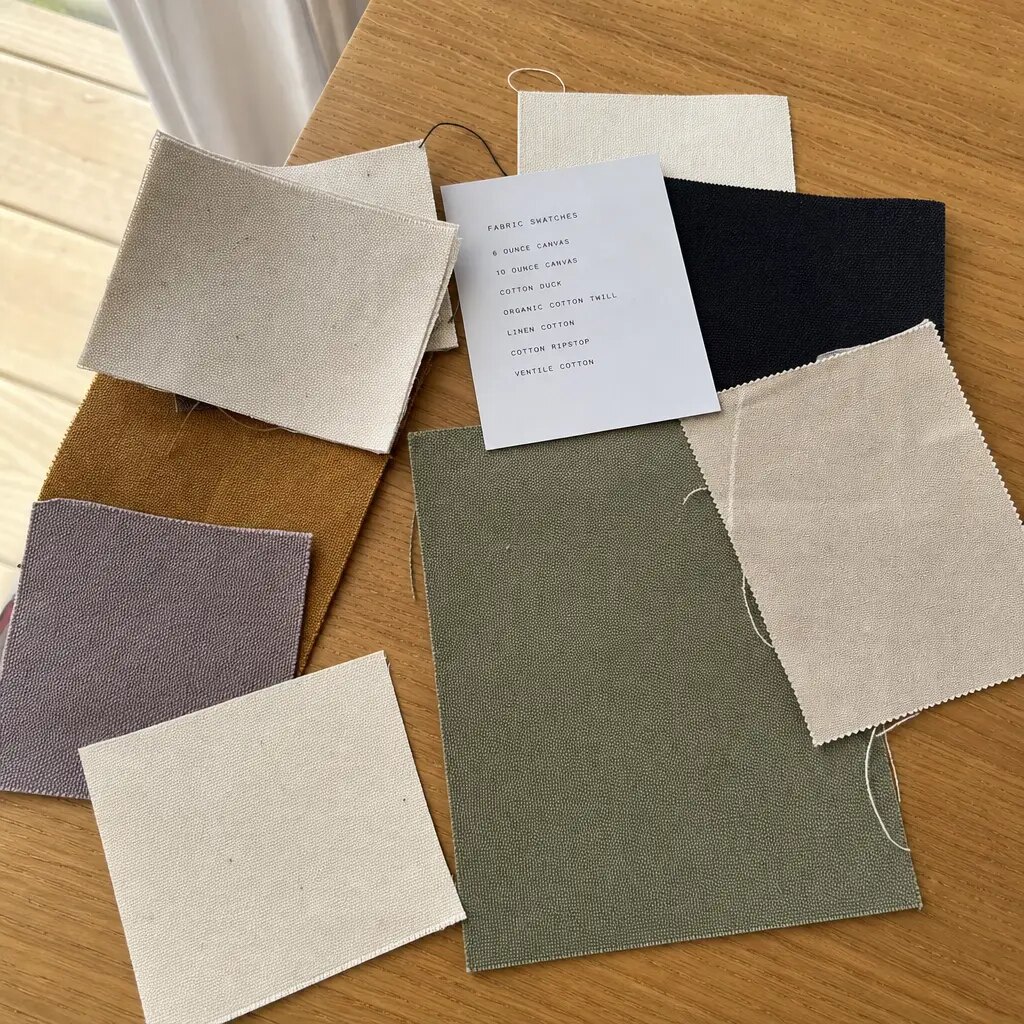
Natural canvas needs a visual standard too. Seed flecks, slubs, cotton marks, and minor shade variation are normal. Some craft brands like that texture; others need a cleaner surface for sharp logos. Approve a swatch or reference standard before bulk cutting, and keep it for repeat orders. If a supplier changes fabric mills between runs, the shade and stiffness may shift even when the GSM appears similar.
- Use about 170-240 GSM for short-term giveaway programs where cost is the main driver.
- Use about 280-340 GSM for most craft fair retail, winery event, and reusable promotional programs.
- Use about 360-420 GSM only when the premium feel justifies extra freight, bulk, and sewing cost.
- Write GSM tolerance, fabric composition, finish, shrinkage expectation, and acceptable natural marks into the PO.
- Request physical swatches for natural, dyed, recycled, or organic canvas because shade and stiffness vary by lot.
Build The Pattern Around Real Bottles
A canvas wine carrier can look right in a supplier photo and still fail with the buyer’s actual bottle. Bordeaux, Burgundy, Champagne, cider, olive oil, and spirits bottles vary in diameter, shoulder shape, height, closure, and filled weight. Many craft fair sellers bring several bottle styles to the same event, so the opening, base, height, and divider position need to be developed around real measurements, not a generic 750 ml assumption.
For single-bottle carriers, buyers often start with a finished base width around 9-11 cm and a finished height around 34-38 cm, then adjust after bottle testing. A slim bottle may look lost in a wide bag. A wide-shouldered bottle may need more opening width and a deeper base. Decide whether the product label should stay visible, partly visible, or mostly covered; that choice affects the bag height, logo position, and booth display.
Two-bottle carriers deserve extra attention. Two bottles, fabric thickness, seam allowance, and a divider all compete for space. The body should hold the bottles without pulling side seams inward, and the divider should reduce glass contact during normal hand carry. A pattern developed around slim Bordeaux bottles can be too tight for sparkling wine or broad Burgundy bottles. Oversizing the bag to fit everything can create the opposite problem: bottles lean, touch, and make the carrier look unfinished.
Ask for both flat and standing dimensions. Flat width and height affect cutting and print placement; standing base, gusset, and compartment width affect loading and display. For any new size, approve the physical sample only after loading and carrying the actual bottle shapes. If the sample needs force at the opening, revise it before bulk. Normal sewing tolerance can make a tight fit worse in production.
- Provide bottle diameter, total height, shoulder shape, neck height, closure height, and approximate filled weight.
- Define finished flat width, height, gusset or boxed base, opening width, and measurement tolerance.
- State whether the bottle label should remain visible above the carrier for booth display.
- For two-bottle bags, define sewn compartments, divider depth, divider attachment, and base width.
- Test the largest bottle expected in the program, not only the easiest standard bottle.
Engineer Handles For Loaded Carry
Handles are where low-price canvas wine carriers often reveal their weakness. One filled 750 ml wine bottle commonly weighs about 1.2-1.5 kg depending on glass weight. A two-bottle carrier can exceed 3 kg before brochures, tasting cards, small gifts, or extra market purchases are added. Shoppers may carry the bag through a crowded fair, swing it while walking, or grip it with cold hands. The handle needs a safety margin beyond a neat-looking sample photo.
Self-fabric handles create a clean, matching look and can be efficient when cut from the same canvas. They need proper folding, seam allowance, and stitching so they do not fray, twist, or pull out. Cotton webbing handles are often strong and practical for two-bottle styles, though color and texture may not match the body exactly. Rope handles can add a gift-packaging look, but they increase bulk and require reinforced insertion points. Choose the handle for load and user comfort first, then for appearance.
Specify finished handle length and handle drop. A hand-carry handle around 28-35 cm can work on compact single-bottle carriers. A longer handle around 40-50 cm may allow shoulder carry, but it can swing too much on a narrow wine bag. Handle drop is often more useful than total handle length because it shows whether a shopper’s hand clears the opening comfortably. Strap width matters as well; very narrow straps can dig into the hand once the bottle is inside.
Reinforcement should be part of the quote, not an afterthought. X-box stitching, bar tacks, double rows, or a reinforced top seam should be specified before price comparison. For QC, test one-bottle carriers with at least about 2.5 kg and two-bottle carriers with about 5 kg, or use the buyer’s higher internal requirement. After hanging, lifting, and short carry movement, check seam opening, broken stitches, loose bar tacks, fabric tearing, and handle slippage.
- Specify handle material, width, finished length, handle drop, attachment point, and reinforcement pattern.
- Use X-box stitching, bar tacks, or reinforced top seams on load-bearing handles.
- Test above the real filled-bottle load instead of relying on visual inspection.
- Inspect inside handle joins because hidden raw edges can fray after repeat use.
- Avoid approving short handles if craft fair shoppers may wear gloves or winter coats.
Choose Dividers And Bases Carefully
Two-bottle canvas wine carriers need more than a decorative separator. When a shopper walks through a fair, the bottles move. A weak divider can allow glass contact, noisy rattling, and customer concern even when nothing breaks. The divider should be designed for normal carry movement, not just for a standing product photo.
A simple sewn fabric divider is usually enough for standard wine bottles if it is positioned correctly and secured well. Higher-value gift sets or heavier bottles may justify a reinforced or padded divider. Padding adds cost and packing bulk, so use it only when the commercial value supports it. Removable dividers can add flexibility, but they are easy to lose during booth setup unless they are packed, counted, and explained clearly.
Base construction shapes the customer’s perception of quality. A boxed base or gusseted bottom helps the carrier sit better on a table and makes loading faster. A very narrow base can make round or wide bottles lean. A flat seam-only bottom may cost less, but it can display poorly and concentrate stress at the bottom seam. For many 750 ml bottle styles, a base width around 8-10 cm is a practical starting point, but the final dimension should follow the actual bottle set.
Ask the factory to show the inside construction. Front-panel photos do not tell you how the divider is attached, how the bottom seam is finished, or whether the top edge is reinforced. During sample review, load two bottles, hold the carrier normally, and move it gently as a shopper would. If bottles touch, lean heavily, or pull the divider loose, revise the pattern before approving bulk production.
- Use a sewn-in divider for most two-bottle carriers intended for actual carry use.
- Anchor the divider deep enough to prevent bottle bases from sliding together.
- Choose padded dividers only when the gift value justifies extra cost and bulk.
- Specify boxed base, gusset, or bottom seam construction in the RFQ.
- Inspect loaded two-bottle samples for glass contact, leaning, and divider pullout.
Match Decoration To The Artwork
Screen printing is usually the most practical decoration method for wholesale canvas wine carriers when the artwork uses one to three solid colors. It offers good cost control, repeatability, and durability when ink deposit and curing are controlled. It works well for winery logos, regional craft market graphics, simple event names, and natural canvas backgrounds. The limitation is detail: canvas is textured, so tiny serif text, thin rules, reversed lettering, distressed effects, and QR codes can lose clarity.
Heat transfer can help with short-run full-color graphics or many small logo versions. It reproduces gradients and complex images better than basic spot screen printing, but the film feel can be noticeable on cotton canvas. Edges, corners, and small details should be checked for adhesion after bending and rubbing. Digital direct printing may work for some artwork, but color control on textured cotton depends heavily on equipment and pretreatment. Embroidery can look premium on larger bags, yet it may pucker small panels and is usually less cost-efficient for craft fair wine carriers.
Do not approve production from a digital proof alone. Request a print strike-off on the final canvas, especially for first-time artwork, dark fabric, multiple colors, fine text, or QR codes. The strike-off should confirm print size, position, color tolerance, ink coverage, curing, and handfeel. Pantone references help, but natural cotton shade and absorbency can change the way a color appears.
Print placement should be measured from finished seams rather than raw fabric edges. Wine carriers are small; a 1 cm shift can make a logo look off-center or too close to the base seam. On two-bottle carriers, the front panel may curve when loaded, so keep critical details away from folds, heavy seams, and high-stress points. For multi-logo orders, approve each artwork version through a strike-off or, at minimum, a clear placement proof before bulk printing.
- Use screen printing for simple logos, solid colors, repeat orders, and cost-sensitive wholesale programs.
- Use heat transfer only after checking film feel, edge adhesion, bend resistance, and rub performance.
- Keep fine text, QR codes, and reversed details large enough for textured canvas.
- Define print size, position, Pantone references, underbase, curing, and acceptable color tolerance.
- List setup charges by artwork and color so multi-logo quotes can be compared fairly.
Compare MOQ And Quote Structure
MOQ for canvas wine carriers is usually shaped by fabric sourcing, cutting efficiency, trim purchasing, print setup, sewing line handling, and packing complexity. A natural cotton canvas carrier with one size and one logo is far easier to quote than a dyed fabric carrier with special webbing, multiple logos, hangtags, and destination-level carton allocation. If the quote does not separate these drivers, the lowest unit price may simply be hiding work elsewhere.
The common craft fair challenge is mixed winery logos. A distributor may want one shared construction but 200 pieces for each winery. The factory might be able to cut and sew the body together, yet every logo can still require separate screens, setup time, strike-off approval, packing segregation, and carton marks. One combined purchase quantity does not always create one simple MOQ.
Ask suppliers to quote MOQ by fabric color, size, artwork, print color count, and packing split. Also ask for below-MOQ surcharges when launch quantities are small. This gives procurement a useful decision tree: standardize one natural canvas body, reduce fabric color options, simplify artwork, combine orders by delivery date, or accept a surcharge for smaller logo runs.
A complete quote should read like a compact production sheet. It should include fabric composition and GSM, finished dimensions, handle construction, divider design, print method, print size, packing method, pieces per carton, carton dimensions, gross weight, sample cost, sample timing, bulk lead time, payment terms, Incoterms, and quote validity. Missing GSM, carton data, or setup charges are not savings. They are unknowns.
- Request MOQ by fabric color, size, artwork, print color count, and packing split.
- Separate unit price from screen charges, sample fees, hangtags, barcodes, packing upgrades, and export costs.
- Confirm Incoterms, currency, quote validity, payment terms, and excluded destination charges.
- Ask whether repeat orders can reuse screens, patterns, swatches, and approved samples.
- Compare suppliers only after specs, packing, and charge structure are aligned.
Approve Samples With Real Tests
A pre-production sample should prove the product, not just show the concept. It needs to confirm fabric handfeel, bottle fit, handle strength, divider function, print placement, print color, seam construction, label placement, and packing assumptions. Photos are useful during early development, but they do not reliably show GSM, stiffness, handle comfort, print texture, or loaded behavior. For a new custom style, a physical sample is the safer approval basis.
Sample approval should create a written production standard. Mark the approved sample with date, version number, fabric specification, print method, print size, and any approved deviations. Record finished width, height, base width, gusset, handle length, handle drop, divider position, and print placement. If the buyer changes the handle or logo after approval, update the version record so the factory, buyer, and inspector work from the same reference.
The buyer and factory should each keep a reference sample. If a third-party inspection team is involved, send photos and the measurement sheet before inspection. Final inspection should compare bulk goods to the signed pre-production sample, not to a long email chain. This reduces disputes over natural canvas marks, shade variation, logo location, stitch appearance, and handle length.
A practical sequence is fabric swatch, print strike-off, construction sample, pre-production sample, then bulk. Repeat orders can move faster when style, fabric, print, and packing are unchanged. If any element changes, especially fabric weight, handle construction, divider, or print method, treat it as a new approval point rather than assuming the old sample still controls.
- Measure flat width, height, base, gusset, handle length, handle drop, divider location, and print position.
- Load the actual bottle and carry the sample for several minutes, not only for a photo.
- Rub and bend the print after curing to check adhesion, cracking, smearing, and transfer.
- Photograph front, back, side, inside, handle join, divider, bottom seam, and carton packing.
- Record approved deviations so inspectors can distinguish intentional changes from defects.
Write QC Criteria Before Production
Quality control for canvas wine carriers should be practical, measurable, and written into the purchase order. The main checks are fabric weight, finished dimensions, bottle fit, handle strength, stitch quality, print accuracy, divider function, packing count, and carton labeling. If these points are not defined before production, defects become subjective after goods are packed.
Use tolerances that match textile production reality. For many canvas wine carriers, fabric GSM tolerance of +/-5% is reasonable unless the buyer requires tighter control. Finished body dimensions often use +/-1 cm, while handle length may use +/-1.5 cm. Print placement tolerance should be tighter when the logo area is small; many buyers use +/-5 mm to +/-10 mm depending on layout. The key is to write the exact tolerance rather than assume everyone shares the same standard.
Inspection should include functional testing. A single-bottle carrier should load smoothly and pass a weighted handle test. A two-bottle carrier should be checked for glass contact after lifting and movement. Inspect stress points closely: handle joins, divider attachments, side seams, boxed base corners, and top edges. Loose bar tacks, skipped stitches, open seams, and raw edges in load areas should be treated as defects, not cosmetic details.
Print QC should compare production to the approved strike-off. Check placement, color, registration, pinholes, smearing, cracking, dye migration, and rub transfer. Natural canvas will always have some texture and shade variation, so define acceptable fabric marks separately from printing defects. For multi-logo programs, inspection must verify every artwork version and confirm cartons are packed and marked by the correct logo, SKU, and quantity.
- Use written tolerances for GSM, body size, handle length, print placement, and carton count.
- Check stress points: handles, top seam, side seams, bottom corners, and divider attachments.
- Test loaded samples above the expected bottle weight and inspect after the test.
- Compare bulk print to the approved strike-off, not only to digital artwork.
- For multi-logo orders, inspect artwork version, carton mark, barcode, hangtag, and packing list accuracy.
Plan Packing For Event Distribution
Packing is a commercial specification, not a warehouse footnote. Craft fair teams need to unpack quickly, count stock, and sometimes reload unsold carriers at the end of the event. Retail buyers may need hangtags, barcodes, or store-level quantities. Distributors may need cartons separated by winery logo, region, customer account, or fair date. If packing is not specified, the factory may choose the cheapest method and leave the buyer with extra labor after arrival.
Flat packing is usually the most efficient format for canvas wine carriers. Counted bundles of 25 or 50 pieces can reduce plastic, speed booth setup, and make carton counts easier to verify. Individual polybags protect against dust and moisture, but they add cost and may conflict with sustainability preferences. Avoid over-compression because it can crease handles, distort boxed bases, and cause print abrasion.
Print curing and packing sequence matter. Large, dark, or heavy-coverage prints can transfer if stacked too soon under pressure. Ask the supplier what curing time is included before packing and whether they perform a rub or transfer check. Interleaving may be needed for some prints, but it adds material and labor, so approve it before quoting rather than discovering the cost later.
Carton marks should include item code, size, fabric color, logo version, quantity, purchase order, carton number, gross weight, and destination if relevant. Carton gross weight should follow the buyer’s warehouse and event handling limits; many programs prefer cartons around 12-18 kg, but the buyer’s own limit should control. For ocean freight or humid storage, use dry cartons and moisture protection because cotton canvas can absorb humidity.
- Define bulk pack, bundle pack, individual polybag, or store-level allocation before quoting.
- Set pieces per bundle, pieces per carton, carton dimensions, gross weight limit, and carton marks.
- Require packing lists that show quantity by artwork version and carton number for multi-logo orders.
- Confirm print curing time before stacking and packing to reduce transfer risk.
- Choose moisture protection for long transit routes or humid storage conditions.
Specification comparison for buyers
| Spec decision | Recommended option | When it fits | Buyer risk to check |
|---|---|---|---|
| Fabric weight for event use | 10 oz to 12 oz cotton canvas, typically about 280-340 GSM, with GSM tolerance written as +/-5% unless otherwise agreed | Most winery booths, craft fairs, gift markets, tasting events, retail add-on programs, and reusable promotional carriers | Below 240 GSM may collapse, wrinkle sharply, or feel disposable; above 400 GSM can create bulky seams, higher freight, and slower sewing |
| Bottle capacity and fit | Single-bottle carrier for checkout sale; two-bottle carrier with sewn divider and adequate compartment width | Single fits impulse purchase and giveaways; two-bottle fits holiday gift sets, wine club pickups, and paired bottle promotions | Generic 750 ml sizing can fail with Burgundy, Champagne, cider, spirits, or olive oil bottles; test real bottle diameter and shoulder shape |
| Body dimensions | Specify finished width, height, gusset or boxed base, opening width, seam allowance, and tolerance of +/-1 cm for body dimensions unless tighter is needed | Needed when buyers sell several bottle formats or require label visibility at booth display | Too narrow causes seam strain; too tall hides labels and slows loading; too short exposes bottle body and weakens gift presentation |
| Handle construction | Self-fabric handles with X-box stitching or cotton webbing handles bar-tacked into reinforced top seam | Craft fair shoppers carry filled bottles while walking, browsing, and sometimes wearing coats or gloves | Short handles may not clear hands comfortably; narrow or under-reinforced handles may cut into the hand or tear at the seam |
| Loaded strength test | Test at no less than 1.5x expected load: about 2.5 kg for one-bottle and 5 kg for two-bottle styles, adjusted for buyer contents | Useful for reusable carriers, wine club pickups, gift sets, and distributor event kits | Passing a visual check is not enough; inspect seam opening, broken stitches, handle slippage, and divider distortion after loading |
| Print method | Screen print for 1-3 spot colors; heat transfer for short-run full-color art; woven label for low-risk repeat branding | Screen print is usually best for simple winery logos on natural canvas and repeat wholesale orders | Fine text, reversed details, QR codes, and thin lines may fill in on textured canvas; require strike-off on final fabric |
| Divider design | Sewn-in fabric divider with base anchoring for most two-bottle carriers; optional padded divider for higher-value gift sets | Needed when bottles are carried, not only displayed upright on a table | Loose dividers allow glass contact; overly tight dividers slow loading and can fail with wide-shouldered bottles |
| MOQ structure | Quote MOQ by fabric color, size, artwork, print color count, and packing split; list below-MOQ surcharge separately | Best for importers consolidating winery logos, regional retailers, distributor programs, and seasonal event kits | A low unit price may exclude screen charges, sample fees, carton segregation, hangtags, barcode labels, and logo-by-logo handling |
| Packing format | Flat packed in counted bundles of 25 or 50 pieces, with carton gross weight commonly kept around 12-18 kg unless buyer allows more | Works for distributors shipping to craft fairs, wineries, boutiques, gift shops, and seasonal pop-up events | Over-compression can crease handles, abrade prints, distort boxed bases, slow booth setup, and create inaccurate event counts |
Buyer checklist before sampling
- Define the commercial use: paid checkout add-on, single-bottle giveaway, two-bottle gift set, winery club pickup, branded retail package, or distributor event kit.
- List actual bottle dimensions for every format: diameter, total height, shoulder shape, neck height, closure height, and approximate filled weight.
- Specify fabric composition, target GSM or ounce weight, GSM tolerance, color, finishing, shrinkage expectation, acceptable slubs, and whether recycled or organic documentation is required.
- State finished bag dimensions: flat width, height, gusset or boxed base, opening width, divider position, handle length, handle drop, and measurement tolerance.
- Confirm handle material, handle width, attachment method, reinforcement pattern, stitch type, seam allowance, and loaded carry test requirement.
- Send logo files in vector format and define print size, print position measured from finished seams, Pantone references, underbase requirement, curing expectation, and color tolerance.
- State whether the divider is sewn-in, removable, padded, base-anchored, reinforced at the top, or only a simple fabric separator for display use.
- Request fabric swatch photos, physical swatches where possible, a print strike-off on final canvas, and a physical pre-production sample for any new size, print, divider, or handle construction.
- Define packing quantity per bundle or polybag, carton gross weight limit, carton marks, barcode or hangtag needs, inner assortment rules, and destination allocation requirements.
- Separate product cost, print setup, sample cost, packaging cost, inland freight, export fees, documentation, tooling, screen charges, and below-MOQ surcharges in the quote.
Factory quote questions to send
- What exact fabric is quoted: 100% cotton canvas, recycled cotton canvas, organic cotton canvas, or cotton-poly blend, and what actual GSM tolerance is included?
- Is the fabric greige, natural, dyed, washed, softened, sanforized, or pre-shrunk, and what finished size variation should we expect after cutting, sewing, and finishing?
- What bottle size and shape did you use to develop the pattern, and can you test our bottle if we provide dimensions, drawings, or reference bottles?
- What are the finished bag dimensions, gusset or base width, handle length, handle drop, divider position, and measurement tolerance in the quote?
- Is the handle self-fabric, cotton webbing, rope, or another material, and what reinforcement pattern is included in the quoted unit price?
- What loaded test do you perform for one-bottle and two-bottle carriers, how much weight is used, and how long is the sample suspended or lifted?
- How many print colors are included, what print method is quoted, and are screen charges or setup charges listed separately for each artwork and color?
- Can you provide a print strike-off on the final canvas before the full pre-production sample, especially for fine text, dark fabric, QR codes, or full-color art?
- What is the MOQ per fabric color, per size, per artwork, and per packing split, and what surcharge applies below the normal MOQ?
- What carton dimensions, gross weight, pieces per carton, bundle method, moisture protection, and carton marks are included in the quote?
Quality-control points to confirm
- Fabric weight should match the approved specification within the written tolerance, commonly +/-5% for GSM unless the purchase order states another range.
- Finished carrier dimensions should stay within practical tolerance, usually +/-1 cm for body width, height, and base, and +/-1.5 cm for handle length unless the design requires tighter control.
- A standard 750 ml bottle and every buyer-specified specialty bottle should load smoothly without forcing seams, scraping heavily at the shoulder, distorting the opening, or leaning excessively.
- Two-bottle carriers should prevent direct glass contact during normal hand carry, not only when standing upright on a table.
- Handle attachment should pass a loaded hanging, lift, and short carry test using weight above the expected filled-bottle load, with no seam opening, broken stitches, loose bar tacks, or handle slippage.
- Stitching should be straight enough for retail presentation, with no open seams, skipped stitches, broken threads, untrimmed thread clusters, exposed raw edges, or weak backstitching in stress areas.
- Print should match the approved strike-off for placement, scale, registration, and acceptable color tolerance, with no obvious pinholes, smearing, cracking, dye migration, transfer, or severe shade shift.
- Natural cotton marks, slubs, seed flecks, and minor shade variation should be graded against an agreed visual standard before production rather than disputed after packing.
- Dividers should be measured for position and attachment strength, and checked after loading because loose dividers can look acceptable when empty but fail under carry movement.
- Cartons should not exceed the buyer's warehouse weight limit and should protect carriers from crushing, moisture, dust, print transfer, and mixed-logo packing errors during transit.