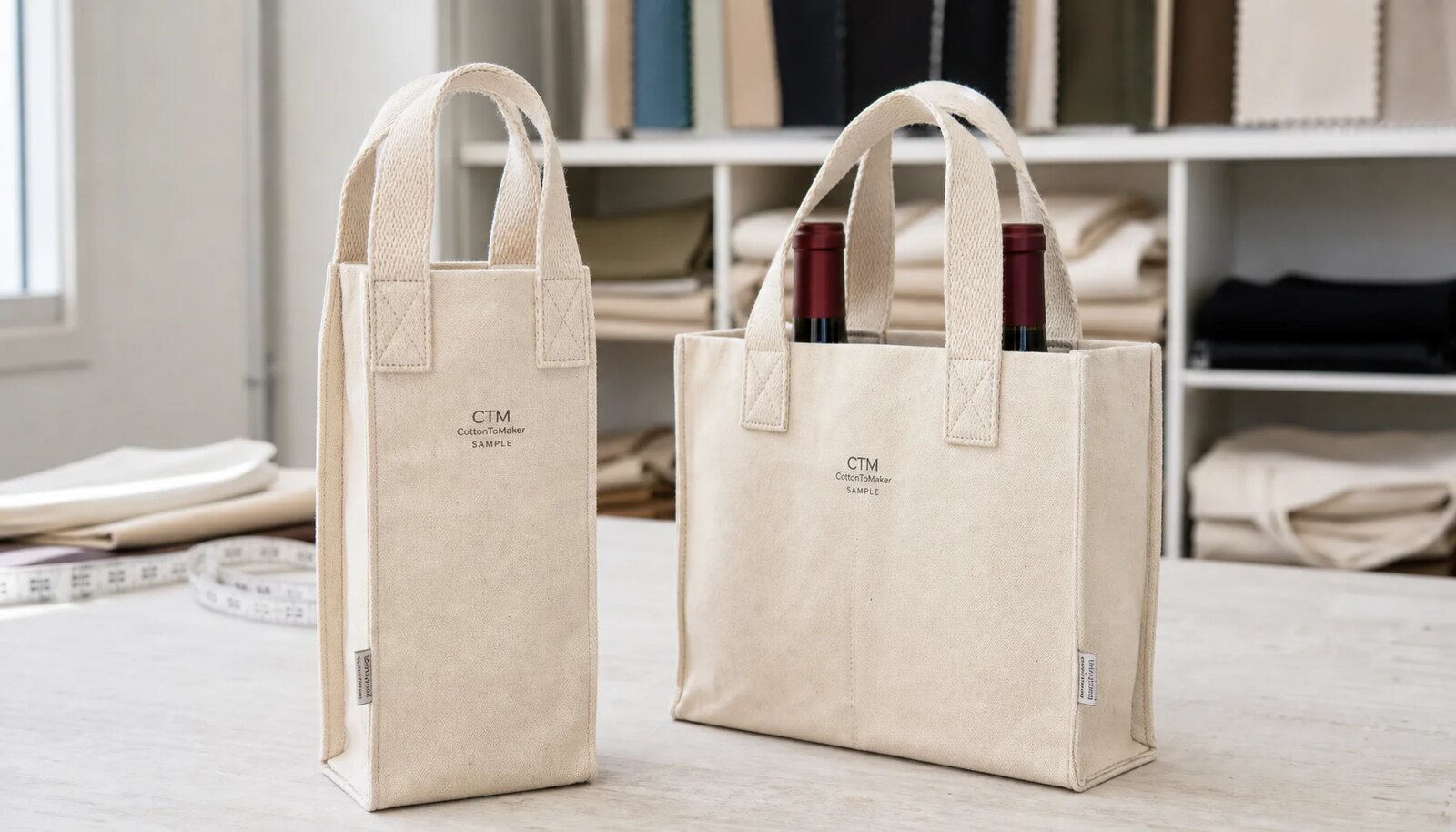
Buying Problem: A Wine Carrier Is Not a Small Tote
Canvas wine carriers for craft fairs look simple, but they fail in different ways from regular tote bags. A tote can tolerate a soft shape, loose base, and light handle load. A wine carrier must hold a rigid glass bottle, keep the neck controlled, and remain presentable after shoppers carry it through a busy fair. If the RFQ only says “canvas wine bag with logo,” suppliers may quote different fabrics, different bottle templates, and different reinforcement levels while appearing cheaper on paper.
The main buying problem is quote comparability. One supplier may quote 8 oz cotton with a single line of stitching and heat transfer print. Another may quote 12 oz canvas, sewn divider, reinforced handles, and screen print. Both can write “canvas wine carrier,” but the landed cost, retail feel, and failure risk are not the same. A good RFQ should lock the functional details first, then request price breaks.
- Use the actual bottle size, not only “750 ml,” because wine bottle shoulders and base diameters vary.
- Define whether the carrier is a retail gift item, a checkout carry bag, or a reusable branded accessory.
- Separate appearance requirements from strength requirements so the factory can cost each part correctly.
- Treat print proof, bottle fit, and handle load as approval points before bulk production.
Start the RFQ With Bottle Fit and Carrier Format
Bottle fit is the first specification because it decides the pattern, base depth, divider width, and handle position. A slim Bordeaux bottle, wider Burgundy bottle, sparkling wine bottle, and craft cider bottle can all be 750 ml but need different clearances. If buyers do not provide bottle height, base diameter, shoulder shape, and neck height, the factory may use its standard wine bag pattern and the carrier may feel tight or unstable during booth use.
For craft fairs, the most common formats are single-bottle carriers for gift purchases and two-bottle carriers for bundles. Four-bottle caddies can work for wineries or specialty shops, but they need heavier canvas, stronger dividers, and larger cartons. If the event involves walking distance from booth to parking area, handle comfort and loaded balance matter more than a very slim retail silhouette.
- Single-bottle carrier: specify bottle height, base diameter, opening height, handle drop, and print area.
- Two-bottle carrier: specify divider type, base width, bottle spacing, and whether bottles should touch each other.
- Sleeve-style gift bag: good for low-cost branding, but weaker for repeated carry unless the handle is reinforced.
- Multi-bottle caddy: suitable for heavier purchases, but requires load testing and careful carton planning.
Canvas Weight, GSM, and Fabric Finish
For most branded craft fair wine carriers, 10 oz to 12 oz cotton canvas is a practical starting point. This is roughly 280 to 340 GSM depending on weave and finishing. It gives enough body for a bottle-shaped bag without becoming too stiff or expensive to ship. An 8 oz canvas can be acceptable for promotional single-bottle sleeves, but it may collapse around the bottle and show stress at seams. A 14 oz canvas feels premium but increases fabric cost, sewing difficulty, and carton weight.
Natural canvas is popular because it fits craft, winery, and handmade retail positioning, but buyers should accept that natural cotton has slubs, shade variation, and small fiber specks. If the brand needs a clean white or exact color, the RFQ should request bleached, dyed, or custom Pantone-matched fabric and include the related MOQ. Dyed canvas may need extra time for lab dips and bulk shade approval.
- Budget promotional use: 8 oz to 10 oz canvas, mainly for short-term gifting and lighter bottles.
- Standard reusable use: 10 oz to 12 oz canvas with reinforced handle attachment.
- Premium retail use: 12 oz to 14 oz canvas, often with better structure and stronger seams.
- Natural canvas: lower dye complexity, but buyer must accept normal cotton texture variation.
- Dyed canvas: stronger brand control, but higher MOQ and longer approval process.
Handle and Divider Construction Control the Failure Rate
The handle area is where weak wine carriers usually fail. Glass bottles create concentrated weight, and shoppers often swing the carrier while walking. A low-cost straight stitch may look clean on a sample but open during repeated loaded use. For commercial orders, specify folded handle ends, box-stitch or cross-stitch reinforcement, and a minimum loaded test using the heaviest bottle in the program.
Two-bottle carriers need a divider that is more than a loose fabric flap. The divider should hold bottles apart so glass does not knock together, especially when customers move through crowded aisles. A sewn-in divider connected to the base or side seams costs more than a loose separator, but it reduces movement and improves perceived quality. The RFQ should state whether the divider must reach the base, stop above the base, or be removable.
- Handle drop should suit hand carry; very short handles feel awkward with heavier bottles.
- Handle width should be comfortable enough for a loaded carrier, especially for two-bottle styles.
- Box-stitch reinforcement is preferred where handle ends join the bag body.
- Divider attachment should be visible in sample photos before approval.
- Base seams should be checked for puckering because bottle weight pulls directly on this area.
Print Method: Match Artwork to Canvas Texture
Screen printing is usually the best value for canvas wine carriers when the artwork is one to three solid colors and the order is 300 pieces or more. It gives predictable color coverage and reasonable repeat cost after screen setup. Natural canvas texture can break very fine lines, so artwork should avoid tiny text and thin strokes. For craft fair retail, a slightly bolder logo often looks better on fabric than a complicated full-color graphic.
Heat transfer or digital transfer can work for small runs, gradients, or multi-color art, but buyers should understand the tradeoff. Transfers may sit on top of the fabric and feel less natural. They can also crack or lift if the supplier uses poor film or presses onto uneven canvas. Embroidery is possible for premium carriers, but it changes fabric tension and may not suit large filled artwork. The RFQ should name the print method or request separate pricing by method instead of accepting the cheapest default.
- Screen print: best for solid logos, repeat orders, and clean brand marks.
- Heat transfer: useful for full-color small runs, but requires adhesion and wash or rub review.
- Embroidery: premium look, higher cost, better for small marks than large filled logos.
- Woven label: good for retail branding when front print must stay minimal.
- Print strike-off: should be approved on the final canvas fabric, not on paper.
MOQ Logic and Price Breaks for Craft Fair Programs
MOQ is not only a supplier policy; it is tied to fabric sourcing, cutting efficiency, print setup, and packing labor. For stock natural canvas and one-color screen print, many factories can quote practical MOQs around 300 to 500 pieces per artwork. For dyed canvas, custom labels, special handles, or multi-bottle caddies, the efficient MOQ may rise because the factory must reserve fabric, set up dye lots, or manage more sewing operations.
Buyers should request price breaks at realistic quantities rather than only one target quantity. A 300-piece order may be useful for a local craft fair launch, while 1,000 or 3,000 pieces may support multiple event dates or distributor replenishment. The best RFQ format separates unit price from screen charges, sample charges, label charges, inner packing, and carton cost. This prevents a low unit price from hiding setup costs.
- Request price at 300, 500, 1,000, and 3,000 pieces for the same specification.
- State whether multiple artworks can be combined under one total quantity or priced separately.
- Clarify whether MOQ is per fabric color, per print design, or per total order.
- Ask whether the quoted price includes trimming, thread cleanup, carton marks, and barcode labels.
- For repeat craft fair seasons, ask if screens or patterns can be retained for reorder consistency.
Quote Data That Makes Supplier Offers Comparable
A useful quote should include enough data for procurement, merchandising, logistics, and quality teams to make the same decision. Unit price alone is not sufficient. The quote should list fabric weight, finished dimensions, print method, number of print colors, handle construction, divider construction, sample cost, production lead time, carton quantity, carton size, gross weight, and delivery terms. Without these details, landed cost and risk cannot be compared accurately.
For importers and distributors, carton data is especially important because wine carriers can ship bulky if packed flat. A cheaper unit price may lose its advantage if the packing method creates excessive carton volume. Buyers should request carton CBM and gross weight at the quote stage, then recalculate landed cost by air, sea, or courier depending on the event deadline. If a supplier cannot provide basic carton estimates, the quote is not ready for buying approval.
- Product data: finished size, fabric GSM, handle length, divider type, and estimated piece weight.
- Branding data: print method, print size, colors, setup charge, and artwork file requirement.
- Commercial data: MOQ, price breaks, sample cost, payment terms, and validity period.
- Logistics data: carton quantity, carton dimensions, gross weight, CBM, and shipping mark plan.
- Schedule data: sample lead time, bulk lead time, inspection window, and handover date.
Sample Approval Should Test Use, Not Just Appearance
A good sample approval process checks whether the carrier works with the real bottle and real logo. The first prototype can confirm shape and construction, but the pre-production sample should use final fabric, final print method, final handle length, and final divider construction. This is the sample that should be approved before cutting bulk fabric. If a factory sends a substitute fabric sample only to show size, it should not be treated as final approval.
Procurement teams should create simple acceptance criteria for sample review. Insert the intended bottle, lift the carrier by the handle, place it on a flat table, check whether it stands reasonably, and look at how the print sits when the bottle is inside. For two-bottle carriers, place two filled bottles in the bag and walk with it for several minutes. The goal is not laboratory perfection; the goal is to catch obvious failures before bulk production.
- Bottle insertion should be smooth without forcing the base through tight seams.
- Handle should not twist sharply or pull the top opening out of shape under load.
- Print should remain visible and centered when the carrier is filled.
- Divider should keep bottles separated during normal hand carry.
- Natural canvas shade should be approved under normal retail lighting, not only factory lighting.
Packing Plan for Event-Ready Delivery
Craft fair orders often have fixed opening dates, small storage areas, and fast booth setup requirements. Packing should protect the carrier and make counting easy. For printed canvas wine carriers, flat packing is usually safer than tight folding because it reduces print creasing and keeps the base shape cleaner. If the product must be folded to reduce freight cost, the fold line should avoid the main logo and be tested on the sample.
Carton weight should stay practical for warehouse and event handling. A carton that is too heavy may be rejected by retail receiving teams or become hard to move at temporary event sites. Buyers should specify carton quantity, polybag preference, moisture protection, barcode or SKU labeling, and shipping marks. If the carriers are going directly to different craft fair locations, the order may need split carton labels or multiple delivery addresses.
- Use inner polybag only if required; excessive individual bagging can add labor and plastic waste.
- Add a carton liner or moisture bag for humid shipping routes or rainy-season production.
- Keep printed faces separated or facing inward if ink transfer risk exists.
- Require carton marks with SKU, artwork code, quantity, gross weight, and destination.
- Confirm whether cartons can be opened and counted quickly at event receiving.
Lead Time Risks Around Craft Fair Seasons
Canvas wine carrier lead time depends on sample approval, fabric availability, printing, sewing capacity, inspection, and shipping. A simple stock natural canvas order with one-color print may move quickly after artwork approval, while dyed canvas, custom labels, and multi-bottle structures need more time. The most common schedule mistake is starting the clock from RFQ date instead of from final artwork, sample approval, and deposit readiness.
Craft fair and holiday seasons create demand peaks for promotional bags, wine gift packaging, and retail totes at the same time. If the buyer needs delivery before a fixed event, the RFQ should include the required in-warehouse date, not only the event date. This leaves time for customs clearance, domestic delivery, repacking, and distribution to booths or stores. Rush production can be possible, but it usually reduces time for sample correction and inspection.
- Build the schedule from final delivery date backward: event date, warehouse receipt, shipping, inspection, packing, production, sample approval.
- Reserve extra time for dyed fabric, multi-color print, and custom woven labels.
- Avoid changing artwork after screen making unless the cost and delay are accepted.
- Plan inspection before final carton sealing when possible for large or retailer-sensitive orders.
- For split shipments, define which quantity ships first and whether all cartons use the same marks.
Specification comparison for buyers
| Spec decision | Recommended option | When it fits | Buyer risk to check |
|---|---|---|---|
| Fabric weight | 10 oz to 12 oz cotton canvas, about 280-340 GSM | Most craft fair wine, cider, olive oil, and gifting programs needing a structured but foldable carrier | Under 8 oz fabric can sag around bottle shoulders; over 14 oz may raise freight and feel bulky for retail browsing |
| Carrier format | Single-bottle or two-bottle tote with reinforced handle area | Single-bottle for impulse gifting; two-bottle for winery bundles or holiday sets | Bottle diameter and height must be supplied; some 750 ml burgundy bottles do not fit slim templates |
| Divider construction | Sewn-in center divider for two-bottle version | Needed when glass bottles are sold in pairs or transported around crowded fair booths | Loose dividers save cost but shift during use; divider seam strength should be checked after bottle loading |
| Print method | Screen print for solid logos; heat transfer only for full-color small runs | Screen print gives stable unit cost on 300+ pcs and works well on natural canvas | Ink coverage on textured canvas is not the same as paper proof; require a fabric strike-off before bulk |
| Handle reinforcement | Cross-stitch or box-stitch at handle attachment with folded fabric edge | Best for repeated hand carry at events where buyers walk booth to booth | Simple straight stitching may pass visual inspection but fail under loaded bottle weight |
| MOQ logic | 300-500 pcs per color/print for efficient screen print setup | Fits distributors and retail buyers consolidating several craft fair dates | Very low MOQ may mean digital transfer, higher unit cost, or leftover fabric shade variation |
| Packing method | Flat packed or lightly folded in export cartons with moisture protection | Flat packing protects print face and speeds booth setup | Aggressive folding can crease printed logos and distort bottle base panels |
| Sample approval | Pre-production sample using final fabric, handle length, print size, and bottle test | Necessary before branded craft fair launch or retailer planogram approval | Prototype made from substitute fabric does not prove bulk hand-feel, shrinkage, or print adhesion |
Buyer checklist before sampling
- Define the bottle type before requesting price: 750 ml Bordeaux, Burgundy, sparkling, cider, olive oil, or mixed use.
- State required carrier format: single bottle, two bottle with divider, four bottle caddy, or flat gift sleeve style.
- Specify canvas weight in oz or GSM, fabric color, dye requirement, and whether natural cotton slubs are acceptable.
- Provide logo artwork size, Pantone colors, print position, and acceptable print tolerance on textured canvas.
- List handle length, reinforcement method, seam allowance, and minimum loaded weight test requirement.
- Request sample photos showing bottle fit, divider spacing, print close-up, inside seams, and carton packing.
- Separate unit price, mold or screen charge, sample charge, inner packing, carton quantity, and export carton size.
- Confirm MOQ by fabric color and by print design, not only total order quantity.
- Require a pre-production sample approval before fabric cutting and a carton drop or compression review for export packing.
- Include delivery terms, port, lead time after artwork approval, and penalty-sensitive dates such as craft fair opening or retailer delivery window.
Factory quote questions to send
- What canvas weight are you quoting in oz and GSM, and is it stock greige, natural washed, dyed, or bleached fabric?
- What bottle dimensions does your existing pattern fit, and can you test with our bottle diameter and shoulder shape?
- Is the handle made from the same canvas body fabric, cotton webbing, or a separate tape, and how is it reinforced?
- For a two-bottle carrier, is the divider sewn into the base and side seams, or only attached at the top?
- Which print method is included in the unit price, and how many colors, positions, and screens are covered?
- What is the MOQ per artwork and per fabric color, and what price break applies at 300, 500, 1,000, and 3,000 pcs?
- Can you provide a pre-production sample from bulk fabric, and what sample lead time applies after artwork confirmation?
- What loaded weight test do you use for wine carriers, and how many cycles or minutes are applied during inspection?
- How many pieces are packed per carton, what is the carton size and gross weight, and are bags folded or flat packed?
- What production lead time applies after sample approval, and what risks could affect it during peak craft fair or holiday season?
Quality-control points to confirm
- Fabric GSM tolerance should be agreed before production, commonly plus or minus 5 percent for woven cotton canvas.
- Finished size tolerance should be practical for bottle fit, normally within plus or minus 5 mm on width and base depth for simple carriers.
- Handle attachment must pass a loaded bottle test using the heaviest intended bottle format, not an empty visual inspection.
- Print position should be measured from fixed seams or top edge, with a tolerance agreed before bulk print starts.
- Ink adhesion should be checked by rub test after drying, especially on natural canvas with uneven surface fibers.
- Divider seams on multi-bottle carriers should be checked for alignment, skipped stitches, and pulling under load.
- Cartons should protect against moisture, crushing, and print transfer, especially for natural canvas packed during humid months.
- Final inspection should include bottle insertion, handle pull, print review, loose thread trimming, and carton marking verification.