Build the QC plan around glass-bottle use
Canvas wine carriers look simple, but they carry glass, liquid weight, and a visible brand mark on a narrow panel. A filled 750 ml wine bottle often falls around 1.2-1.6 kg depending on bottle weight and fill level; treat that as a buyer-verifiable starting point, not a universal standard. A two-bottle carrier can place more than twice that stress on handle roots, bottom corners, side seams, and divider stitching.
At craft fairs, the carrier may be loaded quickly, placed on a booth table, handed to a shopper, carried with other purchases, and reused as gift packaging. Defects that might be tolerable on a casual tote become more obvious here: a tight mouth opening slows sales, a leaning bottom looks low value, a crooked logo is easy to see, and a weak handle creates a serious complaint.
The main procurement risk is an incomplete specification. A photo and target price do not tell the factory the required bottle range, finished GSM, handle reinforcement, divider construction, print tolerance, or packing method. To compare quotations, create a technical sheet and inspect against the approved pre-production sample, not a marketing image.
- Use real bottle measurements for pattern approval and inspection.
- Treat handle failure, severe seam opening, mold, wrong bottle capacity, and missing essential components as serious defects.
- Inspect both appearance and function: fit, carry, standing stability, divider security, print position, and packing condition.
- Write defect classifications before final inspection so stains, slubs, print drift, and loose threads are not debated carton by carton.
Start with bottle fit, not the bag sketch
“For a 750 ml bottle” is not precise enough for sourcing. Bordeaux-style bottles are usually slimmer than many Burgundy bottles, while sparkling or Champagne-style bottles may be wider and heavier. Some craft fair vendors also sell cider, olive oil, spirits, syrups, or specialty drinks. If the same carrier must handle several products, approve the pattern against the widest and tallest bottle in scope.
Finished measurements should be taken after sewing, pressing, washing, or finishing. The important dimensions are finished height, body width, gusset depth, bottom width, mouth opening, handle width, and handle drop. The mouth opening controls insertion speed; the gusset and bottom width affect whether the loaded carrier stands cleanly.
Soft canvas moves during measurement, so state the method. Define whether the carrier is measured flat or standing, where height begins and ends, where gusset is measured, and how handle drop is recorded. Practical starting tolerances for many canvas wine carriers are +/-0.5 cm on width and gusset, +/-0.5 to 1.0 cm on height, and +/-1.0 cm on handle drop, but closures, tight sleeves, or printed borders may need tighter control.
- Create a physical bottle gauge or keep the approved bottle at the factory.
- Test the largest approved bottle, not only the easiest slim bottle.
- Specify finished sewn dimensions, including mouth opening and bottom width.
- Confirm fit while empty and loaded because the body can distort under bottle pressure.
Choose canvas by finished GSM, handfeel, and print surface
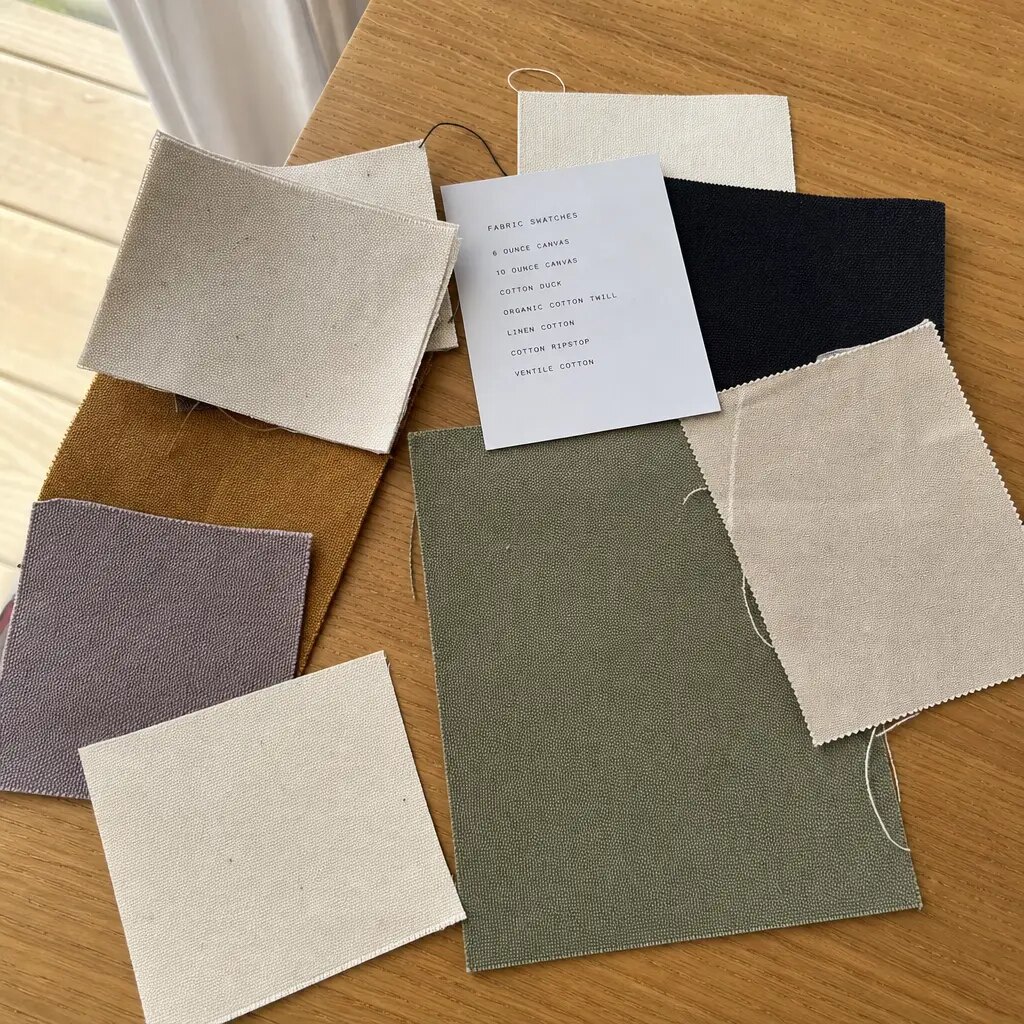
Canvas weight is often quoted as ounces, but suppliers may mean greige weight, finished weight, or a stock fabric category. Ask for finished GSM plus nominal ounce weight. For single-bottle carriers, buyers often begin evaluating around 12 oz canvas, commonly quoted near 340-360 GSM finished weight. For two-bottle, heavier-bottle, or premium styles, buyers may evaluate around 14 oz canvas, often quoted near 400-430 GSM. These are starting points to verify with the supplier, not universal standards.
The right fabric depends on bottle weight, target price, desired structure, print detail, and reuse expectations. Lighter canvas may be suitable for a low-cost event program. Heavier canvas can improve structure and perceived value, but it increases material cost, carton weight, and sometimes sewing difficulty. Require a tolerance, such as +/-5% finished GSM if acceptable, and retain a bulk production swatch for inspection.
Texture affects branding. Tightly woven canvas usually gives cleaner screen print edges. Coarser rustic canvas can fit craft positioning but may create ink pinholes, broken edges, or poor small-text readability. If the logo includes thin lines, QR codes, fine borders, or small sponsor names, approve a printed strike-off on the actual bulk canvas before mass printing.
Natural cotton should look natural, not dirty. Small seed flecks or slubs may be acceptable if they match the approved sample and are not prominent on the logo panel. Oil stains, water marks, mildew, dirty fold marks, dark contamination, and strong odor should be classified as defects. For any organic, recycled, OEKO-TEX, or restricted-substance claim, require documentation tied to the exact fabric used.
- Request finished GSM, nominal ounce weight, composition, color, and tolerance.
- Compare bulk fabric to the approved swatch for weight, shade, stiffness, weave, and handfeel.
- Approve printing on the real canvas surface, not only on a lab dip or digital mockup.
- Separate acceptable natural slubs from rejectable stains, odor, and contamination.
Specify construction where failures actually occur
Construction controls both strength and presentation. A flat sleeve can be economical, but a boxed bottom or controlled gusset usually supports a bottle base better and helps the carrier stand on a display table. Straight side seams, even bottom corners, and consistent seam allowance matter because the load pushes directly against these points.
Interior finishing should match the price level and sales channel. An unlined carrier can be acceptable, but the inside should not show uncontrolled fraying, long thread tails, uneven overlock, or raw edges in high-stress areas. If the bag is lined, confirm that the lining does not reduce mouth opening, distort the gusset, or hide weak seams.
Handles are the highest-risk component. Specify self-fabric or webbing, finished width, length, handle drop, thread color, stitch density, reinforcement stitch pattern, and any inner patch. Common reinforcement options include box stitch, box-and-cross, bartack, or reinforced patches. Rivets can add a sturdy look, but they introduce metal quality, rust, and fabric-tear considerations.
For two-bottle carriers, the divider is functional. Define divider material, thickness or GSM, height, width, and attachment points. A divider sewn only near the top may look correct when empty and collapse when two bottles are loaded. Inspect divider separation while loaded.
- Define bottom construction: flat, boxed gusset, separate bottom panel, or reinforced base.
- State inside seam finish: overlock, binding, turned seam, lining, or other approved method.
- Require handle reinforcement details in the BOM, not only in sample photos.
- For two-bottle bags, inspect divider attachment and loaded separation as functional checks.
Control branding before bulk printing starts
Screen printing is common for craft fair wine carriers because it suits simple one- or two-color logos. The narrow panel leaves little room for drift. A logo that is 0.8 cm off center may be acceptable on a large tote but obvious on a bottle carrier. Set placement from measurable references such as top edge, side seam, centerline, or bottom seam.
For screen print, specify artwork version, print size, print side, ink color, Pantone reference if needed, and placement tolerance. Clarify whether Pantone is coated or uncoated when color matching matters. Natural canvas can change how ink appears, so a physical strike-off on bulk fabric is more reliable than a digital mockup.
Curing and packing interact. Poorly cured ink can rub off, block, or transfer under carton pressure. Inspectors should check ink coverage, smudges, pinholes, registration, rub resistance, and print-to-print contact risk. If flat packing creates a fold across the logo, test the fold before approving mass packing.
Transfers may work for small runs or multi-color artwork, but textured canvas can reduce adhesion. Test for edge lift, cracking, glossy mismatch, and rub performance. Woven labels, cotton labels, and patches can look premium, but they add checks for material, size, stitch line, placement, edge quality, and correct version.
- Approve a production strike-off on actual bulk canvas.
- Set logo placement tolerance, often around +/-0.5 cm for narrow panels when practical.
- Check ink curing and rub resistance before cartons are compressed.
- Include label, patch, hangtag, barcode, and setup costs in quote comparisons.
Make supplier quotes comparable
Canvas wine carrier quotes can hide major differences. MOQ may apply by fabric color, custom dye lot, style, print version, label version, and packing method. A supplier may quote a low unit price for one natural canvas style but not for ten artwork versions split into small quantities. Screen setup, cutting efficiency, sewing changes, and SKU segregation all affect cost.
Issue a standardized RFQ. Include finished dimensions, canvas GSM, composition, color, construction, handle reinforcement, divider requirement, branding method, print size, color count, label details, tolerance expectations, packing method, and inspection requirements. Ask suppliers to separate unit price from sample fees, screen charges, setup charges, hangtags, barcode labels, carton upgrades, testing, and documentation.
Confirm logistics early. Heavier canvas increases gross weight, and inefficient folding increases carton volume. Ask for carton dimensions, pieces per carton, gross weight, packing photos, and maximum carton weight before approving the order. For repeat craft fair programs, also ask whether fabric shade, stiffness, webbing, and print results can be repeated across seasons.
- Request MOQ by style, color, artwork, label, and packing format.
- Compare quotes against the same technical sheet, not the same reference image.
- Confirm whether the divider, reinforcement, label, and retail packing are included.
- Ask for carton dimensions and gross weight before order award, not after production.
Use sampling to lock the production standard
Development samples are useful for early decisions. They can confirm silhouette, bottle fit, handle drop, divider concept, and general look. They may use available fabric or temporary trim, but they should not become the final production standard unless all materials and methods match bulk production.
The pre-production sample should use confirmed bulk fabric, actual branding method, final thread, final label or patch, final handle construction, final divider, and final packing method. This sample becomes the reference for mass production and inspection. If the factory cannot provide a true pre-production sample before mass cutting, the buyer should treat the order as higher risk.
Approve the sample by use, not only by photo. Insert the approved bottle several times, load the carrier, lift it, set it down, and inspect handle roots, bottom corners, side seams, mouth opening, and print position. For a two-bottle carrier, use two bottle equivalents and confirm that the divider prevents normal contact during carry.
Keep records. Photograph the front, back, inside seams, bottom, handle attachment, divider, branding, label, hangtag, and packing. Keep one approved sample with the buyer and one signed or sealed sample with the factory to reduce disputes during final inspection.
- Use development samples for design choices and pre-production samples for control.
- Approve fit, carry, standing stability, branding, and packing physically.
- Do not release bulk production from a digital proof alone.
- Attach sample photos and tolerances to the purchase order or inspection file.
Apply AQL and defect classification clearly
Final inspection should follow an agreed sampling plan when applicable, commonly ANSI/ASQ Z1.4 or ISO 2859-1. State inspection level, AQL limits, sample size approach, and whether tests are destructive or non-destructive before production. Many buyers set different acceptance limits for major and minor defects; critical defects are often not accepted. The exact plan should match buyer policy, destination market, and order risk.
Critical defects are conditions that make the carrier unsafe, unusable, or clearly wrong. Examples include handle breakage during the agreed loaded carry check, severe seam opening, mold, strong mildew odor, sharp foreign objects, wrong item, wrong bottle capacity, or missing essential component that prevents use.
Major defects affect saleability, function, or brand presentation. Examples include dimensions that prevent approved bottle insertion, missing or collapsed divider, incomplete handle reinforcement, incorrect artwork, logo outside tolerance, obvious stain on the front panel, fabric weight outside agreed tolerance, wrong color, wrong label, or cartons mixed incorrectly by SKU.
Minor defects are small workmanship or appearance issues that do not affect function and are within the approved quality standard. Examples may include a short loose thread that can be trimmed, a small non-prominent natural slub, or slight shade variation within the approved range. Define these limits in writing so inspectors and suppliers do not reclassify defects at shipment time.
- Critical example: handle tears during the agreed loaded carry check; result should fail or trigger escalation.
- Major example: mouth opening is too narrow for the approved widest bottle; affected units are not saleable for the program.
- Major example: print is visibly off center beyond the approved tolerance on the front panel.
- Minor example: one short thread tail outside a stress point, if within the trimming standard.
- Pass example: loaded carrier holds the approved bottle weight with no seam opening, handle slippage, fabric tear, or visible stress failure.
Inspect inline, not only after packing
Inline QC prevents repeat defects. At fabric receiving and cutting, check shade, GSM, obvious defects, panel direction, cut size, and whether front panels are clean enough for branding. Oil marks, water marks, mildew, and dark contamination are easier to reject before printing and sewing.
During printing, inspect artwork version, color, placement, ink coverage, registration, curing, and rub performance. Printed panels should be checked before they enter the sewing line. If a logo is already off center, stitching cannot fix it.
During sewing, inspect first pieces and then monitor regularly. Focus on seam allowance, stitch density, skipped stitches, broken thread, bottom gusset shape, handle reinforcement, divider position, closure alignment, and trimming. If the first bundle is wrong, stop the line before the issue spreads through the order.
Final inspection should pull samples from multiple cartons, colors, print versions, and production lots. Check finished dimensions, bottle insertion, loaded carry, bottom stability, print rub, divider security, loose threads, odor, labels, packing, carton marks, SKU segregation, and quantity count.
- Cutting QC: shade, GSM, fabric defects, panel direction, cut size, and clean logo panels.
- Printing QC: artwork, color, placement, curing, rub resistance, smudges, pinholes, and registration.
- Sewing QC: seam allowance, stitch density, gusset shape, handles, divider, closure, and trimming.
- Functional QC: bottle fit, loaded carry, bottom stability, handle comfort, and two-bottle separation.
- Final QC: dimensions, appearance, odor, labels, packing, carton marks, SKU separation, and count.
Protect quality through packing and moisture control
Packing can create defects after good sewing. Flat packing saves freight space, but over-compression can cause hard creases, twisted handles, crushed gussets, and print offset. The risk is higher with dark prints, transfers, patches, closures, and bags packed before ink is fully cured.
Specify fold method, bundle count, pieces per carton, print orientation, and whether handles are tucked or laid flat. Avoid print-to-print contact if blocking is a risk. If hardware, patches, snaps, or labels are used, confirm they do not dent fabric or print during carton compression.
Cartons should be organized for receiving and event setup. Mark by PO number, item code, color, logo version, quantity, carton number, gross weight, and destination information if required. Mixed cartons should be used only when planned and clearly labeled.
Moisture control should match the shipping route and sustainability policy. If individual polybags are avoided, consider a master carton liner, desiccant where appropriate, and storage rules that keep cartons off damp floors. Strong musty odor, mildew, or water damage should be treated as serious for wine gift packaging.
- Approve fold method and bundle count before final packing.
- Control carton gross weight and compression to protect handles, prints, and gussets.
- Prevent print offset by confirming curing and print orientation.
- Use carton liners or approved moisture controls when polybags are avoided.
- Mark cartons clearly by SKU, artwork version, quantity, and carton sequence.
Specification comparison for buyers
| Option to compare | Best fit | Specification to request | Main QC risk |
|---|---|---|---|
| 12 oz cotton canvas single-bottle carrier | Cost-controlled craft fair sales, winery giveaways, simple 750 ml bottle programs | Finished GSM as buyer-verifiable starting point, fiber content, finished dimensions, mouth opening, boxed or flat bottom, handle drop, reinforcement stitch | Too soft to stand, fabric weight quoted inconsistently, weak handle roots, bottle fit approved only on a slim bottle |
| 14 oz cotton canvas two-bottle carrier | Premium retail programs, heavier bottles, reusable gift packaging, sparkling or mixed bottle ranges | Finished GSM, divider material and attachment, boxed bottom, reinforced handles, load check using two bottle equivalents | Divider collapses, mouth opening too tight, high carton weight, print cracking on thicker folds |
| Cotton-poly canvas carrier | Larger repeat programs needing more dimensional stability or lower shrinkage risk | Blend ratio, finished GSM, shrinkage expectations, color lot control, print compatibility | Handfeel may not match natural cotton positioning; sustainability claims must be documented |
| Screen printed logo | One- or two-color winery, event, sponsor, or private-label branding | Artwork version, ink color reference, print size, print side, placement tolerance, production strike-off on bulk fabric | Off-center logo on narrow panel, poor curing, ink rub-off, print blocking during packed storage |
| Woven label or cotton label | Premium, low-color, or repeat branding where small print detail is difficult on canvas | Label size, material, edge finish, stitch line, placement tolerance, barcode or care content if needed | Crooked label, frayed edges, wrong label version, extra cost omitted from quote |
| Heat transfer or digital transfer | Short runs, multi-color artwork, or detailed graphics not suited to screen print | Transfer type, artwork file, adhesion test, fold test, rub check, packing method approval | Edge lift, cracking on fold lines, glossy mismatch, adhesion failure on textured canvas |
| Open-top carrier | Fast booth loading and widest bottle compatibility | Finished mouth opening, height, gusset, handle drop, bottle fit test with widest and tallest approved bottle | Bottle protrudes unexpectedly, opening distorts, carrier looks unfinished if top edge is poorly sewn |
| Closure carrier with snap, loop, drawstring, or hook-and-loop | Gift sets, transport containment, retail display requiring partial closure | Closure type, hardware spec, position, alignment tolerance, compatibility with all approved bottles | Closure does not reach on tall bottles, hardware dents fabric, alignment defects increase labor rejects |
Buyer checklist before sampling
- Define the bottle scope before quoting: Bordeaux 750 ml, Burgundy 750 ml, sparkling bottle, tall dessert bottle, olive oil bottle, spirits bottle, cider bottle, or mixed compatibility.
- Record maximum bottle diameter, bottle height, shoulder shape, and filled bottle weight used for fit and load checks; keep a physical bottle or drawing for factory reference.
- Specify finished sewn dimensions after sewing and pressing: height, body width, gusset depth, bottom width, mouth opening, handle width, and handle drop.
- Use practical dimension tolerances as starting points: often +/-0.5 cm for width and gusset, +/-0.5 to 1.0 cm for height, and +/-1.0 cm for handle drop unless design needs tighter control.
- State canvas weight as finished GSM and nominal ounce weight, with an agreed tolerance such as +/-5% against the approved bulk swatch.
- Confirm fiber content and documentation requirements before making organic, recycled, OEKO-TEX, restricted-substance, or other compliance claims.
- Define construction: single-bottle or two-bottle, boxed bottom, divider, base reinforcement, lining, seam finish, closure, hangtag, retail label, and barcode requirement.
- List handle details: self-fabric or webbing, finished width, length, drop, thread, stitch density, reinforcement pattern, reinforcement patch, and loaded carry expectation.
- Name the branding method, print side, print size, artwork version, ink color reference, Pantone requirement if any, logo placement reference points, and placement tolerance.
- Require a pre-production sample made from confirmed bulk fabric, final branding method, final trim, final sewing construction, and final packing method before mass cutting.
Factory quote questions to send
- What bottle range is your quoted pattern designed for, and what maximum diameter and height will it accept after sewing?
- What finished dimensions are included in your price: height, width, gusset, bottom width, mouth opening, handle width, and handle drop?
- What dimension tolerances do you apply, and are measurements taken flat, standing, or loaded with a bottle?
- What is the finished fabric weight in GSM, what is the nominal ounce weight, and is weight measured before or after dyeing, washing, printing, or finishing?
- What is the fabric composition, and can you provide documents for organic, recycled, or restricted-substance requirements if requested?
- Is the quote based on stock natural canvas, stock dyed canvas, custom-dyed canvas, or a reserved fabric lot? Can the same lot or shade be repeated?
- For two-bottle styles, is the divider included in the unit price, what material and GSM is it, and where is it attached?
- What handle reinforcement is included: box stitch, box-and-cross, bartack, rivet, inner patch, or another method?
- What thread type and stitch density do you use for body seams, bottom corners, handle roots, and divider attachment?
- What load or pull check do you perform, what test weight is used, how long is it held, and what is the failure criterion?
Quality-control points to confirm
- Use an agreed sampling plan, commonly ANSI/ASQ Z1.4 or ISO 2859-1 when applicable, and state inspection level and AQL before production; many soft goods buyers use tighter AQL for major defects than minor defects.
- Classify critical defects as unsafe or unusable conditions such as handle breakage during normal load check, severe seam opening, mold, strong mildew odor, wrong item, wrong bottle capacity, sharp foreign object, or missing essential component.
- Classify major defects as saleability or function failures such as dimensions preventing bottle fit, missing divider, weak or incomplete handle reinforcement, incorrect artwork, print outside tolerance, obvious front-panel stain, fabric weight outside agreed tolerance, or wrong packing by SKU.
- Classify minor defects as limited appearance issues that do not affect function, such as small trimmed thread tails, minor non-prominent natural slubs within the approved standard, or slight shade variation inside the agreed range.
- Verify finished dimensions against the approved spec and pre-production sample; practical starting tolerances may be +/-0.5 cm for body width and gusset, +/-0.5 to 1.0 cm for height, and +/-1.0 cm for handle drop unless otherwise agreed.
- Check fabric weight against approved finished GSM using production swatches or cut samples; a commercial tolerance such as +/-5% should be agreed in advance rather than assumed.
- Inspect bottle fit using the approved bottle or equivalent gauge; insertion should be smooth, the mouth opening should not distort excessively, and the loaded bag should stand as intended if stand-up presentation is required.
- Inspect every sampled handle attachment for the approved reinforcement pattern, stitch density, skipped stitches, broken thread, loose bartacks, needle damage, unraveling, and fabric tearing at the handle root.
- Perform a loaded carry check on sampled units using the approved bottle weight or equivalent test weight; pass means no seam opening, handle slippage, fabric tear, or visible stress failure.
- For two-bottle styles, confirm the divider is present, correctly positioned, correctly stitched, and keeps two bottle equivalents separated during a normal carry simulation.