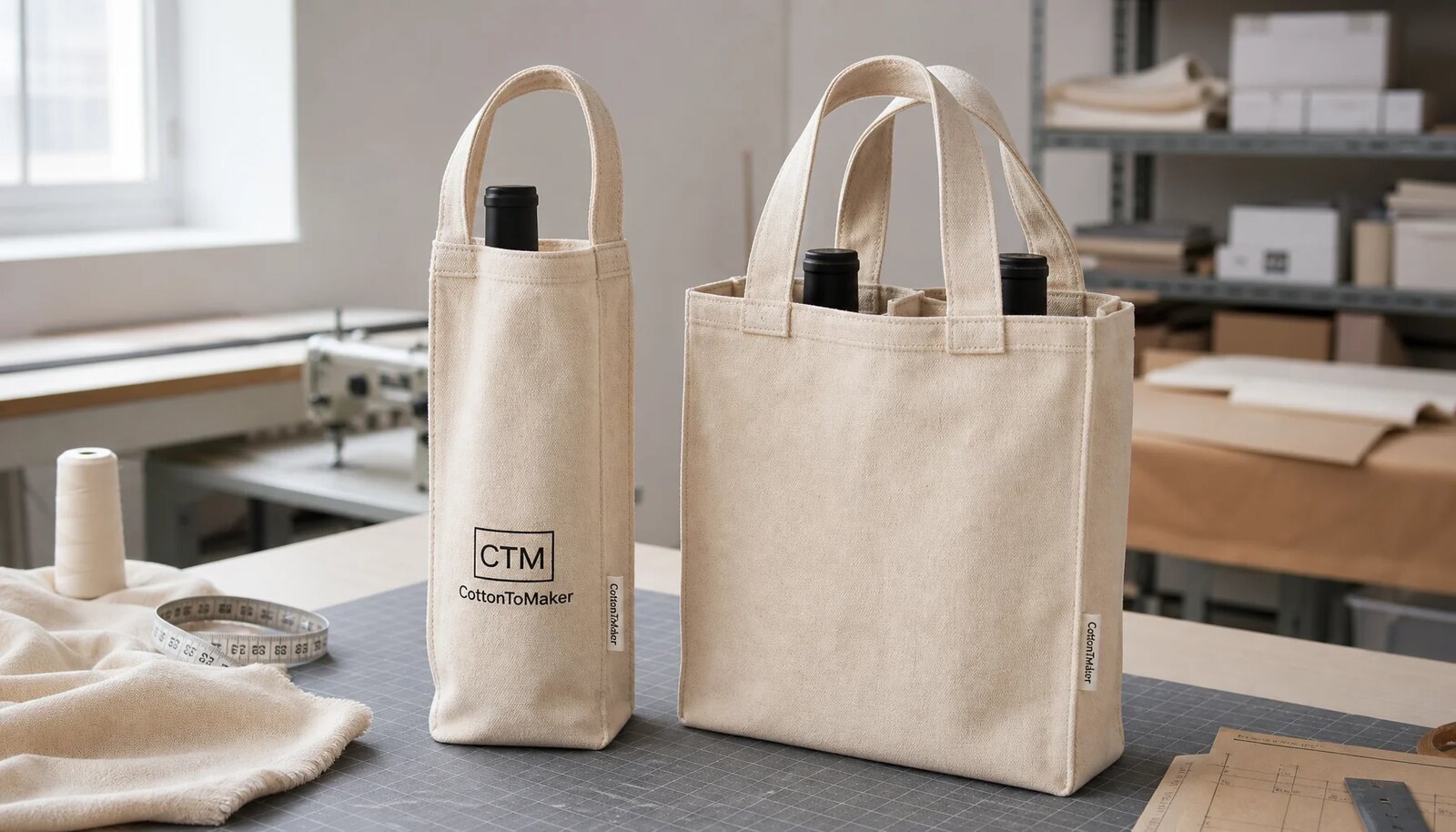
Start With the Craft Fair Use Case
Canvas wine carriers for craft fairs do more than hold a bottle. They sit on crowded vendor tables, hang from booth rails, move through aisles, and keep a brand visible while the shopper continues browsing. That movement matters. A logo that looks perfect on a flat mockup can feel too high, too low, or slightly twisted once the bag is sewn, loaded, lifted, folded, and packed.
For procurement teams, the first decision is not the artwork file. It is the use case. An empty giveaway carrier can prioritize cost, speed, and a simple one-color print. A resale carrier needs neater sewing, stronger handfeel, cleaner presentation, and retail labeling space. A pre-packed gift set needs better base stability, secure dividers, and carton protection. A tasting-room bag may need repeat-order consistency across seasons. A multi-brand craft fair program may need the same construction with many logo versions.
Write the RFQ in operating language. State whether the carrier must stand upright with a bottle inserted, hang from a rack, fold flat for event transport, ship pre-packed with bottles, or support multiple artwork versions. If the front panel will be folded during packing, the fold can cut through the logo. If the print sits too close to the handle, stitching and shadows will compete with it. If the print sits too low, the bottom gusset, bottle bulge, and table edge can hide or crease the mark.
- For table display, keep the primary logo on the front panel and above the strongest bottle bulge and bottom-gusset zone.
- For hanging display, leave clear space below the handle reinforcement so the logo does not look crowded.
- For retail resale, reserve space for hangtags, barcode labels, price stickers, care labels, or belly bands.
- For distributor programs, create a version matrix that lists artwork, quantity, print color, packing label, and destination.
- For gift sets, test the carrier with the exact bottle count and heaviest expected filled weight before bulk approval.
Lock the Carrier Format Before Sizing Artwork
Logo sizing should follow the sewn pattern. Reversing that order creates avoidable problems. A basic single-bottle canvas carrier may appear to have a generous front panel before sewing, but the visible face narrows when the side seams turn around a round bottle. A two-bottle carrier has more width, yet the internal divider and heavier load can pull the front panel differently once both compartments are filled.
The most common procurement formats include economy single-bottle carriers, premium single-bottle carriers, two-bottle carriers with dividers, and tall carriers for sparkling wine, olive oil, craft beverages, or specialty bottles. If the same brand mark will be used across several formats, scale and place it separately for each finished pattern. A 150 mm logo may look balanced on a two-bottle carrier and oversized on a narrow single-bottle bag.
Avoid quoting by product name alone. Ask for finished measurements in millimeters: body width, body height, side gusset, bottom gusset, handle drop, handle width, and divider width if used. Finished dimensions are more useful than cut-panel dimensions because buyers receive sewn goods, not flat panels. If the supplier proposes a stock pattern, ask which bottle height and diameter that pattern was built around. A bag that fits a slim Bordeaux-style bottle may not fit a wider Burgundy, sparkling, olive oil, or craft beverage bottle cleanly.
- Economy single-bottle carrier: often works best with simple artwork and an 80-100 mm wide logo, depending on front-panel width.
- Premium single-bottle carrier: can often carry a 100-120 mm wide logo when canvas weight and base stability are stronger.
- Two-bottle carrier: may support a 120-160 mm wide logo if it stays clear of side curves and divider pull.
- Tall bottle carrier: needs height review because long necks and taller silhouettes shift the visual center.
- Mixed bottle carrier: should be tested against the largest diameter, tallest height, and heaviest filled bottle combination expected.
Build a Placement Spec Inspectors Can Measure
Good logo placement instructions use finished sewing references. Phrases such as “centered on front” or “middle of bag” sound clear in email, but they are too loose for production. Operators and inspectors need measurable points: the lower edge of the handle stitch box, finished side seams, bottom gusset fold, and finished vertical centerline.
For many standard front-panel wine carrier layouts, a practical starting point is to center the artwork horizontally and place the top of the artwork 35-45 mm below the lower edge of the handle reinforcement stitch box. Keep at least 20 mm from each finished side seam. For borders, fine type, QR codes, or rectangular frames, increase side clearance to 25-30 mm. Keep the bottom of the artwork above the bottom gusset fold, commonly at least 25-35 mm depending on bag height and base construction.
Approve the placement with the reference bottle inserted, not just on a flat table. The flat view confirms measurement and print registration. The standing loaded view shows the bottle curve, panel tension, and table-display angle. The lifted-by-handle view reveals whether the handle pulls the logo area into a crease. When all three views work, the approved pre-production sample becomes a useful inspection standard rather than a decorative approval photo.
- Measure logo placement from finished side seams and handle stitch box, not from raw cut-panel edges.
- Use a finished centerline or folded center reference to keep the artwork visually centered after sewing.
- Set a practical placement tolerance, often ±5 mm for front-panel screen prints on sewn canvas.
- Keep fine text, borders, QR codes, and thin outlines away from seam curves, bottom folds, and handle reinforcement zones.
- Ask the supplier to photograph the PP sample with a ruler visible so placement approval is documented.
Control Bottle Fit and Loaded Shape
A canvas wine carrier is load-bearing packaging. It should be specified around the bottle, not around a generic idea of “standard wine.” Provide bottle height, maximum diameter, base diameter, shoulder style, and estimated filled weight. If vendors may sell wine, cider, spirits, syrups, olive oil, or specialty beverages, specify the largest and heaviest bottle the carrier must handle.
Bottle geometry changes the way the logo looks. A round bottle pushes the front panel outward, especially near the lower body and side seams. Wider bottles can move a logo into the curve zone even when the artwork technically sits inside the printable area. Tall bottles can make the same logo appear lower because the neck changes visual balance. Two-bottle carriers deserve extra attention because two filled compartments and the divider may pull the front panel unevenly.
Functional testing does not need to be elaborate, but it does need to be written down. Load the carrier with the intended bottle count and carry it by the approved handles. For higher confidence, ask whether the supplier can test at 1.25x to 1.5x the intended working load without tearing, open seams, handle failure, or divider movement. Put the agreed method in the PO or QC sheet so the buyer, factory, and inspector judge the same requirement.
- Provide maximum bottle diameter and height in millimeters rather than relying on “standard wine bottle” wording.
- Check fit with real bottles or dimensionally equivalent dummy bottles during sample approval.
- For two-bottle styles, confirm that the divider prevents glass-to-glass contact while the carrier is carried.
- Inspect loaded samples for twisting, leaning, base collapse, handle discomfort, and visible logo distortion.
- Define whether load testing is a sample-only approval check, an inline QC check, or a final inspection check.
Choose Canvas Weight and Finish Deliberately
Canvas weight affects structure, sewing, print clarity, freight cost, and perceived value. For many reusable craft fair wine carriers, 10-12 oz canvas, approximately 280-340 GSM, is a balanced sourcing range. It usually gives enough body for table display without creating excessive folded-edge bulk. Lighter canvas can work for budget promotional single-bottle bags, but it is more likely to wrinkle around the bottle and create an uneven print surface.
Heavier canvas is not automatically better. Around 340-380 GSM, the handfeel can be more substantial and the carrier may stand more confidently, but the trade-offs are real: thicker folded seams, more needle stress, slower sewing, and higher carton gross weight. Above roughly 380 GSM, confirm sewing capability, handle reinforcement, carton weight, and whether the added material cost supports the retail or promotional goal.
Finish changes both the look and the print result. Natural canvas may show shade variation, cottonseed flecks, slubs, and weave texture. That can suit a craft-market aesthetic, but it should be approved as a swatch range, not treated as a defect after delivery. Bleached canvas gives a cleaner print background. Dyed canvas may require higher fabric MOQ and an underbase for light artwork. Washed canvas can feel softer, but shrinkage and panel flatness need control before cutting.
- 260-280 GSM: possible for budget promotional carriers, but test wrinkles, opacity, and loaded shape.
- 280-340 GSM: balanced range for many craft fair, tasting-room, and retail wine carrier programs.
- 340-380 GSM: stronger handfeel, but review seam bulk, handle stitching, and freight impact.
- Above 380 GSM: best reserved for premium reusable packaging where cost, bulk, and sewing complexity are acceptable.
- Natural canvas: approve shade, slub level, and texture show-through because they affect perceived print color.
Match the Print Method to Artwork Risk
Screen printing is usually the most reliable commercial choice for one- to three-color logos on canvas wine carriers. It is easy to quote, repeatable in bulk, and strong for winery, retailer, distributor, and event branding. Still, canvas is not coated paper. Slight weave show-through, softer edges, or small pinholes may be normal if they are visible in the approved strike-off.
Heat transfer can help with short runs, full-color logos, gradients, and event graphics with many colors. The risk is surface behavior. On textured canvas, transfer edges may be noticeable, and folding or carton pressure can affect adhesion or appearance. If using transfers, test folding, dry rub, loaded bottle curvature, and carton compression before mass production. Do not approve a transfer based only on a digital rendering or a smooth substitute fabric.
Embroidery, woven labels, and printed labels are useful alternatives when direct front-panel printing is not the best choice. Embroidery can feel premium, but large filled areas can pucker canvas and raise cost. Woven labels work well for smaller brand marks near the upper panel or side seam, especially when the buyer wants subtle reusable packaging. Whichever method is selected, specify artwork size, placement, color target, underbase need, and defect limits before the PO is confirmed.
- Use screen print for bold solid logos, repeat programs, efficient bulk production, and clean unit-cost comparison.
- Use heat transfer for full-color or short-run artwork only after adhesion, rub, fold, and loaded-shape testing.
- Use embroidery after checking puckering, backing, stitch density, and cost on the selected canvas weight.
- Use sewn labels for small premium branding or when the main panel curve makes direct print risky.
- Avoid tiny reverse text, dense QR codes, thin outlines, and tight borders unless the supplier proves readability on exact fabric.
Make Supplier Quotes Truly Comparable
A low unit price is not useful if the quote hides assumptions. Canvas wine carrier pricing depends on fabric weight, fabric finish, pattern size, handle material, divider construction, print method, artwork versions, setup charges, sample stages, packing, carton count, inspection level, and shipping terms. Put these variables into an RFQ matrix so every supplier prices the same construction and service package.
MOQ should be separated into its real components. Bag MOQ is not the same as fabric color MOQ, print setup MOQ, artwork-version MOQ, or packing MOQ. A natural canvas carrier with one black screen print is easier to schedule than a dyed canvas program with eight logos, hangtags, and different carton labels. Multi-brand craft fair programs can work well, but only if the buyer gives quantity per design and keeps construction variables controlled.
Ask for price breaks that match likely buying behavior, such as 500, 1,000, 3,000, and 5,000 pieces, plus the incremental cost for each additional artwork version. If repeat orders are likely, ask whether screen charges, strike-off fees, fabric shade matching, or setup costs apply again. Also confirm whether the supplier will hold the approved pattern and logo placement standard for reorders, because replenishment drift can create brand inconsistency.
- Quote carrier body, print setup, sample charges, hangtags, barcodes, retail packing, and carton labeling as separate line items.
- List quantity per artwork version instead of giving only total order quantity.
- Confirm whether all versions share the same fabric lot, handle construction, print color, and carton packing.
- Ask whether reorder pricing assumes the same artwork, same fabric color, and same approved pattern.
- Compare carton dimensions and gross weight because packing efficiency affects landed cost and warehouse handling.
Use Sample Gates Before Bulk Cutting
A strong sample process keeps buyers from approving a staged bag that will not perform in use. For a new pattern, start with a blank construction sample if size, gusset, divider, handle drop, or base stability is not final. Next, approve a print strike-off on the exact production fabric and color. Then approve a pre-production sample that combines final fabric, final construction, final print method, final logo placement, and intended packing.
Treat the pre-production sample like a control document. Measure it. Photograph it. Insert the reference bottle. Lift it by the handle. Fold it the way it will be packed. Record the revision number. If the approved logo position is 40 mm below the handle stitch box and at least 20 mm from the side seams, those measurements should appear on the marked sample photos and inspection sheet.
When a sample fails, diagnose the cause before requesting a revision. A logo may look low because the artwork is too tall, the handle drop changed, the gusset pulls the panel, or the bottle is wider than expected. A print color may look dull because natural canvas texture shows through, the ink deposit is light, or an underbase is missing. Specific feedback shortens sampling time and prevents the production team from guessing what matters most.
- Approve blank construction before artwork if the carrier pattern, divider, or bottle fit is new.
- Approve strike-off before mass printing, especially for exact brand colors or light ink on dark canvas.
- Approve PP sample with bottle inserted, not only flat on a table.
- Label the approved control sample with date, revision, fabric weight, print method, artwork size, and placement measurements.
- Require new approval if fabric weight, fabric color, print method, bottle size, or handle construction changes.
Write QC Tolerances Into the PO
Quality control should cover safety, brand presentation, and shipment consistency. Because the carrier holds glass, handle strength, seam integrity, bottom stability, and divider security are not minor details. Because the same product carries the brand, logo placement, color, clarity, and print durability also need written acceptance limits. Replace vague wording such as “good quality” or “accurate logo” with measurable standards.
For logo placement, many buyers use ±5 mm from the approved pre-production sample for standard front-panel screen prints on sewn canvas. Finished body width and height may be controlled around ±5-8 mm, while gusset depth may need ±3-5 mm depending on the pattern. Handle drop often needs a ±5 mm tolerance, with both handles matching visually on each carrier. Confirm these figures with the supplier; very tight tolerances on soft sewn goods can increase cost or rejection rates.
Defect grading should be clear before inspection. Critical defects may include handle failure, open bottom seam, wrong artwork, or contamination that makes the item unusable. Major defects may include a broken brand name, severe off-center print, wrong print color, peeling transfer, large stain on the front panel, loose divider, or skipped stitches at handle reinforcement. Minor defects may include small loose threads or slight natural canvas slub variation outside the main logo area if that variation was approved.
- Set logo location tolerance, finished dimension tolerance, handle drop tolerance, and carton quantity tolerance before production.
- Define unacceptable print defects: broken text, heavy smudge, peeling, transfer, severe color mismatch, and visible misregistration.
- Define unacceptable sewing defects: open seams, skipped stitches at stress points, loose divider, handle misalignment, and weak reinforcement.
- Check loaded performance with intended bottle count and agreed safety margin where possible.
- Use the approved PP sample, marked photos, and written tolerance sheet as the final inspection reference.
Protect Print and Shape in Packing
Packing can create defects after sewing and printing have passed inspection. Canvas wine carriers are often flat packed to reduce carton volume, but a hard fold through the logo can create creases, cracking on transfers, or permanent fold memory on large ink areas. Freshly printed panels can also block, stick, or transfer under carton pressure, especially in humid conditions or when ink coverage is heavy.
Ask the supplier to confirm packing before bulk production: pieces per bundle, pieces per carton, folding direction, logo orientation, interleaving method, carton dimensions, net weight, gross weight, and carton markings. If the buyer has warehouse limits for manual handling, carton barcode rules, or destination-specific labels, include those details in the RFQ. A carrier with an attractive unit price can still become inefficient if cartons are oversized, overweight, or hard to identify by artwork version.
Reduced-plastic packing can work, but it still needs protection. Options may include kraft paper bundle wraps, tissue between printed panels, carton liners, or grouped bags instead of individual polybags. If individual polybags are required for retail or warehouse control, specify bag thickness, warning text where applicable, barcode position, fold presentation, and whether the logo faces outward or inward. Approve the packing sample with the same discipline as the product sample.
- Avoid a hard fold directly through the main logo whenever the pattern and carton size allow it.
- Use tissue, kraft paper, liners, or approved bundle packing to reduce abrasion and print blocking.
- Label cartons with PO number, item code, artwork version, quantity, carton number, and destination if required.
- Confirm carton gross weight before PO if the buyer has manual handling or warehouse receiving limits.
- Inspect packed samples after compression or storage simulation when using large ink areas, dark prints, or heat transfers.
Specification comparison for buyers
| Spec decision | Procurement-ready recommendation | Typical tolerance or control point | Buyer risk to check |
|---|---|---|---|
| Logo placement reference | Measure from finished sewing references: handle stitch box, finished side seams, bottom gusset fold, and vertical centerline | Front-panel placement commonly controlled within ±5 mm from approved pre-production sample; tighter tolerances may raise reject risk | Artwork centered on a flat cut panel can look off-center after seam turn, bottle pressure, or handle pull |
| Top logo clearance | Place the top of artwork 35-45 mm below the lower edge of the handle stitch box for many standard front-panel layouts | Keep at least 10-15 mm additional clearance if the handle reinforcement is visually heavy or the logo has ascenders | Too-high placement competes with handle stitching, shadows, and fabric puckering near reinforcement |
| Side logo clearance | Keep artwork at least 20 mm from finished side seams; use 25-30 mm for borders, fine type, QR codes, or rectangular frames | Measure clearance after sewing, not only from the cut panel width | Wide marks can wrap into the bottle curve and appear distorted on craft fair tables |
| Bottom logo clearance | Keep the bottom of artwork above the bottom gusset fold and table contact zone | Use a minimum 25-35 mm above the bottom fold for standard bags; increase if the base collapses inward when loaded | Low placement can crease, disappear behind the bottle bulge, or rub against tables and cartons |
| Fabric weight | 10-12 oz canvas, approximately 280-340 GSM, for many reusable single- and two-bottle craft fair carriers | Ask for GSM tolerance, commonly ±5% if the mill or supplier can support it | Under 260 GSM may wrinkle and lose structure; above 380 GSM can add sewing bulk, carton weight, and cost |
| Finished dimensions | Specify body width, height, side gusset, bottom gusset, handle drop, handle width, and divider width in millimeters | Typical sewn bag dimensional tolerances: body width/height ±5-8 mm, gusset ±3-5 mm, handle drop ±5 mm, subject to buyer approval | Generic size names can hide bottle-fit failures, unstable standing, and inconsistent logo proportion |
| Bottle-fit reference | Quote against actual bottle height, diameter, shoulder shape, and filled weight; include largest expected bottle | Test with real or dimensionally equivalent bottles before PP sample approval | A carrier that fits Bordeaux-style bottles may not fit wider Burgundy, sparkling, olive oil, or craft beverage bottles |
| Print method | Screen print for one to three solid colors; heat transfer for short-run full color only after adhesion and folding tests | Approve strike-off on exact fabric color; check dry rub, cure, edge sharpness, and fold behavior | Digital mockups do not show weave texture, ink gain, underbase needs, or transfer film feel |
| Two-bottle divider | Use an anchored divider secured into side and bottom seams or a construction proven by loaded testing | Check divider height, bottom attachment, and glass-to-glass separation with two filled bottles | Loose dividers may shift, allow bottle contact, or pull the front panel and logo out of shape |
Buyer checklist before sampling
- Define the commercial use first: empty giveaway, resale item, pre-packed gift set, tasting-room purchase bag, or multi-brand craft fair program.
- Provide bottle reference data in millimeters: height, maximum diameter, base diameter, shoulder style, and estimated filled weight.
- Confirm the carrier format: economy single-bottle, premium single-bottle, two-bottle with divider, tall bottle, or mixed beverage/olive oil format.
- List finished dimensions: body width, body height, side gusset, bottom gusset, handle drop, handle width, divider width, and any seam allowance assumptions that affect fit.
- State fabric construction and finish: natural, bleached, dyed, washed, laminated, lined, pre-shrunk, or untreated; include target oz and GSM range.
- Ask for GSM tolerance, shrinkage control, and expected shade variation for natural or dyed canvas lots.
- Set logo placement from finished references: handle stitch box, finished side seams, bottom gusset fold, and finished vertical centerline.
- Specify artwork width and height, print color count, Pantone or brand color target, underbase requirement, and acceptable canvas texture show-through.
- Require a strike-off on exact production fabric and color, not only a digital mockup, paper proof, or substitute cotton swatch.
- Request sample photos flat, standing empty, standing loaded, hanging by handle, folded for packing, and angled from the side.
Factory quote questions to send
- What finished dimensions are included for each carrier format: body width, body height, side gusset, bottom gusset, handle drop, handle width, seam construction, and divider width?
- What bottle size is the quoted pattern designed to fit, and what maximum bottle diameter, height, and filled weight should the buyer not exceed?
- What canvas weight is quoted in oz and GSM, what GSM tolerance applies, and is shrinkage controlled before cutting or only allowed for in the pattern?
- Is the quoted fabric natural, bleached, dyed, washed, pre-shrunk, laminated, lined, or untreated, and does that fabric color require a separate MOQ?
- What printable area is recommended after sewing, and what clearance do you require from finished side seams, handle stitching, and bottom gusset fold?
- Which print method is quoted, what ink or transfer type is used, and what setup charge applies per artwork, per color, per size, and per reorder?
- Will light ink on dark or dyed canvas require an underbase, and is that underbase included in unit price, setup cost, sample cost, and lead time?
- What logo placement tolerance can you hold in bulk production on sewn canvas, and how will it be measured during inline and final inspection?
- Can single-bottle and two-bottle carriers share the same fabric lot, cutting schedule, print setup, packing method, or carton label system, or are they quoted separately?
- What handle material, finished handle width, handle drop, reinforcement pattern, thread type, stitch density, and loaded test method are included?
Quality-control points to confirm
- Logo placement should be measured from finished sewn references and normally remain within ±5 mm of the approved pre-production sample for standard front-panel screen prints.
- Logo centering should be checked against the finished front panel centerline, not only the cut panel, and should remain visually level with the reference bottle inserted.
- Finished body width and height should be checked after sewing and pressing; common commercial tolerances are about ±5-8 mm unless the buyer sets another standard.
- Gusset depth and divider width should be checked separately because small deviations can affect bottle fit and standing stability.
- Handle drop should be measured from bag top edge to handle apex; common tolerance is about ±5 mm, with both handles matching visually on each carrier.
- Handle attachment should pass an agreed loaded hang or carry test using the intended bottle count plus a defined safety margin, such as 1.25x to 1.5x working load if the supplier can support it.
- Handle reinforcement must match the approved construction, such as box-stitch, cross-stitch, bartack, or specified stitch pattern, with no skipped stitches at stress points.
- Screen print should show no broken brand name, heavy smudge, excessive pinholes, misregistration, obvious off-center placement, peeling, or transfer to adjacent panels.
- Printed areas should pass an agreed dry rub check, such as 10 cycles with a clean white cotton cloth, without obvious powdering, flaking, or color transfer beyond the approved limit.
- Large ink areas and heat transfers should be checked after folding and carton compression to confirm they do not block, stick, crack, or crease heavily.