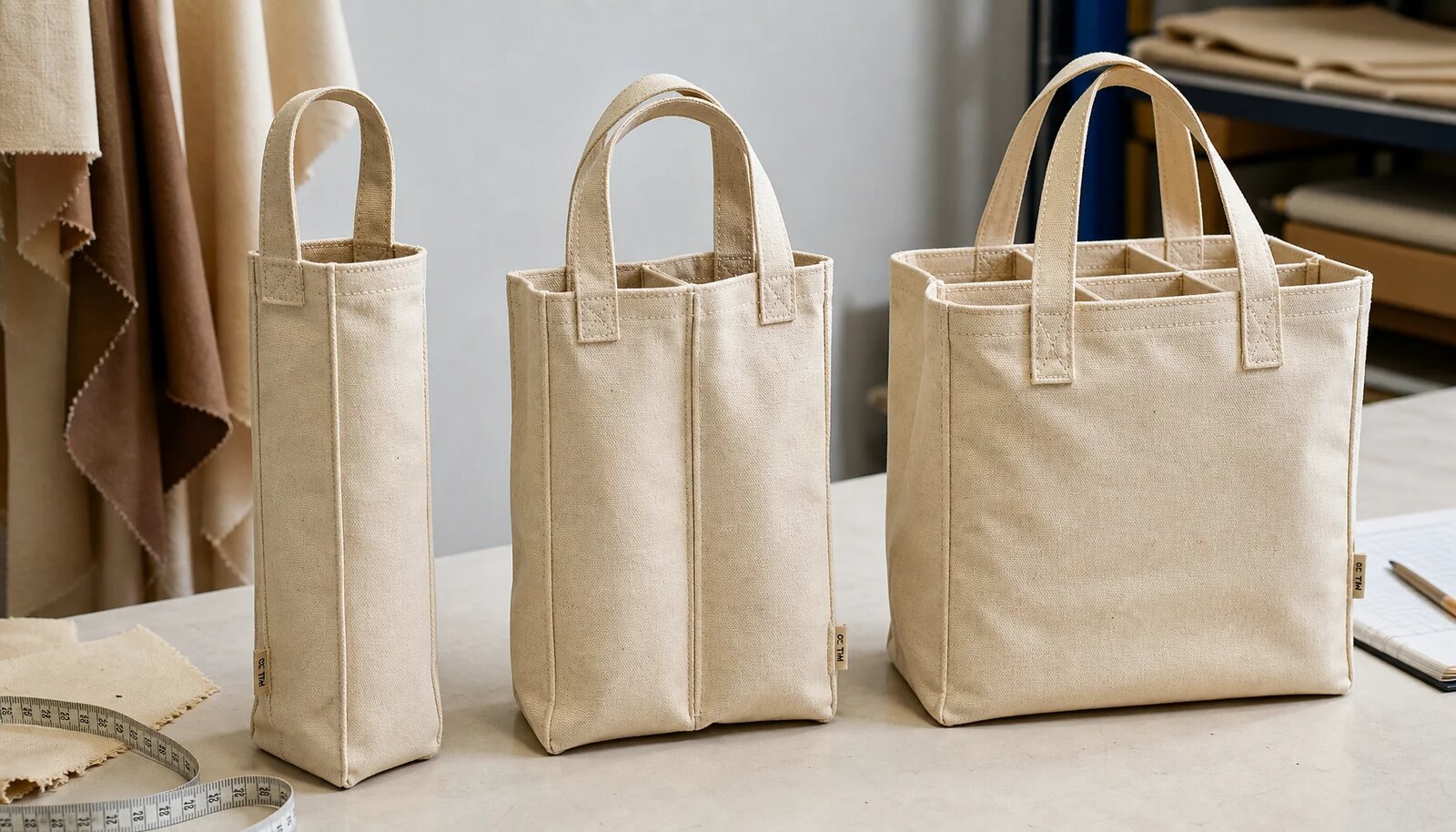
Start With the Real Buying Problem
Canvas wine carriers for craft fairs have to do more than look rustic. They hold glass, sit on crowded vendor tables, carry a logo, and often need to feel giftable at a price that still leaves room for resale margin. That mix is why fabric weight matters. It affects structure, print quality, sewing time, carton weight, and how the product feels in a shopper's hand.
The first mistake is asking factories for a canvas wine bag without locking the use case. One supplier may price an 8 oz decorative sleeve. Another may quote a 12 oz carrier with reinforced handles. A third may include a divided base, heavier thread, and screen setup. All three quotes may say canvas wine carrier, but they are not the same product.
Craft fair use also changes the spec. Some bags are sold empty as reusable accessories. Some are bundled with a bottle at checkout. Others are used for winery events, holiday sets, or gift-with-purchase promotions. A bag that only needs to carry one bottle from booth to car can be lighter than a carrier expected to stand upright empty and sell as a premium reusable item.
- Open the RFQ with bottle type, bottle count, selling channel, and target retail price.
- Use 10-12 oz canvas for many price-sensitive single-bottle craft fair carriers.
- Move to 12-14 oz when the bag has a divider, carries two bottles, or needs stronger table presence.
- Reserve 16 oz canvas for premium reusable programs where structure is part of the value.
- Ask every supplier to quote both ounces and GSM so fabric comparisons stay consistent.
Fabric Weight Ranges That Make Sense
A useful canvas wine carriers for craft fairs fabric weight guide starts with load and structure, not with a generic bag category. A standard 750 ml wine bottle is heavy enough to expose weak stitching, but it does not automatically require the heaviest canvas. For most single-bottle carriers, 10 oz to 12 oz cotton canvas, roughly 280-340 GSM, is the practical starting range. It looks substantial, prints well, folds flat enough for freight, and still keeps the unit price under control.
Two-bottle carriers need more support because the bag has to manage movement between bottles. For divided two-bottle styles, 12 oz to 14 oz canvas, roughly 340-400 GSM, is usually safer. The extra body helps the divider stay in place, improves side-panel shape, and gives holiday gift sets or winery pairings a better presentation. Four-bottle carriers should be treated as a different construction project altogether. The handle system, divider anchors, and base shape matter as much as the fabric weight.
Heavier canvas can improve perceived durability, but it is not a cure-all. A well-built 14 oz carrier with the right seam allowance and reinforcement can outperform a 16 oz carrier with poor handle placement. Heavy fabric also creates sewing bulk, stronger crease memory, higher carton weight, and slower production. Buyers should approve the complete construction, not just the number on the fabric line.
- 6-8 oz cotton is usually too light for a functional glass-bottle carrier unless the bottle has separate support.
- 10 oz canvas can work for economical single-bottle bags when handle reinforcement is clearly specified.
- 12 oz canvas is the safest general-purpose starting point for many craft fair wine carrier RFQs.
- 14 oz canvas suits divided two-bottle carriers, stronger empty presentation, and heavier reuse expectations.
- 16 oz canvas fits premium reusable caddies, but check seam bulk, freight cost, and crease recovery.
Bottle Fit Comes Before Price
A carrier that uses the right canvas can still fail if the bottle fit is wrong. Before requesting a quote, define the bottle by format, diameter, shoulder shape, and height range. A bag made around a standard Bordeaux bottle may not fit a sparkling bottle, Burgundy bottle, cider bottle, or some spirits bottles. If the product is for mixed craft fair retail, quote around the largest bottle you expect to handle.
Finished dimensions should be written into the RFQ. For a single-bottle carrier, include finished height, internal width, mouth opening, base depth, and handle drop. For a two-bottle carrier, add clear opening per compartment and divider position. For a four-bottle carrier, specify the bottle layout and whether the bag must stand on its own when loaded.
Tolerances protect both sides. For sewn canvas goods, a practical starting point is +/- 0.5 cm on critical body dimensions such as height, width, and base width, and +/- 1.0 cm on less critical handle length, depending on the pattern. If the canvas is unwashed or natural, ask whether cutting dimensions already account for shrinkage after sewing, pressing, and packing. Small changes here can decide whether bulk production fits as well as the sample.
- State the bottle type: Bordeaux, Burgundy, sparkling, cider, spirits, or mixed use.
- List finished height, body width, base depth, mouth opening, and handle drop.
- Use +/- 0.5 cm on critical dimensions unless your internal standard requires tighter control.
- Clarify whether measurements are taken before or after washing, pressing, or final packing.
- Test the widest and tallest expected bottle, not only the most common 750 ml shape.
Construction Carries the Load
Fabric weight is only one part of strength. A 14 oz carrier with weak handles is still risky. The main stress points are the handle ends, top seam, side seam, base corners, and any divider attachment. When bottles swing during walking or get set down quickly on a table, those areas take the strain.
The RFQ should name the construction method instead of leaving it to interpretation. A wine carrier may use a flat base, boxed base, gusseted side, or simple folded bottom. Dividers may be loose, stitched into the base, stitched into side seams, crossed, or padded. Most craft fair programs do not need padding, but they do need reliable separation so bottles do not knock together under normal handling.
Handles deserve their own specification line. Self-fabric handles look clean and coordinated, especially on natural canvas. Cotton webbing handles can be more consistent on heavier loads and multi-bottle designs. Either way, define handle width, total length, handle drop, attach point, stitch density, reinforcement shape, and whether the handle is inserted into the top seam or sewn onto the exterior panel. The difference between a safe carrier and a complaint is often hidden in those details.
- For single-bottle carriers, require box-X stitching or bartacks at each handle end.
- For two-bottle carriers, anchor the divider into the base seam or side seam, not only the top edge.
- For four-bottle carriers, confirm the handle pattern is engineered for combined load.
- Use cotton webbing handles if 14 oz or 16 oz self-fabric handles create excessive top-seam bulk.
- Request loaded and unloaded sample photos to judge structure and recovery after packing.
Printing and Branding Choices
Most craft fair canvas wine carriers use spot-color screen printing. It is practical at common MOQs, gives a clean handmade-market look, and works well on natural, black, or dyed canvas when the artwork is simple. One-color and two-color logos are usually the easiest to control on 10 oz to 14 oz fabric. Fine lines, tiny serif text, and large dense ink blocks need extra review because the weave can soften edges or make ink coverage look uneven.
Heat transfer is useful for gradients, photo-style art, many colors, or short personalization runs. The buyer should still check handfeel, adhesion, and fold behavior on the actual canvas. Transfers sit differently on textured fabric than on smooth polyester or paper. Embroidery can feel premium for boutique programs, but dense embroidery may distort lighter panels and is rarely cost-efficient for large logos. Woven labels and sewn patches are good options when the same carrier body will be used across multiple seasons or private-label accounts.
Artwork approval should not stop at a digital proof. A PDF confirms placement only. A swatch strike-off confirms ink color only. The best approval is a pre-production sample using the final fabric weight, final bag color, final construction, and final logo process. If the print is close to a seam, fold, handle, or boxed base, inspect the sample after folding and reopening because that is how the product will arrive.
- Use screen print as the default for simple logos, one to three colors, and repeat orders.
- Use heat transfer for complex artwork only after checking adhesion, handfeel, and fold-line cracking risk.
- Avoid large dense embroidery on single-layer light canvas panels.
- Use woven labels or patches when one carrier body needs multiple seasonal or private-label versions.
- Approve print on the actual production fabric weight and color, not only on a separate swatch.
MOQ and Quote Comparability
MOQ is driven by fabric availability, color, print setup, divider complexity, lining, and packing. A natural canvas carrier with a standard pattern and one-color print may be possible at 300-500 pcs if the factory has suitable stock fabric. Dyed canvas, custom Pantone fabric, special handle colors, lining, and multiple sizes often push MOQ higher because the supplier must control dye lots, cutting loss, setup time, and separate production flow.
For a first craft fair run, the cleanest route is usually one body size, one canvas color, and one print method. This lets the buyer test bottle fit, perceived value, handle comfort, and sell-through before adding colors or shapes. Splitting a small order across several sizes and prints may look attractive for merchandising, but it can raise setup cost and make inspection more complicated.
Fair quote comparison requires identical assumptions. If one supplier prices 500 pcs of 10 oz natural canvas and another prices 1,000 pcs of 12 oz canvas with a divider, the lower unit price does not tell you much. Ask each factory for the same price breaks and require a clear list of included and excluded costs: sample fee, screen charge, setup charge, packing, labels, cartons, and export handover.
- Lowest MOQ path: natural canvas, stock fabric, standard pattern, unlined body, and one-color logo.
- Moderate MOQ path: divided two-bottle style, standard natural or black canvas, and simple logo placement.
- Higher MOQ path: dyed fabric, custom lining, special handle color, nonstandard divider, or multi-size range.
- Hidden MOQ issue: the bag MOQ may be low while the dyed fabric MOQ is much higher.
- Ask for price breaks at 300, 500, 1,000, and 3,000 pcs using the same specification.
Sample Approval Should Be Functional
Do not approve a canvas wine carrier sample only because the photo looks clean. Load it with the intended bottle, carry it, set it down, and inspect what moved. Measure the finished height, width, base depth, mouth opening, handle length, handle drop, divider position, and print placement. If a supplier says bulk fabric will be equivalent to the sample fabric, ask equivalent by what measure: GSM, weave, shade, shrinkage, or handfeel.
One common sourcing risk is a beautiful sample made from sample-room fabric, followed by bulk production from a different lot. The pre-production sample should use approved bulk fabric or fabric pulled from the same confirmed stock lot. If the carrier is printed, approve the logo after curing and a light dry rub check. Natural canvas can have yarn slubs, but dark slubs running through the logo area should be treated as visible defects for retail goods.
Bottle fit needs the same discipline. Test real bottles, not only an empty bag. If the item will be used for wine, cider, sparkling bottles, or spirits, test the largest and tallest format expected in the program. A carrier that looks fine around a narrow bottle may be too tight for a wider shoulder or too short for a taller neck. The sample is the first functional checkpoint, not a decorative reference.
- Measure dimensions with and without the loaded bottle.
- Photograph handle reinforcement from the outside and inside.
- Check whether the base stays flat, twists, or pulls after carrying.
- Confirm divider placement with actual bottles in the compartments.
- Rub the cured logo with a dry white cloth and record any visible transfer.
- Verify sample fabric weight against the quoted GSM when practical.
Bulk QC for Loaded Glass Use
Bulk inspection should focus on the areas that affect safe carrying and retail presentation. A wine carrier is a sewn textile item, but it is used around breakable goods. The QC plan should include fabric weight, shade, surface cleanliness, odor, dimensions, stitching, handle strength, divider attachment, print quality, and packing. The approved sample is useful, but the written specification should control the order when there is any conflict.
Fabric checks should confirm GSM tolerance, lot consistency, shade, weave appearance, and odor. Natural canvas may show small yarn variations. Large stains, oil marks, mildew smell, water marks, heavy dark slubs in the logo area, and obvious panel shade differences are not acceptable for retail carriers. For dyed canvas, inspect under consistent lighting and confirm the agreed shade tolerance.
Stitching inspection should slow down around the handle ends, top seam intersections, base corners, and divider anchors. Broken stitches, skipped stitches, seam slippage, thread nests, and uncontrolled fraying can become functional defects once the bag is loaded. Print QC should cover placement, color, registration, curing, and light dry-rub resistance. Packing QC should confirm that printed surfaces are protected and dividers are not crushed before the cartons leave the factory.
- Fabric check: verify GSM tolerance, shade, surface cleanliness, lot consistency, and mildew-free odor.
- Dimension check: measure height, base width, mouth opening, handle length, and divider placement.
- Load check: test handle and seam performance with the intended bottle weight or agreed equivalent.
- Print check: inspect placement, registration, color, curing, and light dry-rub resistance.
- Packing check: confirm carton count, carton marks, print protection, moisture control, and divider condition.
Packing Protects the Sale
Canvas wine carriers are not fragile like glassware, but they can still arrive unsellable. Over-compression can leave hard fold lines. Poor stacking can cause print offset. Crushed dividers make a two-bottle carrier look cheap. Dust, moisture, and creased handles reduce the retail feel before the product ever reaches a craft fair table.
Flat packing is usually efficient, but it should be planned. Avoid placing a sharp fold directly through a large logo when the product is sold as a finished retail item. For 14 oz and 16 oz canvas, ask whether the factory uses a controlled fold pattern or packs the bags flat without heavy pressure lines. If carriers ship to several event locations, smaller carton quantities may reduce repacking time and handling damage even if carton cost rises slightly.
Packing requirements should be part of the quote. Ask for pieces per inner pack, pieces per export carton, carton dimensions, gross weight, print protection method, and shipping marks. If the goods need paper bands, hang tags, recyclable individual bags, or retail labels, specify those early. They affect labor, carton loading, inspection, and final landed cost.
- Flat pack single-bottle carriers in aligned stacks to protect print surfaces.
- Avoid over-compression that bends dividers or creates deep creases in heavy canvas.
- Allow enough curing time or use interleaving when printed areas may touch another bag.
- Specify moisture protection for rainy-season shipment or long ocean transit.
- Require carton labels with item code, quantity, color, size, gross weight, carton number, and destination.
Lead Time and Buying Sequence
Craft fair dates do not move, so lead time needs more detail than one number on a quote. Break the schedule into artwork proofing, sample making, sample shipment, buyer approval, bulk fabric preparation, cutting, printing, sewing, inspection, packing, and export handover. Natural canvas with a simple one-color print is usually faster than dyed canvas or custom lining, but artwork changes and sample shipping can still take more calendar time than expected.
The biggest schedule risks are late artwork revisions, unclear bottle dimensions, and fabric changes after sampling. Moving from 10 oz to 14 oz after approval is not a small edit. The factory may need to recheck cutting, sewing bulk, print absorption, finished measurements, carton packing, and price. Changing the bottle format after the pattern is approved can also affect base width, height, divider placement, and handle balance.
Freeze the physical specification before final price negotiation and production slot booking. That means bottle type, fabric weight, dimensions, divider construction, handle design, print method, and packing are all confirmed. Also build in inspection and rework time. A factory production completion date is not the same as an export-ready date, and export handover is not the same as final delivery to the event location.
- Fastest path: standard natural canvas, standard pattern, one-color logo, approved artwork, and no custom dyeing.
- Moderate risk: two-bottle divider, two-color print, custom handle length, and pre-production sample approval.
- High risk: dyed canvas, custom lining, special bottle shape, multiple SKUs, and late artwork or size changes.
- Freeze bottle size, fabric weight, dimensions, and divider construction before confirming print screens.
- Track inspection, rework, inland delivery, export handover, and destination delivery separately from sewing time.
Specification comparison for buyers
| Spec decision | Recommended option | When it fits | Buyer risk to check |
|---|---|---|---|
| Single-bottle fabric weight | 10 oz to 12 oz cotton canvas, roughly 280-340 GSM | Best for 750 ml wine bottles, craft fair resale, winery gift-with-purchase, and low-to-mid price retail programs | Below 10 oz can look limp and may stress at the handle seam; confirm actual GSM, weave count, shrinkage, loaded carry test, and print opacity on the production fabric |
| Two-bottle divided carrier | 12 oz to 14 oz canvas, roughly 340-400 GSM, with divider anchored into the base or side seam | Useful for holiday sets, market stalls, winery pairings, cider and wine bundles, or small retail gift packs | A loose divider can shift under load; require a loaded sample test with two full bottles and inspect base seam distortion after carrying |
| Four-bottle or heavy-load carrier | 14 oz canvas minimum for most designs; 16 oz only if premium positioning and freight budget support it | Fits reusable bottle caddies sold as a durable accessory rather than a disposable gift bag | Handle pattern must be engineered for combined load; do not approve a four-bottle carrier that simply scales up a single-bottle pattern |
| Premium heavy canvas option | 16 oz canvas, roughly 450-500 GSM, with heavier needle sewing and controlled seam bulk | Works for boutique wine brands, reusable market totes, and higher retail prices where structure matters | Heavy fabric raises carton weight and can reduce sewing speed; check needle marks, bulky turned seams, carton creasing, and final dimensions after sewing |
| Lining requirement | Unlined for most craft fair programs; light cotton lining only for premium gift-retail presentation | Unlined bags are easier to quote, faster to produce, and usually sufficient when divider and handle construction are strong | Lining can hide weak internal seams and adds labor; require inside photos, seam diagrams, and confirmation of whether divider panels are lined |
| Handle construction | Self-fabric handles with box-X reinforcement or cotton webbing handles stitched securely into the top seam | Self-fabric looks more retail; webbing improves consistency on heavier bags and multi-bottle loads | Handle length, stitch density, seam allowance, and bartack placement affect comfort and safety; specify a loaded pull or carry test |
| Print method | Spot-color screen print for most logos; heat transfer only for gradients, photo-style art, or short artwork runs | Screen print gives a clean craft-market look on natural, black, or dyed canvas at practical MOQ levels | Ink can break on textured canvas or crack at folds; approve a strike-off on the actual fabric weight, color, and finished panel |
| MOQ planning | 300-500 pcs for simple natural canvas with one-color print; 1,000+ pcs for dyed fabric, custom lining, or multiple sizes | Supports small seasonal runs without forcing excess inventory before fair demand is proven | Low MOQ may rely on available greige or stock fabric; write GSM tolerance, color shade tolerance, and fabric lot status into the quote |
| Packing method | Flat packed by size with protected print surfaces, then export cartons sized to avoid crushed dividers | Keeps freight efficient and protects resale presentation for event distribution or retail display | Over-compressed cartons can crease heavy canvas and deform dividers; require carton dimensions, gross weight, pieces per carton, and inner packing method |
Buyer checklist before sampling
- Define the bottle format before quoting: 750 ml wine, champagne-style bottle, cider bottle, spirits bottle, or mixed retail use.
- Choose fabric weight by structure: 10-12 oz for most single-bottle carriers, 12-14 oz for divided two-bottle carriers, and 14-16 oz for premium multi-bottle carriers.
- State whether the carrier must stand upright empty, stand only when loaded, or simply function as a protective carry sleeve.
- Require the supplier to quote canvas in both ounces and GSM, including tolerance, fabric lot status, weave count if available, and whether the fabric is washed, unwashed, bleached, dyed, or natural.
- Specify finished dimensions, base width, seam allowance, divider attachment, handle length, handle material, stitch density, and reinforcement pattern.
- Approve printing on the final fabric weight and final bag color, not only on a digital proof, paper proof, or separate flat swatch.
- Request sample photos showing front panel, back panel, top seam, base seam, divider attachment, handle reinforcement, inside seams, and loaded bottle fit.
- Confirm packing count per inner pack, pieces per carton, carton dimensions, gross weight, print protection method, and whether bags are flat packed or lightly shaped.
- Separate sample lead time, artwork approval time, bulk material lead time, printing time, sewing time, inspection time, packing time, and export handover date.
- Include defect acceptance rules for incorrect GSM, seam slippage, handle failure, print misregistration, ink rubbing, stains, odor, broken stitches, and incorrect dimensions.
Factory quote questions to send
- What exact canvas weight are you quoting in ounces and GSM, and what production tolerance should we allow?
- Is the quoted fabric stock greige, natural, bleached, dyed to order, or pre-dyed inventory fabric from an existing lot?
- Is the fabric washed or unwashed, and what shrinkage should we expect after cutting, sewing, and normal handling?
- For the intended bottle load, what handle pull test, drop test, or internal factory carry test do you perform before shipment?
- Can you provide a pre-production sample using the same fabric weight, handle construction, divider construction, and print method as bulk production?
- What is the MOQ for natural canvas with one-color print, and how does MOQ change for dyed canvas, lining, webbing handles, multiple sizes, or multiple print versions?
- Which print method is included in the quote, how many colors are included, what is the maximum printable area, and are screen charges or setup charges separate?
- Are divider panels included in the quoted price, and are they stitched into the base seam, side seam, top seam, or only inserted as loose panels?
- What are the packing details: pieces per inner polybag or paper band, pieces per export carton, carton size, gross weight, and print protection method?
- What are the sample lead time and bulk lead time after artwork approval, deposit, and final specification confirmation?
Quality-control points to confirm
- Fabric weight must match the approved sample within agreed tolerance, with no substitution from lighter stock canvas or a different weave without buyer approval.
- Finished carrier dimensions should remain within agreed tolerance after sewing, especially height, mouth opening, base width, handle length, and divider placement.
- Handle attachment must survive the agreed loaded carry or pull test using the intended bottle weight, with no broken stitches, seam tearing, or excessive elongation.
- Base seam and side seams must not twist, pucker heavily, expose uncontrolled raw fraying, or distort when the bag is loaded with the intended bottles.
- Internal dividers must keep bottles separated under normal carrying conditions and must not detach from the base, side, or top seam during loaded handling.
- Screen print must be centered, cured, and resistant to light dry rubbing after drying; print color and placement must match the approved strike-off within tolerance.
- Natural canvas should be free from major stains, oil marks, dark yarn slubs in the logo area, mildew odor, water marks, and obvious shade variation within the same order.
- Packing must protect print surfaces and avoid crushing divider panels; export cartons should carry correct shipping marks, item codes, quantity, gross weight, and destination details.