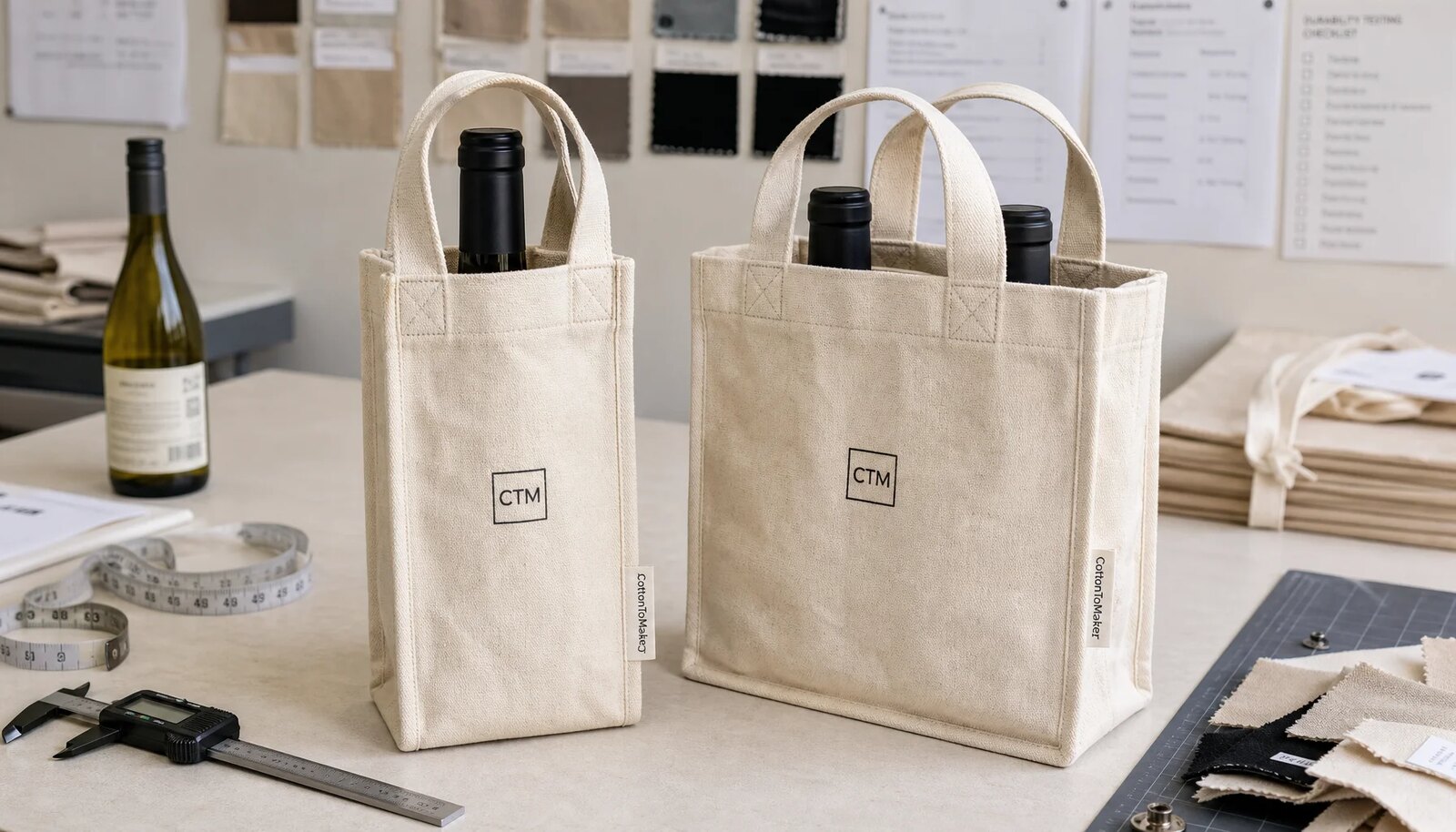
Start with the Real Craft Fair Use Case
Canvas wine carriers for craft fairs live a harder life than a gift sleeve on a retail shelf. They carry glass, liquid, and brand presentation through a busy buying environment. A shopper may lift the carrier by one handle, swing it while browsing, set it on a rough table, put it on the ground, and pick it up again after buying another item. The load is narrow and heavy, so stress does not spread evenly. It gathers at the handle roots, top seam, side seam intersections, divider, and bottom gusset.
For procurement buyers, the biggest sourcing problem is not always a dramatic tear. It is quote ambiguity. Two suppliers can both write “canvas wine carrier” and mean very different products. One quote may assume 8 oz cotton, a folded hem, light-duty stitching, and bulk packing. Another may include 12 oz canvas, reinforced handles, an anchored divider, print curing controls, and lined export cartons. The label sounds the same. The risk, cost, carton volume, and customer experience are not the same.
A durability testing checklist gives the buyer, factory, sample room, and inspection team one shared standard. Instead of asking for “good stitching” or “strong canvas,” the RFQ can require no handle stitch breakage after a loaded swing test, no base corner splitting after a short controlled drop, no divider detachment after one-sided loading, and no visible print transfer after carton compression. That language is easier to quote, easier to inspect, and harder to reinterpret during production.
- Define the heaviest approved bottle before choosing fabric weight, gusset depth, divider style, or handle construction.
- Classify handle breakage, base seam tearing, divider detachment, and wrong bottle fit as critical defects because the carrier holds glass.
- Separate appearance approval from functional approval; a neat sample is not automatically strong enough for fair use.
- Write the test method and pass-fail criteria before bulk cutting starts.
- Keep the approved sample sealed and support it with close-up construction photos for inspection reference.
Define Bottle Fit, Load, and Balance
Bottle compatibility should be the first technical requirement in the RFQ. A 750 ml wine bottle is not a single universal format. Height, diameter, shoulder shape, punt depth, glass thickness, sleeve wrap, and filled weight all vary. Standard still-wine bottles are often narrower than sparkling bottles. Premium glass can add weight without changing liquid volume. If the same carrier will serve several wineries, beverage types, or event programs, use the largest and heaviest expected bottle as the test standard.
Record the bottle diameter, bottle height, filled weight, and any added wrap, neck tag, sleeve, or protective insert. Many filled 750 ml wine bottles fall roughly in the 1.2-1.7 kg range, but sparkling bottles and heavy glass formats can be wider and heavier than a light promotional sleeve was designed to hold. Do not approve a sample tested with a convenient lightweight bottle if the real fair assortment includes larger glass.
Single-bottle carriers need secure vertical support and a base that does not collapse around the circular bottle footprint. Two-bottle carriers add another problem: balance. A sample may look stable when both compartments are filled, then twist sharply when only one side is loaded. That matters because craft fair customers do not always buy in balanced pairs. They may buy one bottle first, add a second later, or combine wine with other booth purchases.
- Record approved test bottle diameter, height, filled weight, shoulder type, and sleeve or wrap condition in the PO or tech pack.
- Check that the bottle inserts and removes smoothly, especially when the carrier has a narrow gusset or divider.
- For two-bottle styles, test left-side-only loading, right-side-only loading, and balanced two-bottle loading.
- If the loaded carrier must stand upright on a booth table, state that requirement and inspect it after load testing.
- Do not assume one carrier fits sparkling wine, cider, spirits, olive oil, or sleeved bottles unless those formats are tested.
Specify Canvas Weight, Finish, and Tolerance
For most reusable canvas wine carriers for craft fairs, 10-12 oz cotton canvas, approximately 280-340 GSM, is a practical starting point. It gives the bag enough body for carrying and display while remaining workable for cutting, sewing, printing, folding, and carton packing. An 8 oz fabric may be acceptable for a cost-driven promotional program if the loaded test passes, but buyers should look closely for base sagging, seam strain, and a thinner hand feel. Heavier canvas around 14 oz can feel premium, yet it can raise fabric cost, needle stress, sewing time, carton CBM, and fold creasing.
Fabric weight belongs in the specification as a measurable range, not a vague phrase such as “heavy canvas.” Ask for both oz and GSM, then agree on a production tolerance, such as ±5% where appropriate for the fabric. Also state whether the body is single-layer, whether the base is reinforced, and whether any lining or backing is included. A 300 GSM carrier with a double-layer base can outperform a 340 GSM carrier with weak bottom seam construction.
Finish affects both appearance and inspection risk. Natural unbleached cotton canvas suits wineries, craft markets, farm shops, and sustainable-looking gift programs, but it may show seed flecks, small slubs, and shade variation. Bleached canvas looks cleaner and shows dirt faster. Dyed canvas needs shade approval and crocking review. Washed canvas needs shrinkage control and dimensional checks. If the item is marketed as washable, ask for shrinkage data or a simple wash-test tolerance. If it is mainly a reusable event carrier, load strength, odor, cleanliness, and print durability usually matter more than repeated laundering.
- Use 10-12 oz canvas, about 280-340 GSM, as the normal baseline for reusable craft fair carriers.
- Use 8 oz canvas only when the item is positioned as light promotional packaging and still passes bottle-load tests.
- Use heavier canvas only after checking sewing feasibility, handle reinforcement, carton CBM, and fold memory.
- State the fabric finish clearly: natural, bleached, dyed, washed, unwashed, or pre-shrunk.
- Define acceptable natural canvas characteristics, including seed flecks, small slubs, shade variation, and wrinkles.
Engineer Handles, Seams, Base, and Divider
Handle attachment is the highest-risk construction point. It receives repeated lifting force, sideways movement, and occasional shock load. A wine carrier handle should not depend on one straight stitch through a folded top hem. Stronger constructions include box-X stitching, bar-tacks, double-row lockstitching, handle ends inserted into a reinforced top seam, or cotton webbing handles with reinforced ends. Name the construction in the RFQ, then approve close-up photos from the pre-production sample.
Stitch quality matters as much as the stitch pattern. Skipped stitches, loose tension, broken threads, needle cuts, uneven stitch density, and poor back-tacking can weaken an otherwise sensible design. At handle roots, bottom corners, divider seams, and side seam intersections, inspection should be stricter than on low-stress decorative seams. If you want a stitch density target, agree it with the factory based on fabric weight and equipment rather than guessing after production.
The base must support a round bottle footprint. A flat sleeve can work for simple gifting, but craft fair carriers usually benefit from a gusseted bottom, reinforced bottom corners, or a double-layer base panel. Failures often start where the side seam meets the bottom gusset, not in the center of a fabric panel. For two-bottle carriers, the divider should be structural. It should stay aligned, keep bottles separated, and resist pulling away when only one side is loaded.
- Require reinforced handle construction using box-X, bar-tack, double-row lockstitch, inserted seam reinforcement, or an equivalent stress stitch.
- Inspect handle roots for skipped stitches, loose tension, needle cuts, fabric tearing, and weak back-tacking.
- Specify whether handles are self-fabric, cotton webbing, or another material, including width, length, color, and reinforcement method.
- Define base construction: flat sleeve, gusseted base, double-layer base, bound seams, reinforced corners, or another approved method.
- For two-bottle carriers, state divider height, material, anchoring point, and one-sided loading performance.
Set Dimensions and Tolerances Before Sampling
A canvas wine carrier can fail commercially without tearing. If the cavity is too tight, booth staff struggle to insert bottles quickly. If it is too loose, bottles shift, the base distorts, and the finished product looks sloppy. If handle length varies too much, the same order can feel inconsistent from carton to carton. These are preventable problems, but only if finished dimensions are agreed before sampling.
Key measurements include finished height, width, gusset depth, handle length, handle attachment distance, divider height, print placement, label placement, and carton count. A practical starting tolerance for many sewn cotton carriers is ±5 mm on key body dimensions and ±10 mm on handle length, but the final tolerance should match the bottle fit, pattern complexity, and display requirement. Tight tolerances can add cost. The goal is not unnecessary precision; it is avoiding bottle-fit disputes and uneven retail presentation.
Measure samples both empty and after loaded testing. Canvas can relax, stretch, or distort around stress points. A carrier that fits at the cutting table may become unstable after swing testing if the base stretches or the top seam elongates. For two-bottle styles, inspect the internal divider as well as the outside body because divider drift can reduce usable cavity width.
- Measure finished height, width, gusset depth, handle length, handle spacing, divider height, print position, and label position.
- Use a written tolerance such as ±5 mm for major dimensions and ±10 mm for handle length unless the design needs a different standard.
- Check dimensions against the approved bottle after loaded testing, not only before use simulation.
- Confirm that print and label placement remain visually centered after sewing, gusset formation, and folding.
- Add a dimension table to the RFQ so every supplier quotes the same pattern.
Choose Branding That Survives Carrying and Cartons
Branding is often the reason buyers order custom canvas wine carriers, but decoration must survive more than a product photo. It has to handle folding, hand contact, carton pressure, and sometimes outdoor fair conditions. Screen printing is usually practical for winery names, event logos, and one- to three-color artwork. It can be efficient for repeat orders and works well on cotton canvas when ink deposit, curing, and fabric surface are controlled. Still, buyers should test dry rub, fold cracking, and transfer during tight carton packing.
Heat transfer, digital transfer, and DTF-type applications can be useful for low MOQ programs, full-color artwork, and multiple seasonal versions. They are not automatically wrong; they simply need different checks. Transfers may show a glossy carrier film, peel at corners, collect pressure marks, or crack when folded over a seam. If low quantity is the reason for choosing transfer, ask whether setup fees, film charges, and artwork handling are charged per design.
Embroidery can look premium on wine gift programs, although dense stitching may pucker lighter canvas and increase cost. Woven labels are often a durable solution when the buyer wants a consistent brand mark across many front artwork versions. Hang tags, paper sleeves, and neck cards can add retail storytelling without stressing the fabric panel. Whatever method is selected, the RFQ should include artwork size, placement tolerance, color target, print side count, and approval process.
- Use screen print for simple solid artwork where setup cost is justified and repeatability matters.
- Use transfer methods for full-color, low MOQ, or many artwork versions only after peel, rub, fold, and carton-pressure checks.
- Use embroidery cautiously on lighter canvas because dense designs can pucker the panel.
- Use woven labels when the buyer needs a durable brand mark across multiple printed versions.
- Specify print size, placement tolerance, color reference, ink coverage, number of sides, and setup charges per artwork.
Build a Practical Durability Test Plan
Most craft fair wine carrier orders do not need a complicated laboratory program. They do need a repeatable test that reflects actual use. Load the sample with the heaviest approved bottle, hang it by the handles, swing it in a controlled way, set it down repeatedly, and inspect every stress point. For two-bottle carriers, repeat the sequence with the left side loaded, the right side loaded, and both sides loaded.
A useful test sequence includes static hang, walking swing, repeated set-down, short controlled drop, divider pull review, base shape review, seam strain review, print rub, and packing compression. The drop test should be controlled and safe; the purpose is to review bag construction, not to create a broken-glass hazard. A dummy weight or protected bottle may be used if needed, but size and weight should match the approved bottle. Acceptance should focus on visible failure: broken stitches, fabric tears, seam opening, severe base distortion, divider detachment, or print damage.
Use the same checklist during sample approval and final inspection. If the sample passes because the sample room made one perfect piece, production can still drift. Ask the factory to test production units from the first completed batch, not only a showroom sample. For higher-risk orders, inline inspection after the first stitched shells can catch weak handle reinforcement before printing and packing make rework expensive.
- Static hang: load the carrier with the approved bottle weight and inspect handles and top seam after a defined period.
- Walking swing: simulate normal customer movement and check handle elongation, seam strain, and base shifting.
- Short controlled drop: use a low defined height and safe surface to review base corners and seam shock resistance.
- One-sided loading: test two-bottle carriers with only the left compartment loaded and only the right compartment loaded.
- Print rub and fold: check for ink transfer, cracking, flaking, peeling, and visible distortion.
- Packing compression: pack units in the proposed carton method and inspect for creasing, print transfer, crushed gussets, and shape loss.
Make Quotes Comparable Across Suppliers
Canvas wine carrier pricing depends on many variables beyond quantity. Fabric GSM, finish, bottle capacity, handle material, base reinforcement, divider construction, stitch operations, print method, artwork count, color count, retail labels, packing method, carton allocation, and shipping terms all affect the final unit cost. If the RFQ asks only for a price on “canvas wine bags,” suppliers will fill in missing details in different ways.
Separate recurring unit cost from setup and short-run charges. Screen charges, transfer film charges, embroidery digitizing, woven label MOQ, dyed fabric minimums, barcode labels, hang tags, and split-destination packing may all be handled differently. A distributor ordering several winery logos may be able to combine sewing quantity when fabric, pattern, and construction are identical, while still paying separate print setup per logo. That distinction can change the real cost of a low MOQ offer.
Ask for price breaks at realistic quantities, sample cost, sample lead time, bulk lead time after approval, carton dimensions, carton gross weight, CBM, packing count, and inspection availability. Landed cost can move quickly when heavier canvas or a larger gusset increases carton volume. A slightly higher unit price may be the better purchase if the construction is reinforced, the packing prevents print damage, and the carton data supports efficient freight.
- Quote by style, fabric weight, fabric color, fabric finish, print method, artwork version, print color count, label set, and packing format.
- Request setup fees separately from unit price so low MOQ offers can be compared fairly.
- Ask whether sewing quantity can be consolidated across artwork versions when construction is identical.
- Request carton dimensions, gross weight, quantity per carton, and CBM at quote stage.
- Compare the approved construction and packing method, not only the lowest unit price.
Control Packing, Allocation, and Freight Risk
Packing is part of product quality. Many visible defects happen after sewing and printing are complete. Natural canvas can pick up dirt, moisture, and odor. Printed panels can rub against each other. Gussets can be compressed until the carrier no longer stands neatly. Handles can crease, twist, or leave pressure marks on the front panel. For craft fair programs, goods often arrive close to event dates, leaving little time to air out, sort, or repack cartons.
Bulk flat packing in lined export cartons is practical for many fair and winery programs. If ink transfer is a risk, the packing specification can require printed panels to face the same direction, tissue separation, or a curing hold before packing. Individual polybags may be needed for retail shelves, barcode control, white canvas protection, or multi-destination allocation. They also add material cost, labor, waste, and carton volume, so require them only when they solve a real distribution problem.
Finalize carton data before production. Heavy canvas, reinforced handles, wide gussets, and two-bottle dividers can increase CBM. Carton gross weight should remain manageable for warehouse handling and fair setup. Overweight cartons are more likely to be dropped. Over-tight cartons are more likely to deform product shape. Carton marks should identify purchase order, style, artwork, color, quantity, destination, and any allocation code needed by the distributor or event team.
- Use lined export cartons to protect natural canvas from dirt, moisture, and carton abrasion.
- Specify panel orientation or tissue separation when printed panels may rub or transfer.
- Confirm whether individual polybags are required for retail control or only adding cost and waste.
- Keep carton gross weight, carton count, and CBM within agreed limits.
- Mark cartons by PO, style, artwork, color, quantity, destination, and allocation code.
Schedule Sampling, Inspection, and Fair Delivery
Lead time risk is high when the carrier is tied to a fixed craft fair date. The production calendar includes artwork confirmation, fabric sourcing, sample making, sample shipment, buyer review, corrections, material preparation, cutting, stitching, printing, curing, inspection, packing, export documentation, and freight. A fast quote is not enough if the approval schedule cannot support the event date.
Be clear about sample type. A look sample can confirm size and general appearance, but it may not prove load strength if substitute fabric or simplified stitching is used. A pre-production sample should use final canvas, final thread, final handle reinforcement, final divider, final print, final label, and final packing method. If the order includes custom dyed canvas, multiple artwork versions, embroidery, retail packing, or split destination cartons, build in extra approval time.
Inspection should include both inline and final checks. Inline review can catch wrong fabric weight, weak handle reinforcement, bad divider anchoring, and first-print issues before the full order is completed. Final inspection should compare production units against the approved sample and purchase order, then repeat functional load checks on selected pieces. Set defect classifications in advance so unsafe or functionally weak units are not accepted as minor appearance defects.
- Fastest path: stock natural canvas, standard pattern, one-color screen print, bulk packing, and one destination.
- Higher-risk path: custom dyed fabric, several artwork versions, transfer print, embroidery, individual retail packing, or split shipments.
- Schedule time for at least one sample correction if bottle fit, handle reinforcement, divider strength, or print placement is wrong.
- Run inline checks before all units are printed and packed.
- Use the sealed approved sample, photo set, PO, and durability testing checklist as the final inspection reference.
Specification comparison for buyers
| Spec decision | Recommended option | When it fits | Buyer risk to check |
|---|---|---|---|
| Bottle test standard | Use the largest and heaviest approved bottle, commonly a filled 750 ml bottle in the 1.2-1.7 kg range; sparkling bottles may be heavier and wider | Craft fairs, winery booths, farmers markets, event gifting, and distributor programs with mixed bottle formats | Testing only with a lightweight Bordeaux-style bottle can miss fit, balance, base pressure, and handle stress failures |
| Canvas fabric weight | 10-12 oz canvas, approximately 280-340 GSM, with a written production tolerance such as ±5% or an agreed GSM range | Most reusable single-bottle and two-bottle craft fair wine carriers | Below about 260 GSM may sag at the base; above about 380 GSM can raise cost, sewing difficulty, carton CBM, and fold-memory issues |
| Fabric finish | Natural unbleached cotton canvas unless the brand requires bleached, dyed, washed, or pre-shrunk fabric | Artisan winery, craft market, farm shop, and sustainable-looking gift programs | Natural flecks and slubs must be defined; dyed fabric needs shade and crocking review; washed fabric needs shrinkage tolerance |
| Bottle capacity structure | Single-bottle carrier for simple gifting; two-bottle carrier with full-height or anchored divider and stable bottom gusset | Single bottle fits checkout and tasting booths; two bottle fits bundles, gift pairs, and retail sets | Two-bottle designs can fail under one-sided loading even when they pass a balanced two-bottle test |
| Handle construction | Self-fabric or cotton webbing handles inserted into reinforced top seam with box-X, bar-tack, double-row lockstitch, or equivalent reinforcement | Crowded fairs where customers lift, swing, set down, and re-lift loaded carriers repeatedly | Handles sewn only into a folded hem can tear under shock load; weak thread tension can fail before the fabric does |
| Base reinforcement | Bottom gusset with reinforced side intersections; double-layer base panel when upright display or heavier bottles are required | Booth tables, retail shelves, gift sets, and carriers expected to stand upright | Base corner tearing is common because the round bottle footprint concentrates pressure near seams |
| Print method | Screen print for simple solid logos; transfer or digital print only after peel, rub, fold, and carton compression checks | Screen print fits repeat winery logos; transfer fits low MOQ, full-color art, or many artwork versions | Uncured ink can transfer; thick ink can crack on folds; transfer film can peel, shine, or imprint adjacent panels |
| Dimensional tolerance | Write finished size tolerance, commonly ±5 mm for key dimensions and ±10 mm for handle length unless the design requires tighter control | Programs with known bottle sizes, retail display needs, or multiple suppliers quoting the same item | Loose tolerances can create bottle-fit disputes, uneven display, and inconsistent carton counts |
| MOQ logic | Quote MOQ by style, fabric color, fabric finish, artwork version, print color count, label set, and packing format | Distributor programs with multiple wineries, seasonal fair designs, private-label assortments, or split destinations | A single low MOQ may exclude separate screens, short-run print charges, dye-lot minimums, labels, and allocation labor |
Buyer checklist before sampling
- Confirm the exact bottle range before quoting: diameter, height, filled weight, shoulder shape, punt depth, sleeve or wrap, and whether the carrier must also fit sparkling wine, cider, spirits, olive oil, or specialty bottles.
- Select the heaviest real bottle as the functional test standard; record its filled weight and diameter instead of testing only with an average 750 ml bottle.
- Specify canvas in both oz and GSM, including tolerance, color, finish, shrinkage expectation, surface appearance standard, and whether natural flecks or slubs are acceptable.
- State finished dimensions and tolerance for height, width, gusset depth, divider height, handle length, print position, and label placement.
- Require reinforced handle attachment with box-X, bar-tack, double-row lockstitch, or an equivalent written construction; approve close-up photos from the final pre-production sample.
- Define base construction clearly: flat bottom, bottom gusset, double-layer base, side seam reinforcement, and whether the loaded carrier must stand upright on a table.
- For two-bottle carriers, specify divider height, divider material, base anchoring, top seam attachment, and one-sided loading performance because customers often carry bottles unevenly.
- Approve the logo on final production canvas, not a substitute swatch; review color target, registration, ink coverage, curing, dry rub, fold behavior, and carton pressure marks.
- Ask for MOQ and price breaks by style, fabric color, artwork version, print color count, packing method, label set, and ship-to allocation to avoid misleading quote comparisons.
- Build a sample durability checklist covering static hang, walking swing, short controlled drop, seam strain, base distortion, divider pull, print rub, and packing compression.
Factory quote questions to send
- What exact canvas oz weight and GSM are included in the quote, and what production tolerance will be accepted in bulk: ±5%, a GSM range, or another written standard?
- Is the fabric natural greige, bleached, dyed, washed, or pre-shrunk, and can you provide shade, shrinkage, and crocking information if the fabric is dyed or washed?
- What finished dimensions are quoted for height, width, gusset depth, handle length, divider height, and print area, and what dimensional tolerance will be used during inspection?
- What bottle diameter, bottle height, and loaded weight capacity is the quoted carrier designed for, and what internal load test is used before shipment?
- How are the handles attached: box-X stitch, bar-tack, double-row lockstitch, inserted seam, webbing reinforcement, rivet-free reinforcement, or another construction?
- What thread type, stitch density target, and needle control will be used at handle stress points, bottom corners, divider seams, and side seam intersections?
- For two-bottle carriers, what divider material is used, how high is the divider, is it anchored to the base, and how does it perform with one bottle loaded on one side?
- Which print method is quoted, how many colors are included, what print area is included, and what setup charges apply per artwork, screen, colorway, or transfer film?
- What color matching method is used for print approval: Pantone reference, physical standard, tolerance by visual approval, or production drawdown on final canvas?
- Can the pre-production sample be made using final bulk fabric, final thread, final handle construction, final divider, final print, final label, and final packing method?
Quality-control points to confirm
- Fabric weight should be checked in GSM or oz against the approved specification, with no substitution to lighter canvas after sample approval; retain a fabric cutting or swatch as reference.
- Fabric appearance should be clean, dry, odor-free, and free from oil marks, mold spots, excessive slubs, heavy wrinkles, shade mismatch, and unexpected shrinkage if washable or pre-shrunk claims are made.
- Cut panels should match approved dimensions and bottle fit, including finished height, width, gusset depth, handle length, divider size, seam allowance, and print panel position.
- Handle attachment must show consistent reinforcement stitching with no skipped stitches, loose threads, broken bar-tacks, needle cuts, unbalanced tension, or fabric tearing at stress points.
- Loaded bottle testing should include static hanging, walking swing simulation, one-sided loading for two-bottle carriers, repeated set-downs, and a short controlled drop using the approved bottle size.
- Side seams, bottom gussets, and base corners must remain intact after loading; corner tearing, seam opening, excessive sagging, or bottle pressure through the base is a critical failure.
- Divider panels in multi-bottle carriers must hold position after uneven loading and should not detach, collapse, twist severely, or scratch printed panels during packing.
- Print must pass dry rub, fold review, and carton compression review with no obvious transfer, flaking, peeling, cracking, registration shift, color mismatch, or logo distortion.
- Retail labels, woven labels, hang tags, barcodes, warnings, and carton marks must match the purchase order, artwork file, allocation plan, and destination requirements.
- Cartons should protect shape and print, stay within agreed gross weight, use the approved inner packing, and contain the correct count by artwork, style, color, and destination.