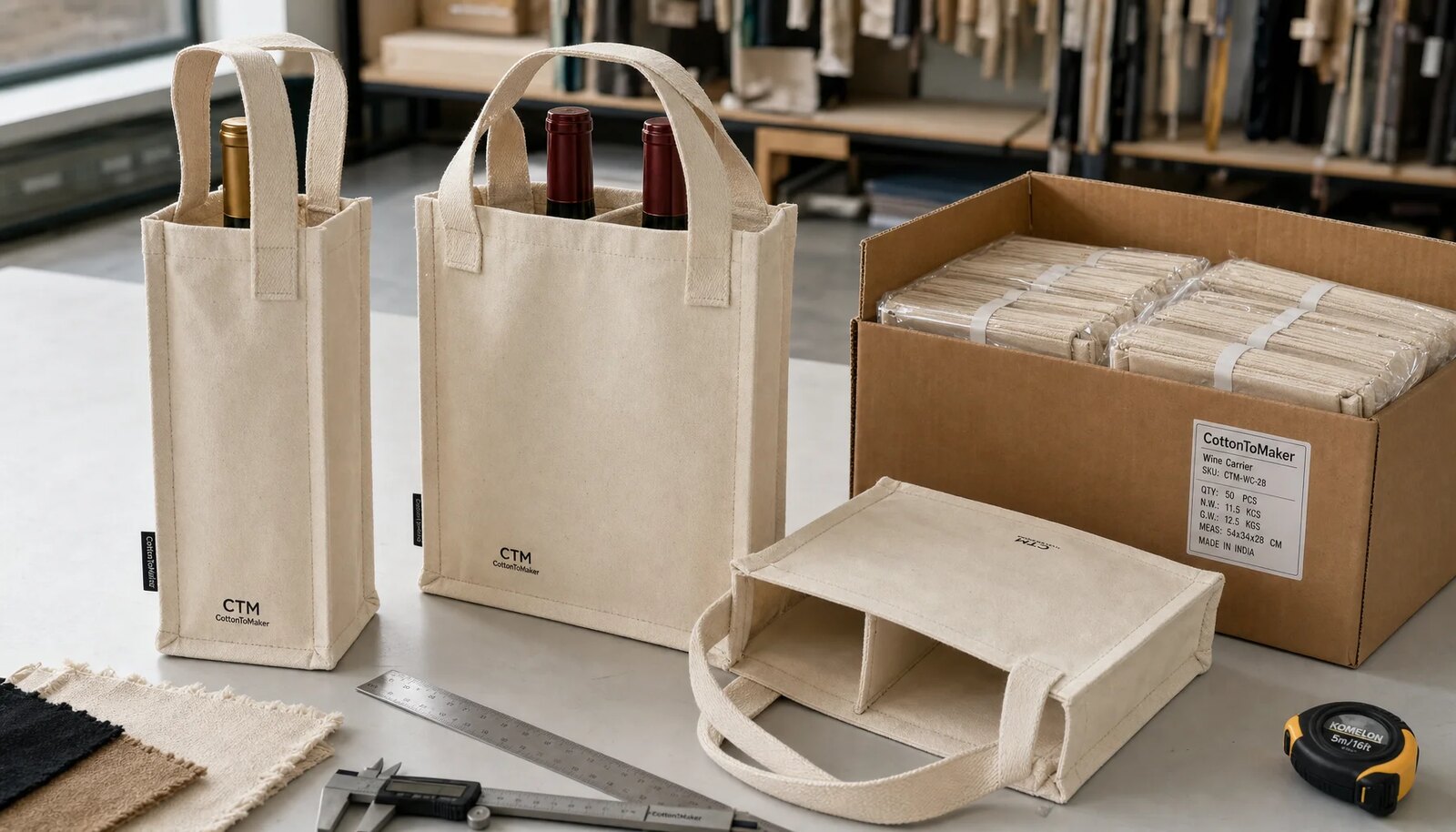
Procurement Scope for Craft Fair Wine Carriers
Canvas wine carriers look simple at first glance. For a procurement buyer, though, they are not just promotional totes in a smaller shape. They are branded, load-bearing packaging for rigid glass bottles. That changes the sourcing conversation. The bag has to fit the bottle, hold concentrated weight at the handles, keep its shape on a craft fair table, protect a printed logo panel, and arrive in cartons that staff can open, count, move, and repack without fighting the product.
The carton packing plan belongs in the product specification, not at the end of the order as a shipping detail. A low unit price can disappear quickly if cartons are too heavy for manual handling, if SKUs are mixed without clear carton marks, if dividers twist during compression, or if a hard fold runs across the front logo. Buyers need the supplier to connect the carrier construction, packing layout, carton measurements, gross weight, net weight, and CBM before the purchase order is approved.
Craft fair programs often sit between promotional sourcing and retail packaging. A winery may use the same carrier for farmers markets, tasting room add-ons, bottle club gifts, and holiday bundles. An olive oil brand may need a cleaner presentation and less plastic. A craft distillery may need a taller fit or stronger handle. Define the selling channel early. The factory can then quote the right canvas, print method, inner packing, carton separation, labeling, and inspection level instead of guessing from a picture.
- Classify the item as branded load-bearing packaging, not a standard tote bag.
- Lock the bottle profile before pattern approval because bottle shape drives width, gusset, divider, and handle load.
- Treat carton count, carton weight, and CBM as quote-line data needed before PO approval.
- Separate craft fair giveaway, tasting room sale, retail gift, and regional event allocation requirements.
- Compare suppliers only after each one quotes the same fabric, construction, print, packing, and QC assumptions.
Bottle Fit, Capacity, and Pattern Inputs
The phrase 750 ml wine bottle is not specific enough for pattern work. Bordeaux bottles are often about 70-76 mm in body diameter. Burgundy bottles are commonly wider and rounder. Sparkling bottles can be closer to 85-90 mm in diameter, with heavier glass and taller closures. Spirits, olive oil, syrup, sauce, and specialty gift bottles may be square, tapered, short, or unusually tall. A difference of only 5-10 mm can decide whether the bottle loads smoothly or fights the seam.
For a one-bottle carrier, the common problems are tight insertion, weak handle attachment, poor table stability, and a front panel that creases across the print. For a two-bottle carrier, the risk increases. The load roughly doubles, and the divider becomes a safety feature. Two filled 750 ml glass bottles often place about 2.5-3.0 kg or more on the handle area, depending on the bottle weight. Premium glass and sparkling bottles can push the test load higher, so the test should come from the actual product, not a broad estimate.
Give the supplier a bottle drawing or a measurement table before sampling. Include maximum body diameter, maximum shoulder width, total height, closure or neck height if it affects the opening, and filled weight. Also include any tissue wrap, bottle sleeve, protective paper, hang tag, neck tag, or gift insert that stays with the bottle. If one carrier must fit several bottle styles, approve the pattern against the widest and heaviest bottle first. Then check the smallest bottle to make sure it does not lean too far or knock against another bottle inside the same carrier.
- Bordeaux bottle fit: check shoulder clearance and body width; do not assume it matches Burgundy fit.
- Burgundy bottle fit: allow for wider rounded shoulders and more side pressure in a divider bag.
- Sparkling bottle fit: check larger diameter, heavier glass, taller closure, and higher handle load.
- Two-bottle carrier fit: test two bottles together, not one bottle in one compartment.
- Display fit: confirm empty, one-bottle, and fully loaded standing behavior on a flat table.
Canvas Fabric Specification and Material Tolerances
Most craft fair canvas wine carriers fall between 8 oz and 12 oz cotton canvas, or roughly 270-407 GSM depending on yarn, weave, and finishing. An 8 oz canvas can be suitable for an economy single-bottle giveaway where lower cost, lower weight, and easy folding matter. For carriers that need to stand on a booth table and hold one or two filled glass bottles, 10-12 oz canvas is usually a better starting point because it gives more structure, better hand feel, and a stronger retail impression.
Do not stop the fabric line at cotton canvas. State the fiber content, weave, oz, GSM, color, finish, and whether the fabric is natural, dyed, washed, unwashed, bleached, or pre-shrunk. Natural canvas often includes seed flecks, slubs, and shade variation. That can be part of the look, but it should still be approved. Dyed canvas needs lab dip review and bulk shade control. Washed canvas may reduce later shrinkage, but it can change surface texture, softness, and print behavior.
Set the GSM tolerance before cutting. Many production orders use an agreed percentage tolerance instead of expecting every roll to match the sample exactly. A practical PO can state the approved sample GSM plus or minus the agreed range, with incoming roll checks before cutting. If brand appearance matters, ask for a physical fabric swatch or cut panel by courier. Photos are useful for records, but they cannot confirm hand feel, stiffness, odor, shade depth, surface contamination, or how the fabric folds inside a carton.
- 8 oz canvas: use for economy single-bottle promotions where structure is less important.
- 10 oz canvas: practical middle point for branded craft fair carriers and moderate carton density.
- 12 oz canvas: stronger presentation but higher sewing bulk, carton weight, and freight sensitivity.
- Natural canvas: approve acceptable flecks, slubs, shade range, and surface marks before bulk cutting.
- Dyed canvas: require lab dip, bulk shade approval, and colorfastness review if rubbing or moisture exposure is likely.
Construction: Handles, Dividers, Gussets, and Seams
Handle failure is the highest-severity product risk because the carrier holds glass. The RFQ should state the handle material, finished handle width, handle drop, attachment area, reinforcement pattern, thread type, and stitch density. Cotton webbing handles are efficient and consistent. Self-fabric handles can look more integrated and premium. Either version needs reinforcement at the load point. A phrase such as reinforced handle is too vague unless the supplier identifies the bartack, box stitch, cross stitch, patch, extra fabric layer, or other method being quoted.
Stitching should be approved on a physical sample and then controlled in production. Many canvas bag programs use about 8-10 stitches per inch, but the right number depends on fabric thickness, needle size, thread, seam type, and bartack setting. Loose stitching may open under load. Overly dense bartacks can perforate the canvas and weaken the attachment area. Load-point samples should be checked after lifting or static hanging, not only while lying flat on a table.
The divider and bottom gusset decide whether a two-bottle carrier works in real use. A loose divider may look fine before packing, then twist after carton compression or repeated bottle insertion. A fixed stitched divider should stay centered, separate the bottles, and connect strongly enough to the base or side seams. The bottom gusset needs a stable footprint without creating so much folded bulk that carton density suffers. Inspect gusset corners after loading because filled bottles push directly into those seams.
- Handle spec: define width, drop, attachment height, reinforcement pattern, and thread type.
- Load test: use actual filled bottle weight plus agreed safety margin, not an empty-bag pull.
- Divider spec: define fixed or loose, attachment points, material, width, and centered-position tolerance.
- Gusset spec: define finished depth, fold direction, base symmetry, and table-standing requirement.
- Seam spec: reject skipped stitches, loose bartacks, open seams, needle cuts, raw exposed edges, and sharp thread ends.
Print Method, Artwork Limits, and Approval Tolerances
Water-based screen printing is usually the lowest-risk choice for simple craft fair branding on natural canvas. It works well for one to three solid colors, bold logos, farm names, winery names, and reusable packaging marks. Canvas texture limits fine detail, so artwork should be reviewed before the supplier quotes. As a practical rule, text below about 6 pt, line weights below about 0.5 mm, small reversed-out details, and dense QR codes need a strike-off on the actual production canvas.
Heat transfer and digital print can be useful for full-color graphics, illustrated bottle labels, seasonal artwork, or limited-release promotions. They also require more testing. Transfers may crack at fold lines or lift from the weave if curing, pressure, temperature, or adhesive compatibility is not right. Digital prints can vary in opacity and hand feel on natural canvas. Ask the supplier to check adhesion, dry rub, light bend or fold, and appearance after carton-style compression. A flat mockup is not enough for complex artwork.
Print placement should be measured from stable points on the finished product, such as the top edge, side seam, bottom seam, pocket seam, or center line. A common placement tolerance for canvas wine carriers is plus or minus 5 mm from the approved sample, although the artwork may require tighter or looser control. If printing happens before sewing, sewing alignment can shift the final logo. If printing happens after sewing, seams, gussets, and handles can limit the printable area. The safer approval route is a print strike-off followed by a full pre-production sample.
- Low-risk print: one-color or two-color screen print with bold artwork on a flat front panel.
- High-risk print: small QR codes, metallic effects, fine label art, large solids, and prints over seam ridges.
- Artwork data: provide vector file, print size, Pantone targets, color count, minimum line width, and placement reference.
- Tolerance target: use plus or minus 5 mm print placement unless the approved sample defines another value.
- Approval evidence: require strike-off photo, physical print sample if needed, rub result, fold check, and production sample.
MOQ, Cost Drivers, and Quote Comparability
MOQ is not just one total order quantity. For canvas wine carriers, minimums are shaped by fabric availability, dyeing, cutting efficiency, print setup, sewing complexity, packing style, and carton marks. A supplier may accept a smaller run when the order uses stock natural canvas, one size, one-color screen print, and standard export cartons. The same unit count becomes harder to price when it is split across several fabric colors, artwork versions, hangtags, regional carton marks, or destination allocations.
The main cost drivers are canvas weight, pattern waste, divider construction, handle reinforcement, number of print colors, print area, sample rounds, inner packing, carton strength, and inspection requirements. Heavy canvas can improve presentation, but it also increases material cost, sewing bulk, carton gross weight, and freight sensitivity. A structured base may help the carrier stand better on a table, but it can reduce packing density. Individual polybags reduce dirt risk, yet they add labor, material, and waste handling that many craft fair buyers prefer to avoid.
Ask suppliers to quote defined scenarios instead of open-ended ideas. For example, request a price for stock natural 10 oz canvas, one-bottle, one-color screen print, flat packed. Then request the two-bottle version with fixed divider and reinforced handles. If needed, add a dyed canvas option with hangtag and barcode label. Each quote should show whether samples, screen charges, setup fees, carton upgrades, and courier costs are included or separate. If carton CBM is missing, the quote is incomplete because landed cost cannot be calculated.
- Lowest complexity: stock natural canvas, one size, one-color screen print, flat packing, one carton mark.
- Higher complexity: two-bottle divider, heavy canvas, multi-color print, hangtags, and destination-separated cartons.
- MOQ split: confirm minimums by fabric color, artwork, print colorway, structure, and shipping mark.
- Hidden costs: check screen fees, strike-offs, sample revisions, courier charges, carton upgrades, and inspection support.
- Quote rule: reject comparisons that omit carton L x W x H, gross weight, net weight, pieces per carton, and CBM.
Carton Packing Plan and CBM Control
Approve the carton packing plan before bulk packing, and ideally before mass production. For canvas wine carriers, flat packing is usually the most efficient export method. Units are folded consistently, stacked in bundles, and placed so the main logo panel avoids a hard crease where possible. The pieces per carton can change sharply with fabric weight, finished size, gusset depth, divider structure, handle bulk, and inner packing. Do not assume 50, 80, or 100 pieces per carton without a packing trial.
A complete packing plan includes pieces per carton, inner bundle quantity, fold direction, carton L x W x H, carton material, net weight, gross weight, CBM per carton, total carton count, total CBM, shipping marks, and SKU separation rules. CBM per carton is calculated as length x width x height in meters. For example, a 60 x 40 x 35 cm carton is 0.084 CBM. If it holds 80 pieces, the theoretical carton volume is 0.00105 CBM per piece before pallet effects and freight rounding. Use this only as a calculation example; the supplier should provide actual product data.
Gross weight matters for real event handling. A tightly packed carton may reduce freight volume but become awkward for craft fair staff, small warehouses, or tasting room teams. Overpacking can crush gussets, crease printed panels, and distort dividers. Underpacking wastes CBM and allows units to shift in transit. For a new design, ask for open-carton photos, closed-carton photos, carton mark photos, bundle layout photos, and one unit removed after compression. These records help catch presentation problems before the shipment leaves the factory.
- Packing layout: flat pack consistently and keep hard fold lines away from the primary logo when possible.
- Bundle count: use 10, 20, or 25 pieces per bundle if fast event counting is needed.
- CBM data: require carton L x W x H, CBM per carton, total carton count, and total CBM in the proforma invoice.
- Weight data: require gross weight and net weight and compare against manual handling limits.
- SKU rule: avoid mixed cartons unless the packing list and carton marks clearly identify the internal split.
Sample Approval Sequence and Records
A strong approval route has three checkpoints: a blank fit sample, a printed pre-production sample, and packed-carton confirmation. The blank sample proves body size, handle drop, divider placement, gusset stability, sewing quality, and bottle fit before printing costs are added. This is the cheapest moment to adjust the pattern width, handle length, divider attachment, or base structure.
The printed pre-production sample confirms artwork scale, placement, opacity, edge quality, color, and appearance after folding. It should use production-style canvas and the intended print method, not a convenient substitute fabric. Test it with real bottles. Carry it by the handle, set it on a table, insert and remove bottles several times, and fold it using the proposed packing method. If the product will be sold or handed out at a craft fair, approval should reflect booth handling, not only a clean sample photo.
Packed-carton confirmation is especially useful for heavy canvas, two-bottle dividers, large prints, hangtags, or retail presentation requirements. Check whether units recover shape after unpacking, whether the logo crease is acceptable, whether dividers remain usable, and whether carton weight is practical. Keep one signed physical approval sample with date, version number, fabric spec, print file code, and approved tolerances. Ask the factory to keep a matching reference sample so production and inspection do not depend only on email images.
- Blank sample: approve dimensions, bottle fit, handle comfort, divider, gusset, stitch quality, and standing behavior.
- Print sample: approve color, opacity, placement, rub resistance, curing, and fold appearance.
- Packed sample: approve fold method, bundle count, carton fit, carton mark, logo crease risk, and unpacked shape.
- Version control: label each sample round with date, pattern version, artwork code, and material spec.
- Reference control: use a signed physical sample whenever possible for production and inspection alignment.
Inspection Plan and Defect Classification
Inspection should cover function, appearance, and packing. The highest-risk areas are handle attachments, divider seams, bottom gusset corners, and printed panels. Define defects before production starts so the factory, buyer, and any third-party inspector classify problems the same way. A loose thread inside a low-cost one-bottle giveaway may be minor. A loose divider seam in a two-bottle carrier is major because it can allow glass contact. Handle breakage, severe seam opening, unsafe contamination, or unusable bottle fit should be treated as critical.
Dimensional checks should include body width, body height, gusset depth, handle drop, handle width, divider location, and print placement. Common starting tolerances are plus or minus 5 mm for body and gusset measurements and plus or minus 10 mm for handle drop, but the final PO should match the approved sample and bottle fit. Print placement is often controlled within plus or minus 5 mm. If QR codes are printed, scan finished units after folding. For fabric, check shade, odor, stains, slub level, seed flecks, and GSM against the signed standard.
Loaded-use testing should be simple, repeatable, and documented. Use the actual filled bottle weight or a calibrated equivalent. For a two-bottle carrier, test two filled bottles together and inspect after lifting, holding, light movement, and placement on a flat surface. Acceptance should state no handle seam failure, no fabric tearing, no bottom seam opening, no severe elongation, and no divider failure. Carton inspection should verify count, bundle quantity, carton marks, dry cartons, carton condition, gross weight, net weight, and carton dimensions against the approved packing plan.
- Critical defects: handle failure, unsafe contamination, severe seam opening, wrong SKU, or unusable bottle fit.
- Major defects: divider failure, large print deviation, wrong dimensions outside tolerance, broken stitches at load points, or crushed cartons.
- Minor defects: small loose threads, slight shade variation within standard, or small cosmetic marks within agreed limit.
- Function tests: bottle insertion, loaded carry, table standing, divider separation, and post-fold recovery.
- Packing tests: count verification, carton weight, carton dimensions, carton marks, SKU separation, and logo crease review.
Lead Time, Freight, and Event Schedule Risk
Lead time should start from the right milestone, usually after deposit or payment milestone, final artwork approval, material approval, and signed pre-production sample. It should not be counted from the first inquiry date. Stock natural canvas with one-color screen print can move faster than dyed canvas, multi-color print, new divider patterns, retail hangtags, or barcode labeling. Lab dips, strike-offs, sample revisions, and carton trials all add calendar time, so fixed craft fair dates need a real approval schedule with buyer deadlines.
Freight planning depends on carton data. Sea freight needs total CBM and carton count early enough for booking, pallet planning, and receiving. Air freight is more sensitive to volumetric weight, so a shaped-open packing method can cost much more than flat packing. If the event date is close, ask the supplier for carton dimensions from the packing trial before choosing between air and sea. For split regional events, confirm destination carton marks and packing list details before cartons are sealed.
The production critical path should show what is locked and what can still change. Bottle fit, fabric GSM, divider construction, handle reinforcement, print method, and carton packing method should be frozen before bulk cutting and printing. Hangtag wording, carton marks, and allocation details may remain adjustable later only if the supplier gives a clear cut-off date. A schedule with no buffer for inspection, carton correction, export documents, customs clearance, or domestic redistribution is risky because craft fair dates rarely move.
- Fast route: stock natural canvas, approved bottle fit, one-color screen print, flat packing, and standard carton marks.
- Slow route: custom dyed canvas, lab dip, complex print, revised divider pattern, hangtags, and split destinations.
- Buyer deadline: approve physical sample before bulk cutting and approve print before bulk printing.
- Freight deadline: lock pieces per carton, carton dimensions, gross weight, and CBM before booking.
- Schedule buffer: allow time for inspection, packing corrections, export documents, customs clearance, and event allocation.
Specification comparison for buyers
| Spec decision | Recommended option | When it fits | Buyer risk to check |
|---|---|---|---|
| Bottle fit baseline | Approve against an actual bottle, bottle drawing, or measured bottle table; record diameter, shoulder width, height, closure height, and filled weight | Required for Bordeaux, Burgundy, sparkling, spirits, olive oil, sauce, syrup, and mixed gift bottle programs | A generic 750 ml reference can miss 10-20 mm in diameter or shoulder shape, creating tight loading, tipping, or divider pressure |
| Fabric weight for craft fair handling | 10-12 oz cotton canvas, typically about 340-407 GSM depending on mill conversion and finish | Good starting point for table display, repeated shopper handling, and one- or two-bottle loaded use | 8 oz canvas can work for economy single-bottle use, but it may collapse, stretch at handles, or show the bottle shape strongly |
| Finished size tolerance | Body width and height commonly plus or minus 5 mm; gusset plus or minus 5 mm; handle drop plus or minus 10 mm after approval sample | Useful for standard production inspection when dimensions affect bottle fit, carton count, and booth presentation | Loose tolerances can make some units too tight for bottles or too bulky for the approved carton plan |
| Divider construction | Fixed stitched divider, centered, secured at base or side stress points, with no loose floating panels unless approved | Best for two-bottle craft fair bundles and winery gift packs where glass-to-glass contact must be controlled | Loose dividers can twist during compression; test after carton packing, not only on a flat sewing sample |
| Handle reinforcement | Cotton webbing or self-fabric handle with bartack, box stitch, cross stitch, or reinforcement patch; specify stitch pattern and thread | Needed when full glass bottles are carried across outdoor event grounds, parking lots, and tasting rooms | The phrase strong handle is not measurable; require a loaded hang, lift, or static hold test and inspect stitch breakage |
| Stitching standard | Lock seam type, thread type, and stitch density; common canvas range is about 8-10 stitches per inch unless the design requires otherwise | Applies to side seams, bottom gusset, handle attachments, divider seams, and top opening | Very dense bartacks may cut fabric; loose stitching may open under load; both should be checked against the approval sample |
| Print method for simple logos | Water-based screen print, usually 1-3 solid colors, with artwork adjusted for textured canvas | Best for craft fair logos, winery names, farm brands, and reusable branded packaging | Fine text below about 6 pt, thin lines under about 0.5 mm, and small QR codes need strike-off testing |
| Print method for complex artwork | Heat transfer or digital print only after adhesion, bend, rub, and fold testing on actual production canvas | Useful for full-color seasonal graphics, illustrated labels, or limited-release bottle promotions | Transfers can crack or lift on canvas texture if temperature, pressure, adhesive, or curing window is uncontrolled |
| Carton packing method | Flat pack in consistent bundles, with the main logo panel protected from hard fold lines where possible | Most efficient for export cartons, event distribution, warehouse counting, and freight planning | Overpacking can crease prints, deform gussets, twist dividers, and create cartons over buyer handling limits |
Buyer checklist before sampling
- Provide bottle type and dimensions before quoting: body diameter, maximum shoulder width, total height, neck height if relevant, and filled bottle weight.
- Specify whether the carrier must fit Bordeaux, Burgundy, sparkling, spirits, olive oil, or mixed specialty bottles; do not rely on generic 750 ml wording.
- Define finished carrier dimensions, gusset depth, divider style, handle drop, handle width, and front printable panel size.
- Specify canvas in both oz and GSM where possible, for example 10 oz or approximately 340 GSM cotton canvas, and state natural, dyed, washed, or unwashed finish.
- Set dimensional tolerances before production, commonly plus or minus 5 mm for body and gusset and plus or minus 10 mm for handle drop unless design requires tighter control.
- State the required loaded test: one filled bottle or two filled bottles, test weight, duration, and acceptance criteria for handle, divider, side seams, and base seams.
- Provide artwork file, print size, Pantone references, number of colors, minimum line width, minimum text size, and required placement tolerance.
- Request a print strike-off on actual canvas before approving bulk print, especially for QR codes, fine label art, dark fabric, or large ink coverage.
- Confirm whether individual polybags are prohibited, optional, or required; many craft fair programs prefer paper bands or bundle packing to reduce plastic handling.
- Request carton packing plan in the quotation: pieces per carton, inner bundle count, carton L x W x H, gross weight, net weight, CBM, and carton mark format.
Factory quote questions to send
- What exact fabric are you quoting: fiber content, canvas construction, oz, GSM, natural or dyed finish, washed or unwashed finish, and stock or custom material?
- What GSM tolerance can you maintain in bulk fabric, and how will GSM be checked against the approved sample or fabric swatch?
- Which bottle dimensions did you use for the pattern, and can you test with our actual bottle, drawing, or 3D bottle dimensions before sample approval?
- What finished dimensions are included in the quote for body width, body height, gusset, divider width, handle width, and handle drop?
- What production tolerance do you propose for body size, gusset depth, handle drop, print placement, and carton dimensions?
- How is the divider constructed: fixed stitched divider, loose divider, bottom-attached divider, side-attached divider, same-fabric divider, or lighter internal fabric?
- How are handles reinforced at the load point: bartack, box stitch, cross stitch, reinforcement patch, double-layer fabric, or cotton webbing?
- What thread type, seam type, and stitch density are included for side seams, bottom gusset, handles, divider, and top opening?
- What load test can you perform in production: test weight, hold time, sample quantity, and pass-fail criteria for seams and handles?
- What print method is included, how many colors are included, what is the maximum printable area, and what artwork limits apply for fine lines, QR codes, and small text?
Quality-control points to confirm
- Finished body width and height measured against approval sample and specification, with typical tolerance of plus or minus 5 mm unless otherwise agreed.
- Gusset depth, base symmetry, and divider position checked because small deviations can affect bottle fit, table stability, and carton density.
- Handle drop commonly controlled within plus or minus 10 mm; handle width and attachment placement checked for user comfort and load balance.
- Fabric GSM verified by cutting and weighing a known area or by mill test report plus random incoming inspection; agreed tolerance should be stated in the PO.
- Canvas shade, weave, slub level, seed flecks, odor, stains, oil marks, and surface cleanliness checked against signed fabric reference.
- Bottle fit checked with actual bottle or approved dummy: insertion, removal, shoulder clearance, upright display, and loaded carry behavior.
- One-bottle and two-bottle loaded tests performed as applicable; no seam popping, thread breakage, fabric tearing, severe handle elongation, or base opening.
- Divider inspected after loading and light movement; bottles should remain separated and divider seams should not twist, pull loose, or expose raw edges.
- Stitching inspected for skipped stitches, broken thread, loose bartacks, uneven stitch density, needle damage, open seams, and untrimmed sharp thread ends.
- Print checked for color, opacity, edge sharpness, registration, curing, adhesion, rub resistance, placement, and distortion after folding.