Why MOQ becomes hard on corporate gifting orders
Canvas wine carriers look simple on a catalog page, but procurement buyers know the quote is really covering a system of small choices. Corporate gifting introduces more pressure than a standard retail run because the carrier has to fit a specific bottle, present well in hand, survive packing and shipping, and still match a campaign deadline. That means the supplier is pricing not only fabric and sewing, but also cutting, reinforcement, decoration, sample handling, and the risk of a small run. If you ask only for a unit price, the quote often looks clean until the setup charges and packing assumptions appear.
MOQ becomes harder because both sides are trying to protect different things. The supplier wants enough volume to justify material booking, sewing setup, and decoration runs. The buyer wants flexibility, a low opening quantity, and room for a pilot order. The fastest way to turn that into a useful negotiation is to freeze the variables that drive production cost before discussing quantity. Once bottle fit, fabric weight, branding method, and packing format are fixed, MOQ stops being a vague number and becomes a commercial decision with tradeoffs you can actually compare.
- Treat MOQ as a function of setup, labor, and material booking, not as one number that applies to every spec.
- Expect the minimum to move if you change bottle size, closure style, artwork complexity, or packing format.
- For corporate gifting, approval speed inside your own organization can be as risky as factory capacity, so build time for both.
Start with bottle fit and the actual gift scenario
The first sourcing mistake is treating every wine bottle as interchangeable. A standard 750 ml still bottle is a useful reference, but shoulder shape, base diameter, neck height, and closure type vary enough to affect fit. If the carrier is for champagne or a larger format, say so in the brief. A carrier designed around a slim Bordeaux bottle can feel loose on a wider bottle and can look underbuilt even when the material is correct. Fit is not only about size. It also changes the unboxing moment, the carry feel, and whether the carrier will stand upright during gifting.
The second mistake is not stating how the bag will be used. A display carrier for a gift table is different from a carrier that will be handed to an attendee and walked across a venue. If the bottle needs to be inserted and removed often, the opening and seam finish should be cleaner. If the bag must sit on a desk or table after the bottle is removed, the base should be reinforced or designed with a structure insert. Write the use case into the spec so the factory understands whether the carrier needs presentation value, transport protection, or both.
- Specify bottle dimensions or send a physical bottle sample, not only the words wine bottle.
- State whether the carrier must stand upright, collapse flat, or support a presentation insert.
- Write the use case into the brief: event handout, client gift, retail resale, or internal distribution.
Build a sourcing spec sheet the factory can actually quote
If the specification is loose, every supplier will make different assumptions and the quotes will not be comparable. A useful brief for canvas wine carriers should cover material, dimensions, reinforcement, branding, packing, and approval rules. On dimensions, give body width, base depth, and usable height. On tolerances, many procurement teams start with plus or minus 5 mm for body dimensions and plus or minus 10 mm for handle length, then tighten that range if the fit is critical. If the bag is supposed to hold a premium bottle shape without collapsing, include that requirement in the brief rather than hoping the sample room guesses it correctly.
Decoration details need the same discipline. State whether the artwork is a one-color screen print, two-color print, woven label, side label, or patch. Add the artwork file version, Pantone references if color matters, and whether the logo can cross a seam or must stay on a flat panel. If the brand requires a premium finish, you may also want to specify thread color, label placement, and whether the design is allowed to use contrast stitching. The clearer the spec, the easier it is to compare quotes on the same basis.
- List the fabric weight in oz and gsm, and ask the factory to state the tolerance instead of assuming it.
- Write the handle type, handle drop, and reinforcement method in the spec, not only in the sample approval email.
- Assign one artwork version for the first order unless there is a real business reason to split the run.
Material and construction choices that move price
For canvas wine carriers, fabric weight is usually a bigger cost lever than many buyers expect. A lighter canvas can work for a low-cost promo item, but most corporate gifting programs need something that feels stable and premium in the hand. Twelve-ounce canvas, roughly 340 gsm, is often a practical middle ground. Fourteen-ounce canvas, roughly 400 gsm, gives more structure and better shelf presence when the bag is part of a premium gift set. Heavier is not automatically better. If the carrier becomes too stiff, too bulky, or too expensive to freight, the experience can get worse rather than better.
Construction choices matter just as much. A reinforced base seam helps the carrier stay presentable after the bottle is inserted. A gusset can improve bottle clearance and shape retention, but it can also add labor. Cotton webbing handles are common because they carry load well and look clean; self-fabric handles can work, but they usually need better reinforcement to avoid a weak, flat feel. If the carrier must stand upright, think about the whole structure, not just the fabric weight. A well-chosen medium-weight canvas with solid reinforcements often beats a heavier bag that ships badly and arrives misshapen.
- Use fabric weight as a controlled lever, not as a vague marketing phrase.
- Choose structure features only when the use case needs them, such as a gusset or base insert.
- Keep the closure and decoration simple unless the gift experience truly needs extra complexity.
Branding and decoration without blowing up MOQ
Decoration is where a lot of low-MOQ programs get expensive, because branding decisions influence setup work more than buyers expect. A one-color screen print is usually the easiest method to keep the first order manageable. It is predictable, repeatable, and easy to proof. A woven label or side label can make the item feel more premium, but it adds labor and may increase the minimum. Embellishment choices should follow the brand's real use case. A client gift that will be photographed may justify a cleaner label treatment, while a large internal send-out may benefit from the simplest durable logo application.
The practical detail that gets missed most often is artwork placement. If the logo crosses a seam, the registration risk rises. If the design is too close to the edge or handle join, the factory may need to slow the line down. Ask for a mockup that shows the final print position on the actual bag panel, not just the artwork file. Define the Pantone reference if color matters, and ask the supplier how many screens, plates, or label runs are included. For procurement, the point is not to eliminate all decoration complexity. It is to keep the decoration choice aligned with the MOQ, the budget, and the look the gift actually needs.
- Use one-color screen print when the run is small and the logo is simple.
- Ask whether the logo can cross seams; if it can, require proof on the sample.
- Define print position, Pantone reference, and label placement before sampling starts.
Compare sourcing routes without mixing apples and oranges
Direct factory sourcing usually gives the best control over materials, stitching, and packing. It is the best fit when the buyer needs a repeatable program, wants to keep a stable spec, or expects to negotiate around annual volume. The tradeoff is that the buyer owns more of the work: artwork approval, sample review, version control, and the discipline of answering questions quickly. If the team is not ready to manage those steps, the factory quote can look cheaper than it really is because the internal coordination cost is hidden from the price.
Trading companies and local decorators can be useful when speed matters or when the order is very small. They may also help if the gifting program combines multiple items into one delivery. The risk is that the quote can hide the factory minimum, and the sample may reflect a stock carrier instead of the exact construction you will receive. Procurement should compare only like with like. Ask every source to quote the same fabric weight, the same decoration method, the same packing method, and the same delivery term. If one quote is EXW, another is FOB, and another is DDP, the unit price is not actually comparable.
- Ask who owns the bag body, who owns decoration, and who owns final packing before comparing prices.
- Compare quotes on the same Incoterm, currency, and carton assumptions.
- For annual gifting, prefer suppliers that can hold the same base spec across repeat orders.
Ask quote questions that expose hidden costs
A useful supplier quote should separate the carrier into its cost components. At minimum, ask for bag body cost, decoration cost, packing cost, and carton or handling cost. Some suppliers prefer one all-in number because it looks simple, but that makes it hard to see where the real cost pressure sits. If one quote is much lower than the others, the reason is usually in the assumptions: thinner fabric, simpler stitching, cheaper packing, lower QA effort, or a looser understanding of the spec. Procurement should not let the spreadsheet hide those differences.
The same discipline applies to setup and change fees. Ask whether screen charges, plate charges, artwork conversion, Pantone matching, or sample shipment are included. Ask whether the MOQ changes if the order uses multiple colors or multiple logos. Ask what the factory defines as a production variation versus a new style. Those questions matter because a corporate gifting program often includes several regions, departments, or campaigns. The first order can look cheap while the second order becomes expensive if the spec is not controlled. Good quote questions force the commercial structure into the open before approval.
- Request line-item pricing instead of only a single unit price.
- Ask for price breaks at 300, 500, 1,000, and 3,000 pieces if the program may scale.
- Confirm whether sample, setup, and carton charges are one-time costs or repeat-order costs.
Negotiate MOQ without weakening quality control
The best MOQ negotiations are built around concessions that do not damage the user experience. If the supplier needs a lower opening quantity, the buyer can often trade off packaging complexity, color assortment, or the number of decoration variants. A flat pack with simple interleaf protection may reduce labor enough to make the order viable at a smaller run. Another option is to keep the bag construction fixed while changing only the logo artwork for different client groups. That allows the supplier to keep the cutting and sewing process efficient while the buyer tests demand.
Annual volume commitments can also help, but only if the forecast is real. Factories may agree to a lower first-order MOQ when they can see repeat business later in the season or next year. That works only if the buyer can support the follow-on order. If the commitment is vague, the supplier will discount it and protect itself in the first price. Decide what is actually negotiable: fabric finish, packaging, artwork complexity, carton density, order split across colors, or delivery schedule. Do not negotiate away stitch quality, print durability, or bottle fit just to win a lower minimum. In corporate gifting, those are the details the recipient will notice.
- Trade packaging simplicity for MOQ relief when the presentation allows it.
- Use a documented annual forecast only if the follow-on volume is realistic and owned internally.
- Keep fit, stitching, and print durability non-negotiable even when the first run is small.
Sampling and QC gates for a clean bulk run
A sample can look polished and still fail in production use. For wine carriers, test the actual bottle intended for the program, not a generic bottle from the sample room. Check insertion, removal, carry comfort, and stability. If the bottle catches on the seam, leans too far in the bag, or forces the base to buckle, the bag is not production-ready even if the print is clean. This matters more in corporate gifting than in ordinary promo work because the carrier is part of the brand experience, not just an accessory.
The approval record should be written and specific. Record the approved fabric weight, color reference, artwork file version, print location, handle length, seam detail, and packing method. If the approval is vague, the factory may assume it can optimize materials or simplify construction later. That is where many MOQ and quality disputes start, because each side remembers the conversation differently. A good approval process ends with a golden sample, a dated approval note, and a clear production reference that the factory can follow and the buyer can audit later.
- Test with the actual bottle or a dimensionally equivalent sample bottle.
- Approve the sample by written spec, not by a photo and a casual email thread.
- Capture the exact artwork version and sample ID so bulk production cannot drift.
Packing, cartonization, and the repeat-order decision
Packing is often treated as a minor detail, but for canvas wine carriers it can change both freight cost and arrival quality. If the bags are packed loosely, printed surfaces can rub, handles can crease, and the canvas can pick up marks before it reaches the destination. A simple tissue layer, polybag, or controlled flat pack can protect the product without adding much cost. The right choice depends on whether the buyer will repack the item later, place it into a gift set, or distribute it directly from the carton. What matters is that the packing plan supports the downstream workflow instead of forcing the warehouse to improvise.
Carton sizing and count are equally important. Standardized carton quantities simplify receiving and reduce split handling in the warehouse, but the factory should not choose carton density only to make its own packing easier. If the carton is too full, the carrier can crease or compress. If it is too loose, freight cost rises and carton integrity drops. When you award the order, ask whether the supplier can hold the same base spec for a repeat season, whether it can quote reorders separately, and whether it can preserve the same carton marks and inner pack method. That is the difference between a one-off order and a manageable gifting program.
- Protect printed or labeled surfaces from rub marks during transit.
- Align carton count with the buyer's receiving and fulfillment process.
- Confirm whether packing is for export, storage, or direct gift assembly.
Specification comparison for buyers
| Spec decision | Practical starting point | Why it matters | What to verify in the quote |
|---|---|---|---|
| Bottle fit | Size the carrier to the actual bottle drawing, not only to a generic 750 ml reference; many buyers allow about 5 mm clearance on width and depth | Bottle profile drives fit, presentation, and whether the bag feels premium or cramped | Ask for internal width, base depth, usable height, and the exact bottle type the sample was built around |
| Bottle use case | Single bottle gift, two-bottle presentation, champagne, or magnum all need different body geometry | The same exterior look can fail if the intended bottle shape is not stated up front | Confirm whether the quote covers one bottle only, a set, or a larger format |
| Fabric weight | 12 oz canvas, roughly 340 gsm, is a common premium starting point; 14 oz, roughly 400 gsm, gives more structure | Fabric weight changes hand feel, shape retention, and freight cost | Confirm whether the quote is based on nominal fabric weight or finished weight, and what variance the factory allows |
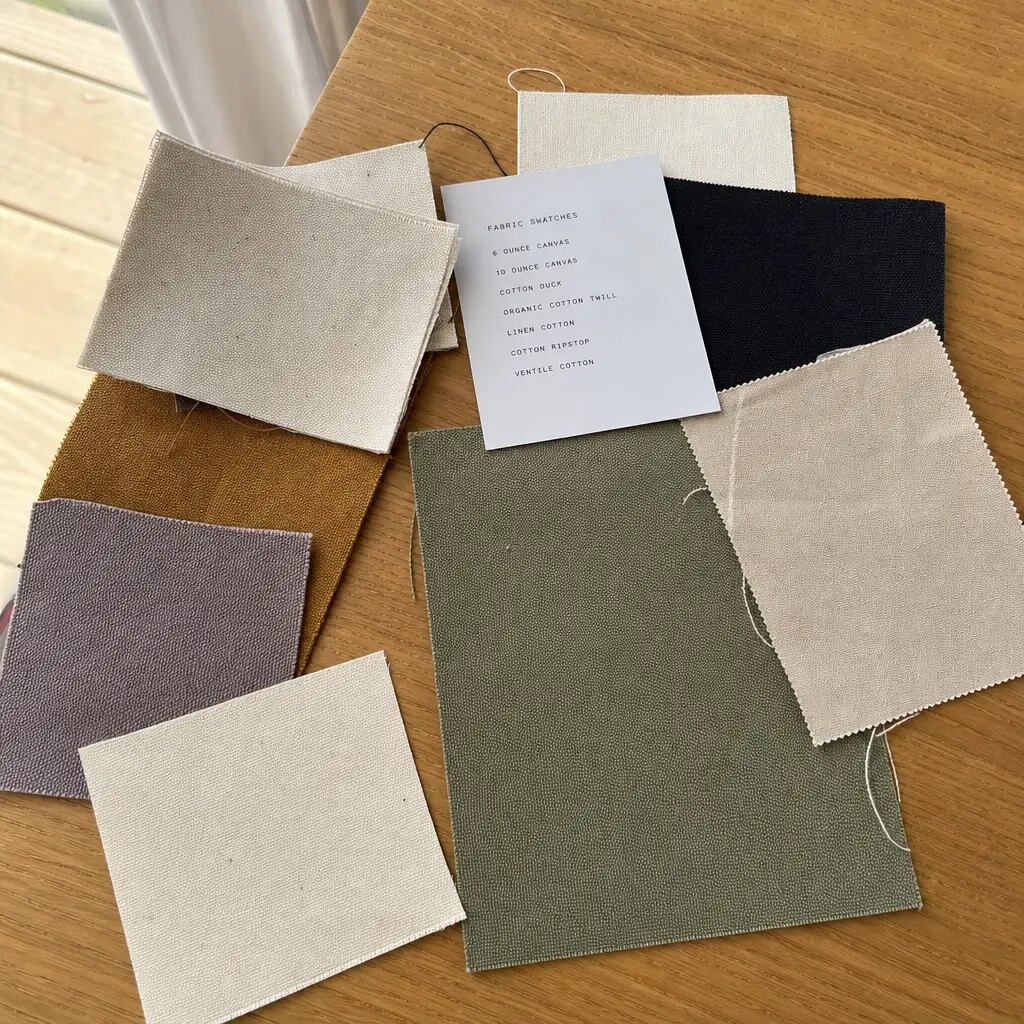
| Canvas finish | Natural, bleached, dyed, or washed canvas each gives a different look and consistency risk | Finish affects perceived quality, color match, and repeat-order consistency | Ask whether the fabric is pre-shrunk, piece-dyed, or finished after sewing |
| Handle construction | 25 to 30 mm cotton webbing or self-fabric handles with reinforced attachment points and at least two bartacks or a box stitch at each join | Handles carry the load and are often the first failure point in use | Verify handle drop, handle length, reinforcement method, and whether stitch density is stated |
| Base and side structure | Reinforced base seam, optional insert, and a stable gusset if the carrier must stand upright | Structure affects shelf presence, bottle stability, and damage resistance in transit | Check base width, gusset depth, and whether the bag collapses flat or holds shape empty |
| Branding method | One-color screen print for lower setup cost; woven label or side label for a more premium finish | Decoration method affects MOQ, setup charges, repeatability, and appearance | Ask how many screens, plates, or label runs are included, plus the registration tolerance |
| MOQ basis | Negotiate by style, color, artwork version, and packing format, not by product name alone | A low body MOQ can hide high setup costs if other variables change | Confirm whether MOQ applies per color, per artwork, per carton format, or to the combined order total |
| Packing method | Flat-packed with tissue or polybag protection, often 25 to 100 pcs per carton depending on bag size and structure | Packing changes damage risk, warehouse labor, and freight efficiency | Verify carton count, carton dimensions, inner pack method, and whether printed surfaces are protected from rub marks |
Buyer checklist before sampling
- Provide the exact bottle type, including 750 ml still wine, champagne, magnum, or another format, and include bottle drawing dimensions if you have them.
- State whether the carrier is for one bottle only or for a presentation set, because bottle count changes width, base reinforcement, and carton size.
- Lock the fabric spec in oz and gsm, then note whether the canvas is natural, bleached, dyed, washed, or treated for color consistency.
- Define the handle type, handle drop, reinforcement method, and whether the bag must remain upright when empty or only when filled.
- Choose one branding method for the first order and specify artwork version, Pantone references, print area, and whether the logo can cross seams.
- Ask the factory for a pre-production sample, a confirmed golden sample, or both, before you approve bulk production.
- Write your dimensional tolerance into the brief, for example plus or minus 5 mm on body size and plus or minus 10 mm on handle length unless your design needs tighter control.
- Request carton quantity, carton dimensions, net and gross weight, and pallet pattern if the order will enter a distribution center.
- Compare MOQ by colorway, artwork version, and packing format, not only by style name or catalog photo.
- Build a landed-cost view that includes decoration, sample charges, carton work, inland freight, customs-related terms if relevant, and a realistic rework allowance.
Factory quote questions to send
- What is the MOQ by style, by color, by artwork version, and by packing format for this canvas wine carrier?
- Is the fabric weight quoted as nominal or finished weight, and what tolerance do you allow on incoming material?
- How do you handle multiple colors or multiple logos in one order, and does each version carry its own setup charge?
- Can you split the quote into bag body, branding, packing, carton, sample, and freight so we can compare suppliers on the same basis?
- What is the handle construction, handle drop, and reinforcement method, and can you state the stitch spec used on load-bearing seams?
- What is your standard lead time after sample approval, and which step usually causes the biggest delay risk?
- What sample can you provide for fabric hand feel, color match, print placement, stitch quality, and bottle fit before mass production?
- What inspection method do you use for seam strength, print alignment, count accuracy, and packaging accuracy, and do you run AQL or a full final check?
- If we simplify packing or reduce artwork complexity, how much can you improve MOQ or unit cost without changing the core bag construction?
- Can you hold the same base spec for a repeat order next season if only the artwork or packing changes?
Quality-control points to confirm
- Approve the golden sample against the written spec, not against an earlier rough sample or a photo.
- Measure body width, base depth, and usable height against the approved bottle type, and keep the dimensional tolerance in the PO.
- Check handle drop and handle attachment symmetry, and confirm each load-bearing join has the agreed reinforcement, such as two bartacks or a box stitch.
- Inspect stitch quality on the main seams, including skipped stitches, loose thread tails, needle holes, and puckering; if SPI is used, confirm the target on canvas seams.
- Verify print placement, registration, and color against the approved artwork file and Pantone reference, and reject obvious drift before the line runs.
- Check seam finish, edge fray, and any exposed raw edges, especially around openings, gussets, and handle joins.
- Open cartons from the top, middle, and bottom of a pallet if the order is palletized, and confirm the count in each sampled carton.
- Confirm that inner packing prevents rub marks on printed or labeled surfaces and that the bag folds the same way in every carton.
- Review carton marks, SKU labels, destination labels, and packing lists against the purchase order before shipment release.
- If your team uses AQL, put the sampling plan in writing; if not, use a pass or fail defect list that names major and minor defects clearly.