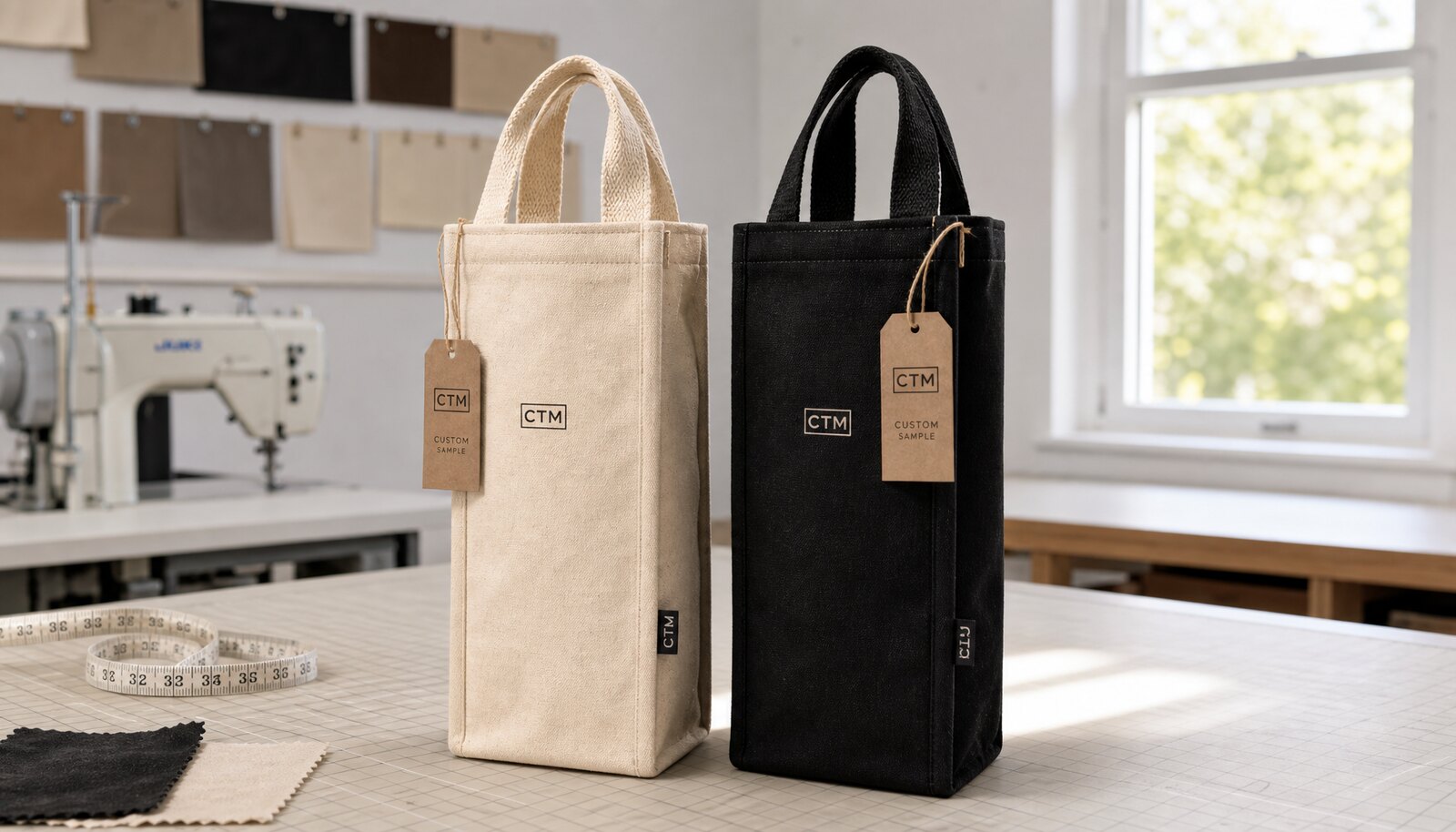
Work backward from the gift date
Canvas wine carriers for corporate gifting rarely have a flexible deadline. They are usually tied to a holiday mailing, executive client program, hotel welcome gift, wine club promotion, distributor event, or conference handout. That fixed date changes the sourcing conversation. A carrier that arrives after the kitting window may still be well made, but it has missed the business purpose of the order.
Start with the recipient delivery date, then work backward through domestic distribution, warehouse receiving, customs clearance, international freight, final inspection, packing, sewing, decoration, cutting, material booking, sampling, artwork proofing, and internal approval. This gives procurement more than a production estimate. It shows the latest safe dates for artwork approval, sample signoff, PO release, inspection booking, and freight handover.
Ask suppliers to break the schedule into stages. A quote that says 30-35 days production may exclude lab dips, sample courier time, buyer review days, print screen setup, carton printing, final inspection, document preparation, or forwarder pickup. Those excluded days are often where fixed-date gifting programs lose control.
The calendar should also shape the product brief. If the timeline is tight, keep the specification clean: stock canvas, one carrier size, one decoration method, one logo position, and a simple packout. With more time, custom dyed fabric, multiple market versions, closures, inserts, gift-ready folding, or special labeling can be considered. Lead time should guide the design before the RFQ goes out, not after the first sample is already late.
- Set the recipient delivery date, kitting date, and warehouse receiving date before approving the product brief.
- Ask for separate days for proofing, sampling, material booking, decoration, sewing, packing, inspection, and freight handover.
- Put buyer-side approval deadlines on the same calendar as supplier milestones.
- Treat every added color, logo version, closure, label, insert, and packout as a possible schedule change.
- Keep one written timeline that shows the latest safe PO date and latest safe artwork approval date.
Define the bottle before the bag
The carrier should be designed around the bottle, not around a generic bag size. Standard 750 ml wine bottles are not all the same, and champagne, sparkling wine, spirits, olive oil, and specialty beverage bottles can be wider, taller, heavier, or shaped differently. Maximum diameter, shoulder shape, base diameter, closure type, and filled weight affect finished width, base depth, handle placement, and seam stress.
The intended use matters just as much as the bottle profile. A carrier handed out at a reception needs quick loading and comfortable handles. A direct-to-recipient gift may need cleaner folding, individual protection, and a polished front panel. A carrier packed inside a rigid gift box may need a lower profile or no bottom insert. A reusable branded carrier should have stronger reinforcement than a one-time presentation sleeve.
Write the construction in plain, measurable terms. A flat single-bottle carrier is efficient and packs tightly, but it may not stand upright when loaded. A gusseted or box-base carrier improves stability and presentation, but it adds cutting accuracy and sewing operations. A bottom insert can improve shape, yet it adds a component, a packing instruction, and another inspection point. Two-bottle carriers should normally include a divider to reduce glass-on-glass movement.
When possible, send the supplier a physical bottle. If that is not practical, provide a dimensioned drawing and filled weight. Ask the supplier to confirm the fit with a comparable bottle and share loaded photos from the front, side, and top. Empty sample photos help with appearance, but they do not prove the carrier will hold the actual gift safely or neatly.
- Provide bottle height, maximum diameter, shoulder shape, base diameter, closure type, and filled weight.
- Specify whether the carrier must stand upright, fold flat, fit inside a gift box, or support repeat use.
- Confirm single-bottle, two-bottle, divider, insert, gusset, and open-top requirements before sample making.
- Approve the sample while loaded, lifted by the handles, and folded in the intended packout.
- Judge function against the actual gifting workflow, not only against a flat drawing.
Specify canvas in numbers
For procurement, phrases such as thick canvas, premium cotton, or heavy duty fabric leave too much room for interpretation. Replace them with measurable specifications. Canvas is commonly quoted by ounce weight or GSM. For many canvas wine carriers for corporate gifting, 10-12 oz cotton canvas is a practical baseline because it gives the bag enough body for a clean logo, folds reasonably well, and keeps carton volume under control.
Heavier canvas can be useful, but it changes production. A 12-16 oz fabric may feel more substantial and support a premium reusable position. It also adds bulk at hems, gussets, handle attachments, and side seams. Thick layers can slow sewing, require different needles or machines, and reduce the number of units per carton. If the design includes webbing handles, a bottom insert, and reinforced stitching, review those layer buildups during sampling.
Color route is one of the biggest lead-time choices. Stock natural, black, or standard dyed canvas is usually the fastest path. Custom dyed canvas may be right for strict brand programs, but it can require lab dips, shade approval, bulk dyeing, drying, sorting, and minimum fabric yardage. Even natural canvas is not identical from batch to batch. Seed specks, slubs, and yarn tone variation may be normal within limits, but the acceptable range should be anchored to a swatch or sealed sample.
Material planning should include every component. Webbing handles, thread, labels, drawcords, bottom inserts, snaps, cartons, and polybags can each delay an order if they are custom ordered or short in stock. Ask whether the supplier has enough material for the quoted quantity and version split. Many delays described as sewing delays are really waiting time for webbing, transfer film, labels, inserts, or printed cartons.
- Use 10-12 oz canvas for standard gifting when cost, foldability, printability, and schedule matter.
- Use 12-16 oz canvas when the premium feel justifies added cost, bulk, and sewing complexity.
- Confirm oz or GSM, fiber content, weave, shade reference, shrinkage expectation, and acceptable surface variation.
- Ask whether body fabric, webbing, thread, labels, inserts, and cartons are in stock in the required quantity.
- Keep approved swatches for incoming material inspection and later reorder matching.
Choose decoration by risk, not habit
The logo is the most visible brand element on most corporate wine carriers. It is also one of the easiest places to lose time. Screen printing is usually the most predictable choice for simple one-color or two-color artwork at volume. It works well on flat panels, supports clear placement rules, and is efficient once screens and approvals are complete.
More complex artwork deserves a slower look before the PO is locked. Gradients, fine lines, small legal text, metallic effects, large ink coverage, and multiple brand colors may need extra proofing or a different decoration method. Heat transfer can reproduce detail that screen printing cannot, but buyers should check hand feel, edge adhesion, cracking on folds, and appearance on textured canvas. Embroidery can feel premium for small marks or patches, while large embroidery may pucker the fabric or distort the panel.
A digital mockup is useful, but it is not approval enough for brand-sensitive programs. It cannot confirm ink coverage, fabric absorption, thread tension, transfer edges, or placement after sewing. The proof should show logo size, artwork orientation, color references, and placement measured from stable points such as the top hem, side seam, bottom edge, or center line. If panels are printed before sewing, placement tolerances must account for cutting and sewing variation.
Ask suppliers to state setup assumptions clearly. Screen charges, embroidery digitizing, transfer setup, color matching, artwork cleanup, and extra proof rounds may be separate. Also ask what happens if the logo size changes after approval. A small revision can mean new screens, new transfers, or another pre-production sample. For fixed delivery dates, simpler decoration often protects the schedule better than a complicated mark that needs repeated correction.
- Use one-color screen printing when the artwork is simple and the delivery date is firm.
- Use heat transfer for detailed artwork only after approving hand feel, edge adhesion, fold behavior, and rub performance.
- Use embroidery, woven labels, or patches for small premium branding, not large detailed artwork unless tested.
- Define logo size, position, color references, and placement tolerance in the RFQ and PO.
- Require a decorated pre-production sample for brand-sensitive programs or any new decoration setup.
Price MOQ by version
MOQ is not one number. A supplier may quote 3,000 pieces, but the order behaves very differently if those 3,000 pieces are split across six canvas colors, four logos, two packing methods, and three destinations. Each variable can create a separate material allocation, cutting batch, print setup, line changeover, packing instruction, carton label, and inspection sample.
Ask for MOQ and price breaks by variable. Confirm the minimum per fabric color, per logo version, per print method, per embroidery setup, per label, per packing format, and per shipping mark. A low total MOQ is not helpful if each version carries its own high setup cost or minimum. Sometimes a slightly higher unit price with simpler version rules is easier to execute and less risky for an event date.
One useful approach is to standardize the sewn carrier and customize a lower-risk element. For example, use one natural canvas base carrier with one front logo, then vary paper insert cards, hang tags, outer gift box labels, or regional sleeves. This keeps fabric cutting and sewing efficient while still allowing campaign segmentation. It also reduces the chance of mixed goods during packing.
Version control should be part of the packout plan, not a separate spreadsheet added at the end. If different departments, markets, languages, recipient tiers, or customer groups need separate versions, cartons need visible labels and packing lists must match those labels. Mixed cartons can turn a clean factory shipment into a sorting job at the kitting house.
- Ask for MOQ by fabric color, logo version, decoration setup, packing format, and destination.
- Standardize the carrier body before adding market, language, or recipient variations.
- Use inserts, hang tags, sleeves, or outer labels when versioning is needed but the date is tight.
- Require inner carton and master carton labels for each SKU, logo, market, or gift tier.
- Compare landed execution risk as well as unit price.
Use samples as working tests
Sampling should prove that the approved specification can be repeated in bulk. For canvas wine carriers, a digital proof alone is too thin. It cannot show fabric hand feel, bottle balance, seam stress, print texture, handle comfort, folding behavior, or carton presentation. Physical sampling is where procurement catches issues while they are still inexpensive to correct.
A practical sample path has four stages. First, a digital proof confirms artwork, scale, placement, and quoted assumptions. Second, a material swatch or blank sample confirms fabric, webbing, handle drop, base shape, and construction. Third, a decorated pre-production sample confirms the final logo method, color, placement, and workmanship. Fourth, a sealed reference sample is retained for the factory, buyer, and third-party inspector.
Review samples with a checklist, not just a camera. Load the bottle, lift the carrier several times, and check whether the handles feel balanced. Look for base sag, seam strain, twisted gussets, and uncomfortable handle drop. Fold the carrier as it will be packed and check whether the logo creases badly or transfers onto adjacent units. Measure finished dimensions and logo position against the agreed tolerance.
Internal review speed is part of lead-time control. If marketing, sales, procurement, legal, and the end client all need to approve the sample, collect comments in one window. Staggered feedback can create multiple revisions and restart the sample clock. For natural canvas, agree in advance which variations are acceptable and which defects require rejection.
- Approve a digital proof before making physical samples.
- Review fabric and construction before paying for a decorated pre-production sample when the design is new.
- Test the sample loaded, lifted, folded, and packed, not only photographed empty.
- Keep a sealed reference sample for fabric shade, dimensions, logo placement, stitch quality, and packing.
- Collect buyer-side comments in one round and separate critical defects from acceptable natural variation.
Lock packing early
Packing is part of the specification. Loose packing is often fastest and may be best when carriers go to a kitting house that will insert bottles and assemble the final gift. It can also create wrinkles or inconsistent presentation if the carrier is expected to look gift-ready when opened. Individual polybags protect cleanliness and simplify counting, but they add labor, materials, and sustainability considerations.
Tissue folding, hang tags, barcodes, belly bands, inner cartons, market labels, and retail-ready presentation all affect lead time. They also affect inspection because the inspector must verify the full packout, not only the carrier. If the buyer adds a barcode or market label after sewing is complete, the supplier may need to reopen cartons, relabel units, update packing lists, and schedule another check.
Carton data matters for landed cost. Heavier canvas, larger gussets, bottom inserts, and individual bags can reduce pieces per carton and increase CBM. Procurement should request estimated inner carton quantity, master carton quantity, carton dimensions, gross weight, net weight, and total volume before approving the quote. That makes supplier comparison more realistic than ex-factory unit price alone.
If the carriers feed into a fulfillment line, align the packout with that line. A kitting house may prefer a consistent fold direction, fixed carton counts, visible SKU labels, no mixed versions, and a carton order that matches the insertion workflow. Small packing decisions can save hours during bottle loading.
- State loose pack, fold method, polybag, tissue wrap, barcode, hang tag, bundle, inner carton, and master carton requirements.
- Confirm carton quantity, dimensions, gross weight, net weight, and estimated CBM before PO release.
- Align carton counts and labels with the kitting house or distribution center receiving process.
- Keep different logo versions, markets, and gift tiers in clearly labeled separate cartons.
- Do not change packing after bulk production without revising labor, inspection, carton data, and timeline.
Build a real production calendar
A useful calendar separates the work into controllable stages. The usual sequence is specification confirmation, artwork proofing, swatch or sample review, pre-production approval, material booking, decoration setup, cutting, printing or embroidery, sewing, trimming, packing, inspection, document preparation, and shipment handover. Each step needs an owner and a due date.
Material lead time should be separated from sewing capacity. A supplier may have sewing lines available and still be blocked by fabric dyeing, webbing delivery, printed labels, transfer film, bottom inserts, or cartons. Ask the supplier to identify the critical path item. If custom dyed fabric is the constraint, faster sewing later may not recover the lost days.
Production route also affects tolerance. Some carriers are printed on cut panels before sewing. Others are decorated after sewing, depending on logo placement, equipment, and construction. Panel printing can be efficient, but cutting and sewing must be accurate enough to keep logo placement consistent. Decorating finished goods can reduce placement risk for some designs, but it may be slower or harder around seams and handles.
Inspection and rework need space on the calendar. Loose threads, minor packing errors, carton label mistakes, and mixed versions may be correctable, but correction takes time. Avoid scheduling freight pickup immediately after the theoretical production finish date. Build in finished-goods inspection, a rework window, document preparation, and forwarder handover.
- Request the lead time after sample approval and the time required before sample approval.
- Identify the critical path component: fabric, dyeing, webbing, print setup, labels, inserts, cartons, or sewing capacity.
- Clarify whether decoration happens before or after sewing and how that affects placement tolerance.
- Book final inspection with enough notice and leave time for corrective action.
- Update the calendar immediately if artwork, quantity, version split, or packing changes.
Set QC rules before bulk starts
Quality control works best when acceptance rules are agreed before production. For canvas wine carriers, the inspection standard should reference the approved sample and written tolerances. Without measurable criteria, disputes become subjective: one side sees natural canvas variation, the other sees inconsistent quality. Define which issues are critical, major, and minor for the program.
Incoming material checks should cover fabric shade, fabric weight, surface defects, webbing color, thread, inserts, labels, and packing materials. Inline checks should verify cutting accuracy, print placement, stitch consistency, and handle reinforcement before the full order is completed. Final inspection should verify finished dimensions, decoration, loaded fit, workmanship, packing accuracy, carton marks, and version separation.
Tolerances need to be realistic for sewn goods. Finished dimensions can vary because fabric stretches, shrinks, and moves during sewing. Logo placement can vary when panels are printed before sewing or when natural canvas shifts under printing equipment. The goal is not impossible perfection. The goal is a professional range that protects fit, brand appearance, and packing consistency.
Handle strength deserves special attention. Wine bottles are heavy relative to the size of the carrier, and handle failure is a visible, high-impact defect. The approved construction should specify webbing width, attachment length, stitch pattern, bar-tack or box-stitch position, thread quality, and loaded check method. A carrier that looks clean on a table but strains during lifting should not pass for corporate gifting.
- Define critical, major, and minor defects before bulk production starts.
- Inspect incoming fabric, webbing, labels, inserts, and cartons before they enter production.
- Use inline inspection to catch print placement, stitch, and handle issues before the entire order is complete.
- Include a loaded bottle check in inspection for fit, balance, base shape, and seam stress.
- Verify packing count, carton labels, SKU separation, and shipping marks before shipment release.
Compare suppliers by control
Supplier choice should match the risk profile of the program. A direct factory or closely managed factory partner is often a good fit for custom canvas wine carriers because construction, decoration, packing, and rework can be coordinated under clearer ownership. That matters when the buyer needs milestone updates and a firm event date.
A trading company or sourcing agent can still be useful, especially when the order includes multiple product categories or consolidation is more important than direct factory control. The buyer should still ask for transparency. Who is printing? Who is sewing? Who approves the pre-production sample? Where does packing happen? Who fixes defects if inspection fails? Without these answers, order updates can sound active while a critical step has not started.
Stock carriers can be the right route for urgent gifting if the buyer accepts standard dimensions, standard colors, and limited decoration. The tradeoff is less control over fabric shade, structure, and exact bottle fit. Stock should still be checked for available quantity, bottle compatibility, print area, carton condition, and decoration capacity before the buyer makes a delivery promise.
When comparing quotes, score the supplier on more than unit price. Look at specification clarity, sample discipline, material confirmation, decoration capability, packing control, inspection access, rework process, and communication cadence. For event-driven corporate gifting, clearer accountability can reduce the chance of air freight, repacking, missed kitting slots, and internal escalation.
- Ask which steps are in-house and which are outsourced.
- Require milestone updates tied to material received, sample approved, printing started, sewing started, packing started, and inspection booked.
- Confirm who pays for and performs rework if defects are found.
- Use stock routes for urgent simple programs, but confirm actual inventory and decoration capacity.
- Compare quotes using the same specification, packing method, inspection expectation, and delivery term.
Specification comparison for buyers
| Planning decision | Practical B2B specification | Typical lead-time impact | QC or buying risk to control |
|---|---|---|---|
| Fabric weight | 10-12 oz cotton canvas for standard gifting; 12-16 oz when a firmer, more premium carrier is worth the extra bulk | Stock 10-12 oz fabric is usually faster. Heavier fabric, custom weave, or custom dye can add sourcing, cutting, sewing, and packing time | Do not approve vague terms such as heavy canvas. Confirm oz or GSM, fiber content, shade range, shrinkage expectation, surface variation, and an approved swatch or sealed sample. |
| Bottle fit | Build the finished size around the actual bottle height, maximum diameter, shoulder shape, base diameter, closure type, and filled weight | Fit should be confirmed before sampling. Missing bottle data often causes sample revisions and late dimension changes | A carrier that looks fine empty may sag, tilt, or strain when loaded. Require a loaded fit check using the intended bottle or a close dimensional equivalent. |
| Color route | Use stock natural, black, or standard dyed canvas for tight schedules; use custom dye only when there is time for lab dips and shade approval | Custom dye can add lab dip review, bulk dyeing, drying, shade sorting, and minimum fabric yardage constraints | Natural canvas varies by batch. Set acceptable variation with a sealed swatch instead of relying on verbal promises of exact color. |
| Logo method | Use one-color screen print for simple volume programs; heat transfer for detailed artwork; embroidery, woven label, or patch for smaller premium marks | Screen printing is usually efficient after approval. Transfers and embroidery often need extra proofing, testing, or digitizing | Check print size, registration, color match on the chosen canvas, logo skew, rub resistance, transfer edge adhesion, embroidery puckering, and label alignment. |
| Construction | Single-bottle open-top carrier with reinforced webbing handles, gusset or flat base, and optional bottom insert | Open-top designs move fastest. Inserts, dividers, flaps, drawcords, snaps, and trims add operations and inspection points | Handle attachment and base strength are common failure points. Define stitch type, reinforcement points, seam allowance, and loaded pull expectations. |
| MOQ structure | Price and MOQ by fabric color, logo version, packing format, carton label, and shipment destination, not only by total order quantity | Multiple versions create print setup changes, packing separation, carton labels, inspection samples, and sorting time | A low headline MOQ can become inefficient if every color, logo, or packout has its own minimum, setup fee, and production stream. |
| Sample path | Digital proof, material swatch or blank sample, decorated pre-production sample, packing mockup if needed, and sealed reference sample | Sampling time depends on artwork completeness, material availability, supplier workload, courier time, and buyer response speed | Approvals should cover fabric, dimensions, loaded fit, print placement, stitching, folding, packing, and version labels. |
| Packing format | Loose pack for kitting efficiency; individual polybag, tissue fold, barcode, hang tag, bundle, or inner carton when required | Special packing adds labor, materials, carton changes, packing instructions, and inspection steps | Changing packing after production often causes rework. Confirm carton count, labels, gross weight, SKU separation, and pack order before bulk packing. |
| Inspection plan | Use incoming material checks, inline checks, and final inspection against the approved sample and written tolerances | Inspection must be scheduled before freight pickup, with time reserved for sorting, repair, repacking, or replacement | Check fabric defects, dimensions, print placement, stitch quality, handle strength, packing count, carton marks, and version separation. |
Buyer checklist before sampling
- Confirm the exact bottle profile before requesting a final quote: volume, height, maximum diameter, shoulder shape, base diameter, closure type, and filled weight.
- Decide whether the carrier is a protective transport bag, the final branded gift presentation, a reusable item, a bottle sleeve inside a rigid gift box, or a component in a larger kit.
- Lock the base specification: finished width, height, gusset or base depth, fabric weight, canvas color, handle material, handle width, handle drop, reinforcement method, closure style, insert, divider, label, and logo area.
- Provide print-ready vector artwork with Pantone or brand color references, target logo size, number of colors, print position measured from fixed edges, and acceptable placement tolerance.
- Ask for lead time by stage: proofing, sampling, buyer approval, material booking, decoration setup, cutting, printing or embroidery, sewing, trimming, packing, inspection, document preparation, and shipment handover.
- Request MOQ and price breaks by total quantity, fabric color, logo version, decoration method, packing format, carton label, and shipment destination.
- Confirm whether canvas, webbing, thread, labels, inserts, closures, cartons, polybags, and printed packing materials are stock, custom ordered, or produced after PO approval.
- Specify the final packout before bulk starts: loose packed, folded, individually polybagged, tissue wrapped, barcoded, bundled by market, packed by inner carton, inserted into gift boxes, or sorted by recipient tier.
- Set measurable acceptance criteria for fabric shade, fabric weight tolerance, finished dimensions, seam allowance, stitch quality, handle reinforcement, print alignment, rub resistance, packing count, and carton labeling.
- Approve a loaded sample using the intended bottle or a dimensional equivalent, and confirm that the base does not collapse, seams do not strain, and handles remain balanced.
Factory quote questions to send
- What is your MOQ and price break by total order quantity, fabric color, logo version, decoration method, packing format, carton label, and shipment destination?
- Is the quoted canvas stock fabric, greige fabric to be dyed, or custom dyed fabric? What oz or GSM rating, construction, shrinkage expectation, and shade tolerance are included?
- What finished dimensions are quoted, including width, height, gusset or base depth, handle width, handle drop, seam allowance, and bottom insert or divider dimensions if applicable?
- What bottle size did you assume for fit, and can you test the sample with a bottle matching our height, maximum diameter, shoulder shape, and filled weight?
- Which logo method will you use for this artwork, and what setup charges, screens, transfer costs, digitizing fees, artwork revisions, or color matching charges are included or excluded?
- What sample path do you recommend: digital proof, fabric swatch, blank sample, decorated pre-production sample, packing mockup, and sealed reference sample? How many calendar days are required for each stage?
- Which production steps are in-house and which are outsourced, including fabric dyeing, cutting, screen printing, heat transfer, embroidery, sewing, trimming, packing, carton labeling, and rework?
- What lead time do you need for material booking, decoration setup, cutting, printing, sewing, trimming, packing, final inspection, document preparation, and shipment handover after sample approval?
- What QC tolerances do you use for fabric defects, shade variation, fabric weight, finished dimensions, logo position, print registration, stitch defects, handle strength, and packing accuracy?
- Can we inspect at incoming material, inline production, finished goods before packing, and final packed cartons before shipment? How much notice is required to book inspection?
Quality-control points to confirm
- Fabric weight should match the agreed oz or GSM specification within the supplier-approved tolerance, with no holes, weak opacity, severe slubs, oil marks, mildew odor, water stains, or contamination that affects presentation or printing.
- Fabric color should be checked against the approved swatch or sealed reference sample under consistent light. Natural canvas may show normal yarn variation, but obvious batch mismatch, panel-to-panel shade difference, or unacceptable staining should be rejected or sorted.
- Finished dimensions should be measured on a representative sample set, including width, height, gusset or base depth, handle drop, compartment width, bottom insert fit, and folded size for carton packing.
- Bottle fit should be checked loaded with the intended bottle or dimensional equivalent. The bottle should sit securely, the base should not sag excessively, and seams should not show visible stress after repeated lifting.
- Logo placement should remain within the agreed tolerance from top edge, side seam, center line, or bottom reference. Crooked prints, off-center embroidery, inconsistent label placement, or visible skew should be sorted against the approved standard.
- Print quality should be inspected for color consistency, edge definition, registration, pinholes, smudging, ink buildup, cracking on folds, poor coverage over textured canvas, transfer edge lifting, and rub resistance after normal handling.
- Embroidery or patch decoration should be checked for thread color, stitch density, puckering, backing residue, loose threads, patch alignment, and distortion of the canvas panel.
- Handle construction should match the approved sample, including webbing width, handle drop, attachment length, box-stitch, cross-stitch, or bar-tack position. There should be no skipped stitches, broken threads, open seams, or weak reinforcement at load points.
- Seam quality should be consistent across body, side seam, base, gusset, top hem, and closures. Puckered corners, twisted seams, uneven seam allowance, wavy top edges, and base distortion should be rejected when they affect appearance or function.
- Components such as bottom inserts, dividers, drawcords, snaps, labels, hang tags, and trims should match approved materials and placement, with no sharp edges, loose glue, missing parts, color mismatch, or functional interference with bottle insertion.