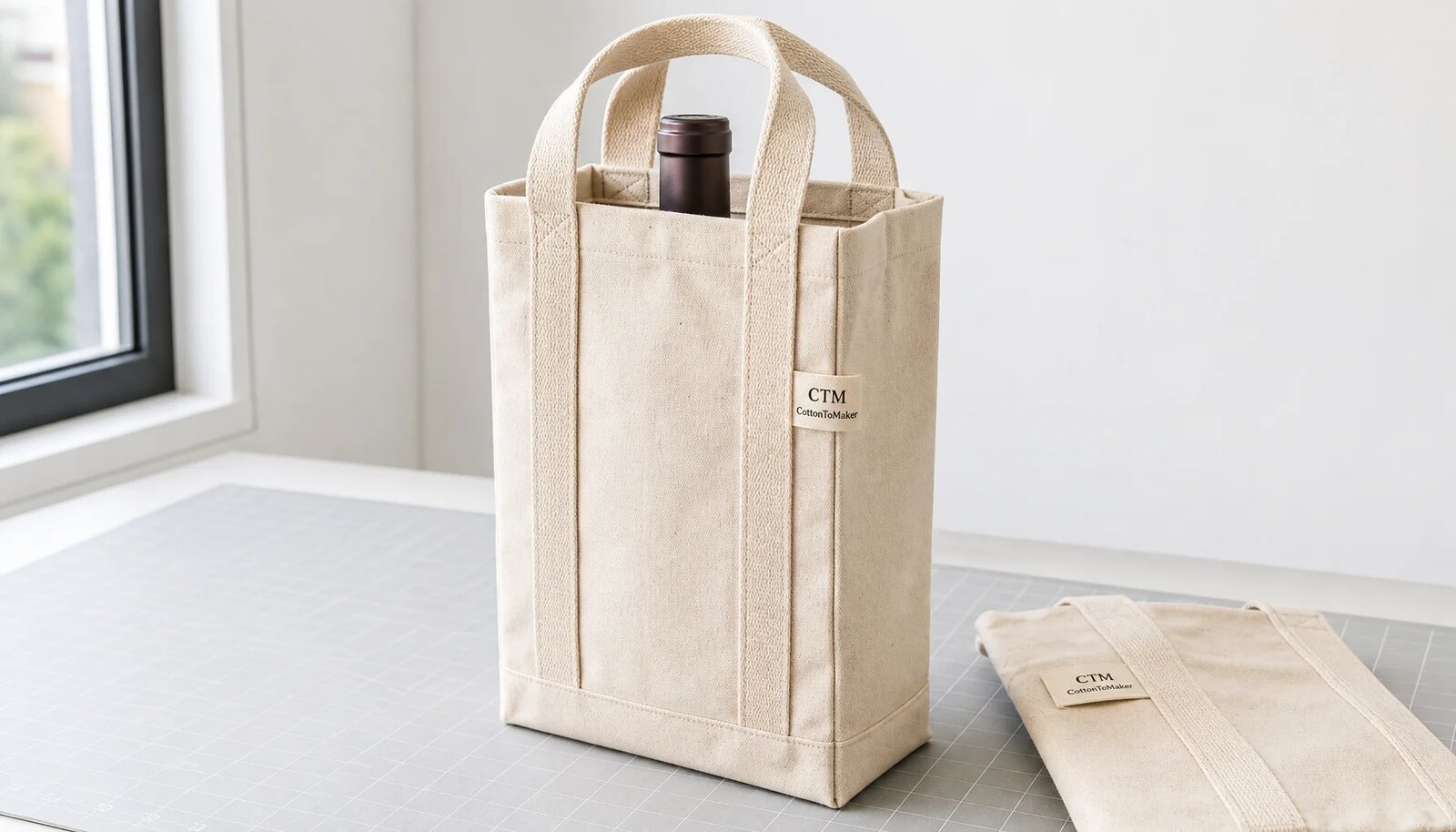
Durability Starts With the Spec
A canvas wine carrier for corporate gifting is more than a decorative bottle bag. It is a branded package that must carry dense weight, protect the bottle presentation, survive packing, and still look intentional when handed to a client, guest, employee, or event attendee. Many failures are not visible in a product photo: thin canvas, narrow seam allowance, weak handle anchors, rough interior threads, loose base inserts, or ink that marks the opposite panel inside the carton.
The most useful buying document is a short durability checklist attached to the RFQ. It should define the bottle, canvas, construction, logo method, packing, sample approval, and inspection rules before suppliers quote. This keeps price comparisons honest. A carrier made from a lighter canvas with simple straight-stitched handles and no base insert is not the same product as a reinforced boxed-bottom carrier with controlled logo placement and final AQL inspection.
- Treat the carrier as a load-bearing gift package, not only a printed promotional item.
- Tie every quote to the same bottle data, construction details, decoration method, and packing plan.
- Keep the approved sample, artwork proof, measurement sheet, and carton plan together for production control.
Begin With Bottle Data
The carrier should be engineered around the bottle first. A Bordeaux bottle, Burgundy bottle, champagne bottle, and spirits bottle can differ in height, shoulder shape, widest diameter, base diameter, and filled weight. A bag that fits an empty showroom bottle may scrape a real label, strain a side seam, or lean once a heavier filled bottle is loaded.
Send dimensions in millimeters and weight in grams. Include the full bottle height, widest body diameter, base diameter, approximate filled weight, and any tissue, sleeve, neck card, tasting note, opener, or gift insert that travels with the bottle. Flag delicate paper labels, foil, wax seals, embossed surfaces, and high-gloss finishes so the factory understands that interior seams and insert edges must not rub aggressively.
- Provide bottle height, widest diameter, base diameter, and filled weight with the RFQ.
- Share a real bottle or weighted dummy for sample testing when possible.
- State whether the carrier must stand upright during staging, display, warehouse assembly, or reception handoff.
- For two-bottle styles, define bottle spacing and divider performance instead of only adding width.
Specify Canvas Carefully
Canvas weight is useful, but it must be written clearly. Buyers often describe canvas by ounce class, while mills and factories may purchase by gsm. The relationship is not universal because different markets use different measurement conventions, finishes, and fabric constructions. Instead of treating 12 oz, 14 oz, or 16 oz as fixed gsm values, ask the supplier to state the actual gsm target and tolerance for the fabric being quoted.
As a practical sourcing guide, a 12 oz class canvas may work for budget one-bottle programs after fit and load testing. A 14 to 16 oz class canvas often gives better body for mid-to-premium gifts and reuse-oriented programs. Heavier is not automatically better. It can increase sewing bulk, create hard fold marks, raise freight cost, or make decoration less consistent on thick seams and textured surfaces.
- List both the oz class and the supplier's actual gsm target with tolerance.
- Confirm fiber composition: cotton, recycled cotton, organic cotton, cotton blend, or another material.
- Approve shade, hand feel, weave, odor, shrinkage behavior, and visible slub level before cutting.
- Require production fabric to match the approved sample or approved swatch within written limits.
Engineer Stress Points
Durability usually fails in predictable places: handle anchors, side seams, top hems, base corners, divider attachment, and insert edges. These details should be defined before sampling because late reinforcement changes can affect price, appearance, sewing time, and finished dimensions.
Handles need particular control because wine bottles are compact and heavy. Specify handle material, width, drop, anchor height, stitch pattern, thread, and reinforcement. Cotton webbing can give consistent strength and comfort; self-fabric handles can look more integrated but may become bulky in heavier canvas. Boxed-X stitching or bartacks are usually stronger than a single straight stitch, but the approved method should be verified on the loaded sample.
- Define handle width, handle drop, stitch type, thread, and anchor reinforcement.
- Specify seam allowance, top hem construction, divider attachment, and interior seam finishing.
- Check for skipped stitches, broken threads, loose ends, anchor distortion, and panel pulling after load testing.
- Measure finished handle drop after sewing, not only the cut length of the handle tape.
Control the Base and Divider
A wine carrier that cannot stand cleanly can feel cheap even if the canvas is good. Base construction determines whether the bottle sits upright during staging, photography, event distribution, or office delivery. Common insert options include cardboard, greyboard, PP sheet, and other stiffeners. The spec should identify material, thickness, attachment method, corner treatment, and moisture sensitivity.
Two-bottle carriers require more than a wider body. The divider must reduce bottle-to-bottle contact, the base must resist twisting, and the handle anchors must carry the higher combined load. Ask the supplier which filled weight they used for the divider and base design, then test the sample by loading, lifting, turning, setting down, and unpacking it several times.
- State whether the base is boxed, gusseted, flat, reinforced, or supported by a loose or secured insert.
- Define insert material, thickness, edge treatment, and whether it is loose, glued, wrapped, stitched, or trapped.
- Require divider material, attachment points, and seam finishing for two-bottle designs.
- Reject sharp insert corners, exposed rough edges, or shifting inserts that make the bottle lean.
Choose Branding for Handling
Decoration should be selected for the full handling route, not only for artwork appearance. Screen print is practical for many corporate logos on a flat canvas panel, but it should be placed away from hard folds, top hems, handle anchors, side seams, and base creases unless that position has been tested. Heat transfer can hold fine detail but may feel too plastic, lift, or crack on some canvas finishes.
Embroidery can look premium for smaller logos, yet backing, thread density, and panel distortion must be checked. A woven side label is often durable for subtle branding and repeat gift programs because it avoids a large ink field. For strict brand color, approve a strike-off or decorated sample on production fabric; a digital proof alone will not show how natural canvas changes color perception.
- Set logo size and placement in millimeters from top edge, side seam, and base.
- Define logo placement tolerance for final inspection.
- Test decorated samples for dry rub, light abrasion, fold recovery, tape-pull if agreed, and packing transfer.
- Check the interior behind embroidery or labels for rough backing that could touch the bottle.
Make the Sample Earn Approval
A pre-production sample is the first serious QC event. It should use production-level fabric, final handle material, final insert, final divider if any, final decoration, and the proposed folding and carton method. A showroom sample can help with direction, but it does not prove the bulk order will carry the bottle, protect the logo, or recover after packing.
Sample testing should be simple and repeatable. Insert and remove the real bottle several times. Lift the loaded carrier, hold it by the handles, walk a short distance, set it down, and check whether it stands upright. Run fingers along interior seams and insert edges. Fold it the way the factory plans to pack it, place it under similar carton pressure, then reopen it and inspect the logo, handles, base, and shape.
- Use the real bottle or a weighted dummy matching both filled weight and diameter.
- Record finished dimensions, handle drop, logo placement, stitch details, insert details, and packing photos.
- Keep one approved control sample sealed or clearly tagged for final inspection comparison.
- Do not approve bulk production from substitute fabric, temporary handles, or undecorated samples when decoration durability matters.
Define Inspection Rules
Inspection language must be measurable. Words such as strong, neat, heavy, and premium are useful for conversation but weak for final acceptance. The QC sheet should say what will be measured, what test will be run, which sample units will be checked, and what defects are critical, major, or minor.
For many bulk orders, General Inspection Level II with AQL Critical 0, Major 2.5, and Minor 4.0 is a common starting point, though buyers can set stricter limits for premium or event-critical gifts. Destructive or stress checks may use a smaller special inspection level such as S-2 or S-3, depending on order size and risk. The important point is to agree this before production, not after problems appear.
- Critical defects: handle detachment under agreed load, unsafe sharp insert exposure, serious contamination, or unusable structure.
- Major defects: wrong fabric, failed bottle fit, failed load test, seam opening, unstable base, wrong logo, severe shade mismatch, or print transfer.
- Minor defects: loose threads, light lint, slight sewing waviness, or natural canvas variation within the approved standard.
- Measure fabric weight, finished dimensions, handle drop, logo placement, divider position, cleanliness, odor, carton condition, and labeling.
Use Buyer-Defined Durability Tests
A practical static load check is useful, but it should be framed correctly. A one-bottle carrier may be tested at 5 kg for 10 minutes as an internal buyer acceptance screen when the real bottle is lighter and the requirement is written into the spec. That figure is not an industry standard. Two-bottle carriers, champagne bottles, and spirits bottles should use a higher agreed load based on real filled weight plus handling margin.
Add a short carry simulation, base stability check, print rub check, fold recovery check, and packed-carton review. The aim is not to create a laboratory program for every order; it is to catch common failures before cartons ship. If a customer, retailer, or regulated program requires formal laboratory testing, write that requirement separately and confirm the method, sample quantity, and pass criteria.
- Load test should show no handle anchor creep, seam opening, thread breakage, or base deformation.
- Bottle fit should allow smooth insertion and removal without scraping labels or forcing seams.
- Base stability should keep the loaded carrier upright within the buyer's approved visual limit.
- Decoration should not crack, lift, transfer, or show unacceptable ink loss after handling and packing checks.
Quote Packing and Lead Time Together
Packing can damage an otherwise good carrier. Tight flat packing may crush handles, press folds across the logo, bow base inserts, or transfer ink between panels. Individual sleeves, paper protection, carton dividers, or shaped packing can improve presentation but affect unit cost, carton count, freight volume, sustainability goals, and warehouse handling.
Quote requests should include packing format, units per carton, carton dimensions, gross weight, label format, and destination split. Lead time should be mapped by milestone: artwork proof, material booking, pre-production sample, sample approval, bulk cutting, decoration, sewing, in-line QC, final inspection, packing, and shipment. For holiday and event gifting, this schedule discipline matters as much as the unit price.
- Approve folding method, inner protection, master carton size, carton strength, and carton label content.
- Protect decorated panels from rubbing against each other during storage and transit.
- Avoid long-term handle compression that leaves permanent bends before gifting.
- Ask for MOQ by fabric color, logo version, print colors, insert type, packaging format, and destination split.
- Keep pattern files, approved samples, artwork placement, inspection records, and carton photos for repeat orders.
Specification comparison for buyers
| Option to compare | Best fit | What to specify | Main durability risk |
|---|---|---|---|
| Stock blank plus local decoration | Small rush orders, low customization, simple one-color logos | Confirm blank dimensions, canvas weight, handle width, base structure, decoration area, and packed condition before decorating | Blank may be designed for light promotional use rather than repeated bottle-load handling |
| Direct factory custom carrier | Corporate gifting programs needing repeatable bottle fit, logo position, packing, and inspection control | Issue one spec covering bottle data, fabric, insert, handles, artwork, packing, AQL level, and sample approval | Bulk production may drift from sample if the control sample and inspection criteria are weak |
| Trading company with named factory | Bundled gift sets, mixed packaging items, or early supplier screening | Ask for factory identity, production photos, fabric source, sample timing, inspection support, and carton details | Quote may hide material substitutions or construction assumptions unless the technical sheet is signed off |
| 12 oz class canvas | Budget one-bottle carriers and light handoff use after testing | State the supplier's actual gsm target and tolerance because oz-to-gsm conventions vary | Panels can sag, logo areas can wrinkle, and base shape can distort under load |
| 14-16 oz class canvas | Mid-to-premium gifts, better standing shape, reuse expectation, heavier bottles | Approve finished samples in the exact canvas, not swatches only; verify sewing bulk and fold recovery | Heavier cloth can create bulky seams, pressure marks, higher freight, or decoration challenges |
| Boxed bottom with insert | Reception staging, warehouse assembly, upright display, premium presentation | Define insert material, thickness, corner treatment, attachment method, and moisture sensitivity | Loose or sharp inserts can shift, deform the base, wear through canvas, or mark bottles |
| Cotton webbing handles | Repeat lifting, event staff handling, two-bottle formats, heavier bottle shapes | Specify handle width, drop, boxed-X or bartack reinforcement, thread, stitch density, and anchor placement | Weak anchors can creep, tear, or show skipped stitches only after loaded testing |
| Screen print on flat panel | Clean corporate logos at scale, controlled unit cost, simple color artwork | Set print size, Pantone reference, placement tolerance, curing requirement, and rub/fold checks | Ink can crack, transfer, or abrade if placed over hard folds or under carton pressure |
| Woven label or embroidery | Subtle branding, premium look, repeat programs, smaller marks | Define label size, stitch position, embroidery backing, interior feel, and placement tolerance | Backing, thread density, or label edges can rub bottle finishes if not checked inside the carrier |
Buyer checklist before sampling
- Identify the exact bottle or bottle family: Bordeaux, Burgundy, sparkling wine, champagne, spirits, mini bottle set, or bottle plus accessory kit.
- Record bottle height, widest body diameter, base diameter, filled weight, and any label, foil, wax, sleeve, or wrap that could be scratched.
- Set finished internal dimensions in millimeters: usable height, opening width, base depth, divider width, and clearance for easy insertion.
- Specify whether the carrier is for one bottle, two bottles, or a bottle plus opener, card, tasting note, tissue, sleeve, or other gift item.
- Request canvas by supplier-stated gsm target, oz class, fiber composition, finish, color standard, and acceptable production tolerance.
- Define stress-point construction: seam type, seam allowance, top hem, handle material, handle width, handle drop, handle anchor reinforcement, base insert, and divider method.
- Choose the decoration method before sampling so artwork placement, fold lines, seams, pressure points, and packing can be tested together.
- Approve a pre-production sample made with production-level fabric, final handles, final insert, final divider, final decoration, and proposed carton packing.
- Run fit, lift, static load, short carry, base stability, print rub, fold recovery, and packed-carton checks on the same decorated sample.
- Ask for MOQ by fabric color, dyed lot, logo version, print color count, packaging format, and destination split instead of accepting one blended figure.
Factory quote questions to send
- What actual gsm target, oz class, and fabric weight tolerance are included in the quote, and how will incoming fabric be checked?
- Is the canvas 100 percent cotton, recycled cotton, organic cotton, cotton blend, or another composition, and what documentation can be provided if required?
- What shade, shrinkage, odor, finish, and dye-lot controls apply before cutting, especially for natural, dyed, washed, or recycled canvas?
- Which bottle dimensions and filled weight did you use to set carrier size, handle reinforcement, base depth, insert strength, and carton packing?
- Are you quoting a one-bottle carrier, two-bottle carrier, or bottle-and-accessory set, and are dividers, sleeves, pockets, or cards included?
- What are the finished dimensions and tolerances for height, width, base depth, opening clearance, handle drop, logo placement, and divider position?
- What reinforcement is used at the handle anchors, side seams, top hem, base corners, and divider, and can you show close-up sample photos?
- What insert material and thickness are included, and is the insert loose, glued, wrapped, stitched, trapped in the seam, or removable?
- What stitch type, thread type, stitch density, and reinforcement method are used at loaded stress points?
- Which decoration method is quoted, how many colors are included, what is the maximum print area, and where will artwork sit relative to folds, handles, seams, and base creases?
Quality-control points to confirm
- Use General Inspection Level II as a common starting point for final random inspection; consider Special Inspection Level S-2 or S-3 for destructive load checks when the order size makes full functional testing impractical.
- Set AQL expectations in writing, such as Critical 0, Major 2.5, Minor 4.0, or the buyer's own stricter standard for premium gift programs.
- Classify critical defects as safety or unusable-product risks, including handle detachment under agreed load, broken glass risk from exposed sharp insert material, serious contamination, or wrong product structure.
- Classify major defects as failures that affect function or brand presentation, including wrong fabric, wrong logo, failed load test, seam opening, unstable base, incorrect bottle fit, severe shade mismatch, or print transfer.
- Classify minor defects as issues within usable limits, such as small loose threads, slight sewing waviness, minor lint, or acceptable natural canvas variation within the approved standard.
- Control fabric weight against the supplier-stated gsm target and agreed tolerance; avoid relying on a universal oz-to-gsm conversion because market conventions vary.
- Measure finished height, width, base depth, opening clearance, handle drop, divider position, and logo placement against signed tolerances.
- Use the agreed static load check as an internal buyer acceptance test, not an industry standard; for one-bottle styles, 5 kg for 10 minutes is a practical screen when documented and approved.
- Test two-bottle or heavier bottle designs at a higher buyer-defined load based on actual filled weight plus handling margin.
- Inspect packed goods for fold recovery, handle compression, print transfer, dust, odor, carton labeling, carton strength, and base distortion after unpacking.