Why coffee roasters need a procurement-grade RFQ
Coffee roasters usually buy canvas wine carriers as part of a broader retail or gifting program, not as a generic bottle sleeve. The carrier may support a holiday wine collaboration, a tasting-room add-on, a coffee club welcome gift, a wholesale partner bundle, or a seasonal promotion with coffee pouches, syrup, cards, and accessories. Those programs have more moving parts than a standard bottle-bag order. Bottle fit, brand presentation, packing, retail shelf behavior, and receiving requirements all affect whether the order works.
The sourcing risk is that many suppliers can quote the phrase "canvas wine carrier" while pricing very different products. One quote may be an 8 oz cotton sleeve with self-fabric handles and no reinforced base. Another may be a 12 oz canvas carrier with 25 mm cotton webbing, X-box handle stitching, a boxed base, and an anchored divider. Both may look similar in a short email, but they are not equivalent in use, cost, or failure risk.
A stronger RFQ makes the factory quote the actual construction, not the product name. It should tell the supplier what the carrier must hold, how it will be handled, how it will be branded, how it will be packed, and how it will be inspected. For B2B procurement, the goal is not the lowest first unit price. The goal is a comparable quote that protects launch timing, product fit, brand appearance, and landed cost.
- Define the load case before asking for price.
- Compare suppliers on the same fabric, handle, divider, print, and packing assumptions.
- Use measurable tolerances instead of subjective terms like "premium" or "strong."
- Treat sampling, QC, and carton packing as part of the commercial quote.
Start with bottle geometry and payload weight
A 750 ml wine bottle is not a complete specification. Many still-wine bottles are roughly 295-330 mm tall and 70-80 mm in body diameter, while sparkling bottles and some premium glass formats can reach about 85-95 mm diameter and carry more weight. Olive oil bottles, spirits bottles, and collaboration bottles can vary again. If the carrier is meant to work across multiple bottle SKUs, the RFQ should list the narrowest, widest, shortest, and tallest bottle. The factory can then design the gusset, opening, divider, and handle balance around the real range.
Filled weight also matters. A 750 ml glass bottle commonly weighs around 1.1-1.7 kg depending on glass weight and contents. Two bottles can push the working load above 3 kg before any coffee pouch, jar, mug, or insert is added. The carrier is lifted by the handles, not carried as a static display object, so dynamic stress at the handle roots can be higher than the tabletop weight suggests. For procurement purposes, ask the factory what load they assumed and require a simple handle test using the approved contents.
The RFQ should also specify whether the bag is expected to stand upright when loaded. A narrow single-bottle sleeve can look clean in a photo but tip on a retail shelf if the base is too soft or the gusset is not proportioned to the bottle. For a gift display, a boxed base or full gusset is often more practical than a flat envelope construction. If coffee pouches share the bag, list pouch dimensions and net weight because the pouch can press against the bottle and distort the front print panel.
- List bottle height, body diameter, base diameter, shoulder shape, and filled weight.
- Use the widest and tallest bottle as the fit standard when one bag must cover multiple SKUs.
- State whether extra items such as coffee, syrup, cards, or mugs go inside the same carrier.
- Ask the factory to confirm the load assumed in the quote and sample test.
Define the selling channel before the construction
Retail carry-out, wholesale gifting, and parcel shipment need different constructions. A tasting-room or coffee shop counter handoff can use an open-top canvas carrier with clean branding, webbing handles, and a soft divider. The bag mainly needs to look good, carry safely for a short trip, and pack efficiently at the store. In that channel, overbuilding the carrier can waste budget and freight allowance.
Direct-to-consumer parcel shipment is different. A canvas wine carrier is usually presentation packaging, not the protective shipper. It does not replace molded pulp, EPE, corrugated retention, suspension packaging, or another tested outer-pack system. If the roaster wants the customer to receive the bottle inside the canvas bag, specify that the canvas bag will be packed inside a tested shipper and that the combined pack must be sampled. Do not ask the canvas bag to solve impact protection by itself unless you plan to test the full pack accordingly.
Distributor and retail DC programs add receiving requirements. Carton marks, SKU separation, barcode labels, carton weight, and inner pack counts can matter as much as the bag construction. If a retail partner requires cartons under a specific gross weight, store-ready inner packs, or no mixed SKUs, include that in the RFQ. Adding those requirements after the factory has priced bulk production can create avoidable labor charges and schedule pressure.
- Retail carry-out favors appearance, handle comfort, and quick packing.
- DTC parcel use requires a separate tested protective shipper.
- Distributor programs need carton marks, SKU separation, and predictable counts.
- The channel determines whether the carrier is presentation, carry packaging, or part of a tested shipper.
Choose canvas weight and fabric finish deliberately
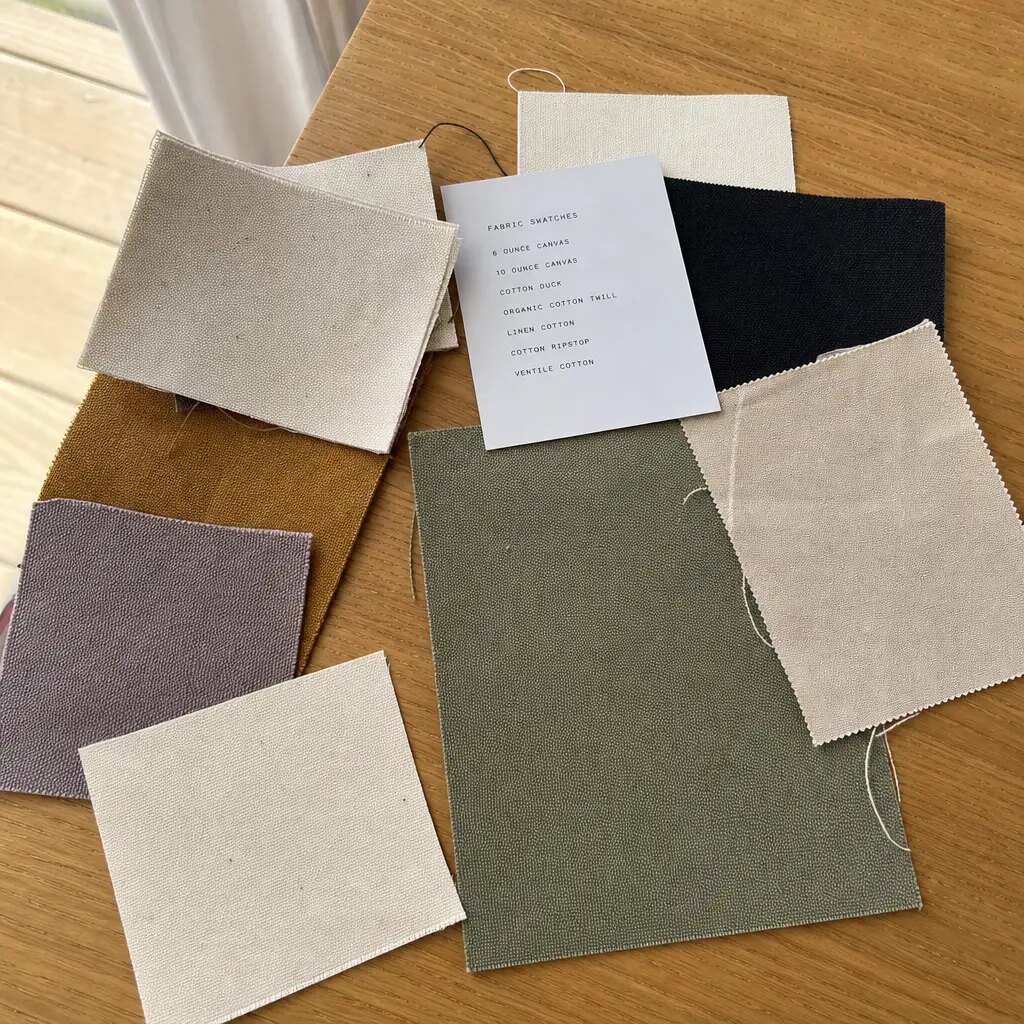
For most single-bottle canvas wine carriers for coffee roasters, 10 oz to 12 oz cotton canvas, about 280-340 GSM, is a practical starting range. It provides enough body for branding and retail presentation without becoming unnecessarily stiff or heavy. Lighter 6 oz to 8 oz canvas may be acceptable for very low-load promotional sleeves, but it can wrinkle, collapse, and look less structured around a glass bottle. Heavier 14 oz to 16 oz canvas can be useful for two-bottle carriers or premium reusable bags, but it increases fabric cost, sewing resistance, carton weight, and freight impact.
The buyer should avoid treating GSM as the only strength indicator. Durability comes from the whole construction: fabric, handle webbing, seam allowance, stitch density, thread, base shape, and reinforcement. A 16 oz body with weak handle tabs can fail sooner than a 12 oz body with proper webbing and X-box stitching. Ask the supplier to quote the fabric weight and the reinforcement method together so the quote reflects actual performance.
Fabric finish affects both appearance and production risk. Natural canvas is common, cost-effective, and usually faster because it may be available as stock fabric, but it can show cotton seed specks, slubs, and shade variation. Bleached or dyed canvas can give a cleaner branded look, but it may require lab dips, shade approval, and higher minimum yardage. Black canvas can look polished with the right print, yet it shows lint and may need stronger ink opacity. If brand color is important, approve the bulk fabric swatch or PP sample rather than relying on a digital image.
- Use 10-12 oz canvas for most single-bottle retail programs.
- Use 12-16 oz canvas when two bottles, heavier contents, or stronger structure are required.
- Specify whether natural cotton specks and minor slubs are acceptable.
- Ask whether custom dyeing changes MOQ, lead time, shade tolerance, and repeat-order consistency.
Lock the construction details that drive failures
Handle construction is one of the most important details in the RFQ. For bottle carriers, 25-30 mm cotton webbing handles are usually more dependable than self-fabric handles, especially when the bag will be lifted repeatedly by staff and consumers. The RFQ should state handle width, handle drop, attachment length, thread color, and stitch pattern. A practical handle drop for comfortable hand carry is often around 250-300 mm, but shorter drops may be acceptable for compact gift packaging. If the handle must fit over a wrist or forearm, test it with the actual loaded bag.
Reinforcement should be visible in the spec, not assumed. X-box stitching or bar-tacking at each handle root helps distribute stress. Ask the supplier to confirm the reinforcement pattern and stitch quality, then check it during sampling and inspection. It is reasonable to request load testing at 2 times the intended filled load for retail carry and higher where the use case justifies it. For a two-bottle carrier, the test should be run with both bottles or equivalent weight in place.
Divider construction is another common weak point. A two-bottle carrier should have a divider that reaches the bottom and is anchored into the base seam or otherwise fixed so bottles cannot swing into each other. A loose hanging divider may look acceptable in photos but fail in real handling. Base construction also matters. A boxed base or full gusset improves standing behavior and bottle stability, while a flat sleeve is cheaper but less stable. Define the base, divider, and handle together because they function as one load system.
- Specify handle width, handle drop, attachment length, and reinforcement pattern.
- Require X-box stitching, bar-tack reinforcement, or an approved equivalent at stress points.
- For two-bottle bags, require the divider to be anchored at the base.
- Check base construction with real loaded bottles, not an empty sample.
Make branding and print production-ready
Most coffee roaster branding works well with screen printing, especially when the logo is one to three solid colors. Screen print is usually practical for cotton canvas because it can provide good opacity and durability when the ink is matched to the fabric and cured correctly. The RFQ should define print method, print size, print position, ink colors, and the distance from top edge and side seam. A typical placement tolerance for a sewn bag is about +/-5 mm, but buyers should set the exact tolerance before bulk production.
Canvas is textured, so artwork that works on labels or cartons may not reproduce cleanly on fabric. Very fine type, hairline strokes, tiny reverse text, and tight registration can fill in or blur. As a practical rule, ask the printer to review any text below about 5-6 pt equivalent and any strokes below the factory's reliable screen-print limit. If the brand mark contains fine detail, request a printed strike-off or PP sample on the actual bulk fabric. Do not approve print from a flat digital mockup alone.
Print cost also depends on setup logic. Each screen, color, body color, and print position can add cost. A front logo only is simpler than front plus side gusset. One shared logo across all units is simpler than account-specific artwork across many low-volume variants. Ask whether screen charges repeat on reorders and whether the same screen can be reused when only the bag color changes. If black canvas or dark dyed canvas is used, require opacity approval because light inks may need underbase or multiple passes.
- Use vector artwork with Pantone or agreed ink references.
- State exact print dimensions and placement from measurable edges.
- Ask the factory to flag fine type, thin strokes, and difficult registration before sampling.
- Separate screen charges, color charges, and repeat-order setup fees in the quote.
Build the RFQ as a comparable quote table
A useful RFQ should make every supplier price the same assumptions. Start with a short project summary, then include a spec table covering style, dimensions, fabric, handle, divider, print, labels, inserts, packing, QC, and Incoterm. Avoid vague phrases such as "good quality," "premium canvas," or "standard handle." Replace them with measurable requirements: 12 oz cotton canvas, 25 mm cotton webbing, X-box reinforcement, divider sewn into bottom seam, front screen print 90 x 120 mm, print placement tolerance +/-5 mm, packed 50 pieces per carton, maximum carton gross weight 15 kg.
Ask for pricing at realistic quantity breaks. For many custom canvas programs, 500, 1,000, 3,000, and 5,000 pieces are more useful than one unsupported MOQ number. MOQ should be stated by style, fabric color, print artwork, and label design. If the roaster plans multiple seasonal designs or partner logos, do not assume those can all share one MOQ. Print screens, material cutting, and production scheduling often make each variant its own cost center.
The quote should separate base bag cost from optional additions. Side woven label, hangtag string, paper hangtag, internal corrugated insert, custom carton print, barcode label, store allocation packing, and special folding can all change cost. When everything is bundled into one unit price, it becomes hard to compare suppliers or remove cost without damaging the core construction. A transparent quote table helps procurement decide which features protect the program and which are optional.
- Ask for price breaks at quantities you may actually buy or replenish.
- Request MOQ by style, color, print artwork, label, and custom fabric lot.
- Separate base unit price from setup fees, trims, inserts, packing, and freight.
- Require the quote to state carton quantity, gross weight, and estimated cube.
Use sampling to prevent sample-to-bulk drift
A good sample process moves from construction to decoration to packed reality. First, approve a blank construction sample. This checks body dimensions, bottle fit, gusset width, base stability, handle drop, divider position, and overall hand feel. Second, approve a printed pre-production sample made with the intended fabric and print method. Third, if the order is presentation-sensitive or shipping-sensitive, approve a packed sample that shows folding, inner pack, carton arrangement, and how the print looks after packing.
Testing should use the real contents. Put the approved bottle, coffee pouch, insert, or accessory into the carrier and carry it as the customer or staff will carry it. Check whether the logo remains visible, whether the handle feels balanced, whether the bottle leans, and whether two bottles touch. If the bag will be sold on a shelf, test how it stands when loaded. If it will be sent to customers, place it inside the intended shipper and review the full pack rather than only the canvas carrier.
Document the approved sample clearly. Record dimensions, fabric color, print placement, handle drop, divider height, packing fold, and any acceptable natural fabric characteristics. Attach photos to the approval record. This matters because bulk production can drift when fabric lots, sewing operators, or print screens change. A signed PP sample or written approval sheet gives both buyer and supplier a shared reference during final inspection.
- Approve a blank construction sample before judging artwork.
- Use actual bottle SKUs and actual companion items in fit testing.
- Approve print on the intended fabric, not only as a digital mockup.
- Keep a written PP approval record with dimensions, photos, and tolerances.
Set QC criteria before production starts
Quality control works best when acceptance criteria are written into the PO or production spec before cutting begins. For canvas wine carriers, inspection should cover dimensions, bottle fit, handle strength, divider placement, print quality, fabric appearance, labels, and packing. Finished dimensions can often be controlled within +/-5-10 mm depending on the construction, while handle drop may need +/-10 mm. Print placement is usually more sensitive, so +/-5 mm is a common practical target. If a dimension is critical to fit a wide bottle, mark it as fit-critical and test against the actual bottle range.
Defect classification should be clear. Major defects include open seams, broken stitches at handle roots, missing dividers, wrong print, severe stains on the front panel, incorrect labels, unusable bottle fit, and carton count errors. Minor defects may include a small loose thread, minor natural cotton specks within the approved standard, or slight non-critical measurement variation. If the buyer uses third-party inspection, an AQL plan such as 2.5 major and 4.0 minor can be discussed, but the exact standard should be agreed in the purchase documents.
Handle and divider checks deserve special attention. Inspectors should load the bag with the intended weight or approved test weight and verify that the handle roots do not tear, seams do not open, and the divider keeps bottles separated. Print checks should include registration, opacity, curing, rub resistance, and placement. Packing checks should confirm that cartons are not over-compressed, counts are correct, SKUs are separated, and carton marks match the PO. These checks are not paperwork extras; they are the controls that prevent expensive receiving problems.
- Write tolerances into the production spec and PO.
- Classify major and minor defects before final inspection.
- Use real load or approved test weight for handle and divider checks.
- Inspect cartons for count, marks, SKU separation, compression, and fold consistency.
Plan packing, labeling, and landed cost early
Packing is often where a cheap quote becomes expensive. Flat packing is usually efficient for canvas wine carriers, but the fold direction matters. A fold across a large screen print can create a visible crease, especially if the ink coverage is heavy or the bags are packed before full cure. If the front panel needs to look clean at retail, specify whether the print should face inward, whether tissue or interleaving is required, and how many pieces go into each inner pack.
Carton weight and cube affect freight and warehouse handling. Heavy canvas, two-bottle construction, inserts, and overlarge cartons can raise landed cost even when the unit price looks competitive. Ask each supplier to quote pieces per carton, carton dimensions, net weight, gross weight, and estimated cubic meters. Set a maximum carton gross weight that matches your warehouse or retail DC requirements. Many buyers prefer cartons under roughly 15-20 kg for manual handling, but the right limit depends on your receiving rules.
Incoterm also changes quote comparison. EXW may look low but excludes inland transport, export handling, and international freight. FOB is often easier for buyers with their own forwarder. CIF or DDP may be useful when the supplier manages more logistics, but the included services must be clear. Compare quotes on the same Incoterm and destination. For seasonal coffee programs, also ask for ready-date assumptions, inspection window, and shipping cutoff. A few cents of unit-price savings will not help if the goods miss the retail launch and require expedited freight.
- Define fold direction and inner pack count before bulk packing.
- Ask for carton dimensions, gross weight, net weight, and estimated CBM in every quote.
- Compare suppliers on the same Incoterm and destination basis.
- Include inspection timing and shipping cutoff dates in the production calendar.
Specification comparison for buyers
| Spec decision | Recommended option | When it fits | Buyer risk to check |
|---|---|---|---|
| Bottle fit basis | Design around actual bottle height, body diameter, shoulder shape, base diameter, and filled weight; do not rely on "750 ml" alone | Coffee roaster gift sets, wine collaborations, olive oil bundles, and mixed retail programs | A universal fit can fail on sparkling or heavy glass formats if the gusset and opening are not sized to the widest bottle |
| Canvas weight | 10 oz to 12 oz cotton canvas, about 280-340 GSM, for most single-bottle retail carriers | Retail carry-out, holiday gifts, tasting-room sales, and gift-with-purchase programs | Below 8 oz can sag and wrinkle; above 14 oz raises sewing resistance, carton weight, and freight without automatically improving load performance |
| Two-bottle body | 12 oz to 16 oz canvas, about 340-450 GSM, with an anchored center divider and reinforced base seam | Bottle pair gifts, coffee plus wine bundles, club packs, and premium retail sets | A divider that hangs loose or stops above the base lets bottles strike each other during handling |
| Handle construction | 25-30 mm cotton webbing, with a handle drop matched to the use case and X-box or bar-tack reinforcement | Repeated store handling, heavier glass bottles, staff packing, and consumer reuse | Self-fabric handles and short tab stitches are common quote shortcuts; require load testing at 2-3 times intended filled load |
| Seam and reinforcement | Lockstitch seams, back-tack at stress points, and consistent stitch density unless the factory standard differs | Most sewn cotton canvas bottle carriers | Loose stitch density, missed back-tacks, or narrow seam allowance can fail even when the fabric weight looks strong |
| Print method | Screen print for one- to three-color logos; heat transfer only for complex art or short runs; embroidery for small marks only | Most coffee roaster logos, seasonal graphics, and corporate gift marks | Fine type below about 5-6 pt equivalent, thin strokes, and large solid dark areas can lose clarity on textured canvas unless bulk fabric is approved |
| Measurement tolerance | Typical finished-goods tolerance: +/-5 mm for print placement, +/-5-10 mm for body dimensions, +/-10 mm for handle drop; tighten only where fit-critical | Production RFQs where the buyer needs measurable acceptance criteria | No tolerance means the factory decides what is acceptable; overly tight tolerance can raise rejection rate and price |
| Inner protection | Canvas divider for retail carry; EPE, molded pulp, corrugated insert, or tested shipper for parcel shipment | Store handoff versus DTC or courier movement | Canvas carriers are presentation packaging, not impact-rated parcel shippers unless the full outer pack is tested |
| Packing method | Flat packed by SKU, consistent fold direction, inner polybag or paper band by count, export carton under buyer weight limit | Wholesale replenishment, distributor receipt, retail DC delivery, and seasonal bulk orders | Folds across heavy print, over-compression, mixed-SKU cartons, and unclear carton marks create receiving delays and appearance complaints |
Buyer checklist before sampling
- State the exact bottle SKUs or dimension range: height, body diameter, base diameter, shoulder shape, neck length, and filled weight.
- Define the use case: retail carry-out, tasting-room sale, gift-with-purchase, subscription welcome pack, distributor program, or DTC parcel shipment.
- Specify whether the carrier holds one bottle, two bottles, or one bottle plus coffee pouch, syrup, mug, card, or insert.
- List target canvas composition and weight: 100% cotton or cotton blend, 10 oz/12 oz/16 oz, GSM range, natural, bleached, dyed black, or custom Pantone dyed.
- Provide a dimensioned drawing or annotated reference photo showing body width, height, gusset, base style, divider height, handle width, handle drop, and seam allowance.
- Define handle construction: cotton webbing width, attachment length, stitch pattern, thread color, X-box or bar-tack reinforcement, and required load-test method.
- Define divider construction: full-height or partial divider, whether it is sewn into the base seam, seam allowance, and whether it must prevent bottle-to-bottle contact.
- State print method, print position, artwork size, ink color references, minimum acceptable line weight, and whether the file is final vector artwork.
- Ask for separate quote lines for base bag, print setup, additional print colors, labels, hangtags, inserts, custom dyeing, sampling, packing, and freight if included.
- Set measurable tolerances: dimensions, handle drop, print placement, shade range, stain allowance, thread trimming, and acceptable slub level for natural canvas.
Factory quote questions to send
- What exact fabric are you quoting: composition, weave or yarn description if available, oz and GSM, finished width, color process, shrinkage expectation, and whether fabric is stock or made to order?
- What body dimensions are included in the quote, and what finished-goods tolerance will you accept for width, height, gusset, base, and handle drop?
- What bottle diameter and filled weight did you assume when pricing this carrier?
- Does the quoted price include an anchored divider, bottom reinforcement, cotton webbing handles, care or origin label, side woven label, hangtag string, and inner packing?
- What handle reinforcement is included: X-box, bar-tack, stitch count, attachment length, and thread type?
- What load test can you perform on the handle and seams, and at what test weight and hold time?
- How many screen charges, color charges, artwork charges, and setup fees apply per logo, print position, body color, and repeat order?
- What is the MOQ by style, body color, print design, label design, and custom-dyed fabric lot?
- Can you quote the same construction in 10 oz, 12 oz, and 16 oz canvas so we can compare price, carton weight, and structure?
- What carton size, units per carton, net weight, gross weight, and estimated cubic meters are used in the quote?
Quality-control points to confirm
- Measure body width, height, gusset width, base width, divider height, handle width, and handle drop against the approved spec; use +/-5 mm for print placement and fit-critical points, +/-5-10 mm for body dimensions, and +/-10 mm for handle drop unless the approved spec states otherwise.
- Check bottle fit with the approved bottle range, including the widest and tallest bottle; the bottle should enter without forcing, sit upright, and not distort the printed front panel.
- Load-test handle attachment using the real filled load plus safety margin; for a one-bottle bag, test at least 2 times the intended load, and for two-bottle styles test with both bottles installed.
- Verify handle X-box or bar-tack reinforcement is present at every handle root, with no skipped stitches, broken threads, or loose back-tacks.
- Confirm the divider is sewn into the bottom seam or otherwise anchored so bottles do not touch during normal hand-carry movement.
- Inspect seam allowance, stitch density, back-tack length, thread tension, and gusset corner reinforcement; flag puckering, skipped stitches, needle cuts, and open seams as major defects when they affect strength.
- Check screen print position from top edge and side seam, registration between colors, opacity, curing, edge sharpness, and rub resistance after full cure.
- Inspect natural canvas panels for oil marks, dark stains, severe slubs, weaving faults, panel-to-panel shade mismatch, and needle damage; agree in advance whether minor cotton seed specks are acceptable.
- Review dyed fabric for shade variation between body panels, handles, dividers, and repeat orders; use an approved bulk swatch or signed PP sample as the shade reference.
- Confirm labels, hangtags, barcodes, country-of-origin marks, and any required fiber-content wording are correct before cartons are sealed.