Why MOQ negotiation is harder for coffee roaster wine carriers
Coffee roasters usually do not buy canvas wine carriers as a high-volume evergreen item. They buy them for tasting-room upsells, bottle-and-bean gift sets, holiday launches, winery collaborations, or subscription add-ons. That demand pattern creates a mismatch with how many bag factories quote. The factory wants a stable run on one fabric, one print setup, one size, and one packing standard. The buyer often needs two or three roast-themed artworks, uncertain sales quantities, and a short promotional window. MOQ becomes a planning issue, not just a price issue.
The first mistake is treating MOQ as a single number. In practice, there are several MOQs inside one quote: fabric MOQ, dyeing MOQ, print setup MOQ, cutting efficiency MOQ, and packaging MOQ. A factory may accept 500 bags on paper, but only if they are natural canvas, single-color print, one size, and bulk packed. Change that to dyed black canvas with divider construction, woven label, and individual retail sleeves, and the workable MOQ may move to 1,000 or 1,500 units. The buyer who understands which part of the build is forcing the minimum order has room to negotiate. The buyer who only presses for a lower unit price usually loses on hidden extras later.
- Low MOQ is easiest when the body size, fabric color, and handle construction stay standard.
- Mixed artwork is often more negotiable than mixed sizes because cutting markers stay the same.
- Promotional coffee programs fail when MOQ is set before the exact bottle and insert dimensions are fixed.
Start with the product architecture, not the logo
Before discussing price, lock the load the bag must carry. A standard 750 ml wine bottle is the common reference, but coffee roasters often add a 200 g or 250 g coffee pouch, a hangtag, or a tasting card. That changes width and base depth immediately. A single-bottle carrier that fits only glass may need a 10 cm to 11 cm base depth, while a bottle-plus-flat-pouch format may need 12 cm to 14 cm depending on pouch gusset. If the RFQ does not define the actual packout, suppliers will quote to their own template. The result is a bag that technically matches dimensions but works poorly in hand or collapses at retail.
Single-bottle carriers are usually the cleanest MOQ route for coffee brands. Two-bottle carriers, divider styles, or window-panel gift bags look attractive in concept but push up labor minutes and sampling revisions. Divider panels need extra stitching and make tolerance control tighter. Window cut-outs require edge finishing and can distort under weight. If the objective is a branded add-on item rather than a permanent wine accessory line, simplifying the structure is often the best negotiation lever. Keep premium perception in the fabric handfeel and branding, not in a complicated bag pattern.
- Write the intended contents into the RFQ: bottle size, pouch size, accessory card, and target total load.
- Include a requirement for upright stability if the carrier will be displayed filled in stores.
- Use one shared body dimension for multiple graphics if you expect uncertain reorder volume.
Fabric weight and construction choices that move MOQ
For canvas wine carriers, fabric choice affects both perceived value and production economics. A practical starting point is 12 oz to 14 oz cotton canvas, roughly 340 to 400 GSM. This range gives enough structure for a filled bottle without making the bag stiff and expensive. At 16 oz or about 450 GSM and above, the bag can feel more substantial, but sewing becomes slower, seam bulk increases, and factories may need a different needle setup or a slower production speed. That matters when you are negotiating a run that is not large enough to absorb inefficiency.
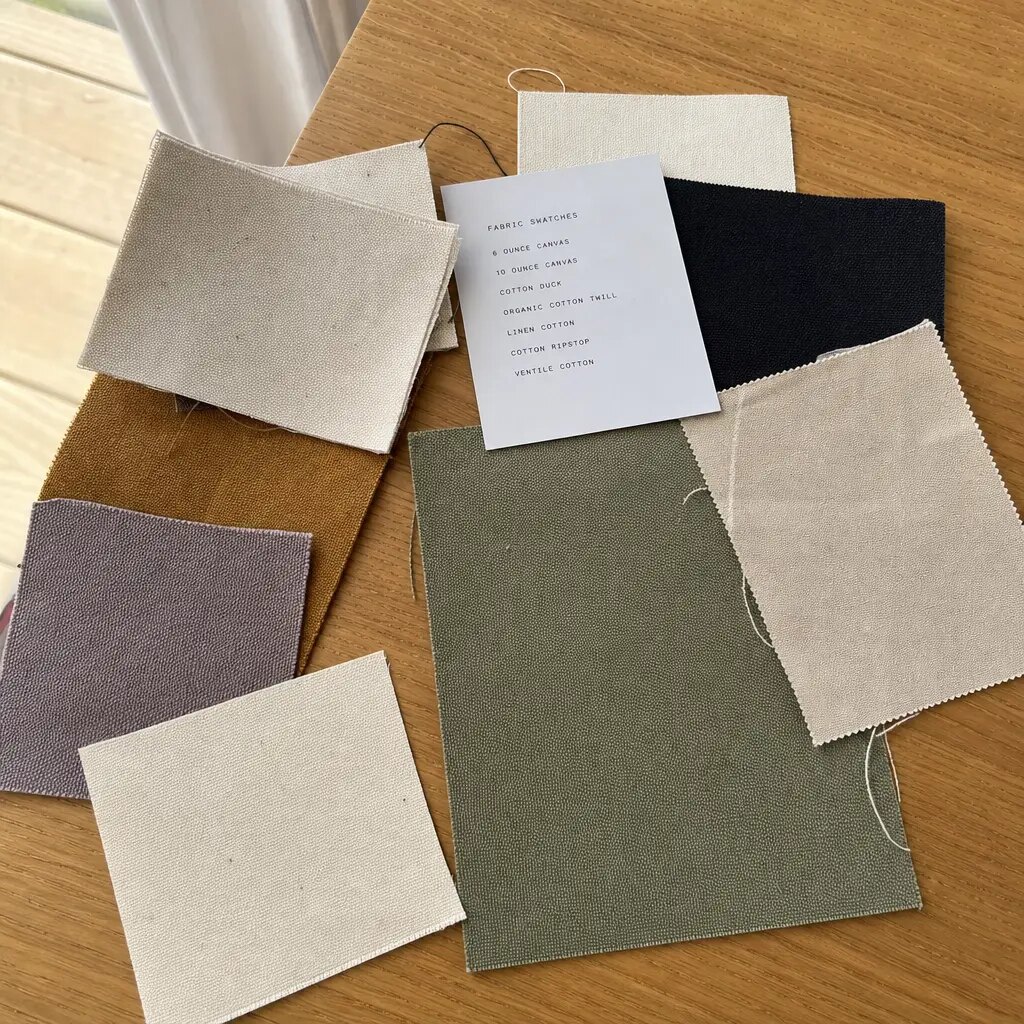
Natural canvas is normally the lowest-risk route for MOQ because mills and factories often stock it or can source it quickly in smaller amounts. Dyed canvas gives stronger brand alignment, especially for darker coffee packaging palettes, but custom dyeing brings a fabric minimum and possible shade variation from batch to batch. Recycled cotton canvas can be commercially useful if the buyer needs a sustainability story, but it should be specified carefully because recycled blends often vary in handfeel, color specking, and print smoothness. If marketing requires a deep black body and tight logo contrast, you should assume higher MOQ or longer sourcing lead time unless the supplier already holds matching stock fabric.
- Typical buyer-friendly spec: 340 to 400 GSM cotton canvas for single-bottle use.
- If the bag must hold bottle plus coffee pouch, increase base support before jumping straight to very heavy canvas.
- Natural canvas lowers MOQ; custom dyed fabric usually raises fabric minimums and lead time.
Print method determines setup cost more than many buyers expect
Most coffee roasters think first about branding, but print choice is one of the biggest hidden MOQ drivers. A one-color screen print on natural canvas is usually the most flexible route. Screens are straightforward, print speed is high, and many factories can combine moderate logo runs with one fabric batch. Once the artwork moves to large coverage, multiple colors, halftones, or exact brand matching on dark dyed canvas, setup becomes more expensive and misprint risk rises. The factory may not raise the quoted MOQ directly, but they will either add higher sample charges, raise wastage allowance, or pad the unit cost.
Woven labels are often a smart compromise for coffee brands that want cleaner brand presentation without paying for complex body printing. A small woven side label combined with a one-color body print can reduce print registration problems and keep the product looking more premium. Embroidery works on thicker canvas, but it is rarely the best MOQ route for wine carriers because stitch backing can show inside the bag and run time is slower. Heat transfer or digital transfer can help with short graphic programs, but buyers should verify rub resistance and edge adhesion, especially if the bags will be handled repeatedly in stores or used outdoors at events.
- Lowest-friction MOQ route: one-color screen print on natural canvas.
- Use woven labels when you need crisp branding across multiple body colors with less print complexity.
- Do not approve transfer prints without abrasion and curing checks on the actual canvas weight.
How handle design and reinforcement affect real cost
A wine carrier fails most often at the handle attachment, not the side panel. For procurement teams, this means handle specification deserves more space in the RFQ than many standard tote bag templates give it. Cotton self-fabric handles can look clean, but webbing handles generally offer better load performance and more consistent seam strength for bottle carry. A practical spec for single-bottle canvas carriers is cotton webbing around 2.5 cm to 3 cm wide, stitched into the side seams with X-box reinforcement or bartacks at stress points. That detail changes sewing time, yet it also reduces complaint risk during retail handling.
Handle length also affects both usability and carton efficiency. Short carry handles keep the bag compact and are common for winery or gift shop use. Longer shoulder-length handles increase webbing consumption, raise sewing minutes, and create more folding bulk in cartons. Some buyers request padded grips or wrapped handles for a premium feel, but unless the item is positioned as a permanent retail accessory, those features tend to push cost faster than they add sales value. For coffee roaster promotions, spending budget on dependable reinforcement and clean presentation is usually a better trade than decorative handle treatments.
- Request close-up sample photos of handle stitch patterns, not only front view product photos.
- State minimum handle width and attachment method in the purchase specification.
- If the bag is for in-store gifting, test with a full bottle and repeated lifting before bulk approval.
MOQ logic by SKU mix, artwork mix, and fabric sourcing route
The easiest way to negotiate MOQ is to separate what the factory truly must produce together from what only needs to look different at retail. If three coffee roast variants can use one bag body size, one natural canvas fabric, and one handle spec, the factory may run one cutting lot and change only the print screens or labels. That is much easier to negotiate than three fully separate SKUs. In many projects, MOQ tension comes from the buyer trying to match every roast or seasonal blend with a different bag color, which forces separate fabric sourcing and reduces yield.
When comparing quotes, ask the supplier to break the MOQ logic into layers. There should be a base MOQ for the bag body, then extra notes for custom dyeing, label weaving, or individual packing. This is where buyers can often regain control. A supplier may say 1,000 units MOQ for dyed black canvas, but only 500 units for natural canvas with black print. Another may allow 300 pieces per artwork if total order volume reaches 1,200 pieces across one construction. Those are very different commercial positions. Without a line-by-line MOQ explanation, buyers cannot tell whether a factory is flexible or just masking small-run inefficiency inside a higher unit price.
- Negotiate total-order MOQ across shared construction before negotiating per-artwork split.
- Use stock natural canvas when testing a new gift concept or uncertain sales channel.
- Ask whether label changes can replace full artwork changes for smaller seasonal runs.
Sample approval should test use conditions, not only appearance
A blank sample is useful for dimension review, but it is not enough for approval. Coffee roasters should request at least one logo sample and one pre-production sample made with the intended fabric weight, handle method, and print or label application. The pre-production sample should be loaded with the actual bottle type and any added coffee pouch or paper inserts. This is the only reliable way to confirm whether the top opening is wide enough, whether the bag tilts under load, and whether the handle position causes the bottle neck to sit awkwardly.
Approval criteria should be written, not implied. That includes body dimensions with tolerances, print placement tolerance, label position, seam appearance, and acceptable natural canvas shade variation if undyed fabric is used. For screen print, include whether minor ink show-through at inner seams is acceptable. For dyed canvas, note whether color approval is visual or Pantone-referenced. These details matter because small-run factory teams often assume normal bag tolerance rules, while branded coffee retail programs may expect tighter presentation. If you do not write the acceptance standard, the factory will use its own.
- Approve samples with real contents loaded: bottle, pouch, card, and any hangtag.
- Record dimensional tolerances such as plus or minus 0.5 cm on critical width and height points.
- Require photos of approved sample front, side, inside seam, base, and handle attachment for production reference.
Packing decisions can erase a low unit price
Many MOQ negotiations focus so heavily on FOB unit price that buyers ignore packing until the end. That is a mistake for canvas wine carriers because shape, handle bulk, and print surface all influence carton efficiency. Flat-packed bulk cartons are usually the most economical route. Depending on canvas weight and bag size, 50 to 100 pieces per export carton is common, but buyers should compare not only count per carton but also carton dimensions and gross weight. A quote that saves a few cents per unit can still cost more landed if the carton cube is poor or if the carton weight exceeds your warehouse handling preference.
Retail-ready packing adds complexity quickly. Individual polybags, paper wraps, barcode stickers, or header cards can all be justified for certain channels, but they should be priced as separate decisions. For eco-positioned coffee brands, many buyers want no individual polybag. That is workable, but then the RFQ should include moisture barrier requirements at carton level and a protection method for printed faces. Freshly printed canvas packed too tightly before full curing can offset onto adjacent bags. If the supplier does not explain curing and packing sequence, the buyer should not assume the low quote is operationally sound.
- Request carton dimensions and gross weight for every quote tier, not only unit price.
- Separate bulk pack pricing from retail-ready pack pricing to keep negotiations transparent.
- If omitting individual polybags, add carton liner or other moisture protection in writing.
Lead time planning for promotional coffee programs
Lead time for canvas wine carriers is rarely just sewing time. It includes fabric sourcing, dyeing if used, label production, screen preparation, sample approval, and final packing. For a straightforward natural canvas bag with simple screen print, a realistic example might be 5 to 7 days for sample work and about 20 to 30 days for bulk after approval in a normal production period. Dyed canvas, woven labels, or peak holiday scheduling can push that significantly. Coffee roasters planning Q4 gifting should not treat bag lead time as interchangeable with their regular printed pouch lead time. Different suppliers and production bottlenecks apply.
The schedule risk is highest when artwork approval and content dimensions are still moving while the buyer is also trying to reserve production space. If a gift set depends on both imported bags and in-house roasted product, the bag timeline must be pulled earlier than the coffee pack assembly date. A delayed bag does not only delay shipment from the factory; it can also delay gift set kitting, photo shoots, wholesale preorder commitments, and distributor intake. Buyers should ask suppliers which materials are reserved only after deposit and which can be tentatively booked during sample review. That detail often determines whether a factory can truly support a seasonal launch.
- Plan extra time for dyed fabric, woven labels, and peak holiday sewing capacity.
- Pull bag approval earlier than final gift-set assembly if the program has a fixed launch date.
- Ask when materials are secured: at quote stage, sample approval, or deposit receipt.
Use quote breakdowns to compare landed cost, not just FOB price
A useful factory quote should separate material cost, print or label cost, sample cost, and packing assumptions. Even if the supplier does not disclose full cost sheets, they should at least identify which elements change with volume. For example, a single-bottle natural canvas carrier at 340 GSM with one-color print may quote at one level for 500 pieces and a lower level for 1,000 pieces because screen setup is spread over more units. But if the 500-piece quote includes a separate sample charge, higher carton count inefficiency, and a small-run print surcharge, the real comparison should measure all-in landed cost per saleable unit, not FOB alone.
A simple landed-cost exercise often changes negotiation strategy. Suppose Supplier A is slightly cheaper per unit but packs fewer bags per carton, uses heavier cartons, and has a longer lead time that forces air shipment of part of the order. Supplier B may have a higher FOB price but better carton utilization and more stable schedule. For promotional coffee programs, stockout and late arrival risk can be more expensive than a few cents on unit cost. Buyers should therefore request volume breaks, carton data, and sample charges in the same comparison sheet. A quote without those details is not truly comparable.
- Compare total cost including sample charges, print setup, packing, freight cube, and expected defect allowance.
- Ask for volume breaks such as 500, 1,000, and 2,000 pieces on the same specification.
- Treat lead-time reliability as part of landed cost when the item supports a fixed campaign date.
Specification comparison for buyers
| Spec decision | Recommended option | When it fits | Buyer risk to check |
|---|---|---|---|
| Bag format | Single-bottle carrier with side gusset and boxed bottom | Best for coffee roasters testing gift bundles or cellar-door add-on sales because MOQ stays lower than divided multi-bottle constructions | Factories may quote low using a flat sleeve shape that cannot stand well or protect a bottle base |
| Canvas weight | 12 oz to 14 oz cotton canvas, about 340 to 400 GSM | Suitable for 750 ml bottle carry when the handle is reinforced and base seams are bartacked | Below about 300 GSM the bag may wrinkle, print through, and feel too soft for premium gifting |
| Color route | Natural canvas body with black or dark brown print | Works when buyers need lower MOQ and faster fabric sourcing without dye-lot risk | Natural canvas shade varies by lot; approve an acceptable color range if brand appearance is strict |
| Branding method | 1-color screen print plus woven side label | Good balance for roasters that want visible branding without high setup cost from embroidery or multi-color print | Screen print registration and label placement tolerance should be written into the sample approval |
| Handle construction | Cotton webbing handles stitched into side seams with X-box reinforcement | Better for heavier gift packs or bottle plus coffee pouch combinations | Some factories use shorter stitch runs or only top seam attachment, which can fail during retail handling |
| Interior structure | No divider unless truly needed | Keeps cutting and sewing simpler for single-bottle promotions and lowers MOQ pressure | If the bag is later used for glass with metal accessories, lack of divider may lead to scuffing complaints |
| Assortment strategy | One shared body size across two or three print versions | Helps buyers spread one production run across multiple roast lines or seasonal graphics while holding MOQ on the same base bag | Some suppliers treat each print artwork as a separate MOQ if print positions or ink colors change |
| Packing method | Flat packed by style, 50 to 100 pcs per export carton with moisture barrier liner | Most cost-efficient for ocean freight and warehouse receiving | Carton compression can crease printed panels if bags are packed before ink fully cures |
Buyer checklist before sampling
- Define whether the carrier holds only one 750 ml bottle or a bottle plus coffee pouch, card, or opener; dimensions drive MOQ more than many buyers expect.
- Set target fabric weight in GSM and ounce terms on the RFQ, such as 12 oz or about 340 GSM, to avoid factories quoting lighter canvas and calling it standard.
- State if the bag must stand upright when empty or only when loaded; boxed bottoms, base inserts, and gussets change cutting yield and sewing time.
- Specify print method, print size, ink colors, and print side count; a small one-color logo and a full-panel print are different cost structures.
- Decide whether natural canvas is acceptable or whether dyed black, olive, or custom Pantone canvas is required; dyed fabric usually raises MOQ.
- Confirm handle material, width, and reinforcement method, especially for bottle gift packs sold in retail where repeated lifting happens before purchase.
- Request carton pack quantity, carton size, and gross weight in every quote so freight comparisons are based on actual shipping volume, not only unit price.
- Approve a pre-production sample against a real filled bottle, not an empty shell sample, to test balance, seam strain, and top opening clearance.
- Clarify whether mixed artwork can run on one body size and one fabric lot; this is a common way to negotiate workable MOQ for coffee roaster seasonal programs.
- Include acceptable quality tolerances for print placement, seam alignment, fabric shade, and loose threads before production starts.
Factory quote questions to send
- What is your MOQ by bag construction: single bottle, two-bottle divider style, and bottle-plus-coffee gift set style?
- Is the MOQ based on total units, per color, per print artwork, or per size?
- What fabric do you quote exactly in GSM and weave, and is the canvas stock fabric or made to order?
- Does your price include pre-shrunk canvas, fabric inspection, and needle detection if required by the buyer's retail channel?
- Which print method is included in the quote: screen print, heat transfer, digital transfer, embroidery, or woven label only?
- How many print colors and print positions are included before extra charges apply?
- What are the sample charges for blank sample, logo sample, and pre-production sample, and can those charges be credited back to bulk order?
- What reinforcement is used on handles and base seams, and can you provide close-up photos or video of the sewing method?
- What is the standard production lead time from sample approval and from deposit receipt during peak season?
- How are bags packed per polybag, inner pack, and master carton, and what carton dimensions and gross weight do you estimate for 1,000 units?
Quality-control points to confirm
- Fabric weight within agreed tolerance, typically plus or minus 5 percent from quoted GSM, verified on bulk fabric before cutting
- Body dimensions checked with an actual 750 ml bottle or intended gift-set pack to confirm insertion clearance and upright balance
- Handle stitch density, bartack or X-box reinforcement, and seam backstitching inspected against approved sample
- Print color, sharpness, curing, and placement measured to the approved artwork location tolerance
- Gusset width and boxed bottom symmetry checked because uneven folding makes the bag lean or twist when loaded
- Woven label or side label placement aligned within approved tolerance and sewn without raw edge exposure
- Loose threads, skipped stitches, needle damage, oil marks, and fabric slubs reviewed against agreed cosmetic standard
- Carton count, carton labeling, moisture protection, and drop resistance verified before shipment release