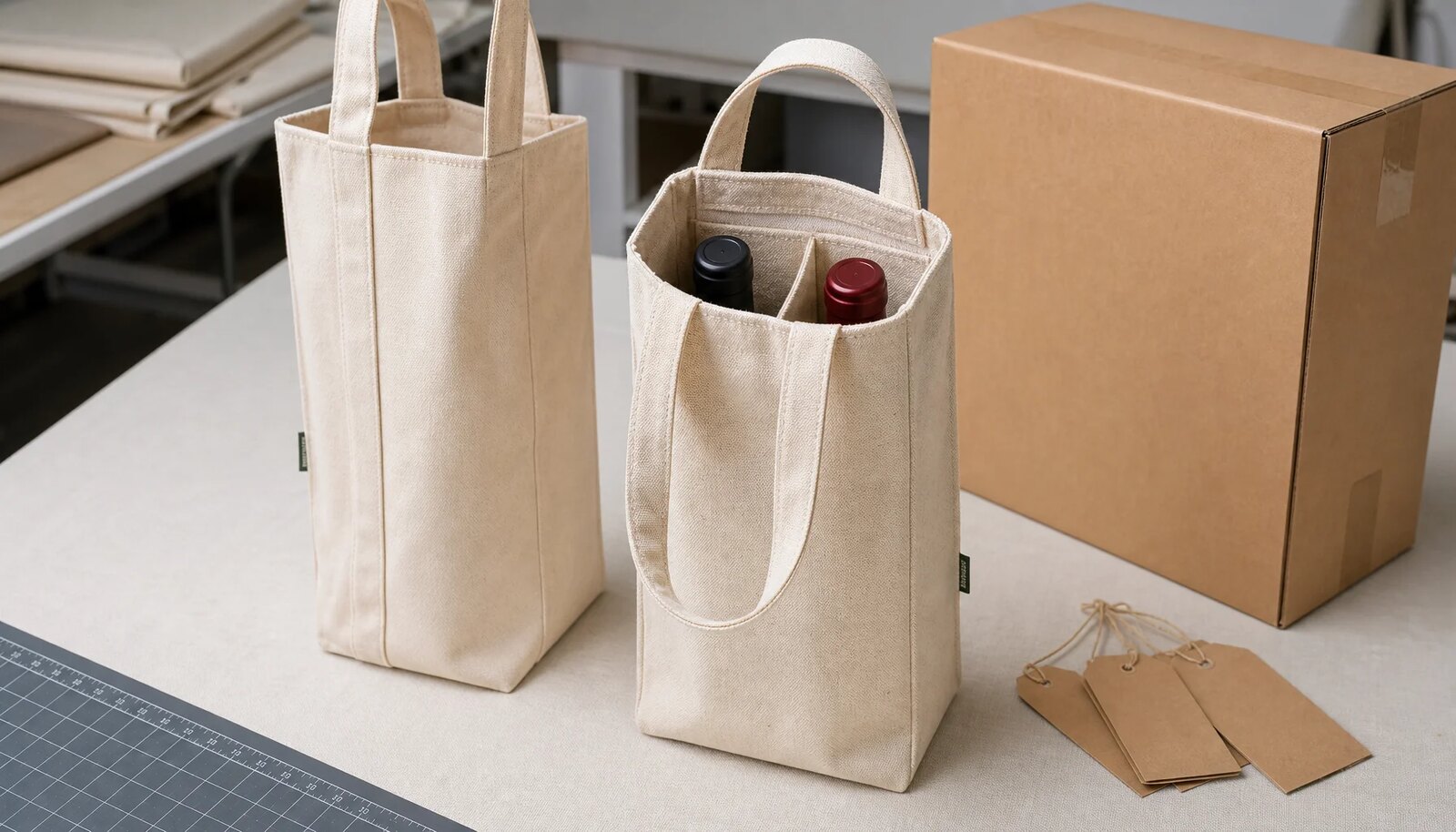
Start With Bottle Data, Not A Stock Tote Size
A good canvas wine carriers carton packing plan for hotel retail begins on the table, with real bottles and a tape measure. The carrier has one simple job: hold the intended bottle cleanly, keep it upright, protect the presentation, and feel secure when a guest walks away from the boutique, restaurant, tasting room, or event desk. That sounds straightforward until one hotel group asks the same carrier to support lobby retail wine, restaurant take-away, minibar upsell, regional gift sets, wedding welcome bags, and a winery collaboration.
Those programs rarely use identical bottles. A supplier may quote around a common 750 ml Bordeaux bottle if the RFQ is vague. That can work for a basic one-bottle sleeve, but it becomes risky for mixed hotel retail assortments. Burgundy bottles have fuller shoulders. Champagne and sparkling bottles can be taller, wider, and heavier. Spirits may arrive in square or broad-base shapes. Olive oil bottles can be tall, slim, and slippery. Add tissue wrap, neck tags, bottle sleeves, or barcode labels, and the practical clearance changes again.
Procurement teams should separate mandatory bottle fit from nice-to-have future flexibility. Build the sample around the largest mandatory bottle, then test smaller bottles for wobble and shelf appearance. If the retail assortment is not final, ask the supplier to design against a bottle envelope: maximum height, maximum base diameter, maximum shoulder diameter, maximum neck diameter, and maximum filled weight. That gives the factory a target without pretending every bottle behaves like a standard Bordeaux.
- Record bottle height, base diameter, widest shoulder diameter, neck diameter, and filled weight before requesting a quote.
- Define whether tissue wrap, neck tags, barcode labels, bottle sleeves, or gift cards are inserted with the bottle.
- For one-bottle carriers, confirm internal width, gusset depth, bottom stability, and shelf appearance when filled.
- For two-bottle carriers, test two filled bottles together and check whether the divider prevents glass contact during lift and set-down.
- For mixed assortments, test the widest bottle and the heaviest bottle combination, not only the easiest Bordeaux reference.
Turn Hotel Retail Use Into A Working Spec
Hotel buyers do not only buy a bag. They buy a guest experience, a receiving process, a shelf presentation, and a repeatable replenishment item. A resort boutique may need cleaner canvas, quiet branding, barcode labeling, and consistent folding. A restaurant take-away carrier may care more about quick bottle insertion, strong handles, and low packing waste. An in-room amenity program may need tissue, a welcome card, or property-level allocation by carton. If these details stay informal, supplier quotes will be based on different assumptions.
Write the RFQ so it explains where the carrier will live and how it will move. A central hotel warehouse can receive full master cartons and split stock across properties. A small boutique may have limited backroom space and prefer cartons that are easy to lift and count. A distributor may need carton marks and inner bundles suitable for onward shipment. These operating details affect cost and carton packing as much as fabric weight or logo size.
The best specification is not necessarily the longest. It is the one that removes the most expensive guesswork. State the finished size, canvas standard, handle construction, divider construction, branding method, retail add-ons, inner packing, carton quantity, maximum carton weight, and inspection expectations. Ask the supplier to confirm inclusions and exclusions in writing. This is especially important when one hotel group uses the same base carrier with several property logos.
- Identify the use case: boutique retail, restaurant take-away, in-room amenity, event gifting, distributor resale, or winery collaboration.
- State whether the carrier is sold empty, packed with bottles locally, or shipped as a retail-ready gift item.
- Define the visual tier: casual natural canvas, premium minimalist hotel branding, seasonal artwork, or private-label merchandise.
- Confirm whether hotel staff or the factory applies hang tags, tissue, barcode labels, paper bands, and property codes.
- Include sustainability requirements, especially restrictions on individual polybags or preference for paper bundling.
Choose Canvas Weight, Finish, And Shade Standards
Canvas weight changes the feel of the wine carrier, but it also changes sewing performance, print result, carton density, and landed cost. For most hotel retail canvas wine carriers, 10 oz to 12 oz cotton canvas is a practical starting range. Depending on weave and finishing, this often sits around 280-400 GSM. Still, ounce weight and GSM are not perfectly interchangeable across mills, so buyers should ask for both values and approve a swatch from the actual fabric source.
Lighter 6 oz to 8 oz canvas can work for promotional sleeves, short-term event packaging, or a softer giveaway style. It folds neatly and saves space, but it may sag around a filled glass bottle. Heavier 14 oz or 16 oz canvas can feel substantial and premium. It also adds fabric cost, creates bulky seams, slows sewing, and reduces pieces per carton. For two-bottle carriers, a well-anchored divider and reinforced handle usually matter more than simply moving to a heavier cloth.
Finish deserves the same attention as weight. Natural canvas can show slubs and seed flecks, which may suit an organic hotel retail look. The same slubs can become a problem if they run through a fine logo or serif text. Dyed canvas needs shade control and may require lab dip approval. Washed canvas may shrink and soften differently from unwashed canvas. For repeat orders, the approved sample should record shade, stiffness, shrinkage expectation, and acceptable surface character.
- Request fabric weight in oz and finished GSM, plus composition and weave description.
- Use 10 oz to 12 oz as the default range for most retail-ready one-bottle and two-bottle carriers.
- Use lighter 6 oz to 8 oz canvas only when a softer promotional carrier is acceptable.
- Use 14 oz or heavier only when premium hand feel justifies lower carton density and higher sewing cost.
- Set fabric shade and slub acceptance standards, especially for natural canvas with printed logos.
Engineer Handles, Divider, And Bottom For Filled Glass
A two-bottle canvas wine carrier is not just a tote with a center seam. The divider has to stop two filled glass bottles from knocking together during normal lift, carry, and set-down handling. It should be tall enough to separate the shoulders, wide enough to keep two usable cells, and anchored so it does not float, twist, or pull the side panels inward. When the divider is too low, bottles can touch. When it is too loose, the whole carrier looks unstable.
The base decides whether the carrier stands well on a boutique shelf and whether it folds cleanly into the carton. A flat-bottom or gusseted base usually improves standing stability. At the same time, the bottom seam should not create a hard ridge that leaves a permanent crease after packing. For two-bottle styles, ask exactly how the divider connects to the base and side seams. A divider that looks tidy when empty may still shift under the weight of two filled bottles.
Handles carry the real risk. Self-fabric handles give a consistent canvas look and can feel premium. Cotton webbing handles can be firmer in the hand and easier to reinforce. Either way, the RFQ should define handle width, handle drop, stitch pattern, thread type, and reinforcement. Box-X stitching or bar tacks are common load-point solutions. Test handle comfort with the heaviest intended bottle combination, because a technically strong carrier can still feel awkward if the handle drop is too short.
- Specify divider height, divider cell width, seam allowance, base anchoring, and reinforcement at top and bottom stress points.
- Confirm handle drop so the hand clears the bottle neck while the carrier remains visually proportionate.
- Require box-X stitching or bar tacks at handle attachment points for filled-bottle use.
- Measure stitch density and inspect for skipped stitches, broken threads, fabric tearing, and weak backstitching.
- Load-test the approved sample with the heaviest intended bottle combination before confirming bulk production.
Control Branding Before It Reaches The Carton
Hotel branding has to survive more than the print table. It must look right after sewing, folding, carton pressure, freight, receiving, and store handling. Water-based screen printing is often a strong option for natural cotton canvas because it has a softer hand and suits clean one-color or two-color hotel artwork. It is not the only option, though. The right method depends on fabric color, logo detail, quantity, touch preference, and whether the logo sits near a fold line.
Dark canvas may need an underbase for opacity. That can improve the logo but may change the hand feel, curing time, and price. Fine crests, small serif text, thin lines, and metallic effects should be reviewed before screens or transfers are made. Heat transfer can give crisp detail, but it may feel less integrated with the canvas. Embroidery can look premium, yet it can pucker lighter fabrics and create pressure marks in cartons. Woven labels, patches, and leatherette badges can work well when their edges, stitching, and carton contact points are controlled.
Use three approvals instead of one. First, approve the digital layout so size and placement are clear. Second, approve a strike-off on the final fabric to check ink color, opacity, line clarity, and hand feel. Third, review a folded or packed sample. The packed sample is where buyers catch creased logos, scuffed ink, patch pressure marks, and fold lines that were invisible in a flat photo. Logo placement should be measured from a clear reference point, such as the top edge, side seam, or center line.
- Provide artwork size, Pantone references, print method, logo position, and placement tolerance from a measurable edge.
- Ask for minimum line thickness and minimum readable text height before approving screens or transfers.
- For dark fabric, confirm whether an underbase is required and whether it affects price, hand feel, or curing time.
- Approve a strike-off on final fabric before bulk cutting or mass printing.
- Review a folded or packed sample to confirm the logo is not creased, scuffed, transferred, or pressure-marked.
Build The Carton Plan Before Price Approval
A unit price without carton data is only half a quote. For canvas wine carriers, packing affects freight, warehouse labor, product condition, and receiving accuracy. Before approving price, collect pieces per inner bundle, pieces per master carton, carton dimensions, gross weight, net weight, and CBM. For freight comparison, calculate CBM per 1000 pieces. A lower unit price can lose its advantage if the cartons are oversized, unstable, or packed in a way that creates extra hotel labor.
One-bottle carriers usually fold flatter than two-bottle carriers. They may pack in higher quantities with less risk of crushing. Two-bottle carriers with structured dividers need more care and often fewer pieces per carton. Raised embroidery, patches, hang tags, and paper bands can also require protective layers or looser packing. If the factory compresses the cartons too aggressively, the goods may arrive with creased logos, bent tags, warped dividers, or uneven shelf presentation.
Cartons must work for hotel receiving teams, not only for factory loading. Many property-level teams prefer manageable cartons, commonly below about 15 kg gross weight where practical. The carton should protect the shape without shipping excessive air. Ask for mock packing photos during sampling and pre-shipment packing photos before release. Good photos show fold direction, inner bundle quantity, logo orientation, carton marks, final weight, and how dividers are protected.
- Require pieces per carton, carton dimensions in centimeters, gross weight, net weight, and CBM before approving the quote.
- Calculate CBM per 1000 pieces to compare freight impact across supplier quotes.
- Keep carton gross weight practical for hotel receiving teams, commonly below about 15 kg where possible.
- Do not crush structured dividers or raised branding simply to increase carton quantity.
- Approve fold direction and carton layout with photos before mass packing begins.
Match Inner Packing To Receiving And Display
Inner packing should follow the way the hotel or distributor will count, store, replenish, and display the carriers. Bulk packing reduces material and factory handling, but it can increase dust exposure, print scuffing, and counting errors. Individual polybags protect pale canvas and retail-ready items, yet they add cost, plastic waste, carton volume, and unpacking labor. For many hotel retail orders, grouped paper bundles or grouped polybags give a better balance.
Retail add-ons need to be included before quotation. Hang tags, barcode labels, belly bands, tissue, welcome cards, and property codes all affect labor time and carton space. A carrier displayed empty in a boutique may need a neat hang tag and a scannable barcode. A carrier packed by hotel staff with local wine may only need clean grouped bundling. A multi-property shipment may need inner bundles separated by logo version or destination code. Add these details after sampling and the supplier may need to revise both price and carton data.
Sustainability policies can push the decision in either direction. Some hotel groups restrict single-use plastic, while others require polybags to protect pale fabric through long transit and multiple handling points. The RFQ should state the preferred packing material and the conditions that allow exceptions. If paper bundling is used, define the bundle quantity and whether tissue or paper sheets are needed between printed surfaces.
- Use bulk packing only when dust, scuffing, and counting risk are low.
- Use 10-25 piece grouped paper bundles or grouped polybags when warehouses need quick counting.
- Use individual polybags only when retail readiness, pale fabric, moisture risk, or multiple handling points justify them.
- Define hang tag position, barcode label location, paper band size, tissue insertion, and scannability requirements.
- Never mix property logos in one carton unless inner separation and carton marks make allocation unmistakable.
Compare MOQ, Quote Breaks, And Allocation Costs
MOQ is not a single issue. It can come from fabric availability, dyeing, cutting efficiency, print setup, sewing line changeover, label production, or packing labor. Natural cotton canvas in a common weight may allow lower quantities than custom dyed canvas. A one-color screen print is usually simpler than multi-color artwork, embroidery, or patch application. Ask what is really driving the MOQ: fabric purchase minimum, dye lot, screen setup, label MOQ, or line efficiency.
Hotel groups often buy across several properties. The total order may be healthy, while each logo version is small. If all versions share the same carrier size, canvas color, handle, divider, and packing method, the supplier may be able to buy fabric and cut panels in one lot, then separate printing, counting, carton marking, and destination allocation. That is different from treating every property logo as a separate production order.
Quote comparison should separate the base carrier from optional work. Ask for the sewn carrier unit price, branding cost, screen charge, sample fee, hang tag cost, barcode label cost, paper band cost, special packing cost, carton cost if separate, and palletization if required. Also confirm overage and shortage tolerance by logo version. A 3 percent shortage on one property logo can disrupt a launch more than the same shortage spread evenly across the full purchase order.
- Request price breaks at 500, 1000, 3000, and 5000 pieces or at the buyer's real forecast levels.
- Ask whether MOQ applies per total order, per fabric color, per logo version, or per packing style.
- Separate base sewing cost from print setup, labels, tags, bands, special packing, cartons, and palletization.
- For custom dyed canvas, confirm dye lot MOQ, lab dip timing, and shade tolerance.
- Define overage and shortage tolerance by logo version and destination allocation, not only by total PO.
Approve Samples With Practical, Measurable Tests
Sample approval should prove more than appearance. It should confirm bottle fit, load strength, logo quality, folding behavior, and packing performance. An early prototype can be useful for checking size and construction, but it should not become the production standard if it uses substitute fabric or temporary branding. The pre-production sample should use final fabric weight, final color, final print or decoration method, final handle construction, final divider, final stitching, and the intended fold method.
Review the sample in the way hotel staff and guests will actually use it. Measure it flat and filled. Insert the target bottles with tissue, neck tags, barcode labels, or cards if those will be used. Carry the loaded carrier, set it down several times, and inspect handle stitching, side seams, bottom seams, and divider anchoring. Leave the sample folded for several days, then reopen it to check crease memory and logo appearance. A quick tabletop photo will not show these issues.
For larger orders or multi-property programs, approve packing evidence before mass packing. A packed sample is ideal. If timing is tight, request clear photos and measurements from the factory. The evidence should show inner bundle style, fold direction, logo orientation, protection between printed surfaces, carton size, carton marking, piece count, and gross weight. This becomes the reference for final inspection and avoids arguments after cartons are sealed.
- Measure width, height, gusset depth, handle drop, divider height, divider cell width, and logo position on the sample.
- Test the sample with the widest, tallest, and heaviest intended bottles, including tissue wrap or tags if used.
- Carry the loaded sample and inspect handle stitching, side seams, bottom seams, and divider anchoring afterward.
- Check logo color, opacity, line clarity, placement, rub resistance, and fold behavior against the approved strike-off.
- Photograph the approved fold method and carton layout so production and inspection use the same reference.
Set QC Thresholds Before Final Inspection
Quality control should focus on the defects that affect safety, retail appearance, allocation, and hotel labor. Natural canvas may have small slubs or seed flecks. That is different from oil marks, mildew odor, severe shade variation, weak stitching, incorrect logo placement, or dirty packing. Classify defects before inspection so the factory, buyer, and inspector share the same view of what is critical, major, or minor.
Load-bearing issues deserve strict treatment. Broken handle stitching, open side seams, torn divider attachment, and failed bottom seams can create real problems when filled glass bottles are carried. These should be major or critical defects depending on the inspection plan. Cosmetic issues should be judged against the approved sample and normal retail viewing distance, but dimensions and logo placement should be measured. For example, logo position can be controlled within a defined millimeter tolerance from the top edge, side seam, or center line.
Packing QC matters just as much for hotel groups. Wrong carton count, mixed logo versions, missing property codes, inaccurate carton weights, or unreadable barcode labels can delay receiving and retail launch. Final random inspection should open selected cartons, verify piece count and inner bundle count, check carton marks, compare gross weight with the approved range, and confirm that logo versions are separated as agreed. A clear carton packing plan saves last-minute sorting and protects the launch schedule.
- Classify broken handle stitching, open seams, loose divider anchoring, wrong logo, severe odor, and wrong allocation as major or critical defects.
- Set measurement tolerances for body width, height, gusset depth, handle drop, divider height, and logo placement.
- Use the approved pre-production sample as the standard for fabric shade, stiffness, print color, stitching, and folding method.
- Check dry rub and light wet rub performance on printed areas using a practical retail-handling method agreed before production.
- Verify carton count, carton marks, logo version, destination code, gross weight, and carton dimensions during final inspection.
Specification comparison for buyers
| Procurement decision | B2B specification to request | Typical hotel retail fit | QC or cost risk to control |
|---|---|---|---|
| Bottle reference | Quote against measured bottle families: 750 ml Bordeaux, Burgundy, Champagne/sparkling, tall Riesling, 500 ml spirits, 700 ml spirits, olive oil, or mixed assortment | Hotel boutiques, resort gift counters, restaurant take-away, welcome amenities, event gifting, and winery collaborations | A generic 750 ml assumption can fail on wider Burgundy shoulders, heavy sparkling bottles, square spirit bottles, tissue wrap, or neck tags |
| Finished internal size | State internal width, height, gusset depth, divider cell width, and clearance target; allow approximately 5-10 mm practical clearance around the widest required bottle | One-bottle sleeves, flat-bottom totes, and two-bottle carriers needing repeatable fit across properties | Too tight causes forced insertion and seam stress; too loose creates wobble, poor shelf appearance, and bottle-to-bottle impact |
| Canvas weight | 10 oz to 12 oz cotton canvas, roughly 280-400 GSM depending on weave and finish, for most hotel retail carriers | Balanced option for structure, printability, sewing efficiency, and carton density | Below 8 oz may sag with filled glass; 14 oz+ can create bulky seams, lower pieces per carton, and higher freight volume |
| Fabric standard | Confirm natural, bleached, dyed, recycled cotton, organic cotton, or blended canvas; approve swatch and shade standard before cutting | Hotel brands with visual standards, sustainability policies, or repeat annual orders | Natural slubs, shade variation, shrinkage, and stiffness differences can change logo appearance and finished dimensions |
| Carrier construction | One-bottle flat-bottom carrier or two-bottle carrier with stitched divider, reinforced base, and defined seam allowance | Impulse retail, restaurant bottle sales, amenity gifting, and bundled wine promotions | Divider height, bottom anchoring, and seam reinforcement must prevent bottle contact during normal lift, carry, and set-down handling |
| Handle construction | Self-fabric or cotton webbing handles with defined width, drop, stitch density, and box-X or bar-tack reinforcement | Premium hotel retail where guests carry filled bottles from boutique, restaurant, or event desk | Weak handle attachment is a functional defect; short handle drop can make checkout and guest carry uncomfortable |
| Branding method | Water-based screen print for simple logos; heat transfer, embroidery, woven label, leatherette patch, or fabric patch only when artwork and budget justify it | Hotel logos, restaurant marks, destination retail artwork, seasonal programs, and co-branded winery merchandise | Fine crests, small serif text, dark fabric, metallic ink, and logos near folds need strike-off and packed-sample review |
| Inner packing | Bulk pack, 10-25 piece paper bundles, grouped polybags, or individual polybags based on display and handling risk | Central hotel warehouses, property-level receiving, distributor allocation, and boutique replenishment | Loose bulk packing can scuff prints; individual polybags add cost, plastic waste, receiving labor, and carton volume |
| Master carton plan | Confirm pieces per carton, carton dimensions, gross weight, net weight, CBM, carton grade, sealing method, and pallet instruction before price approval | Sea freight, air freight, courier, consolidated hotel shipments, and multi-property allocation | Oversized or overfilled cartons can crush dividers, crease logos, trigger freight surcharges, or create unstable pallets |
Buyer checklist before sampling
- Measure the exact bottle family before quoting: height, base diameter, widest shoulder diameter, neck diameter, filled weight, and whether the bottle is round, sloped-shoulder, square, or tapered.
- Confirm whether the carrier must fit 750 ml Bordeaux only or also Burgundy, Champagne/sparkling, tall Riesling, spirits, olive oil, or tissue-wrapped gift bottles.
- State the selling or use scenario: hotel boutique retail, restaurant bottle take-away, in-room amenity, wedding/event gifting, resort shop promotion, or distributor resale.
- Define carrier format: one-bottle sleeve, one-bottle flat-bottom tote, two-bottle carrier with divider, or gift set carrier with accessories such as opener, card, tissue, or hang tag.
- Specify fabric weight in oz and GSM, fabric composition, weave, color standard, shrinkage expectation, stiffness, and whether natural slubs are acceptable near the logo zone.
- Confirm finished dimensions and tolerances: width, height, gusset depth, handle drop, handle width, divider height, divider cell width, and logo placement from a measurable reference point.
- Provide final artwork with Pantone references, print size, print position, number of colors, minimum line thickness, small text height, and approval requirements for strike-off.
- Define load expectations using the heaviest intended filled bottle combination, especially for two-bottle carriers containing sparkling wine or spirits.
- Require a construction description for handle attachment, seam allowance, stitch type, stitch density, divider anchoring, bottom seam, and reinforcement points.
- Set packing rules: pieces per inner bundle, pieces per master carton, maximum carton gross weight, carton dimensions, CBM per 1000 pieces, fold method, and logo protection method.
Factory quote questions to send
- Which exact canvas will be used: ounce weight, finished GSM, yarn/weave description, composition, finish, shrinkage allowance, and approved shade standard?
- Is the fabric stock, fresh woven, custom dyed, recycled cotton, organic cotton, or blended canvas, and what MOQ, lead time, or shade-lot risk applies?
- What are the finished dimensions and tolerances for width, height, gusset depth, handle drop, handle width, divider height, and divider cell width?
- Can you size the sample around our measured bottle data and test the widest, tallest, and heaviest required bottle rather than assuming a standard Bordeaux bottle?
- What is the MOQ by carrier size, fabric color, print method, and logo version, and how does unit price change at 500, 1000, 3000, and 5000 pieces?
- Can multiple hotel property logos share one fabric purchase and cutting lot, with separate printing, counting, carton marking, and destination allocation?
- How will the divider be constructed, how high will it be, what seam allowance is used, and how is it anchored at the base and side seams?
- What handle material, handle drop, stitch pattern, stitch density, thread type, and reinforcement method are included in the quoted unit price?
- What tested or factory-supported load capacity can you provide for handles, side seams, bottom seams, and divider when carrying filled glass bottles?
- Which branding method do you recommend for our artwork on this canvas, and what limits apply to line thickness, small text, ink opacity, Pantone matching, and curing time?
Quality-control points to confirm
- Fabric weight should match the approved sample or written specification within a practical tolerance, commonly plus or minus 5 percent unless the buyer sets a tighter requirement.
- Finished dimensions should remain within agreed tolerance, typically plus or minus 5 mm for small panels and plus or minus 10 mm for overall width, height, or gusset depth unless the design requires tighter control.
- Handle drop and divider height should be measured separately because a visually acceptable carrier can still be uncomfortable to carry or allow bottles to knock together.
- Bottle fit must be tested with the buyer's target bottle shapes, including insertion, standing stability, divider clearance, tissue-wrapped fit, neck-tag clearance, and handle comfort.
- Handle attachment should show clean box-X stitching or bar tacks with no skipped stitches, broken threads, loose ends, weak backstitching, fabric tearing, or distortion after a loaded handling check.
- Divider seams must be straight, secured at stress points, tall enough to prevent bottle-to-bottle contact, and anchored so the divider does not float, twist, or pull the side panels inward.
- Bottom seams and gussets should hold the filled bottle upright without puckering, seam opening, needle damage, unstable shelf presentation, or excessive bulk after folding.
- Print should pass dry rub and light wet rub checks suitable for retail handling, with no obvious pinholes, smearing, ghosting, ink buildup, wrong color, poor opacity, or wrong logo position.
- Natural canvas should be free from visible oil marks, mildew odor, heavy slubs in logo areas, insect marks, unacceptable panel shade variation, dirt, stains, and factory handling marks.
- Folding must not place hard creases directly across printed logos, embroidery, patches, or woven labels unless the buyer has approved the packed sample and fold method.