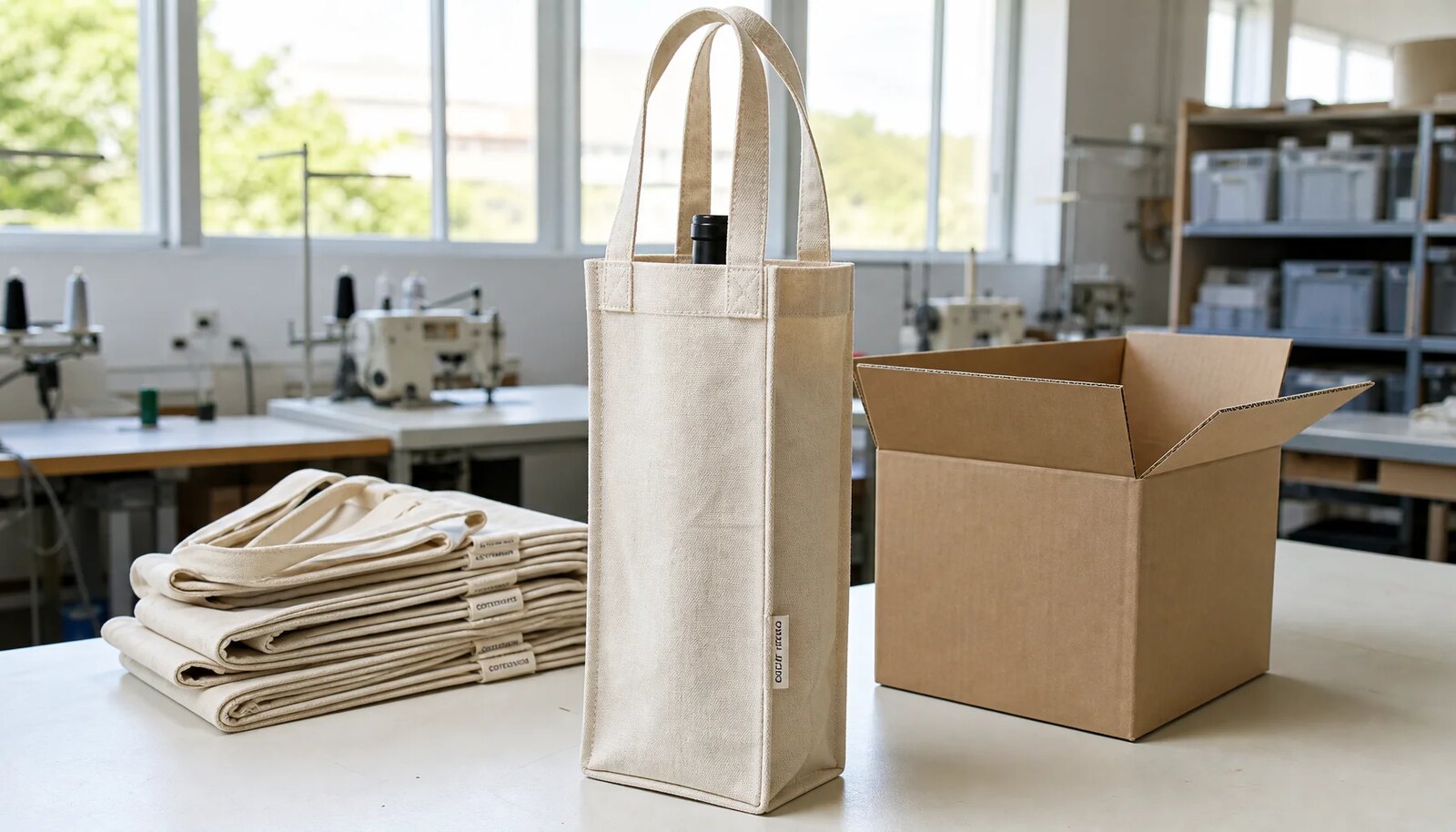
Start With The Receiving Day
Canvas wine carriers look simple in a product photo, but event procurement is really buying a timed receiving workflow. The order has to arrive clean, countable, branded correctly, and easy for staff to move from dock to storage to guest tables. A low unit price loses value quickly if cartons are too heavy, mixed by artwork, crushed in transit, or packed in a way that forces the venue team to recount every bag the day before the event.
For that reason, the carton packing plan belongs in the first RFQ. It should not be settled after the carrier price is approved. The supplier needs to quote the sewn product and the packed product together: units per carton, carton dimensions, gross weight, carton marks, unit protection, and pallet pattern if used. That is the practical meaning behind canvas wine carriers for event planners carton packing plan: the bag, bottle, brand, carton, and receiving constraints must be specified as one purchase.
- Define who will receive the cartons: warehouse, hotel dock, caterer, distributor, sponsor office, or venue team.
- State whether cartons must be light enough for hand carry or suitable for pallet movement.
- Tell the supplier if cartons need to be opened by table, tasting station, location, or sponsor group.
- Require carton marks that show SKU, artwork, quantity, PO or event name, carton number, and destination when split shipments are used.
Specify Bottle Fit Before Bag Cost
The bottle drives the carrier. A Bordeaux bottle, Burgundy bottle, Champagne-style bottle, and specialty gift bottle can differ in body diameter, shoulder shape, neck length, height, and filled weight. If the event uses mixed wine, the carrier must fit the largest realistic bottle without making smaller bottles feel unstable. That choice affects the mouth opening, side depth, base width, handle drop, seam stress, and how the bag folds into the carton.
Do not rely only on a generic 750 ml note. Give the supplier a measured bottle drawing, photos, or a physical bottle when schedule allows. Ask the factory to confirm whether the loaded carrier stands upright, whether the seams pull under weight, whether the bottle label is rubbed by the carrier, and whether the handle length suits the intended handout style. A wine carrier used at a seated gala may need a different feel from a carrier used for a tasting station or sponsor giveaway.
- Provide bottle diameter, total height, shoulder height, neck length, and filled weight.
- Note whether the bottle label must stay untouched by seams, inserts, or handle pressure.
- Confirm finished carrier dimensions after sewing, not only fabric panel dimensions before assembly.
- Test the approved sample loaded, empty, folded, and refolded after storage.
Choose Canvas And Construction
Canvas weight should be treated as an engineered choice, not a decoration preference. Suppliers often discuss canvas in ranges such as 10 oz, 12 oz, or 16 oz, with GSM equivalents depending on the mill, weave, and finish. These are useful commercial examples, not universal rules. Lighter canvas may work for short-use promotional handouts. Heavier canvas may be better for premium presentation, repeated reuse, or heavier bottles, but it can increase fold thickness, carton cube, and print handling risk.
Construction details matter as much as fabric weight. Handle bar tacks, side seams, bottom seams, and base shape determine whether the carrier can be lifted repeatedly without strain. A flat bottom or base insert may improve loaded presentation, but it can reduce carton count and add another QC point. Procurement should ask the supplier to explain why the proposed construction fits the bottle weight, event use, branding process, and packing plan.
- Specify canvas weight in oz or GSM with agreed tolerance and supplier confirmation.
- Confirm handle length, handle width, bar tack method, seam allowance, and bottom construction.
- Decide whether a base insert is required, removable, sewn in, recycled board, gray board, or another material.
- Ask how the selected fabric and insert affect folded thickness and units per carton.
Branding Must Survive Packing
Event planners judge the carrier in front of guests, but procurement has to protect that appearance through production, folding, carton movement, and receiving. Screen printing is often practical for simple one- or two-color logos on canvas because factories can control it with a physical approval sample. Heat transfer may suit detailed graphics or smaller runs, while woven labels, stitched patches, and embroidery add a more finished look. Each method changes thickness, cure time, rubbing behavior, and carton pressure points.
The artwork instruction should be measurable. Replace vague phrases such as centered logo or premium placement with dimensions from top edge and side seam, logo size, color reference, and facing direction when folded. For simple logos, a placement tolerance such as plus or minus 3 mm can be written into the approval, subject to supplier confirmation. The approved sample should be checked on a loaded carrier, because fabric tension and bottle shape can shift how the logo appears.
- Confirm drying or curing time before printed carriers are folded and packed.
- Request a rub or handling check when units are tightly packed or shipped long distance.
- For woven labels, define label size, fold direction, seam placement, and visibility when the carrier stands upright.
- Approve artwork on the loaded carrier and on the folded packing reference.
Build Two Carton Scenarios
A useful quote gives options, not just one packed count. The right carton count depends on folded thickness, canvas weight, inserts, unit wrap, carton strength, gross weight, and receiving labor. A compact carton may increase freight cost per unit but make venue handling faster. A high-count carton may reduce carton material and warehouse touches, but only if it does not crush handles, over-compress prints, or become too heavy for staff.
Use planning examples to start the discussion, then require supplier confirmation from the actual product. A simple unwrapped single-bottle carrier may be tested at 50 units per carton for easier handling and 100 units per carton for bulk efficiency. A premium wrapped carrier with base insert may need a lower count, often in the 40 to 60 unit range depending on thickness. If event stations need fixed quantities, 10-, 20-, or 25-unit inner cartons may be more valuable than maximum cube efficiency.
- Ask for units per carton, outer dimensions, net weight, gross weight, carton board grade, and carton marks.
- Compare cube per unit by dividing carton volume by unit count.
- Require photos of packed layers before final carton approval.
- Check whether the carton closes naturally without forced flaps, bulging, or handle compression.
- Confirm whether carton counts are consistent across the order or vary by artwork, insert, or destination.
Plan Pallets And Venue Handling
Carton dimensions should connect to pallet planning before the PO is issued. A carton that looks efficient in isolation may stack poorly, overhang the pallet, collapse under load, or exceed the height preferred by the forwarder. For larger orders, ask for cartons per layer, layers per pallet, total units per pallet, pallet dimensions, and pallet gross weight. If the goods will be de-palletized before delivery to a venue, note that too.
Venue handling can be more restrictive than freight handling. Hotels, catering kitchens, rented event spaces, and sponsor offices may have limited dock time, no forklift, small elevators, or short storage windows. In those cases, a lighter carton with clearer marks may beat a dense carton that saves a little freight. For multi-location programs, carton marks and pre-counted inner cartons can reduce re-sorting and prevent the wrong artwork from being sent to the wrong site.
- Check whether destination accepts pallets or requires loose carton delivery.
- Set a maximum carton gross weight based on staff handling, not only carrier acceptance.
- Request pallet pattern photos or diagrams for larger shipments.
- Avoid carton footprints that create pallet overhang or unstable stacking.
- Use destination-specific carton marks when shipments are split by venue or event date.
Sample The Pack, Not Only The Bag
A sewn pre-production sample proves fabric, handle length, stitching, and branding. It does not prove that the finished order can travel in cartons without wrinkling, rubbing, crushed handles, or count errors. Event buyers should approve the loaded carrier, the empty folded carrier, and the proposed pack method. The sample review should include inserting the bottle, lifting it, setting it on a table, removing the bottle, folding the carrier, and checking how the logo and seams behave.
The supplier does not always need to ship a full packed carton during early quoting, especially when timing is tight. However, before bulk packing begins, procurement should receive a photo set or pilot pack showing the real fold method, unit count, carton dimensions, and carton closure. For higher-value or fixed-date programs, a packed carton sample is worth considering because it reveals pressure, bulging, and count logic that a single bag sample cannot show.
- Approve one loaded carrier sample and one folded packing reference.
- Ask for photos of first layer, middle layer, bottom layer, and closed master carton.
- Check whether the carrier changes appearance after staying folded overnight.
- Confirm that wrapping, bands, or bundles do not hide defects from inspection.
- Keep approval samples for seasonal reorders or repeat sponsor programs.
Write QC Terms Into The PO
Quality disputes usually become expensive when acceptance terms are vague. For canvas wine carriers, the PO should identify inspection method, defect categories, sampling level, loaded-use checks, branding tolerance, carton count requirements, and evidence required before shipment. Final inspection may reference ANSI/ASQ Z1.4 or ISO 2859-1, General Inspection Level II, with AQL levels agreed by buyer and supplier before production begins.
For guest-facing event products, critical defects may include unsafe construction, wrong artwork, wrong size, severe odor, or incorrect carton count that would disrupt distribution. Major defects may include weak seams, visible print defects, wrong placement beyond tolerance, stains, or damaged cartons. Minor defects may include loose threads or small cosmetic issues within agreed limits. The exact AQL values should be written into the PO so both sides know what passes.
- Loaded lift test: lift with the approved filled bottle or equivalent weight and inspect handles, bar tacks, side seams, and bottom seams.
- Print check: inspect placement, color density, registration, curing, cracking, smudging, and transfer marks.
- Fabric check: verify ordered canvas weight or GSM within tolerance and compare samples from multiple cartons.
- Carton count check: sampled cartons must match carton marks and packing list.
- Stack or compression check: confirm cartons do not bulge or collapse under expected warehouse stacking.
- Pre-shipment evidence: request inspection report, packed-carton photos, carton weight, packing list, and correction records if defects are found.
Compare Supplier Routes
The best supplier route depends on schedule, customization, and how much packing control the buyer needs. A direct factory is usually strongest for custom canvas weight, exact print, inserts, carton count, pallet pattern, and export packing evidence. The tradeoff is earlier approval, clearer MOQ, and more time for sampling. A stock wholesaler can be faster if inventory exists, but the buyer inherits the stock carton plan and may have fewer options for fabric, size, or branding location.
A domestic decorator or converter can help when artwork approval is late or the event is regional, although the base carrier may be fixed and unit cost may be higher. A broker or trading company can simplify vendor consolidation across several event items, but procurement should clarify factory identity, inspection responsibility, packed-carton evidence, and who signs off before shipment. The route is less important than proof that the packed product can arrive on time and in usable condition.
- Use direct factory sourcing when carton count, insert choice, and pallet plan are part of the product requirement.
- Use stock wholesale only after confirming bottle fit, available inventory, print area, carton count, and received condition.
- Use a domestic decorator when timing matters more than custom construction.
- Use a broker when consolidation helps, but require factory-level packing photos and inspection records.
- Compare quotes only after all suppliers price the same pack style, carton marks, delivery terms, and inspection expectations.
RFQ Details That Prevent Rework
A strong RFQ removes assumptions before they become schedule problems. It should include bottle reference, quantity, artwork, desired event date, destination, presentation level, receiving restrictions, and sustainability rules for polybags, paper wrap, recycled board, or labels. It should also ask for itemized pricing so procurement can see the cost of the carrier, print, label or patch, insert, unit protection, master carton, and packing labor.
Ask for two carton options when the order is still being planned. For example, request a 50-unit carton for easier handling and a higher-count carton for freight efficiency. The supplier should explain the tradeoffs in plain terms: units per carton, carton cube, gross weight, expected pallet count, handle compression risk, print rubbing risk, and receiving convenience. This turns a generic bag quote into a procurement-ready packing plan.
- Send bottle dimensions, bottle photos, and sample availability in the first RFQ.
- Attach artwork with placement dimensions and color references.
- State target fabric, then ask the supplier to validate it against bottle load, print method, and fold thickness.
- Request carton scenarios with dimensions, weights, cube per unit, carton grade, and pallet pattern if applicable.
- Include event date, latest safe delivery date, destination restrictions, and preferred carton marks.
- Ask for sample approval steps, final inspection standard, AQL language, and shipment evidence before production starts.
Specification comparison for buyers
| Carton plan option | Example unit count and pack style | Example carton data to request | Handling impact | Freight and procurement implication |
|---|---|---|---|---|
| Loose bulk master carton | 50 units folded flat, no unit wrap, no insert | Outer dimensions, net weight, gross weight, carton grade, fold direction, photos of packed layers | Fastest and lowest packing labor, but harder to keep units clean and count during event setup | Good for internal assembly or low-presentation handout; confirm handle compression and print rub before approving |
| High-count bulk carton | 100 units folded flat if carrier is thin and unwrapped | Outer dimensions, gross weight, cube per unit, bulge check, pallet pattern | Fewer cartons to receive, but heavier cartons and more risk of crushed handles or wrinkled panels | Can reduce carton material and freight cube per unit only if the carton remains stable and liftable |
| Unit wrapped in master carton | 40 to 80 units with tissue, paper band, or polybag | Wrapping material, units per carton, added cube, gross weight, sustainability compliance | Cleaner guest-facing presentation and easier distribution, with more packing labor and material | Useful for sponsor gifts, hotels, and catered events where cartons may sit in storage before handout |
| Inner cartons inside master carton | 10, 20, or 25 units per inner carton; multiple inners per master | Inner carton count, master carton count, carton marks, destination split, pallet count | Best for table allocation, tasting stations, or multi-location events because staff can issue fixed quantities | Costs more in carton material but reduces miscounts, re-sorting, and venue labor |
| Carrier with base insert or divider | 40 to 60 units depending on insert thickness and carrier fabric | Insert material, insert weight, packing sequence, carton compression photos | Better structure and bottle support; more cube and more inspection points | Good for premium gifting; freight comparison must include insert weight and lower units per carton |
| Palletized export carton plan | Any approved carton count arranged by pallet layer and stack height | Cartons per layer, layers per pallet, pallet dimensions, total units, pallet gross weight | Improves warehouse handling if receiving site accepts pallets; may be unsuitable for small venues | Needed for larger orders, sea freight, truckload planning, and clean handoff to forwarders or distributors |
Buyer checklist before sampling
- Confirm the bottle program: 750 ml Bordeaux, Burgundy, Champagne-style bottle, specialty bottle, or mixed bottle set.
- Measure bottle body diameter, shoulder height, neck length, total height, and filled weight if available.
- Lock finished carrier size, mouth opening, base width, handle length, seam reinforcement, and whether the carrier must stand upright when loaded.
- Frame canvas weight as a supplier-validated specification, such as asking whether 10 oz, 12 oz, or 16 oz is suitable for the bottle load, branding method, and fold plan.
- State branding method, color references, artwork position, cure or drying expectation, and print placement tolerance before sampling.
- Choose the unit pack: loose folded, tissue wrapped, polybagged, paper banded, bundled, inner-cartoned, or packed with base inserts.
- Request at least two carton scenarios with units per carton, outer dimensions, net weight, gross weight, carton grade, and carton marks.
- Check gross-weight logic: unit weight times quantity, plus inserts, wrapping, carton, tape, label allowance, and stated variance.
- Compare carton dimensions against venue receiving limits, storage rooms, staff handling, and whether cartons must be opened by table or station.
- Request pallet pattern when applicable: cartons per layer, layers per pallet, units per pallet, pallet dimensions, and pallet gross weight.
Factory quote questions to send
- Which bottle shape and dimensions did you use to confirm fit, and can you test with our bottle or a measured equivalent?
- What finished carrier size, canvas weight in oz or GSM, shrinkage allowance, handle construction, and seam reinforcement are included?
- Which branding method are you pricing, what cure or drying process is used, and what placement tolerance do you recommend for this fabric?
- Is the quoted price based on loose bulk packing, unit wrapping, bundles, inner cartons, dividers, base inserts, or export master cartons?
- What are the proposed units per carton, outer carton dimensions, net weight, gross weight, carton grade, and carton marks?
- Can you quote two carton scenarios, such as a lighter 50-unit carton and a higher-count bulk carton, with handling and freight tradeoffs?
- If palletized, what are the cartons per layer, number of layers, total units per pallet, pallet dimensions, and estimated pallet gross weight?
- How do you calculate gross weight, and what variance should we expect between quoted weight and final packed weight?
- What MOQ applies per size, artwork, fabric color, print method, carton specification, and destination carton mark?
- Can the pre-production approval include the final fold method, insert or wrap if used, and packed-carton photos before bulk packing starts?
Quality-control points to confirm
- Bottle fit must be checked with the approved bottle or a measured equivalent, confirming smooth insertion, stable standing, and no seam strain when lifted.
- Loaded lift testing should use a filled bottle or equivalent test weight, with handle bar tacks, side seams, and bottom seams showing no tearing, skipped stitches, or distortion beyond agreed tolerance.
- Print placement should match the approved sample; for simple logos, buyers may specify plus or minus 3 mm unless the supplier recommends a different tolerance for the fabric and artwork.
- Print quality should be inspected for registration, color density, curing, smudging, cracking, transfer marks, and rubbing between adjacent packed units.
- Canvas weight should be checked against the ordered GSM or oz specification with an agreed tolerance and sampled across more than one carton where possible.
- Stitching should be checked for loose threads, missed stitches, broken threads, uneven bar tacks, raw edges, and visible contamination.
- Base inserts, dividers, or stiffeners must sit flat, support the bottle, and show no warping, delamination, sharp edge, or odor that affects the carrier.
- Carton count must match the packing list, with no mixed counts, mixed artwork, or mixed size cartons unless the PO allows it and carton marks identify the mix clearly.
- Final inspection language may reference ANSI/ASQ Z1.4 or ISO 2859-1, General Inspection Level II, with AQL levels agreed by buyer and supplier before production.
- For event-gift use, many buyers set critical defects at 0, major defects around AQL 2.5, and minor defects around AQL 4.0, but the exact levels should be written into the PO.