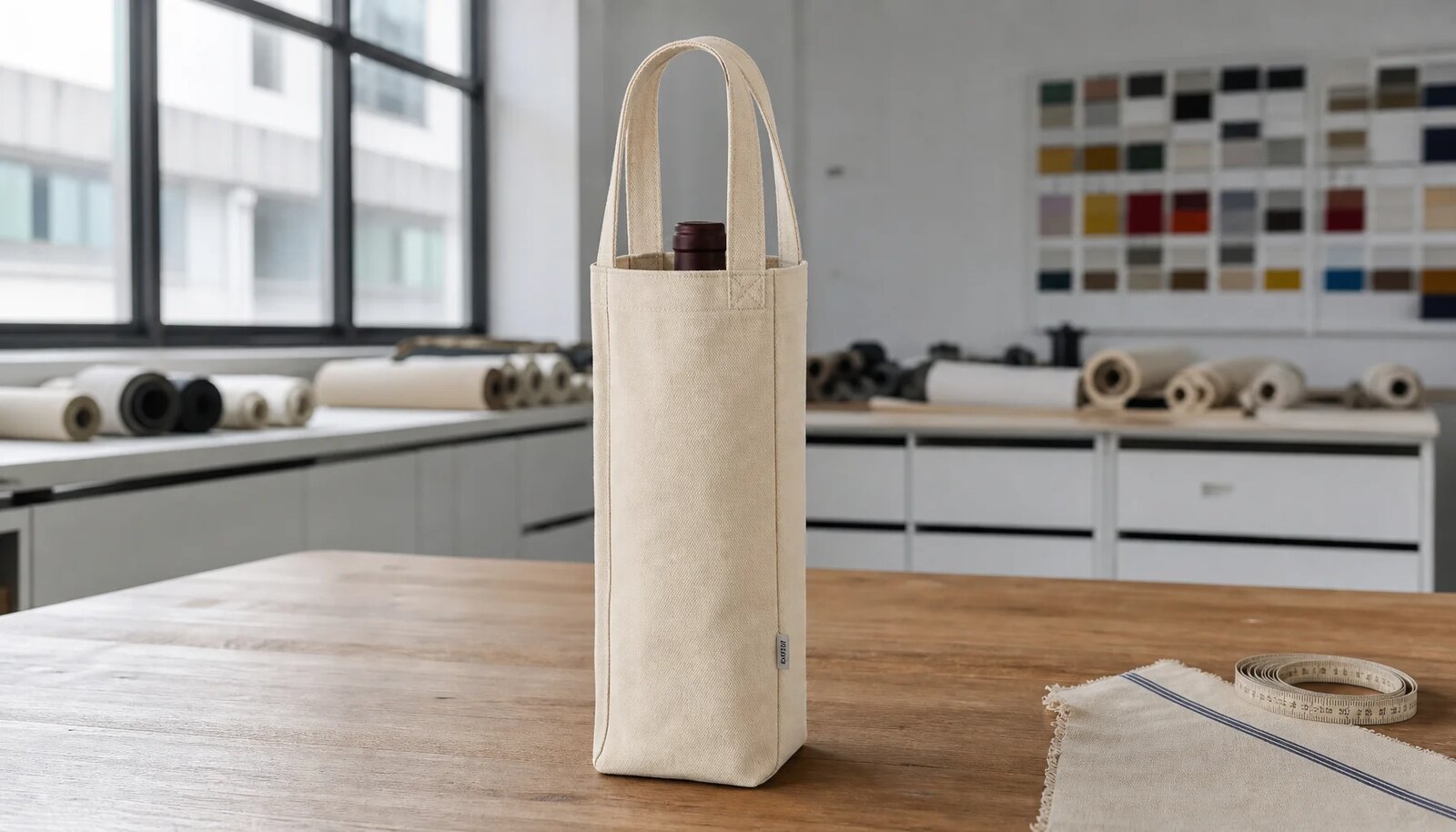
1. Start with the event job, not the product photo
The right canvas wine carrier specification depends on how the bag will be used. A dinner-table gift may only need to present one bottle cleanly for a few hours. A winery activation, sponsor campaign, or VIP welcome amenity may be carried through a hotel, venue, parking lot, or airport. That difference changes the acceptable handle strength, canvas weight, decoration durability, packing method, and delivery buffer.
Before requesting prices, classify the order as presentation packaging, functional carry-home packaging, branded sponsor merchandise, or repeat retail-style stock. Presentation packaging can be lighter and simpler. Carry-home and sponsor programs need stronger handles, better seam reinforcement, and more reliable print adhesion. If the bags will appear in event photography, shade control, lint, creasing, print placement, and upright stability become visible quality requirements.
Do not buy exactly to the guest count unless attendance and distribution are tightly controlled. Add extras for client approval, sponsor sets, speaker gifts, venue display, damaged units, lost cartons, and post-event gifting. A 280-person dinner may need 300-320 pieces. A 500-person activation with several handout points may need a larger reserve because boxes are opened and moved by multiple teams.
- Define the use as table presentation, carry-home gift, sponsor merchandise, or retail-style packaging.
- Add a 5-10% buffer for approvals, VIPs, venue samples, damage, and setup needs.
- Confirm whether the carrier holds one bottle, two bottles, or a bottle plus card insert.
- Decide whether leftover inventory can be reused or whether event-dated artwork makes extras risky.
2. Normalize every quote before comparing suppliers
A useful canvas wine carriers bulk pricing plan for event planners separates costs instead of chasing the lowest single unit price. One supplier may include screen setup in the unit price, another may charge it separately, and a third may exclude freight, inspection, or special packing. Without normalization, a cheap quote can become expensive once artwork versions, carton marks, air freight, or local delivery are added.
Use the same specification across every tier: same canvas weight, same finished size, same handle reinforcement, same logo method, same packing, same delivery term, and same destination. Then compare tiers at 100, 300, 500, and 1000 units. Setup fees matter most at low quantities; fabric and sewing efficiency matter more as volume rises.
A simple quote-normalization formula is: landed estimate per unit = base bag + decoration + packing + setup fees divided by quantity + sample fees divided by quantity if charged to the order + freight per unit + duty/tax/brokerage if applicable + inspection or receiving cost per unit. For internal budgeting, keep a separate line for risk items such as rush freight, repacking, or event-venue delivery.
- Ask every supplier to quote the same spec sheet and the same four quantity tiers.
- Separate base bag, decoration, setup, sample, packing, freight, duty/tax, and inspection.
- Compare landed estimate per unit, not only ex-factory or blank bag pricing.
- Flag split logos, split colors, and split destinations because they often reduce volume efficiency.
3. Use a tier table to see setup amortization and landed cost
The table below is an illustrative planning model, not a market price promise. Replace each line with supplier data once fabric, decoration, packing, shipping terms, and destination are confirmed. The assumption is a one-bottle natural 12 oz canvas carrier, reinforced self-fabric handles, one-color screen print in one position, bulk carton packing, one artwork, and one delivery destination.
| Quantity | Base bag | Decoration | Setup amortized | Packing | Freight estimate | Landed planning estimate | Notes | |---:|---:|---:|---:|---:|---:|---:|---| | 100 | $2.90 | $0.55 | $1.80 | $0.20 | $0.80 | $6.25 | Setup dominates; good for urgent or small VIP events. | | 300 | $2.55 | $0.42 | $0.60 | $0.18 | $0.55 | $4.30 | Better balance for mid-size dinners and regional programs. | | 500 | $2.35 | $0.36 | $0.36 | $0.16 | $0.45 | $3.68 | Often enough volume to justify stronger construction. | | 1000 | $2.10 | $0.30 | $0.18 | $0.14 | $0.35 | $3.07 | Best for repeat campaigns or stock programs with stable artwork. |
This format shows why a planner should not treat freight or setup as afterthoughts. A lower base bag price can lose its advantage if cartons are inefficient, the shipment must move by air, or the order needs rework before the event. For multi-venue programs, add local sorting, relabeling, pallet handling, and last-mile delivery to the model.
- Use the table for budgeting only until confirmed quotes replace the assumptions.
- Amortize setup and sample fees by quantity so small-order impact is visible.
- Estimate freight from carton dimensions and gross weight, not unit count alone.
- Add local receiving, kitting, storage, and venue delivery if those costs fall on the planner.
4. Choose canvas weight by function, feel, and freight impact
Canvas weight affects hand feel, structure, sewing time, carton volume, and freight. A 10 oz canvas can work for light presentation sleeves or cost-sensitive giveaways, but it may wrinkle more and show the bottle outline. A 12 oz canvas is a practical middle range for many single-bottle event gifts. A 14 oz canvas gives a firmer, more premium feel and usually stands better for photography. A 16 oz canvas can feel retail-ready, but it increases material cost, bulk, and sewing resistance.
Ask suppliers to state both oz and GSM where possible. Weight labels are not always used consistently across markets, and finishing can change the hand feel. A softer washed canvas may feel pleasant but less structured. A stiff unfinished canvas may stand well but crease more sharply. If brand presentation matters, approve a fabric swatch and a decorated sample on the same fabric before releasing bulk production.
Natural canvas has shade variation. Some buyers like the organic look, while corporate programs may need tighter color control for logo approval. Dyed canvas adds color options but can introduce shade-lot variation, crocking risk, and longer preparation time if fabric is not in stock. If the event uses mixed wine, design around the widest likely bottle or separate SKUs by bottle profile.
- 10 oz: light presentation use, budget-sensitive orders, and simple giveaways.
- 12 oz: balanced option for many event wine carriers.
- 14 oz: firmer hand for premium corporate gifting and sponsor programs.
- 16 oz: heavier retail feel with higher cost, sewing, and freight impact.
- Confirm finished dimensions after sewing, not only the flat cut size.
5. Treat handle reinforcement as a primary risk control
The handle is the most common high-visibility failure point. A filled wine bottle concentrates load at the handle attachment, top hem, side seams, and gusset. Empty samples may look acceptable, so buyers should require loaded testing and close-up photos before approval.
Self-fabric handles create a clean, coordinated look. They should be folded, stitched, and attached consistently. Cotton webbing handles can provide a stronger load path and reduce distortion, but they change the look and may add trim cost. Reinforcement options include box-x stitching, bar-tacks, double rows, folded top hems, internal patches, and heavier thread. The chosen reinforcement should be written into the purchase order, not left as a factory assumption.
Specify handle drop as well as handle length. A short handle may look neat on the table but feel awkward when guests carry several items. A longer handle can swing or pull at the seam. For most wine carrier events, comfortable hand carry is more important than shoulder carry unless the design is intentionally tote-like.
- Require handle attachment close-ups on the sample and during inspection.
- Test with a filled bottle plus safety margin, then check for seam opening, tearing, and distortion.
- Write box-x stitching, bar-tacks, folded hem, or internal reinforcement into the spec if required.
- Reject samples where the handle construction differs from the quoted production method.
6. Match decoration method to artwork and quantity
Decoration drives both cost and failure risk. Screen printing is efficient for simple one-color or two-color logos repeated across a batch. The screen fee may feel high at 100 pieces but spreads better across 300, 500, or 1000 pieces. Embroidery adds texture and perceived value, but pricing depends on digitizing, stitch count, thread colors, sewing time, and puckering risk. Heat transfer or digital print can work for detailed artwork or short runs, but adhesion, cracking, edge lift, and hand feel should be tested on the selected canvas.
Artwork should be simplified for textured fabric. Thin lines, small sponsor marks, gradients, and fine serif type can lose clarity. A clean one-color mark often looks more premium than a complex design that prints unevenly. Request print size, placement from top edge and side seam, Pantone target, and placement tolerance. Also ask whether the print will be applied before or after sewing, because that can affect positioning and production control.
If the program has multiple sponsors or venues, quote every logo version separately. Six logo versions across 600 units may behave like six 100-piece jobs, each with setup, sampling, sorting, and inspection risk. Multi-version packing also needs carton marks that clearly identify artwork, destination, and quantity.
- Screen print: efficient for simple repeat artwork at scale.
- Embroidery: premium texture, higher setup, stitch-count sensitivity, and puckering risk.
- Heat transfer: useful for detail or short runs; test adhesion and flexibility.
- Digital print: flexible for color, but canvas texture can reduce sharpness.
- Quote every artwork version before assuming full bulk savings.
7. Approve samples that prove production reality
Sampling should confirm the actual process, not just the general shape. A proper pre-production sample should use the specified canvas weight, handle material, reinforcement method, thread color, trim, decoration method, packing approach, and intended bottle profile. A substitute sample can help early review, but it should not release bulk production.
The approved sample becomes the golden sample. It should answer practical questions: does the bottle fit without forcing, does the carrier stand upright when filled, is the logo centered, does the handle feel secure, is the fabric shade acceptable, and does the decoration survive basic handling? For corporate or sponsor events, brand teams should approve the physical sample rather than only a digital mockup.
Build revision time into the schedule. A first sample may show that the logo sits too low, the gusset is too narrow, the handle drop feels wrong, or embroidery puckers the fabric. Those changes are normal, but they can affect cost and timing if they require new screens, pattern changes, or different material. Bulk lead-time examples such as 25-35 days should be treated as production estimates after final approval, not a universal standard across factories, regions, or freight plans.
- Approve the golden sample before bulk cutting whenever the schedule allows.
- Photograph the sample flat, filled, front, back, handle close-up, seam close-up, and decoration close-up.
- Record tolerances for dimensions, logo placement, color, stitch quality, and shade range.
- Keep one approved sample with the buyer and one retained at the factory.
- Confirm price and lead-time impact after every sample revision.
8. Plan lead time by route, not by wish date
Lead time depends on sourcing route, material stock, decoration method, factory capacity, inspection, freight mode, customs if applicable, and local delivery. Local stock plus domestic decoration can support some short deadlines, but stock limits fabric weight, size, color, and construction. Domestic decorators using imported blanks may be efficient for 100-300 units if blank quality is acceptable and artwork approval is quick.
Direct factory custom production gives more control and better scale potential, but it requires planning discipline. Standard fabric and simple decoration may be quoted with an example bulk production window after final sample approval, while dyed canvas, embroidery, custom labels, dividers, retail packing, or multiple artwork versions can add time. Freight can add a few days or several weeks depending on mode and destination.
Work backward from the in-hand date, not the event date. If gift assembly needs five days and the venue requires delivery three days before setup, warehouse arrival may need to happen nearly two weeks before guests arrive. Rush orders compress the steps that protect quality, including print curing, sewing checks, carton audits, and final inspection.
- Local stock route: fastest, least custom, useful for urgent events.
- Domestic decorator route: good for short runs when blank quality is acceptable.
- Direct factory route: stronger control at scale, but requires sampling and freight planning.
- Air freight: faster but can erase unit-cost savings on bulky cartons.
- Ocean or consolidated freight: lower cost, but requires earlier production release.
9. Lock packing, inspection, and delivery before production ends
Packing changes cost, freight, and event execution. Bulk carton packing is economical, but premium gifts may require tissue, paper bands, individual poly-free wraps, hangtags, insert cards, retail cartons, or kitting with bottles and collateral. Each packing element affects labor, carton size, inspection time, and venue setup speed.
Carton labels are especially important for multi-venue programs, sponsor versions, and staggered delivery dates. Labels should show style, color, artwork version, event name, quantity, carton number, and destination when relevant. A low-cost carton plan becomes expensive if warehouse staff must open every box to identify the right version.
Inspection criteria should be agreed before production. Major defects include wrong artwork, handle failure, wrong size, severe stains, broken seams, heavy odor, unusable packing, or visible print defects in normal presentation. Minor defects may include small loose threads, slight shade variation within the approved range, or cosmetic issues that do not affect use. Many B2B buyers use an AQL framework such as 2.5 for major defects and 4.0 for minor defects, adjusted to order value and event risk.
- Confirm packing method before mass production because it affects carton count and freight.
- Require carton dimensions, gross weight, quantity per carton, and labeling format before shipment.
- Inspect handle load, seam strength, bottle fit, dimensions, odor, print quality, and carton condition.
- For multi-venue programs, approve a carton mark layout before packing starts.
- Do not skip inspection on rush orders; compressed timelines increase defect and sorting risk.
Specification comparison for buyers
| Sourcing route | Best fit | Pricing logic | Lead-time profile | Main buyer control point |
|---|---|---|---|---|
| Local stockist or event distributor | Urgent events, small VIP dinners, last-minute sponsor changes, and low-customization orders | Higher unit price, lower development burden, limited control over fabric and construction; decoration may be charged separately | Fastest when blanks are in stock, but proofing, decoration, and local delivery still need schedule space | Confirm blank quality, available inventory, decoration capacity, and reorder consistency before client approval |
| Domestic decorator using imported blanks | 100-300 unit orders where speed matters and the existing bag construction is acceptable | Moderate-to-high unit price; print, embroidery, or transfer cost depends on artwork size, color count, and setup | Often faster than full custom if blanks are available; artwork proofing can still become the bottleneck | Inspect blank dimensions, handle strength, fabric shade, and decoration approval as separate quality gates |
| Trading company or sourcing agent | Mixed gift kits, multi-SKU programs, split deliveries, or planners needing coordination support | Mid-range pricing with service margin included; useful when bags, boxes, cards, and inserts must be consolidated | Depends on factory capacity, consolidation, and inspection schedule | Write inspection, packing, carton labels, and approved sample retention into the purchase order |
| Direct factory custom order | 500-1000+ units, winery activations, sponsor campaigns, repeat programs, and premium branded gifting | Best potential unit economics at scale; buyers can control fabric, handle, print, packing, and carton plan | Requires sample approval, material confirmation, production, inspection, and freight planning | Use a complete spec sheet, approved golden sample, carton plan, and QC checklist before bulk release |
| Hybrid plan: domestic prototype plus factory bulk | High-visibility events where client approval is needed early but bulk economics still matter | Higher development cost, but useful when sponsors or brand teams need a physical signoff sample | Longest planning path because prototype approval and factory bulk production are separate steps | Prevent mismatch by requiring the factory sample to match the approved material, decoration, and handle construction |
| Domestic premium gift partner | VIP gifting programs where presentation, kitting, and local delivery are more important than lowest unit cost | Higher all-in cost; value comes from assembly control, short communication loops, and local issue resolution | Moderate if materials are available; delays occur when custom bags or packaging are imported | Confirm whether the partner controls production or only repacks goods from another supplier |
| Import-ready distributor with private-label option | Planners needing moderate customization without managing full factory production | Unit price may include freight and margin; setup and logo charges may still apply | Predictable when the distributor has incoming stock, less flexible when stock is not yet landed | Check arrival date, substitution policy, and whether the quoted bag is the exact approved construction |
| Multi-vendor event procurement plan | Large programs with bags, bottles, inserts, cartons, and venue drops handled by different vendors | Costs can be competitive but coordination risk is higher; missed specs create rework and sorting cost | Lead time is controlled by the slowest component and final assembly window | Assign one owner for spec control, delivery dates, carton marks, and final receiving inspection |
Buyer checklist before sampling
- Define the use case: table gift, welcome amenity, tasting-room giveaway, sponsor kit, VIP thank-you package, auction lot, or retail-style bottle presentation.
- Confirm bottle profile before quoting: Bordeaux, Burgundy, Riesling, champagne-style, spirits bottle, or mixed bottles with wider shoulders.
- Specify finished height, width, gusset, bottom shape, handle drop, handle width, seam allowance, divider requirement, and whether the carrier must stand upright when filled.
- Set a canvas weight such as 10 oz, 12 oz, 14 oz, or 16 oz; ask suppliers to confirm oz and GSM if both systems are used.
- State whether natural canvas shade variation is acceptable or whether dyed canvas, tighter shade control, or fabric swatch approval is required.
- Choose handle construction: self-fabric handle, cotton webbing, folded top hem, box-x stitching, bar-tacks, double stitching, internal patch, or reinforced webbing.
- Confirm decoration method, logo size, placement, number of colors, Pantone target, artwork file type, ink type, curing requirement, and rub-test expectation.
- Request quote tiers at 100, 300, 500, and 1000 units with base bag, decoration, setup, sample, packing, freight, duty/tax if applicable, and inspection listed separately.
- Ask how pricing changes if the order is split by logo version, canvas color, handle color, packing format, delivery address, or event date.
- Approve a production-intent sample using the specified fabric, handle, reinforcement, trim, decoration method, and intended bottle shape before bulk production.
Factory quote questions to send
- What exact canvas weight are you quoting in oz and/or GSM, and is the fabric greige, natural, dyed, washed, or finished?
- Is the quoted fabric in stock, or does it require weaving, dyeing, washing, or special procurement before cutting can begin?
- What finished dimensions, gusset size, handle length, handle drop, handle width, and seam allowance are included in the quoted construction?
- What handle reinforcement is included: box-x stitching, bar-tacks, double stitching, webbing reinforcement, folded top hem, or internal patch?
- Which bottle profile has the pattern been tested with, and can you test Bordeaux, Burgundy, and champagne-style bottles if our event uses mixed wine?
- Is the quoted decoration screen print, heat transfer, digital print, embroidery, woven label, paper hangtag, or another method?
- What print size, print location, and number of print colors are included in the unit price, and what is the charge for a second position or extra color?
- What are the MOQ and price tiers at 100, 300, 500, and 1000 units for one canvas color, one artwork, and one packing format?
- How do MOQ and setup fees change if we split the order by canvas color, handle color, logo version, delivery location, or event date?
- What setup fees apply for screens, embroidery digitizing, transfer plates, woven labels, custom cartons, or carton marks?
Quality-control points to confirm
- Use an approved golden sample confirmed by the buyer before bulk cutting, and keep one retained sample at the factory for production comparison.
- Confirm fabric weight against the approved specification with an agreed tolerance; avoid substitutions described only as heavy canvas or premium canvas.
- Check fabric before cutting for stains, oil marks, holes, odor, excessive slubs, color streaks, and shade variation outside the approved range.
- Measure finished height, width, gusset, handle drop, handle width, logo size, print position, and carton quantity against the technical sheet.
- Agree on an AQL inspection plan before production; many B2B buyers use AQL 2.5 for major defects and AQL 4.0 for minor defects, adjusted for order risk.
- Run a handle load test with a filled bottle weight plus safety margin, then inspect for tearing, seam opening, stitch breakage, distortion, and handle elongation.
- Perform seam pull checks at handle attachment, side seam, bottom seam, and gusset stress points before the goods are packed.
- Inspect box-x stitching, bar-tacks, stitch density, skipped stitches, loose threads, puckering, and crooked reinforcement on finished goods.
- Test bottle fit with the approved bottle profile and at least one wider bottle if the event will use mixed wines or sparkling bottles.
- Check print registration, Pantone match, edge sharpness, ink coverage on textured canvas, placement skew, curing, cracking, rub resistance, and hand feel.