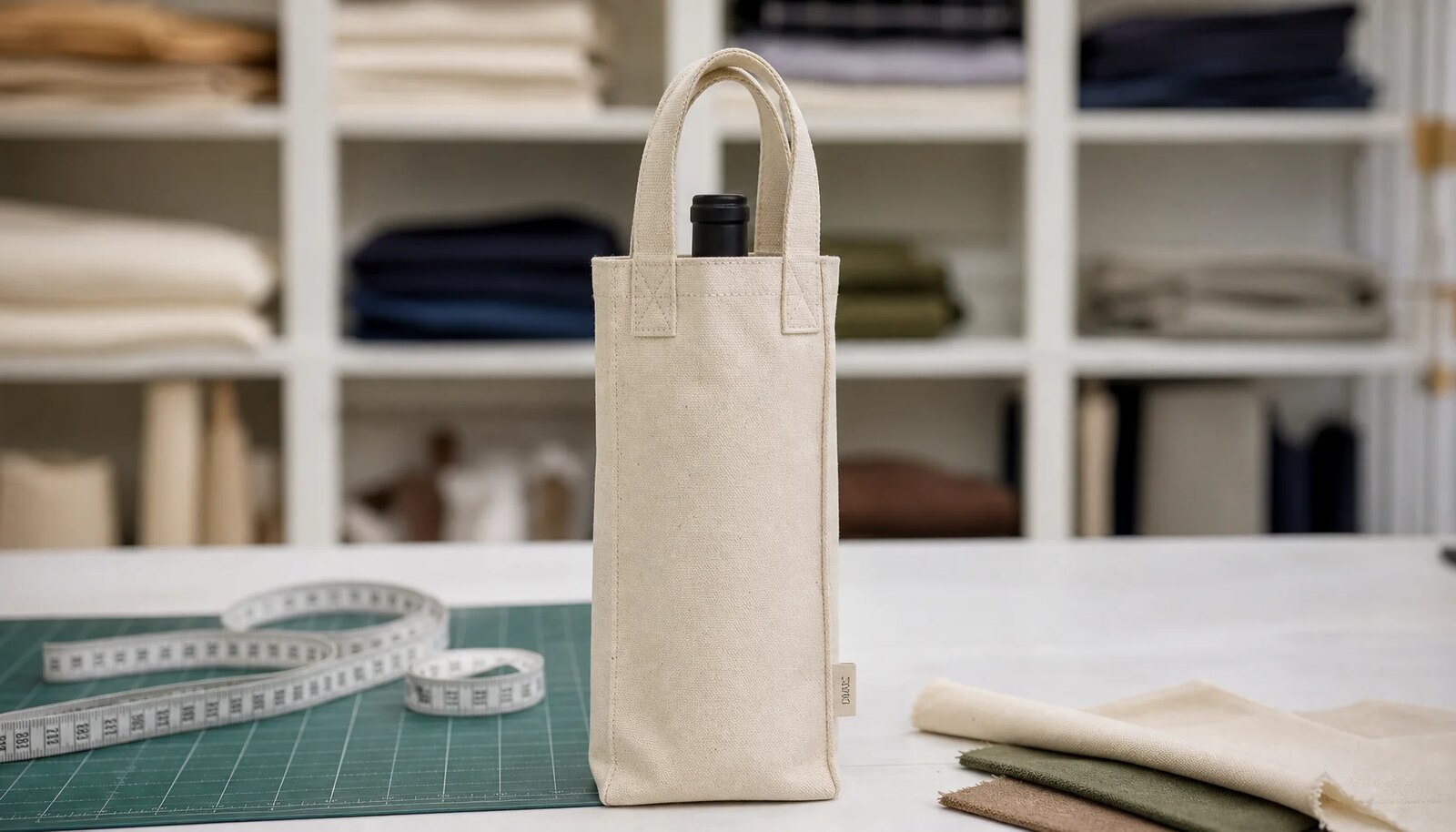
Price the carrier as packaging with load requirements
A canvas wine carrier is not just a small tote. A tote usually carries flexible goods, while a bottle carrier holds a rigid cylinder with concentrated weight and a narrow contact area at the base. That changes the sourcing logic. The bag must load quickly, hold the bottle upright, protect the brand presentation, and survive hand carry without the handles or bottom seam becoming the failure point.
For eco apparel brands, the carrier also has to sit beside garments, hang tags, recycled mailers, and store fixtures without looking like an afterthought. Buyers may be using it for wine, olive oil, candles, wellness gifts, or holiday bundles, so the RFQ must define the physical product first. Pricing should be tied to fit, construction, decoration, and packing method rather than a generic "canvas wine bag" description.
The best canvas wine carriers bulk pricing plan for eco apparel brands separates the launch decision from the reorder decision. The launch tier may use a stock base and one-color decoration to reduce commitment. The repeat tier can move into custom dimensions, certified material, improved handles, or custom packaging once demand and channel requirements are proven. That structure gives procurement room to protect quality without overbuying the first run.
- Treat the item as reusable bottle packaging, not a flat promotional tote.
- Price against a loaded bottle, not only exterior bag dimensions.
- Separate launch specifications from repeat-order specifications.
- Require measurable specs before comparing supplier unit prices.
Build the RFQ around real bottle dimensions
The bottle is the starting point. A "750 ml bottle" is not a complete spec because bottle shapes vary widely. A Bordeaux bottle, Burgundy bottle, sparkling bottle, spirits bottle, olive oil bottle, or wrapped gift bottle can have different diameter, shoulder, height, and balance. A carrier that fits one may be too tight, too loose, or visually distorted on another.
Ask the product or merchandising team to provide the actual bottle, or at minimum a dimensioned drawing with maximum body diameter, base diameter, total height, shoulder width, and neck height. Record any packaging that remains on the bottle during packing, including a sleeve, neck tag, cap cover, cork protector, wax dip, tissue wrap, or gift collar. These additions often matter more than the nominal bottle volume.
Finished bag dimensions should include inside usable width and depth after sewing. For a one-bottle carrier, buyers usually want enough clearance for fast loading without visible wobble. A practical RFQ asks the supplier to confirm finished dimensions and tolerance, commonly around +/-5 mm for sewn dimensions unless the construction or factory standard requires a different value. Tighter tolerances may increase inspection pressure; looser tolerances may produce inconsistent shelf presentation.
- Measure in millimeters, not only inches, to avoid rounding confusion.
- Confirm the widest bottle point, not just the base diameter.
- Test the approved sample with the real bottle and expected fill weight.
- Keep one-bottle, two-bottle, and mixed-gift carriers as separate specs.
Choose canvas weight with cost and structure in view
Canvas weight is one of the clearest cost drivers, but it should not be treated as a simple good-better-best ladder. A 10oz canvas can work for a low-cost event giveaway or short-term promotional program if the carrier is narrow and the handle reinforcement is sound. A 12oz canvas is often the balanced starting point for retail gifting because it has better body without overbuilding the item. A 14oz canvas gives a firmer hand and more premium feel, but it can raise material cost, sewing difficulty, carton weight, and packing volume.
Request both oz and GSM in the quote. Suppliers may use different fabric descriptions, and phrases like "thick cotton" or "premium canvas" are not procurement specifications. Where possible, state a commercial fabric-weight tolerance, such as +/-5%, and make sure the approved swatch is linked to the quoted fabric. Two fabrics with similar GSM can still differ in weave density, finishing, shrinkage, slub level, and print behavior.
Natural canvas needs its own controls. Eco apparel brands often like unbleached or undyed fabric because it feels honest and restrained, but natural fabric still varies by yarn lot and finishing batch. Define acceptable slubs, seed flecks, and shade variation before production. If the brand wants organic cotton or recycled cotton, the RFQ should list the documents required before any claim is used in product copy, packaging, or wholesale compliance paperwork.
- 10oz: cost-focused, lighter structure, best for simple event or giveaway programs.
- 12oz: balanced option for reusable retail, gift-with-purchase, and branded bundles.
- 14oz: firmer premium hand, higher cost and possible freight impact.
- State fabric weight in oz and GSM with a written tolerance.
- Do not use sustainability claims unless the supplier can support them with relevant documents.
Specify construction before negotiating price
Construction details decide whether the carrier performs under load. A filled glass bottle commonly weighs more than the liquid volume suggests because the bottle itself may be substantial. For practical sourcing, many buyers specify a loaded carry test of at least 3 kg for a one-bottle carrier, then adjust upward if the product is heavier or if the brand wants a stronger reusable standard. The test should be simple, repeatable, and performed on actual production construction.
Handle construction should include material, width, drop, attachment position, seam allowance, and bartack details. A 25-35 mm handle width is a useful range for comfortable hand carry, though the final choice depends on design and cost. Handle drop often falls around 100-140 mm for hand-carry bottle bags. Whatever the design, the supplier should confirm stitch density and bartack count instead of simply saying "reinforced handles."
Bottom shape is equally important. A flat seam may suit a very low-cost sleeve, but a boxed bottom or reinforced base helps the bottle stand upright and reduces pressure on one seam. If the carrier will be merchandised on a table, photographed for ecommerce, or packed into a gift set, base stability is part of the product value. Lining, padding, or dividers should be added only when they solve a defined protection or presentation need because they add labor, inspection points, and CBM.
- Define handle width, drop, bartack count, and stitch density in the spec sheet.
- Use a written loaded carry test rather than a vague strength promise.
- Choose boxed or reinforced bottoms when shelf stability matters.
- Quote lining, divider, and insert options as separate cost lines.
- Inspect the carrier loaded, not only flat on a table.
Control decoration risk on textured canvas
Decoration is where many small wine carrier programs become unexpectedly expensive. A one-color screen print is usually the most efficient route for a clean logo on natural canvas. It keeps setup manageable, reads well from a short distance, and works for repeat orders. A woven label or sewn patch may be better when the brand wants a trim-driven apparel feel or when the canvas texture makes fine print less predictable.
Production artwork should be reviewed before the supplier quotes the final decoration. Thin type, small registered marks, gradients, dense ink coverage, and multicolor artwork can all raise rejection risk on coarse canvas. Ask whether printing happens before sewing or after sewing, because panel access affects placement accuracy and print smoothness. For narrow carriers, logo placement also needs to account for the curve and tension created when the bottle is inside.
Decoration specs should include artwork file type, print size, number of colors, ink color reference, position from fixed seams or edges, and placement tolerance. A practical logo placement tolerance might be +/-3 mm for many small sewn items, but the supplier should confirm what is realistic for the construction. The QC plan should include color, opacity, edge clarity, curing, rub resistance, and print-to-print transfer during packing.
- Use one-color screen print for simple, repeatable logo programs.
- Choose woven labels or patches when trim consistency matters more than print area.
- Sample embroidery before committing; dense stitching can distort narrow canvas panels.
- Define logo position from fixed reference points, not by visual approval only.
- Include print rub and packing-transfer checks in final inspection.
Separate MOQ triggers and price breaks
MOQ is rarely one number. A supplier may offer a low MOQ for a stock natural canvas base with one-color printing, but the minimum can increase for custom dimensions, dyed canvas, organic cotton, recycled cotton blends, woven labels, embroidery, foam inserts, or retail-ready packing. If procurement asks only "what is your MOQ," the answer may hide the part of the spec that actually creates the constraint.
A stronger RFQ asks for price tiers by specification route. For example, request a stock-base launch price, a custom-size price, and a repeat-order price at higher quantities. Ask suppliers to identify setup charges separately from unit cost. Screen charges, label development, embroidery digitizing, sample fees, and custom dye minimums should be treated as launch costs in the pricing model rather than surprises after the first proof is approved.
Quote validity matters too. Cotton fabric, dyeing schedules, trim availability, labor capacity, and freight conditions can change. Ask how long the quote is valid and whether it assumes a specific fabric lot or packing method. For repeat programs, store the approved quote, spec sheet, artwork proof, carton data, and golden sample photos together so the next buying cycle starts from controlled information rather than memory.
- Ask for MOQ by fabric, color, size, decoration, insert, and packing change.
- Request launch-tier and reorder-tier pricing.
- Separate setup fees from unit price.
- Confirm quote validity and sample revision charges.
- Keep a complete reorder file after approval.
Compare suppliers with a normalized costing sheet
A one-line unit price does not tell procurement enough. One supplier may quote 10oz stock canvas with flat packing, while another quotes 12oz custom construction with a boxed bottom and individual polybags. Both may call the item a canvas wine carrier, but the cost base is not the same. Normalize every quote before discussing margin or target price.
The costing sheet should include bag body, fabric upgrade, custom dye, decoration, setup, label or patch, insert or lining, hang tag, individual packing, export carton, sample fee, inland freight, and any inspection support. It should also include carton dimensions, pieces per carton, gross weight, net weight, and CBM per 1,000 units. These details help the team compare landed cost, not just ex-factory price.
When a quote misses a cost line, do not assume it is included. Ask the supplier to confirm in writing. This is especially important for decoration setup, hang tags, polybags, and carton markings. If the target cost is too high, the team can make visible decisions such as moving from 14oz to 12oz, reducing print size, removing individual polybags, or using a stock base for launch. That is healthier than pressuring the supplier until quality is reduced invisibly.
- Normalize by bottle size, fabric weight, construction, decoration, and packing.
- Compare landed-cost inputs, not just ex-factory unit price.
- Request carton data before estimating freight.
- Use visible spec tradeoffs to hit cost targets.
- Document what is excluded as clearly as what is included.
Sample for production readiness, not just approval photos
The first sample should answer functional questions: Does the real bottle fit? Does the handle feel secure? Does the bag stand acceptably? Does the print remain clear when the bottle is inside? Does the canvas shade work beside apparel packaging and trims? A sample that looks good empty may behave differently once loaded.
If the supplier uses substitute fabric, temporary stitching, or a faster decoration method for the first sample, label that limitation clearly. It may be useful for size checking, but it should not become the final approval. The pre-production sample should use bulk fabric or the approved fabric lot, final artwork, final handle construction, final insert or divider, and intended packing method.
Create a written approval record with measurements, tolerances, fabric weight, color reference, stitch details, handle drop, decoration placement, trim, and packing. Photos are helpful, but they do not replace a spec sheet. Keep the physical golden sample where the QC team and supplier can reference it. If a sample revision changes only the handle or logo placement, record exactly what changed so the rest of the approved spec does not drift.
- Load the sample with the approved bottle before reviewing appearance.
- Measure finished dimensions and handle drop against the spec sheet.
- Review the logo while the bottle is inside the carrier.
- Approve packing folds, carton count, and surface protection before mass production.
- Keep the golden sample, spec sheet, artwork proof, and carton data together.
Set inspection standards before production starts
Canvas wine carriers tend to fail in predictable ways: weak bartacks, loose handle stitching, uneven top openings, twisting bases, off-center logos, stains, shade mismatch, print scuffs, and poor bottle fit. A useful QC plan ranks these defects by severity before the order begins. That prevents arguments later about whether an issue is cosmetic, functional, or shipment-blocking.
Critical defects should include handle failure, wrong logo, wrong size that prevents bottle loading, missing divider or insert, torn seams, sharp exposed material, mold, strong odor, or any issue that makes the item unusable. Major defects may include obvious stains, crooked print, poor bottle fit, uneven mouth opening, damaged fabric, incorrect packing, or a visible shade mismatch outside the approved range. Minor defects may include small thread tails, light fold marks, or slight natural slub variation within the approved standard.
Inspection should include more than flat visual checks. Pull random units, load them with the approved bottle or weighted dummy, lift them, set them down, and check the handles, bottom, and mouth opening. Measure logo placement and finished dimensions. Compare fabric against the approved swatch. Check print rub and carton packing. For seasonal launches or retail-facing orders, final random inspection before shipment is often worth planning into the timeline.
- Define critical, major, and minor defects in the purchase order or inspection brief.
- Use the golden sample as the physical reference for shade, construction, and logo placement.
- Perform loaded handle and bottle-fit checks during inspection.
- Measure logo placement instead of judging by eye.
- Inspect before goods are sealed for shipment.
Plan packing, freight, and storage conditions
Packing can quietly change the economics of bulk wine carriers. Flat packing usually improves carton density, but aggressive folds can crease handles, distort boxed bottoms, or scuff printed logos. Individual polybags protect the product and simplify retail handling, but they add cost, labor, and plastic-use concerns. Master polybags, tissue, or carton dividers may be useful for premium programs, but only if the added protection solves a real problem.
Ask suppliers to provide carton dimensions, pieces per carton, gross weight, and CBM per 1,000 units for the exact packing method being quoted. A cheaper carrier can become more expensive once freight is calculated, especially if a rigid insert or bulky handle construction reduces carton efficiency. Packing photos should be part of the approval record, not an afterthought at booking time.
Cotton canvas also needs moisture awareness. Long ocean freight routes, humid production areas, damp cartons, and extended warehouse storage can create odor, staining, or mildew risk. Discuss carton strength, master polybags, desiccant use where appropriate, and dry loading practices. The goal is not to overpack every order; it is to match packing protection to freight route, storage time, and retail presentation standards.
- Request carton size, piece count, gross weight, and CBM per 1,000 units.
- Test fold direction for print scuff and handle creasing.
- Balance individual polybags against plastic-reduction goals.
- Confirm carton marks and piece counts before shipment.
- Plan moisture protection for ocean freight or long storage windows.
Specification comparison for buyers
| Pricing variable | Practical spec target | Typical B2B impact | Quote or QC detail to lock |
|---|---|---|---|
| Bottle fit | Quote from actual bottle max diameter, total height, shoulder shape, and packed accessories | Prevents tight loading, loose wobble, leaning display, and slow warehouse packing | Confirm finished inside width/depth and height tolerance, ideally +/-5 mm for key dimensions |
| Canvas weight | 10oz for promotional use, 12oz for balanced retail, 14oz for premium structure; request GSM too | Fabric weight affects unit cost, sewing time, hand feel, opacity, carton weight, and CBM | State oz, GSM, and allowed fabric-weight tolerance, commonly +/-5% unless otherwise agreed |
| Material claim | Conventional cotton, organic cotton, recycled cotton blend, or undyed natural canvas | Eco apparel buyers need claim accuracy for hang tags, wholesale compliance, and marketplace copy | Request transaction or scope certificates where certification claims are used; avoid unsupported "eco" wording |
| Construction | Boxed bottom, reinforced side seams, bartacked handles, clean top edge binding | Concentrated bottle weight puts more stress on seams than a small flat tote | Specify stitch density, seam allowance, bartack count, handle width, and loaded carry test |
| Handle design | 25-35 mm webbing or self-fabric handle with 100-140 mm drop for hand carry | Comfort and failure risk change quickly once a 1.1-1.5 kg filled bottle is loaded | Confirm handle material, drop tolerance, bartack size, and minimum loaded test weight |
| Decoration | 1-color screen print, woven label, sewn patch, or embroidery after sampling | Decoration can drive setup fees, rejects, MOQ, and sample revisions | Define print size, color standard, position tolerance, curing, rub test, and acceptable edge sharpness |
| Insert or divider | Unlined for simple gifting; divider or light padding only when protection requires it | Adds material, sewing steps, QC points, packing volume, and MOQ pressure | Quote insert, divider, lining, and base reinforcement as separate cost lines |
| Packing method | Flat pack, half fold, individual polybag, master polybag, tissue, or retail-ready pack | A lower unit price can lose advantage through creasing, print scuff, or poor carton density | Request pieces/carton, carton size, gross weight, CBM per 1,000 units, and packing photos |
| MOQ structure | Separate MOQ for stock base, custom size, custom dye, organic fabric, label, and insert | One generic MOQ hides the real order constraint and makes launch budgets unreliable | Ask for launch tier, reorder tier, price breaks, setup fees, and quote validity |
Buyer checklist before sampling
- Measure the actual bottle in millimeters: maximum body diameter, base diameter, total height, shoulder width, neck height, and any cork protector, wrap, sleeve, tag, or gift collar that stays on during packing.
- Define the commercial use before asking for price: retail accessory, gift-with-purchase, wholesale wine bundle, tasting event item, loyalty gift, subscription insert, holiday pack, or reusable lifestyle product.
- Set the target loaded weight. A standard filled 750 ml glass bottle often lands around 1.1-1.5 kg depending on bottle glass weight; specify a practical loaded carry test such as 3 kg for one-bottle carriers unless your product requires more.
- Choose fabric with numbers, not adjectives: 10oz for budget promotional programs, 12oz for most reusable retail or gift programs, 14oz for firmer premium presentation, with GSM and tolerance stated in the quote.
- Define the fabric finish: natural unbleached, bleached, dyed, washed, organic cotton, recycled cotton blend, or custom color. Add shade tolerance using an approved swatch and light box or agreed viewing condition.
- Decide whether the carrier is unlined, has a boxed bottom, includes a base panel, uses a divider, or needs light padding. Ask suppliers to price these options separately before choosing.
- Specify handle construction: material, width, finished length, drop height, attachment placement, bartack count, bartack size, seam allowance, stitch density, and loaded test requirement.
- Provide production artwork files with decoration method, Pantone or standard color reference, print area, number of colors, print side, placement from fixed edges, and placement tolerance such as +/-3 mm for logo position.
- Break out every cost line in the RFQ: bag body, fabric upgrade, custom dye, decoration, screen or setup charge, label or patch, insert, packing, hang tag, export carton, sample fee, inland freight, and inspection support.
- Ask for MOQ by change driver: stock base, custom dimensions, canvas weight, dyed fabric, certified material, woven label, patch, embroidery, insert, individual packing, and mixed-color assortment.
Factory quote questions to send
- What finished bag dimensions are you quoting, and what bottle diameter, height, and loaded weight did you assume?
- What are the inside usable dimensions after sewing, and what tolerance do you allow on width, depth, height, and mouth opening?
- What exact canvas weight are you quoting in oz and GSM, and is the fabric weight tolerance +/-5% or another value?
- Is the fabric conventional cotton, organic cotton, recycled cotton blend, or another fiber composition, and what documents can you provide if we make a certification or recycled-content claim?
- Is the canvas greige, natural unbleached, bleached, dyed, washed, or coated, and how will shade variation be controlled against the approved swatch?
- Is the quoted construction unlined, or does it include a divider, base reinforcement, padding, inner seam binding, mouth binding, or removable insert?
- What handle material, width, drop, stitch density, seam allowance, bartack count, and bartack dimensions are included in the quoted price?
- What loaded carry test do you perform for one-bottle carriers, what test weight and duration do you use, and can this be repeated on pre-shipment samples?
- Which decoration method is included, how many colors or label units does it cover, and what are the setup charges for screens, embroidery files, labels, or patches?
- What logo placement tolerance, color tolerance, print rub standard, and curing process will be used for bulk production?
Quality-control points to confirm
- Finished dimensions should be checked against the approved spec sheet. For most sewn canvas wine carriers, key measurements such as width, depth, height, handle drop, and logo placement should have written tolerances before production begins.
- Fabric weight must match the approved oz and GSM within the agreed commercial tolerance. Reject quotes or samples that only state "heavy canvas," "premium cotton," or "eco fabric" without measurable values.
- Fabric shade should be compared with the approved swatch under consistent light. Natural canvas may have slubs and tone variation, but stains, dirty yarns, oil marks, and obvious panel mismatch should be classified before inspection.
- Bottle fit must be checked using the actual approved bottle or a weighted dummy with matching dimensions. The bottle should load smoothly, sit upright, and avoid excessive side-to-side movement when lifted.
- Handle attachment must show the agreed bartack count, stitch density, and clean thread tension. There should be no skipped stitches, broken stitches, loose bartack ends, pulled seams, or tearing after a loaded carry test.
- Bottom construction should support the bottle without twisting, sagging, dragging, or creating a sharp pressure point. Boxed bottoms and reinforced bases should be symmetrical enough for retail display.
- Print quality should be judged on the actual bulk canvas texture. Check color, opacity, edge clarity, registration, curing, placement, print scuff, and light rub performance before goods are packed.
- Woven labels, patches, or embroidery should sit straight and remain secure after handling. Label placement should be measured from fixed edges, not approved by eye alone.
- Lining, divider, or insert components should sit flat without trapped corners, puckering, exposed adhesive, loose foam, or sewing tension that changes the outside shape of the carrier.
- Top opening and binding should be even from unit to unit. Uneven mouth width is highly visible when carriers are displayed in rows or packed by retail staff.