Why Bakery Wine Carriers Need a Sourcing Brief
Wholesale canvas wine carriers for artisan bakeries are small textile products, but they carry concentrated weight and visible brand value. A bakery may use them for wine-and-sourdough pairings, holiday gift hampers, corporate gifts, tasting events, wedding welcome bags, farmers market bundles, or retail add-on sales. The carrier must support glass bottles, display neatly near premium food, protect the bakery's logo, and arrive clean after factory packing, transit, and warehouse handling.
The common buying mistake is treating a wine carrier like a generic promotional tote. A wine carrier has a narrow body, tighter bottle fit, smaller printable panel, heavier point load, and more stress at handle joins. A logo that looks balanced on a large tote can sit too close to a seam on a bottle bag. A carrier that looks attractive empty can twist or lean once loaded. A two-bottle divider that looks fine in a photo can still allow glass contact at the base.
For B2B procurement, the print proofing checklist should operate as a production-control document. It should confirm fabric, construction, artwork scale, print method, placement tolerances, packing fold, carton marks, approval responsibility, and inspection criteria. This is especially important when a distributor, importer, bakery head office, designer, and factory all touch different parts of the order. The more specific the proof and RFQ, the fewer disputes occur after bulk printing.
- Treat the carrier as loaded packaging, not only a branded giveaway.
- Define whether the program is retail resale, gifting, tasting, corporate distribution, or branch allocation.
- Use actual bottle dimensions and filled weights before approving pattern or divider design.
- Require proof views showing seams, handles, divider, gusset, fold direction, and safe print area.
- Reject low-resolution screenshots, unmeasured mockups, and artwork files without revision control.
Start with Contents, Load, and Display Use
A strong specification starts with what the bakery will put inside the carrier. A single 750 ml bottle usually weighs about 1.1 kg to 1.6 kg when filled, depending on glass weight and closure. Two filled bottles can place roughly 2.2 kg to 3.2 kg into a small textile base before any extra jars, biscotti sleeves, bread cards, or gift packaging are added. These figures vary by product, so procurement should use the buyer's actual bottle data instead of generic assumptions.
Bottle shape matters as much as bottle volume. Bordeaux, Burgundy, sparkling wine, cider, olive oil, vinegar, and syrup bottles can differ in base diameter, shoulder width, height, and cap profile. A carrier built around a narrow wine bottle may be difficult to load with a wider sparkling bottle. A carrier made too loose can let the bottle lean, which looks unstable on a bakery counter and puts uneven stress on the handle.
Display format also affects the specification. Some bakeries display carriers folded flat near the checkout. Others pre-load the carrier for seasonal gift tables or corporate gift assembly. If the front panel collapses, the handle covers the logo, or the packing fold cuts through the artwork, the product may look mishandled before it is sold. Ask the supplier to show the carrier empty, loaded, and folded as it will arrive.
- List every intended product: wine, cider, olive oil, vinegar, syrup, preserves, baked goods, and inserts.
- Record bottle height, base diameter, shoulder diameter, cap/cork height, and filled weight in the spec.
- State whether the carrier must stand upright when loaded or only function as a carry sleeve.
- Define how the carrier will be displayed: flat, hanging, empty, pre-loaded, or retail packed.
- Include insert cards, hangtags, and gift wrap if they affect bottle fit or panel appearance.
Specify Canvas Weight, Shade, and Hand Feel
For most bakery wine carrier programs, 10 oz to 12 oz cotton canvas is a practical starting point. In metric terms, this is commonly around 280 to 340 GSM, although conversion depends on yarn, weave, finishing, and the supplier's fabric source. Lighter 6 oz to 8 oz canvas can reduce unit cost, but the filled bottle weight is concentrated in a narrow footprint. It may pass a flat visual inspection and still sag at the bottom seam or wrinkle badly around the print panel when loaded.
Fabric weight alone does not guarantee performance. A well-sewn 10 oz single-bottle carrier with strong handle stitching may perform better than a poorly reinforced 12 oz carrier. For two-bottle carriers, premium holiday hampers, or mixed glass-bottle sets, buyers should consider heavier canvas, a reinforced base, stable divider construction, and a measured loaded test. If the bakery wants a soft natural look, very heavy canvas can feel stiff, increase carton volume, and make folding creases more visible.
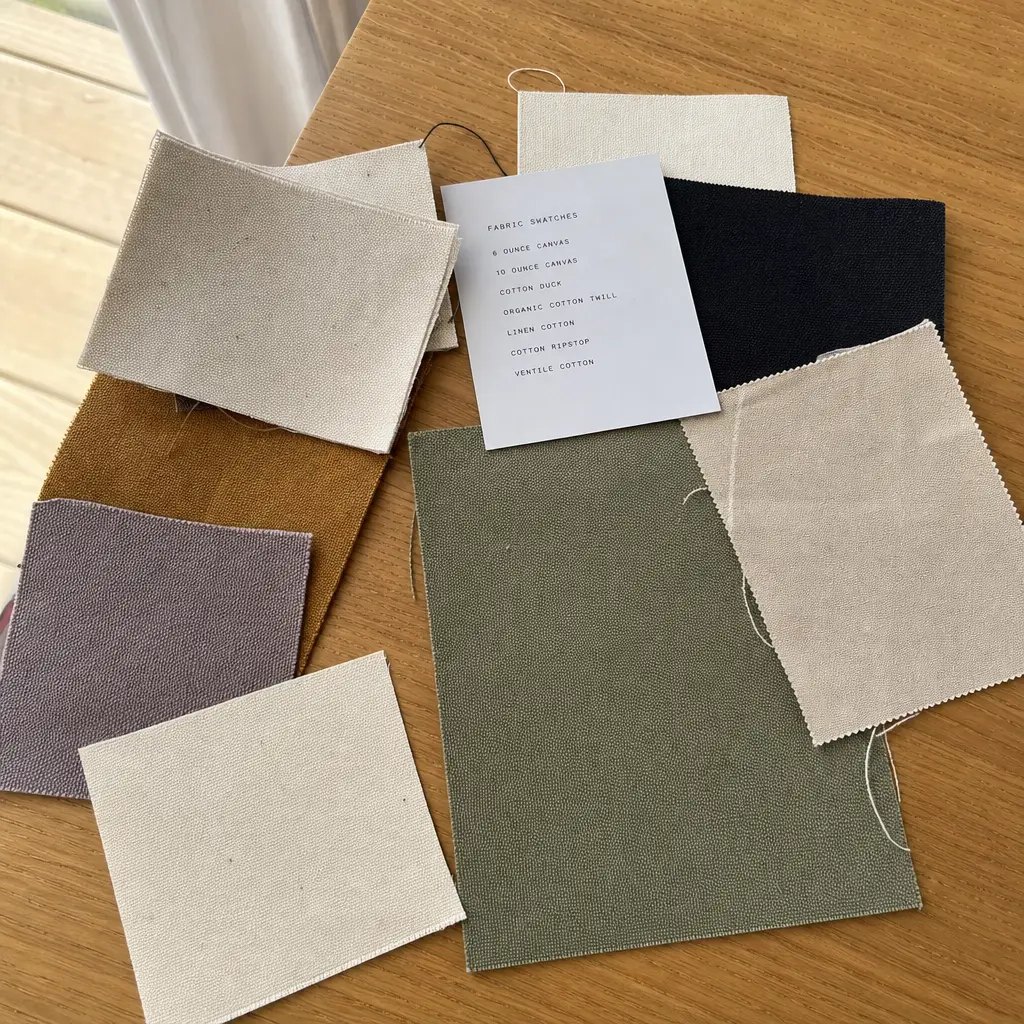
Canvas shade must be treated as a controlled material, not a background afterthought. Natural canvas can range from warm beige to speckled off-white. Bleached canvas gives a cleaner logo background but changes the artisan look. Dyed canvas can support seasonal merchandising, yet it introduces questions about shade consistency, rubbing, colorfastness, and print contrast. For brand-sensitive bakery packaging, approve a swatch or fabric card before approving ink color.
- Specify fabric in both oz and GSM, with agreed tolerance and whether the fabric is stock or made-to-order.
- Use natural canvas for a rustic bakery look, but confirm shade range and speckle level.
- Use bleached canvas when higher logo contrast is needed, then check whether the appearance still fits the brand.
- Use dyed canvas only after reviewing shade consistency, rubbing, and print opacity on the chosen color.
- Record whether washing, softening, starching, or finishing changes shrinkage, feel, or print behavior.
Control Finished Dimensions and Bottle Fit
Finished dimensions are more useful than cut-panel dimensions because sewing and finishing change the usable shape. The RFQ should state finished height, finished width, gusset depth, base depth if applicable, usable compartment width, handle loop length, handle width, and divider height. For soft textile goods, buyers often agree practical tolerances such as +/-5 mm to +/-10 mm on finished size, depending on construction and measurement point. The key is to agree the tolerance before bulk production, not during inspection disputes.
The bottle opening should allow bakery staff to load products without forcing them through the top. If loading requires pressure, the side seam can be stressed before the customer receives the carrier. If the opening is too loose, bottles can lean and make the front print look distorted. Two-bottle styles need enough separation that bottles do not knock together, but not so much width that the carrier becomes bulky or unstable.
The sample should be tested with the real product or a measured equivalent. For a program involving wine plus olive oil, wine plus syrup, or cider plus bakery goods, test the mixed set because uneven weights can make the carrier lean. A pattern that works with two identical wine bottles may not work with one tall bottle and one shorter jar or syrup bottle.
- Ask the factory to identify the bottle size used for its original pattern.
- Measure finished size after sewing and pressing, not only before assembly.
- Confirm usable opening and compartment width with actual bottle diameter, not nominal volume.
- Test unequal loads when the bakery sells mixed bottle sets.
- Photograph sample fit from front, side, top, and loaded carry position for the approval record.
Engineer Handles, Base, Seams, and Dividers
Handle failure is one of the highest-risk defects because the customer is carrying glass. The specification should define handle material, handle width, handle loop length, thread color, stitching pattern, and reinforcement. A 2.5 cm to 3 cm handle width is often more comfortable than narrow tape for bottle loads, although design and cost may vary. Handle joins should use bartack, box stitch, cross stitch, or an equivalent reinforcement matched to the intended load and fabric.
Base and side seams need the same attention. A narrow carrier concentrates force along the bottom seam and lower side seams. If the bakery wants the carrier to stand upright when loaded, base construction and bottle fit are central design points. Buyers should ask whether the bottom is a simple seam, boxed base, gusseted base, or reinforced panel, and how seam allowance is secured. Loose threads, skipped stitches, poor tension, and weak seam allowance can all become functional failures under load.
For two-bottle carriers, the divider is not decorative. It should be described by fabric, size, seam attachment, and reinforcement. A divider caught into the bottom seam usually controls bottle contact better than a divider attached only near the top, but it must be sewn consistently. If the order includes mixed contents, the divider should still prevent glass contact when one side is heavier than the other.
- Specify handle width, loop length, attachment position, and reinforcement pattern.
- Agree a loaded test weight and duration before sample approval and inspection.
- Define seam type, seam allowance, thread, and reinforcement at bottom and side seams.
- Require divider construction in the technical drawing, not only in email notes.
- Inspect loaded carriers for base sag, leaning, handle twist, seam strain, and divider movement.
Choose Print Method for Bakery Artwork
Screen printing is usually the most reliable method for solid bakery logos, simple illustrations, and one- to three-color artwork on cotton canvas. It can give good opacity and a traditional finish when the artwork has adequate line thickness. Common bakery graphics such as wheat icons, oven marks, bread silhouettes, rolling pins, establishment dates, and wine-pairing marks can print well if the file is prepared for textile texture rather than paper.
Heat transfer, digital print, woven labels, and cotton labels all have valid uses, but they need different proofing controls. Heat transfer can reproduce gradients and watercolor-style seasonal artwork, yet buyers should check hand feel, edge adhesion, cracking, and whether the finish looks too promotional for an artisan bakery. Digital print can support complex or short-run artwork, but color consistency and rub behavior must be tested on the actual canvas. Woven or cotton labels work well for subtle premium branding, especially when multiple bakery logos share one base carrier.
Artwork should be simplified for canvas. Fine serif type, small URLs, delicate flourishes, tiny wreaths, establishment dates, and QR codes can lose definition as ink interacts with the fabric weave. Low-contrast combinations, such as cream ink on natural canvas or muted gold on beige fabric, may disappear under warm retail lighting. Procurement should request supplier feedback on minimum stroke width and minimum text height for the selected method, then confirm with a physical strike-off when detail matters.
- Use screen print for strong spot-color logos and repeat wholesale volume.
- Use heat transfer only after checking adhesion, edges, hand feel, and rub on actual canvas.
- Use digital print for complex designs only after confirming color control and durability expectations.
- Use woven or cotton labels when premium subtlety is more important than large front graphics.
- Avoid tiny QR codes, thin flourishes, and small legal text unless a physical proof proves readability.
Print Proofing Checklist Before Release
A print proof must show actual scale and measurable placement. It should include finished carrier dimensions, front-panel print area, print size, distance from print to top edge, side seams, bottom seam, handle stitching, divider seam, gusset line, and packing fold. For centered front logos, buyers should define whether placement is measured from finished side seams, visible panel edges, or total bag width. Those reference points can differ after the carrier is sewn and folded.
Color approval requires more than a PDF. Pantone references are useful, but the same ink will not look identical on coated paper, natural canvas, bleached canvas, and dyed canvas. Natural beige undertones can warm burgundy and brown, soften black, and reduce contrast for cream or pale gold. For first production or color-critical bakery branding, approve a strike-off or pre-production sample on the actual bulk fabric or the closest approved production-equivalent fabric.
Version control prevents expensive mistakes. The approved proof should include file name, revision number, date, buyer contact, supplier contact, print method, ink references, print dimensions, and approval status. If a distributor manages several bakery branches or co-branded winery designs, each artwork should have its own approval line while sharing the same base carrier specification. Avoid informal file names such as final, final2, or latest unless the revision record is explicit.
- Confirm print size in millimeters, not only by visual proportion.
- Mark no-print zones around seams, handles, divider stitching, gusset folds, and packing folds.
- Define print-position tolerance, commonly around +/-3 mm to +/-5 mm when the construction allows.
- Identify number of colors, ink references, print side, setup charges, and print method.
- Show front, back, side, bottom, handle orientation, divider location, and fold direction where relevant.
- Separate digital layout approval from physical sample approval when color, texture, or detail is important.
Manage MOQ, Variations, and Reorders
MOQ is driven by fabric purchasing, cutting efficiency, print setup, sewing line scheduling, label production, packing labor, and inspection complexity. A supplier may offer better flexibility when one base construction, one fabric color, one handle, one divider, and one packing method are used across several print designs. The order becomes more expensive and harder to control when every bakery location asks for a different canvas color, handle color, divider style, label, and retail pack.
For multi-branch bakery groups or distributors, the cleanest sourcing strategy is often to standardize the base carrier and vary only the front print, woven label, hangtag, or barcode sticker. This allows the factory to buy one fabric lot, cut consistently, and use the same inspection criteria. Seasonal artwork can become a controlled design variation instead of a new product development project each time.
Quotes should state quantity tiers and variation rules clearly. The buyer should know whether MOQ applies by total order, by style, by fabric color, by print design, by label, or by packing method. Screen charges, strike-off charges, label charges, barcode application, carton allocation, and branch-level sorting should be separated from the unit price. This makes landed-cost comparison more accurate and reduces surprise charges at production release.
- Lowest complexity: one size, one fabric color, one print, flat bulk packing.
- Moderate complexity: one base carrier with several one-color bakery logo prints.
- Higher complexity: several fabric colors, handle colors, labels, and branch carton assortments.
- Highest complexity: custom dyed canvas, mixed print methods, retail packing, and destination sorting.
- Best reorder control: one master spec with artwork variations tracked by SKU or design code.
Pre-Production Sample Approval and QC Plan
The pre-production sample is the bridge between quotation and safe bulk production. It should use actual or production-equivalent canvas, actual print method, actual ink or transfer, actual handle material, actual divider construction, actual label, and intended packing fold. A showroom sample can help evaluate shape, but it should not release bulk production if fabric weight, shade, print process, reinforcement, or packing remains different from the final order.
Sample review should include loaded performance, not only appearance. Load the carrier with the real bottle or agreed equivalent, carry it by the handle, set it down loaded, and inspect base sag, leaning, handle twist, seam stress, divider movement, and print distortion. For two-bottle programs, load both compartments at the same time. If the bakery plans wine plus syrup or oil, test the actual mixed contents because unequal weights can reveal balance problems.
The QC plan should translate the approved sample into inspection checkpoints. Buyers should set AQL or inspection level if using third-party inspection, but even simple internal QC should define sample size, measurement points, defect categories, and pass/fail rules. Critical issues include broken handles, open seams, unsafe divider failure, severe stains, wrong artwork, wrong packing, and wrong carton assortment. Major issues include print misplacement beyond tolerance, unreadable logo detail, weak stitching, obvious shade mismatch, and creases through the retail-facing print panel.
- Approve only after checking construction, print, loaded performance, and packing behavior.
- Photograph approved samples with ruler views and close-ups of handles, divider, print, seams, and labels.
- Record approved deviations, such as adjusted logo size or acceptable natural canvas shade range.
- Keep one sealed reference sample for inspection and one working sample for internal review.
- Do not allow bulk cutting or printing until sample comments are closed in writing.
Quote, Packing, and Carton Controls
Many canvas wine carrier quotes look cheaper because key information is missing. A complete quote should state fabric weight, fabric type, finished dimensions, handle specification, divider construction, print method, print size, number of print colors, setup charges, sample fees, packing method, pieces per bundle, pieces per carton, estimated carton size, net weight, gross weight, production lead time, payment terms, and Incoterm. Without these fields, procurement cannot compare suppliers fairly or estimate landed cost.
Freight and warehouse handling can change the real cost. Heavy canvas, reinforced handles, two-bottle dividers, individual retail packing, barcodes, hangtags, and branch allocation increase labor, carton volume, and sometimes carton weight. A lower unit price with unrealistic packing may create higher freight, storage, repacking, or damage cost. Request estimated carton dimensions and gross weight at quotation stage, then reconfirm after the packing sample is approved.
Packing should match the buyer's operating model. Flat bulk packing works well for bakery back-room use and lower packaging waste. Individual bags, belly bands, hangtags, and barcode stickers may be needed for resale or distributor control. Printed faces should be protected from abrasion, moisture, odor, dust, and hard folds. Carton marks should identify style number, fabric color, print design code, quantity, PO number, carton number, destination, barcode, and country of origin where required.
- Use the same RFQ table for every supplier so unit prices are comparable.
- Separate unit price from screen charges, sample fees, label costs, retail packing, and inspection costs.
- Confirm Incoterm and named place, such as EXW factory, FOB port, CIF destination port, or DDP address.
- Approve carton label artwork before packing starts, especially for mixed bakery designs.
- Keep carton weight practical for warehouse handling and protect printed panels from hard compression.
Specification comparison for buyers
| Spec decision | Recommended B2B specification | When it fits | Buyer risk to check |
|---|---|---|---|
| Canvas weight and tolerance | 10 oz to 12 oz cotton canvas, commonly about 280 to 340 GSM; agree fabric-weight tolerance before bulk, such as +/-5% or supplier's documented mill tolerance | Single-bottle bakery wine carriers, two-bottle gift carriers, tasting events, seasonal hampers, and retail resale programs | Quoting only 'canvas' allows substitution; 6 oz to 8 oz fabric can look acceptable empty but sag, twist, or stress at seams when loaded |
| Finished size control | Specify finished height, width, gusset depth, compartment width, handle loop, and tolerance; typical soft-goods finished-size tolerance is often +/-5 mm to +/-10 mm depending on construction | Buyers using Bordeaux, Burgundy, sparkling wine, cider, olive oil, vinegar, syrup, or mixed bakery gift contents | Cut-panel dimensions are not enough; sewing, turning, washing, and pressing can shift the usable bottle opening and print position |
| Bottle-fit standard | Approve with the buyer's actual filled bottle or a measured dummy: bottle height, base diameter, shoulder diameter, cap/cork height, and filled weight | Wine pairing sets, cider launches, olive oil collaborations, vinegar sets, and corporate bakery gifts | A carrier developed around one 750 ml bottle shape may be too tight for sparkling wine or too loose for narrow syrup bottles |
| Two-bottle divider | Divider caught into the bottom seam or securely anchored near bottom and sides; specify divider fabric, width, seam type, and reinforcement | Two 750 ml bottles, wine plus oil, cider plus syrup, or mixed glass-bottle gift sets | A divider sewn only at the top can allow bottle bases to collide, increasing noise, breakage risk, and customer complaints |
| Handle reinforcement | 2.5 cm to 3 cm handle width where practical; bartack, box stitch, cross stitch, or equivalent reinforcement at handle joins; agree loaded test weight | Retail shoppers carrying from bakery counter to car, market stall purchases, hotel welcome gifts, and event handouts | Narrow handles may look premium in photos but feel sharp under load; weak joins can fail even when the fabric itself is strong |
| Print method | Screen print for solid one- to three-color logos; heat transfer or digital print only after testing adhesion, hand feel, and rub; woven/cotton label for understated branding | Bakery wordmarks, wheat icons, oven marks, holiday artwork, co-branded wine pairing graphics, and repeat seasonal designs | Fine flourishes, small serif type, low contrast ink, and QR codes can fill in or become unreadable on textured canvas |
| Print placement tolerance | Measure from finished seams and edges; set allowed print-position tolerance, commonly +/-3 mm to +/-5 mm for simple front-panel placement when feasible | Centered front logos, brand marks near the lower panel, co-branded bakery and winery artwork, and retail-facing panels | A perfect PDF mockup can become visually off-center after sewing tolerance, gusset folds, shrinkage, or packing crease |
| Color approval | Use Pantone or lab dip targets as references, then approve strike-off on actual bulk fabric shade; define practical color tolerance by method and substrate | Brand-color-sensitive bakery logos on natural, bleached, black, burgundy, olive, brown, or custom dyed canvas | Pantone on coated paper is not a reliable predictor on cotton; natural canvas undertones shift cream, beige, burgundy, olive, and brown inks |
| Packing plan | Flat pack in protected bundles, commonly 25 to 50 pcs per inner bundle when size permits; define fold direction, carton lining, moisture protection, and carton marks | Wholesale distribution, bakery warehouse receiving, branch allocation, retail resale, event kits, and seasonal inventory | Over-compression can crease print panels; poor lining can cause dust, odor, moisture, abrasion, or mixed-design receiving errors |
Buyer checklist before sampling
- Define the carrying scenario: one 750 ml bottle, two 750 ml bottles, sparkling cider, wine plus olive oil, wine plus syrup, vinegar, preserves, or a mixed bakery hamper with glass and baked goods.
- Provide bottle data in millimeters and grams: total height, base diameter, shoulder diameter, cap or cork height, and filled weight for every product that must fit.
- Specify finished carrier dimensions, not only cut size: finished height, finished width, gusset or base depth, usable compartment width, divider height, handle loop, and handle width.
- State fabric clearly: cotton canvas weight in oz and GSM, acceptable tolerance, natural or bleached shade, dyed color, organic or recycled-content requirement, and whether washing or softening is included.
- Define construction details: seam type, seam allowance, bottom reinforcement, divider anchoring, handle material, handle stitching pattern, thread color, and whether the carrier must stand upright when loaded.
- Provide editable vector artwork, Pantone or brand-color references, maximum print size, print side, minimum line thickness, minimum text height, and any areas where print must not cross seams or fold lines.
- Require a measured digital proof showing finished dimensions, safe zone, seam allowance, gusset fold, handle stitching, divider location, label placement, print location, and packing fold direction.
- For first orders, changed artwork, changed fabric color, or two-bottle construction, approve a physical pre-production sample made with actual fabric, actual ink, actual handles, actual divider, and proposed packing.
- Set written tolerances for finished size, print placement, print color, print registration, label position, fabric weight, shade range, seam quality, handle strength, odor, stains, carton count, and carton marks.
- Compare suppliers using the same RFQ basis: GSM, dimensions, print area, number of colors, sample fee, screen/setup charges, packing format, pieces per carton, Incoterm, payment terms, inspection scope, and lead-time trigger.
Factory quote questions to send
- What exact fabric is quoted: cotton canvas weight in oz and GSM, yarn or weave description if available, fabric-width basis, stock or made-to-order, and accepted mill tolerance?
- Is the canvas natural, bleached, dyed, washed, organic, recycled-content, or blended, and what shade variation should we expect between bulk lots?
- What finished dimensions are quoted, what finished-size tolerance do you recommend, and are dimensions measured flat, loaded, or after pressing?
- Which bottle shape was used for your pattern, and can you test our actual bottle diameter, height, cap/cork, and filled weight before approving the sample?
- What is the MOQ by style, fabric color, print design, label type, and packing method, and can multiple bakery logos share one base fabric lot?
- Which print method is included, how many colors are included, what is the maximum print area, and what screen, transfer, plate, digital setup, or color-matching charges apply?
- What minimum line thickness and text height do you recommend for our artwork on this canvas, and can you flag details that may fill in or lose readability?
- Can you produce a strike-off or pre-production sample using actual bulk fabric, actual ink or transfer, actual handle material, actual divider, and proposed packing fold?
- How long does sampling take after artwork approval, and what production step cannot start until sample approval: fabric purchase, cutting, screen making, printing, or sewing?
- What seam reinforcement is included at handles, side seams, bottom seam, divider, and gusset, and can you provide close-up photos before sample approval?
Quality-control points to confirm
- Fabric weight should be checked against the approved specification and sample; if the agreed canvas is 10 oz or 12 oz, confirm the GSM and allowed tolerance before accepting substitutes.
- Canvas shade should be compared with an approved swatch or bulk fabric card under consistent lighting because natural, bleached, dyed, and recycled-content canvas can shift logo color appearance.
- Finished dimensions should be measured flat from finished seams, not cut panels; record height, width, gusset depth, handle loop, handle width, and usable compartment width.
- Bottle fit should be verified with the buyer's actual bottle or measured dummy, especially for Burgundy, sparkling wine, cider, olive oil, syrup, vinegar, or mixed glass contents.
- Print color should be checked on the same fabric shade used for bulk, not on paper or a different canvas lot; note that cotton texture reduces apparent sharpness and saturation.
- Print position should be measured from finished top edge, side seams, bottom seam, gusset fold, and handle stitching; use the agreed tolerance rather than visual judgment only.
- Small text, URLs, dates, wheat illustrations, wreaths, fine serif details, and QR codes should remain readable after drying and light rubbing if they are included in approved artwork.
- Ink coverage should be checked for pinholes, broken lines, smearing, registration shift, uneven pressure, poor opacity, and cracking or lifting where transfer methods are used.
- Handle attachment should show the approved reinforcement pattern, such as bartack, box stitch, or cross stitch, with no skipped stitches, loose threads, or weak thread tension.
- Two-bottle dividers should be fixed as approved and should prevent bottle contact during carrying, setting down, and light movement with both compartments loaded.