Buying Problem: A Flat Proof Does Not Prove the Bag
Canvas wine carriers look simple until a bottle goes inside. Then the front panel curves, the gusset opens, the bottom crease moves, and the handle bartacks pull fabric toward the top. A bakery logo that sits perfectly on a PDF can suddenly look high, low, off-center, or squeezed. The issue is not the artwork alone. It is the way fabric, seams, glass weight, and decoration interact on a narrow load-bearing item.
For artisan bakeries, this matters because the carrier is part of the gift experience. It may sit beside sourdough, cheese, crackers, chocolate, olive oil, cider, preserves, or a corporate gift card. The branding has to be visible enough for a shelf or market table, but not so large that the gift feels like a giveaway bag. Words like “center front” and “make it balanced” leave too much judgment on the production floor. Buyers need coordinates, safe zones, tolerances, and a real sample.
The biggest risk usually appears close to launch. Holiday hampers, tasting events, wine-pairing boxes, and corporate gift programs have fixed dates. If the pre-production sample is rejected, the schedule tightens. If the team accepts poor placement, every retail display carries the mistake. A stronger RFQ turns logo placement into a production specification: format, bottle range, finished dimensions, print size, coordinates, decoration method, sample sequence, tolerances, packing, and inspection checks.
- Use millimeter coordinates from finished edges instead of vague placement language.
- Separate cut-panel measurements from the visible panel after sewing, folding, and bottle loading.
- Ask whether the factory centers artwork on the flat cut part or the finished front face.
- Approve logo placement on a stitched carrier with the target bottle inserted.
- Define the display condition: shelf standing, peg hanging, hamper packing, counter display, or hand carry.
- Request a full-size paper placement proof before screens, transfers, embroidery, or woven labels are made.
Start With Bottle Range, Carrier Format, and Sales Channel
Logo placement should not be finalized before the bottle range is known. A single-bottle canvas wine carrier has a narrow vertical front, so compact artwork usually performs best. A two-bottle carrier gives more width, but the divider or center stitch can interrupt the panel and change the visual center. If the bakery also sells cider, olive oil, vinegar, maple syrup, kombucha, or tall preserves, include those products in the sizing conversation before artwork is scaled.
Avoid the shorthand “standard wine bottle” in the purchase order. Bottle height, body diameter, shoulder shape, closure height, base width, filled weight, and label sensitivity all affect fit. A slim Bordeaux bottle may leave a smooth print area. A wider sparkling bottle or specialty olive oil bottle can push the canvas forward and distort the logo. Test the hardest item first, which is usually the widest, heaviest, or most label-sensitive product in the range.
The sales channel changes the spec as well. A gift-with-purchase carrier may prioritize cost and quick branding. Retail merchandise needs stronger construction, cleaner packing, barcode control, and often a care label. A corporate hamper may need the logo visible after tissue, ribbon, hangtags, or bakery insert cards are added. Wholesale programs should also think about receiving: how cartons are marked, how carriers are counted, and how the product sits on a shelf after unpacking.
- Typical single-bottle carrier: about 100-120 mm wide, 90-110 mm gusset, and 330-380 mm high, depending on bottle shape.
- Typical two-bottle carrier: about 190-230 mm wide, 90-110 mm gusset, and 330-380 mm high with a divider or internal partition.
- Common wine bottle body diameters often fall near 73-90 mm, but sparkling, cider, and specialty bottles can exceed that range.
- Keep front artwork at least 50 mm narrower than the usable flat panel to reduce seam and curve distortion.
- Record filled weight because handle bartacks and bottom seams must support glass, not only fabric.
- If one program uses several bottle types, approve the print on the widest and heaviest bottle combination.
Build a Logo Placement Map the Factory Can Measure
A useful placement map is more than an artwork mockup. It is a production drawing that marks the finished top edge, side seams, bottom seam or crease, gusset folds, handle attachment, bartacks, divider stitches, woven labels, hangtags, and no-print zones. The logo should be specified by width, height, distance from the top edge, distance from the bottom seam, and centerline or side clearance. If the logo has text, show the live artwork size, not only a box.
For most canvas wine carriers, the safest primary branding area is the upper-middle to center-front zone. It sits below the handle base and above the bottom crease, so it remains visible when the carrier stands upright. Lower front placement can look refined, especially for bakery gift sets, but test it in the actual display. Shelf lips, hamper trays, table edges, and carton compression can hide a logo that looked elegant in a close-up proof.
Two-bottle carriers need extra judgment. A sewn divider may create a vertical ridge, pull the front panel inward, or reduce the clean printable width. Large artwork can look split even when it is mathematically centered. In many bakery programs, a smaller centered emblem, two small marks over each bottle bay, or a front print plus a woven side label gives a cleaner result than one oversized graphic.
- Front center zone: commonly 60-90 mm below the finished top edge and centered on the visible front panel.
- Lower front zone: commonly 35-55 mm above the bottom seam or fold line for compact premium marks.
- Side label zone: use a 20-35 mm folded label and define its position from the bottom seam or top edge.
- Back panel zone: use for website, care message, batch note, or small origin statement, not primary shelf branding.
- Handle zone: suitable only for short woven tape or simple text because handles twist and rub during use.
- No-print zone: keep at least 25 mm clear of seams, bartacks, gusset folds, divider stitches, and bottom creases.
Specify Canvas by Weight, Weave, Color, and Shrinkage
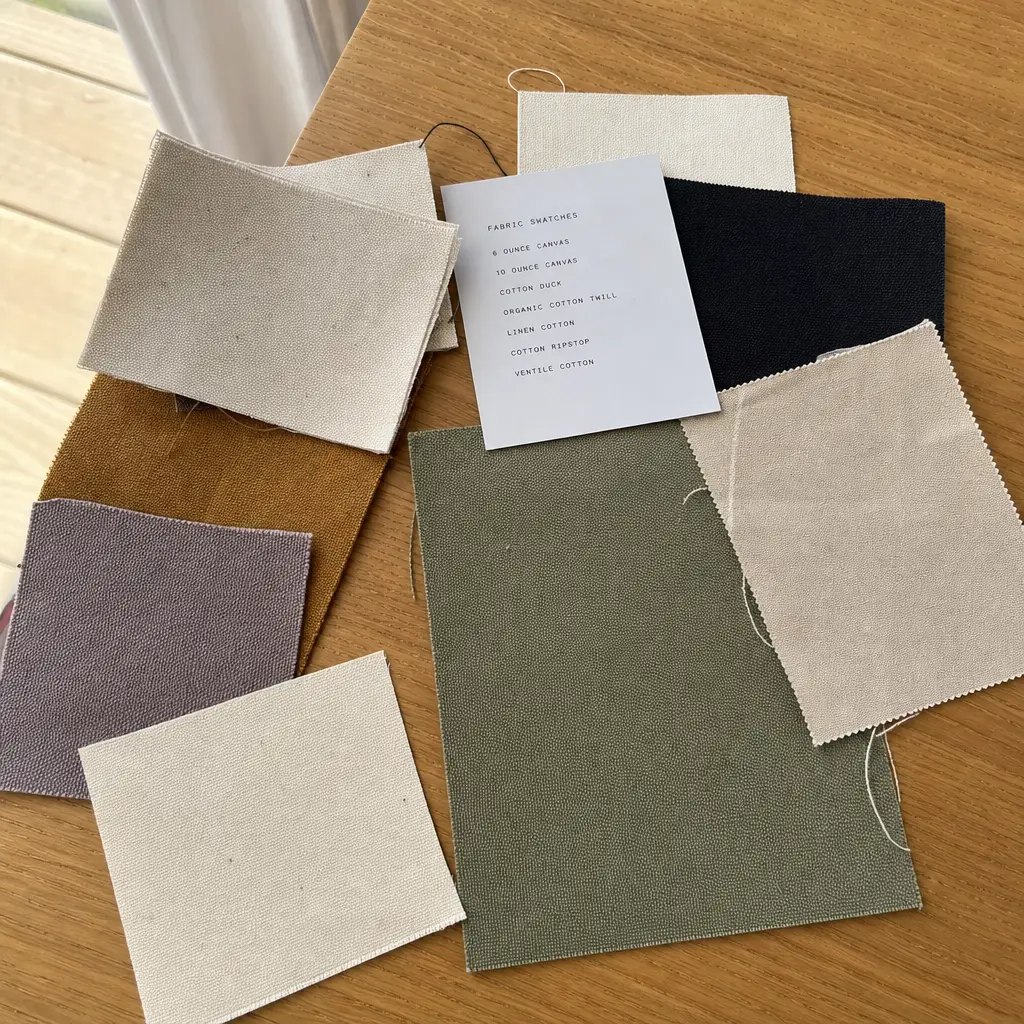
Canvas wine carriers are often quoted as 10oz, 12oz, or 14oz cotton canvas. That is a helpful starting point, not a complete specification. Two fabrics with similar GSM can feel different because of yarn count, weave, finishing, and supplier measurement method. One may print cleanly; another may look rough, loose, or slubby in the logo area. Ask for both oz and GSM, then confirm fabric width, hand feel, shrinkage, and finished carrier weight.
For many artisan bakery gift programs, 12oz canvas is the practical middle ground. It usually feels reusable, holds a bottle better than light promotional cloth, and can take a screen print cleanly when the weave is not too coarse. A 10oz carrier may be acceptable for short campaigns or lightweight single-bottle promotions, but it can wrinkle around the logo and collapse when empty. A 14oz carrier can look more premium, yet it also raises material cost, sewing effort, export weight, carton cube, and sometimes MOQ.
Color deserves the same discipline as construction. Natural canvas gives the warm, rustic bakery look buyers often want, but cotton flecks and slubs can reduce clarity for pale ink, thin linework, and distressed marks. Bleached canvas provides a cleaner background, though it may feel less artisanal. Dyed canvas can match a brand palette, but it requires shade-lot approval and rub checks. Recycled cotton blends may be suitable, provided surface consistency and strength are tested before artwork approval.
- 10oz canvas: lower cost and easier folding, but less structure and higher logo-wrinkle risk.
- 12oz canvas: balanced choice for reusable bakery wine carriers and regular retail programs.
- 14oz canvas: premium feel and stronger body, but higher landed weight, carton cube, and sewing stress.
- Natural canvas: rustic appearance, but flecks and slubs can interfere with small or pale artwork.
- Dyed canvas: strong brand effect, but requires shade approval, rub checks, and ink-contrast testing.
- Shrinkage: confirm whether dimensions are quoted before or after any washing, pressing, or finishing process.
Match Decoration Method to Artwork, Quantity, and Feel
One-color screen print is usually the most dependable decoration method for bakery logos on canvas wine carriers. It suits solid marks, wheat icons, bread silhouettes, monograms, addresses, and simple wine graphics. On coarse canvas, treat 0.4-0.5 mm as a practical minimum line thickness range. Positive text below about 4-5 mm high may lose readability, depending on fabric texture, ink, and font choice.
Two-color screen printing can work well, but it adds registration risk. Thin outlines, knockouts, and tiny accent shapes may shift by 1-2 mm and look uneven on a narrow panel. Heat transfer can reproduce gradients, seasonal graphics, and multi-color collaboration artwork, but it changes the surface feel. Test edge lifting, fold pressure, cracking, heat marks, surface shine, and whether the final carrier still feels like canvas rather than a plastic label.
Embroidery and woven labels are better for subtle, premium branding than for large shelf graphics. Embroidery adds texture, but dense filled areas can pucker the panel or create stiff points against glass. Woven labels feel durable and reusable, yet they are less visible from the front. Many premium bakery programs use a restrained front screen print for recognition, a woven side label for detail, and a removable hangtag for seasonal or corporate messaging.
- Screen print: specify ink type, Pantone target, print size, print position, color count, and approved sample.
- Two-color print: agree registration tolerance before sampling and avoid thin trapped outlines.
- Heat transfer: approve edge feel, flexibility, fold resistance, wash or rub performance, and surface shine.
- Embroidery: keep stitch count moderate and avoid large filled shapes on narrow bottle panels.
- Woven label: define size, fold type, yarn colors, spelling, seam position, and insertion depth.
- QR codes: test at final size on actual canvas; many small codes fail on textured fabric.
Turn Brand Guidelines Into Production Artwork
Brand guidelines tell the supplier what the identity should feel like. Production files tell the factory what to make. Send vector artwork such as AI, EPS, or PDF with fonts outlined, and provide separate files for each logo version, colorway, and placement. If the mark includes distressed flour texture, fine serif type, tiny social icons, delicate line drawings, or small address text, ask the supplier to flag details that need enlargement or removal before setup.
Color must be approved on fabric. A Pantone reference is helpful, but canvas is not coated paper. Natural cotton absorbs ink differently, dyed fabric changes perceived color, and recycled cotton may show more variation. Buyers should approve a printed strike-off or stitched pre-production sample using the same fabric and ink conditions planned for bulk. If the desired look is rustic, define acceptable cotton character instead of leaving inspection teams to debate every slub or fleck.
Scale should be judged at real viewing distance. A small logo may look tasteful in a close-up mockup and almost disappear once tissue, ribbon, bottle neck trim, or bread sleeves are added. A large logo may read well from across a table but make the gift feel promotional. The safest approval path is simple: full-size paper placement proof, stitched sample, target bottle loaded, then review in the intended shelf, hamper, or counter-display condition.
- Send outlined vector artwork and identify the approved logo version for each SKU.
- Specify Pantone or swatch references, then approve final color on the actual canvas.
- Set minimum line thickness and text height before screen or transfer production.
- Confirm whether the logo is visually centered after sewing or mathematically centered on the cut panel.
- Remove details that will close up on canvas, including thin distress textures and tiny serif type.
- Use a full-size paper proof to verify logo size, no-print zones, and coordinates before sampling.
Compare Quotes by Full Specification, Not Unit Price Alone
Two canvas wine carrier quotes can look close and still describe different products. A natural 12oz single-bottle carrier with one-color screen print is not comparable to a dyed 14oz two-bottle carrier with divider, custom handles, woven label, hangtag, barcode sticker, paper interleaving, and reinforced export cartons. Ask for a line-by-line quotation so the cost drivers are visible before the team chooses a supplier.
MOQ moves with fabric, construction, decoration, and packing. Custom dyed canvas can trigger fabric minimums and longer lead times. Heavier canvas increases material cost, sewing time, export weight, and carton volume. Dividers, binding, reinforced handles, and bartacks add labor. Decoration setup may include screens, transfer films, embroidery digitizing, woven label tooling, and separate charges for each logo version. For bakery groups with several locations, one shared construction with variable print or hangtag versions can keep the program manageable.
Packing is often where a low quote hides risk. Individual polybags, paper bands, tissue, barcode labels, insert cards, paper interleaving, and stronger cartons all add cost. They can also prevent offset marks, dirt, fold lines, and receiving disputes. A cheap quote that packs printed panels face-to-face without protection may become expensive once the goods arrive with transfer marks or crushed corners.
- Base cost drivers: fabric weight, fabric color, carrier size, gusset, divider, binding, handle length, bartacks, and stitch density.
- Decoration cost drivers: print colors, print size, screen setup, transfer film, embroidery stitch count, label setup, and sample remakes.
- Packing cost drivers: polybag, paper band, tissue, interleaving, hangtag, barcode sticker, care label, carton strength, and carton cube.
- MOQ often increases for custom dyed fabric, uncommon weights, custom woven labels, multiple logos, or retail-ready packing.
- Ask for FOB unit price, setup charges, sample costs, packing costs, carton data, and lead time assumptions separately.
- For multi-location bakeries, consolidate construction and vary only logo color, woven label, or hangtag where possible.
Approve Samples Under Real Use Conditions
A fabric swatch or print strike-off helps, but it does not prove the finished carrier. For production approval, request a stitched pre-production sample made with the same fabric, decoration method, logo size, handle construction, divider, reinforcement, and packing fold intended for bulk. Test it with the widest and heaviest approved bottle, not only while it is empty on a table.
The sample review should include measurement, handling, display, and packing checks. Measure the logo from fixed finished edges and compare it with the placement map. Insert the bottle, hold the carrier by the handles, and watch the logo. Does it wrinkle, twist, or drift visually? Place the sample on the shelf or table with the expected tissue, ribbon, hangtag, bakery insert, or bottle neck detail. Then fold it the way bulk goods will be folded and inspect the decoration after light pressure.
A signed sample prevents vague arguments later. One approved sample should stay with the factory production team, and one should stay with the buyer, inspection company, or receiving team. The approval sheet should record fabric weight, finished dimensions, logo size, coordinates, ink or label details, handle construction, divider type, packing method, and permitted tolerance. Without those notes, final inspection becomes a matter of opinion.
- Approve a stitched pre-production sample before bulk cutting, printing, or sewing.
- Load-test with the heaviest expected bottle or gift combination.
- Check whether the logo remains visually centered after bottle insertion and hand carry.
- Fold the carrier as bulk goods will be packed and inspect the logo after 24 hours under light pressure.
- Confirm hangtag, barcode, care label, paper band, or insert position if the carrier is retail-ready.
- Keep signed reference samples with both factory and buyer-side inspection teams.
Set QC Thresholds for Logo, Fabric, and Construction
Quality control works best when brand expectations become measurable pass-fail checks. For front screen print, plus or minus 5 mm from the signed sample is a common practical placement tolerance, assuming the carrier itself is within dimensional tolerance. Woven labels often need plus or minus 3 mm because small shifts are easier to notice. Multi-color print should be checked against the agreed registration tolerance, especially around outlines, small type, and knockout details.
Fabric inspection matters because the logo depends on the surface underneath it. Incoming material should be checked for GSM, oz weight, shade, hand feel, stains, holes, loose yarns, odor, shrinkage, and excessive slubs in the print area. Natural canvas variation is normal, but buyer and supplier should agree which knots, oil marks, dark flecks, or slubs are acceptable. If the bakery uses pale ink or fine black linework, tighten standards inside the print area.
Construction inspection is just as important as print inspection because the carrier holds glass. Check handle bartacks, bottom seams, side seams, divider seams, binding, and stitch density together with logo position. A clean logo on a weak carrier is still a claim risk. The inspection plan should include bottle insertion and removal, handle pull review, divider alignment, loose thread trimming, cleanliness, and final packing verification.
- Logo placement: check against the signed sample, commonly plus or minus 5 mm for front print.
- Woven labels: check fold, spelling, yarn color, insertion depth, and plus or minus 3 mm position tolerance.
- Print defects: reject smearing, ghosting, pinholes, missing ink, color mismatch, poor registration, cracking, or transfer lift.
- Fabric defects: inspect weight, shade, odor, stains, slubs, loose yarns, shrinkage, and finished carrier weight.
- Seam defects: reject skipped stitches, loose bartacks, open seams, raw load-bearing edges, and weak divider stitching.
- Bottle fit: insert and remove approved bottles without scraping labels, excessive bulging, or logo distortion.
Protect Branding With Packing and Carton Controls
Canvas wine carriers are usually packed flat to reduce freight space. That makes sense, but flat packing can damage decoration if the method is not controlled. Fresh screen print pressed against another printed panel can create offset marks, surface shine, or sticking. Heat transfers can show edge impressions or cracking if the fold line crosses the artwork. Natural canvas can also pick up moisture, dust, and carton odor, so packing belongs in the specification, not in a last-minute email.
Sustainability rules may limit individual polybags for bakery and food-adjacent brands. If plastic is not allowed, specify paper interleaving, tissue, paper banding, or controlled bundle packing. Do not leave the choice open. A factory trying to reduce cube may pack bare carriers tightly, which can crease the logo or dirty the fabric. Barcode stickers and hangtags should be positioned so they do not cover the logo, leave adhesive residue, or crease the printed panel.
Carton planning affects margin and claim risk. Heavier 14oz two-bottle carriers with dividers need stronger cartons and usually fewer pieces per carton than light single-bottle versions. Before order confirmation, request pieces per carton, carton dimensions, gross weight, net weight, and estimated CBM. Carton marks should identify SKU, logo version, fabric color, quantity, purchase order number, destination, and carton sequence so multi-bakery or multi-store programs are easier to receive.
- Use paper interleaving, tissue, or controlled stacking direction when printed panels touch.
- Avoid folding through the logo unless the decoration passes a fold-pressure test.
- Specify carton strength suitable for carrier weight, transport route, and warehouse stacking.
- Mark cartons by SKU, logo version, fabric color, quantity, gross weight, net weight, carton number, and purchase order.
- If polybags are restricted, define paper banding or bundle packing instead of leaving packing unspecified.
- Check moisture protection, carton cleanliness, and odor because cotton canvas can absorb warehouse smells.
Specification comparison for buyers
| Spec decision | Recommended option | When it fits | Buyer risk to check |
|---|---|---|---|
| Primary front logo placement | Place artwork 60-90 mm below the finished top edge, centered on the visible front panel, with at least 25 mm clearance from side seams, handle bartacks, divider stitches, gusset folds, and bottom crease | Best for artisan bakery retail shelves, farmers markets, tasting events, wine-pairing gifts, and holiday hampers where the mark must remain visible when the carrier stands upright | A logo approved on a flat PDF can shift visually after sewing and bottle loading; require a stitched pre-production sample with the target bottle inserted |
| Lower front logo placement | Place the logo 35-55 mm above the bottom seam or fold line, normally using a compact mark below 90 mm high | Useful for premium gift sets where the top panel is reserved for ribbon, hangtag, bakery label, corporate card, or bottle neck trim | Logo may be hidden by shelf lips, hamper inserts, table edges, or carton compression creases if positioned too low |
| Side seam woven label | Use a 20-35 mm folded woven label sewn into the side seam or lower side seam, with label top or fold position measured from the bottom seam | Good for understated reusable branding, premium bakery gift shops, and programs where a front print would feel too promotional | Small labels appear inconsistent if seam allowance or insertion depth varies; specify plus or minus 3 mm placement tolerance |
| One-color screen print | Use water-based or plastisol screen print with minimum line thickness of 0.4-0.5 mm and minimum positive text height of 4-5 mm on coarse canvas | Most reliable for bakery names, simple wheat icons, bread silhouettes, addresses, one-color emblems, and repeat retail programs | Fine serif type, distressed flour texture, tiny social icons, and QR codes can fill in; approve actual-size print on production canvas |
| Two-color screen print | Limit to two solid colors, avoid hairline traps, and agree registration tolerance before sampling, commonly plus or minus 1-2 mm depending on factory capability and panel size | Works when the bakery needs a house color plus accent color without moving to full-color transfer | Misregistration is obvious on narrow panels; thin outlines around bread, grape, or bottle illustrations may look uneven |
| Heat transfer print | Use for multi-color graphics, gradients, photo-style seasonal art, or short logo-version runs where screen setup is inefficient | Fits regional collaborations, limited holiday campaigns, tasting-room graphics, and distributor test orders | Check transfer edge feel, heat marks, cracking, peeling, fold resistance, and whether the carrier still feels like canvas |
| Embroidery | Restrict to small monograms, initials, or emblem-style marks; use backing and avoid dense filled blocks on narrow bottle panels | Works for high-end bakery gift shops, hotel bakery programs, and small premium runs | Dense stitches can pucker canvas, stiffen the panel, create pressure marks against glass, and distort bottle fit |
| Canvas weight | Use 10oz for budget promotions, 12oz for standard reusable gifting, and 14oz for heavier premium carriers after sewing and carton cost review | 12oz is usually the safest middle spec for bakery wine, cider, olive oil, syrup, or specialty bottle gift sets | Quotes based only on GSM are not comparable; request oz, GSM, fabric width, weave feel, shrinkage, finished carrier weight, and fabric swatch |
| Divider and bottle fit | For two-bottle carriers, use a sewn divider or internal partition sized to the actual bottle diameter range, commonly 75-95 mm depending on product mix | Needed for wine plus olive oil, cider plus syrup, two wine bottles, or mixed beverage bakery hampers | Divider seams can create a center ridge, reduce printable width, scrape bottle labels, or make visual centering different from mathematical centering |
Buyer checklist before sampling
- Define the commercial use: single wine bottle, two bottles, cider, olive oil, syrup, vinegar, jam bottle, mixed bakery hamper, tasting event giveaway, or retail merchandise.
- Record the actual bottle range by height, body diameter, shoulder shape, base shape, closure height, label sensitivity, and filled weight before confirming carrier dimensions.
- Specify finished carrier dimensions in millimeters, not only cut-panel dimensions: width, height, gusset, handle drop, divider width, seam allowance, and bottom construction.
- State canvas weight in oz and GSM, fabric composition, fabric color, dyeing method if applicable, shrinkage allowance, shade tolerance, and expected finished carrier weight.
- Mark logo placement from fixed finished edges in millimeters, including logo width, logo height, distance from top edge, distance from bottom seam, and side clearances.
- Set a print-safe zone at least 25 mm away from side seams, handle bartacks, divider stitches, bottom creases, gusset folds, and heavy bottle contact points.
- Provide vector artwork with outlined fonts, Pantone or approved color references, minimum text height requirements, and notes on details that may be simplified for production.
- Approve a stitched pre-production sample using actual canvas, actual decoration method, actual handle reinforcement, actual divider, and actual bottle loading.
- Define measurable tolerances: commonly plus or minus 5 mm for front logo placement, plus or minus 3 mm for woven labels, and agreed print registration for multi-color work.
- Confirm whether woven labels, care labels, hangtags, barcode stickers, price labels, paper sleeves, tissue, or retail inserts are included in the quoted unit price.
Factory quote questions to send
- What canvas weight are you quoting in both oz and GSM, and what is the estimated finished weight per carrier after handles, divider, and decoration?
- Is the fabric natural, bleached, dyed, recycled cotton, organic cotton, or cotton blend, and what shade variation, slub level, odor, and shrinkage should we allow?
- What are the finished dimensions, gusset depth, handle length, handle drop, seam allowance, divider construction, and recommended bottle diameter range?
- What is the maximum safe printable area on the front panel after seam allowance, handle bartacks, divider stitch, bottom crease, gusset fold, and bottle bulge are considered?
- Which decoration method do you recommend for our artwork and order quantity: screen print, heat transfer, embroidery, woven label, or combined branding?
- What minimum line thickness, minimum text height, color limit, registration tolerance, and QR code size do you require to keep the logo readable on this fabric?
- Can you provide a paper placement proof, fabric or ink strike-off if needed, and a stitched pre-production sample before bulk production starts?
- What is the MOQ for this exact construction and decoration method, and how does MOQ change for dyed fabric, custom handles, woven labels, dividers, or multiple bakery logo versions?
- What setup charges are excluded from the unit price, including screens, transfer films, embroidery digitizing, woven label setup, sample freight, and retail packing?
- What are the sample lead time and bulk lead time after artwork, fabric, packing, payment, and purchase order details are approved?
Quality-control points to confirm
- Logo placement tolerance should normally be within plus or minus 5 mm from the signed sample for front screen print and plus or minus 3 mm for small woven labels unless the buyer specifies otherwise.
- For two-color screen print, registration should be checked against the approved sample and agreed tolerance; small misalignment around outlines or knockout type should be treated as a visible defect.
- Screen print edges should be sharp enough that bakery names, city text, bread icons, wheat marks, and simple wine graphics remain readable at normal shelf distance.
- Print color should be checked against an approved swatch, Pantone reference, strike-off, or signed sample under consistent lighting, not only by phone photo.
- Canvas GSM, oz weight, hand feel, shade, shrinkage, odor, slub level, and finished carrier weight should be verified during incoming material inspection.
- Handle bartacks, side seams, bottom seams, binding, and divider seams should be checked for skipped stitches, loose threads, uneven stitch density, exposed raw edges, and weak reinforcement.
- A real bottle fit test should be performed using the approved bottle height and diameter range before production release and during final inspection.
- Printed panels should pass dry rub, light fold, and visual checks for cracking, smearing, ghosting, pinholes, transfer, offset, surface shine, or ink contamination.
- Embroidery should be checked for puckering, thread tension, backing show-through, loose threads, stitch density, and whether stitching creates pressure points against the bottle.
- Woven labels should be checked for correct fold, yarn color, spelling, cut edge quality, seam insertion depth, and consistent position from the signed sample.