Start With the Bakery Program, Not the Artwork
Canvas wine carriers for artisan bakeries are not just small tote bags with a bottle-shaped opening. They sit at the intersection of food retail, local gifting, glass-bottle safety, and brand presentation. A carrier may be used for a sourdough-and-wine pairing one month, a vineyard collaboration the next, and a holiday hamper in the fourth quarter. The same product may be handled by bakery staff, warehouse teams, distributors, and end customers. That is why the sourcing brief should begin with the actual program, not the logo file.
A single-store bakery may be comfortable with simple bulk cartons, a lower MOQ, and a more rustic finish. A regional bakery group needs tighter controls: repeatable dimensions, SKU labels, carton marks, barcode rules, and a packing format that receiving teams can process quickly. A corporate gifting program raises the bar again because the carrier is part of a paid gift experience. In that case, clean folding, stain control, consistent logo placement, and predictable carton quantities matter as much as the fabric weight.
Before asking suppliers for price, describe the route the carrier will take. Will it ship empty to stores, arrive at a fulfillment center, or be combined with bread sleeves, pastry boxes, preserves, cheese, or outer gift cartons after import? Will staff hang it near checkout, stack it under a counter, pre-load it for display, or ship it directly to recipients? Each answer changes the best handle style, gusset depth, folding method, carton size, and retail finishing.
This is also where procurement can prevent quote confusion. If one supplier prices a loose bulk pack and another includes hangtags, paper bands, barcode labels, and stronger cartons, the unit prices will not tell the real story. The RFQ should make the use case and carton packing plan visible from the start, so buyers can compare unit cost, freight cube, quality risk, and receiving labor on the same basis.
- Define the sales channel: bakery counter, online gift bundle, wholesale distributor, winery collaboration, event pack, or corporate gifting program.
- Map the handling route: factory to importer, importer to warehouse, warehouse to store, store to customer, or direct-to-recipient fulfillment.
- State whether carriers ship empty, get loaded locally, or combine with bread sleeves, pastry boxes, preserves, cheese, or outer gift cartons.
- Set the buying priority early: lowest unit cost, premium hand feel, plastic-free packing, retail-ready presentation, fast replenishment, or lowest landed cost.
- Ask suppliers to quote the product and carton packing plan together so CBM, defect risk, and unit price can be compared accurately.
Measure the Bottle Range Before Locking Size
The phrase “standard 750 ml bottle” creates avoidable problems. Bordeaux bottles are relatively straight and efficient. Burgundy bottles are wider through the shoulder. Sparkling wine bottles are often heavier, taller, and broader because the glass is thicker. Cider, olive oil, syrup, and non-alcoholic beverage bottles may have square shoulders, tall closures, or labels that catch on a tight opening. If a bakery changes winery partners by season, the carrier should be built around the largest realistic bottle, not the neatest sample on the buyer’s desk.
Procurement teams should collect simple but useful bottle data before the RFQ goes out. Record height, base diameter, widest shoulder diameter, neck or cap diameter when relevant, and filled weight. For two-bottle carriers, list the heaviest intended combination. A wine-and-olive-oil gift set may require a different divider and more clearance than two matching Bordeaux bottles.
Fit is not only about whether the bottle can be pushed inside. Bakery staff may load carriers while serving a line of customers, especially around holidays. A tight mouth opening slows the handoff, scuffs labels, and stresses seams. As a working starting point, many buyers allow about 10-15 mm total width clearance around the widest bottle area, plus enough height clearance so the handle does not press awkwardly against the neck. Final clearance still needs sampling because canvas stiffness, gusset shape, and handle placement all affect real use.
Bottle fit also changes freight. A deeper gusset, taller panel, thicker divider, or wider mouth uses more fabric and creates a bulkier folded item. That can reduce pieces per carton and raise CBM. For that reason, size approval should happen before landed-cost comparison. The cheapest quote may simply be based on a smaller carrier that will not support the actual bakery program.
- Provide actual bottle measurements instead of relying on “standard wine bottle” language in the RFQ.
- Identify the largest bottle the carrier must accept, including Burgundy, sparkling, cider, olive oil, syrup, or specialty beverages if relevant.
- Decide whether the order needs one universal fit or separate SKUs for single bottle, two bottle, and specialty bottle bundles.
- Test loading speed with staff-style handling, not only a still photo of a bottle inside the sample.
- Keep artwork away from lower gusset folds and curved areas where a loaded bottle can distort the logo.
Choose Canvas Weight With GSM Evidence
For most canvas wine carriers for artisan bakeries, 10 oz to 12 oz cotton canvas is the practical sourcing range. Depending on weave and finishing, that is typically about 340-407 GSM. The conversion from ounces to GSM is not perfectly uniform, so a buyer should ask for both the commercial fabric weight and the measured GSM from the production lot or a production-equivalent swatch. Otherwise, two suppliers can both quote “12 oz canvas” while delivering noticeably different structure and hand feel.
An 8 oz canvas can work for a short-term promotion where the main goal is a low-cost giveaway. The tradeoff is easy to feel. The carrier may collapse around the bottle, wrinkle more visibly, and look weak beside premium bakery packaging. If the bag is part of a higher-value gift set, the fabric should support the value of the wine, bread, and other components rather than making the whole offer feel temporary.
A heavier 14 oz or 16 oz canvas can be attractive, but heavier is not automatically better. Thick canvas may require stronger needles, create bulky handle folds, slow sewing, and reduce pieces per carton. It can also hold deep fold creases if cartons are compressed too aggressively. Approve heavier fabric only after checking sewing quality, folded thickness, carton quantity, and whether the premium feel is worth the higher landed cost.
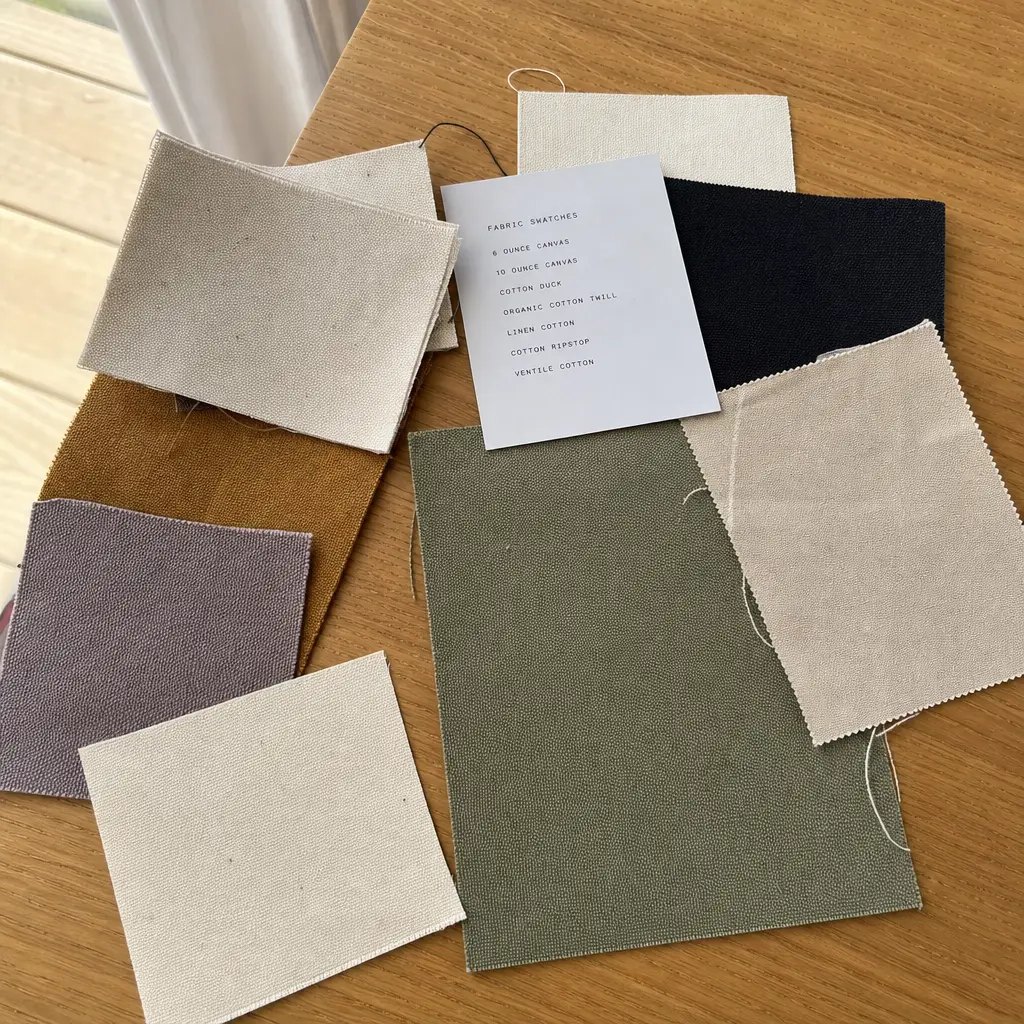
Natural canvas brings its own visual rules. Seed flecks, small slubs, and modest shade variation may suit an artisan bakery aesthetic. Oil marks, mildew odor, dirty fold lines, heavy weaving faults, and large dark slubs through the logo area should not be excused as natural character. Dyed canvas adds lab dip approval and shade tolerance. Recycled cotton blends need closer review for strength, color consistency, and print clarity.
- Use 8 oz only for light promotions where structure, reuse, and premium presentation are not primary requirements.
- Use 10 oz for basic retail single-bottle carriers with simple printing and moderate durability expectations.
- Use 12 oz for reusable gift carriers, two-bottle formats, and programs where shelf appearance matters.
- Use 14 oz or heavier only after checking sewing feasibility, folded bulk, carton CBM, and crease behavior after packing.
- Review fabric swatches under bakery-style lighting because natural canvas shade can shift between digital images, trade-show samples, office lighting, and retail counters.
Engineer Handles, Gussets, Seams, and Dividers
The handle is the first place to slow down. A filled 750 ml wine bottle often weighs roughly 1.2-1.6 kg, and sparkling bottles can be heavier. Two-bottle carriers may carry about 2.5-3.5 kg depending on the bottle mix. Customers may also be holding pastries, jars, or another purchase in the same hand. The carrier needs to feel comfortable, stay balanced, and remain secure after repeated lifting.
Common handle options include self-fabric canvas, folded canvas, and cotton webbing. Cotton webbing in the 25-35 mm range is often stable and comfortable. Self-fabric handles can look more integrated and rustic, which may suit artisan bakery branding. Reinforcement should be named, not assumed: box-X stitch, bar tack, dense lockstitch, backtack, or another agreed method. “Standard handle” is too vague unless the sample has already been tested with the intended filled weight.
Stitching also needs practical language in the PO. Ask the supplier to state stitch type, stitch density, thread, and reinforcement at the handle joints, side seams, bottom gusset, and divider attachment. A common canvas sewing target is about 8-10 stitches per inch, but the right setting depends on fabric thickness and thread. Too few stitches may weaken the seam. Too many can perforate the canvas and create a tear line.
The gusset controls both standing performance and load distribution. A shallow gusset packs flatter but may tip when loaded. A deeper gusset supports counter display and easier loading, but it uses more fabric and increases carton bulk. Two-bottle styles add another risk: the divider must work when the bag is loaded and moving. During sampling, lift the carrier, tilt it, walk with it, and lightly shake it. Bottles should not strike each other during normal handling.
- Specify handle width, handle drop, handle material, stitch pattern, thread color, and reinforcement position in the tech pack or PO.
- Check that the loaded handle does not twist sharply, cut into the hand, or pull the front panel badly out of shape.
- Confirm gusset depth based on whether the loaded carrier must stand upright or only function as a hand-carry bag.
- For two-bottle carriers, require the divider to prevent bottle contact when lifted, tilted, and lightly shaken.
- Inspect bottom seam alignment and corner finishing because these areas absorb concentrated bottle weight during use.
Make Logo Printing Work on Real Canvas
Screen printing is usually the best starting point for cotton canvas wine carriers when the artwork is a solid bakery logo in one to three colors. It is cost-effective for wholesale quantities and fits the natural texture many artisan brands want. Still, canvas is not a smooth paper label. The weave absorbs ink, edges soften, and fine type can lose sharpness. Small serif text, thin strokes, distressed illustrations, and low-contrast ink should be tested on the actual fabric.
A digital proof confirms placement and size, but it cannot prove ink absorption, opacity, curing, Pantone appearance, or rub resistance. Request a strike-off or printed sample on production-equivalent canvas. If the front panel has a bottom gusset fold, handle stitching, or nearby seams, the artwork may need to move upward or become smaller. For many bakery programs, a simple one-color logo with enough negative space looks cleaner and performs better than a complex illustration.
Heat transfer can reproduce gradients, fine detail, or photographic artwork, but it changes the surface feel and may look less natural on rustic canvas. Embroidery can feel premium, though it may pucker narrow panels and raise cost. Woven labels or cotton side labels are useful when the bakery wants a permanent brand marker while changing seasonal front graphics.
Brand placement must also survive the packing plan. If printed panels are folded face-to-face or pressed against handles before ink is fully cured, ink transfer can occur. Dark green, black, burgundy, navy, and other saturated inks on natural canvas should be checked after drying, after folding, and after packed compression. The approved carton method should protect the print without adding materials the buyer does not want.
- Choose screen print for solid bakery logos, simple seasonal graphics, and repeatable wholesale orders.
- Set minimum text height and line thickness from a real fabric strike-off, not only from a digital proof.
- Keep artwork away from seams, handle stitch zones, lower gusset folds, and high-friction folded areas.
- Use heat transfer only when artwork detail cannot be simplified and the buyer accepts the changed surface feel.
- Confirm dry rub, wet rub where relevant, and carton abrasion checks before approving mass production.
Quote MOQ, Samples, and Lead Time Honestly
MOQ is shaped by the full specification, not only by the bag silhouette. A stock natural canvas single-bottle carrier with one-color screen print may be feasible at 300-500 pcs when the factory has suitable fabric and trims available. Dyed canvas, custom GSM, recycled fabric, custom labels, barcode application, retail folding, or individual packing can raise MOQ because each input brings its own minimum and setup time.
The cleanest way to compare suppliers is tier pricing at a locked specification. Ask every factory to quote 300, 500, 1000, and 3000 pcs using the same fabric, print method, handle construction, divider, label set, folding method, and carton plan. If one quote quietly uses lighter fabric, removes the divider, or assumes bulk packing while another includes retail-ready finishing, the unit prices are not comparable.
Separate one-time charges from production costs. Screen charges, artwork cleanup, lab dips, strike-offs, blank samples, printed samples, pre-production samples, hangtag printing, barcode setup, and courier freight should be visible. Some suppliers include screens above a certain order quantity, while others list them separately. Both approaches can work, but procurement needs the detail to forecast reorders and seasonal expansions.
Sampling should move in steps. A blank construction sample checks size and sewing. A print strike-off checks ink on fabric. A pre-production sample confirms final fabric, print, stitching, labels, folding, and packing. For a holiday bakery launch, lead time should include sample revisions, material booking, production, inspection, export packing, freight, customs, and local delivery. A cheap quote with no realistic calendar can become expensive if goods miss the selling window.
- Request MOQ by fabric color, print design, color count, label type, retail finishing, and carton packing method.
- Ask for tier pricing at 300, 500, 1000, and 3000 pcs using the identical specification.
- Separate unit cost from screen charge, sample cost, lab dip, labels, barcode setup, packing upgrade, and courier freight.
- Confirm whether the supplier can retain screens, patterns, cutting templates, and approved samples for reorders.
- Avoid pilot orders made with substitute fabric or cheaper construction if the goal is to validate future bulk production.
Design the Carton Packing Plan Before the PO
Carton packing is not a final warehouse detail. Canvas wine carriers are narrow, but handles, gussets, and dividers create uneven bulk. If the factory folds them randomly, cartons fill inconsistently and front panels arrive with different crease marks. If cartons are over-compressed to reduce CBM, handles can flatten, gussets can distort, and printed panels can rub. If cartons are underfilled, goods shift during transit and pick up random creasing. The packing method should be approved before PO release.
A workable plan names the folding direction, bundle quantity, inner packing, export carton quantity, carton dimensions, carton board strength, moisture protection, sealing method, and carton marks. For 10-12 oz single-bottle styles, 50-100 pcs per export carton is a common planning range. Two-bottle carriers, thick dividers, heavy canvas, hangtags, paper bands, or individual polybags can reduce that quantity. Final carton data should come from a packed sample or a production-equivalent packing trial whenever possible.
Buyers should decide early whether individual polybags are necessary. Plastic-free goals may favor paper bands, tissue separation, or clean bulk bundles. That choice still needs protection against dust, moisture, and print rubbing. If the carrier requires barcode scanning, retail shelf cleanliness, direct-to-store allocation, or individual handling, a polybag or another retail-ready pack may be justified.
Carton marks deserve the same discipline as artwork. Distributor orders often need SKU, PO number, color, design, quantity, gross weight, net weight, carton number, destination, and country of origin. Multi-location bakery programs may need allocation labels. Late carton mark changes delay packing, inspection, and shipment booking, especially when several designs are moving through production at the same time.
- Approve one folding method with photos showing front, back, handle position, divider fold, bundle direction, and carton orientation.
- Choose inner packing: no individual pack, tissue separation, paper band, bundle bag, individual polybag, or retail-ready folded pack.
- Require carton dimensions, pieces per carton, gross weight, net weight, board strength, total cartons, and estimated total CBM in the quote.
- Avoid bulging cartons because they indicate compression risk and may fail warehouse stacking or receiving expectations.
- Finalize carton marks early when goods ship to distributors, multiple bakery locations, fulfillment centers, or retail replenishment hubs.
Compare Landed Cost Instead of FOB Alone
A low FOB unit price can hide cost elsewhere. Canvas weight, handle bulk, dividers, labels, and individual packing all increase carton volume. For importers and bakery groups, the more useful measure is landed cost per usable carrier. That includes unit price, freight, duty, customs handling, inspection, local delivery, warehouse handling, and any rework or repacking at destination.
CBM per piece matters because canvas wine carriers are soft goods but should not be crushed without limits. Extreme compression may lower freight cost on paper, but it can also create deep handle creases, distorted gussets, rubbed print, and wrinkled retail presentation. If the carrier is part of a premium bakery gift, poor appearance reduces commercial value even when the bag can still carry a bottle.
Ask how the carton data was created. Was it estimated, calculated from a pattern, copied from a previous order, or measured from a packed sample carton? Early estimates are acceptable during the first RFQ stage. Before shipment booking, final carton dimensions and gross weight should be confirmed with the same fabric, handle, divider, labels, and packing method used for production. Gross weight also matters for warehouse handling and downstream parcel or store-delivery requirements.
Landed cost should also allow for receiving accuracy. Incorrect carton quantities, mixed designs without clear labels, unreadable carton marks, or inconsistent bundle counts create sorting labor at destination. In a seasonal bakery launch, that rework can erase any savings gained from choosing a cheaper quote.
- Compare FOB unit price together with CBM per piece, carton weight, carton quantity, and expected freight mode.
- Ask whether carton data is estimated or based on a packed sample with the same fabric, handle, divider, labels, and packing method.
- Calculate landed cost per usable carrier, allowing for inspection, local handling, storage, and potential repacking risk.
- Do not approve extreme compression solely to reduce CBM if it damages presentation, handle shape, or print quality.
- Check carton weight against warehouse handling limits and downstream parcel or store-delivery requirements.
Approve Samples Under Loaded Conditions
Sample approval should copy real bakery handling as closely as possible. An empty flat sample can look excellent, then fail once a filled bottle is inserted. Load the sample with the intended bottle, lift it repeatedly, set it down on a counter, insert and remove the bottle several times, and inspect the side seams, handle joints, bottom gusset, and mouth opening. If the carrier is part of a gift set, test it alongside the bread sleeve, pastry box, jam jar, tissue wrap, or outer gift carton it will meet in production.
Two-bottle samples need a tougher check. Load both bottles, tilt the carrier, walk with it, and lightly shake it. The divider should keep bottles apart, and it should not pull out of shape. If sparkling wine or mixed bottles are within the intended use, test the heaviest realistic combination instead of the easiest pair.
The printed sample should be folded exactly as mass production will be folded. This shows whether the logo sits on a crease, whether ink transfers, whether the handle presses into the print, and whether the folded item fits cleanly into the intended carton. If the factory cannot send a packed sample carton, ask for clear packing photos that show folding, bundle count, inner pack, carton orientation, carton closure, and carton marks.
Keep a control file for the order. The buyer should retain the approved sample, measurement record, artwork proof, print strike-off, label proof, packing photo, and carton mark approval. The factory should keep matching references. During inspection, these records reduce subjective arguments and make repeat orders easier to control.
- Approve fit with real filled bottles and planned bakery gift components, not only with an empty flat sample.
- Photograph the approved sample loaded, unloaded, folded, bundled, and positioned inside the carton.
- Measure and record width, height, gusset, mouth opening, handle drop, divider position, print size, and print placement.
- Run a repeated lift test before approving handle construction for bulk production.
- Keep one approved reference at the buyer side and one at the factory for inspection and reorder control.
Set QC Standards for Retail-Ready Delivery
Canvas is a natural material, so the quality standard should separate normal texture from defects. Minor seed flecks, small slubs, and slight shade variation may be acceptable for a rustic bakery look. Oil marks, mildew odor, dirty fold lines, heavy dark slubs through the logo, broken stitches, skipped stitches, twisted handles, open seams, print smears, and incorrect labels should not pass. Write the distinction before production begins.
Functional inspection is important because glass bottles create load and safety concerns. AQL visual inspection should be paired with targeted checks: loaded carry test, seam review, bottom gusset check, handle reinforcement check, divider fit test, and print rub check. The sample size and acceptance level depend on order size and buyer risk tolerance, but inspection should not be visual only. A beautiful carrier that fails under bottle weight is not a usable product.
Print QC should cover color, position, registration, opacity, curing, and abrasion. Pantone color on natural canvas will not look the same as coated paper, so the buyer should approve a realistic fabric standard. If logo presentation is important on shelf, measure print placement from the top edge, side seam, and bottom gusset so drift is caught across the production run.
Packing QC closes the loop. Inspect quantity, folding consistency, carton marks, carton dryness, carton sealing, and compression. Open cartons from different stack positions, not only the carton sitting on top. Lower cartons may show pressure damage while upper cartons look clean. If goods are palletized, check pallet stability and whether carton marks remain visible. For distributor programs, accurate carton labeling can be as important as the bag itself because receiving teams rely on it to route inventory.
- Use AQL visual inspection for stains, print defects, seam issues, size tolerance, labeling, and packing accuracy.
- Add loaded carry tests using the target bottle weight and check for handle movement, thread breakage, seam opening, and fabric tearing.
- Inspect two-bottle dividers with actual bottles inside and confirm there is no glass-to-glass contact during normal handling.
- Check print rub after folding and carton contact, especially for dark inks on natural canvas.
- Open cartons from different stack positions to verify compression, fold consistency, quantity, moisture condition, and carton mark accuracy.
Specification comparison for buyers
| Procurement decision | Recommended specification | Best fit for bakeries | Risk to control before PO |
|---|---|---|---|
| Fabric weight | 10 oz to 12 oz cotton canvas, typically about 340-407 GSM depending on weave and finish; confirm measured GSM from the production lot | Retail wine carriers, winery collaborations, holiday bakery gifts, and reusable checkout add-ons | Below about 280 GSM often feels limp around glass bottles; above about 475 GSM can increase sewing difficulty, folded bulk, carton cube, and freight cost |
| Bottle format | Single-bottle carrier or two-bottle carrier with tested divider; size from actual bottle height, base diameter, widest shoulder diameter, and filled weight | Single bottle for impulse add-ons and tasting events; two bottle for corporate gifts, festive hampers, and premium local pairings | A vague “750 ml standard bottle” can fail with Burgundy, sparkling wine, cider, olive oil, syrup, or non-alcoholic beverage bottles |
| Finished dimensions | Allow practical clearance: usually 10-15 mm total width clearance and 15-25 mm height clearance above the shoulder or neck area, depending on design | Buyers who need quick store loading and one carrier that supports defined partner bottles | Too tight slows staff loading and stresses seams; too loose causes sagging, poor shelf presentation, and bottle movement |
| Handle construction | 25-35 mm cotton webbing or folded canvas handles; reinforce with box-X stitch, bar tack, or dense lockstitch; handle drop commonly 120-160 mm | Reusable positioning, premium gift feel, and heavier two-bottle loads | Weak handle attachment is a functional failure; visual sample approval does not prove safe loaded performance |
| Seams and stitching | Lockstitch or chainstitch as agreed; common SPI target is 8-10 stitches per inch for canvas; backtack or bartack stress points | Retail-ready carriers that must survive repeated lifting and holiday handling | Skipped stitches, loose tension, needle cutting, and poor backtacking can open under bottle weight |
| Interior divider | Canvas divider, center seam divider, or reinforced panel; divider must prevent bottle-to-bottle contact during normal carry and tilt | Two-bottle wine bags, wine-plus-olive-oil sets, and mixed glass gift products | Thin divider fabric or loose attachment lets bottles knock together, creating noise, breakage risk, and a weaker premium impression |
| Print method | Screen print for solid logos; heat transfer for complex graphics; woven label for a permanent brand marker; approve strike-off on production-equivalent canvas | Screen print suits natural canvas, one to three colors, bakery logos, and repeat wholesale orders | Fine serif text, uncured ink, low contrast, off-shade color, or print too near folds can fail rub and carton abrasion checks |
| Retail finishing | Paper band, hangtag, barcode sticker, care/country label, folded presentation, bundle pack, or individual polybag as the channel requires | Retail shelves, distributor cartons, multi-location replenishment, and gift counters | Late finishing decisions change MOQ, labor, barcode control, carton count, inspection scope, and lead time |
| Carton packing | Controlled fold with approved bundle count; often 50-100 pcs/export carton for 10-12 oz single-bottle styles, less for bulky two-bottle styles | Importers needing predictable CBM, clean presentation, and warehouse-friendly receiving | Overpacked cartons crease handles, distort gussets, transfer ink, and may arrive bulging or rejected by receiving teams |
Buyer checklist before sampling
- Define the commercial use first: checkout add-on, wine-and-bread pairing, holiday hamper component, winery collaboration, corporate gift carrier, event pack, or distributor retail SKU.
- List every bottle type the carrier must support and provide actual measurements: height, base diameter, widest shoulder diameter, neck diameter if relevant, and filled weight.
- Decide whether one universal size is acceptable or separate SKUs are needed for Bordeaux, Burgundy, sparkling, cider, olive oil, syrup, or mixed beverage bottles.
- Choose fabric weight by purpose: 8 oz for light promotions, 10 oz for basic retail, 12 oz for reusable gift carriers, and 14 oz only when premium structure justifies added carton cube.
- Specify finished width, height, gusset, handle drop, handle width, handle material, divider layout, seam allowance, and whether the loaded carrier must stand upright on a counter.
- Set measurable tolerances: finished width/height typically +/-5 mm, gusset +/-5 mm, handle position +/-3 mm to +/-5 mm, and print placement +/-3 mm to +/-5 mm depending on layout.
- Define the print method, artwork size, placement, Pantone reference, ink type, number of colors, minimum text height, and dry rub, wet rub, or carton-abrasion requirement.
- Decide all finishing before quote comparison: divider, inside binding, side label, care label, country label, hangtag, barcode sticker, paper band, retail fold, polybag, or plastic-free bundle pack.
- Request tier pricing at the same locked specification for 300, 500, 1000, and 3000 pcs, with screen charges, samples, lab dips, labels, and packing upgrades separated.
- Require carton dimensions, pieces per carton, gross weight, net weight, carton board strength, carton mark layout, and total estimated CBM with the quotation.
Factory quote questions to send
- What exact fabric are you quoting: oz, measured GSM, weave, stock natural canvas, bleached canvas, dyed canvas, recycled cotton blend, or custom-milled cotton canvas?
- Is the quoted fabric in stock, and can you provide a swatch from the same lot or a production-equivalent lot before sample approval?
- What finished size do you recommend for our bottle dimensions, including width, height, gusset, mouth opening, handle drop, handle width, and divider allowance?
- What bottle size and filled weight is your quoted construction designed to carry: one 750 ml bottle, two 750 ml bottles, sparkling wine, or a mixed bottle set?
- What handle construction is included: self-fabric, cotton webbing, folded canvas, box stitch, cross stitch, bar tack, backtack, or another reinforcement method?
- What stitch density, thread type, and reinforcement method will be used at handle joints, side seams, bottom gusset, and divider attachment?
- Which print method is included, how many colors are priced, what is the maximum print area, and what minimum text height do you recommend on this canvas texture?
- Can you provide a print strike-off on production-equivalent canvas and state the expected Pantone tolerance or approved visual standard?
- What is the MOQ for this exact fabric, print, trim, label, and packing method, and how does cost change at 300, 500, 1000, and 3000 pcs?
- Are screen charges, artwork setup, lab dip, strike-off, blank sample, printed sample, pre-production sample, and sample courier freight included or separate?
Quality-control points to confirm
- Finished bag size tolerance should normally stay within +/-5 mm for width and height, +/-5 mm for gusset depth, and +/-3 mm to +/-5 mm for handle position and print placement on compact wine carriers unless the PO states otherwise.
- Handle stitching should be checked with the target filled bottle weight, with no seam opening, skipped stitches, broken thread, fabric tearing, stitch slippage, or handle twisting after repeated lift cycles.
- For functional checks, use the heaviest realistic bottle combination: one filled sparkling bottle for single-bottle styles or two filled bottles for two-bottle styles if that is within intended use.
- Two-bottle carriers need a divider fit test so bottles do not hit each other when the carrier is lifted, tilted, lightly shaken, placed on a counter, or handed from staff to customer.
- Bottom gusset and side seam strength should be inspected because filled bottle weight concentrates pressure at the base, especially when the carrier is set down quickly on bakery counters.
- Print should be inspected for registration, ink coverage, pinholes, edge bleeding, off-shade color, misplacement, curing, dry rub, wet rub where required, and abrasion after folded carton contact.
- Canvas surface should be free from oil marks, mildew odor, dirty fold lines, heavy weaving faults, large dark slubs through logo areas, and stains that reduce retail presentation quality.
- Carton packing should be checked for correct quantity, dry cartons, readable carton marks, no bulging, no excessive compression, consistent folding direction, and protected printed panels.
- Barcode placement, country-of-origin label, retail hangtag, suffocation warnings where relevant, and carton marks should be verified before final packing, not corrected at destination.
- Inspection should open cartons from top, middle, side, and bottom positions in the packed stack or pallet so compression and handling effects are represented.