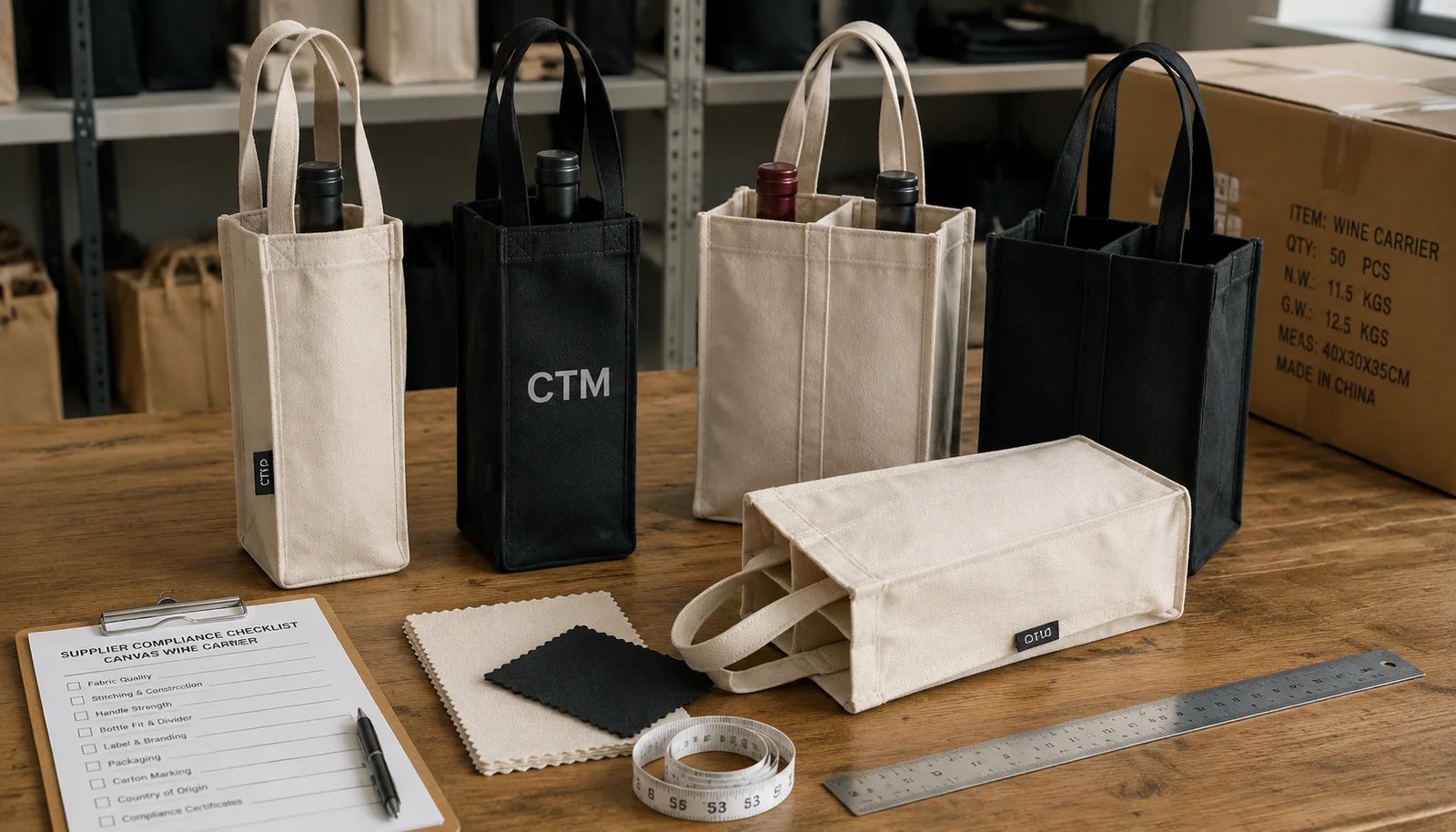
Why compliance matters more than a low unit price on canvas wine carriers
Canvas wine carriers look simple, but liquor retail programs usually carry more compliance friction than a basic promo tote. The bag may need to support glass weight, survive checkout handling, match a brand look, fit store shelving or counter storage, and pass buyer-specific packaging rules. If the supplier misses any one of those points, the resulting cost is rarely limited to rework at source. It often shows up later as store complaints, late relabeling, rejected cartons, or a second emergency order at a higher freight cost.
That is why a compliance checklist is more useful than a generic product specification sheet. Procurement teams need a sourcing tool that ties product construction to actual retail risk: load-bearing seams, print durability, fabric consistency, carton labeling, and traceable production responsibility. A cheap quote from a supplier who cannot document these basics is usually not cheaper once claims, delays, and labor are counted.
- Main failure modes: weak handles, wrong bottle fit, print rub-off, carton count errors, non-matching fabric shade, and undocumented subcontracting
- Most common hidden cost: low quote on bag body, then add-ons for divider, reinforcement, barcode labels, export carton upgrades, and pre-production sampling
- Best use of compliance checklist: compare like-for-like supplier offers before price negotiation starts
Start with the bottle format, not the artwork
Many RFQs start with the logo and color, but wine carrier sourcing should begin with bottle geometry. A one-bottle carrier for a standard 750 ml bottle is very different from a two-bottle holiday gift bag or a champagne format with a wider base and taller neck. If the supplier builds from a vague reference like 'wine bottle bag', you will get inconsistent quotations because each factory assumes different dimensions, gusset depth, and reinforcement level.
A better RFQ includes the loaded use case. For example, a one-bottle bag for in-store upsell can often use 280-300 GSM canvas if the handle base is reinforced. A two-bottle carrier usually needs heavier cloth, stronger bottom seam construction, or an internal divider to prevent bottle contact. Premium retailers may also want the bag to stand better at the shelf, which can push the spec toward 320-380 GSM, a wider bottom gusset, or added structure.
- Include bottle height, bottle base diameter, and target number of bottles
- State whether the bag is for standard wine, champagne, spirits, or mixed bottle sizes
- Define whether divider is required and whether bottles must stay separated during normal carry motion
- Note if the bag must fit tissue wrap, neck tag, gift card, or promotional insert
Choose fabric weight by load, shelf presentation, and cost tolerance
For liquor retail buyers, fabric weight is not just a look-and-feel decision. It affects support, print quality, folding behavior, and carton cube. In practice, natural canvas around 280-300 GSM works for many one-bottle carriers with moderate branding. Moving to 320-340 GSM often improves body and perceived quality, especially for dark prints or premium store positioning. For larger multi-bottle formats, some factories quote 340-380 GSM depending on gusset size and reinforcement, although seam engineering matters as much as fabric weight.
Heavier fabric is not automatically better. It increases material cost, can reduce print sharpness if the surface is very textured, and raises packed carton weight. If the bag is meant for seasonal gift campaigns with large volume and limited retail handling time, a properly sewn 300 GSM body may be more cost-efficient than an overbuilt 380 GSM bag. The decision should balance structural need against freight, packing density, and the buyer's quality threshold.
- Typical one-bottle range: about 280-320 GSM depending on handle and bottom reinforcement
- Typical two-bottle range: about 320-380 GSM, often with divider or stronger base engineering
- Natural canvas usually quotes lower than dyed canvas
- Stock canvas reduces lead time but may show more batch variation than made-to-order dyed fabric
Print method selection changes both compliance risk and quote logic
Screen printing remains the most practical choice for many wine carrier programs because it handles spot-color logos at scale and generally gives better unit economics after setup. On natural canvas, one-color or two-color branding is usually the cleanest route for retail bags. It also simplifies color control, especially when the logo is bold and the art does not require gradients. For buyers comparing quotations, the real variables are print size, number of colors, ink coverage, and whether the factory includes print setup in the first order.
Digital or transfer-based methods can make sense for short runs, event SKUs, or complex graphics, but they bring different risks. Adhesion and rub performance vary widely by supplier and ink system. A wine carrier gets friction in cartons, at checkout, and during carrying, so a decorative print that looks good on a sample can fail in field use. If the supplier proposes digital printing for convenience, the RFQ should include a defined rub-resistance or adhesion acceptance standard, not just a visual approval.
- Screen print usually fits: simple logos, chain-store volume, and tighter cost per unit at scale
- Digital or transfer methods usually fit: low MOQ tests, multi-color art, or short seasonal runs
- For dark canvas, request print opacity and cure consistency evidence
- Print position tolerance should be written into approval, for example plus or minus 5 mm if acceptable
MOQ logic: why structure, color, and print often matter more than total quantity
Factories rarely calculate MOQ from one number alone. For canvas wine carriers, MOQ is driven by how much setup the order creates in cutting, printing, and sewing. A one-bottle natural canvas bag with one-color screen print and no divider may use stock cloth and common sewing operations, so the MOQ can be relatively manageable. Once the order adds dyed fabric, an internal divider, custom woven label, barcode sticker application, and mixed carton assortment, the factory has more changeover and more room for error. The unit price then reflects complexity, not only quantity.
Buyers often get misleading quote comparisons because one supplier quotes a stock-material scenario while another assumes custom dyeing and full retail packing. To compare suppliers properly, split the quote into body fabric, print, trims, packing, sampling, and optional compliance services. That exposes whether one factory is truly cheaper or simply omitting elements that will come back as extras.
- Natural stock canvas typically supports lower MOQ than custom-dyed canvas
- Each print color or artwork change can create separate setup cost
- Dividers, bottle sleeves, or reinforced bottoms raise sewing time and often MOQ
- Retail barcode labeling and store-pack sorting can be quoted as labor add-ons rather than included
What supplier evidence is worth reviewing before sample approval
Compliance is not proven by a polished catalog. Procurement teams should request evidence tied to the specific product category: heavy-load stitching on bottle bags, experience with dark and natural canvas, print control on textured fabric, and organized packing for retail delivery. A supplier that mainly makes light promo totes may still quote wine carriers, but that does not mean they understand bottom seam stress, divider alignment, or the practical carton handling issues of liquor retail.
Useful evidence is operational, not promotional. Review sample photos showing inside seams, handle reinforcement, and divider construction. Ask for a current production layout or process flow showing which steps are in-house and which are outsourced. If the buyer has restricted-substance requirements, ask whether the factory has experience arranging third-party testing for cotton fabric and printing inks. The goal is not to create paperwork for its own sake; it is to verify that the supplier can reproduce the approved sample at bulk scale.
- Request inside-out photos of seams, bartacks, and bottom joins
- Review actual carton photos with shipping marks, not only product beauty shots
- Ask whether printing, sewing, and packing happen under one management system
- If supplier uses outside printer, require ownership of color standard and reprint liability
How to run a sample approval that predicts bulk results
A prototype sample only proves shape. It does not prove production readiness unless it is made with the same fabric class, print method, stitch construction, and packing approach planned for bulk. This is where many liquor retail programs go wrong. The development sample may look clean because it was sewn slowly by a sample room technician using substitute cloth. Bulk then arrives with different stiffness, print feel, and handle alignment because the production line used stock material and standard settings.
A better approval process has two stages. First, approve the dimensional concept and bottle fit. Second, approve a pre-production sample made from bulk-intended fabric, print process, and labels. That second sample should be loaded with actual bottles or weight equivalents to evaluate balance, handle comfort, divider function, and seam stress. If the buyer wants a bag to stand neatly at point of sale, test that under realistic fill conditions rather than by hand-shaping a single sample.
- Sample checks should include loaded carry test, print rub test, and folding for packing review
- Measure body height, gusset width, handle drop, divider width, and logo placement
- Approve side label position and barcode readability if those are part of retail execution
- Keep a signed sample or sealed approval record as the final production reference
QC thresholds that prevent most wine carrier claims
The highest complaint rates on canvas wine carriers usually come from defects that are visible but not caught early: uneven handles, weak seam closure, twisted body panels, off-center prints, and dirt marks on natural fabric. Procurement teams can reduce this by defining a few product-specific thresholds instead of relying on a generic bag inspection form. The inspection should focus on performance-related points, not only cosmetics.
For example, dimensions should be measured on a flat bag with agreed tolerance, but bottle clearance should also be verified on a loaded sample. Stitching should be judged by seam security and consistency at stress points, not just by overall appearance. Print quality should include location tolerance and rub resistance, especially for dark inks on natural canvas or light prints on dark canvas. These controls catch the majority of commercial issues before shipment.
- Dimension tolerance should be agreed in advance, especially height and gusset on bottle bags
- Stress points: handle roots, bottom corners, divider joins, and side seam overlap
- Print defects to define: smear, pinhole clusters, major misregistration, color mismatch, and under-cured ink rub-off
- Natural canvas should be reviewed for visible stains, mildew marks, and unacceptable slub concentration on front panels
Packing and labeling details can decide whether a retailer accepts the shipment
Packing is often treated as a finishing detail, but for retail buyers it is a compliance line item. A well-made wine carrier can still trigger problems if the folding method creases the print face, if the carton exceeds handling limits, or if barcode labels are applied to the wrong panel or carton side. For distributor and retail programs, packing instructions should be written with the same care as the product spec.
Flat packing is standard, but there are still choices to make: whether handles are tucked inside or laid flat, whether each unit needs individual poly protection, whether dividers should be pre-shaped or folded, and how many pieces go into each export carton. Those choices affect labor, carton cube, and retail readiness. In many programs, a slightly higher packing cost prevents much larger receiving and relabel costs later.
- Define pieces per inner pack if store allocation matters; otherwise quote master-carton only
- Set maximum carton gross weight suitable for warehouse handling rules
- Specify barcode symbology, label size, placement, and whether labels are buyer-supplied or supplier-printed
- For natural canvas, consider protective layering if print rub or dust pickup is a concern during transit
Lead time planning: where canvas wine carrier schedules usually slip
Lead time for canvas wine carriers is usually a chain of small dependencies rather than one long sewing window. Stock natural canvas can shorten the fabric stage, but custom dyeing, printing queue congestion, and late approval of carton marks often create the real delays. If the supplier is using separate subcontractors for printing or labels, each handoff adds schedule uncertainty even when the quoted ex-factory date looks competitive.
Buyers should map the schedule backward from the required ship window. The key milestones are sample approval, fabric booking, print strike-off or color approval if needed, cutting release, inline inspection, final inspection, and export packing completion. If any of those gates remain undefined, the apparent lead time is not reliable. For seasonal liquor promotions, missing a selling window can matter more than saving a few cents per unit.
- Higher schedule risk factors: custom dyeing, multiple print colors, outsourced printing, and mixed-SKU carton sorting
- Pre-production sample approval delays commonly push the entire line booking
- Carton artwork and barcode approval are often late but can still block packing completion
- Book inspection timing early if third-party final inspection is mandatory before shipment release
Specification comparison for buyers
| Supplier option | What to verify | Commercial advantage | Buyer risk to control |
|---|---|---|---|
| Direct sewing factory | fit-test photos with reference bottle, bottom reinforcement close-up, handle load proof, and final carton photo set | Better sample-to-bulk control and faster production feedback | May be weaker on export paperwork or branded packing unless checked early |
| Trading company | Factory name, production photos, trim-source proof, and who owns QC decisions | Can coordinate small mixed orders and extra services | Markup can hide real factory capability and slow defect decisions |
| Specialized bag workshop | bottle fit, bottom reinforcement, handle or cord strength, divider option, seam allowance, and upright stability | More practical for detailed construction, trims, and repeat programs | Capacity may be limited during peak seasons |
| Low-price general supplier | cotton canvas, jute, felt, nonwoven, or laminated paper sized to bottle diameter, weight, and condensation risk | Useful for simple promotional runs with loose specs | Material downgrades, weak packing, and vague inspection scope can erase savings |
| Retail-ready supplier | upright or flat packing, bottle-protection insert, carton count, moisture control, and retail display orientation | Can handle labels, SKU separation, carton marks, and receiving rules | Higher unit cost must be compared against reduced warehouse work |
| Compliance-focused supplier | Fabric records, labeling review, test plan, and production traceability | Safer for retail programs and repeat brand orders | Documentation claims need evidence, not only sales language |
| Local sample room plus bulk factory | Signed sample, bulk factory handoff, first-piece photos, and deviation owner | Good for complex branding before large production | Sample room quality may not match bulk line unless handoff is controlled |
Buyer checklist before sampling
- Define bottle format clearly: 1-bottle, 2-bottle, or 4-bottle carrier, and provide bottle height and base diameter, not only bottle volume.
- Specify target fabric weight in GSM or oz canvas, with tolerance if acceptable, for example 280-300 GSM or 12 oz equivalent.
- State whether the bag must stand empty, stand only when loaded, or fold flat for checkout counter storage.
- List handle construction details: self-fabric handles, webbing handles, handle width, handle drop, box-X reinforcement, and minimum stitch density.
- Clarify if an internal divider is required for 2-bottle or multi-bottle bags, and whether the divider must be fixed or removable.
- Identify print method by artwork type: screen print for spot colors, heat transfer or digital only if image detail justifies the cost.
- Approve print location tolerances, logo size, and acceptable color variation before pre-production sample signoff.
- Define retail compliance requirements such as azo-free dyes, REACH-related restrictions where applicable, California labeling requirements if relevant, or buyer-specific restricted substance standards.
- Request packaging format by unit and carton: flat packed count, polybag rules, carton size limit, gross weight cap, carton barcode, and shipping marks.
- Require a pre-production sample made in bulk fabric and bulk print method, not a prototype made from substitute material.
Factory quote questions to send
- What fabric weight do you recommend for this bottle count, and is it stock canvas or woven to order?
- What is the actual GSM tolerance you can hold in bulk, and how do you test it?
- Will this style be produced in one factory from cutting through packing, or will printing or packing be subcontracted?
- What is your MOQ by color, by print design, and by total order quantity for this wine carrier structure?
- Can you quote separately for natural canvas versus dyed canvas and show the price effect of each?
- What print method are you quoting, what is the print size allowance, and how many colors are included?
- For 2-bottle and 4-bottle carriers, what reinforcement do you use at the handle base and bottom panel?
- Can you provide carton pack options with outer carton dimensions and gross weight per carton?
- What pre-production sample lead time and sample charge apply if the sample must use bulk fabric and approved print method?
- What are your standard inline and final inspection points for stitching, dimensions, print adhesion, and count accuracy?
Quality-control points to confirm
- Fabric GSM within approved tolerance and matching approved hand feel and shade standard.
- Finished dimensions within agreed tolerance, especially bottle height clearance, gusset width, and divider fit.
- Handle attachment reinforced with consistent box-X or bartack construction and no skipped stitches.
- Bottom seam strength suitable for loaded bottle weight; no seam grin, open seam, or weak backtack.
- Print position, size, and color match approved sample; no major pinholes, smudging, ghosting, or misregistration.
- No obvious needle holes outside seam line, oil stains, mold spots, or severe fabric slubs on front-facing panels.
- Divider stitching centered and secure where applicable; bottles should not collide in a 2-bottle structure during normal handling.
- Carton count accuracy, barcode label correctness, and carton gross weight within buyer handling limits.
- Metal contamination and broken needle control records available if buyer compliance program requires them.
- Packing fold method consistent so the printed face is protected and handles are not permanently creased.