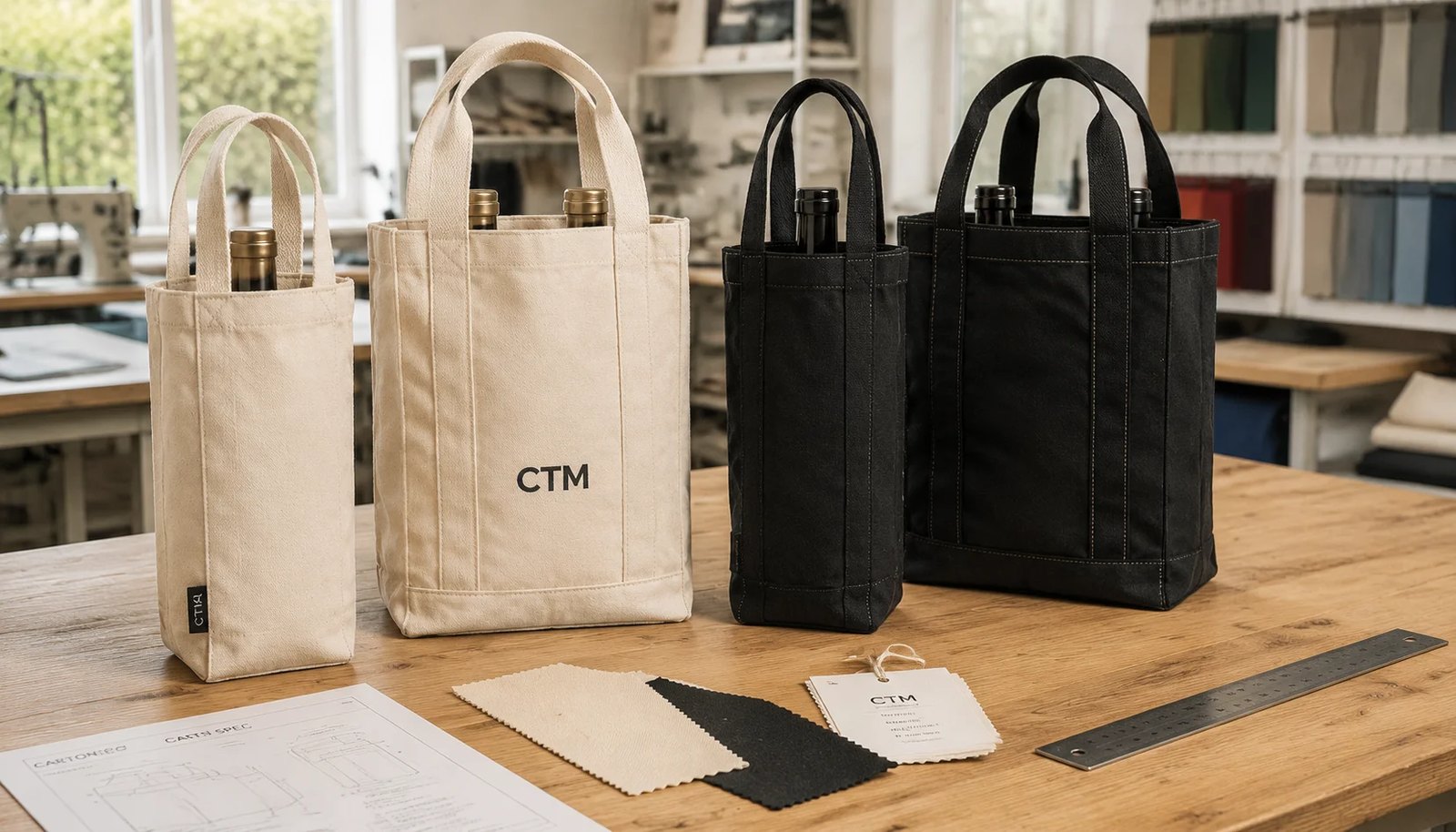
Why compliance becomes a buying problem with canvas wine carriers
For liquor retailers, a canvas wine carrier is not just a promo bag. It is a customer-facing item that sits close to food-adjacent retail environments, carries heavy glass, and often uses dark dyes, printed logos, webbing, labels, hangtags, and retail packaging from multiple material streams. That means compliance failures usually come from mismatch across components, not from the canvas body alone. Buyers who only request a 'canvas wine bag with logo' usually receive quotes that are impossible to compare because one supplier assumes stock natural canvas with one-color print, another assumes dyed canvas and woven label, and neither quote includes the same documentation burden.
The practical issue is this: compliance affects material choice, print process, packing, and lead time at the same time. If your internal QA team needs evidence for dyes, inks, and packaging materials, the wrong supplier route creates delays after price approval. A good RFQ should therefore identify which parts of the bag need documentary support, which test route will be used, and whether the supplier can hold material consistency lot to lot. Without that, retail launch dates slip while sourcing teams try to rebuild the spec after artwork approval.
- Canvas body, webbing handles, sewing thread, labels, prints, and poly or paper packing may all need to be documented separately
- Dyed black, navy, or burgundy canvas usually carries more colorfastness and rub-risk attention than natural canvas
- Retail gift programs often need cleaner presentation standards than simple bulk promo giveaways
- A low quote can become expensive if testing has to be repeated because the approved sample and bulk materials do not match
Write the RFQ around the actual bottle and retail use case
The first preventable mistake is sizing the carrier from a visual concept instead of the real bottle range. A standard 750 ml Bordeaux bottle does not occupy the same width and shoulder profile as Burgundy or sparkling wine. If your stores sell mixed bottle shapes, the carrier needs enough gusset and height for the widest likely SKU while still looking structured on shelf. Too narrow, and insertion is difficult or seams stress under load. Too loose, and the bag looks cheap and folds badly at retail.
State whether the bag is for single-bottle gifting, two-bottle upsell, club membership packaging, or paid reusable retail merchandise. That one decision changes the acceptable handle feel, divider need, fabric weight, and packing method. Buyers often under-specify handle drop and reinforcement. Sales teams later discover that a bottle neck protrudes awkwardly or the bag sits too low for in-store carrying comfort. Those are production issues, not artwork issues, so they should be settled before suppliers quote.
- Include bottle type: Bordeaux, Burgundy, Champagne, or mixed-fit requirement
- Specify target internal width, gusset depth, and usable height, not only flat bag dimensions
- Define whether bottom support is single canvas, reinforced fold, or inserted board
- State target carry load: one full bottle, two full bottles, or heavier gift set with accessories
- Add shelf presentation requirement if the bag must stand neatly when loaded or folded
Choose fabric weight and construction for load, print quality, and freight
For most custom canvas wine carriers, 10 oz to 12 oz canvas, roughly 280 to 340 GSM, is the commercial middle ground. It gives enough body for a filled single-bottle bag without becoming too stiff for folding or too heavy for freight. Below about 8 oz, around 225 GSM, many bags feel promotional rather than retail-grade unless the size is small and handle reinforcement is strong. Above 14 oz, around 400 GSM, the bag becomes more premium in hand feel but costs rise in fabric, sewing time, and carton weight.
Fabric construction matters as much as GSM. Open weave cloth with variable slubs may technically meet target weight but print less cleanly and skew more during cutting. If logo placement matters, ask for a closer weave face on the print panel. For dyed colors, note whether the fabric is piece dyed after weaving or sourced from stock dyed lots. Stock lots reduce MOQ pain but can create batch variation that becomes visible if replenishment orders must match prior retail stock. If your program expects repeat buys, preserve a fabric approval swatch from the pilot order.
- Natural canvas is usually easier for color consistency and lower minimums
- Dyed canvas improves shelf impact but increases colorfastness review and lot matching risk
- 10 oz to 12 oz canvas suits most single-bottle retail bags
- Two-bottle carriers usually benefit from 12 oz plus stronger webbing and reinforced base seams
- Keep approved swatches for future reorder comparison, not just the final sample photos
Pick a print method that matches the fabric, logo detail, and reorder plan
Screen print is still the most practical choice for most canvas wine carriers. It gives durable solid graphics, holds up well on textured fabric, and stays cost-efficient once volume reaches normal factory minimums. On natural canvas, a one-color or two-color screen print usually produces the best price-to-appearance ratio. On dark dyed canvas, an underbase may be required for accurate logo color, which adds setup and can slightly stiffen the print area. Buyers should account for that in both cost and hand feel.
Heat transfer is useful for photo-like art, small test runs, and situations where multiple artwork variants are needed on the same base bag. The tradeoff is edge feel, cure sensitivity, and a less woven-in look on premium retail bags. Embroidery can work for small logos but may distort lighter canvas panels or create puckering unless backing and stitch density are managed. If you want a premium but low-risk branding element, a woven side label plus small front print often performs better than a large embroidery field.
- Use screen print for solid brand marks and medium to large quantities
- Use heat transfer for detailed multicolor art or limited-run campaigns
- Use woven labels where subtle branding and repeat consistency matter
- Request print rub test and visual review on actual dyed fabric, especially for dark shades
- For dark bags, note whether white underbase is included in the quote
Understand MOQ logic before comparing unit prices
MOQ on canvas wine carriers is rarely one number. It changes by fabric color, bag size, print color count, and whether components are stock or custom. A supplier may quote 500 pieces as an MOQ, but that figure may only apply to natural canvas with one-color print and standard handle webbing. If you need custom dyed burgundy canvas, contrast lining, or a two-bottle divider, the economical MOQ could move much higher because the supplier needs to justify fabric dyeing, cutting loss, and setup time across the order.
The buying error is to compare a low MOQ offer with a standard MOQ factory quote without matching assumptions. Low-MOQ routes often rely on stock remnants, mixed lot production, or outsourced printing. That can be useful for pilot orders, but it should not be evaluated as equivalent to a controlled repeat program. Procurement teams should request price breaks at realistic volume steps and ask how each break is achieved. Sometimes the biggest savings come not from doubling order volume, but from reducing print colors, standardizing one handle length, or using a stock fabric width that reduces cutting waste.
- Ask for pricing at several volume tiers such as pilot, launch, and reorder quantities
- Separate MOQ by fabric color, print color count, and bag construction
- Clarify whether pre-production sample charges are credited back on bulk order
- Do not treat stock-fabric pricing as equal to custom-dyed repeat-program pricing
- Ask which cost element drops at higher volume: fabric, print setup, labor, or carton efficiency
Use supplier evidence that goes beyond a generic compliance claim
Many suppliers can say they are 'compliant,' but buyers need evidence tied to this exact bag build. A useful supplier should be able to map materials from body fabric to handle webbing, labels, print ink system, and packaging components. If the supplier cannot clearly state which parts are sourced in-house, which are bought from regular sub-suppliers, and which documents are available per component, expect delays later. This is especially true when retail QA teams ask for support after commercial approval, because the salesperson may have quoted a build that cannot be documented as presented.
Request evidence in a structure that lets your QA and sourcing teams review quickly: finished bag bill of materials, material photos, fabric weight, dye route, print method, and packing materials, along with any existing reports that are relevant as reference only. Then identify what still needs order-specific testing or submission. Old reports can still be useful to screen out weak suppliers, but they should not be treated as approval for a different fabric, dye shade, or packaging version. A disciplined supplier will be comfortable separating indicative documents from order-specific evidence.
- Ask for a bill of materials listing body fabric, webbing, thread, labels, ink, hangtag, and poly or paper packing
- Request recent workshop photos showing cutting, sewing, and inspection rather than only office images
- Review whether bulk material lots can be traced to the sample approval version
- Treat old test reports as capability evidence, not automatic approval for the new order
- Prefer suppliers that can explain which documents come from raw material vendor and which come from finished goods testing
Set sample approval rules that prevent bulk surprises
A digital mockup does not approve a wine carrier. At minimum, move through an artwork proof and then a physical pre-production sample made in actual canvas, actual print method, and actual handle construction. If bottle fit is critical, send the real bottle dimensions or courier a sample bottle. Too many disputes happen because the approved artwork looked fine, but the sewn gusset reduced the usable width, or the print moved upward to avoid seam allowance, or the webbing color looked wrong against the dyed body fabric.
Your sample approval form should include measurable acceptance points. These should cover finished dimensions, logo size and placement, handle drop, bottle insertion test, seam alignment, and basic print durability observations. If the order will be sea freighted to a humid destination, ask for packing simulation photos or a packed sample. Flat-packed bags can crease and transfer ink if the packing method changes after sample approval. The approval stage is where you lock product and packing together, not separately.
- Approve against actual fabric and print process, not substitute material
- Measure usable internal dimensions, not only outer flat dimensions
- Load-test the sample with a full bottle for seam behavior and handle comfort
- Review print edge sharpness, opacity, and hand feel on final fabric color
- Approve a packing sample if retail presentation or long sea transit matters
Build QC thresholds around the defects that matter in stores
Retail buyers care about the defects customers notice first: crooked logos, fabric stains, inconsistent handle height, weak seams, and bags that look crushed or dirty out of carton. QC should therefore focus less on abstract textile perfection and more on visible retail acceptability plus load safety. A simple natural slub in canvas may be acceptable away from the logo panel, while a tiny print pinhole at the center front may not be. Set these priorities early so the factory knows where to spend inspection attention.
For load-bearing bags, seam and handle reinforcement deserve a clear threshold. A supplier may meet dimension specs but still produce marginal attachment strength if stitch density changes across lines or bartacks are inconsistent. Inline inspection helps because these faults are easier to correct during sewing than at final packing. For dark dyed bags, rub and transfer risk should also be reviewed because cartons and adjacent bags can pick up loose dye or under-cured ink. Final inspection should include random load tests, print appearance checks, odor review, and carton verification.
- Set acceptable tolerance for dimension variance, especially width, gusset, and handle drop
- Define critical visual zones such as front logo panel and top opening area
- Reject bags with skipped stitches, open seams, loose bartacks, or major skewing
- Review stain tolerance separately for natural and dark dyed fabric
- Verify cartons by count, size, weight, and shipping marks before release
Packing and export details affect retail condition and landed cost
Packing looks like a minor line item until the bags arrive creased, dusty, or offset with print marks. Canvas wine carriers are usually flat packed, but the method needs to match the print type and retail condition expectation. Printed front panels may need tissue interleave, especially with dark inks or stacked pressure during sea transit. If bags are packed too tightly to reduce carton count, webbing can kink and panel corners can curl, which creates a poor first impression at store level even when the bag is technically usable.
From a landed-cost angle, carton dimensions and fill ratio matter because a bulky wine carrier with reinforced handles can become volume-heavy quickly. Sometimes a small adjustment in handle folding method or gusset lay-flat direction improves carton efficiency enough to offset a slightly higher unit cost. Buyers should request both unit weight and packed carton data during quotation. This helps compare not only ex-factory cost but also freight impact across supplier options. If your distribution center has carton size limits, include them in the RFQ or the supplier may optimize for factory convenience instead of inbound handling.
- Specify if individual polybags are allowed, prohibited, or only used for moisture protection
- Consider tissue interleave for screen-printed dark panels
- Set maximum outer carton dimensions to suit warehouse receiving limits
- Request packed carton gross weight to avoid difficult manual handling
- Add desiccant or moisture barrier only when route and climate justify it
Lead time risk usually comes from approvals, not sewing speed
Canvas wine carriers are not usually technically hard to sew, so major delays often come earlier: artwork clarification, bottle fit revision, fabric dyeing, compliance review, and packaging confirmation. If your retailer launch date is tied to a holiday gift period, the calendar should include these approval gates instead of assuming one continuous factory lead time. A supplier may honestly offer a 25 to 35 day production window, but that may start only after fabric, print, sample, and packing are all approved. Procurement teams that treat those steps as separate later lose the launch window.
A better schedule view breaks the order into dependencies. For example, stock natural canvas with one-color print can move faster because the supplier avoids dyeing. Dark custom color with woven label and compliance testing adds front-end time even if sewing capacity is available. Shipping booking and consolidation may add another risk layer. Ask the supplier which milestones are on the critical path and which can run in parallel. That answer tells you whether the supplier really manages production or is simply quoting standard lead times from habit.
- Separate sample lead time from bulk lead time in the quote review
- Identify whether fabric dyeing, printing screens, or packaging sourcing drives the schedule
- Plan buffer time for internal QA sign-off and not only for supplier production
- Use a booking-ready date rather than a vague completion date
- For seasonal retail, delay in sample approval is often more dangerous than delay in stitching
Specification comparison for buyers
| Supplier option | What to verify | Commercial advantage | Buyer risk to control |
|---|---|---|---|
| Direct sewing factory | fit-test photos with reference bottle, bottom reinforcement close-up, handle load proof, and final carton photo set | Better sample-to-bulk control and faster production feedback | May be weaker on export paperwork or branded packing unless checked early |
| Trading company | Factory name, production photos, trim-source proof, and who owns QC decisions | Can coordinate small mixed orders and extra services | Markup can hide real factory capability and slow defect decisions |
| Specialized bag workshop | bottle fit, bottom reinforcement, handle or cord strength, divider option, seam allowance, and upright stability | More practical for detailed construction, trims, and repeat programs | Capacity may be limited during peak seasons |
| Low-price general supplier | cotton canvas, jute, felt, nonwoven, or laminated paper sized to bottle diameter, weight, and condensation risk | Useful for simple promotional runs with loose specs | Material downgrades, weak packing, and vague inspection scope can erase savings |
| Retail-ready supplier | upright or flat packing, bottle-protection insert, carton count, moisture control, and retail display orientation | Can handle labels, SKU separation, carton marks, and receiving rules | Higher unit cost must be compared against reduced warehouse work |
| Compliance-focused supplier | Fabric records, labeling review, test plan, and production traceability | Safer for retail programs and repeat brand orders | Documentation claims need evidence, not only sales language |
| Local sample room plus bulk factory | Signed sample, bulk factory handoff, first-piece photos, and deviation owner | Good for complex branding before large production | Sample room quality may not match bulk line unless handoff is controlled |
Buyer checklist before sampling
- Define bottle format before quoting: 750 ml standard, Burgundy, Champagne, or mixed bottle sizes
- State target canvas weight in GSM or oz, and whether tolerance is acceptable by roll lot
- Specify single-bottle, two-bottle, or divider construction and whether divider is fixed or removable
- Name the print method by panel: screen print, heat transfer, embroidery, woven label, or combo
- Set logo position tolerance, print size, and print color reference such as Pantone or physical swatch
- State handle material, width, finished drop height, and reinforcement method at attachment points
- List any retailer compliance documents required for fabric, dyes, ink, trims, and packaging materials
- Request pre-production sample made in actual fabric and print process, not artwork mockup only
- Define flat-pack method, units per poly if used, inner pack quantity, outer carton size limit, and carton marks
- Include inspection standard, acceptance criteria for seam defects, print flaws, odor, stains, and dimension variance
Factory quote questions to send
- Is your quote based on stock greige canvas, stock dyed canvas, or fresh dyed fabric for this order?
- What is the exact fabric construction and weight in GSM, and what tolerance do you apply by lot?
- Do you produce the cutting and sewing in-house, and which processes are subcontracted, if any?
- Which print method is included in the quote, and how does it affect color accuracy and rub resistance?
- What bottle dimensions did you use to size the bag, and what clearance is added for insertion and removal?
- How are handles attached: stitch count, box stitch size, bartack count, and webbing specification?
- What sample stages are charged separately: artwork proof, blank fit sample, pre-production sample, shipping sample?
- What is the MOQ logic by fabric color, print color count, and bag size, and where do price breaks begin?
- What export packing is included in the quote: tissue, polybag, desiccant, carton board grade, carton marks?
- What compliance support can you provide for finished bag materials and packaging, and what must be tested per order?
Quality-control points to confirm
- Fabric weight should match approved spec within agreed tolerance and visually match approved weave density
- Finished dimensions must fit the stated bottle type with practical insertion clearance but without excessive slouching
- Handle attachment must show even stitch density, no skipped stitches, and reinforcement as approved in sample
- Print location should stay within approved placement tolerance and show no pinholes, ghosting, smudging, or under-cure
- Dark dyed fabric should be checked for crocking risk, especially at handles and printed areas that contact cartons
- Divider panels, if any, must be centered, secure, and not collapse when loaded with full bottle weight
- All bags should be free from oil marks, needle damage, mildew odor, heavy slubs at logo area, and exposed thread ends
- Carton packing count, inner pack method, carton dimensions, and shipping marks must match approved packing sheet