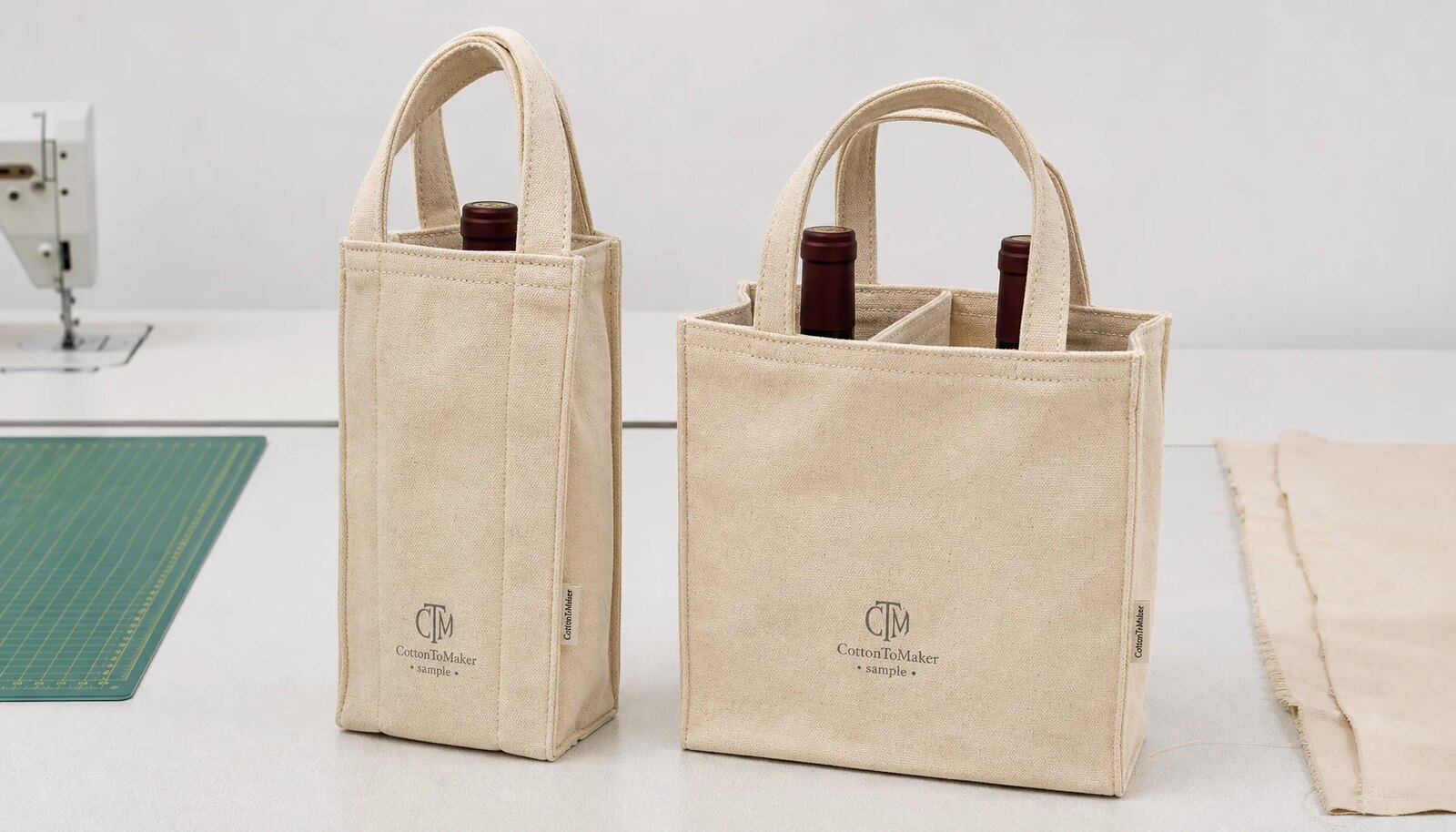
Why Wine Carrier Compliance Needs Procurement Detail
Canvas wine carriers for craft fairs look uncomplicated at first glance. They are small, familiar, and often sold as promotional packaging. In real use, however, they carry one to six filled glass bottles through crowded aisles, tasting rooms, outdoor markets, loading areas, vans, and storage rooms. That makes them load-bearing branded packaging, not just a decorative sleeve.
The supplier has to control more than fabric and logo placement. Bottle fit, bottom stability, divider alignment, handle reinforcement, print durability, carton protection, label accuracy, and delivery timing all affect the buyer’s risk. A weak handle can fail in public. A tight divider can frustrate staff at the booth. A wrong logo version can make finished inventory unusable for an event date that cannot move.
Most sourcing issues start with vague language. An RFQ that says natural canvas wine bag with logo may attract quotes for very different products: a lightweight single-bottle giveaway, a medium two-bottle craft fair carrier, a premium reusable market bag, or a generic tote adjusted for bottles. The prices may sit in the same spreadsheet, but the assumptions behind them are not the same. A supplier compliance checklist makes those assumptions visible before the purchase order is issued.
- Treat the item as load-bearing branded packaging, not a generic tote or decorative sleeve.
- Write bottle dimensions, filled weight, carrier capacity, event use, and delivery deadline into the RFQ.
- Approve one sealed pre-production sample as the standard for fabric, construction, print, label, and packing.
- Separate critical, major, and minor defects before production starts.
- Link shipment release to inspection results, approved samples, and required documents, not supplier claims alone.
Start With Bottle Format, Capacity, and Fit
The bottle comes first. A standard 750 ml Bordeaux bottle is usually slimmer than many Burgundy and sparkling bottles. Champagne-style bottles often have a wider base and a heavier filled weight. Craft spirits, olive oil, and specialty bottles may be taller, squarer, or wider at the shoulder. If the pattern is built around the wrong reference bottle, the gusset can distort, the divider can pinch, and shoppers may need to force bottles into the carrier.
Ask the internal product or event team for the actual bottle data: overall height, base diameter, widest shoulder diameter, neck diameter if relevant, and filled weight. If the program includes mixed bottles, decide whether the carrier must fit the largest bottle, the most common bottle, or a specific combination. Do not approve a carrier based only on empty samples. Filled bottles change the load, balance, sag, and comfort.
Capacity changes the construction. A one-bottle gift sleeve can be simple, but the bottom and handle still matter. A two-bottle canvas wine carrier is popular for craft fairs because it supports gifting and bundle sales without becoming too heavy. Four-bottle and six-bottle carriers need stricter divider geometry, wider or stronger handles, better bottom support, and clear carton-weight rules. This is where generic tote-bag assumptions start to fail.
- Single bottle: control bottom shape, neck clearance, print centering, and handle attachment.
- Two bottles: control divider width, bottle separation, handle comfort, and balanced carrying.
- Four bottles: require crossed-divider accuracy, bottom reinforcement, and load testing with all bottles filled.
- Six bottles: treat as a market carrier with higher total load, stronger base, wider handles, and stricter carton weight limits.
- Mixed bottles: approve with the widest bottle and check that slimmer bottles do not rattle excessively or tip the bag.
Specify Canvas Weight, GSM, and Fabric Tolerance
Canvas descriptions can sound reassuring and still be useless for procurement. Heavy duty, premium cotton, eco canvas, and natural canvas do not tell the factory what to buy or the inspector what to measure. Use ounce weight and GSM, then add a tolerance. Fabric weight affects strength, hand feel, print absorption, sewing difficulty, carton weight, and cost.
Approximate conversions help during early quoting: 8 oz canvas is commonly around 270 GSM, 10 oz around 340 GSM, 12 oz around 400 to 410 GSM, 14 oz around 470 GSM, and 16 oz around 540 GSM. These figures vary by weave and finishing, so the purchase order should refer to the approved swatch and bulk-roll measurement, not only a conversion table.
For many craft fair and winery programs, 10 oz to 12 oz cotton canvas gives a practical balance of shape, durability, printability, and landed cost. Lighter 8 oz to 10 oz canvas can work for basic single-bottle giveaways if the reinforcement and load tests pass. Heavier 14 oz to 16 oz canvas gives a more premium reusable feel, but it can increase raw material cost, sewing time, needle stress, carton weight, and freight cost. The right fabric is the one that passes the intended use case.
Appearance control belongs in the same conversation. Natural unbleached canvas may show seed marks, slubs, mild shade variation, and weave irregularities. Those features may suit an artisan product, but oil stains, dark contamination, shade-mixed panels, and heavy defects should be rejected against approved limit photos. Dyed canvas needs lab dip or swatch approval, dye-lot control, and colorfastness review. If recycled, organic, plastic-free, or low-impact claims appear on labels or marketing, request evidence tied to the bulk fabric lot.
- 8 oz to 10 oz: lower material and freight cost; use only if fit, reinforcement, and load tests pass.
- 10 oz to 12 oz: common practical range for reusable craft fair and winery wine carriers.
- 14 oz to 16 oz: premium structure; review sewing feasibility, fold recovery, carton weight, and freight impact.
- GSM tolerance: define an allowed range, often by percentage or roll test result, before bulk cutting.
- Natural canvas: approve visible seed marks and slubs with limit photos, not verbal descriptions.
- Claimed sustainable fabric: request evidence tied to the actual bulk material before using the claim.
Lock Construction Details Before Quote Comparison
Construction is where price differences hide. Two suppliers may both quote a two-bottle canvas wine carrier, yet one includes a double-fold top hem, bartacked webbing handles, a secured divider, and a reinforced bottom while the other assumes a lighter hem and minimal stitching. The product name is the same. The risk is not.
Define seam allowance, top hem layers, handle material, handle width, handle drop, reinforcement method, bottom gusset, bottom panel, divider attachment, thread type, stitch density, and edge finishing before comparing offers. Ask for close-up photos of the approved construction. If the supplier says a detail is standard, have them show it. Standards vary widely by workshop and price point.
Finished-size tolerances should be written in millimeters. A practical starting point for soft sewn goods may be plus or minus 5 mm for critical features such as divider width, handle drop, print position, and gusset depth, with a wider range for less critical overall dimensions if the design allows it. Do not copy those values blindly. A tight divider tolerance matters more when bottles are wide and close together. Print tolerance matters more when the logo sits near a seam or fold.
Handle reinforcement deserves special attention. Specify whether the handle is self-fabric, cotton webbing, polyester webbing, rope, cord, or another trim. State handle width and drop because both affect comfort and balance. Require the reinforcement stitches to pass through the intended fabric layers. A decorative stitch on one layer can look acceptable in photos and still fail under filled-bottle weight.
- Seams: define seam allowance, stitch density, thread color, thread type, and acceptable puckering.
- Top hem: specify single fold, double fold, binding, or reinforced patch construction.
- Handles: define material, width, drop, stitch method, reinforcement area, and comfort requirement.
- Bottom: specify gusset depth, bottom panel, double layer, or insert if required for standing stability.
- Dividers: define stitched, crossed, removable, padded, webbing-supported, or no divider.
- Tolerances: measure from fixed edges and record deviations in millimeters during inspection.
Control Printing, Artwork, and Brand Versions
Branding is visible, but print quality depends on the fabric, construction, and packing method. Screen printing is often suitable for one to four spot colors on canvas wine carriers because it can deliver useful opacity and repeatability on textured fabric. Digital printing and transfers may suit gradients, many colors, or smaller artwork runs, but they should be tested for hand feel, cracking, rub behavior, and folded-packing transfer. A digital mockup is not approval. A strike-off on bulk-equivalent fabric is.
Artwork instructions should remove interpretation. Provide vector files, Pantone references, print dimensions, print location, orientation, color count, and version codes. Measure print placement from a stable reference such as the top opening, side seam, or bottom seam. Avoid measuring from a soft fold that shifts when the bag is opened or packed.
If artwork sits near a gusset, divider stitch line, bottom fold, or handle attachment, ask the supplier to confirm whether distortion can be controlled. Printing on cut panels can give a flatter surface, but sewing variation may move the final logo position. Printing on finished bags can align to the sewn shape, but seams and gussets make registration harder. Neither method is automatically better. The supplier should state the method and the tolerance they can hold.
Version control is a common B2B failure. Craft fair programs may include different winery labels, event dates, sponsor logos, languages, retail barcodes, or distributor SKUs. Use an artwork matrix that lists item code, fabric color, print file, Pantone colors, label, hangtag, barcode, carton mark, and quantity. Inspection should confirm that the right version is printed, labeled, packed, and marked on the carton.
- Approve a strike-off for color, opacity, edge clarity, hand feel, curing, and rub performance.
- Set print placement tolerance in millimeters and measure from the same edge every time.
- Avoid placing logos across thick seams, gussets, divider stitches, or heavy fold lines unless tested.
- Check dry rub, wet rub, tape pull where appropriate, and folded face-to-face transfer risk.
- Use an artwork matrix for multiple designs, event versions, languages, barcodes, or carton marks.
- Hold bulk printing until artwork files, Pantone colors, and version quantities are signed off.
Make Quotes Comparable and Audit the MOQ
MOQ is rarely one simple number. A supplier may have separate minimums for the bag style, stock fabric, custom dyed fabric, printing screens, woven labels, hangtags, barcode labels, carton marks, and packing method. A natural canvas two-bottle carrier with one-color screen print is commercially different from a dyed 12 oz carrier split across six artwork versions with retail-ready labeling.
Ask suppliers to explain what drives the MOQ and what changes would lower or raise it. Request price breaks at defined quantities such as 500, 1,000, 3,000, 5,000, and 10,000 pieces. Then ask for the same price breaks by artwork count and packing method. A 3,000-piece order with one logo may cost less than 3,000 pieces split into six designs because setup, proofing, screens, sorting, and carton separation all add labor.
If a buyer needs a lower minimum, the usual levers are stock natural canvas, one base construction, fewer artwork versions, one-color print, standard labels, and standard carton marks. These changes may be sensible for a craft fair launch or test program. For a retail resale program, however, the savings must be balanced against barcode control, labeling, presentation, and warehouse requirements.
A useful quote separates cost components. Fabric GSM, divider complexity, handle reinforcement, individual packing, labels, barcode work, carton strength, third-party inspection, and inland freight can all change landed cost. With that detail, buyers can make deliberate trade-offs instead of chasing the lowest unit price. Sometimes paying for SKU separation at the factory prevents expensive sorting right before an event.
- Fabric cost: GSM, fiber claim, color, dyeing, wastage, stock availability, and roll quantity.
- Construction cost: bottle count, divider style, bottom reinforcement, handle type, bartacks, and seam finishing.
- Print cost: color count, print area, ink type, screens, artwork versions, proofing, and rework risk.
- Packing cost: flat versus folded packing, inner bundles, polybags, barcode labels, cartons, and pallet rules.
- Compliance cost: documentation, retailer labeling, factory audit support, traceability, and restricted-substance statements.
- Inspection cost: AQL level, load testing, print checks, barcode scanning, third-party inspection, and reinspection.
Verify Supplier Evidence and Compliance Records
Supplier compliance is not a folder of certificates alone. It is evidence that the supplier controls the steps that create the product. For canvas wine carriers, useful records include fabric purchase details, retained swatches, cutting records, print strike-off approvals, sewing-line standards, inline inspection photos, final inspection reports, packing photos, carton label samples, and corrective-action records when issues occur.
Subcontracting is common and can be acceptable. Printing may be outsourced. Labels may come from a trim supplier. Cartons may come from a packaging vendor. The risk is the handoff. If panels are printed before sewing, cutting and sewing variation can move the final logo toward a seam. If finished bags are printed and folded too soon, ink can block or transfer. If labels arrive late, versions can be mixed at packing.
Ask the supplier to map which process happens where: cutting, sewing, printing, label application, packing, final inspection, and shipment release. Also confirm who has authority to approve rework or deviations. When a defect appears, a slow decision chain can be as damaging as the defect itself, especially when the order is tied to a fixed craft fair or winery event.
Document needs vary by destination and sales channel. A local craft fair may not require the same evidence as a national retail program, but buyers should still know what the supplier can provide. Common requests include fiber composition records, restricted-substance declarations, packing-material statements, country-of-origin support, factory profile, audit availability, and traceability references. Sustainability claims should be worded carefully and backed by evidence for the exact bulk material used.
- Request photos of bulk fabric, cutting, printing, sewing, handle reinforcement, dividers, labels, and packed cartons.
- Confirm whether printing is done on cut panels or finished bags and how placement is controlled.
- List subcontracted processes before PO confirmation and assign deviation approval responsibility.
- Keep a sealed factory sample and a matching buyer or inspector sample for comparison.
- Check documents against the bulk material lot, not only a generic supplier certificate.
- Release shipment based on approved sample, inspection results, and agreed documents together.
Approve Samples With Measurable Acceptance Criteria
Sample approval should prove production reality, not showroom skill. A sales sample made with substitute canvas, hand-cut panels, temporary handles, different thread, or a non-final print process can create false confidence. The pre-production sample should use bulk-equivalent canvas, final handle trim, final divider style, final stitch method, final print method, final label position, and the intended packing fold.
Test the sample the way shoppers and event staff will use it. Insert the intended filled bottles. Carry the bag by the handles. Set it on a flat table. Lift it repeatedly. Check the base, side seams, top hem, handles, dividers, and print. Then fold it as the factory plans to pack it, place light pressure on it, and reopen it. Look for print creasing, ink transfer, handle deformation, divider collapse, and poor recovery.
Sample comments must become measurable instructions. Do not write make handle stronger and hope the factory interprets it correctly. Specify the reinforcement change, bartack length, patch size, box-stitch dimensions, or thread requirement. Do not write move logo up. State the new print distance from the top opening or bottom seam. If the divider is too tight, specify the required divider width and tolerance.
The final approval package should include the signed sample, photos, measurement sheet, artwork proof, strike-off, packing instruction, and QC checklist. That package gives the factory, buyer, and inspector the same reference. It also helps when a later production issue requires a quick decision.
- Fit approval: bottle inserts without forcing, carrier stands acceptably, and divider keeps bottles separated.
- Load approval: no handle tearing, seam opening, bottom failure, divider failure, or unsafe distortion.
- Print approval: color, opacity, placement, edge sharpness, curing, rub resistance, and folded-transfer risk pass.
- Sewing approval: reinforcement, seam allowance, stitch density, loose thread control, and corners match the standard.
- Packing approval: folding method does not crush handles, deform dividers, dirty fabric, or crease logos beyond tolerance.
- Documentation approval: all sample comments are converted into PO specs before bulk production.
Set Final QC, AQL, and Defect Definitions
Final inspection should reflect risk, not just appearance. Buyers can use ANSI/ASQ Z1.4 or ISO 2859-1 sampling concepts when appropriate, but the AQL levels should match the order value, product risk, and sales channel. Many buyers classify unsafe or unusable failures as critical, functional failures as major, and small cosmetic issues as minor. Define those categories before production starts.
Critical defects for canvas wine carriers include unsafe handle failure, seam opening under the agreed load, wrong bottle fit, wrong artwork, wrong barcode, mixed SKU cartons, severe contamination, and missing required label information. Major defects may include print placement outside tolerance, divider distortion, weak or missing bartacks, unacceptable shade variation, bottom sag beyond the approved standard, or cartons packed in a way that damages the product. Minor defects may include small loose threads, light removable marks, or small slubs inside the approved natural-canvas range.
Inspection should combine measurement, functional testing, and packing review. Inspectors should measure finished height, width, gusset, handle drop, divider dimensions, seam allowance, and print position from fixed reference edges. They should test bottle fit with the intended filled bottles, perform the agreed load test, scan barcodes where used, and compare carton labels against the packing list and artwork matrix.
If the load test is destructive or time-consuming, define the test quantity and the decision rule in advance. One failure may trigger expanded testing, sorting, rework, or rejection depending on the severity. Inspection reports should include defect photos, measurement results, test results, carton counts, and records of any rework completed before shipment release.
- Critical defects: unsafe load failure, wrong bottle fit, wrong artwork, wrong barcode, severe stains, or missing required labels.
- Major defects: print off tolerance, divider failure, weak reinforcement, unacceptable shade panels, or poor carton protection.
- Minor defects: small loose threads or minor natural-canvas marks within the approved limit standard.
- Measurement checks: height, width, gusset, handle drop, divider size, seam allowance, and print position.
- Functional checks: filled-bottle fit, standing stability, carry test, handle reinforcement, divider recovery, and bottom sag.
- Release checks: carton count, SKU separation, barcode scan, carton marks, gross weight, CBM, and document match.
Control Packing, Labels, and Event Handling
Packing affects both product quality and event readiness. Flat packing protects shape and dividers but increases carton cube. Folded packing reduces CBM, yet it can crease prints, crush handles, and distort dividers. Individual polybags protect natural canvas from dust and moisture, although some buyers prefer plastic reduction. If polybags are used, check destination rules for suffocation warnings, recycling marks, and bag thickness where applicable.
Craft fair teams often move cartons by hand. A carton that looks efficient for freight may be too heavy for booth setup, or it may crush the first-display appearance. Inner bundles of 10, 20, or 25 pieces can make replenishment easier and reduce mixed-version errors. Cartons should not be overfilled to the point that handles, dividers, or printed panels are compressed.
Light natural canvas shows dirt quickly, so clean packing tables and moisture-aware storage matter. Ask for final carton photos, carton weight, carton dimensions, packing orientation, and inner bundle method. If the bags will go into storage before the fair, discuss humidity, odor, and stain risks before shipment. A clean product can still arrive looking poor if packing is rushed.
Retail and distributor programs need stricter label control. Barcode labels must scan and match the item code, artwork version, quantity, and carton mark. Carton labels should include item code, description, quantity, gross weight, net weight, carton number, destination, and any receiving requirement. If the carrier is sold as a consumer textile item, check whether fiber content, country-of-origin, warning language, or hangtag information is required for the destination market and sales channel.
- Choose flat or folded packing before final quote approval because it changes CBM and print-risk controls.
- Set inner bundle quantities by artwork version to simplify event replenishment and warehouse receiving.
- Define carton marks with item code, artwork version, quantity, gross weight, net weight, carton number, and destination.
- Scan barcodes during inspection when the carrier is retail-sold or received under SKU control.
- Use clean, dry, moisture-aware packing for natural canvas and light colors, especially before sea freight or storage.
- Avoid overpacked cartons that crush handles, deform dividers, or make the first display look damaged.
Specification comparison for buyers
| Supplier option | What to verify | Commercial advantage | Buyer risk to control |
|---|---|---|---|
| Direct sewing factory | fit-test photos with reference bottle, bottom reinforcement close-up, handle load proof, and final carton photo set | Better sample-to-bulk control and faster production feedback | May be weaker on export paperwork or branded packing unless checked early |
| Trading company | Factory name, production photos, trim-source proof, and who owns QC decisions | Can coordinate small mixed orders and extra services | Markup can hide real factory capability and slow defect decisions |
| Specialized bag workshop | bottle fit, bottom reinforcement, handle or cord strength, divider option, seam allowance, and upright stability | More practical for detailed construction, trims, and repeat programs | Capacity may be limited during peak seasons |
| Low-price general supplier | cotton canvas, jute, felt, nonwoven, or laminated paper sized to bottle diameter, weight, and condensation risk | Useful for simple promotional runs with loose specs | Material downgrades, weak packing, and vague inspection scope can erase savings |
| Retail-ready supplier | upright or flat packing, bottle-protection insert, carton count, moisture control, and retail display orientation | Can handle labels, SKU separation, carton marks, and receiving rules | Higher unit cost must be compared against reduced warehouse work |
| Compliance-focused supplier | Fabric records, labeling review, test plan, and production traceability | Safer for retail programs and repeat brand orders | Documentation claims need evidence, not only sales language |
| Local sample room plus bulk factory | Signed sample, bulk factory handoff, first-piece photos, and deviation owner | Good for complex branding before large production | Sample room quality may not match bulk line unless handoff is controlled |
Buyer checklist before sampling
- Define bottle formats before asking for price: standard 750 ml Bordeaux, Burgundy, sparkling wine, craft spirits, olive oil, or mixed bottles. Provide base diameter, shoulder diameter, overall height, and filled weight for each bottle type.
- State the intended use: single-bottle gift sleeve, two-bottle craft fair carrier, four-bottle set, six-bottle market carrier, tasting-room purchase bag, promotional giveaway, or retail resale product. The use determines strength, packing, labeling, and QC level.
- Specify canvas with measurable terms: ounce weight, GSM target, GSM tolerance, fiber composition, weave, finish, natural or bleached shade, dyed color standard, shrinkage expectation, and whether the fabric is stock, custom dyed, recycled, or organic.
- Use realistic GSM guidance in the RFQ: 8 oz canvas is commonly around 270 GSM, 10 oz around 340 GSM, 12 oz around 400 to 410 GSM, 14 oz around 470 GSM, and 16 oz around 540 GSM. Require confirmation by supplier roll because conversions vary by weave and finish.
- Define finished-size tolerances separately for height, width, gusset, bottom panel, handle drop, divider width, divider height, and print placement. Common soft-goods tolerances may be plus or minus 5 mm for key dimensions and plus or minus 10 mm for less critical overall dimensions, but set your own approval range.
- Specify reinforcement details: handle material, handle width, handle drop, top hem layers, bartack length, box-stitch size, stitch density, thread type, seam allowance, bottom panel structure, and whether stress points need extra fabric patches.
- State divider requirements: no divider, stitched divider, crossed divider, removable divider, padded divider, or self-fabric divider. Include divider height, width, seam allowance, and whether bottles must not touch during normal carrying.
- Set a filled-bottle load test using the target bottle count and weight. Require no handle tearing, no seam opening, no divider failure, no unsafe distortion, and no severe bottom sag after the agreed hold or carry test.
- Provide artwork as vector files with Pantone references, logo size, print position from a fixed edge, color count, ink preference, and artwork version matrix. Identify any logo that crosses a seam, gusset, fold line, or divider stitch area.
- Require a pre-production sample made with bulk-equivalent fabric, final handles, final divider construction, final print method, final label position, and intended packing fold before mass production approval.
Factory quote questions to send
- Which exact fabric will be used for bulk production, including ounce weight, GSM target and tolerance, fiber composition, weave, finish, shrinkage expectation, available roll quantity, and whether it is stock, custom dyed, recycled, or organic?
- What finished-size tolerances can you hold for height, width, gusset, handle drop, divider width, divider height, and print position? Please quote tolerances in millimeters, not only as normal tolerance.
- Which bottle dimensions did you use to set the pattern, divider, and gusset? Can you provide fit-test photos using our bottle or a reference bottle matching our supplied base diameter, shoulder diameter, height, and filled weight?
- Are cutting, sewing, printing, label application, packing, and final inspection done in-house or subcontracted? If subcontracted, identify the process and confirm who approves rework, deviation, and shipment release.
- What MOQ applies separately to the bag style, fabric color, print design, woven label, hangtag, barcode label, carton mark, and packing method? How does pricing change at 500, 1,000, 3,000, 5,000, and 10,000 pieces?
- Can the quote separate unit price, sample cost, screen or plate charge, label charge, hangtag charge, special carton charge, barcode labeling cost, inspection support cost, inland freight, documentation fees, and tooling if any?
- What handle reinforcement is included in the quoted price: bartack, box stitch, cross stitch, extra patch, double-layer hem, reinforced webbing, or another method? How do you check handle strength during inline and final QC?
- What seam allowance, stitch density, thread type, needle size, and top-hem construction are planned for this canvas weight? Can you provide close-up photos of the approved seam and reinforcement standard?
- What print method do you recommend for our artwork on this canvas weight and color? Please state risks for ink bleeding, low opacity, cracking, dry rub, wet rub, tape pull, blocking, or transfer after folded packing.
- Will printing be done on cut panels before sewing or on finished bags? What placement tolerance can you hold, and how will you prevent logo distortion near gussets, seams, dividers, and folded edges?
Quality-control points to confirm
- Verify fabric weight from bulk roll cutting panels, not only from a sales swatch. Record GSM results by roll when shade, thickness, or handle feel varies. Use a tolerance such as plus or minus 5 percent only if agreed in the PO.
- Check fiber composition and fabric finish against the approved swatch. For natural canvas, compare seed marks, slubs, shade panels, oil stains, weaving defects, and dirt marks to approved limit photos.
- Measure finished dimensions after sewing and pressing: height, width, gusset, bottom panel, handle drop, divider width, divider height, seam allowance, and print position from the same fixed reference edge.
- Conduct bottle-fit testing with the intended filled bottle size and quantity. Bottles should insert without forcing, sit upright, avoid excessive rattling, and not push dividers or side seams into visible distortion.
- Run a filled-bottle load test on finished carriers using the agreed bottle count and filled weight. Inspect handle stitches, top hem, side seams, divider seams, bottom gusset, and bottom sag after the test period.
- Check handle reinforcement against the approved sample: bartack length, box-stitch dimensions, stitch density, thread color, thread tension, needle damage, symmetry, and whether reinforcement penetrates all intended fabric layers.
- Inspect divider construction for straightness, seam security, edge finishing, bottle separation, top-edge strength, and whether dividers twist, collapse, or shrink after folded packing and reopening.
- Measure print placement and orientation on inspected units, especially when artwork is close to a bottom gusset, side seam, center divider, handle line, or fold line. Record deviations in millimeters.
- Check ink curing and durability with dry rub, wet rub, scratch observation, tape pull where appropriate, and folded face-to-face packing transfer assessment before approving shipment.
- Inspect cutting and sewing workmanship: skipped stitches, loose threads, needle holes, puckering, crooked hems, uneven corners, raw edges, shade-mixed panels, and contamination from cutting tables or packing areas.