The Compliance Problem Bakery Buyers Miss
A canvas wine carrier looks simple, but for an artisan bakery it often sits at the intersection of food gifting, alcohol-adjacent retail, seasonal packaging, and brand presentation. Procurement teams may treat it like a normal tote bag, then discover late that the bottle format is wrong, the handle seam is weak, the print rubs against neighboring products, or the carton cannot be received efficiently by a distributor warehouse.
The buying problem is not only finding a canvas wine carriers supplier. The real problem is proving that the selected supplier can repeat the approved sample across a bulk order while meeting destination-market expectations for labeling, restricted substances, packing, and shipment documents. A good RFQ should make those risks visible before price comparison begins.
- Use the phrase canvas wine carrier only after defining bottle size, bottle weight, and intended retail use.
- Treat bakery gift packaging as a functional load-bearing product, not just a printed promotional item.
- Build compliance requirements into the quote request instead of adding them after price approval.
- Require supplier evidence that connects the sample, bulk fabric, print method, inspection records, and export packing.
Define the Carrier Before Requesting Price
The first RFQ mistake is asking for one price for a canvas wine bag without describing the product architecture. A single-bottle 750 ml carrier with short handles is a different production item from a two-bottle carrier with an internal divider, reinforced base, and long shoulder-style handles. The sewing time, fabric consumption, thread stress, carton cube, and inspection method all change.
Bakery buyers should start with the retail scenario. If the carrier holds a wine bottle plus a baguette sleeve, the side gusset and height matter more than a standard wine bag template. If it is for holiday bakery hampers, the bag may need to stand upright on a retail shelf. If it is for distributor resale, carton labeling and repeat SKU control may be more important than a decorative trim.
- Single-bottle carrier: common finished size around 10 to 11 cm wide by 35 to 40 cm high, adjusted for bottle shoulder and neck.
- Two-bottle carrier: divider should be stitched into the bottom or side seam so bottles do not knock together.
- Gift-set carrier: allow enough gusset depth for bottle diameter plus a bakery item without distorting the logo panel.
- Retail display carrier: specify whether the bag must stand upright when empty, filled, or both.
- Reusable carrier: add stronger handle reinforcement and better seam finishing than a one-event promotional bag.
Fabric Weight and Construction Choices
For canvas wine carriers, fabric weight should be quoted in both ounces and gsm because suppliers use different conventions. A practical range is often 10 oz to 16 oz cotton canvas, roughly 339 gsm to 542 gsm depending on weave and finishing. For a basic single-bottle bakery gift carrier, 12 oz canvas is usually a workable balance. For two-bottle carriers or premium retail use, 14 oz to 16 oz gives better hand feel and load confidence.
Weight alone is not enough. A loose weave heavy canvas can stretch and sag more than a tighter medium-weight canvas. Natural cotton canvas also varies in shade, seed specks, and shrinkage. If the bakery brand uses a clean natural look, these variations may be acceptable. If the buyer needs strict color matching to a retail display system, dyed canvas or bleached canvas requires tighter shade control and higher material scrutiny.
- Request gsm from the supplier and include the allowed tolerance on the purchase order.
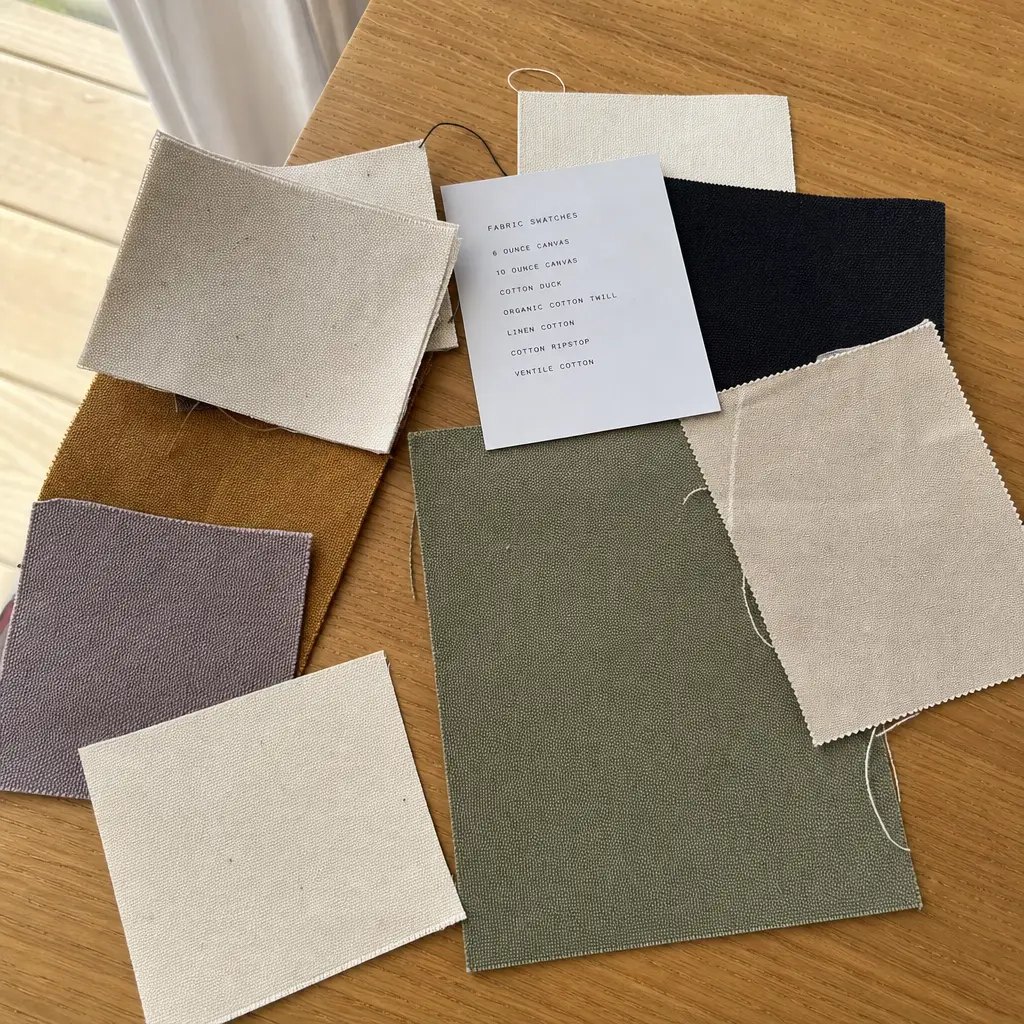
- For natural canvas, approve shade range with physical swatches instead of only digital photos.
- For dyed canvas, define Pantone target, acceptable color difference, and whether lab dips are required.
- For heavy canvas, check whether the factory sewing machines can handle reinforced handle areas without skipped stitches.
- For washable claims, discuss shrinkage and print durability before using any consumer-facing wording.
Print Method and Branding Controls
Screen printing is usually the safest choice for bakery logos on canvas wine carriers when artwork uses solid colors and the order quantity justifies screen setup. It provides good coverage on cotton canvas and predictable unit cost. For a natural canvas background, dark green, brown, black, navy, and wine red often print cleanly, but the final tone should be approved on the actual bulk-intended fabric.
Heat transfer and digital printing can work for detailed seasonal artwork, illustrated bakery labels, or low-MOQ promotional runs. The tradeoff is durability and hand feel. Transfers can crack at fold lines, lift at edges, or feel plastic on rough canvas. Digital printing may look softer but can be sensitive to fabric texture and pretreatment. The RFQ should require print testing instead of relying on a supplier photo.
- Provide vector artwork with logo size, print position, Pantone colors, and minimum safe distance from seams.
- Specify whether the logo is printed before sewing or after sewing because placement accuracy and coverage differ.
- Approve a real printed sample, not a paper proof or flat artwork mockup.
- For screen print, confirm setup charges, ink type, curing method, and repeat-order screen retention policy.
- For transfers, test edge lifting after folding the bag and loading it with bottles.
MOQ Logic and Cost Drivers
A supplier MOQ is rarely one number. Canvas fabric may have one minimum, dyed fabric another, logo printing another, woven labels another, and carton customization another. A bakery buyer ordering several gift-set designs can reduce risk by using one base bag construction with different prints or labels, instead of creating several new fabric colors and sizes at once.
Cost drivers should be separated in the quote. A low unit price can hide expensive setup charges, poor packing assumptions, or a fabric substitution. Ask the supplier to show bag sewing cost, logo cost, material surcharge for heavier canvas, sample charge, screen or plate charge, custom label cost, and export carton cost. This makes supplier comparison more accurate than comparing one blended number.
- Lower MOQ route: stock natural canvas, standard size, one-color screen print, neutral thread, standard carton.
- Mid-range route: custom size, natural or dyed canvas, two-color print, reinforced handles, custom carton label.
- Higher-control route: dyed fabric lab dip, woven side label, internal divider, reinforced bottom, pre-shipment inspection.
- Common hidden costs include print setup, artwork adjustment, sample courier, carton upgrade, palletization, and failed inspection rework.
- For multi-SKU programs, ask whether the MOQ applies per design, per color, or per shipment.
Supplier Evidence for Compliance
Supplier compliance is practical evidence, not a logo wall of certificates. For canvas wine carriers used by bakeries, the buyer should know fabric composition, restricted substance control, dye or ink suitability, factory inspection method, and shipment documentation. If the product will be sold in retail, distributed through a chain, or included in a food gift pack, documentation discipline matters.
Not every order needs expensive third-party testing, but every importer should know which standards apply in the destination market and sales channel. For example, azo dye restrictions, heavy metals in prints, packaging waste rules, carton labeling, and retailer packaging manuals may affect the order. The supplier should be able to provide test reports where available or prepare bulk samples for buyer-arranged testing.
- Request a material composition statement for cotton canvas, thread, handle tape, divider, ink, and label.
- Ask whether recent fabric or ink test reports are available and whether they match the exact material used.
- Confirm carton markings, country of origin marking approach, and any retail barcode requirements.
- Require traceability from approved sample to bulk production lot through fabric swatches and production photos.
- For regulated channels, add third-party inspection and testing costs into the buying budget early.
Sample Approval That Prevents Bulk Disputes
A photo sample approval is not enough for a load-bearing canvas wine carrier. The pre-production sample should use the intended fabric weight, handle material, thread, divider construction, print method, label, and packing style. If the supplier sends a sample made from available workshop fabric, the buyer should treat it as a shape sample only, not a production approval.
Write acceptance notes directly after reviewing the sample. Measure the bag flat, load it with the actual bottle, check balance, fold and unfold it, rub the print, and inspect handle attachment. If the carrier is used in bakery retail, put it next to the bread sleeve, pastry box, or bottle product that it must pair with. This catches real fit problems before cutting bulk fabric.
- Approve one signed reference sample kept by the buyer and one duplicate kept by the factory.
- Record finished dimensions, fabric weight, logo size, print position, handle drop, and divider position.
- Take photos of acceptable natural fabric shade, seed specks, print coverage, and seam finish.
- Classify changes after approval as either no-cost correction, charged revision, or new sample requirement.
- Do not release bulk production until artwork, sample, packing method, and carton label are all approved.
Inspection Thresholds for Finished Bags
Finished canvas wine carriers should be inspected as both sewn textile goods and bottle-carrying packaging. Cosmetic checks include stains, yarn slubs, oil marks, loose threads, crooked hems, uneven gussets, and print defects. Functional checks include handle strength, divider stability, seam security, bottle fit, and the ability of the bag to stand or carry as specified.
For bulk orders, define critical, major, and minor defects before production starts. A broken handle, missing divider, wrong fabric weight, unsafe sharp object, or incorrect logo is usually critical or major. Small natural cotton specks may be minor if approved in the shade standard. This prevents arguments when the inspector finds defects that are normal for natural canvas but unacceptable for premium retail display.
- Measure size tolerance from fixed points, such as bottom seam to top edge and side seam to side seam.
- Load test handles with filled bottles for a defined time and check seam tearing or stitch elongation.
- Check print registration, smudging, pinholes, color deviation, and adhesion after curing.
- Open the divider and confirm bottles sit separately without forcing the seam.
- Use an agreed AQL plan or buyer-defined inspection level for larger distributor and importer orders.
Packing, Cartons, and Warehouse Receiving
Packing affects landed cost and retail usability. Canvas wine carriers can be packed flat, folded, or individually polybagged, but each method changes carton cube, labor, moisture risk, and receiving time. Many bakery buyers prefer reduced plastic, yet export shipping may still require inner moisture protection. If the bag is natural cotton, humidity and carton compression can create odor, creasing, or stains.
Carton planning should be decided before price approval. A supplier may quote a low price based on oversized cartons, too many units per carton, or weak board. Importers and distributors should set carton gross weight limits, label format, barcode placement, and pallet pattern requirements. For retail buyers, the carton must protect product shape so the bag does not arrive with crushed gussets or distorted dividers.
- Set units per carton based on warehouse handling limits, not only factory convenience.
- Request estimated carton size and gross weight in the quote for freight comparison.
- Specify flat packing direction so logos do not crease across the printed area.
- Use clean inner liners or bundled packing if individual polybags are restricted by the buyer.
- Ask for carton drop or compression expectations when shipping by sea or courier.
Lead Time and Seasonal Risk Control
Canvas wine carriers for bakeries often peak before holidays, winery collaborations, corporate gift seasons, and regional food festivals. The danger is that buyers approve artwork late, then expect normal lead time while fabric mills, print rooms, and sewing lines are already booked. A supplier may accept the order but compress sample review, curing time, inspection, or packing, which increases defect risk.
Build the schedule backward from the required warehouse date. Include artwork confirmation, sample production, sample courier time, sample comments, material purchase, fabric inspection, cutting, printing, curing, sewing, trimming, final inspection, packing, export documents, and shipment handover. If the order has custom dyed canvas or multiple print colors, the buffer should be larger.
- Typical sample development can take several working days after artwork and spec confirmation, longer for dyed fabric or custom labels.
- Bulk lead time depends on quantity, fabric availability, print complexity, and factory season; do not rely on a verbal estimate.
- Reserve inspection time before the shipment date so defects can be reworked without automatic air freight.
- During peak season, ask whether production capacity is confirmed by line schedule or only estimated by sales staff.
- For launch programs, approve a backup standard fabric or print option before the schedule becomes critical.
Specification comparison for buyers
| Supplier option | What to verify | Commercial advantage | Buyer risk to control |
|---|---|---|---|
| Direct sewing factory | fit-test photos with reference bottle, bottom reinforcement close-up, handle load proof, and final carton photo set | Better sample-to-bulk control and faster production feedback | May be weaker on export paperwork or branded packing unless checked early |
| Trading company | Factory name, production photos, trim-source proof, and who owns QC decisions | Can coordinate small mixed orders and extra services | Markup can hide real factory capability and slow defect decisions |
| Specialized bag workshop | bottle fit, bottom reinforcement, handle or cord strength, divider option, seam allowance, and upright stability | More practical for detailed construction, trims, and repeat programs | Capacity may be limited during peak seasons |
| Low-price general supplier | cotton canvas, jute, felt, nonwoven, or laminated paper sized to bottle diameter, weight, and condensation risk | Useful for simple promotional runs with loose specs | Material downgrades, weak packing, and vague inspection scope can erase savings |
| Retail-ready supplier | upright or flat packing, bottle-protection insert, carton count, moisture control, and retail display orientation | Can handle labels, SKU separation, carton marks, and receiving rules | Higher unit cost must be compared against reduced warehouse work |
| Compliance-focused supplier | Fabric records, labeling review, test plan, and production traceability | Safer for retail programs and repeat brand orders | Documentation claims need evidence, not only sales language |
| Local sample room plus bulk factory | Signed sample, bulk factory handoff, first-piece photos, and deviation owner | Good for complex branding before large production | Sample room quality may not match bulk line unless handoff is controlled |
Buyer checklist before sampling
- Define the bottle format before asking for price: 750 ml wine, sparkling wine, olive oil, cider, or mixed bakery gift bottle.
- State whether the carrier is single-bottle, two-bottle, or multi-purpose for bread, bottle, and small retail items.
- Specify fabric by construction and weight, such as natural cotton canvas 12 oz or 407 gsm, not only by the word canvas.
- Set minimum finished size tolerance, handle length tolerance, and divider position tolerance on the approved sample.
- Decide whether the bag needs reinforced bottom stitching, cross-stitch handles, inner divider, side gusset, or bottle neck support.
- Provide artwork as vector files with Pantone references and required print position from bag edges.
- Require a pre-production sample using bulk-intended fabric, thread color, handle material, print method, and packing method.
- Request fabric composition statement, azo and heavy metal test availability where required, and packaging material declarations for destination market compliance.
- Define carton packing, polybag policy, silica gel use, barcode label placement, and pallet requirements before the supplier quotes.
- Add acceptance criteria for fabric stains, needle holes, loose threads, print smudges, color deviation, handle strength, and carton damage.
Factory quote questions to send
- What exact fabric weight will be used in gsm and ounces, and is the weight measured before or after washing, dyeing, or finishing?
- Can you provide a fabric swatch from the same mill lot intended for bulk production before making the pre-production sample?
- What is your MOQ for the bag body, the print color, the dyed fabric color, and the custom woven label if each has a different minimum?
- Which print method do you recommend for our artwork and expected order quantity, and what are the setup charges or screen charges?
- What finished size tolerance can your sewing line hold for height, width, gusset, handle drop, and divider location?
- How do you test handle strength for filled wine carriers, and what load and duration do you use for internal QC?
- Will the bulk order use the same sewing thread, handle tape, divider fabric, and reinforcement as the approved sample?
- How many bags per export carton, what is the estimated carton size and gross weight, and can the carton pass our warehouse receiving limit?
- Do you inspect printing before sewing, after sewing, or both, and what defect categories trigger rework or rejection?
- What documents can you provide with shipment, such as packing list, commercial invoice, material statement, inspection report, and carton label photos?
Quality-control points to confirm
- Fabric weight should match the approved specification within an agreed tolerance, commonly plus or minus 5 percent when tested from bulk fabric cuttings.
- Finished dimensions should be measured on flat bags before packing, including height, width, gusset, handle drop, and divider position.
- Handle pull testing should simulate filled bottle weight with safety margin, especially on two-bottle carriers and longer handles.
- Print adhesion should be checked by dry rub, light scratch, and tape pull tests after full curing time, not immediately after printing.
- Logo placement should be measured from fixed seams or bottom edge, with an allowed deviation agreed before production.
- Divider stitching must be straight, secured at stress points, and positioned so bottles do not collide during normal carrying.
- Needle holes, skipped stitches, loose threads, fabric stains, oil marks, and uneven top hems should be classified before inspection.
- Cartons should be checked for correct quantity, barcode or item label, inner packing, moisture control, and crush damage before shipment.