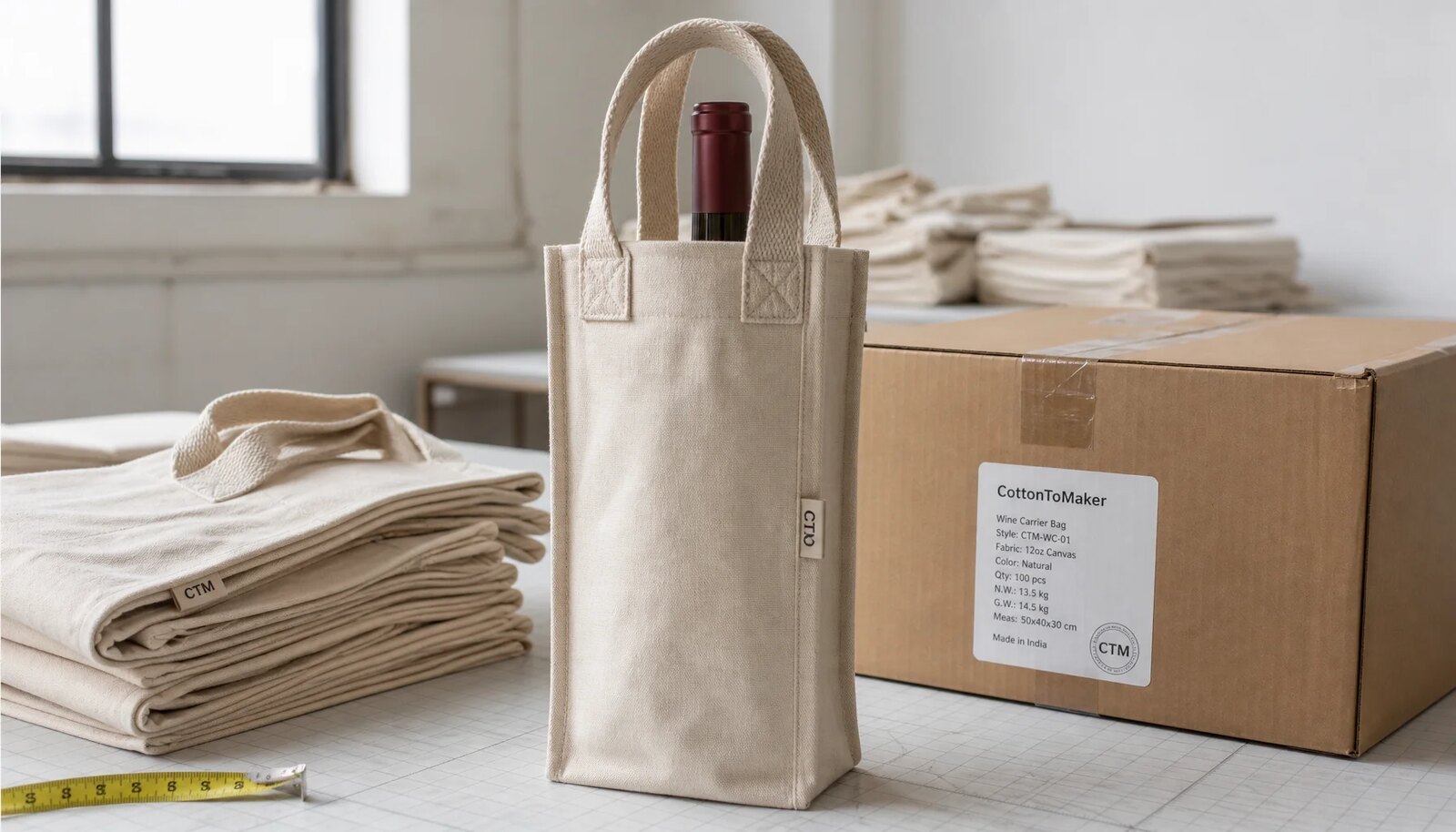
Plan the Carton as Part of the Product
Canvas wine carriers look simple on a product sheet. In event procurement, they are not simple. The buyer is not purchasing a loose sewn bag; the buyer is purchasing clean, counted, branded, event-ready units that must arrive in the right place, in the right sequence, with the logo still sharp and the carton easy to handle. The shipping carton is part of that product.
That is why canvas wine carriers shipping carton planning for event planners should start before the purchase order is released. A carrier for a winery tasting, hotel welcome gift, sponsor reception, trade-show handout, or VIP room drop may pass through a factory packing line, forwarder, warehouse, fulfillment partner, venue dock, and temporary event crew. Every handoff can create scuffed print, mixed cartons, wrong counts, crushed folds, or late setup.
The practical procurement question is not only, How much is each bag? It is, What is the landed cost per usable carrier at the event handoff point? A lower unit price can disappear quickly if staff must relabel cartons, remove lint, recount shortages, split mixed destinations, or repack damaged goods the day before an event.
- Define the purchased item as a packed, labeled, event-ready carrier, not only a sewn canvas bag.
- Ask suppliers to quote the carrier, decoration, inner packing, carton, label, and packing labor clearly.
- Approve a packed sample before accepting carton dimensions, case-pack, pallet count, or gross weight.
- Make receiving, room-drop, and event distribution needs part of the RFQ.
- Treat carton size, board, label format, and case-pack changes as controlled specification changes.
Map the Bottle, Handoff, and Route
The first specification is use. Will the carriers ship empty and flat, or will they be paired with bottles, tasting cards, sponsor notes, ribbons, inserts, or table assignments? Will a warehouse split them by destination, or will cartons go directly to a hotel dock? A one-bottle flat carrier and a two-bottle divided carrier may both be called canvas wine carriers, but they do not pack, stack, or distribute the same way.
Bottle dimensions need early confirmation. Buyers often say 750 ml bottle as if that settles the matter. It does not. Bordeaux, Burgundy, Champagne, sparkling wine, dessert wine, and specialty promotional bottles can vary enough to affect base depth, divider width, handle drop, carton height, and packed weight. If the carrier will be filled onsite, fit still matters because staff need fast insertion, stable presentation, and a handle that balances under real load.
The receiving team also shapes the carton. A warehouse with pallet jacks, scanners, and trained staff can handle larger cartons. A temporary crew moving goods through a service corridor may need lighter cartons that open cleanly and stage neatly by room, guest tier, sponsor, or registration batch. Freight efficiency matters, but not at the cost of slow distribution.
- Record bottle height, maximum diameter, shoulder shape, base shape, and approximate filled weight.
- State whether carriers ship empty, folded, stuffed, paired with inserts, pre-kitted, or pre-filled.
- Identify every receiving point: factory, forwarder, warehouse, fulfillment partner, hotel, venue, store, or final recipient.
- Define who opens cartons and how quickly they must count, stage, or distribute the goods.
- Avoid mixed-destination cartons unless barcode scanning or strict count sheets are in place.
Lock the Carrier Specification First
Carton planning depends on the finished carrier, so the bag specification must be more exact than natural canvas wine tote with logo. Canvas is commonly described by ounces per square yard and grams per square meter. As a working reference, 10 oz canvas is roughly 340 GSM, 12 oz is roughly 400 GSM, and 16 oz is roughly 540 GSM. Conversions vary by finishing and supplier practice, so the RFQ should state the target and the acceptable tolerance.
For many event programs, 10 oz to 12 oz canvas gives a useful balance of cost, hand feel, printability, and packing efficiency. Heavier canvas may feel more structured, but it also increases folded thickness, carton weight, and pressure on printed or embroidered areas. A small fabric-weight change can reduce the carton count or cause bulging if the supplier keeps the old case-pack.
Construction details matter just as much as fabric. A flat carrier nests tightly. A gusseted bottom, boxed corner, divider, padded panel, thick handle tape, woven side label, patch, or embroidery creates raised points that may not stack evenly. Those features can be right for the program, but the fold method and carton size must be built around them.
- Specify fabric by oz, GSM, tolerance, weave appearance, color standard, and shrinkage expectation.
- List finished dimensions: height, width, gusset, base depth, handle drop, handle width, and folded size.
- Define seam allowance, stitch density, reinforcement, thread type, thread color, and trimming standard.
- Identify raised elements such as labels, embroidery, patches, dividers, padding, and thick handles.
- Require the carton plan to be based on the approved production-like carrier, not a drawing alone.
Protect the Branding During Packing
Decoration is the part the event team and guests will notice first, and it is also one of the easiest parts to damage through poor packing. Screen printing is common for canvas wine carriers because it suits clear logos and repeat quantities, but the ink still needs correct curing and fold-line testing. A print can feel dry and still transfer if stacked too soon under carton pressure.
Heat transfer can give sharp edges and controlled color, but the supplier should confirm pressure, temperature, surface compatibility, and rub expectations. Embroidery can look more premium, but it adds thread height and a textured back side that may mark the adjacent carrier. Woven labels, patches, and side tags are durable, yet they can create pressure marks when cartons are packed tightly.
Artwork approval should include placement tolerance and fold behavior. The tolerance may be measured from a seam, centerline, top edge, or base, depending on the design and factory capability. Buyers should ask exactly where the fold will cross the decorated panel. A logo sitting on a hard fold can crease, crack, shine, or show a pressure line even when the print itself meets the artwork standard.
- Confirm decoration method, artwork size, color reference, placement point, and acceptable tolerance.
- Ask how long decorated carriers must cure or rest before folding and carton packing.
- Test rubbing between decorated surfaces, labels, handles, inserts, tissue, and carton walls.
- Use tissue or interleaving where print, embroidery, or raised decoration needs separation.
- Do not approve final case-pack until decorated carriers have been packed, handled, opened, and inspected.
Build the Carton From a Packed Sample
A carton drawing is useful, but the packed sample is the proof. Canvas is flexible, which means it can hide problems until real stacks are placed in a real carton. Handles may refuse to nest. Reinforcement patches can form ridges. Printed panels may face each other. A carton that looks correct by internal dimension can still bulge at the center, crush corners, or require packers to press down hard to close it.
The packed sample should show fold direction, unit orientation, stack count, inner protection, closure, label placement, and gross weight. Ask for photos before sealing, after sealing, and after a simple handling check. At minimum, the sample carton should be lifted, turned, set down, opened, and inspected again. This does not replace formal transit testing, but it catches obvious issues while there is still time to change the pack plan.
Carton strength should match the route. Many export shipments use 5-ply corrugated cartons as a starting point, but 5-ply is not a full specification. The buyer also needs gross weight, carton dimensions, pallet height, stacking duration, humidity exposure, and whether cartons move by full pallet, parcel, LTL, warehouse transfer, or venue dock. Sometimes a stronger carton is right. Sometimes the better fix is a lower case-pack.
- Record carton internal dimensions, external dimensions, case-pack, net weight, and gross weight.
- Specify board construction or a performance requirement tied to route and stacking conditions.
- Define fold direction and stack pattern with photos that production packers can follow.
- Confirm closure method: tape type, tape width, staples, straps, glue, or bands where applicable.
- Require written approval before changing carton size, board, case-pack, inner protection, or label placement.
Choose Case-Pack for People and Pallets
Case-pack is not just a freight calculation. It affects procurement cost, carton damage, warehouse slotting, receiving speed, and event labor. A carton of 100 flat carriers may reduce carton count, but it may be too heavy, slow to count, or risky if one carton is damaged. A carton of 24 or 50 may cost more in packaging but align better with tables, registration batches, store allocations, or room drops.
Set a maximum gross weight that reflects real handling. In many event settings, the people moving cartons are not warehouse specialists. They may carry goods through service corridors, lift cartons onto tables, or open them in a narrow back-of-house area. Ask suppliers to quote at least two case-pack options when volume is meaningful, because the cheapest freight option is not always the cheapest event option.
Pallet planning should happen before carton approval. Cartons should not overhang the pallet. Pallet height must suit the receiving warehouse, truck, container, elevator, or venue restriction. If the program includes multiple colors, artwork versions, or destinations, keep carton sizes compatible where possible. Mixed carton dimensions make pallet stability and destination sorting harder.
- Compare at least two case-pack options when quantity, venue handling, or freight cost is uncertain.
- Ask for cartons per pallet, pallet dimensions, pallet height, and estimated pallet gross weight.
- Keep cartons of the same SKU, color, artwork version, lot, and destination together where possible.
- Use carton counts that match operational batches such as 24 tables, 50 registrations, or 100 store units.
- Pack overage or spare units separately so they do not distort destination counts.
Demand Quote Detail That Can Be Compared
Supplier quotes are only comparable when the assumptions are visible. A low unit price may exclude interleaving, stronger carton board, custom labels, carton drawings, packed sample freight, inspection support, pallet wrapping, or export marks. A higher quote may include the exact details that prevent rework at the venue. Procurement should ask for line-item clarity instead of accepting vague packaging included language.
A useful quote separates the carrier base cost, canvas specification, construction, decoration, setup charges, labels or embroidery, inner packing, outer carton, carton printing or stickers, sample fees, tooling, inspection support, and freight term. It should also separate minimum order quantities. The MOQ for sewn carriers may differ from the MOQ for custom dyed fabric, screen setup, woven labels, custom carton board, or printed cartons.
Quote revisions should be predictable. If the buyer changes bottle type, increases canvas weight, adds hangtags, moves the logo, requests individual polybags, lowers case-pack, or splits the order by destination, the carton plan may change. A capable supplier will flag those dependencies before production rather than treating packing as an afterthought.
- Ask for price lines for carrier, decoration, inner packing, outer carton, labels, samples, and freight assumptions.
- Require MOQ and setup charges for each custom element, not only the finished carrier.
- Confirm whether carton drawing, packed sample, and revised sample after changes are included.
- Ask whether pricing assumes flat-packed empty carriers or pre-kitted, pre-sleeved, or pre-filled units.
- Compare landed cost per usable event-ready unit, not loose ex-factory unit price alone.
Use a Sampling Sequence With Real Approval Points
A loose carrier sample confirms the look and construction. It does not prove the order is carton-ready. A B2B sampling plan should move from loose sample to bottle-fit check, decoration approval, folded stack measurement, and packed carton approval. For high-visibility or high-volume programs, a small pilot pack-out can also show how quickly staff can open, count, and stage the goods.
The pre-production sample should be production-equivalent. If the sample uses substitute canvas, a temporary print method, a different thread, hand-cut panels, or lighter carton board, the supplier should disclose that in writing. Early concept samples can use substitutes, but final approval should be based on materials and processes that predict bulk output.
Approval records should be measurement-based, not only visual. Record open carrier size, folded size, handle drop, logo placement, artwork dimensions, carton dimensions, case-pack, gross weight, label content, and stack pattern. Photos are especially useful for fold direction, inner protection, and label placement. If the order has several colors or artwork versions, each version should connect to a controlled master specification.
- Approve a loose sample, bottle-fit sample, decorated sample, folded stack, and packed carton.
- Use the actual bottle or a dimensionally accurate mock-up for fit and balance testing.
- Require written disclosure of any sample-to-bulk differences.
- Photograph stack direction, inner protection, carton closure, label panel, and pallet pattern.
- Do not release bulk packing until the packed sample is approved.
Inspect Product Quality and Carton Accuracy Together
Inspection should follow the failure modes that matter at the event: fabric appearance, odor, dimensions, sewing strength, handle attachment, bottom seam integrity, decoration quality, cleanliness, folded fit, carton count, and label accuracy. A beautiful print with a weak handle is not acceptable. A strong carrier packed into the wrong destination carton is not acceptable either.
Fabric checks should include GSM range, color match, visible slubs, stains, mildew odor, water marks, and storage marks. Sewing checks should cover stitch density, skipped stitches, loose threads, seam puckering, reinforcement alignment, divider placement, and handle stress areas. For decorated goods, inspectors should verify registration, opacity, placement, color, curing, rub resistance, and behavior at fold points.
Carton inspection must happen after goods are packed. Inspectors should check carton dimensions, board condition, closure, bulging, gross weight, units per carton, label data, carton sequence, and destination codes against the packing list. If inspection cartons are opened, they need to be repacked exactly according to the approved fold and stack method before resealing.
- Set defect categories for critical, major, and minor issues before inspection starts.
- Include bottle-fit and handle stress checks for production samples from the bulk run.
- Check print rub and transfer after folding, stacking, and reopening the carton.
- Verify carton quantity by count and, where useful, by sampled gross-weight consistency.
- Match carton labels to PO, SKU, color, artwork version, lot, destination, and carton sequence.
Make Labels Work for the Event Team
Carton labels should serve the people receiving the goods, not only the exporting factory. A basic export mark may include PO and quantity, but an event dock may need event name, date, venue, room, contact, destination code, and open-first instructions. A fulfillment partner may need barcode data, SKU, lot, and scan-readable carton ID. The right label prevents unnecessary opening and reduces shortage disputes.
For multi-destination programs, the label structure should mirror the distribution plan. Cartons may be packed by venue, room, table group, guest tier, store, sponsor, region, or artwork version. Mixed cartons should be used carefully and documented clearly. Handwritten marks are tempting on rushed orders, but they are easy to misread and hard to audit.
Carton numbering should be simple and consistent. A format such as 1 of 40 can work for one destination. For split shipments, a destination prefix helps, such as NYC-01 of 12 or VIP-03 of 06. The packing list should use the same fields as the label so receiving teams can reconcile cartons without opening everything.
- Include SKU, color, artwork version, quantity, lot, PO, carton number, and destination on the carton label.
- Add event-use fields such as venue, room, table group, registration, VIP, open first, or sponsor area where relevant.
- Use printed labels or controlled stickers for multi-carton programs instead of handwritten notes.
- Keep label placement consistent on the same carton panel for easier scanning and receiving.
- Make the packing list match the carton label fields exactly.
Specification comparison for buyers
| Sourcing route | Best-fit carton approach | Useful buyer specification | Procurement risk to control |
|---|---|---|---|
| Direct bag factory with carton engineering | Factory develops the carrier, fold method, case-pack, inner protection, and export carton from one packed sample | Require finished carrier size, folded size, carton internal and external dimensions, board grade, case-pack, gross weight, pallet pattern, and label layout | Avoid approving only the loose bag; make carton approval part of the pre-production sample sign-off |
| Direct bag factory using standard cartons | Supplier adapts an existing carton size by changing fold direction, stack count, or inner wrap | Ask for void-space photos, carton bulge check, sample gross weight, stack photos before sealing, and handling observations | Standard cartons may save time but can cause loose stacks, crushed corners, print rub, or inefficient pallet use |
| Trading company coordinating bag and carton suppliers | One commercial contact manages fabric, sewing, decoration, carton sourcing, packing, and export paperwork | Ask who physically makes the carrier, who supplies the carton, where inspection happens, and who approves rework | Accountability can blur if carton failure is blamed on a subcontracted converter, packer, or warehouse |
| Regional stockholder with local overpack service | Finished stock is relabeled, sleeved, boxed, or split locally for a near-term event deadline | Verify fabric weight, carrier dimensions, print condition, existing pack damage, odor, and inventory age before overpacking | Overpacking can hide defects already present in old stock, mixed-lot goods, or shopworn cartons |
| Bag factory plus independent carton converter | Packaging specialist designs the carton while the bag factory confirms product fit, folding, and print protection | Request carton drawing, board specification, compression target or equivalent performance basis, packed sample photos, and carton closure method | Carton design based only on drawings can miss canvas bulk, raised seams, and logo pressure marks |
| Local fulfillment partner after import | Bulk cartons are received locally, then sorted, relabeled, kitted, or shipped to venues | Define receiving inspection rules, scan fields, shortage reporting, rework fees, relabel authority, and repack method | Extra handling can create count disputes unless carton IDs, packing lists, and rework logs match exactly |
| Low-MOQ sample supplier | Prototype carrier format, bottle fit, branding method, and carton size before committing to a larger run | Require production-equivalent canvas, thread, handle reinforcement, print process, and carton board where possible | Prototype samples made with substitute materials may not predict folded thickness, color, handle behavior, or carton fit |
| High-volume repeat factory | Stable carrier spec runs in pallet-efficient case-packs across recurring events, regions, or gifting waves | Lock fabric GSM range, print standard, sewing tolerance, carton size, case-pack, pallet pattern, and carton mark format as controlled specs | Uncontrolled carton changes between repeats can break warehouse slotting, labels, and reorder comparability |
| Premium gift packaging route | Stronger cartons, cleaner inner protection, tighter presentation, and more controlled label placement | Specify visible unpacking requirements, abrasion protection, tissue or interleaving, acceptable carton appearance, and presentation sequence | Premium packaging should solve a real handling or presentation problem, not just add cost |
Buyer checklist before sampling
- Bottle height, maximum diameter, shoulder style, filled weight, and whether the carrier must hold one or two bottles are defined before RFQ release.
- Carrier format is fixed: flat tote, gusseted bottom, divider, padded panel, drawstring top, boxed bottom, sleeve insert, hangtag, belly band, or gift-kit configuration.
- Canvas fabric is specified in oz and GSM, with an acceptable tolerance such as +/-5% where the supplier can support it, plus color standard, shrinkage expectation, and approved swatch process.
- Finished dimensions include open width, height, gusset or base depth, handle drop, handle width, folded size, and acceptable sewing tolerance.
- Handle construction, bottom seam, stress-point reinforcement, stitch density, thread color, thread type, and loose-thread trimming standard are written into the product spec.
- Decoration method is fixed with artwork size, color reference, placement tolerance, curing or drying time, fold-line risk, and abrasion protection requirements.
- A production-like packed sample is used to confirm folded unit size, case-pack, carton dimensions, carton board, inner packing, closure, label placement, and gross weight.
- Carton requirements include internal size, external size, board construction or performance requirement, flute or ply description, closure method, stack target, pallet height limit, and route assumptions.
- Case-pack is chosen for carton weight, event handling speed, pallet efficiency, destination splits, and count control, not only the lowest freight cost.
- Inner packing rules state whether tissue, interleaving, paper bands, inserts, moisture barrier bags, dividers, polybags, or desiccants are required or prohibited.
Factory quote questions to send
- What exact canvas weight do you propose in oz and GSM, and what production tolerance can you maintain across the order?
- Which color standard will be used for fabric and print approval: Pantone reference, lab dip, physical swatch, or approved production sample?
- What bottle dimensions did you test, and can you test our actual bottle, sleeve, insert, or filled mock-up before production?
- What are the finished open size, folded size, handle drop, gusset depth, packed unit thickness, and acceptable measurement tolerance?
- What stitch density, seam allowance, reinforcement method, and thread specification are included in the quoted construction?
- Which print or decoration method is quoted, how many colors are included, what placement tolerance applies, and how long must the print cure before packing?
- How will you prevent logo scuffing, ink transfer, embroidery pressure marks, woven-label indentation, handle deformation, and dust or lint inside the carton?
- What case-pack do you recommend, and what are the resulting carton internal dimensions, external dimensions, net weight, gross weight, and cartons per pallet?
- What carton board construction, flute or ply description, closure method, pallet pattern, and stacking assumption are included in the quotation?
- Does the quote include tissue, interleaving, bands, hangtags, inserts, moisture protection, carton labels, carton printing, pallet wrap, and export marks?
Quality-control points to confirm
- Canvas GSM is checked against the approved range, with no visible panel-to-panel weight difference, uneven dyeing, mildew odor, water marks, storage stains, or slubs outside the agreed fabric standard.
- Cut panels follow the approved grain or weave direction where specified, and finished width, height, gusset, handle drop, and folded dimensions stay within the agreed tolerance.
- Side seams, bottom seams, gussets, boxed corners, divider seams, handle joins, and reinforcement areas show even stitch density, no skipped stitches, no broken thread, no seam puckering that affects bottle fit, and no untrimmed thread tails beyond the agreed limit.
- Handle stress points are checked by the inspection method agreed before production, especially if the carrier will hold a filled 750 ml bottle or be handed out rapidly by event staff.
- Bottle-fit testing confirms insertion, removal, handle balance, base stability, and carrier appearance using the actual bottle or a dimensionally accurate mock-up.
- Print registration, edge clarity, color match, opacity, curing, rub resistance, and fold-line performance meet the approved sample with no tackiness, transfer, cracking, ghosting, or abrasion marks.
- Embroidery, woven labels, patches, side labels, hangtags, or belly bands are placed consistently and do not create pressure marks when stacked in the approved fold direction.
- Folded units fit the carton without forced compression, wall bulging, crushed corners, print drag, handle deformation, or raised details pressing into adjacent branded panels.
- Inner protection stays in place during lifting and carton opening; tissue, interleaving, inserts, bands, or dividers do not rub inked surfaces or hide count errors.
- Outer cartons close squarely, use the approved tape or closure method, stack straight, show no early corner collapse, and match the approved board, dimensions, label content, and carton sequence.