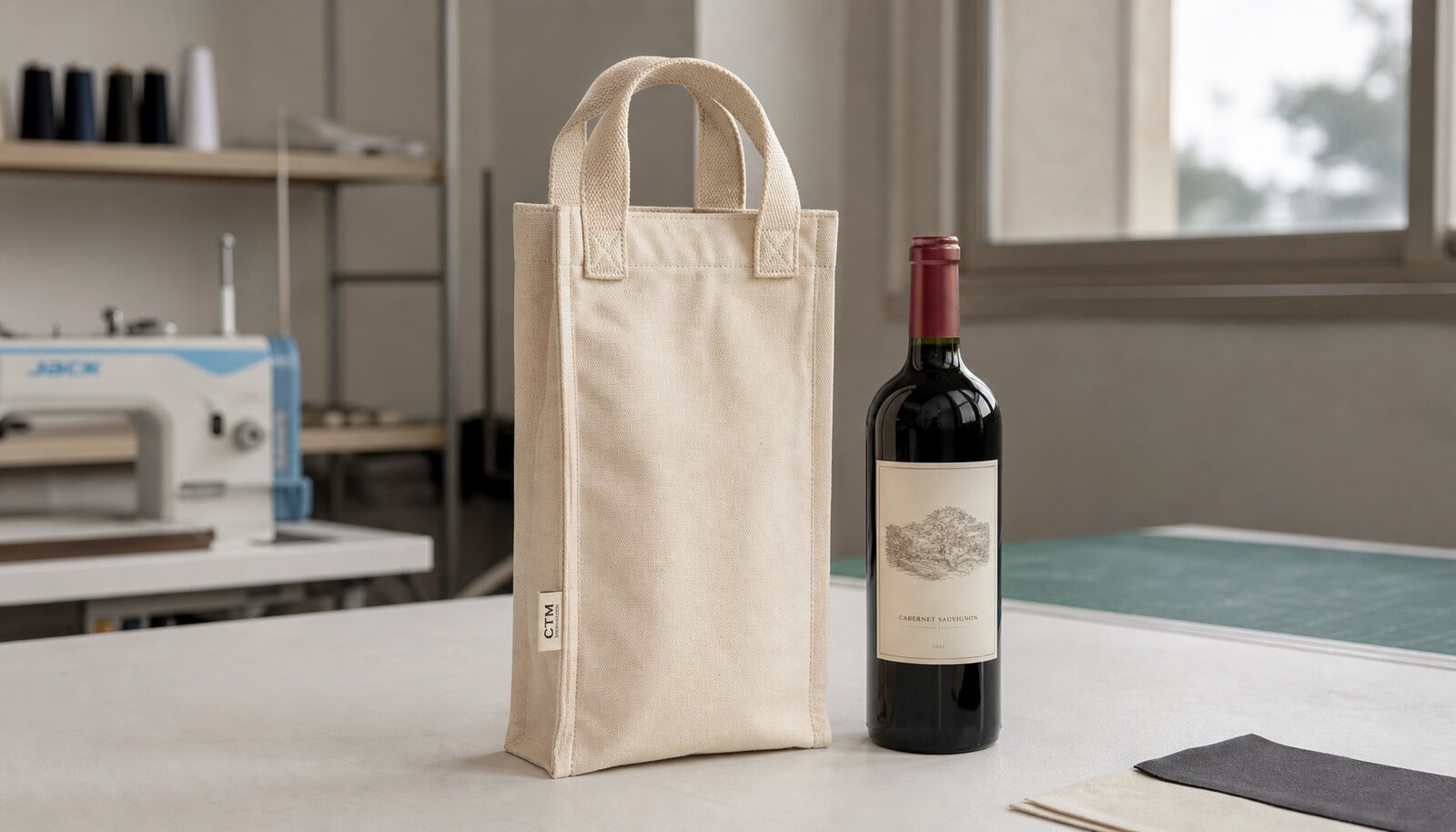
What the RFQ has to solve
For canvas wine carriers, the real sourcing problem is not finding a bag supplier. It is getting one quote that covers the same product definition across every factory you invite to bid. If one supplier prices a 10 oz sleeve, another prices a 14 oz reinforced carrier, and a third assumes a retail-ready polybag, the comparison is useless. The RFQ has to lock the bottle count, fabric weight, decoration method, and packing standard before price becomes meaningful.
In corporate gifting, that matters because the bag is often part of a wider kit. Buyers need a carrier that fits the bottle, matches the brand look, and survives warehouse handling without rework. A good RFQ reduces the number of hidden assumptions so the supplier can quote on production facts instead of guessing what the buyer meant.
- Define the bottle size and number of bottles first.
- State whether the carrier is gift packaging, resale packaging, or both.
- Use one approved spec sheet for every supplier on the bid list.
Define the carrier before you price it
Canvas wine carrier can mean several different products in supplier language: a single-bottle sleeve, a two-bottle carrier with divider, a handled tote with bottle insert, or a soft gift bag with a drawstring or flap top. If you do not name the structure, the factory will price the easiest interpretation. That is how buyers end up comparing unlike quotes that only look similar on paper.
The most useful RFQ defines the bottle dimensions in millimeters, the external bag dimensions, and the use case. For example, a Bordeaux bottle in a corporate gift program does not need the same depth as a sparkling bottle with a wider body. Ask the supplier to confirm the fit drawing against your bottle sample or bottle spec, not against a generic wine bottle photo.
- Provide bottle diameter, shoulder height, and neck length.
- State whether you need one bottle or two bottles per carrier.
- Include a reference photo or dimensioned sketch when the bottle shape is unusual.
Choose fabric weight that matches the brand promise
Fabric weight drives both price and perceived value. For most corporate gifting programs, 12 oz to 14 oz canvas is the practical range. That usually gives enough body for a stand-up look without making the carrier hard to fold, bulky in carton, or expensive to ship. Lighter cloth can work for short-term promotions, but it can wrinkle, sag, or show print strike-through if the ink coverage is heavy.
If the brand position is premium or the carrier needs a stiffer hand, 16 oz canvas is an option, but it should be a deliberate choice, not a vague upgrade. Ask the supplier to quote the cloth in both oz and GSM, and ask whether the fabric is bleached, natural, dyed, pre-shrunk, or enzyme-washed. Those details affect shade, shrinkage, and the way a print sits on the surface.
- 12 oz to 14 oz is the common corporate gifting range.
- Request fabric weight in both oz and GSM to avoid unit confusion.
- Ask whether the cloth is pre-shrunk if size consistency matters after packing or handling.
Print method changes cost, durability, and MOQ
For logo work on canvas wine carriers, screen printing is still the most cost-effective method for simple brand marks. It is strong on flat surfaces and works well for one or two colors. Once the artwork becomes complex, has fine lines, or needs tonal effects, the quote starts to shift. That is where buyers need to decide whether the brand really needs the detail or whether a cleaner version would print better and cost less.
Embroidery and woven labels solve a different problem. They give a more premium look, but they also change the structure of the bag and usually increase setup cost and lead time. Embroidery can pucker on thinner canvas and is not always ideal on narrow panels. If the buyer wants a logo on a side label or a subtle brand mark near the seam, ask the factory to show the exact placement and stitch count before bulk approval.
- Use screen print for simple logos and higher volume.
- Use embroidery or woven labels when the brand needs a premium tactile finish.
- Ask for artwork limits, color count, and whether setup charges are included in the quote.
MOQ logic is usually tied to setup, not only volume
Many buyers treat MOQ as a single number, but with wine carriers it often comes from several separate costs: fabric dye or stock cloth, print setup, cutting layout, and packing labor. A factory may quote a lower MOQ on natural canvas with one-color print and a much higher MOQ on dyed fabric with multi-color print and custom packing. That is normal. The mistake is assuming the lowest MOQ quote is the lowest-risk option.
When you compare quotes, split the MOQ into components. Ask for MOQ per size, per fabric color, per decoration method, and per carton configuration. This is especially important for corporate gifting programs that may need multiple client logos or multiple delivery dates. One carrier style can become several SKUs quickly, and the factory should show you where the price steps change.
- Separate MOQ by size, color, and artwork instead of using one total number.
- Watch for hidden MOQ triggers such as custom lining, dyed webbing, or retail packaging.
- Ask whether mixed artwork can be combined in one production run or not.
Write acceptance criteria for sample approval
A sales sample proves almost nothing if it is not tied to the production process. For this product, the pre-production sample should match the final fabric weight, the final print method, the final handle construction, and the final packing style. If the sample is made from heavier cloth or decorated by hand, it will hide the defects that show up in bulk. The RFQ should say that the approved sample becomes the production standard unless the buyer signs off on a change.
The sample review should be practical, not cosmetic only. Fit the actual bottle, check the opening and shoulder clearance, load-test the handle, and inspect the print against the approved art file. Look for seam straightness, thread trimming, and whether the base sits flat. If the carrier will be used for gifting, also check whether the bag stands neatly after packing or collapses in a way that makes it look cheap in the gift box.
- Approve the exact fabric, not a similar substitute.
- Use the actual bottle during sample testing.
- Treat any material or construction change after sample approval as a formal deviation.
Use a supplier comparison that reveals production reality
The best supplier quote is not always the cheapest. A direct factory usually gives the strongest control on pattern, print, and carton packing, especially when the order needs consistency across repeat runs. A trading company can be useful when the buyer needs several product lines from one contact, but the RFQ should then ask who is actually cutting, printing, and packing the bags. If that detail is missing, the buyer is comparing one factory quote to one managed quote without knowing it.
For importers and distributors, the key issue is production ownership. If a supplier cannot explain where the fabric comes from, who buys the print screens, and who signs off the sample, then delays are more likely. Your RFQ should force a clear answer on whether the supplier is a factory, a broker, or a decorator with outsourced assembly. That clarity is often worth more than a small unit-price difference.
- Ask who owns fabric sourcing, print setup, and final packing.
- Prefer a direct factory when repeat consistency matters more than one-off convenience.
- Use the same RFQ to compare factory route, trading route, and local decoration route on an apples-to-apples basis.
Packing is part of the product, not an afterthought
Corporate gifting orders often move through multiple hands before the end user sees the carrier. That means packing has a direct effect on damage rate, warehouse speed, and presentation. If the bags are shipped loose, the buyer may save a little on labor but lose time in kitting. If they are individually polybagged, the unit cost rises, but the bags stay cleaner and are easier to count and distribute. The RFQ should state which outcome matters more.
Ask for carton packing details that match your route to market. That includes units per carton, carton dimensions, gross weight target, carton marks, barcode labels, and whether the bags are folded or nested. If the carrier has a stiff insert or divider, check how that affects carton count and cubic volume. Many quote disputes come from the fact that one supplier priced the bag and another priced the bag plus a very different packing method.
- Specify whether you want bulk pack or retail-ready pack.
- Set carton marks and barcode requirements before production starts.
- Confirm that packing does not distort the bag shape or crush the print area.
Lead time risk lives in the details
Lead time for canvas wine carriers is not just sewing time. It includes fabric sourcing, print setup, sample approval, cutting, sewing, inspection, packing, and freight booking. A supplier who says the order can ship quickly may be assuming stock fabric, a simple print, and open production capacity. That may be fine for a rush program, but the buyer should still ask what part of the schedule is fixed and what part can slip.
The safest RFQ asks for a calendar, not a single number. Request the days needed for material confirmation, artwork approval, pre-production sample, bulk production, internal inspection, and ex-factory readiness. For seasonal corporate gifting, the real risk is usually late approval rather than slow sewing. If the buyer waits to approve artwork or packaging, the production slot can be lost even when the factory is ready to start.
- Ask for a milestone schedule, not only a ship date.
- Identify which steps depend on buyer approval.
- Reserve extra time if the order has multiple logos, mixed sizes, or special packing.
Use landed cost to compare quotes correctly
An ex-works price alone does not tell you whether a quote is competitive. For a wine carrier, landed cost can change a lot when you add print setup, export packing, inland freight, port fees, duties, and destination handling. A lower unit price can end up more expensive if the carton count is inefficient or the supplier underquotes packing labor and adds charges later. Buyers should compare the full route to warehouse, not just the factory gate price.
A practical RFQ asks the supplier to separate base product cost, decoration cost, packing cost, sample cost, and freight terms. Then the buyer can compare direct factory quotes with trading company quotes and local sourcing options on the same basis. That is the cleanest way to make a decision for corporate gifting, where margin pressure and presentation standards both matter.
- Compare base product, decoration, packing, and freight as separate lines.
- Watch carton volume because bulky packing can erase a small unit-price advantage.
- Use one quote template for every bidder so hidden charges stand out.
Specification comparison for buyers
| Spec decision | Recommended option | When it fits | Buyer risk to check |
|---|---|---|---|
| Source route | Direct factory with bag specialization | Best for custom size, custom print, and repeat corporate gifting orders where you need the same spec every season | Confirm who owns pattern making, print setup, and carton packing so the quoted price covers the real production route |
| Fabric weight | 12 oz to 14 oz canvas for most gift carriers; 16 oz only for premium structure | Works when the carrier should feel substantial without becoming too stiff or expensive | Check whether the supplier quotes fabric in oz, GSM, or both, because mixed units often hide a lighter cloth |
| Decoration method | Single or two-color screen print for logos; embroidery or woven label for premium branding | Fits clean brand marks, short artwork runs, and orders where color control matters more than special effects | Ask for print size limits, registration tolerance, and whether the quote includes screens, digitizing, or color matching |
| Carrier format | Single-bottle sleeve with reinforced base or a two-bottle carrier with divider | Best when the gifting kit has one SKU per bottle count and the buyer needs clear size control | Confirm bottle diameter, shoulder height, and whether the base board or divider is included in the quote |
| Handle construction | Self-fabric handles for value programs; cotton webbing handles for heavier bottles or premium retail use | Useful when the bag must carry weight comfortably and survive repeated handling | Check handle length, stitch pattern, and pull-test requirement so the quote is not based on a cosmetic handle only |
| Interior finish | Unlined natural canvas for value; partial lining or coated interior for stain resistance | Fits either promotional gifting or higher-end retail programs | Clarify whether lining, lamination, or coating changes the hand feel, recycling position, and factory MOQ |
| Packing route | Bulk packed with carton marks for wholesale; individual polybag plus barcode for retail or fulfillment | Best when cartons move through a warehouse, kitting line, or store distribution flow | Make the pack spec explicit so the supplier does not quote bulk packing and later charge extra for retail prep |
| Sample route | Pre-production sample with exact fabric, print, and packaging | Needed when the order has a hard launch date or a brand approval gate | Approve dimensions, print placement, seam quality, and carton markings before bulk production starts |
Buyer checklist before sampling
- State the exact bottle size range, including diameter, shoulder height, and whether the neck must be exposed or covered.
- Define fabric weight in both oz and GSM so suppliers quote the same cloth.
- Specify whether the carrier is for one bottle, two bottles, or a gift set with inserts.
- Lock the decoration method, print size, number of colors, and Pantone references before asking for price.
- Tell suppliers whether handles, base board, divider, lining, or closure are included or optional.
- Confirm target carton quantity, master carton dimensions, and any retail barcode or hangtag requirement.
- Ask for a pre-production sample, not just a sales sample, if the order is seasonal or time-sensitive.
- Request a quote split by item price, print setup, packaging, freight terms, and sample charge.
- Set an acceptable tolerance for size, color, stitch count, and print position.
- Confirm the lead time for material approval, sample approval, bulk production, and shipment booking.
Factory quote questions to send
- What fabric weight will you use, in oz and GSM, and what width of roll fabric is assumed in the quote?
- Is the price based on a direct factory run, a trading setup, or an outsourced decoration step?
- What is the MOQ per size, fabric color, and print color count?
- Does the price include screens, plates, embroidery digitizing, or woven label setup?
- What exact bottle dimensions did you use to calculate the pattern and seam allowance?
- Are handles, base board, divider, lining, or coating included, and if not, what is the surcharge?
- What packing method is included: bulk pack, individual polybag, barcode sticker, or retail insert?
- What is the pre-production sample process, and can the approved sample be used as the production standard?
- What are the lead times for raw material, sample approval, bulk production, and export booking?
- What quality checks will be done before shipment, and what defect level triggers rework or replacement?
Quality-control points to confirm
- Fabric weight matches the approved spec within a reasonable supplier tolerance and is not switched to a lighter cloth after sample approval.
- Bottle fit passes a physical test with the actual bottle shape, including diameter at the shoulder and neck clearance.
- Print placement stays within the approved tolerance and does not drift onto seams, folds, or the handle stitch line.
- Stitching is even, with no skipped stitches, loose thread ends, or weak reinforcement at handle attachment points.
- Handle pull strength is checked on the finished bag, not only on the handle material before sewing.
- Carton marks, barcode labels, and pack quantities match the buyer's shipping instructions and retail routing needs.
- Bulk goods are inspected for odor, stain marks, broken threads, and color variation before final packing.