Why salon chains need a different reorder plan
A salon chain does not use a canvas wine carrier in only one way. The same branded bag may sit beside haircare, skincare, candles, gift cards, and limited gift bundles. It may also support VIP appointments, client appreciation nights, stylist referral rewards, grand openings, holiday tables, or a co-branded wine partner campaign. Those use cases move at different speeds. One region may use carriers every month for client events. Another may touch them only in November and December. If procurement waits for individual salon managers to say they are running low, the reorder usually becomes rushed, split into awkward quantities, and more expensive than it needed to be.
The goal is not simply to keep stock on the shelf. The next batch has to look and perform like the branded item customers already saw. Canvas shade, logo position, handle drop, seam finish, divider height, carton packing, and bottle fit can all drift between orders. “Same as last time” sounds clear, but it is not a specification. The fabric lot may have changed. The print screen may have been remade. The person who approved the last sample may no longer have the sealed reference. A controlled reorder file turns a previous purchase into a repeatable product.
For B2B buyers, canvas wine carrier reorder planning should connect four jobs: demand forecasting, specification control, quote discipline, and quality control. Stock on hand should be separated from stock already committed to store allocations or marketing events. A carton in the warehouse is not available replenishment stock if it is reserved for a Valentine’s campaign. When uncommitted stock reaches the reorder trigger, the buyer should already know the approved specification, quantity tier, carton plan, sample path, inspection standard, and required warehouse date.
- Track usage by program type: retail add-on, loyalty reward, holiday gift, launch kit, wine partner bundle, stylist incentive, or staff event.
- Separate physical stock, committed stock, reserved safety stock, and available replenishment stock.
- Maintain a reorder file with artwork, measurements, fabric references, sample photos, carton details, and prior inspection notes.
- Use central sales and campaign history instead of relying only on salon manager requests.
- Review location-level demand quarterly so fast-moving salons are not hidden by slower stores in the chain average.
Build reorder quantity from demand, not from the last PO
Copying the last purchase order is easy. It is also one of the fastest ways to create either a stockout or excess inventory. Start with actual usage by week or month, then adjust for the selling calendar ahead. Add new salon openings, closed locations, discontinued programs, confirmed wine partner events, and seasonal campaigns. A holiday gift set can burn through several months of normal stock in two weeks. A new wine distributor can change both demand volume and bottle shape. The reorder quantity should reflect what is coming, not only what happened last time.
A useful structure is to divide demand into three buckets: base replenishment, campaign demand, and safety stock. Base replenishment covers normal counter sales, recurring client gifts, and everyday salon use. Campaign demand covers approved marketing programs with a launch date, target location list, and required quantity. Safety stock protects against delayed approvals, production holds, inspection findings, freight delays, carton shortages, and last-minute salon requests. This prevents a common problem: the marketing team uses every available unit for a seasonal push, leaving stores without stock for regular retail activity.
Allocation should be discussed before packing is approved. A 5,000-piece reorder does not mean every salon receives the same number. Flagship salons, high-volume locations, and stores participating in wine partner events may need deeper allocation. Smaller salons may need display stock plus a modest replenishment buffer. If allocation groups are known early, the supplier may be able to pack or mark cartons by destination group. That can reduce counting, relabeling, and repacking after arrival.
- Forecast base demand from the last comparable period, not from the most recent month if that month was seasonal.
- Add confirmed campaign quantities separately instead of hiding them inside the base forecast.
- Set safety stock based on lead time, event importance, freight route, supplier reliability, and inspection risk.
- Create allocation groups before packing approval: flagship, standard, event, warehouse reserve, e-commerce, and gift fulfillment.
- Trigger reorders from available uncommitted stock, not total units physically in the warehouse.
Confirm bottle capacity, fit, and construction before comparing prices
The first product decision is basic but important: does the current construction still match how salon teams use the carrier? A single-bottle canvas wine carrier is usually the most flexible core SKU. It stores easily, packs efficiently, uses less fabric, and works well as an impulse add-on at checkout. A two-bottle carrier feels more premium and suits VIP gifting, partner sets, and holiday bundles. It also uses more fabric and labor, and it normally needs a sewn divider so glass bottles do not knock against each other.
Finished dimensions should be written in millimeters and verified by sample. Standard 750 ml bottles are not all the same. Bordeaux-style bottles are often narrower. Burgundy-style bottles have wider shoulders. Sparkling bottles can be wider and heavier. Dessert wine bottles may be taller or slimmer. If the carrier is too tight, staff have to force the bottle in, which slows checkout and stresses the seams. If it is too loose, the bottle leans and the presentation feels unfinished. The gusset, side seam allowance, top opening, and bottom construction all affect fit.
Handle design is easy to underestimate. A salon client may already be holding a handbag, phone, coat, product bag, or appointment card. A comfortable handle drop makes the carrier feel intentional rather than like a throwaway promo item. Too long, and the bottle may swing awkwardly. Too short, and the filled carrier becomes uncomfortable. For repeat orders, measure the approved handle width, handle drop, and attachment position. A small difference may not show in a supplier photo, but it will show in daily use.
- Typical single-bottle finished size often falls around 100-120 mm wide by 320-360 mm high, but it must be adjusted to the nominated bottle.
- Typical two-bottle width often falls around 200-240 mm with a sewn divider, but construction depends on bottle diameter and divider placement.
- Specify finished dimensions, handle width, handle drop, gusset/depth, and top opening instead of saying “standard wine bag.”
- For two-bottle styles, define divider height, whether it is secured into the bottom seam, and whether both compartments fit the largest bottle.
- Require box-X stitching, bartacks, or an approved equivalent at handle stress points.
- Test loading speed at a counter, not only appearance in a studio photo.
Choose fabric weight, finish, and shade controls with landed cost in mind
For most salon-chain canvas wine carriers, 10 oz to 12 oz cotton canvas, when measured as ounces per square yard, is approximately 339-407 GSM. That range usually gives a reusable retail feel without making the carrier too heavy for broad distribution. An 8 oz canvas is approximately 271 GSM and may work for short-term giveaways, but it can wrinkle more easily, collapse on display, and show bottle edges. A 14 oz canvas is approximately 475 GSM and can look more substantial, but it adds unit weight, carton gross weight, sewing difficulty, and freight cost.
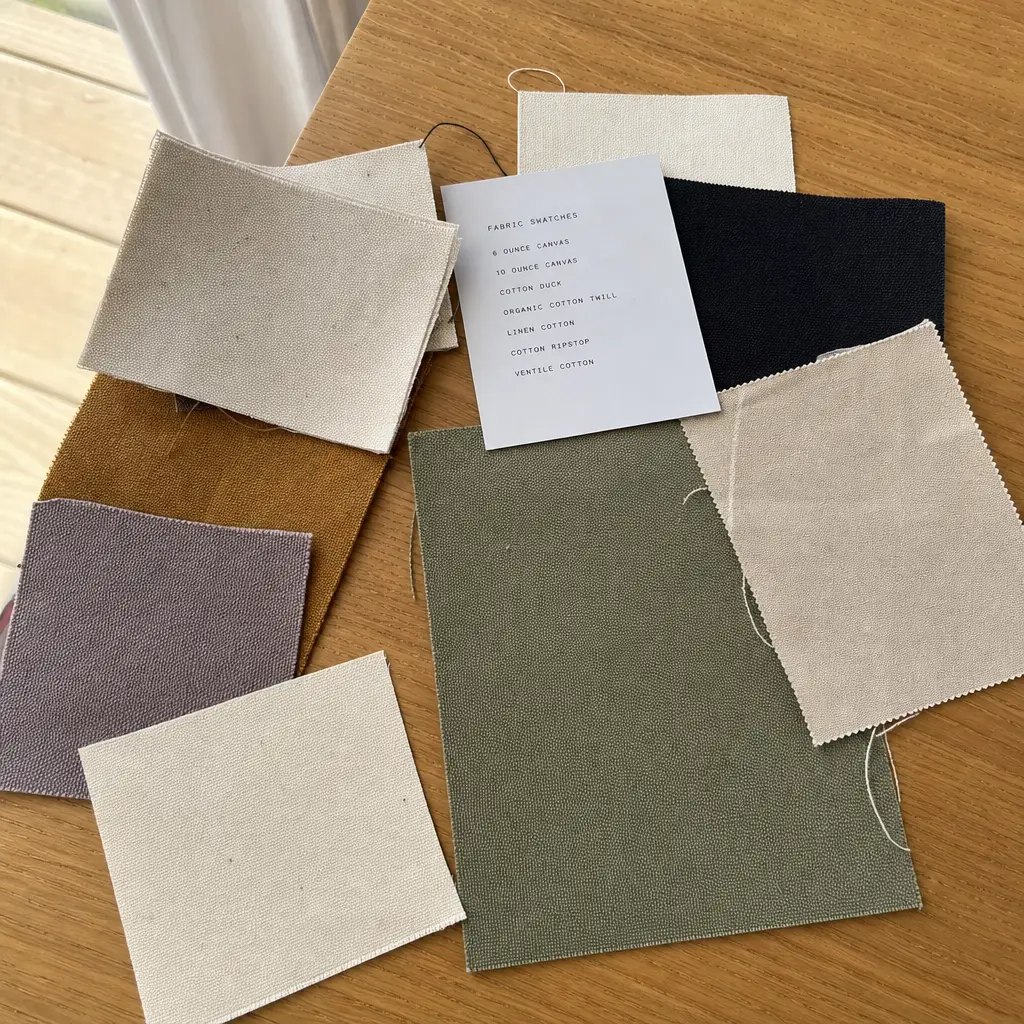
The finish should support both the brand look and the reorder plan. Natural cotton canvas is common for salon and spa positioning because it feels warm, simple, and understated. Still, natural cotton shade can vary from lot to lot. Bleached canvas gives a cleaner base for some logos, but it can show dirt more readily. Dyed canvas helps when a campaign or brand palette needs a specific color, but it brings extra controls: lab dip approval, dye-lot management, shade tolerance, and possible colorfastness checks. Washed canvas may feel softer, but finishing before cutting must be controlled so dimensions do not drift.
Repeat orders need realistic shade control. Exact matching may not be possible if the original fabric lot is no longer available. Keep a sealed reference sample and state how the shade will be judged, under what lighting, and against which reference. Salon retail lighting, mirrors, white shelves, and nearby premium beauty packaging can make small differences more visible. If old and new batches may be displayed together, shade drift matters more than it would for a one-time event giveaway.
- Confirm whether fabric weight is quoted in oz/sq yd and request the GSM equivalent.
- Use 8 oz, approximately 271 GSM, only where lower cost is more important than structure.
- Use 10-12 oz, approximately 339-407 GSM, for most branded salon retail and wine partner programs.
- Use 14 oz or heavier only when premium positioning justifies added cost and freight weight.
- For dyed canvas, approve a lab dip before bulk fabric production and ask whether crocking or rub transfer is checked.
- For natural canvas, compare bulk fabric with the sealed sample under consistent lighting before cutting when possible.
- Ask for estimated unit weight, units per carton, gross weight, and CBM when changing fabric weight.
Control branding for repeatability, not just a good-looking proof
Screen printing is usually the most practical branding method for a canvas wine carrier when the salon logo uses one or two solid colors. It handles canvas texture well, keeps repeat costs predictable, and can be controlled with Pantone references and a signed print strike-off. Heat transfer has its place. It can reproduce gradients, full-color campaign graphics, metallic effects, and very fine detail. But it should be tested for adhesion, rub resistance, heat response, and folding on the exact canvas selected for production. Woven labels, side labels, or small patch labels can work when the buyer wants a quieter premium detail.
The reorder risk is rarely whether a logo can be printed once. The real question is whether batch two will match batch one closely enough for a chain-wide retail environment. Artwork instructions should include the final logo file name, print width and height, placement from a measurable edge or centerline, Pantone reference, print method, underbase requirement, and acceptable placement tolerance. Natural canvas can absorb ink differently between fabric lots. Dyed canvas changes how the same ink appears because the background color shifts the visual result. A print strike-off is a small control point compared with finding color or placement drift after bulk sewing.
Placement deserves extra attention because wine carriers are narrow. A logo that is only a few millimeters off center may look visibly wrong. If the bag has side seams, gussets, or divider stitching near the print area, the supplier needs a clear safe print zone. Avoid placing artwork where a packing fold will cross the design unless testing confirms the ink can handle it. If multiple salon logos, regional marks, or campaign slogans are in the order, each version needs its own artwork proof and carton identification.
- For solid salon logos, request screen print with Pantone or physical color reference.
- For full-color campaign artwork, test heat transfer on the exact canvas and packing fold before bulk approval.
- State print size in millimeters and placement from a measurable top edge, side edge, or centerline.
- Use a print placement tolerance such as plus or minus 3 mm to 5 mm, depending on artwork size and panel width.
- Avoid printing across thick seams unless the supplier confirms flat printing access and acceptable distortion.
- Keep a signed print strike-off for every active logo version and campaign artwork.
- Confirm whether repeat orders require a new screen charge or whether screens are retained and for how long.
Use MOQ logic that matches a multi-location chain
MOQ should be reviewed at more than one level. Ask about the total production quantity, but also the quantity per style, fabric color, logo version, print method, packing format, and shipment destination. A 3,000-piece reorder may sound straightforward. It becomes less efficient if it is split across single-bottle and two-bottle constructions, three fabric colors, five regional logos, and several campaign slogans. Each split can require separate cutting, printing setup, inspection, carton marking, and inventory control.
A cleaner structure is to maintain one core reorder SKU and a limited number of planned campaign SKUs. The core SKU uses stable construction, stable fabric, stable print placement, and standard carton packing. It supports everyday retail, loyalty, and replenishment. Campaign SKUs can be approved separately for holiday, Valentine’s, Mother’s Day, grand openings, or co-branded wine programs. This keeps a seasonal artwork decision from delaying the everyday item salons use all year.
If a supplier offers a very low MOQ, ask what tradeoff made that possible. The factory may be using stock fabric, simplified stitching, digital print, manual cutting, or a higher unit price. That may be fine for a small event, but it may not match the durability, cost, or repeatability needed for chain-wide replenishment. On the other hand, a higher MOQ can be efficient if procurement consolidates demand across regions and orders less often. The right MOQ is the one that balances unit cost, inventory exposure, freight, approval time, and operational simplicity.
- Core reorder SKU: one standard fabric color, one logo placement, one construction, one carton plan, replenished regularly.
- Campaign SKU: limited artwork or color, ordered against a confirmed launch quantity and separate approval calendar.
- Regional SKU: use only when local branding creates measurable commercial value.
- Ask for MOQ per style, fabric color, logo version, print method, packing format, and shipment destination.
- Compare total landed cost, not only unit price, when deciding between one consolidated order and several small reorders.
- Do not mix single-bottle and two-bottle demand into one quote line; the pattern, divider, labor, and carton capacity differ.
Write RFQs that prevent misleading quote comparisons
Canvas wine carrier quotes can look similar while covering very different products. One supplier may quote 8 oz cotton, basic stitching, and one-color print. Another may quote 12 oz canvas, reinforced handles, a sewn divider, export cartons, and support for pre-shipment inspection. If the RFQ does not state fabric weight, dimensions, reinforcement, print method, tolerances, sample requirements, and packing, the lowest price may simply be the least complete interpretation. Many budget surprises appear after sampling because the buyer then asks for details that were not included in the first quote.
A strong RFQ separates unit price from setup costs and logistics assumptions. Ask for unit pricing by quantity tier. Then list print screen charges, sample charges, artwork adjustments, label costs, inner packing, export carton costs, inspection support, and testing costs separately where possible. The quote should also state Incoterms such as EXW, FOB, CIF, DAP, or DDP. Without Incoterms, two prices may not cover the same point in the supply chain, and the comparison will be incomplete.
For reorder planning, ask what carries over from the previous batch. If the same cutting pattern, print screen, fabric reference, carton specification, and sealed sample are still valid, the repeat order may be faster and lower risk. If the supplier must change fabric source, remake screens, adjust construction, or use a different print workshop, treat the job as a controlled resample. The quote should identify those changes before the PO is released.
- Require fabric specification in both oz/sq yd and GSM where possible.
- List finished dimensions and tolerances, not only bottle capacity.
- Request quantity price tiers for the realistic reorder range, not only the MOQ.
- Separate print setup, screen charge, sample charge, label charge, carton charge, and special packing fees.
- Ask for estimated carton dimensions, units per carton, gross weight, net weight, and cubic meters.
- State Incoterms, port, and delivery destination so landed cost comparisons are meaningful.
- Confirm whether the supplier is quoting to the sealed sample or proposing a revised construction.
Approve samples in the same conditions the reorder will face
A salon chain should not approve a canvas wine carrier from a photo alone. A blank size sample can confirm dimensions, bottle fit, and construction, but it does not approve logo color or print durability. A print strike-off confirms artwork direction, but it does not prove the full bag shape. The strongest approval before bulk production is a pre-production sample using the selected fabric, final dimensions, approved reinforcement, print method, logo placement, and intended packing fold.
Sample review should feel close to real use. Load the nominated bottle. Lift it several times. Place it on a retail surface. Fold it as it will be packed. Compare it with the previous approved sample. If the program involves a wine partner, test that partner’s actual bottle rather than a random bottle from an office shelf. If the carrier will be sold or gifted with other salon products, check whether it still presents well after the bottle is inserted and removed several times.
Documentation matters as much as the physical sample. The approval record should include dated photos, measured dimensions, fabric weight, print colors, comments, and the approver’s name. One sealed sample should remain with the supplier for production reference, and one should remain with the buyer for incoming inspection. If a later dispute arises about shade, handle length, divider height, or logo placement, the sealed sample gives both sides a shared reference.
- Measure width, height, gusset/depth, top opening, handle width, handle drop, and print placement.
- Check whether the bag stands straight with and without a bottle loaded.
- Test the largest nominated bottle for smooth loading and removal.
- Rub the printed logo with a dry white cloth and a slightly damp cloth to check transfer.
- Fold the sample for 24 hours in the intended packing style, then inspect print cracking, crease marks, and recovery.
- Photograph the approved sample from front, back, side, top opening, handle attachment, divider, and packed position.
- Keep one sealed sample with the factory and one sealed sample with headquarters or procurement.
Set QC thresholds for stitching, bottle fit, and print consistency
Quality control for canvas wine carriers should focus on two things: loaded performance and visible retail presentation. A filled 750 ml glass bottle commonly weighs around 1.2 kg to 1.6 kg depending on bottle style. Two-bottle carriers can carry roughly double that. Handle reinforcement should match the approved sample and be consistent across inspected units. Box-X stitching, bartacks, or equivalent reinforcement at attachment points are common options. Loose threads around the handle area should not be dismissed too quickly as cosmetic; they can signal poor thread tension or incomplete locking at a stress point.
Print QC should cover placement, registration, ink coverage, color, curing, and cleanliness. Canvas is textured fabric, not coated paper, so buyers should define realistic acceptance criteria. Slight texture show-through may be acceptable if it was approved in the strike-off. Blurred edges, obvious off-center placement, ink stains, ghosting, wrong logo size, wrong artwork, or color drift beyond the approved reference should be treated as defects. For salon displays, the front panel needs to be clean because the carrier may sit next to premium beauty products.
Defect classification should be agreed before production starts. Critical defects include unsafe handle failure, contamination, mold, or a wrong product that cannot be used. Major defects include wrong construction, wrong logo, severe print error, open seams, severe stains, missing divider, failed bottle fit, and carton shortage. Minor defects may include small loose threads away from stress points or very slight shade variation within tolerance. If using AQL, many buyers use critical defects not accepted, major defects at AQL 2.5, and minor defects at AQL 4.0, but the exact plan should be stated in the PO.
- Perform loaded lift testing on sampled units using the intended filled bottle load or an agreed higher test load.
- Set print placement tolerance, commonly plus or minus 3 mm to 5 mm from the approved position.
- Set finished dimension tolerance, commonly plus or minus 5 mm for simple wine carriers unless tighter fit is required.
- Define stitch quality through the sealed sample, stitches-per-inch requirement, or both.
- Reject obvious stains, holes, oil marks, severe slubs on logo areas, open seams, broken stitches, and exposed raw edges at stress points.
- Check two-bottle divider alignment and strength with two filled bottles inserted.
- Count by SKU, logo version, carton mark, and destination allocation, not only by total carton quantity.
- Compare bulk production with the sealed sample under consistent lighting for shade and logo color.
Plan packing and allocation before hidden costs appear
A canvas wine carrier is not complicated to pack, but packing choices affect freight, receiving labor, storage space, and product appearance. Flat packing usually keeps cartons efficient and works well for central distribution. Individual polybags protect against dirt and moisture, but they may conflict with sustainability goals. Paper bands or bulk inner packs reduce plastic, but they offer less protection if cartons meet humidity or rough handling. The best method depends on where goods ship: a central warehouse, 3PL, distributor, e-commerce fulfillment center, or directly to salon groups.
Over-compression is a common packing mistake. It may reduce carton size, but it can leave permanent creases across the print panel, especially if ink has not fully cured or the fold crosses the logo. Loose packing creates the opposite problem: higher freight volume and more movement inside the carton. The packing sample or carton mock-up should show how the carrier is folded, where the logo sits, how many units are in each inner pack, and how many inner packs are in each master carton.
Salon chains often need allocation by region, store group, campaign, or fulfillment channel. If allocation is not built into origin packing, the warehouse may need to open cartons, count units, relabel, and repack. That labor can erase savings from a low unit price and can damage printed panels. Clear carton marks make receiving faster and reduce mis-shipment risk. For repeat orders, keep the same item code and carton format where possible, but update PO, quantity, and destination details clearly.
- Pack by SKU and logo version; avoid random mixed cartons unless the warehouse specifically requests them.
- Use carton marks with PO number, item code, quantity, gross weight, net weight, carton number, and destination group.
- Avoid folding directly across the main logo if it creates cracking or crease memory.
- Choose individual polybags, paper bands, or bulk inner packs based on moisture risk, handling, and sustainability requirements.
- Request carton strength suitable for the route, especially long ocean transit or multiple domestic transfers.
- Confirm whether barcode labels, inner carton labels, or store allocation labels should be applied at origin.
- Ask for carton dimensions and cubic meters before approving the final freight plan.
Specification comparison for buyers
| Spec decision | Recommended option | When it fits | Buyer risk to check |
|---|---|---|---|
| Fabric weight | 10 oz to 12 oz cotton canvas if measured as oz/sq yd, approximately 339-407 GSM; confirm the supplier's measurement standard | Most salon retail add-ons, loyalty gifts, wine partner campaigns, and holiday counter displays where the carrier should feel reusable | 8 oz canvas, approximately 271 GSM, can feel promotional; 14 oz canvas, approximately 475 GSM, increases unit weight, sewing difficulty, and freight cost |
| Fabric finish | Natural canvas for spa-style branding; dyed canvas only when brand color is important enough to justify lab dip and shade control | Natural works for warm salon aesthetics and repeatable everyday SKUs; dyed works for premium campaigns or strict brand palettes | Natural cotton shade varies by lot; dyed lots need lab dip approval, shade tolerance, crocking check, and extra lead time |
| Bottle capacity | Single-bottle carrier for replenishment; two-bottle carrier with sewn divider for VIP and seasonal bundles | Single-bottle suits lower inventory exposure and checkout add-ons; two-bottle suits higher-value gifting and partner events | Different capacities require different patterns, carton counts, load tests, and MOQs; do not combine them under one quote line |
| Finished size | Specify width, height, gusset/depth, bottom construction, top opening, handle width, and handle drop in millimeters | Required when the wine partner uses a non-standard 750 ml bottle, sparkling bottle, or wider Burgundy-style shoulder | A generic bottle description can create tight loading, leaning presentation, or stress on side seams |
| Handle structure | Self-fabric handles with box-X stitch, bartack, or equivalent reinforcement at all attachment points | Needed for filled glass bottles and repeated salon staff handling at retail counters and events | Decorative topstitching without reinforcement may fail at the attachment point under loaded use |
| Branding method | Screen print for 1-2 solid logo colors; heat transfer only for gradients, full-color artwork, metallic effects, or very fine detail | Screen print is predictable for repeat orders on canvas texture; transfer can solve complex campaign art | Control Pantone reference, underbase, curing, rub resistance, folding over print, and print-position tolerance |
| MOQ structure | One core SKU with one fabric color and one logo color, plus separately planned campaign SKUs | Keeps reorder planning efficient across regions and reduces receiving errors | Splitting by salon region, fabric color, logo version, and capacity can push each line below efficient production quantity |
| Packing method | Flat packed by SKU and logo version in inner packs, then export cartons marked by allocation group | Works for central DCs, 3PLs, store replenishment, and pre-built campaign kits | Over-compression can crease the print; mixed cartons can create receiving, counting, and repacking labor |
| Inspection plan | Pre-shipment inspection against sealed sample using agreed defect rules, AQL targets, dimensions, print checks, and loaded bottle testing | Best for repeat orders distributed to many salons where batch consistency matters | Quantity-only inspection misses handle strength, bottle fit, stains, shade drift, print adhesion, and wrong carton allocation |
Buyer checklist before sampling
- Define the buying use case before quoting: retail add-on, loyalty gift, VIP client gift, wine partner campaign, grand-opening kit, holiday set, stylist incentive, staff event, or direct-to-consumer gift fulfillment.
- Create one controlled specification sheet covering bottle capacity, finished dimensions, fabric weight, fabric finish, handle width, handle drop, reinforcement method, seam construction, print size, print location, tolerances, and packing method.
- Confirm how the fabric weight is measured. If the supplier states 10 oz canvas, ask whether it means ounces per square yard and request the approximate GSM equivalent.
- Separate total reorder quantity from store allocation quantity so the supplier quotes efficient production volume instead of fragmented salon-level demand.
- Confirm the nominated bottle: standard 750 ml Bordeaux-style bottle, Burgundy-style bottle, sparkling bottle, tall dessert wine bottle, or the actual wine partner bottle with its maximum diameter and height.
- Request a blank size sample when dimensions or construction change, a fabric swatch or lab dip when material changes, a print strike-off when artwork or ink changes, and a pre-production sample before bulk production.
- Set bottle-fit acceptance using the largest bottle expected in the program, not a generic office sample bottle.
- Specify whether the canvas should be natural, greige, bleached, dyed, washed, recycled cotton blend, laminated, or unlaminated.
- Define acceptable shade tolerance against a sealed reference sample, especially for natural canvas repeat orders displayed under salon retail lighting.
- For two-bottle carriers, specify sewn divider height, divider fabric weight, divider attachment method, and whether the divider is secured to the base seam.
Factory quote questions to send
- What exact fabric weight are you quoting in oz/sq yd and GSM, and is the canvas natural, greige, dyed, bleached, washed, laminated, unlaminated, or a recycled cotton blend?
- What are the finished width, height, gusset/depth, bottom shape, seam allowance, top opening, handle width, handle drop, and safe print area for each wine carrier style?
- Is the quoted price based on a single-bottle or two-bottle construction, and does the two-bottle style include a sewn internal divider secured at the base?
- What reinforcement is included at the handle attachment: box-X stitch, bartack, extra fabric patch, folded self-fabric reinforcement, or another method?
- What is the expected filled-bottle weight used for load testing, and what static hang time or repeated lift cycle can the sample pass?
- Which print method is included, how many colors are quoted, what Pantone references are used, and is an underbase included for dark or dyed canvas?
- What print-position tolerance and print-size tolerance are you proposing for bulk production?
- What MOQ applies per bag style, per fabric color, per logo version, per packing format, and per shipment destination?
- Can you show quantity price tiers and separately list sample cost, print setup, screen charge, label charge, inner packing cost, export carton cost, and any repeat-order setup fee?
- What sample types can you provide: blank size sample, fabric swatch, lab dip, print strike-off, pre-production sample, and sealed approval sample?
Quality-control points to confirm
- Finished width, height, gusset/depth, and top opening should stay within the agreed tolerance, commonly plus or minus 5 mm for simple canvas wine carriers unless a tighter requirement is specified.
- Handle drop should be controlled separately, commonly plus or minus 5 mm to 7 mm, because small changes affect comfort and presentation.
- Bottle fit must be tested with the nominated largest bottle. The carrier should load smoothly without forcing seams, distorting the opening, or leaving excessive loose space.
- Handle attachment should pass loaded lift testing with at least the intended filled bottle load. For higher assurance, buyers can specify a static hang test at 1.5 times expected filled-bottle weight for 10 minutes plus repeated lift cycles, subject to supplier confirmation.
- Seam construction should match the sealed sample, with no broken stitches, skipped stitches, open seams, raw edges on stress points, or unraveling at the top opening.
- Print position should remain centered within approved tolerance, commonly plus or minus 3 mm to 5 mm depending on artwork size and panel dimensions.
- Ink coverage should be even enough for canvas texture, with no severe pinholes, smudges, ghosting, color contamination, blurred edges, or unwanted ink marks on the reverse panel.
- Print durability should be checked by dry rub, light damp rub, and folded packing simulation so ink does not crack, peel, or transfer under normal handling.
- Fabric appearance should be checked under consistent lighting for shade, stains, oil marks, holes, severe slubs on logo areas, and panel-to-panel mismatch.
- Two-bottle dividers should be straight, securely sewn, high enough to separate bottles, and aligned so both bottle compartments load correctly.