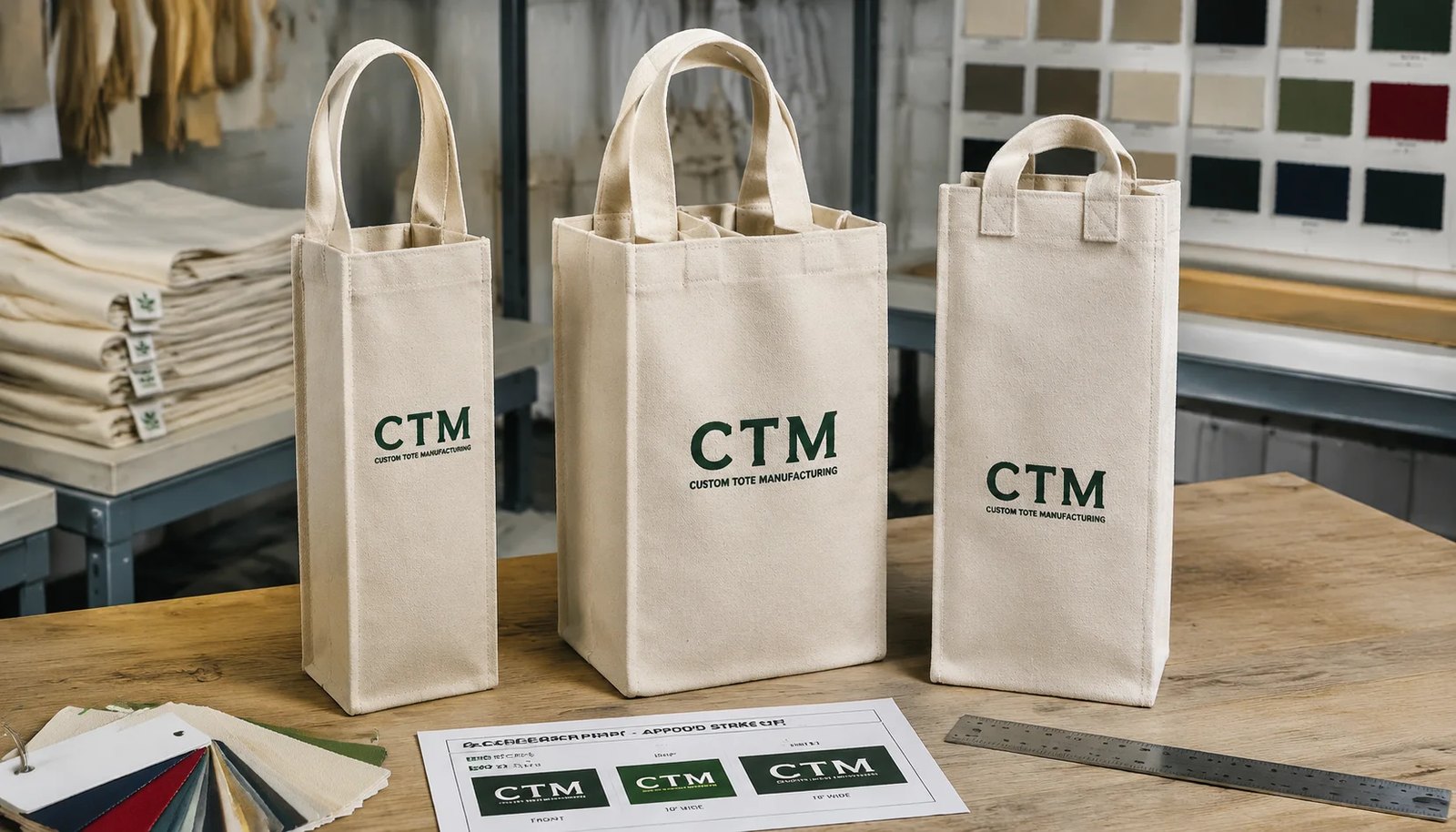
Why print proofing is the real failure point on canvas wine carrier orders
For natural grocer programs, the bag shape is usually simple. The expensive mistakes happen in print approval, especially when the buyer signs off a digital mockup and assumes the final logo will look the same on textured canvas. Canvas absorbs ink differently from coated paper or synthetic tote material. Natural canvas also has an off-white base tone that can shift greens, warm grays, and muted brand colors. That matters when the wine carrier sits next to premium bottles, holiday displays, or private label gift packs where the bag is part of the shelf presentation.
A second issue is panel distortion. Wine carriers are narrow, gusseted bags built around bottle dimensions, so print placement often lands close to side seams or near the upper handle area. If the artwork is centered only on a flat dieline and not adjusted for actual seam take-up, the logo can look off-center once the bottle is inserted. Buyers comparing supplier quotes should treat print proofing as a production control step, not a design formality. A cheaper quote without strike-off approval, seam-based measurements, and fit samples usually becomes the more expensive order.
- Digital proof shows artwork layout, not final ink behavior on canvas
- Natural canvas base shade can visibly change Pantone appearance
- Narrow bag fronts make seam-to-print spacing more sensitive
- Bottle insertion changes how centered artwork appears at retail
Choose the fabric weight around the bottle, not around the quote
Most wholesale canvas wine carriers for grocery retail work best in 10oz to 12oz canvas, roughly 280 to 340 GSM. This range gives enough body for one or two glass bottles without making the bag too stiff to fold flat for export packing. Lighter fabric can lower the unit price, but once you add bottle weight, narrow panel stress, and repeated carrying from checkout to car, underweight material starts showing diagonal pull lines, side seam distortion, and poor upright presentation. If the bag is intended as a reusable shopping accessory, that lower fabric weight often leads to faster wear and complaints.
There are valid reasons to move outside that range. An 8oz canvas may suit a low-cost one-bottle promotion where the bag is more gift wrap than long-life carrier. A 14oz canvas may suit a premium gift set with a reinforced base. But those choices should be made deliberately. Procurement teams should align bottle count, bottle diameter, expected carry cycles, and freight impact before comparing quotes. If one supplier quotes 8oz stock canvas and another quotes 12oz made-to-order canvas, they are not quoting the same bag even if the dimensions match.
- Typical practical range: 10oz to 12oz canvas, about 280 to 340 GSM
- Single bottle promo bags can go lighter if retail life is short
- Two-bottle divider bags generally need stronger seam support and better body
- Always match the sample with the actual bottle shape, not only the bottle volume
Print method selection: where cost savings become visual risk
For most natural grocer wine carriers, screen printing is still the most practical method. It handles solid logos, simple artwork, and medium to high volumes at a low unit cost. It also holds up better than many transfer films when the bag is folded for packing and then opened for use. On textured canvas, however, buyers should expect some micro irregularity at the ink edge, especially with very fine type. That is normal. The issue is not whether the print looks as sharp as coated paper, but whether it stays within an agreed acceptance level on the chosen fabric surface.
Heat transfer and digital transfer methods have a place when volume is low, artwork has tonal detail, or the buyer wants several SKUs without separate screen charges. The tradeoff is durability and feel. On fold lines, cheaper transfer films can crack or lift. On narrow wine bags, a transfer placed too close to a seam can bridge unevenly over the fabric. If a supplier suggests transfer for a large grocery rollout, the buyer should ask whether the recommendation is technical or simply because the supplier lacks a strong screen print line for narrow gusseted bags.
- Screen print: lower unit cost on larger runs, better for solid logos
- Transfer print: useful for low MOQ or detailed artwork, but test fold resistance
- Request print size in centimeters in every quote
- Approve print on production fabric, not on a substitute swatch
What a usable print proof package should include
A usable print proof package has three layers. First is the artwork layout showing panel size, print size, seam distance, and handle keep-out zones. Second is a physical strike-off on the actual bulk fabric or the exact same fabric spec. Third is a pre-production sample made to final construction with the approved print. Many delays happen because these steps are collapsed into one. The buyer approves an artwork file, production starts, and only then does everyone notice that the logo sits too high once the handles are attached or too close to the gusset fold where visual distortion appears.
For natural grocers, muted branding often looks simple but is hard to repeat. Olive, sage, charcoal, and warm earth tones can shift noticeably on natural canvas. The strike-off should be signed against a Pantone reference with a written note that the base cloth is natural or bleached. It should also include placement measurements such as print top edge 60mm below the bag opening and centered on the front panel within plus or minus 5mm. Those numbers are what quality teams can inspect on the line.
- Artwork layout with measured print zone
- Physical strike-off on actual fabric
- Pre-production sewn sample with final print position
- Written tolerance for color and print placement
- Pantone reference tied to natural or bleached base cloth
MOQ logic for grocery programs: lower entry, cleaner reorders
MOQ on canvas wine carriers is rarely just one number. It changes with fabric source, print method, size variation, handle type, and accessories like dividers or woven labels. Buyers running a test launch for a regional chain can usually lower MOQ by using stock natural canvas, standard dimensions, and one-color screen print. Once the program proves out, they can move to custom dyed fabric, branded labels, or multi-color artwork at a higher but more efficient annual volume. The key is to separate launch requirements from scale requirements instead of overbuilding the first order.
When comparing quotes, buyers should isolate setup-driven costs from repeatable unit costs. Screens, strike-offs, custom labels, and pre-production samples may make a small pilot look expensive. On a reorder, those costs may shrink or disappear if artwork and size stay unchanged. Good suppliers explain this clearly. Weak quotes often bury setup in the unit price, which makes future negotiations difficult and obscures the true economics of the program.
- Lower MOQ usually means stock fabric and simple print
- Custom dyed fabric or multiple SKUs often raise practical MOQ
- Separate setup costs from repeat order unit cost
- Ask if screen charges or sample charges are one-time or recurring
Construction sample checks that prevent retail complaints
A wine carrier should be reviewed loaded, not empty. Buyers should place the intended bottle inside the pre-production sample and evaluate four things: opening width, side seam strain, bottom support, and handle balance. A bag that looks clean when flat can become awkward when loaded if the gusset is too narrow or the seam allowance too small. For two-bottle bags, the divider must hold bottles apart at the base, not only near the top. Otherwise the bottles knock together during carrying, and the bag feels unstable.
Construction review should also include foldability for packing. A bag that stands beautifully in a showroom may pack poorly if the divider is too rigid or the base insert is oversized. That affects carton efficiency and freight. Buyers should request photos and measurements in both flat and loaded states. This is especially useful when suppliers propose slight dimension changes to save material. A small reduction in width or gusset can have a much larger effect on real bottle fit than it appears on paper.
- Test with the actual bottle diameter and height
- Measure opening width after sewing, not only on the pattern
- For two-bottle styles, center divider should be anchored at base seam
- Review both retail appearance and folded packing behavior
Packing details matter because these bags are narrow and easy to distort
Packing is often treated as an afterthought, but wine carriers are sensitive to crush marks and fold memory because the front print area is narrow. Over-compressed carton packing can leave hard creases through the logo zone, especially with heavier ink coverage. Flat packing in controlled bundles of 25 or 50 pieces usually works well. If the order includes several SKUs by store group, inner pack labeling becomes more important than the bag itself. Warehouse receiving errors can cost more than the product savings from simplified packing.
Procurement teams should define carton limits early. Some suppliers optimize freight by increasing pieces per carton, but that can push gross weight beyond warehouse handling preferences or lead to panel compression. If the bag has a bottom board, divider insert, or hangtag, carton dimensions change quickly. Include carton size caps, gross weight limits, barcode placement, and assortment rules in the RFQ. Otherwise two suppliers may quote very different packing assumptions, making landed cost comparisons unreliable.
- Common inner packing: 25 or 50 pieces per bundle
- Avoid excessive compression over printed front panels
- State carton gross weight limit if your warehouse requires it
- Separate SKUs clearly by carton marking and inner labels
Lead time risk is usually fabric and print queue, not sewing
Buyers often hear one total lead time number, but that number hides the real schedule risks. For canvas wine carriers, the usual pressure points are fabric booking, print strike-off approval, and screen print queue availability. Sewing is often the most predictable step once fabric and print are cleared. If the supplier uses stock natural canvas, fabric time may be short. If the program needs custom dyed cloth or color-matched handles, the front-end schedule becomes longer and less flexible.
A practical lead time breakdown helps buyers manage launch dates. For example, a supplier may need several days for sample revision, several more for strike-off, then production days after approval. That structure lets procurement teams understand what happens if marketing delays artwork sign-off by one week. Without the breakdown, all delays appear to be factory delay, which is rarely accurate. Importers should also ask whether the print line and sewing line are in-house or subcontracted because each handoff adds schedule risk.
- Request timeline by sample, fabric booking, printing, sewing, and packing
- Custom dyed material adds front-end risk compared with stock natural canvas
- Strike-off approval often controls the true start date
- Subcontracted printing can extend both schedule and QC response time
How to compare supplier quotes without getting trapped by a low unit price
The most common quote mistake is comparing a low ex-factory unit price against a more complete quote and assuming the lower number is better sourcing. For wine carriers, unit price can move based on fabric GSM, print size, print method, seam reinforcement, handle material, divider complexity, packing density, and included service steps like strike-off or final inspection. Unless these assumptions are lined up, quote comparison is mostly noise. A buyer needs a normalized cost view.
Build the comparison around the delivered specification and landed impact. Start with unit price, then add setup charges, sample cost, packaging extras, expected carton count, and freight effect from bag weight and carton cube. A thicker canvas may cost more per piece but reduce return risk and improve shelf appearance. A cheaper transfer print may save setup cost but create a higher complaint rate when folded. Good procurement decisions come from total program cost and execution reliability, not only the ex-factory number.
- Normalize fabric weight, print size, and handle spec before comparing prices
- Separate one-time setup cost from repeat unit cost
- Include carton cube and gross weight in landed cost math
- Account for likely QC and approval cycle cost, not only production cost
QC thresholds to write into the PO so the inspector can act
A purchase order should not stop at artwork and dimensions. It should convert the approval into measurable QC thresholds. For print, that means placement tolerance from seams and top opening, acceptable edge quality, and a written standard for color variation against the approved strike-off. For sewing, it means stitch security on handles, seam appearance under bottle load, and no raw edge exposure where not specified. For fabric, it means the agreed GSM tolerance and acceptable shade range if using natural canvas.
The reason to be this specific is simple: inspectors cannot enforce vague preferences. If the only note says logo centered, one factory may interpret that by eye while another uses a ruler from the cut panel edge. If the only note says natural canvas accepted, one batch may arrive warm beige and another cooler off-white, causing the print to look inconsistent across stores. Buyers should turn every approval detail that affects retail appearance or function into a measurable line item.
- Print placement tolerance example: plus or minus 5mm from approved location
- Fabric weight tolerance example: plus or minus 5 percent from approved GSM
- No skipped stitches or loose thread at handle stress points
- Shade variation on natural canvas must stay within the approved sample range
Specification comparison for buyers
| Spec decision | Recommended option | When it fits | Buyer risk to check |
|---|---|---|---|
| Fabric body weight | 10oz to 12oz canvas, about 280 to 340 GSM | Best balance for grocery retail programs needing upright bottle support without heavy freight cost | Below about 8oz the bag can collapse, distort print panels, and fail shelf presentation with glass bottles inside |
| Handle construction | Same-fabric self handles with box stitch or cotton webbing handles stitched into side seam | Use for wine carriers expected to lift 750ml glass bottles repeatedly in store and at checkout | Short top-stitch only handles may pass sample review but fail drop and carry use during retail launch |
| Single vs double bottle format | Single bottle body for promos; double bottle with stitched center divider for gift sets | Choose by retail bundle strategy and average bottle width used by the chain | Divider width often ignores actual bottle diameter, causing bulging side seams and poor folding for packing |
| Print method | Screen print for simple solid logos; heat transfer only for small runs or photo detail | Screen print gives lower unit cost and better rub resistance on medium to large runs | Transfer prints can look sharp on approval but crack faster on fold lines if film quality is poor |
| Print color approval standard | Physical strike-off on production fabric with signed Pantone reference and print position measurement | Needed when natural grocer brands care about muted earthy tones or exact private label colors | Digital proofs alone do not show ink absorption, natural fabric shade shift, or edge sharpness |
| Bleached vs natural canvas base | Natural canvas for earthy branding; bleached canvas when color match is strict | Natural base suits organic retail image and can reduce bleach process costs | Natural canvas shade varies by lot and changes perceived ink color, especially cream, green, and warm gray logos |
| Packing format | Flat packed in inner poly bundles of 25 or 50, then export carton with carton mark by SKU | Works for multi-store distribution and easier warehouse counting | Loose mixed packing without size or print lot separation creates receiving errors and retail allocation delays |
| MOQ route | Use stock fabric plus standard size for lower MOQ; custom dyed fabric and woven label for higher MOQ programs | Good for testing a regional chain before converting to a full seasonal or annual program | Buyers often compare quotes without seeing that one supplier priced stock material and another priced custom fabric |
Buyer checklist before sampling
- Approve the exact bag style first: single bottle, two-bottle divider, or gift format with gusset depth matched to the actual bottle diameter and height.
- State fabric weight in both oz and GSM, for example 10oz or about 280 GSM, rather than saying heavy canvas only.
- Specify whether the canvas base is natural, bleached, dyed, recycled blend, or organic content if required by your program.
- Define handle material, width, finished drop, stitch method, and minimum load expectation for glass bottle use.
- Request a print proof package that includes digital artwork layout, physical strike-off on the actual fabric, and measured print placement from seams and hem.
- List Pantone references and note whether slight shade shift is acceptable on natural canvas due to fabric tone variation.
- Set print acceptance criteria for edge sharpness, registration tolerance, ink coverage, rub resistance, and no visible strike-through on the inside panel unless accepted.
- Confirm if inside divider panels are required and whether they must be stitched to the bottom seam or only tacked at the top.
- Define packing method: flat folded orientation, pieces per inner pack, pieces per export carton, carton size limit, and barcode label requirements.
- Ask for sample photos showing bottles inserted, top opening width, seam profile, and how the bag stands when loaded.
Factory quote questions to send
- What exact fabric construction are you quoting: cotton percentage, canvas weave, finished GSM tolerance, and whether the fabric is stock or woven to order?
- Is your price based on natural canvas or bleached canvas, and what visible shade variation should we expect lot to lot?
- Which print method is included in the price, how many print colors, and what print size in centimeters is assumed?
- Will you provide a physical strike-off on bulk fabric before production, and is that cost included or charged separately?
- What is your MOQ by size, colorway, and print design, and does MOQ change if we add a divider, lining, or woven label?
- What handle construction is included: self fabric, cotton webbing, handle width, handle insertion method, and reinforcement stitch type?
- What are your sewing tolerances for body width, gusset, handle drop, and print placement deviation from the approved artwork?
- How many pieces per carton are you quoting, what carton dimensions and gross weight are expected, and can you meet our carton weight cap?
- Do you charge separately for pre-production sample, color strike-off, barcode stickers, hangtags, inner polybags, or drop test packaging upgrades?
- What quality checks are done in-line and final for print smudge, seam strength, needle damage, dirt marks, and carton assortment accuracy?
Quality-control points to confirm
- Fabric weight should stay within the agreed tolerance, commonly plus or minus 5 percent, and hand feel should match the approved sample.
- Body dimensions, gusset depth, and bottle fit must match the approved sample with practical insertion of the target 750ml bottle size.
- Print placement should be measured from the top hem and side seam with a defined tolerance such as plus or minus 5mm.
- Print edges should be clean with no ghosting, excessive pinholes, blurred small text, or visible color contamination between passes.
- Ink coverage should be even on the textured canvas surface without patchy absorption, cracking after fold, or tackiness after cure.
- Natural canvas lots should be reviewed for base shade variation before printing because this shifts the perceived logo color.
- Handle attachment stitches should be symmetrical, back-tacked, and free from skipped stitches, loose thread tails, or seam grin under load.
- Divider seam on two-bottle bags must be centered and captured securely at the base so bottles do not collide in transit.
- Inside and outside surfaces should be free of oil, dirt, mildew smell, needle cuts, and excessive lint trapped under print areas.
- Packing quantity, carton marking, barcode placement, and SKU assortment should be counted against the purchase order before sealing cartons.