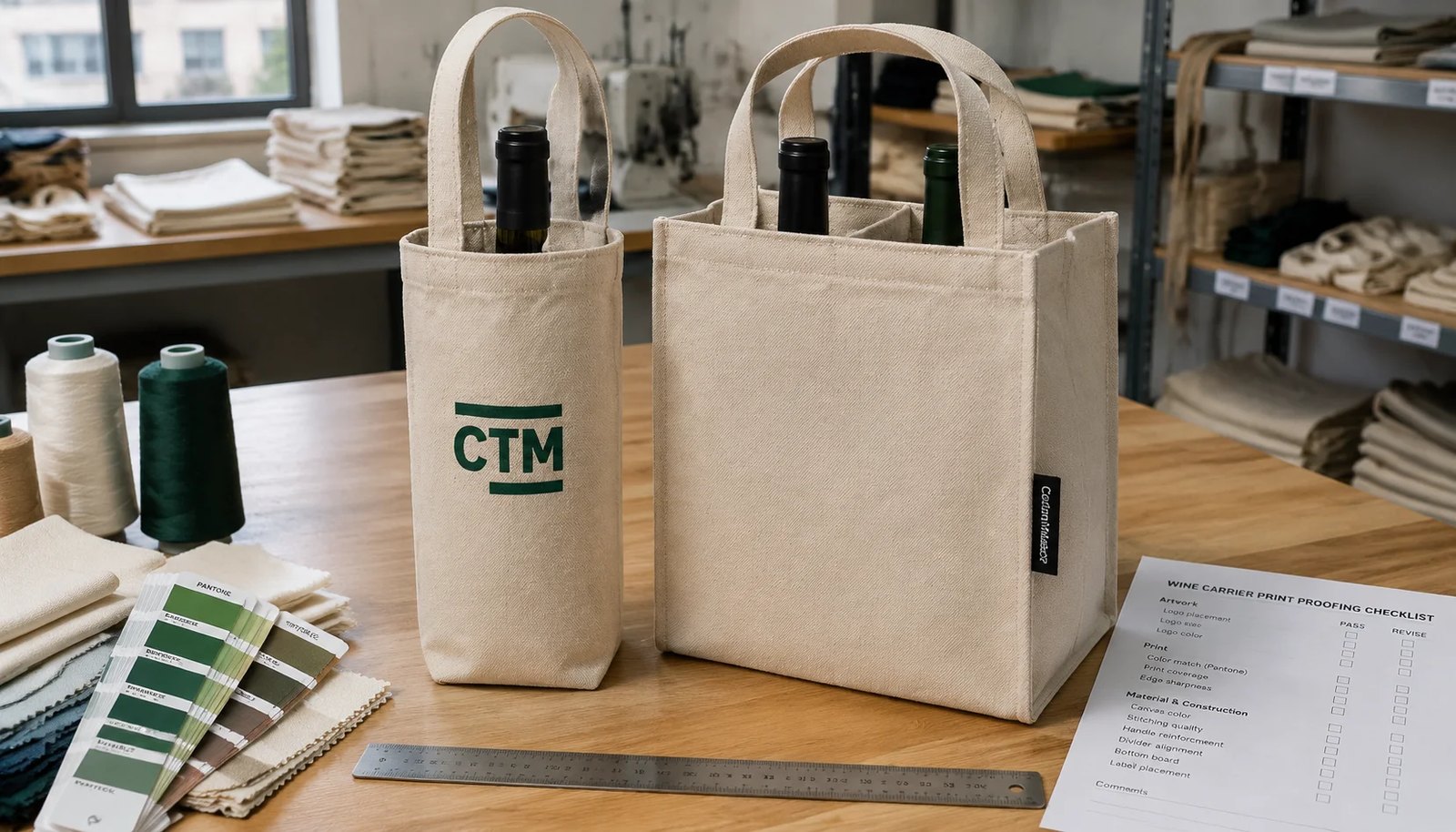
Why liquor retailers need a proofing checklist before ordering
Canvas wine carriers look straightforward in a catalog photo, but they combine three risk areas in one product: sewn construction, bottle fit, and printed branding. A flat digital mockup can make a logo appear centered and crisp, while the same logo can look high, bowed, or too close to a seam once a full glass bottle is inserted. Liquor retailers usually use these carriers at the point of sale, inside gift sets, for wine club pickup, or as branded promotional packaging. In those settings, the bag is not just a utility item. It is part of the shopper's impression of the bottle, the store, and the promotion.
A print proofing checklist protects procurement teams from approving the wrong thing too early. Many disputes start because the buyer approved a logo image before the factory locked fabric weight, gusset size, handle drop, or divider construction. The artwork may be correct, but the bag may not behave correctly when loaded. A stronger process treats the print proof as one part of a full pre-production approval, tied to the actual bottle dimensions and the actual retail use.
For B2B buyers, the goal is not to overcomplicate a simple cotton bag. The goal is to make every quote comparable and every approval measurable. If the RFQ says only 'natural canvas wine bag with logo,' suppliers will quote different fabric weights, different print assumptions, different handle reinforcement, and different packing standards. A checklist turns that vague request into controlled specifications: fabric, fit, artwork, color, tolerance, sample, QC, and packing.
- Approve the bag structure before final logo placement so the artwork is not positioned on an unstable pattern.
- Use the real target bottle during proofing, especially for Burgundy, sparkling, and premium spirits bottles.
- Treat a print proof as a production control document, not only a visual mockup.
- Keep the signed sample, artwork version, and QC checklist together for reorder consistency.
Define the bottle and bag construction before artwork work begins
The first proofing decision is not ink color. It is bottle fit. A standard 750 ml Bordeaux bottle, a wider Burgundy bottle, a sparkling wine bottle, and a spirits bottle can all require different clearance at the opening and gusset. Even when the nominal volume is the same, shoulder shape and bottle diameter affect how the carrier loads, how the front panel stretches, and where the print appears when the bag is full. Procurement should provide bottle diameter, full height including closure, shoulder width, and whether the bottle must be fully covered or partially visible.
Single-bottle carriers are usually simpler, but they still need a stable base and enough side depth for easy loading at checkout. Two-bottle carriers require more attention because the divider controls both safety and presentation. A divider that is merely loose inside the bag may look acceptable in an empty sample, but it can shift when bottles are inserted. A stitched divider anchored into the base seam and side seam area gives better separation and reduces glass-to-glass contact during normal handling.
Finished measurement language also matters. A factory may measure the fabric before sewing, while the buyer expects the final sewn size. That difference can create a bag that technically follows the supplier's quote but fails the retailer's bottle test. RFQs should state finished sewn dimensions and tolerance, and sample reports should measure width, height, gusset, base, handle drop, and divider placement after sewing and pressing.
- Ask suppliers what bottle size they assumed when quoting the pattern.
- Provide the largest realistic bottle shape if the bag will serve multiple SKUs.
- State finished sewn dimensions, not only flat cutting dimensions.
- For two-bottle carriers, require divider attachment details in writing before approving the sample.
Choose canvas weight, fabric color, and handle strength as a connected spec
Canvas weight affects structure, print quality, sewing cost, carton weight, and customer feel. For many liquor retail programs, 12 oz canvas, roughly 340 GSM, is a practical starting point because it gives enough body for a full bottle without making the carrier unnecessarily heavy. Lighter canvas in the 230-280 GSM range can work for budget promotions, but it may sag more visibly and may show more distortion around the bottle. Heavier 400 GSM canvas can suit premium two-bottle or reusable gift programs, but buyers should check handle sewing, needle marks, carton weights, and freight impact.
Fabric color changes print behavior. Natural canvas supports an eco or craft look and often carries a lower MOQ, but the shade can vary and cotton specks can reduce the perceived sharpness of pale ink. Bleached canvas gives a cleaner print base and more predictable color contrast. Black or custom-dyed canvas can look premium for holiday liquor promotions, but light ink opacity and dye rub resistance should be tested. If a retail brand expects a tight color match, lab dips and strike-offs should be built into the schedule.
Handles should be specified with the same discipline as the fabric. A wine carrier is expected to hold a heavy glass bottle safely, often carried by shoppers walking through a parking lot or between event tables. Handle width, material, attachment length, stitch pattern, and thread quality all matter. A box-and-cross reinforcement is common, but it should be visible on the approved sample and included in QC photos. Narrow handles can twist under load, while short stitch boxes can pull at the top edge.
- Use GSM or ounce weight with tolerance instead of vague terms such as thick or heavy canvas.
- Compare fabric color under normal store lighting, not only under factory desk lighting.
- Confirm whether natural canvas shade variation is acceptable for the selling channel.
- Specify handle width, handle drop, stitch reinforcement, and loaded carry expectation.
Match print method to artwork, canvas texture, and order scale
Screen printing is often the best commercial fit for canvas wine carriers when artwork is one or two solid colors. It is efficient for bulk production, durable when cured properly, and suitable for bold logos or simple store branding. However, it is not ideal for every file. Fine crest details, tiny serif type, halftone shadows, and small reversed text may fill in or break on textured canvas. The rougher the weave, the more the print can lose edge clarity.
Heat transfer and digital print can hold more detail, but they bring different risks. Transfers may look too film-like on natural canvas if the coverage is large, and cracking or edge lifting should be checked after folding. Digital print may be useful for shorter runs or multi-color artwork, but color consistency, rub resistance, and cost per unit need review. Embroidery can support a premium impression for small logos or monograms, yet it can pucker narrow panels and is usually less suitable for large central artwork.
The procurement question should not be 'Which print method is cheapest?' It should be 'Which method can reproduce this artwork on this fabric at this order quantity with acceptable durability?' Ask each supplier to comment on minimum line thickness, smallest readable text, ink opacity on the selected fabric color, expected hand feel, setup charges, and whether a strike-off is recommended. Supplier answers often reveal whether they understand canvas printing or are quoting from a generic bag template.
- Use screen print for bold one-color or two-color logos with moderate coverage.
- Use transfer or digital print only after reviewing hand feel, rub resistance, and folding behavior.
- Avoid approving tiny reversed text unless the supplier proves it on the actual fabric.
- For embroidery, check puckering and back-side finish on the finished carrier.
Build a print proof that production can actually follow
A reliable proofing process moves from artwork file to layout to physical evidence. Start with vector artwork so the factory can scale without distortion. Confirm that fonts are outlined, colors are named, and the file version is recorded. Then approve the print size and position in millimeters. A mockup that simply shows a logo centered on a bag image is not enough. The factory needs reference points, such as 85 mm below the top opening and centered between the two side seams, or 25 mm above the base fold with a defined maximum width.
Color proofing should match the commercial risk. If the carrier is a general store-branded giveaway, a reasonable visual match may be acceptable. If the bag supports a spirits brand activation, wine club identity, or private-label packaging program, specify Pantone references and require a physical strike-off on the selected fabric color. Canvas absorbs and scatters light differently from coated paper, so a Pantone number alone does not guarantee the same visual result. The signed strike-off becomes the production standard.
Proofs should also test the artwork in the loaded state. A logo can look well placed when the bag is flat but shift visually upward or outward when a bottle fills the space. For wine carriers, buyers should review the sample empty, loaded, carried by the handles, and placed upright on a counter. If the product will be folded in cartons, review the print after folding and unfolding so creasing or cracking is visible before bulk production.
- Record artwork file name, date, version, and approved color references.
- Approve print width, height, and location in millimeters.
- Set minimum line thickness and smallest acceptable text size for the selected method.
- Use a signed strike-off as the control for color and edge clarity when the order has brand risk.
Use a sample approval routine that tests retail use
A pre-production sample should not be judged only by whether it looks attractive in a photo. It should prove that the factory can make the actual retail product. The sample should use the final fabric weight, fabric color, pattern, handle construction, print method, and intended packing fold. A blank sewn sample can help check rough sizing, but it cannot confirm ink behavior, print position, curing, or how the artwork responds to canvas texture.
The sample review should be hands-on. Insert the target bottle and note whether it enters smoothly or catches at the opening. Place the loaded carrier on a counter and check whether it stands, leans, or twists. Lift it by the handles and inspect whether the top edge distorts, whether the bottle swings excessively, and whether the front logo remains visually balanced. For two-bottle styles, load two bottles and confirm that the divider does not twist or allow contact.
Document approval with photos and measurements rather than informal comments. Procurement teams should ask for front, back, side, bottom, inside divider, handle reinforcement, and loaded-carry photos. Measure the printed logo and finished bag dimensions. If changes are requested, identify whether they require a new sample, a revised digital layout, or only a production note. Ambiguous sample feedback creates avoidable risk when the order moves to bulk.
- Check the sample empty, loaded, carried, folded, and unfolded.
- Photograph the carrier from normal retail viewing distance, not only close-up.
- Measure handle drop and logo position on the physical sample.
- Do not release bulk production until fit, construction, print, and packing fold are all approved.
Compare supplier quotes with a normalized buying grid
Canvas wine carrier quotes can look similar while hiding very different assumptions. One supplier may quote 280 GSM natural canvas, an existing pattern, a small one-color logo, and simple carton packing. Another may quote 340 GSM bleached canvas, reinforced handles, physical strike-off, divider stitching, and barcode labels. The lower unit price is not meaningful unless the specification is normalized. A procurement grid should force every supplier to answer the same spec lines.
Separate one-time charges from repeat-order pricing. Screen charges, sample charges, lab dip charges, artwork setup, and courier costs may be included by one supplier and listed separately by another. For a first order, those costs affect the landed program cost. For a reorder, they may not apply. Buyers should ask which charges repeat if the same artwork is reordered, and which charges apply if only the logo color or fabric color changes.
Landed cost also requires packing data. Canvas bags are bulky relative to unit value, and heavier GSM reduces carton efficiency. Ask for pieces per carton, carton dimensions, gross weight, and whether the quoted packing protects the print. A slightly higher ex-factory price may be more competitive if it includes better carton efficiency, lower reject risk, or cleaner SKU separation for warehouse receiving.
- Normalize GSM, finished size, gusset, handle construction, print method, and packing before comparing prices.
- Separate tooling, screen, sample, courier, and lab dip charges from unit cost.
- Ask for carton dimensions and gross weight early for freight planning.
- Score supplier responses for technical clarity, not only quote speed.
Control MOQ, lead time, and change approvals before production starts
MOQ is usually driven by more than the number of finished bags. Fabric color, canvas weight, dyeing, print setup, custom pattern changes, divider construction, and packing style can each create a separate minimum. Natural canvas with one-color screen print on a standard single-bottle pattern often allows more flexibility than custom-dyed fabric with multiple artwork versions. Buyers managing several liquor brands under one group can sometimes reduce complexity by standardizing bag size and fabric while changing only the print, but this must be confirmed by the supplier.
Lead time should be broken into stages. A single line such as '35 days production' does not show where the risk sits. A realistic schedule includes artwork review, lab dip if needed, strike-off, pre-production sample, buyer approval, fabric booking, cutting, printing, curing, sewing, finishing, inspection, packing, and export handover. If the product is for holiday gifting, wine club release dates, or a seasonal liquor promotion, approval delays can be more damaging than small unit cost differences.
Change control is especially important after sample approval. Moving a logo by 10 mm, changing from natural to bleached canvas, adding a second print color, or switching from Bordeaux to sparkling bottle fit may require new screens, new pattern approval, or a new sample. Procurement should define which changes are minor and which changes restart approval. This prevents pressure on the factory to improvise during bulk production.
- Ask MOQ by fabric color, bag size, artwork version, and print color count.
- Request stage-by-stage lead time instead of one combined production estimate.
- Build extra approval time for dyed fabric, strike-offs, and holiday retail programs.
- Treat post-sample artwork or bottle-fit changes as controlled revisions.
Set QC tolerances for print, sewing, and loaded performance
Quality control should focus on how the carrier will be used in store, not only how it looks flat in a carton. The most important inspection points are finished dimensions, print position, print color, handle strength, bottle fit, divider stability, fabric defects, and packing condition. A generic AQL plan can define sample quantity, but it will not tell the inspector what matters for a wine carrier unless product-specific checkpoints are attached.
Print tolerance should be numeric. If the approved sample shows the logo centered 90 mm below the top opening, the inspection standard should state the acceptable variation, such as plus or minus 3 mm or another agreed value. Color should be checked against the signed strike-off or approved standard under consistent lighting. Print defects should include blurred edges, pinholes, ghosting, weak opacity, registration shift, broken small text, and ink transfer to adjacent fabric.
Loaded performance should be part of QC. Inspectors should insert the approved bottle shape, lift the bag, observe handle strain, check whether the bottom seam holds, and review the front print in loaded condition. For two-bottle carriers, the divider should remain upright and prevent normal bottle contact. Packing inspection should check carton quantity, SKU separation, barcode placement, carton marking, inner protection, and whether folded bags show print blocking or crushing.
- Measure finished dimensions after sewing and pressing, not before assembly.
- Check logo placement from construction reference points rather than by eye alone.
- Inspect handle reinforcement and bottom seams under loaded conditions.
- Include carton and SKU checks so warehouse receiving does not inherit production errors.
Turn the checklist into a better RFQ and purchase order
The strongest way to use a canvas wine carriers print proofing checklist for liquor retailers is to turn it into the RFQ itself. Instead of sending a logo and asking for a price, send a structured specification: bottle type, finished dimensions, canvas weight, fabric color, handle construction, divider requirement, artwork size, print method, color references, sample requirement, QC tolerances, packing, carton data, and target delivery date. This gives suppliers less room to assume and gives procurement a cleaner basis for comparison.
The purchase order should repeat the controlling specifications and identify the approved documents. Include the final artwork file name, approved sample date, signed strike-off reference, fabric standard, measurement tolerance, print placement tolerance, and packing instruction. If the order has multiple artwork versions or store programs, list each SKU clearly. Reorders should refer back to the same standards unless a change is deliberately approved.
This discipline is useful even for simple one-color natural canvas wine bags. It reduces avoidable email back-and-forth, helps suppliers quote the same product, and gives inspection teams a practical standard. For buyers responsible for liquor retail packaging, the checklist is not paperwork for its own sake. It is a way to protect brand presentation, bottle fit, selling-window timing, and landed cost before the order is already on the production floor.
- Attach the checklist to the RFQ so suppliers quote the same product.
- Reference approved artwork, sample, and strike-off in the purchase order.
- List each SKU and artwork version separately for multi-brand programs.
- Keep the approved checklist for repeat orders to control consistency.
Specification comparison for buyers
| Spec decision | Recommended option | When it fits | Buyer risk to check |
|---|---|---|---|
| Fabric weight | 12 oz canvas, about 340 GSM, with tolerance stated in the PO | Mainstream liquor retail gift bags, wine club carriers, and branded takeaway programs | Canvas below target may sag around a full bottle; heavier fabric changes unit cost, carton weight, and sewing difficulty |
| Bag format | Single-bottle flat-bottom carrier with side gusset sized to the largest target bottle | Standard 750 ml retail takeaway, winery gift purchases, holiday bottle promotions | If gusset depth is too narrow, Burgundy or sparkling bottles may catch at the opening and distort the printed front panel |
| Two-bottle construction | Stitched internal divider anchored into the bottom seam and side seam area | Premium bundles, mixed red-and-white packs, corporate gifting, or private-label gift sets | Loose divider panels shift during loading and transit, allowing bottle-to-bottle contact and uneven front tension |
| Print method | Screen print for 1-2 solid colors; transfer or digital only after surface and rub review | Bulk liquor retail programs with bold marks, simple typography, or moderate print coverage | Fine serif type, small reversed text, halftones, and gradients can fill in or lose edge clarity on textured canvas |
| Artwork color control | Pantone-referenced proof plus physical strike-off when brand color matters | Chain retail, spirits brand activation, wine club merchandise, and repeat-order programs | Unreferenced black, green, burgundy, or metallic-look colors can drift between sample, bulk, and reorder |
| Base fabric color | Natural, bleached, or dyed fabric approved before final artwork placement | Natural for value and eco look; bleached for cleaner print base; dyed for premium seasonal programs | Natural shade variation changes contrast; dark dyed fabrics may need opacity testing and rub checks before bulk approval |
| Handle construction | 25-30 mm self-fabric or webbing handles with box-and-cross reinforcement | Full 750 ml glass bottle carry use and retail handoff at checkout | Narrow handles twist under load; weak reinforcement can fail at the top edge or create customer complaints |
| Inner bottle fit | Fit test using actual bottle diameter, shoulder profile, height, and closure | Programs covering Bordeaux, Burgundy, sparkling, spirits, or mixed bottle shapes | A pattern approved on a slim bottle can fail with wider shoulders, taller closures, or premium heavier glass |
| Proof approval stage | Full pre-production sample using actual fabric, final dimensions, and intended print method | First orders, new artwork, dyed fabric, repeat programs with color control, and multi-store launches | A digital mockup alone does not show ink behavior, panel tension, handle balance, or print position when loaded |
Buyer checklist before sampling
- Confirm the bottle program before artwork approval: 750 ml Bordeaux, Burgundy, sparkling, spirits, or custom bottle, with diameter, height, shoulder width, and closure height measured in millimeters.
- State whether the carrier is for one bottle, two bottles, or a mixed bottle set, and specify whether the internal divider must be stitched into the base, side seams, or both.
- Define fabric by GSM or ounce weight, fiber composition, weave type, and acceptable tolerance, for example 340 GSM 100% cotton canvas with plus or minus 5% tolerance.
- Specify fabric color as natural, bleached, black, custom dyed, or Pantone-target dyed fabric, and confirm whether lab dip approval is required before bulk fabric cutting.
- Provide vector artwork in AI, EPS, or editable PDF format, with fonts outlined and all colors named by Pantone, CMYK, or approved supplier ink reference.
- Approve actual print dimensions in millimeters, including maximum logo width, height, distance from top opening, distance from side seam, and clearance from gusset fold lines.
- Set print method expectations: screen print, heat transfer, digital print, embroidery, or supplier-recommended method with written limits for line thickness and small text.
- Require a physical strike-off when the artwork includes fine type, small icons, dark fabric, light ink, heavy ink coverage, metallic-effect colors, or strict brand color control.
- Approve a pre-production sample made with final fabric, final pattern, final handle construction, final print method, and intended packing fold, not a blank construction sample only.
- Test the sample with the actual bottle while empty, loaded, lifted, placed on a counter, folded, unfolded, and viewed from normal retail distance.
Factory quote questions to send
- What exact canvas weight are you quoting in GSM or ounces, and what tolerance will be accepted during incoming fabric inspection?
- Is the quoted fabric 100% cotton canvas, recycled cotton blend, cotton-poly blend, or another composition, and can you provide composition or test documentation if required?
- Are your quoted dimensions flat measurements or finished sewn measurements, and what are the tolerances for width, height, gusset depth, handle drop, and divider position?
- Which bottle dimensions did you use when drafting the pattern, and have you checked fit for Bordeaux, Burgundy, sparkling, or spirits bottles if those are in our program?
- What print method is included in the quoted unit price, and what are the limits for minimum line weight, small text, reversed text, halftones, gradients, and ink coverage?
- How many print colors are included, and how does unit price change when the artwork moves from one color to two colors or from front print to front-and-back print?
- Will you provide only a digital layout, a printed fabric strike-off, or a full pre-production sample using final fabric, final construction, and final ink?
- Can the print be positioned using millimeter measurements from the top opening and side seams, and what placement tolerance can your production line hold?
- Are screen charges, artwork setup charges, lab dip charges, sample charges, and courier charges one-time fees, order-specific fees, or repeated on reorder?
- What MOQ applies by fabric color, bag size, artwork version, and print color count, and can multiple liquor brands share one fabric booking if artwork differs?
Quality-control points to confirm
- Finished bag dimensions measured after sewing and pressing, including width, height, gusset, base depth, divider width, and handle drop, within the tolerance approved in the purchase order.
- Print position checked against approved artwork placement from fixed construction points, commonly top opening and side seam, with tolerance such as plus or minus 3 mm if agreed.
- Print color compared to Pantone reference, signed strike-off, or approved production standard under consistent lighting before bulk packing is released.
- Printed area free from obvious pinholes, blurred edges, ghosting, double hits, registration shift, excessive ink spread, weak opacity, and broken small text.
- Artwork orientation, logo version, spelling, legal marks, vintage or campaign wording, and barcode or QR code readability checked against the final approved file.
- Fabric weight and fabric color inspected against approved standard, with no major stains, holes, heavy slubs, weaving faults, or shade variation beyond agreed tolerance.
- Handle stitching secure with consistent box-and-cross or approved reinforcement, no skipped stitches, loose thread chains, broken needle damage, or short seam bites.
- Bottom seam, side seams, gusset folds, and flat base alignment checked so the loaded carrier stands and hangs as expected without twisting.
- Internal divider, if specified, stitched firmly and evenly with no twisting, loose attachment, or excess slack that allows bottle contact.
- Loaded bottle test completed using the approved target bottle shape, checking insertion, lift, handle comfort, seam strain, base stability, and front print appearance while full.