Why MOQ planning is different for coffee roaster bottle carriers
A canvas wine carrier sounds like a simple accessory, but coffee roasters often use it outside the traditional wine retail channel. It may carry bottled cold brew concentrate, coffee syrup, coffee liqueur, brewing oil collaborations, gift bottles, or private-label beverage sets. Those bottles do not always match a standard 750 ml wine bottle. A standard wine carrier pattern may leave too much top space, squeeze a wide bottle shoulder, or fail to stand well with a shorter glass bottle.
MOQ planning becomes complicated because the carrier is usually tied to seasonal launches, multi-location branding, wholesale gift programs, and retail displays. A roaster may need 800 pieces for its own cafes, 500 pieces for distributor bundles, and 300 pieces with a different holiday logo. The factory may not treat that as one 1,600-piece order if the print screens, fabric color, cutting size, or packing method changes. A good RFQ should make these splits visible from the start.
- Plan MOQ by finished bag style, not only by total promotional quantity.
- List each bottle type the carrier must fit, including future seasonal bottles if known.
- Separate the core logo version from limited edition artwork because setup and print waste are different.
- Decide whether the carrier is a retail item, a free gift, or part of a packed gift set; each use changes cost tolerance.
Define the bottle and carrier before discussing MOQ
Factories can quote faster and more accurately when the RFQ starts with the bottle, not the bag. The critical measurements are bottle height including cap, base diameter, widest shoulder diameter, filled weight, and whether the bottle is straight-sided, tapered, square, or round. For a carrier holding glass, the handle and bottom construction should be designed around filled weight, not empty bottle dimensions.
For a single-bottle canvas carrier, common buyer targets are a flat or boxed bottom, front and back panels large enough for logo printing, and a handle drop comfortable for hand carry. For a two-bottle version, the divider needs to prevent glass contact during carrying. If the divider is only a loose panel, it may look acceptable in sample photos but perform poorly when the user walks with two filled bottles.
- Provide bottle height, base diameter, shoulder diameter, and filled weight in the RFQ.
- State whether bottles are inserted by staff before sale or by end consumers after purchase.
- For square bottles, request corner clearance so seams do not rub the label.
- For short bottles, specify whether excess top height is acceptable or whether the pattern should be shortened.
- For gift sets, define if the bag must fit inside an outer carton or stand alone on shelf.
Canvas weight, structure, and fabric choices that affect MOQ
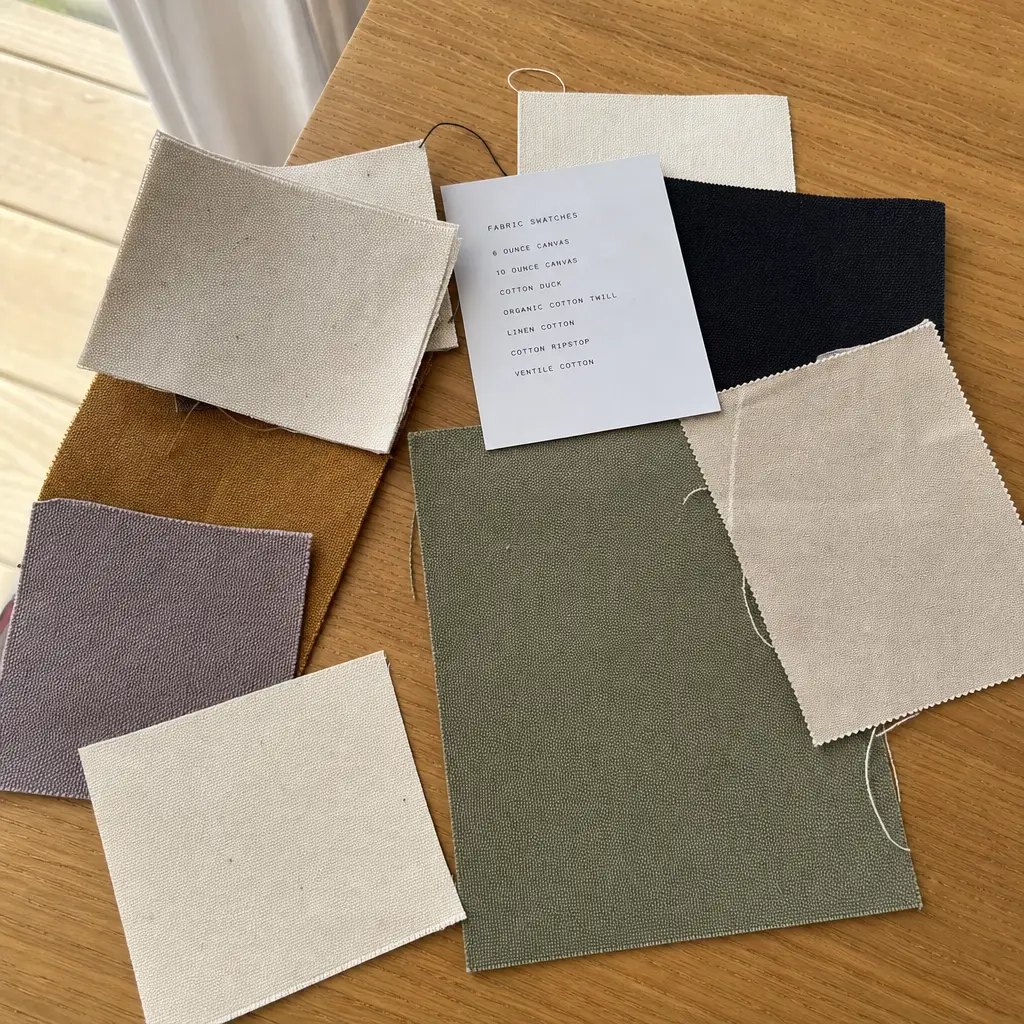
Most custom canvas wine carriers for retail use fall between 10 oz and 12 oz cotton canvas, roughly 340-410 GSM depending on weave and finishing. An 8 oz canvas can work for low-cost giveaways, but it often collapses when empty and may show wrinkles around the print. A 14 oz canvas gives more structure, but it adds material cost, carton weight, needle wear, and sewing time. For roasters selling premium bottled products, 10 oz or 12 oz is usually the practical middle ground.
MOQ is affected by whether the factory has greige or natural canvas in stock, whether the buyer wants dyed canvas, and whether the fabric must be enzyme washed, pigment dyed, or coated. Natural cotton canvas is easier for lower MOQ because stock fabric is more common. Custom dyed canvas can trigger a separate fabric mill MOQ, color lab dip approval, extra lead time, and shade variation risk between lots.
- Natural canvas: usually the easiest route for small or medium MOQ and fast sampling.
- Black canvas: hides stains but may need higher-opacity ink or special print treatment.
- Dyed brand color canvas: stronger brand match but higher MOQ and longer approval cycle.
- Washed canvas: softer hand feel, but dimensions and print placement must account for shrinkage.
- Heavy canvas above 12 oz: premium look, but compare carton weight and sewing cost before approving.
MOQ logic: what factories actually count
Buyers often ask for one MOQ number, but factories normally calculate MOQ across several production steps: fabric purchase, cutting efficiency, print setup, sewing line allocation, and packing. If all pieces use the same canvas, same dimensions, and same print, the MOQ can be treated more efficiently. If the order is split across three logo colors, two bag sizes, and four destination labels, the factory must handle more setups even if the total quantity looks attractive.
For coffee roasters, the most common MOQ mistake is combining unrelated requirements into one line item. A main brand logo carrier for all stores, a holiday gift graphic, and a distributor co-branded carrier may share the same product family, but they do not share the same screen setup or packing labels. The RFQ should show the total annual potential, but the initial purchase order should be broken into clear production lots.
- Same size plus same fabric color plus same print usually gives the strongest MOQ leverage.
- Different logo colors may require separate screens, separate ink mixing, and extra setup waste.
- Different carton marks or SKU labels do not always change MOQ, but they change packing labor.
- A two-bottle carrier should not be grouped with a single-bottle carrier as one MOQ unless the factory agrees.
- Annual forecast helps negotiation, but bulk price should be based on the confirmed first order quantity.
Print method decisions for roaster branding
Screen printing is usually the best method for canvas wine carriers when the artwork is one or two solid colors. It gives good opacity on natural canvas, works well on flat panels before sewing, and keeps cost predictable at scale. For roaster logos with fine text, small origin notes, or certification marks, the artwork should be reviewed at actual print size. Canvas texture can break up very thin lines, especially on heavier fabric.
Heat transfer or digital transfer can be useful for small full-color seasonal graphics, but buyers should not approve it based only on a clean digital proof. Transfers can feel plasticky on canvas, may show edge film, and can behave differently when the bag is folded or compressed in a carton. Embroidery is possible for premium programs, but on bottle carriers it may distort panels and reduce speed. Woven labels are a good option when the brand wants a quieter retail look or when the same bag body will serve multiple printed inserts or hangtags.
- Use screen print for bold coffee roaster logos, simple icons, and one or two color artwork.
- Use transfer printing only after reviewing edge feel, cracking risk, and carton abrasion.
- Keep small text large enough to survive canvas texture and ink spread.
- Avoid placing print over the bottom fold, side seam, divider seam, or handle stitch area.
- For black or dark canvas, request an opacity test because one pass of ink may not be enough.
Cost drivers that should appear in the quote
A useful factory quote should show more than one unit price. Canvas weight, fabric color, handle material, print colors, screen setup, divider construction, inner packing, carton strength, and sample freight can all move the final landed cost. A quote that looks cheap may be based on thinner fabric, no reinforced bottom, a smaller print area, or unprotected bulk packing. Procurement teams should force quotes onto the same basis before comparing suppliers.
The biggest cost differences usually come from fabric and labor. A two-bottle carrier is not simply a single-bottle carrier with a wider panel; it needs a divider, additional seams, and more careful alignment. Reinforced handles also add sewing time. If the bag is intended to carry filled glass bottles, reducing handle reinforcement to save a small unit cost is false economy because failure risk sits directly with the brand.
- Fabric: weight, weave, color, shrinkage treatment, and available stock position.
- Cutting: single style cutting is efficient; mixed sizes reduce efficiency.
- Printing: number of colors, print size, screen charge, ink type, and curing method.
- Sewing: boxed bottom, divider, handle reinforcement, bartacks, binding, and labels.
- Packing: individual polybag, tissue, insert card, carton strength, and carton markings.
- Logistics: carton volume and gross weight can outweigh a small unit price saving.
Sample approval should test function, not just appearance
For first production, a physical pre-production sample is worth the time. The sample should use actual canvas weight, actual print method, actual handle construction, and the correct bottle dimensions. If the factory cannot access the bottle, the buyer should send a sample bottle or provide a dimensioned dummy drawing. A photo of a similar wine bag does not prove that your cold brew bottle or syrup bottle will fit.
The approval should include practical handling tests. Insert and remove the bottle several times. Carry it by the handle with filled weight. Stand it on a flat surface. Check whether the print wrinkles when the bottom opens. For two-bottle carriers, walk a short distance and listen for bottle contact. These checks reveal issues that a flat product photo will not show.
- Approve dimensions against the bottle, not only against the measurement sheet.
- Check handle comfort with the expected filled weight.
- Review print color under normal retail lighting, not only under factory fluorescent light.
- Confirm the bag can be folded or packed without permanently creasing the print.
- Sign off on seam allowance, bartack position, divider height, and label placement before bulk cutting.
Packing and carton planning for retail and distributor orders
Canvas bottle carriers are often shipped flat, but packing still needs attention. If bags are stacked too tightly, the print face can abrade or develop pressure marks. If cartons are too loose, pieces shift during transport and arrive with crushed corners or dusty fabric. For natural canvas, moisture control matters because cartons may sit in warehouses before holiday retail launches.
Retail buyers also need SKU control. If one order includes plain brand carriers, holiday artwork, and distributor co-branded versions, carton marks and inner bundling must prevent mixing. A small packing mistake can create expensive relabeling work at the destination warehouse. For ecommerce or gift-set assembly, the buyer may need barcode labels, bundle counts, or master carton markings aligned with the 3PL receiving rules.
- Define pieces per inner bundle and pieces per export carton.
- Set a carton gross weight limit that warehouse staff can handle safely.
- Use protective interleaving when heavy ink coverage faces another bag surface.
- Request carton dimensions for freight estimation before production finishes.
- Specify carton marks by SKU, artwork version, PO number, and destination.
- Avoid excessive compression if the carrier must look clean for retail display.
Lead time risks and launch calendar planning
A realistic schedule starts before bulk production. Artwork checking, sample making, sample shipping, buyer review, revisions, deposit, material booking, printing, sewing, inspection, and export handover all take time. If custom dyed canvas or special webbing is required, lab dips and material MOQ can add another approval loop. Coffee roasters planning holiday gift programs should not treat the factory sewing time as the full lead time.
The safest approach is to map the launch date backward. If the carriers must arrive at a gift packing facility by a fixed date, allow time for import customs, inland delivery, warehouse receiving, and assembly. Late carrier delivery can hold up the entire bottled gift program even if the beverage is ready. For urgent launches, simplifying the carrier specification often protects the schedule better than pushing the factory for unrealistic speed.
- Fastest route: natural canvas, standard size, one-color screen print, simple flat packing.
- Higher risk route: custom dyed canvas, multi-color transfer, custom labels, mixed SKU packing.
- Build time for one sample revision if bottle fit or logo placement is new.
- Book inspection before cartons are sealed and moved to the forwarder.
- Treat holiday shipping weeks and local factory holidays as real capacity constraints.
How to compare landed cost instead of only unit price
For importers and distributors, the right comparison is landed cost per usable carrier. A factory offering a lower unit price may use a larger carton, increasing air or ocean freight. Another supplier may quote a higher unit price but include stronger cartons, better packing, and fewer defects. If a carrier is used in a paid gift set, a small difference in presentation and defect rate can matter more than a fraction of a dollar in FOB price.
The quote comparison should include expected defect allowance, inspection cost, sample cost, setup charges, freight volume, carton gross weight, and receiving labor. Also consider the cost of leftover stock. If MOQ forces 2,000 pieces of a seasonal print but the roaster can sell only 1,200, the apparent unit cost is misleading. In that situation, a slightly higher cost for a smaller artwork run or a generic evergreen logo may be more profitable.
- Calculate cost per planned sold or used piece, not only per produced piece.
- Separate evergreen brand carriers from seasonal or dated graphics to reduce obsolete inventory.
- Compare carton CBM and gross weight because freight can change the final ranking.
- Include inspection and sample freight in the first-order cost review.
- Value defect prevention when the carrier is part of a premium gift set or retail display.
Specification comparison for buyers
| Spec decision | Recommended option | When it fits | Buyer risk to check |
|---|---|---|---|
| Bag format | Single-bottle canvas carrier with flat gusset or boxed bottom | Core MOQ planning for bottled cold brew concentrate, coffee syrup, olive oil collaborations, or gift bottles sold one at a time | Confirm bottle diameter and height before pattern making; a wine carrier pattern may be too tall or too narrow for squat cold brew bottles |
| Multi-bottle format | Two-bottle divider carrier with reinforced center seam | Holiday gift sets, roaster subscription add-ons, wholesale gift baskets, or distributor promotions | Divider must be stitched into side and bottom seams, not only tacked at the top, or bottles can knock together during carry |
| Fabric weight | 10 oz to 12 oz cotton canvas, approximately 340-410 GSM | Most retail-ready carriers needing structure, print clarity, and reasonable carton weight | Too light can collapse on shelf; too heavy increases sewing difficulty, freight weight, and MOQ fabric commitment |
| Print method | One or two color screen print for main logo; heat transfer only for small full-color art | Coffee roaster branding with clean logos, seasonal marks, or simple campaign graphics | Dense ink over heavy canvas can crack if cured poorly; request wash/rub test and review ink hand feel on sample |
| Handle construction | Self-fabric handles or 2.5-3.0 cm cotton webbing with box-stitch reinforcement | Retail carriers expected to hold glass bottles or heavier concentrates | Handle stitch length, bartack placement, and seam allowance affect load strength more than handle width alone |
| MOQ planning | Base forecast on artwork version, bag size, and fabric color, not only total pieces | Programs with multiple roaster locations, seasonal graphics, or distributor-specific branding | Factories may count each colorway or logo as a separate MOQ because setup, cutting, printing, and packing change |
| Packing method | Flat packed in export carton with inner polybag only if needed for moisture protection | Wholesale and ecommerce fulfillment where cartons are stored before launch | Over-compression causes crease marks across print area; under-filled cartons increase freight volume and carton damage |
| Sample approval | Pre-production sample using actual fabric, print ink, handle, and bottle fit test | Any new bottle size, new logo position, or first order with a factory | Photo sample alone is not enough for bottle fit, handle comfort, or print hand feel; physical sample approval reduces rework risk |
| Quote basis | Unit price separated from setup, sample, packing, carton, and inland freight assumptions | Importers comparing China, India, Vietnam, or local decorator options | A low unit price can hide higher setup cost, weak packing, lower GSM, or no divider reinforcement |
Buyer checklist before sampling
- Measure the exact bottle height, shoulder diameter, base diameter, filled weight, and closure height before requesting a pattern.
- Separate MOQ by bag size, fabric color, artwork version, and delivery destination instead of treating the order as one combined number.
- Choose a canvas weight target in ounces and GSM, for example 10 oz or 12 oz cotton canvas, and allow a reasonable production tolerance.
- Define whether the carrier must stand on a shelf when empty, hang from a retail peg, or ship flat inside a gift set carton.
- Place the logo away from curved bottom folds, side seams, heavy stitch areas, and handle attachment points.
- Require a physical pre-production sample when the bottle is glass, unusually heavy, non-standard in shape, or sold as a premium gift item.
- Include inner packing expectations, carton dimensions, carton gross weight limit, carton marking rules, and any barcode or SKU labeling needs.
- Compare quotes using the same fabric GSM, handle construction, print method, divider design, packing method, and lead time basis.
- Set acceptance criteria for print registration, color variance, seam strength, dimensions, stain level, and carton condition before bulk production.
- Build launch timing around sample revision time, artwork approval, material booking, printing, sewing, inspection, and export handover.
Factory quote questions to send
- What is your MOQ per bag size, per fabric color, and per printed artwork, and can different roaster locations share fabric cutting to reduce waste?
- Which canvas weights do you normally stock for bottle carriers, and what GSM tolerance should we expect in bulk production?
- Can you make the sample from actual bulk fabric and actual print method, not substitute fabric or digital mockup printing?
- What bottle dimensions and filled weight did you use to test fit and handle strength on the sample?
- For a two-bottle carrier, how is the divider attached at the bottom and sides, and can you provide close-up photos of the seam construction?
- What print method do you recommend for our logo size and color count, and what are the setup charges per color or per screen?
- How many pieces are packed per export carton, what are the estimated carton dimensions and gross weight, and will the print face be protected from abrasion?
- What is your standard bulk lead time after sample approval and deposit, and what schedule risks exist for dyed canvas, custom webbing, or special labels?
- Which quote items are excluded, such as sample freight, mold or screen charges, barcode labels, polybags, inland transport, or export documents?
- What inspection standard do you use for AQL, dimensions, printing defects, stains, broken stitches, and carton damage?
Quality-control points to confirm
- Fabric weight verified against agreed ounce or GSM range, with no unexpected substitution to thinner plain cotton.
- Finished dimensions checked against approved sample, including opening width, usable bottle height, bottom gusset, and handle drop.
- Bottle fit test completed with buyer-provided bottle or accurate dummy bottle, including insertion, standing stability, and removal.
- Handle seam strength checked with static load test using a weight above expected filled bottle weight, held for a defined time.
- Print location, color, opacity, curing, rub resistance, and edge sharpness compared with approved sample or Pantone reference.
- Divider construction inspected on multi-bottle carriers so bottles do not touch under normal carrying movement.
- Stitching checked for skipped stitches, loose threads, broken bartacks, seam puckering, and uneven topstitching.
- Cleanliness controlled for stains, oil marks, dust, thread residue, and fabric slubs exceeding the agreed visual limit.
- Carton packing reviewed for piece count, moisture protection, carton strength, carton markings, and print abrasion prevention.
- Random final inspection documented with photos of measurements, packed cartons, print close-ups, and load test results.