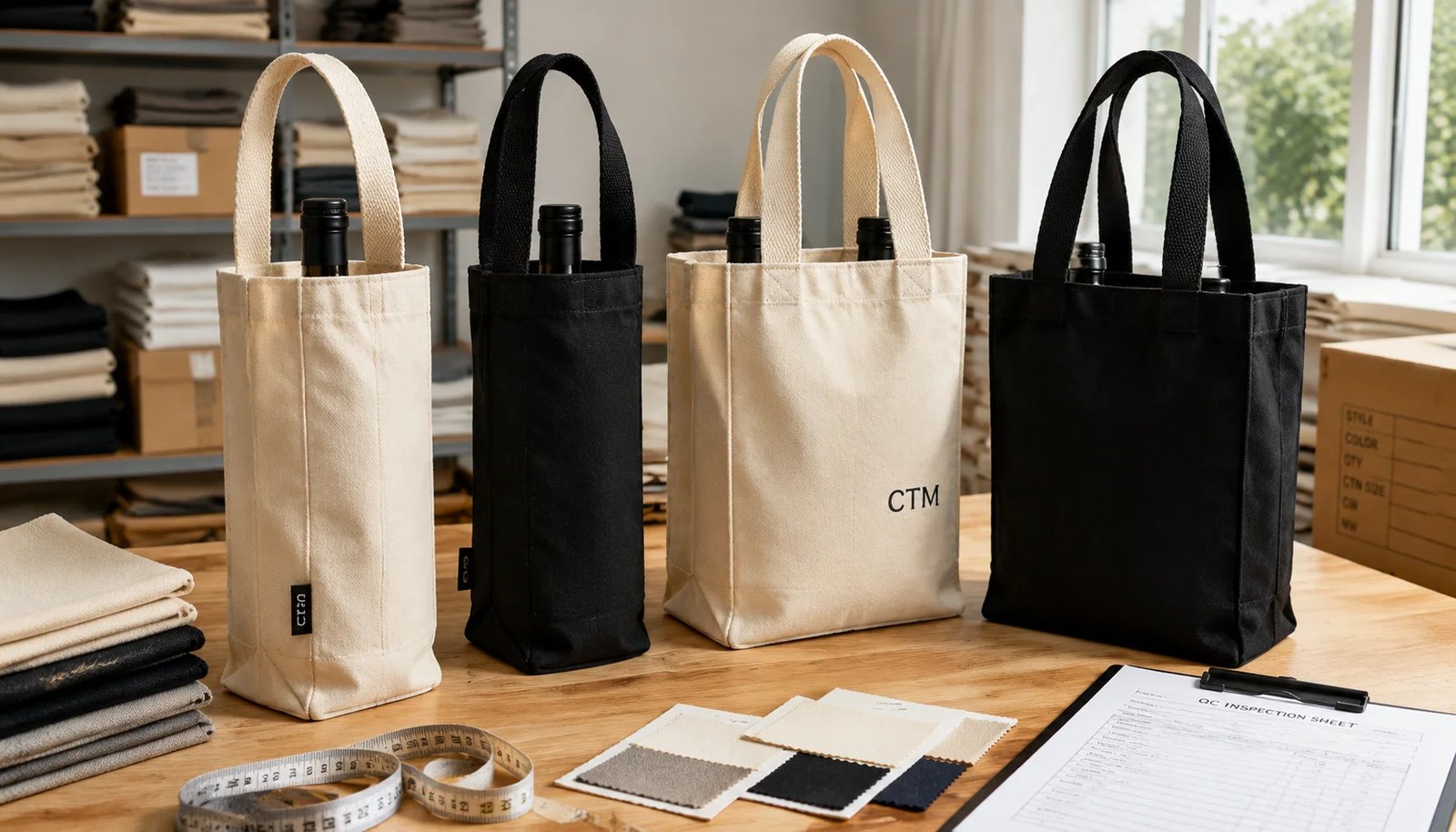
Why MOQ gets difficult on canvas wine carriers for natural grocers
Canvas wine carriers look simple, but MOQ friction usually comes from SKU fragmentation rather than factory unwillingness. Natural grocers often want small runs split by store region, seasonal message, bottle format, or private label logo. A factory can cut and sew one bag body efficiently, yet the order becomes expensive when the buyer spreads the same volume across too many print versions, dyed body colors, or retail packing variants.
The practical fix is to negotiate MOQ around the production process, not around the final assortment list. If the same fabric, same dimensions, and same handle construction can run together, many factories will accept lower minimums per artwork or per store group. The buyer who frames the RFQ by shared components usually gets a more flexible quote than the buyer who sends ten separate SKUs with small quantities and asks for one blended price.
- MOQ pressure usually comes from fabric booking, print setup, and carton assortment complexity
- Natural canvas and one-color print give more room for MOQ flexibility than dyed fabric and multi-color art
- Single-bottle carriers are easier to split across logos than double-bottle carriers with dividers
- The easiest concession to win is print split within one fabric lot, not ultra-low MOQ per SKU
Start with the right carrier spec before negotiating price
MOQ negotiation fails when the bag spec is still vague. For wine carriers, the first decision is whether the bag is meant for checkout upsell, event giveaway, or long-term reusable grocery merchandising. A promo bag can run in 10 oz canvas around 280 GSM if handle reinforcement is sound. A more durable bag for repeated bottle use often lands in the 12 oz range, around 340 GSM. Going heavier than that adds cost and shipping weight faster than it improves user experience for most retail grocery programs.
Size must be tied to bottle type. Most standard 750 ml bottles fit a body width around 4 to 4.5 inches for a single-bottle bag, but the exact gusset depends on the bottle profile. Sparkling wine, olive oil cross-use, or taller imported glass can change fit. If you do not define the bottle profile in the RFQ, suppliers will quote from their default pattern, and those defaults vary more than buyers expect.
- Common practical fabric range: 280 to 340 GSM for retail wine carrier use
- Single-bottle bag needs clear width, height, gusset, and handle drop dimensions
- Two-bottle bags need divider construction details, not just outside size
- Natural grocer programs usually benefit from standardizing one body size across multiple print runs
Use fabric and print choices to lower MOQ without cheapening the bag
The lowest-risk route for MOQ negotiation is usually stock natural canvas plus one-color screen print. Natural fabric avoids dyed-lot minimums, and one-color print keeps setup simple. Screen printing on cut panels before sewing also improves artwork consistency because the print table is flat and registration stays more stable than printing on sewn bags. This matters when your logo sits near a side seam or bottom gusset fold.
If the brand team wants more visual impact, move carefully. Dyed canvas, contrast webbing, inside care labels, and woven logo labels all add small but real MOQ thresholds because each extra component introduces sourcing or machine setup. The better negotiation move is to hold the base bag constant and vary only one element, usually the print. That gives merchandising flexibility while keeping production pooled.
- Natural canvas typically supports lower MOQ than custom-dyed body colors
- One-color screen print is the most MOQ-friendly branded option
- Heat transfer can work for photo graphics, but it is less common for simple grocery wine carriers and may raise unit cost at low volumes
- Woven labels and custom hangtags are easier to add after the main MOQ is secured
How to negotiate MOQ by production logic instead of by unit price pressure
Many buyers try to negotiate MOQ by asking for the same unit price at a smaller volume. Factories usually resist because the setup cost is still real. A better method is to separate fixed cost from running cost. For example, if one body pattern, one natural fabric, and one handle type are fixed across the order, the buyer can request MOQ relief on print splits or store assortments while accepting a small setup charge per artwork. This is often cheaper than forcing the factory to pretend that all small SKUs are equally efficient.
Another useful tactic is staged ordering. If the program forecast is realistic but the initial buy is cautious, some factories will accept a lower first run if the buyer gives a rolling forecast and keeps the same bag spec. This is more credible when the importer is honest about replenishment cadence and does not overstate future volume. Factories can support lower MOQ when they believe the next order will reuse screens, patterns, and fabric booking.
- Negotiate minimums around shared fabric, body size, and handles
- Accept separate screen or setup charges instead of pushing for unrealistic low all-in unit price
- Use phased rollout if replenishment is likely and specs will stay unchanged
- Group store logos by same print color to reduce setup time
Read factory quotes the way a merchandiser does
Canvas wine carrier quotes often look comparable at first glance because the item appears basic. In reality, quote gaps usually hide inside the fabric weight, handle construction, print coverage, or packing basis. One supplier may quote 280 GSM body fabric with 1-inch cotton webbing handles sewn into side seams. Another may quote a lighter body, self-fabric handles, and less reinforcement. Both lines may be labeled canvas wine bag, but the use performance is different.
For procurement teams comparing multiple suppliers, insist on a quote breakout. You need to know which elements are baked into unit price and which are treated as adders. A useful quote is not just the cheapest number; it is the one that lets you compare like for like across fabric, print, packing, and sample cost. If a supplier avoids detail, that usually means they want room to substitute during production.
- Break out sample charge, screen charge, unit price, label cost, and packing adders
- Compare natural canvas shade, GSM, and webbing width line by line
- Confirm whether the price includes export carton, carton mark, and moisture protection
- Request Incoterm basis clearly: EXW, FOB, or another agreed term
Sample approval should prove fit, balance, and print position
A wine carrier sample is not just for logo approval. It should prove that the bag carries a filled bottle safely and hangs correctly from the handle without twisting. For a single-bottle design, insert a standard 750 ml bottle and observe whether the base sits flat, whether the bottle neck protrudes as intended, and whether the handle length feels balanced for hand carry. For double-bottle styles, test with two full bottles to see if the divider actually prevents contact and whether the center weight pulls the seams unevenly.
Physical sample review also catches print issues early. Logos placed too low can disappear into the gusset fold. Logos placed too close to side seams may distort after sewing. A digital layout will not reveal all of this. For imported bulk orders, a pre-production sample in actual fabric and actual print is worth more than a polished rendering because it shows the real sewing behavior of the material.
- Test sample with actual 750 ml bottle dimensions, not only empty fit
- Review handle comfort and balance with loaded bottle weight
- Approve print placement in relation to side seam, hem, and gusset fold
- For double bottle bags, request inside photos and load test video if physical sample shipment is slow
QC thresholds that prevent the most common bulk disputes
Most bulk disputes on canvas wine carriers come from four issues: lighter fabric than approved, crooked or weak handles, print drift, and poor bottle fit. None of these are hard to inspect if the buyer sets acceptance criteria before production. Measurement tolerance should be practical, not theoretical. A small sewn textile item will not hold zero variance, but the bag still needs to fit the intended bottle securely and present consistently at retail.
For natural grocer programs, visual cleanliness matters because products are often displayed in simple earthy merchandising where every stain shows. Natural cotton can have minor slubs, but the print area should not have major weaving flaws, oil marks, or dark contamination. QC standards should separate acceptable natural variation from defects that make the bag unsellable.
- Set measurement tolerance for width, height, gusset, and handle drop before bulk
- Reject loose handle box stitching, skipped stitches, and twisted panels
- Define acceptable natural canvas variation versus unacceptable stains and marks
- Inspect print edge sharpness, ink coverage, and location against approved sample
Packing details affect warehouse labor and damage more than buyers expect
Importers often focus on the bag and ignore export packing until the order is nearly complete. That creates avoidable cost. Wine carriers are usually shipped flat, but the packing count per carton still matters. If cartons are too dense, gusset corners crush, print surfaces abrade, and receiving teams spend extra time reshaping units before distribution. If cartons are too light, freight efficiency drops and inland handling cost rises.
The right packing plan depends on the downstream channel. If a distributor will relabel or sort by region after import, flat pack by style and print is usually best. If store-ready distribution is required, inner bundle counts and carton marks should match warehouse pick logic. These details can affect MOQ because custom assortments add labor and may require separate carton runs.
- Typical export packing may range around 50 to 100 pcs per carton depending on size and fabric thickness
- Set carton gross weight limits that suit your warehouse handling standard
- Use clear carton marks for SKU, print, quantity, and PO reference
- If sea freight is used, request dry cartons and moisture barrier approach appropriate to your route
Lead time risk usually comes from artwork, fabric booking, and assortment changes
A common planning mistake is treating a simple canvas wine carrier as a quick-fill item regardless of season. Production can be straightforward, but delays often happen before sewing starts. Artwork approval, screen preparation, fabric booking, and revised carton marks all consume calendar days. If your team keeps changing print versions or packing splits while negotiating MOQ, the nominal production lead time becomes irrelevant because the factory cannot lock the line.
The safer schedule is to map which inputs trigger the production clock. Some factories count lead time from deposit receipt, while others count from final sample approval. Buyers should also separate sample lead time from bulk lead time. For natural grocer seasonal campaigns tied to harvest, gifting, or holiday promos, this distinction matters. Missing the launch date hurts more than paying a modest setup charge.
- Clarify whether bulk lead time starts after deposit, artwork approval, or pre-production sample signoff
- Freeze carton marks and assortment splits early to avoid repacking delay
- Allow extra time for dyed fabric or multiple print versions
- Peak gifting season can extend screen and sewing line availability even for basic bags
Build a landed-cost view before deciding whether low MOQ is actually worth it
Low MOQ sounds attractive, but the cheapest opening order is not always the best commercial decision. If the unit price jumps sharply at small volume, freight cost per piece rises, and warehouse handling becomes more complex due to fragmented assortments, the total landed cost can exceed a larger, cleaner run. Procurement should model cost per usable retail unit, not just ex-factory price. A slightly larger order with pooled specs may lower landed cost and reduce stockout risk.
The most practical comparison is to model two or three scenarios. Example only: one scenario uses a very low SKU split with multiple logos, another uses a pooled body with one standard print, and a third uses moderate split with a setup charge per artwork. Even without exact market pricing, this exercise quickly shows where fixed costs are driving the quote. It also helps brand owners explain to internal teams why simplifying specs can be more valuable than chasing a lower nominal MOQ.
- Model ex-factory price, setup charges, freight efficiency, and receiving labor together
- Compare MOQ scenarios by total usable units delivered to warehouse, not just by invoice line price
- A standardized body spec often saves more than aggressive per-SKU MOQ reduction
- Use forecasted replenishment to justify tooling or screen cost across multiple orders
Specification comparison for buyers
| Spec decision | Recommended option | When it fits | Buyer risk to check |
|---|---|---|---|
| Base fabric weight | 10 oz to 12 oz canvas, about 280 to 340 GSM | Best balance for natural grocer wine promos, everyday reuse, and stable bottle carry without excess weight | Some suppliers quote lighter 8 oz fabric but describe it as canvas; request actual GSM tolerance and fabric test method |
| Single or double bottle format | Single bottle for promo volume, double bottle with center divider for higher basket value | Single bottle works for checkout impulse and event giveaways; double bottle fits gifting and mixed bottle upsell | Divider construction is often simplified in production; require photo of inside seam and divider anchoring |
| Handle construction | Cotton webbing handles cross-stitched into side seams | Suitable when the bag must safely hold 750 ml glass bottles repeatedly in store and at home | Short stitched patch handles may tear earlier; request stitch count per handle box and reinforcement detail |
| Print method | 1 color screen print on flat panel before sewing | Best for natural grocer private label, low setup cost, and consistent repeat orders across store groups | Printing after sewing can distort artwork near side seams; approve print position tolerance in millimeters |
| Inner protection | No padding, but include stitched divider or snug gusset sizing | Good for cost-sensitive reusable carriers where the bag is not intended as a premium gift pack | Loose bottle fit causes clinking and shape collapse; request filled-bottle fit photos using standard 750 ml bottle |
| MOQ strategy | Negotiate color or print split within one fabric lot instead of pushing for very low total MOQ | Works when chain buyers need different store logos or campaign prints but can share the same fabric and size | Suppliers may agree to split print but not packing assortments; clarify MOQ by SKU, print, color, and carton mark |
| Packing format | Flat packed by style and print, 50 to 100 pcs per export carton with moisture barrier if sea freight | Best for importers and distributors consolidating warehouse handling and relabeling after arrival | Overpacked cartons increase damage risk and receiving labor; define carton gross weight target before booking |
| Sampling route | Digital layout plus one pre-production sample in actual fabric and print | Useful when the design is simple but bottle fit, handle balance, and print placement still matter | Approval based only on artwork PDF leads to disputes; require physical or video proof with loaded bottles |
| Lead time structure | 7 to 10 days for sample, 25 to 35 days for bulk after approval and deposit | Reasonable for stock canvas shades and one-color print outside peak gifting season | Lead time often excludes fabric booking and carton printing; ask what starts only after artwork approval versus payment receipt |
Buyer checklist before sampling
- State bottle format clearly: single 750 ml, double 750 ml, or mixed bottle sizes with required internal divider design
- Specify fabric by GSM and composition, not by generic terms like thick canvas or premium cotton
- Define body color using Pantone reference only if dyed fabric is required; natural cotton shade varies by lot
- List final bag dimensions including gusset, handle drop, and divider width tolerance
- State print method, print color count, print size, and whether printing occurs before or after sewing
- Request confirmation of handle reinforcement method and stitch pattern for loaded bottle weight
- Set MOQ by total order, per SKU, per print colorway, and per packing assortment to avoid hidden minimums
- Require a pre-production sample in actual fabric and print for bottle fit and balance approval
- Define packing: pieces per polybag if any, pieces per carton, carton size limit, gross weight limit, and carton marks
- Include AQL or practical acceptance criteria for seam defects, print registration, fabric stains, and measurement tolerance
Factory quote questions to send
- What is the exact fabric specification in GSM, weave, and cotton content for the quoted canvas wine carrier?
- Is the quoted price based on natural canvas, bleached canvas, or dyed canvas, and what shade variation should we expect?
- Does your MOQ apply to the total order, each size, each print design, each color, or each packing assortment?
- Can one fabric lot be split across multiple logo prints without resetting MOQ, and what setup charges apply per print?
- Will you print panels before sewing or print finished bags, and what print position tolerance do you control?
- What handle material, width, and reinforcement method are included in the quote for a loaded glass bottle application?
- For double bottle carriers, how is the center divider attached, and can you share inside construction photos?
- What sample stages do you offer: digital mockup, blank sample, printed pre-production sample, and production swatch?
- What is the standard measurement tolerance for width, height, gusset, and handle drop on bulk goods?
- How many pieces per export carton are planned, what will carton dimensions be, and what gross weight target do you use?
Quality-control points to confirm
- Fabric GSM should stay within the agreed tolerance and match approved hand feel; random lots that feel thinner usually affect bag stand and bottle stability
- Bag dimensions should be checked with a standard 750 ml bottle inserted; the bottle should sit securely without excessive looseness or seam strain
- Handle stitch reinforcement must be symmetrical and clean, with no skipped stitches, loose thread tails, or visibly weak box stitching
- Print color, edge sharpness, and placement should match approved sample; artwork should not run into side seams or gusset folds unless approved
- Center divider on two-bottle bags should be stitched straight and anchored so bottles do not collide during carrying
- Bottom seam and gusset corners should remain square when loaded; twisted panels usually indicate cutting or sewing drift
- Natural canvas must be free from oil marks, major slubs in print area, mildew smell, and unacceptable color lot variation
- Cartons should be dry, correctly marked, and packed to agreed quantity without crushing the bag shape or overloading the carton weight