Start With The Event Reality
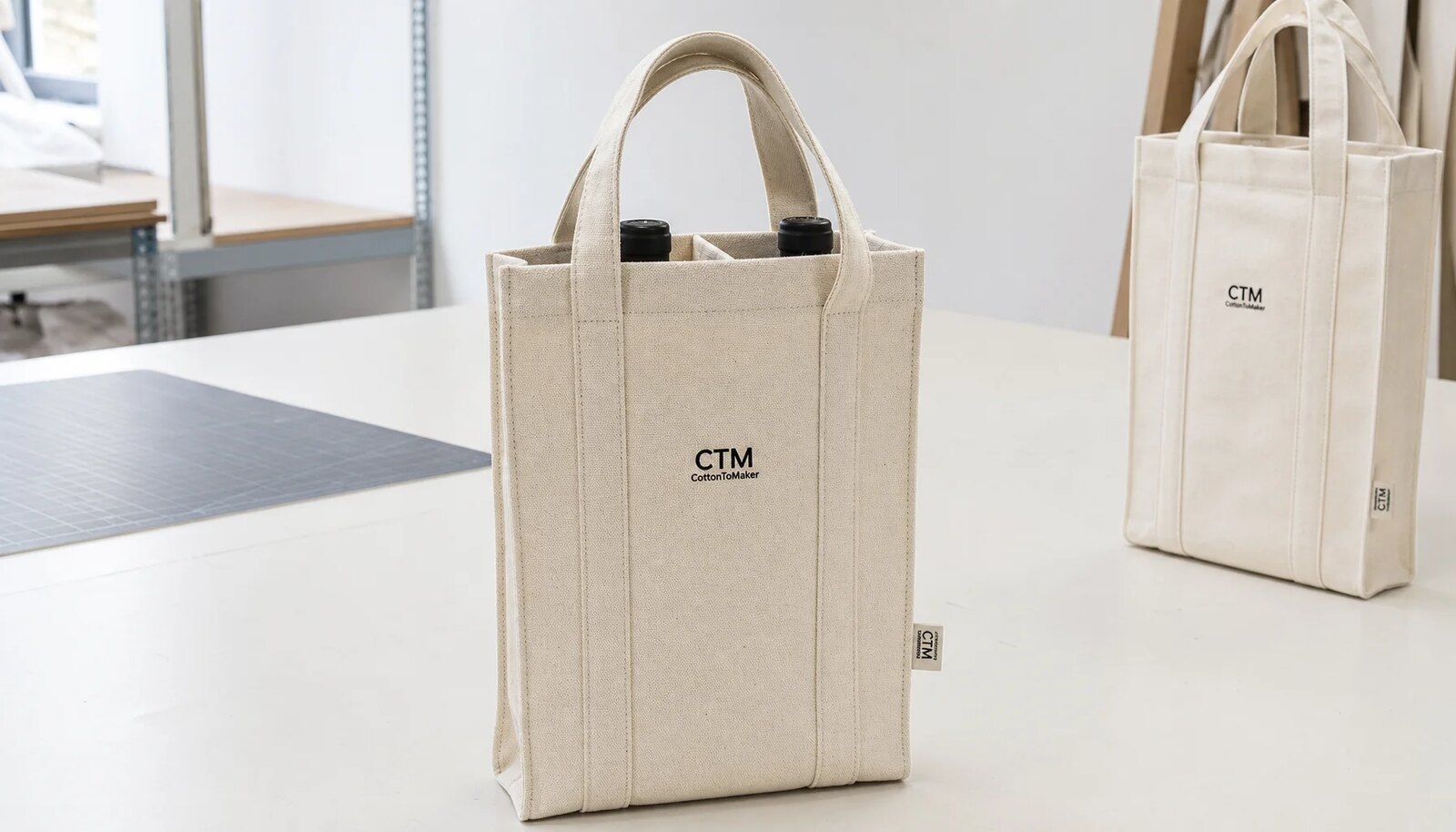
A canvas wine carrier looks simple on a product sheet. At an event, it has to do several jobs at once. It carries weight, shows the host or sponsor brand, photographs cleanly, survives packing, and reaches the venue in a condition that does not create extra work for the event team. Logo placement is therefore not a cosmetic note at the end of the order. It is part of the product specification.
Begin with how the carrier will actually be used. A carrier placed on a tasting table is viewed differently from one handed out at registration. A carrier packed inside a gift kit may need a smaller, more durable mark because the front panel is pressed against other items. A sponsor-facing gala gift may need the logo high on the front panel so it remains visible in photos. A retail-style wine club carrier may call for a small woven side label instead of a large front print.
Bottle choice matters early. Standard 750 ml still wine bottles are often around 70-80 mm in diameter, while sparkling and Champagne-style bottles can be closer to 85-95 mm depending on the bottle. Burgundy bottles can have broader shoulders than Bordeaux bottles. If the program may use more than one bottle shape, write the largest diameter and height into the RFQ. Do not let the supplier build the sample around an easy bottle if the event team will later insert a wider one.
The best logo placement is the one that remains visible after the product is sewn, loaded, carried, folded, and unpacked. A mark that looks perfect on a flat proof can tilt visually once the front panel curves around a bottle. It can also land too close to the handle reinforcement after sewing. That is why procurement teams should treat placement as a measured requirement, not a mockup preference.
- Define where the carrier will be seen: in hand, on a table, in photos, in a retail display, or inside a gift kit.
- Write bottle count, bottle height, and maximum bottle diameter into the RFQ before approving artwork size.
- For mixed wine programs, use the largest bottle as the fit reference.
- Choose the branding goal first: sponsor visibility, premium subtlety, retail reuse, or operational identification.
Lock The Carrier Before The Logo
The carrier structure controls the available decoration area. A one-bottle sleeve, a two-bottle carrier with a center divider, and a four-bottle tote with internal partitions all create different logo zones. Gusset depth changes how the canvas curves. Binding, contrast trim, bottom reinforcement, handle stitch boxes, divider seams, and folded edges all reduce the usable print area. If the artwork is approved before construction is settled, the buyer may approve a placement that cannot be repeated cleanly in production.
For many event wine carriers, 12 oz canvas, about 407 gsm, is a balanced starting point. It has enough body for most one- and two-bottle formats, takes print reasonably well, and does not usually make cartons unmanageable. A lighter 10 oz canvas can be useful for budget-sensitive giveaways or soft foldable carriers, but it may sag when loaded and may distort more around stitch lines. Heavier 14 oz to 16 oz canvas, about 475-540 gsm, gives a firmer hand and a more premium look, but it adds cost, bulk, carton weight, and sewing difficulty.
Ask for finished dimensions in millimeters. The technical sketch should show finished width, depth, body height, opening width, handle drop, divider position, stitch lines, reinforcement areas, and proposed logo box. It should also show no-print zones. For example, a buyer may ask the factory to keep artwork at least 10-15 mm away from major seams and handle stitch boxes, then let the factory confirm whether that clearance is enough for the selected construction.
Avoid generic descriptions such as standard two-bottle carrier. That phrase can mean different things from different suppliers. One factory may quote a narrow stock body with a shallow divider; another may quote a custom gusset with reinforced handles. A procurement-ready specification makes those differences visible before price comparison.
- Request finished width, depth, body height, opening width, handle drop, and divider dimensions.
- Show the decoration box on the technical sketch, not only on a visual mockup.
- Confirm fabric weight in both oz and gsm where possible.
- Reserve clear space around seams, handle stitch boxes, gussets, dividers, and planned fold lines.
Pick The Logo Zone With Use In Mind
For event programs, the upper front panel is usually the strongest logo position. It is visible when the carrier stands on a table, when a guest carries it upright, and when staff place it in a registration or gifting area. It also keeps artwork away from the lower front area, where scuffing, table contact, and fold pressure are more common. Large is not automatically better. A slightly smaller logo in a stable, visible zone often looks more professional than a large mark forced too close to construction details.
A practical placement spec sounds like a measurement, not a mood. For example: artwork centered on front-panel centerline, top of artwork 35 mm below the finished top edge, minimum 15 mm clearance from handle stitch box, and minimum 12 mm clearance from side seams. Those numbers are examples, not universal rules. The important point is that the supplier and inspector can measure the same references.
Lower-front placement can look polished for wine clubs, hospitality gifts, and retail-style programs. The tradeoff is visibility. Once bottles are inserted, the lower panel may curve outward, sit below the normal camera angle, or disappear behind the bottle body when viewed across a table. Side labels, seam labels, and small patches are excellent for understated branding, but they still require tolerances. A 3 mm drift on a small woven label can look more obvious than the same drift on a large screen print.
Be careful with vertical logos on narrow one-bottle carriers. They may look straight on an empty sample and curve once loaded. Also avoid putting sponsor lockups across seams, gusset curves, divider stitch lines, or fold lines unless the design intentionally accepts distortion. If several sponsors must be shown, an insert card, hang tag, belly band, or separate printed program may protect the carrier design better than crowding the front panel.
- Use upper front placement when event photos and sponsor visibility matter most.
- Use lower front, side label, or patch placement when the program needs a quieter premium feel.
- Measure from top edge, side seam, handle stitch box, and panel centerline.
- Keep small text, QR codes, and key logo details away from seams, curves, and fold pressure.
Prepare Artwork For Canvas, Not Paper
Canvas is textured. That texture is part of its appeal, but it changes how artwork behaves. Fine lines can roughen. Tiny text can fill in. Negative spaces can close. A logo that is sharp on coated paper may look softer on 12 oz natural canvas. The artwork file should therefore include final size, color count, Pantone references or thread references, minimum line weight, minimum text height, and any details that cannot be lost, such as sponsor names or QR codes.
For screen print, bold one- or two-color spot artwork is usually the most reliable commercial choice. Ask the supplier to confirm maximum print size, ink type, mesh and print approach if relevant, color matching method, curing method, registration tolerance, and recommended placement tolerance. On stable sewn canvas panels, many B2B buyers work with plus/minus 3 mm to 5 mm placement tolerance for screen print, but the factory should confirm what is achievable with its jigs, operators, and panel construction.
Heat transfer and DTF can reproduce more detail and more color than basic screen print. They can be useful for multi-color event graphics, gradients, or sponsor artwork with small details. Still, they are not a free upgrade. The finish may feel smoother or more plastic than the surrounding canvas. Edges may be more visible on natural fabric. Transfers can also react poorly to sharp folds or heavy pressure if packing is not planned around them. Test adhesion, hand feel, rub resistance, and fold behavior on the actual carrier material.
Embroidery, woven labels, and patches need their own approval path. Embroidery requires digitizing, backing, stitch density control, and a stable panel. Small letters and thin outlines often need simplification. Woven labels can hold fine detail, but they add a sewing operation. Patches can look premium, yet patch size, edge finish, corner lift, and sewing alignment must be checked. Treat each decoration method as a production process with measurable limits.
- Include final artwork width, height, color count, Pantone or thread references, and minimum detail requirements.
- Use screen print for bold spot-color logos and repeatable event orders.
- Test DTF or heat transfer for hand feel, fold resistance, rub, and adhesion on actual canvas.
- For embroidery, confirm digitizing, backing, stitch count, and small-text limits before bulk approval.
Turn Placement Into Inspection Data
A placement tolerance keeps the project out of opinion territory. Sewn canvas goods move. Panels vary slightly. Operators place goods by hand or with jigs, and the fabric is not as rigid as plastic or metal. The goal is not to demand zero variation. The goal is to define an acceptable range that protects the brand and can be inspected fairly.
Use references that can be measured with a ruler. Good references include top edge to artwork top, side seam to artwork centerline, right seam to artwork centerline, handle stitch box to artwork edge, and logo centerline to panel centerline. Weak references include centered, higher, same as picture, or as close as possible. Those words may be fine in conversation, but they do not belong as the only instruction on a purchase order.
A useful PO or inspection sheet may include a small tolerance table. For example: artwork horizontal centerline plus/minus 3 mm from front-panel centerline; artwork top edge plus/minus 5 mm from approved sample; patch position plus/minus 3 mm to 5 mm depending on patch size; visible rotation not obvious, or maximum 2 degrees only if the factory can measure it. These are practical examples. The supplier should confirm capability before accepting the order.
Control the carrier dimensions as well. Finished width, body height, gusset depth, and handle drop all affect how the logo appears. A handle drop that is too short can cause the carrier to bunch when held. A front panel that finishes narrower than expected can make a logo look oversized. Tie the approved sample, fabric swatch, print drawdown, thread card, and final artwork file to the purchase order so inspectors are not guessing from an email proof.
- State logo location with measurable dimensions and millimeter tolerances.
- Use factory-confirmed tolerances for screen print, embroidery, woven labels, and patches.
- Control handle drop and finished panel dimensions because they change logo visibility.
- Attach approved sample, swatch, artwork file, and color standard to the PO.
Choose Decoration By Risk, Not Habit
Screen print is often the best fit for canvas wine carriers used in events. It is cost-effective for bold logos, easy to repeat when the same screen and jig are retained, and familiar to many canvas bag factories. It works especially well for one- or two-color sponsor marks. The risks are familiar too: weak opacity on darker fabric, ink bleeding into the weave, poor curing, smudges, registration problems, and placement drift if the panel is not held consistently.
Heat transfer and DTF are useful when artwork has gradients, small sponsor details, or many colors. They can simplify setup for complex art, but they change the surface feel. On natural canvas, a smooth transfer film can stand out against the woven base. That may be acceptable for a lively promotional event and wrong for a premium wine gift. Ask to see the decorated sample folded the way bulk goods will be packed. A logo that survives the print test but cracks in cartons is still a failed specification.
Embroidery gives a tactile, durable mark, but it is not automatically better. Dense embroidery can pucker lighter canvas. Small text can lose clarity. Rounded letters may close up. A 14 oz or heavier panel often supports embroidery better than a softer 10 oz panel, but backing and digitizing remain critical. Ask for stitch count, thread color standard, backing type, and whether embroidery happens on flat panels before sewing or on completed goods after sewing.
Patches and woven labels can move the product toward a retail-grade feel. They are useful when the brand wants a badge, a small maker mark, or a detail-rich logo. The risk shifts from print quality to sewing quality. Specify patch material, size, edge finish, thread color, stitch path, corner lift standard, and placement tolerance. If the front panel should stay clean, a side seam label may do the job with less visual noise.
- Screen print: strong for bold spot-color logos and repeatable cost control.
- Heat transfer or DTF: useful for detailed artwork, but check hand feel, folding, and rub.
- Embroidery: premium and durable when the artwork is simple enough to stitch cleanly.
- Woven label or patch: strong for retail feel, with added sewing and placement inspection.
Write An RFQ That Makes Prices Comparable
A unit price without context is not a procurement decision. Canvas wine carrier cost depends on fabric weight, carrier size, divider style, handle reinforcement, decoration method, logo size, color count, sampling, packing, carton configuration, and trade term. If Supplier A quotes 10 oz canvas with a small one-color print and Supplier B quotes 12 oz canvas with a larger print area and reinforced handles, the prices are not comparable.
Break the quote into visible components. Ask for the base carrier price, decoration cost, one-time setup charges, sample charges, packing cost, carton details, and freight basis. Screen setup, embroidery digitizing, label loom setup, patch tooling, cutting dies, and special packing may be separate. Ask which charges are reusable on repeat orders and which apply again if size, placement, color, or supplier subcontractor changes.
MOQ should be requested by version. A stock blank carrier may have a low minimum. A stock carrier with one-color screen print may still be flexible. A custom cut-and-sew shape, custom dyed canvas, embroidery, patches, or woven labels can raise the minimum. Ask for MOQ by blank stock, stock with print, custom size with print, embroidery, patch, woven label, and fully custom production. This helps event planners understand where design decisions create quantity pressure.
Landed cost deserves attention before approval. Canvas wine carriers can be bulky relative to unit value. Heavier fabric, individual polybags, protective folding, tissue interleaving, and low carton quantities may increase freight and handling cost. Request carton dimensions, net weight, gross weight, units per carton, carton count, and proposed shipping method. For event orders, a slightly higher unit price with better packing and clearer carton sorting may save time at the venue.
- Compare quotes only after fabric, dimensions, decoration area, packing, and incoterm match.
- Separate base product, decoration, setup, sample, packing, and freight basis.
- Ask which setup charges can be reused for repeat orders.
- Request carton dimensions and weights before approving landed cost.
Use Samples As Decision Gates
Sampling is where logo placement becomes real. Start with a blank fit sample or size sample. This confirms bottle fit, body height, gusset depth, handle drop, divider behavior, and whether the carrier stands upright when loaded. Use the intended bottle type whenever possible. If the event may use sparkling bottles, do not approve a fit sample tested only with a narrow Bordeaux-style bottle.
Once fit is approved, move to a decorated sample with the final artwork size, color, method, and placement. Measure the sample against the technical drawing. Record top edge to artwork, side seam to centerline, clearance from handle stitching, and clearance from dividers or folds. Photograph it empty, loaded, straight on, and at the expected event viewing angle. Those photos help design, procurement, supplier, and event operations discuss the same physical reference.
For larger orders, sponsor-sensitive programs, or repeatable corporate gifting, approve a pre-production sample made with bulk material and the final production process. This matters when the first sample used available fabric, hand-cut panels, substitute ink, or a different sewing line. The signed pre-production sample should represent the standard for bulk dimensions, fabric hand feel, logo placement, print color, stitch quality, bottle fit, and packing.
When a sample fails, update the controlled document. Do not rely on a verbal note such as move logo up a bit. Common failures include logo too low, artwork too close to handle stitching, weak opacity, embroidery puckering, divider too shallow, bottle fit too tight, handle drop too short, and fold pressure across the logo. Put the correction into the sketch, artwork proof, sample report, or QC checklist before the next sample is made.
- Approve blank fit before decoration.
- Use the actual bottle type for fit checks whenever possible.
- Measure the decorated sample and record placement dimensions.
- Use a signed pre-production sample as the bulk inspection standard.
Inspect Function And Appearance Together
Quality control should cover both the way the carrier looks and the way it works. For logo placement, define the measurement points, tolerance, color standard, and acceptable defect limits. Print inspection should check opacity, registration, edge clarity, curing, smudging, pinholes, ghosting, fabric lint trapped under ink, and color consistency across units. A Pantone reference alone is not enough because ink on natural canvas will not match coated paper exactly. Approve a physical drawdown or decorated sample.
Sewing inspection should focus on the load path. Wine bottles create concentrated weight, so handle joints, side seams, bottom seams, divider seams, and reinforcement areas matter more than purely decorative stitch lines. Inspect skipped stitches, loose threads, seam slippage, uneven bar tacks, puckering, twisted handles, and divider misalignment. If the carrier is intended for reuse, define a simple loaded carry check with the specified bottle weight and duration agreed by the supplier.
If the order uses AQL inspection, define defect categories in practical language. Critical defects may include unsafe handle failure, sharp contamination, wrong product, or severe construction failure. Major defects may include logo out of tolerance, wrong color, missing divider, broken seam, heavy stains, or print cracking. Minor defects may include small loose threads or slight cosmetic variation within the approved standard. The AQL level should be agreed before production, especially when event visibility is high.
Fit testing belongs in QC. Insert and remove the specified bottle type. The seams should not strain, the divider should not twist, and the carrier should stand or hang as intended. Also check odor, fabric stains, shade variation, and obvious slubs against the approved standard. Natural canvas may have some texture variation, but the acceptable level should be clear before final inspection.
- Measure logo placement from agreed references during final inspection.
- Inspect print for opacity, curing, registration, rub, pinholes, smudges, and edge quality.
- Inspect handle joints, bottom seams, divider seams, and reinforcement as functional points.
- Test carrier fit with the required bottle type, not a convenient substitute.
Pack For The Venue, Not Just The Carton
Packing should match the way the carriers will be received and distributed. A flat-fold pack can save space, but the fold line should not run through a thick print, transfer, patch, or embroidery area if that creates cracking, pressure marks, or distortion. If the logo is large or heavily inked, ask the factory to fold the carrier so the decoration is protected. Tissue interleaving or individual polybags can reduce rub, but bagging should match the buyer's sustainability goals and venue rules.
Event teams often need cartons sorted by venue, sponsor, table group, kit number, region, or shipment wave. If the factory can pack by these lots, receiving becomes faster and errors are easier to catch. Add carton mark requirements to the PO: item number, PO number, event name, SKU, color, quantity, carton number, destination, and lot code. If barcodes or retail labels are required, confirm who applies them and where they appear.
Ask for carton dimensions and weights before shipment booking. A small product can still create bulky freight if each unit is individually bagged or protected from print rub. Carton gross weight should be practical for manual handling at the venue or warehouse. Dense cartons may look efficient on paper but slow down unloading if they are too heavy for the receiving team.
For international sourcing, align the packing and quote with the trade term. Under EXW, FOB, CIF, DDP, or another incoterm, different parties control freight, customs, insurance, and destination handling. Clarify whether export cartons, pallets, fumigation if wood packaging is used, duties, insurance, destination trucking, and warehouse handling are included. For event planners, the real question is not only the unit cost. It is whether the carriers arrive sorted, clean, countable, and ready to distribute.
- Choose fold direction so the decoration is protected.
- Use tissue or bagging when needed to prevent print rub and abrasion.
- Pack by event lot, venue, sponsor, region, or SKU if distribution requires it.
- Require carton size, gross weight, carton count, and carton marks in the quote.
Specification comparison for buyers
| Spec decision | Recommended option | When it fits | Buyer risk to check |
|---|---|---|---|
| Bottle fit standard | Confirm the exact bottle count plus maximum bottle diameter and height in millimeters | Most event programs use standard 750 ml still wine bottles, but sparkling, Burgundy, and premium bottles can be wider or taller | Do not approve only from a flat drawing; test the largest bottle type that may be used at the event |
| Balanced canvas weight | 12 oz canvas, about 407 gsm | Good structure, printable surface, and manageable carton weight for many one- and two-bottle event carriers | Confirm whether the stated weight is greige, dyed, washed, or finished fabric, and write the tolerance on the PO |
| Premium canvas weight | 14-16 oz canvas, about 475-540 gsm | VIP gifting, retail-style programs, heavier bottles, upright table display, or embroidered decoration | Check added unit cost, fold bulk, needle capability, puckering risk, and carton gross weight |
| Primary logo zone | Upper front panel, centered on the visible face | Best for event photos, sponsor visibility, registration handouts, and table presentation | Keep clear of handle stitch boxes, top opening, side seams, gussets, divider lines, and fold lines |
| Subtle branding zone | Lower-front mark, side woven label, small patch, or seam label | Premium gifting, wine clubs, hospitality, retail assortments, and understated sponsor programs | Verify visibility after bottles are inserted; low marks can disappear below normal viewing angles |
| Placement references | Measure from top edge, side seam, handle base, and panel centerline | Turns a subjective art approval into an inspectable production requirement | Avoid vague terms such as centered, high, or like mockup without dimensions |
| Screen print | One- or two-color spot print with Pantone references and approved ink drawdown | Bold logos, moderate to large event runs, repeat orders, and natural or dyed canvas | Check opacity, curing, rub resistance, edge bleed, registration, and color shift on actual canvas |
| Embroidery or patch | Embroidery on stable heavier panels, or a woven/printed patch sewn after production | Premium reusable carrier, textured logo, detailed badge, or small brand mark | Confirm stitch count, backing, patch edge finish, sewing tolerance, and whether the panel puckers |
| Sampling route | Blank fit sample, decorated sample, then signed pre-production sample | Best control when the order has event deadlines, sponsor approvals, or repeat-order needs | Tie the approved sample to the PO, artwork file, QC checklist, and final inspection standard |
Buyer checklist before sampling
- Confirm bottle count, bottle height, maximum bottle diameter, and whether Champagne, sparkling, Burgundy, magnum-style, or oversized gift bottles must fit.
- Specify carrier format: one-bottle, two-bottle, four-bottle, divider style, gusset depth, handle drop, lining, binding, bottom reinforcement, and whether the loaded carrier must stand upright.
- Define canvas weight in oz and gsm, fabric color, finishing, shrinkage expectation, hand feel, shade tolerance, and acceptable fabric weight tolerance against the approved swatch.
- Mark logo placement from fixed references: top edge, left and right side seams, handle stitch box, bottle opening, fold line, divider seam, and front-panel centerline.
- Confirm artwork size, color count, Pantone or thread references, minimum line weight, minimum text height, QR code requirement, and whether negative space must remain open after production.
- Choose the decoration method only after reviewing the actual panel: screen print, heat transfer, DTF, embroidery, woven label, printed patch, cotton patch, cork patch, or leather-alternative patch.
- Set measurable placement tolerances, commonly plus/minus 3 mm to 5 mm for screen print on stable sewn canvas panels, and use factory-confirmed tolerances for embroidery, patches, and curved panels.
- Approve the sample sequence in writing: blank fit sample, decorated sample, revised sample if needed, and signed pre-production sample for bulk reference.
- Specify QC checks for print curing, rub, opacity, registration, stitch quality, handle reinforcement, bottom seam strength, divider alignment, bottle fit, stains, odor, and packing damage.
- Define packing by event operation: no polybag, individual polybag, tissue interleaf, fold direction, inner pack count, carton count, carton marks, venue sorting, sponsor sorting, and destination labels.
Factory quote questions to send
- Can you provide a dimensioned technical sketch showing finished width, depth, body height, opening width, handle drop, divider position, stitch lines, fold direction, and the exact decorated panel?
- What bottle diameter and height is the sample built to fit, and can you test our required bottle type before sample approval?
- What canvas weight is included in the quote in oz and gsm, and is the tolerance measured before or after dyeing, washing, coating, or finishing?
- What reinforcement is included at the handle joint, side seam, bottom seam, and divider seam? Please specify stitch type, bar tack, reinforcement box, or stitches per inch if available.
- What is the maximum recommended logo size for the selected front panel after allowing clearance from seams, handle stitching, bottle opening, gussets, divider lines, and fold lines?
- For print, what ink type, color matching method, curing method, registration tolerance, placement tolerance, and rub check do you use on natural or dyed canvas?
- For embroidery or patches, what is the estimated stitch count, backing, thread color standard, patch material, patch edge finish, corner standard, and sewing placement tolerance?
- Which costs are one-time charges, such as screen setup, embroidery digitizing, mold, cutting die, patch tooling, or label loom setup, and which repeat on every order?
- What is the MOQ by version: blank stock carrier, stock carrier with print, custom size with print, embroidery, sewn patch, woven label, and fully custom construction?
- Can you provide a blank fit sample, decorated sample, and pre-production sample, and what is the charge, lead time, and approval requirement for each?
Quality-control points to confirm
- Logo position should be measured from agreed references, usually top edge, side seam, handle stitch box, and centerline, with the purchase order tolerance stated in millimeters.
- Common placement tolerance for screen print on stable sewn canvas is plus/minus 3 mm to 5 mm; embroidery, patches, and curved panels need factory-confirmed tolerances.
- Print should be inspected for opacity, color match, curing, edge bleed, ghosting, pinholes, smudges, broken registration, uneven pressure, and visible fabric contamination under the ink.
- Fine lines, small text, QR codes, and sponsor lockups should be checked at actual size before bulk because canvas texture can close gaps, roughen edges, or reduce scan reliability.
- Artwork should not cross seams, gusset curves, handle stitch boxes, divider stitch lines, bottle opening edges, or planned fold lines unless the design is intentionally built for that distortion.
- Embroidery should be checked for thread color, stitch density, backing visibility, puckering, loose threads, skipped stitches, and distortion of letters or small marks.
- Patch or woven-label placement should be checked for square alignment, edge sewing, fraying, color consistency, stitch path, and whether patch corners lift after handling.
- Fabric should match the approved swatch for weight, color, hand feel, weave texture, finishing, odor, shade variation, and obvious slubs or stains outside the agreed standard.
- Carrier fit should be tested with the specified bottle type; seams should not strain, dividers should not twist, and the bottle should insert and remove without excessive force.
- Handle joints, bar tacks or reinforcement boxes, side seams, divider seams, and bottom seams should be clean, secure, and free of skipped stitches, loose thread loops, seam slippage, or puckering.