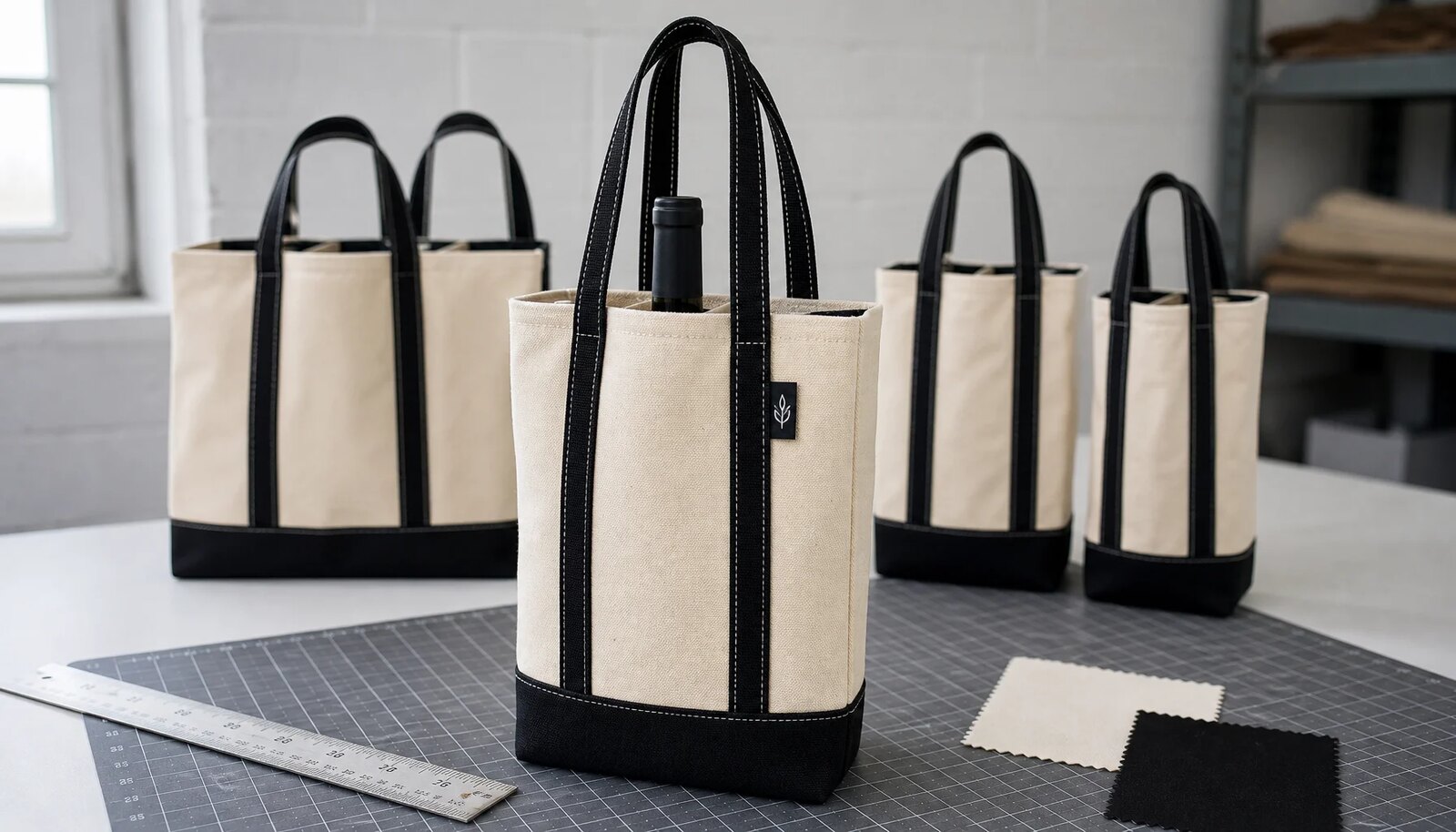
Start With the Market Date, Not the Purchase Order
Lead time planning for canvas wine carriers should begin with the first date the product needs to be on a selling table, not the date the purchase order gets signed. Farmers market programs do not have long, forgiving seasons. A missed spring launch, a harvest weekend, or a holiday gift window is not a small delay. It can remove the only period when foot traffic and impulse purchases are high enough to justify the item at all.
The right way to plan is to work backward from the sell date and break the order into gates: spec lock, sample approval, bulk production, packing, freight, and receiving. Each gate needs a deadline and an owner. For a repeat order on an already approved build, the full path can be short if the factory already has the canvas, trim, and print setup in place. For a new custom carrier with sampling and ocean freight, the schedule needs much more breathing room. The exact number of weeks matters less than whether the supplier can show which steps are fixed and which steps can still move.
This is a critical-path item, even if the product looks simple. A wine carrier is not just a soft good. It is a small sewn product with construction, fit, decoration, and packing decisions that all affect the calendar. If the buyer treats it like a commodity accessory, the schedule usually slips in the sample stage, where the hidden complexity becomes visible. The first question is not whether the factory can make it. The first question is whether the whole chain can deliver saleable stock before the season opens.
A useful discipline is to set one buffer window before the launch date. That buffer absorbs a sample correction, a freight delay, or a carton issue without pushing the item past the market window. Without that buffer, every small problem becomes a lost selling week.
- Work backward from the first sell date and count every approval gate before production starts.
- Reserve time for sample correction, not only for freight delay.
- Treat bottle count, decoration method, and packing format as schedule drivers, not minor details.
Lock the Product Platform Before You Ask for Quotes
A quote is only useful when the product itself is already defined. A canvas wine carrier can be a one-bottle sleeve, a two-bottle carrier, or a gift presentation piece with dividers and a more structured body. Those are different builds. They should not be mixed into one vague spec sheet and then compared as if the lead time and price will mean the same thing. Bottle count, bottle diameter, divider layout, base support, handle drop, and reinforcement points all change the work required at the factory.
Canvas weight is one of the first choices that affects both appearance and schedule. A 10 oz to 12 oz canvas, roughly in the 340 to 400 GSM range depending on weave and finish, is often enough for simpler and more price-sensitive programs. A 12 oz to 14 oz canvas, roughly 400 to 475 GSM, usually gives a sturdier hand and a more premium impression on shelf. That heavier build can be the right answer when the carrier needs better shape or a stronger feel, but it can also add sewing time and make sample revisions slower because the fabric behaves differently at stress points.
If the first order is for a seasonal market accessory, keep the platform simple. One canvas weight. One print method. One label type. One divider spec. Standard webbing handles. Every added option creates a new decision point, and every decision point is another chance for the schedule to stall while artwork or trim is reapproved. The more variable the product, the more the lead time depends on internal buyer speed, not just factory capacity.
The practical goal is to define the carrier in enough detail that the supplier can quote it without guessing. That is the difference between a real procurement spec and a sales conversation.
- Define whether the carrier is for one bottle, two bottles, or a bundled gift presentation.
- Specify the maximum bottle diameter and required bottle clearance before asking for a price.
- Keep the first order to one or two decoration methods if the schedule is tight.
Match the Sourcing Route to the Risk Level
The fastest route is not always the best route. For canvas wine carriers, buyers usually have three workable sourcing paths: blank stock with local decoration, direct cut-and-sew factory production, or a trading company that manages the workflow through a factory. Each one solves a different procurement problem. If the deadline is the main constraint, blank stock with local branding can be the fastest path. If the product needs custom dimensions, a fixed divider layout, or a defined reinforcement pattern, direct factory production is usually the better fit. If the order is small and the buyer wants one point of contact, a trading company can help, but the factory behind the quote still needs to be understood.
The route should be chosen according to uncertainty. High uncertainty belongs with a flexible route. High certainty belongs with a route that gives more control over repeatability and landed cost. That simple rule prevents a lot of lead-time pain. For example, if the market response is not proven yet, holding blank inventory and adding local print or labels later keeps the design open. If the style is already proven and the goal is repeatability, direct factory production with reserved raw materials is usually the cleaner answer.
The buyer should ask for the production path behind every quote. Who cuts the fabric? Who applies the print? Who sews the body? Who packs the cartons? A polished quote means little if the supplier cannot explain those steps clearly. When the process is opaque, the timeline is usually opaque too. A transparent route is easier to schedule, easier to inspect, and easier to repeat next season.
This is also where MOQ strategy matters. Small pilots often need a different route than reorder programs. A lower first commitment can make sense if the buyer is still validating sell-through, but the same setup may not be the best long-term supply chain if the item becomes a staple.
- Use local branding when speed matters more than full spec control.
- Use a direct factory when you need repeatable construction and lower cost at scale.
- Use a hybrid route when the design may still change after the first market response.
Write the RFQ Like a Build Sheet
The cleanest way to shorten lead time is to remove interpretation from the quote request. The RFQ should read like a build sheet, not a marketing brief. Include body width and height, gusset depth, handle length, handle drop, divider layout, maximum bottle diameter, canvas weight, and any reinforcement at the base or handle stress points. If the carrier must fit standard Bordeaux bottles, say that. If it needs to fit wider Burgundy bottles or another specialty shape, include the actual diameter and the clearance required. A factory should not be forced to infer those details from a photo.
Decoration needs the same level of precision. State the print method, the number of colors, the exact placement, the label type, and whether the logo goes on a sewn side tab, woven label, or printed panel. Then define packing in factory terms: flat-packed or folded, polybagged or not, inner carton count, master carton count, carton marks, and whether palletization is required. The best quotes separate product cost, decoration cost, packing cost, and freight assumption. That way the buyer can compare bids without trying to reverse-engineer what was omitted from the low number.
A complete RFQ usually includes a dimensioned sketch, a reference photo, an approved artwork file, and one note on acceptable substitutions. If the supplier can estimate without sending questions back, the schedule usually moves faster. If the same clarifications keep coming back after the first round, the spec is still soft. Soft specs create soft dates. Buyers who want reliable lead time should close the interpretation gap before the supplier starts pricing.
A quote built on assumptions is not a procurement document. It is an invitation for schedule drift later in the process.
- Specify dimensions, bottle type, divider layout, and handle drop so the factory does not fill in the gaps.
- Name the decoration method and label type exactly, including placement and color count.
- Separate product, packing, and freight assumptions so quotes are actually comparable.
Use Sampling to Eliminate Production Risk Early
Sampling is where lead times most often slip, but it is also where most preventable mistakes can be removed. A digital proof can confirm artwork layout, but it cannot tell you how the print will sit on actual canvas, how the divider behaves once the carrier is loaded, or whether the handle stitch lands in the right place. For a custom wine carrier, the buyer should expect a sequence that starts with artwork approval, then a strike-off or material proof on the production fabric, then a pre-production sample, and finally a golden sample that is frozen before bulk sewing begins.
Each sample needs measurable criteria. Check body dimensions, handle drop, divider spacing, seam finish, label placement, and fit for the intended bottle type. Load the carrier with actual bottles or an equivalent test weight and watch for base sag, divider twist, or a handle angle that feels wrong. If the supplier cannot sample on the same canvas weight and trim that will be used in bulk, the risk is still open. Approving a sample by email alone is the fastest way to pay for the same problem twice, once in time and again in freight.
The buyer should also ask for a sample record that shows what changed between revisions. That history matters at reorder time, because it separates true approvals from temporary compromises. A golden sample without measurement notes is weak documentation. A golden sample package with the approved artwork, the exact fabric reference, the trim references, and the measured tolerances is much more useful when the next season comes around.
The point of sampling is not perfection for its own sake. The point is to freeze the build before bulk production starts, so the factory is not solving design questions while trying to meet a date.
- Approve a physical sample on the exact canvas weight before bulk sewing begins.
- Use measured tolerances for size, placement, stitch work, and bottle fit.
- Test the carrier with actual bottle weight, not only by hand feel.
Treat Packing as Part of the Product, Not an Afterthought
Packing changes both cost and lead time, and it is often under-scoped in the first quote. A canvas wine carrier sold at a retail counter may need a clean fold, an individual polybag, a barcode label, and a hangtag so it can go on a shelf without extra handling. A carrier sold by farmers market vendors as a bundled item may be better shipped flat in bulk with simple carton counts and a fold instruction. Those are different labor profiles. The wrong packing spec can increase the factory workload, expand carton size, and leave the goods wrinkled or awkward to merchandise.
Packing also affects damage risk. Soft goods are not fragile in the same way as glass, but they can still arrive in poor condition. A carrier can pick up moisture, odor, or handle deformation if the inner pack is too loose or the cartons are not suited to the route. Buyers should define carton dimensions, units per carton, carton strength if the route is long, and whether the shipment needs palletization. If the order includes several colors or SKUs, carton marks and packing labels must match the packing list. Clean receiving is part of the product experience, especially when the goods are headed into a seasonal warehouse, a pop-up prep room, or a market inventory cage.
There is also a labor-placement decision here. Retail-ready packing pushes work to the factory and increases unit cost, but it reduces work on the buyer side. Bulk packing lowers the factory effort, but your team may need to fold, label, or stage the carriers before they can be sold. Neither is automatically better. The right answer depends on where the labor should sit and how quickly the goods need to be merchandised.
If the local team will reprice, bundle, or label the carriers anyway, do not pay twice for factory packing that will be undone later.
- Use retail packing only when presentation justifies the labor and carton cost.
- Use flat bulk packing when speed and freight efficiency matter more than display readiness.
- Define carton marks, SKU labels, and counts before production starts so receiving is simple.
Set QC Gates Before the Factory Starts Sewing
Quality control for canvas wine carriers should focus on the points that actually fail in use. The first gate is dimensional control: body width, height, gusset, handle length, and handle drop should stay within agreed tolerances so the carrier looks consistent and performs as intended. In practice, buyers often work with +/- 1/8 in to 1/4 in on key dimensions, with tighter control on handle drop and divider positions because those affect fit and appearance most directly. The supplier should confirm the tolerance in writing before sampling is approved.
The second gate is construction quality. Stitch length should be even. Seam ends should be clean. Back-tacks should be secure. Reinforcement should be present where the handles and base carry load. The third gate is decoration quality, where the print or label must match the approved sample in placement, clarity, and color density. For simple artwork and a stable setup, print placement is often best controlled within 2 to 3 mm. If the design includes fine text, thin lines, or edge-to-edge placement, the buyer should tighten the inspection standard accordingly.
Load testing matters because the product is built to carry weight in a small footprint. The divider should not collapse. The base should not bow beyond the agreed limit. The carrier should stay stable with full bottles inserted. Printed carriers should also survive a fold and rub test without obvious cracking, transfer, or misalignment. If the design includes rivets, snaps, or other hardware, the buyer should inspect for sharp edges and secure fastening. These criteria should be documented before bulk production starts, not negotiated after the lot is already finished.
That discipline protects both the date and the margin. A clear QC gate reduces rework, reduces argument, and makes receiving faster because the buyer already knows what counts as acceptable.
- Set tolerances for size, handle drop, divider spacing, and stitch quality before the order is released.
- Require load testing with full bottles or an equivalent weight.
- Reject any print that cracks, transfers, bleeds, or shifts beyond the approved sample.
Plan Freight, Customs, and Receiving as One Schedule
Freight planning is part of lead time, not a separate task after the PO goes out. A quote can look good at the factory gate and still miss the season if the lane is congested, the factory is near a holiday shutdown, or the destination warehouse has a narrow receiving window. For a first launch, it is usually safer to build a buffer before the first market weekend than to assume the fastest transit option will stay reliable. Some buyers split the first season into two shipments: a smaller faster shipment to protect the launch, then a larger replenishment once demand is proven.
Commercial terms matter here. Incoterms, carton dimensions, gross weight, estimated cube, duty, and inland delivery all affect the real landed cost and the actual arrival date. A buyer who knows the warehouse appointment window can keep goods from sitting on a dock when the market prep team needs them. For seasonal programs, on-time arrival in the right cartons often matters more than a slightly lower base price. A cheaper shipment that creates receiving problems is not really cheaper.
If the carrier is going to a distributor, retailer, or multi-location farmers market network, ask how the receiving team wants the cartons labeled and staged. If the factory's packing plan does not match the receiving plan, the savings can disappear into labor at destination. Lead time, in other words, is a total logistics problem. Production is only one part of it.
The buyer who models freight and receiving at the same time usually avoids the most frustrating delays, because the goods arrive in a format the downstream team can actually use.
- Plan freight together with the market calendar, not after the PO is issued.
- Check carton dimensions, gross weight, and cube before booking transport.
- Protect the first launch with a buffer or split shipment if the margin allows it.
Compare Quotes on Landed Cost, Not Unit Price
A clean RFQ should let suppliers quote the same carrier without interpretation. If the spec is frozen, the artwork is fixed, and the packing instructions are clear, then the buyer can compare landed cost instead of unit price alone. The lowest ex-factory number may still become the most expensive order if it excludes labels, cartons, testing, freight, duty, or local delivery. For procurement buyers, the useful quote is the one that shows where the cost lives, not the one that hides it.
When the quotes come back, look at the line items that affect both cost and schedule. Ask whether freight is based on actual carton dimensions or an estimate, whether the sample fee is credited against bulk, and whether the supplier quoted FOB, CIF, or DDP. If one supplier is cheaper but vague on packing, loose on the sample path, and unable to explain a repeat-order plan, that quote is not really lower risk. Award the supplier that can explain the unit economics and the production calendar with enough detail for internal approval.
It helps to create an internal comparison grid before quotes arrive. Score each supplier on specification clarity, sample speed, QC transparency, carton readiness, and repeatability. Price matters, but it is only one dimension. A supplier that can hold the spec, communicate changes early, and ship on the date you need is often worth more than a lower quote with hidden variability. That is especially true for seasonal sellers, where one missed week can erase the value of the savings.
Procurement discipline here is simple: compare the real delivered product, not the number printed on the first page of the quote.
- Compare ex-factory, packing, testing, freight, duty, and inland delivery as one landed-cost picture.
- Do not accept a quote that omits sample fees, carton data, or shipping terms.
- Choose the supplier that can explain the schedule risk, not just the unit price.
Freeze the Reorder Plan Before the First Shipment Leaves
The best canvas wine carrier programs are designed for reorder from the beginning. Once the first run is approved, keep the golden sample, measurement sheet, artwork file, carton mark file, and approved packaging spec in one place. If the carrier is likely to return next season, ask which elements can stay common across colors or variants. Shared fabric, shared handle tape, and shared carton size usually make the next replenishment faster and more predictable than a one-off custom build.
The reorder trigger should also be agreed before the first shipment leaves. If sell-through is strong at the first few markets, how much time is needed to place the next PO so the factory can reserve fabric and schedule line time? If the product is also sold through distributors or gift channels, how many units need to stay in reserve for late-season bundles or holiday sales? These are commercial decisions, but they directly affect factory planning. The buyer who answers them early usually gets a cleaner second order and fewer surprises when the season turns.
The practical value is cycle-time reduction. If the supplier already has the approved spec, the reorder should not restart at the sample stage unless the buyer changes the build. That is why the first order needs disciplined documentation. When the same carrier comes back six months later, the fastest path is to confirm the old golden sample, update only the changed artwork or carton marks, and release the reorder against the preserved production file.
That is the part many buyers miss. Reorder speed is built into the first order, not added afterward.
- Keep the golden sample, measurement sheet, artwork file, and carton marks with the purchase record.
- Define which fabrics, trims, and labels must stay common across repeat orders.
- Set the reorder trigger before the first shipment arrives so the next run does not become a new project.
Specification comparison for buyers
| Spec decision | Recommended option | When it fits | Buyer risk to check |
|---|---|---|---|
| Need stock for next weekend market | Blank-stock carrier with local branding | You need the fastest turn and can accept simpler construction | Confirm blank color consistency, local decoration lead time, and whether the same base SKU will be available for a repeat order |
| New seasonal design with divider layout | Direct cut-and-sew factory | You need fixed bottle spacing, custom dimensions, or a defined reinforcement pattern | Sampling often expands when the pattern, handle drop, or divider width is still changing |
| Low-volume pilot before full rollout | Small-run factory or trading company with a verified factory | You are testing demand and want to avoid a large first commitment | Ask who actually owns the pattern, which steps are outsourced, and whether the sample reflects the real factory line |
| Repeat reorder of the same SKU | Direct factory with reserved raw materials | You need repeatability and a reliable seasonal replenishment path | Confirm dye lot continuity, label stock, webbing supply, and whether the mill can hold the same canvas finish |
| Retail-ready gift presentation | Factory with in-house print and packing | Packaging matters as much as the carrier itself | Late artwork approval can become the critical-path delay if polybags, hangtags, or barcode labels are part of the spec |
| Tight landed-cost target | Direct offshore factory with sea freight | You can plan ahead and want lower ex-factory cost | Transit time, customs timing, carton size, and inland delivery can erase the savings if they are not modeled together |
| Uncertain demand and changing artwork | Blank inventory plus local decoration partner | You want flexibility while the market response is still unknown | Unit cost is higher, but this route lowers the risk of obsolete printed stock |
| Compliance-heavy retail buyer | Specialist OEM factory with QC records | You need carton marks, barcodes, and production traceability | Ask for inspection reports, not just sample photos, before you release the PO |
| Two-bottle carrier with premium feel | 12 oz to 14 oz canvas with reinforcement | The product needs structure and better shelf presentation | Heavier canvas raises sewing time, freight weight, and sometimes sample iteration time |
Buyer checklist before sampling
- Lock the bottle count, bottle type, and maximum bottle diameter before requesting quotes.
- Choose the canvas weight in oz or GSM first, then decide whether you need lining, a divider, or a base board.
- State the print method, number of colors, and exact logo placement in the RFQ so every quote covers the same scope.
- Specify handle width, handle drop, reinforcement points, and whether bartacks are required at stress areas.
- Decide whether the order ships flat, pre-folded, polybagged, or retail packed, because packing changes labor and lead time.
- Ask for a pre-production sample or strike-off on the exact fabric, not just a digital proof.
- Confirm the incoterm, carton size, master carton count, and gross weight before comparing landed cost.
- Build one buffer window before the first market date for sample corrections, freight delays, or carton rework.
- Record the approved golden sample, measurement sheet, and artwork file so reorder approvals stay fast.
- Ask the supplier how they will hold color continuity, label stock, and trim availability for the next season.
Factory quote questions to send
- What is the total lead time from approved sample to ex-factory for blank, printed, and fully packed units?
- Which canvas weight, weave, and finish are you quoting, and is the specification confirmed in oz or GSM?
- What is included in the base price: fabric, lining, divider, handle, label, print, testing, and packing?
- What MOQ applies to the carrier itself, the print color, the label style, and any special carton requirement?
- Do you offer a pre-production sample, a strike-off, or a full hand sample, and what is the sample fee and timeline?
- How will the carrier be packed for shipment: flat-packed, folded, polybagged, inner-boxed, or retail boxed?
- What tolerances do you hold on size, handle drop, stitch count, divider spacing, and print placement?
- Can you share carton dimensions, gross weight, and estimated cube so we can plan freight and warehouse receiving?
- Which parts of the order are made in-house, and which parts are outsourced to trim, print, or packing vendors?
- What is your plan for repeat orders if we need the same spec, color, and label in the next season?
Quality-control points to confirm
- Body width, height, gusset, and handle drop should stay within the agreed tolerance on the golden sample, ideally within +/- 1/8 in to 1/4 in depending on the dimension and production method.
- Fabric weight should match the approved canvas spec, with no downgrade in bulk production and no substitution to a lighter weave without buyer approval.
- Seams at the handle and base need even stitch length, clean back-tacks, and no skipped stitches or loose needle holes.
- Handle reinforcement should be secure and symmetrical, with bartacks or equivalent reinforcement at the stress points specified in the sample.
- Divider panels must hold the bottle spacing without collapsing when the carrier is loaded with the intended bottle diameter.
- The base board or bottom panel, if specified, should not bow excessively under a full load and should remain seated after repeated handling.
- Print registration, edge sharpness, and color density must match the approved strike-off, with placement ideally within 2 to 3 mm of the approved position.
- Rub, fold, and light abrasion testing should not cause obvious cracking, flaking, transfer, or print misalignment on the finished carrier.
- Label placement should stay consistent across cartons, with no upside-down, crooked, or off-center labels.
- Units should arrive free of oil marks, loose threads, broken needles, odor, and damaged packing materials.