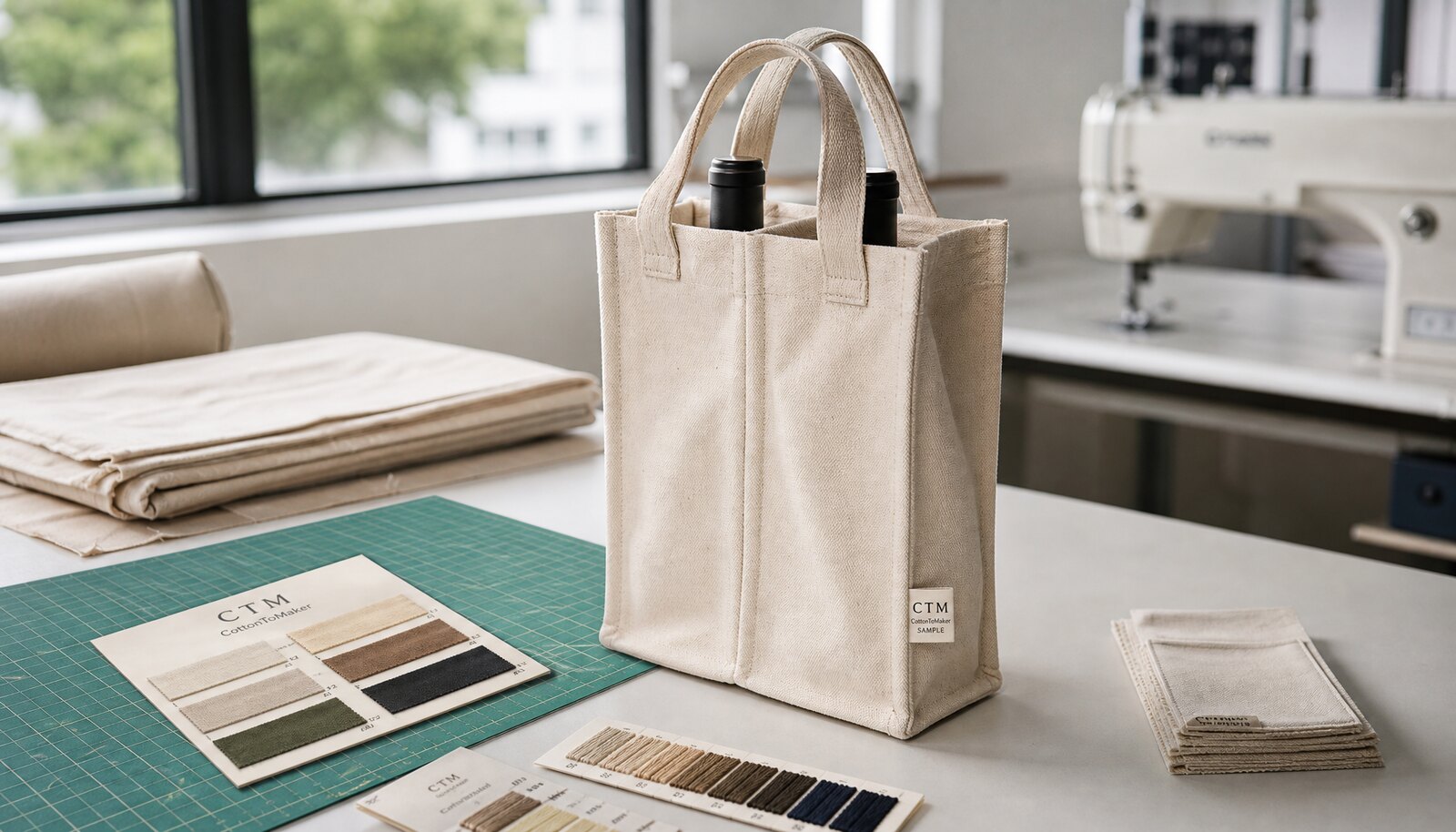
Lead time starts with the bottle count
The easiest way to miss a delivery window is to treat a canvas wine carrier like a generic tote. A two-bottle carrier, four-bottle carrier, or gift-style bottle bag all carry different risks because the structure, handle load, divider layout, and carton size change the production path. If a buyer only asks for "canvas wine carriers" without bottle count, dimensions, and finish level, the factory will fill in the blanks, and the quoted lead time will usually be too optimistic for the real order.
For boutique wineries, the practical planning rule is simple: the more the carrier has to do beyond holding a bottle, the longer the schedule becomes. A plain canvas sleeve with one-color print moves faster than a reinforced carrier with dividers, contrast binding, woven label, and custom carton printing. Your RFQ should state the use case first, because that is what determines whether the factory can use existing materials or must source, cut, and test every part from scratch.
- State bottle count, bottle diameter range, and whether the carrier must fit standard Bordeaux, Burgundy, or tall sparkling bottles.
- Specify whether the carrier is for tasting-room retail, gifting, distribution, or shipment inside larger cartons.
- Call out any structural requirement such as divider panels, base board, lining, or closure hardware.
Choose the canvas weight before you talk about dates
Fabric weight is one of the fastest ways to separate a useful quote from a decorative one. For wine carriers, common canvas choices sit around 280 gsm to 380 gsm for lighter retail bags, and 12 oz to 16 oz canvas for more rigid carry programs. A lighter cloth can look clean in a sample, but if the carrier must hold two glass bottles, keep its shape on a retail shelf, and survive repeated use, the low-weight option may create handle stretch, seam distortion, or a bag that feels cheap in the hand.
Do not specify only "canvas". State whether you want raw cotton canvas, pre-washed canvas, dyed canvas, or laminated canvas, because each path affects lead time differently. Pre-washed or dyed goods can add a dye lot or finishing step. Laminated builds may improve stain resistance, but they also introduce a different curing and inspection process. If you want a short lead time, use a standard fabric base and place your brand value in the logo, label, and sewing quality rather than in custom material construction.
- Use 280-320 gsm for lighter promotional carriers when cost and speed matter more than heavy structure.
- Move to 340-380 gsm or 12-16 oz canvas when the bag must carry multiple bottles with a premium retail feel.
- Ask the supplier if the quoted GSM refers to finished fabric, because shrinkage and washing can change the final hand feel.
Compare supplier routes by schedule risk, not just unit price
A buyer comparing quotes for canvas wine carriers should compare the sourcing route first, then the price. A local decorator, a direct cut-and-sew factory, and a trading company may all quote the same-looking item, but they do not operate with the same control points. The cheapest-looking quote can become the slowest order if it hides a fabric purchase, a missing print setup, or a second sample round that nobody priced upfront.
The safest approach is to map the route that matches your deadline and your spec complexity. If you need a standard carrier with a simple logo and you already trust the base bag, a stock blank may be enough. If you need a custom bottle divider, woven label, and exact carton count, go straight to a cut-and-sew supplier that can own the full build. The wrong route adds handoffs, and handoffs are where dates slip.
- Use stock blanks for speed only if the carrier dimensions and fabric weight already match your spec.
- Choose direct manufacturing when the carrier shape, divider layout, or logo placement is brand-critical.
- Use trading companies only if they add real value in sourcing control, communication, or consolidated shipments.
What actually drives the quote and the calendar
For canvas wine carriers, quote data should show the real cost drivers instead of hiding them in a single unit number. The factory needs to know the body size, fabric weight, print method, color count, handle material, internal divider structure, stitching density, and packing method. If those details are unclear, the quote will either be padded for risk or underquoted and revised later. Both outcomes are bad for planning because they break your cost comparison.
The same inputs affect lead time. Screen printing needs artwork setup and curing time. Embroidery needs a stitch file and thread approval. Woven labels need loom lead time. Custom handles or metal fittings create procurement delays that a plain cotton tape bag would not have. Buyers should assume that each custom component adds one more checkpoint, and each checkpoint adds a chance for rework if the spec is not frozen early.
- Ask for separate pricing for body, print, label, and packaging when possible so the cost drivers are visible.
- Treat custom trims as schedule risks, not just style upgrades.
- If a supplier cannot explain why the lead time is what it is, the quote is not ready for a buyer meeting.
Set MOQ logic before sample approval
MOQ is not just a factory rule; it is usually the point where material buying, setup cost, and packing labor become efficient enough to run the order. For canvas wine carriers, MOQ can move depending on the number of print colors, whether the base fabric is stock or dyed to order, and whether the carrier includes special trims or inserts. A one-color logo on a standard body might support a modest MOQ, while a multi-part premium carrier can require a much higher minimum because the setup cost per unit is larger.
The practical buyer move is to ask for MOQ by version, not just by order. If you have a tasting-room version, a gift version, and a distributor version, those should be treated as separate configurations with separate setup logic. This keeps the order from being split across too many low-volume variants, which is how factories end up overquoting or pushing the schedule. Better to cut one strong SKU first, then build a reorder program once the brand has proof of demand.
- Request MOQ by fabric color, print color count, and packaging format.
- Do not mix too many logo or artwork variations into a first order unless the factory has already run that structure.
- If you need a lower MOQ, expect either a higher unit cost or a more limited spec.
Approve samples against real use, not just appearance
A sample that looks correct on a desk can still fail in retail use. Wine carriers should be sample-tested with the actual bottle size, not an empty shell. Put standard bottles in the carrier, carry it by the handles, set it down, and look for strain points at the top seam, handle anchors, divider edges, and base panel. A sample should also be evaluated under the lighting and merchandising conditions where it will be sold, because natural canvas texture can hide weak print density or uneven stitching if you only look at one close-up photo.
A disciplined sample process usually includes at least three checkpoints: material confirmation, pre-production sample, and first-run reference. The buyer should sign off on dimensions, print placement, sewing details, and packing style before mass production starts. If the supplier substitutes thread color, label material, or binding tape without approval, that is not a minor change. On a premium bottle carrier, small material shifts are visible on shelf and can make the item look off-brand even if the bag still functions.
- Test the sample with filled bottles and a short carry cycle, not only by hand inspection.
- Compare the pre-production sample against the approved artwork file and the approved measurements.
- Keep one signed reference sample for the factory and one for the buyer team.
Packing decisions change carton math and freight timing
Packing is part of lead time because it affects labor, carton count, and shipment readiness. Canvas wine carriers are often bulky even when they are light, so a small change in folding method or inner packing can alter how many units fit into a master carton and how many cartons fit into a container. If the supplier does not quote carton dimensions and gross weight early, the buyer cannot accurately compare freight cost or warehouse receiving cost.
For retail programs, decide whether the carrier ships flat, folded, stuffed, or bagged. Flat packing can save time and simplify QC, but it may increase carton volume. Stuffed packing may improve presentation, but it adds labor. If you are sending carriers to distribution centers, add carton labels, barcodes, and pallet rules before production starts. That way the final week is not lost to re-labeling and repacking.
- Lock the inner pack count, carton count, and carton dimensions before the supplier starts production.
- Specify whether cartons need export marks, barcode stickers, or retail-ready labeling.
- If freight is tight, ask for a packing simulation before the PO is finalized.
Use QC thresholds that match the price point
Quality control for canvas wine carriers should be practical, not abstract. The right threshold depends on how the item will be sold. A tasting-room impulse item can tolerate a simpler finish than a premium retail gift carrier. Even so, every order should define acceptable limits for dimensions, stitch quality, print placement, handle strength, and carton packing accuracy. Without those limits, the factory will inspect against its own standard, which may be looser than your brand can accept.
The most common failure points are not dramatic. They are small shifts: a logo printed too high, a divider stitched off-center, a handle that twists under load, or a fabric shade that changes between lots. Buyers should ask the factory what they do when a defect rate appears. Do they rework the lot, sort the cartons, or hold the shipment? A clear answer matters more than a polished promise because it tells you whether the factory has a real QC system or just a visual final check.
- Set measurable tolerances for size, print position, and seam alignment.
- Require random carton opening before shipment, not only final outer inspection.
- Define what happens if the logo color, fabric shade, or handle stitching misses the approved standard.
Back-schedule the order from the shelf date
A usable lead time plan starts from the date the carrier must be in the warehouse, not from the date the PO is issued. Work backward from retail receipt, then add time for production, inspection, freight booking, transit, customs, and receiving. A buyer who waits until artwork is final to think about the ship date is already late. The better method is to reserve a conservative production window, then compress only the steps you can control, such as approval speed and freight mode.
For boutique wineries, seasonal demand is the main schedule risk. Launch dates, harvest events, holiday gifting, and tasting-room promotions all compress buying windows. That is why a good RFQ should include the destination, required in-stock date, and backup plan if approval slips. If the factory knows the real target date, it can advise whether you need air freight for part of the order, an early base-stock run, or a split shipment from the start.
- Build the schedule from in-stock date backward, not from production start forward.
- Use split shipments only when the inventory plan and carton marks are already defined.
- Keep one buffer week for approvals and one buffer week for freight disruptions if the launch date is fixed.
Specification comparison for buyers
| Spec decision | Recommended option | When it fits | Buyer risk to check |
|---|---|---|---|
| Local decorator on stock carriers | Use existing canvas wine carrier blanks with one-color logo print | Small launches, event programs, reorders that need speed | Confirm the blank size, fabric weight, and real stock before you commit |
| Direct cut-and-sew factory | Order fully custom carrier dimensions, handles, and divider layout | Brands that need precise bottle fit and repeatable quality | Build in sample time; the first quote often omits engineering back-and-forth |
| Trading company or agent | Use when you need one contact across several factories | Buyers sourcing many SKUs or wanting fast quote collection | Watch for hidden margin, vague specs, and weak accountability on QC |
| Hybrid sample house + mass factory | Develop samples in a responsive sample room, then move production to a larger plant | Premium programs with detailed trims or woven labels | Lock the final spec sheet so the mass factory does not reinterpret the sample |
| Stock canvas body + custom logo | Choose a standard carrier body with custom print or label | Moderate volumes and seasonal winery events | Verify that the stock body is real inventory, not a future production slot |
| Nearshore regional factory | Source closer to the delivery market for shorter transit time | Short shelf-life promotions, rush replenishment, lower inventory tolerance | Unit cost can be higher; compare landed cost, not just FOB |
| Fully custom insulated wine bag supplier | Add lining, foil, or foam when wine temperature retention matters | Gift sets, premium retail bundles, chilled transport | More components mean more delay points and more rejection risk |
| Consolidator with mixed-SKU packing | Bundle carriers with other wine accessories in one shipment | Distributors and retail buyers ordering multiple gift items | Mix-ups in carton counts and assortments are common without a clear packing list |
Buyer checklist before sampling
- Final carrier style, bottle count, and target bottle dimensions, including any need for split dividers or a reinforced base board.
- Fabric weight in GSM or oz, plus whether you want raw canvas, pre-washed canvas, laminated canvas, or a lined build.
- Artwork file format, print method, print coverage, and the exact placement of the logo or woven label.
- Handle length, handle width, seam reinforcement, and whether the bag must support full wine bottles for retail carry-out.
- Packaging rules: inner polybag, hangtag, master carton quantity, barcode label, and whether cartons must be drop-tested or export-marked.
- Target delivery date, ship mode preference, and the destination port or warehouse for schedule planning.
- Sample approval rules, including acceptable color tolerance, stitch quality, and whether a pre-production sample is mandatory.
- Tolerance for substitutions on thread, lining, or hardware so the factory cannot replace parts without approval.
Factory quote questions to send
- What exact fabric weight and weave are you quoting, and is that based on finished goods or greige fabric?
- What print method did you price, and how many colors, passes, or setup screens are included?
- What is the MOQ by color and by artwork version, and does a smaller reorder use the same setup price?
- What is the production lead time after sample approval, and how much buffer do you need if fabric or trim must be purchased first?
- What sample stages are included: digital proof, material sample, pre-production sample, and top-of-production sample?
- How are the carriers packed per carton, what is the carton size, and what is the gross weight per carton?
- Which components can be substituted without approval, such as thread, lining, zipper, snap, or woven label?
- What quality checks do you perform before shipment, and will you share inspection photos or a QC report?
Quality-control points to confirm
- Measure finished carrier dimensions against the approved spec and keep the tolerance tight enough that the bottle fit does not shift in production.
- Inspect handle stitching, bar-tacks, and side seam reinforcement under load, not just by visual appearance.
- Verify print placement, color density, and wash or rub resistance so the logo does not look weak on the canvas texture.
- Check divider alignment and base support so bottles do not knock together during transport.
- Open random cartons to confirm inner packaging, barcode labels, and carton count match the packing list.
- Review odor, dust, loose threads, and stain control because canvas can look acceptable at first glance but fail retail standards.
- Run a simple carry test with filled bottles to confirm the handles, seams, and bottom panel stay stable.
- Confirm carton drop resistance and edge protection if the order will move through distribution centers or e-commerce channels.